Login In

Promoting effect of Ti in the Ti-modified γ-Fe2O3 catalyst on its performance in the selective catalytic reduction of NO with ammonia, a DFT calculation study
- Corresponding author: NIU Sheng-li, nsl@sdu.edu.cn
Figures(9)
Citation:
ZHOU Wen-bo, NIU Sheng-li, WANG Dong, LU Chun-mei, HAN Kui-hua, LI Ying-jie, ZHU Ying. Promoting effect of Ti in the Ti-modified γ-Fe2O3 catalyst on its performance in the selective catalytic reduction of NO with ammonia, a DFT calculation study[J]. Journal of Fuel Chemistry and Technology,
;2020, 48(10): 1224-1235.

Figures(9)


LI Ying, NIU Sheng-li, LU Chun-mei, WANG Jia-xing, PENG Jian-sheng. Molecular simulation study of NO heterogeneous reduction by biomass reburning[J]. J Fuel Chem Technol, 2020,48(6):689-697.
SHU Hang, ZHANG Yu-hua, YANG Lin-jun, LIU Ya-ming, LI Fang-yong, XU Qi-sheng, PAN Si-wei. Effects of SCR-DeNOx system on emission characteristics of fine particles[J]. J Fuel Chem Technol, 2015,43(12):1510-1515.
LI Y H, DENG J L, SONG W Y, LIU J, ZHAO Z, GAO M L, WEI Y C, ZHAO L. Nature of Cu Species in Cu-SAPO-18 catalyst for NH3-SCR:Combination of experiments and DFT calculations[J]. J Phys Chem C, 2016,120(27):14669-14680. doi: 10.1021/acs.jpcc.6b03464
LIN Zhuo-wei, LU Qiang, TANG Hao, LI Hui, DONG Chang-qing, YANG Yong-ping. Research on the middle-low temperature denitration and anti-poisoning properties of plate V2O5-MoO3/TiO2 SCR catalysts[J]. J Fuel Chem Technol, 2017,45(1):113-122.
HUSNAIN N, WANG E L, LI K, ANWAR M T, MEHMOOD A, GUL M, LI D L, MAO J D. Iron oxide-based catalysts for low-temperature selective catalytic reduction of NOx with NH3[J]. Rev Chem Eng, 2018,35(2):239-264.
WANG Fang, YAO Gui-huan, GUI Ke-ting. Comparison about selective catalytic reduction of de-NOx on iron-based magnetic materials[J]. Proc CSEE, 2009,29(29):49-53.
LIANG H, GUI K T, ZHA X B. DRIFTS study of γFe2O3 nano-catalyst for low-temperature selective catalytic reduction of NOx with NH3[J]. Can J Chem Eng, 2016,94(9):1668-1675. doi: 10.1002/cjce.22546
PENG Jian-sheng, WANG Dong, ZHANG Xin-li, LU Chun-mei, NIU Sheng-li, LI Jing, XU Li-ting. Kinetic study of selective catalytic reduction of NOx by NH3 on magnetic γ-Fe2O3 catalyst[J]. Proc CSEE, 2015,35(18):4690-4696.
YANG S J, LI J H, WANG C Z, CHEN J H, MA L, CHANG H Z, CHEN L, YUE P, YAN N Q. Fe-Ti spinel for the selective catalytic reduction of NO with NH3:Mechanism and structure-activity relationship[J]. Appl Catal B:Environ, 2012,117-118:73-80. doi: 10.1016/j.apcatb.2012.01.001
WANG Dong, WU Jing-kun, NIU Sheng-li, LU Chun-mei, XU Li-ting, YU He-wei, LI Jing. Structural property of γ-Fe2O3 catalysts doped with Sn and Ti and their activity in the selective catalytic reduction of NOx[J]. J Fuel Chem Technol, 2015,43(7):876-883.
LU W, CUI S P, GUO H X. Study the low-temperature SCR property of M-doped (M=Ni, Cr, Co, Se, Sn) MnO2(100) through density functional theory (DFT):Improvement of sulfur poisoning resistance[J]. Mol Catal, 2018,459:31-37. doi: 10.1016/j.mcat.2018.08.020
LIU Z M, MA L L, JUNAID A S M. NO and NO2 adsorption on Al2O3 and Ga modified Al2O3 surfaces:A density functional theory study[J]. J Phys Chem C, 2010,114(10):4445-4450. doi: 10.1021/jp907925w
ZHANG X P, LI Z F, ZHAO J J, CUI Y Z, TAN B J, WANG J X, ZHANG C X, HE G H. Mechanism of Ce promoting SO2 resistance of MnOx/γ-Al2O3:An experimental and DFT study[J]. Korean J Chem Eng, 2017,34(7):1-7.
REN D D, GUI K T. Study of the adsorption of NH3 and NOx on the nano-γFe2O3 (001) surface with density functional theory[J]. Appl Surf Sci, 2019,487:171-179. doi: 10.1016/j.apsusc.2019.04.250
REN D D, GUI K T, GU S C, WEI Y L. Study of the nitric oxide reduction of SCR-NH3 on γ-Fe2O3 catalyst surface with quantum chemistry[J]. Appl Surf Sci, 2020,509144659. doi: 10.1016/j.apsusc.2019.144659
JΦRGENSEN J E, MOSEGAARD L, THOMSEN L E, JENSEN T R, HANSON J C. Formation of γ-Fe2O3 nanoparticles and vacancy ordering:An in situ X-ray powder diffraction study[J]. J Solid State Chem, 2007,180(1):180-185.
JIAN W, WANG S P, ZHANG H X, BAI F Q. Disentangling the role of oxygen vacancies on the surface of Fe3O4 and γ-Fe2O3[J]. Inorg Chem Front, 2019,6(10):2660-2666. doi: 10.1039/C9QI00351G
BAETZOLD R C, YANG H. Computational study on surface structure and crystal morphology of γ-Fe2O3:Toward deterministic synthesis of nanocrystals[J]. J Phys Chem B, 2003,107(51):14357-14364. doi: 10.1021/jp035785k
GUO P, GUO X, ZHENG C G. Roles of γ-Fe2O3 in fly ash for mercury removal:Results of density functional theory study[J]. Appl Surf Sci, 2010,256(23):6991-6996. doi: 10.1016/j.apsusc.2010.05.013
SEGALL M D, LINDAN P J D, PROBERT M J, PICKARD C J, HASNIP P J, CLARK S J, PAYNE M C. First-principles simulation:Ideas, illustrations and the CASTEP code[J]. J Phys-Condens Matter, 2002,14(11)2717. doi: 10.1088/0953-8984/14/11/301
HUBER K P, HERZBERG G. Molecular spectra and molecular structure:Ⅳ. Constants of diatomic molecules[M]. New York:Springer Science & Business Media, 2013.
LI Shu-ping, MENG Jiang, WANG Ji-gang. Parallel adsorption for NO on the surfaces of Ben (n=2-12) clusters[J]. J At Mol Phys, 2019,36(2):240-245.
LIDE D R. CRC Handbook of Chemistry and Physics[M]. 81st. Boca Raton:CRC Press, 2000.
LYU Z K, NIU S L, LU C M, ZHAO G J, GONG Z Q, ZHU Y. A density functional theory study on the selective catalytic reduction of NO by NH3 reactivity of α-Fe2O3 (001) catalyst doped by Mn, Ti, Cr and Ni[J]. Fuel, 2020,267117147. doi: 10.1016/j.fuel.2020.117147
BENTARCURT Y L, CALATAYUD M, KLAPP J, RUETTE F. Periodic density functional theory study of maghemite (001) surface. Structure and electronic properties[J]. Surf Sci, 2018,677:239-253. doi: 10.1016/j.susc.2018.06.005
ZHANG Qian. DFT study of NH3 and NO adsorption behavior on Fe doping MnO2(110) surface[D]. Taiyuan: Taiyuan University of Technology, 2015.
LI Zhi-peng, NIU Sheng-li, ZHAO Gai-ju, HAN Kui-hua, LI Ying-jie, LU Chun-mei, CHENG Shen. Molecular simulation study of strontium doping on the adsorption of methanol on CaO(100) surface[J]. J Fuel Chem Technol, 2020,48(2):172-178.
YUAN R M, FU G, XU X, WAN H L. Brønsted-NH4+ mechanism versus nitrite mechanism:new insight into the selective catalytic reduction of NO by NH3[J]. Phys Chem Chem Phys, 2011,13(2):453-460. doi: 10.1039/C0CP00256A
HU Hai-peng, WANG Xue-tao, ZHANG Xing-yu, SU Xiao-xin, YANG Xiao-dong, SHI Rui-hua. Performance of Fe-Cu/ZSM-5 catalyst in the deNOx process via NH3-SCR[J]. J Fuel Chem Technol, 2018,46(2):225-232.
LIANG Hui, CHA Xian-bin, GUI Ke-ting. A study of selective catalysis reduction denitration performance and adsorption of NH3 and NO over γFe2O3 catalyst[J]. Proc CSEE, 2014,34(32):5734-5740.
YANG S J, CHANG H Z, MA L, QU Z, YAN N Q, WANG C Z, LI J H. Improvement of the activity of γ-Fe2O3 for the selective catalytic reduction of NO with NH3 at high temperatures:NO reduction versus NH3 oxidization[J]. Ind Eng Chem Res, 2013,52(16):5601-5610. doi: 10.1021/ie303272u
BUSCA G, LIETTI L, RAMIS G, BERTI F. Chemical and mechanistic aspects of the selective catalytic reduction of NOx by ammonia over oxide catalysts:A review[J]. Appl Catal B:Environ, 1998,18(1/2):1-36.
LI Zhi-peng, NIU Sheng-li, HAN Kui-hua, LU Chun-mei. Molecular simulation of the effect of doping modification on the adsorption properties of calcium-aluminum-based composites ester exchange catalysts[J]. CIESC, 2020,71(8):3625-3632.
GUO M Y, ZHAO P P, LIU Q L, LIU C X, HAN J F, JI N, SONG C F, MA D G, LU X B, LIANG X Y, LI Z G. Improved low-temperature activity and H2O resistance of Fe-doped Mn-Eu catalysts for NO removal by NH3-SCR[J]. ChemCatChem, 2019,11(19):4954-4965. doi: 10.1002/cctc.201900979
TRONCONI E, NOVA I, CIARDELLI C, CHATTERJEE D, WEIBEL M. Redox features in the catalytic mechanism of the "standard" and "fast" NH3-SCR of NOx over a V-based catalyst investigated by dynamic methods[J]. J Catal, 2007,245(1):1-10.
QI Fei-hong. Improvement of the activity of Fe-Ti spinel for the selective catalytic reduction of NO with NH3 at low temperatures[D]. Nanjing: Nanjing University of Science and Technology, 2016.
DU Xiao-rui. Experimental and mechanistic studies on catalytic reduction of NO by iron-based spinel[D]. Wuhan: Huazhong University of Science and Technology, 2019.
Feibin Wei , Yongfang Rao , Yu Huang , Wei Wang , Hui Mei . The new challenges for the development of NH3-SCR catalysts under new situation of energy transition in power generation industry. Chinese Chemical Letters, 2024, 35(6): 108931-. doi: 10.1016/j.cclet.2023.108931
Chunyan Yang , Qiuyu Rong , Fengyin Shi , Menghan Cao , Guie Li , Yanjun Xin , Wen Zhang , Guangshan Zhang . Rationally designed S-scheme heterojunction of BiOCl/g-C3N4 for photodegradation of sulfamerazine: Mechanism insights, degradation pathways and DFT calculation. Chinese Chemical Letters, 2024, 35(12): 109767-. doi: 10.1016/j.cclet.2024.109767
Tsegaye Tadesse Tsega , Jiantao Zai , Chin Wei Lai , Xin-Hao Li , Xuefeng Qian . Earth-abundant CuFeS2 nanocrystals@graphite felt electrode for high performance aqueous polysulfide/iodide redox flow batteries. Chinese Journal of Structural Chemistry, 2024, 43(1): 100192-100192. doi: 10.1016/j.cjsc.2023.100192
Ya Ren , Cong Zhang , Haiyan Wang , Jin-Xia Liang , Chun Zhu , Han-Shi Hu , Jun Li . Defective Ru1@Mo2COx Single-Atom Catalyst for Efficient Thermal Catalysis for Ammonia Synthesis. Chinese Journal of Structural Chemistry, 2025, 44(8): 100649-100649. doi: 10.1016/j.cjsc.2025.100649
Jinpeng Du , Junlin Chen , Yulong Shan , Tongliang Zhang , Yu Sun , Zhongqi Liu , Xiaoyan Shi , Wenpo Shan , Yunbo Yu , Hong He . Insight into the effects of C3H6 on fresh and hydrothermally aged Cu-SSZ-39 catalysts. Chinese Chemical Letters, 2025, 36(3): 110019-. doi: 10.1016/j.cclet.2024.110019
Jing Ren , Feng-Huan Du , Xiaowei Chen , Chi Zhang . Monofluoroiodane(Ⅲ) reagent mediated Wagner−Meerwein rearrangement fluorination: Construction of quaternary C(sp3)−F bond. Chinese Chemical Letters, 2026, 37(5): 111407-. doi: 10.1016/j.cclet.2025.111407
Zhengyu Zhou , Huiqin Yao , Youlin Wu , Teng Li , Noritatsu Tsubaki , Zhiliang Jin . Synergistic Effect of Cu-Graphdiyne/Transition Bimetallic Tungstate Formed S-Scheme Heterojunction for Enhanced Photocatalytic Hydrogen Evolution. Acta Physico-Chimica Sinica, 2024, 40(10): 2312010-0. doi: 10.3866/PKU.WHXB202312010
Rohit Kumar , Anita Sudhaik , Aftab Asalam Pawaz Khan , Van Huy Neguyen , Archana Singh , Pardeep Singh , Sourbh Thakur , Pankaj Raizada . Designing tandem S-scheme photo-catalytic systems: Mechanistic insights, characterization techniques, and applications. Acta Physico-Chimica Sinica, 2025, 41(11): 100150-0. doi: 10.1016/j.actphy.2025.100150
Honglin Chen , Rupeng Wang , Zixiang He , Shih-Hsin Ho . Data-driven insights into nonradical activation mechanisms for biochar inverse design: A synergistic approach using DFT and machine learning with meta-analysis. Chinese Chemical Letters, 2026, 37(2): 111372-. doi: 10.1016/j.cclet.2025.111372
Ting-Ting Huang , Jin-Fa Chen , Juan Liu , Tai-Bao Wei , Hong Yao , Bingbing Shi , Qi Lin . A novel fused bi-macrocyclic host for sensitive detection of Cr2O72− based on enrichment effect. Chinese Chemical Letters, 2024, 35(7): 109281-. doi: 10.1016/j.cclet.2023.109281
Chaozheng He , Jia Wang , Ling Fu , Wei Wei . Nitric oxide assists nitrogen reduction reaction on 2D MBene: A theoretical study. Chinese Chemical Letters, 2024, 35(5): 109037-. doi: 10.1016/j.cclet.2023.109037
Sanmei Wang , Yong Zhou , Hengxin Fang , Chunyang Nie , Chang Q Sun , Biao Wang . Constant-potential simulation of electrocatalytic N2 reduction over atomic metal-N-graphene catalysts. Chinese Chemical Letters, 2025, 36(3): 110476-. doi: 10.1016/j.cclet.2024.110476
Sanmei Wang , Dengxin Yan , Wenhua Zhang , Liangbing Wang . Graphene-supported isolated platinum atoms and platinum dimers for CO2 hydrogenation: Catalytic activity and selectivity variations. Chinese Chemical Letters, 2025, 36(4): 110611-. doi: 10.1016/j.cclet.2024.110611
Tao He , Chunxue Wang , Yifei Liang , Tingjie Fu , Kunlin Li , Xin Sun , Kai Li , Ping Ning , Fei Wang . Research progress of core-shell catalysts in the deNOx field. Chinese Chemical Letters, 2026, 37(6): 112113-. doi: 10.1016/j.cclet.2025.112113
Run-Han Li , Tian-Yi Dang , Wei Guan , Jiang Liu , Ya-Qian Lan , Zhong-Min Su . Evolution exploration and structure prediction of Keggin-type group IVB metal-oxo clusters. Chinese Chemical Letters, 2024, 35(5): 108805-. doi: 10.1016/j.cclet.2023.108805
Chen Chen , Jinzhou Zheng , Chaoqin Chu , Qinkun Xiao , Chaozheng He , Xi Fu . An effective method for generating crystal structures based on the variational autoencoder and the diffusion model. Chinese Chemical Letters, 2025, 36(4): 109739-. doi: 10.1016/j.cclet.2024.109739
Wenzheng Chen , Weiyun Chen , Bin Chen , Mingbao Feng . Deciphering the electron-shuttling role of iron(Ⅲ) porphyrin in modulating the reductive UV/S(Ⅳ) system into the oxidative strategy for micropollutant abatement. Chinese Chemical Letters, 2025, 36(10): 110743-. doi: 10.1016/j.cclet.2024.110743
Yu Su , Jinbo Hu , Laiqiang Xu , Xinwen Jiang , Gonggang Liu , Yuanjuan Bai , Yuanyuan Liao , Shanshan Chang , Xiaowei Cheng . Tannin-derived sulfur-doped carbon with tunable porosity and dilated interlayer spacing for reversible Na-ion diffusion. Chinese Chemical Letters, 2026, 37(2): 111210-. doi: 10.1016/j.cclet.2025.111210
Yating Yang , Ming Xu , Ze Gao , Ting Wang , Zhaoxing Li , Yuqi Wang , Daming Yang , Ming Feng . Oxygen vacancy engineering of Fe2O3 nanospindles via cobalt incorporation for enhanced electrocatalytic N2 reduction towards NH3 synthesis. Chinese Chemical Letters, 2026, 37(11): 112580-. doi: 10.1016/j.cclet.2026.112580
Haojie Duan , Hejingying Niu , Lina Gan , Xiaodi Duan , Shuo Shi , Li Li . Reinterpret the heterogeneous reaction of α-Fe2O3 and NO2 with 2D-COS: The role of SDS, UV and SO2. Chinese Chemical Letters, 2024, 35(6): 109038-. doi: 10.1016/j.cclet.2023.109038
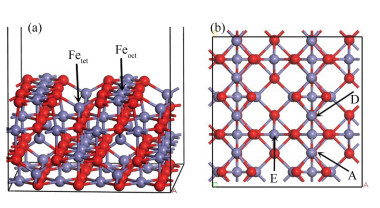
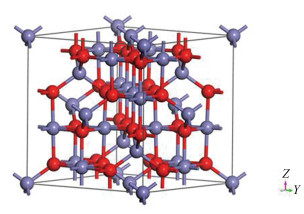
(a): front view; (b): top view
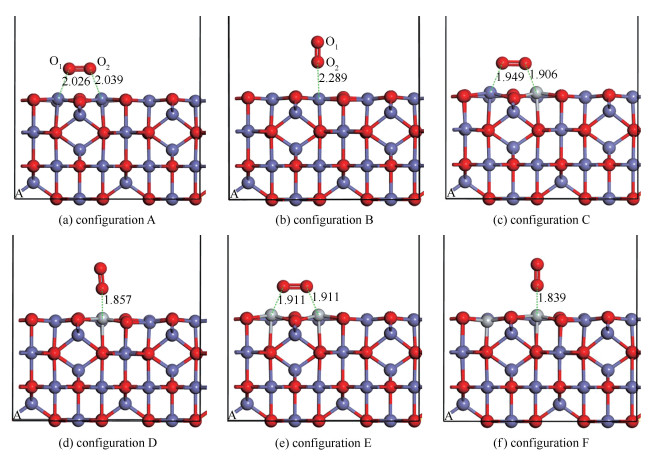
(a):horizontal adsorption of O2 on γ-Fe2O3; (b):vertical adsorption of O2 on γ-Fe2O3; (c):horizontal adsorption of O2 on Ti-γFe2O3; (d):vertical adsorption of O2 on Ti-γFe2O3; (e):horizontal adsorption of O2 on 2Ti-γFe2O3; (f):vertical adsorption of O2 on 2Ti-γFe2O3
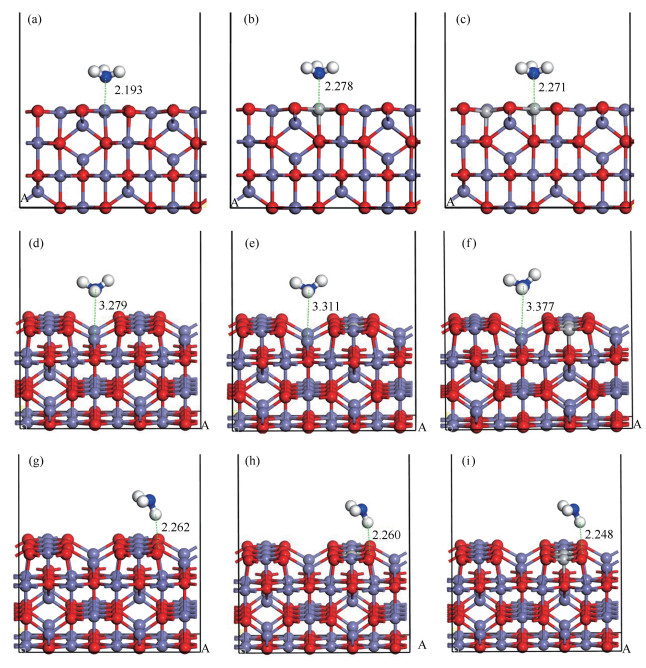
(a): NH3 adsorbed on γ-Fe2O3(oct site); (b): NH3 adsorbed on Ti-γFe2O3(oct site); (c): NH3 adsorbed on 2Ti-γFe2O3(oct site); (d): NH3 adsorbed on γ-Fe2O3(tet site); (e): NH3 adsorbed on Ti-γFe2O3(tet site); (f): NH3 adsorbed on 2Ti-γFe2O3(tet site); (g): NH3 adsorbed on γ-Fe2O3(O site); (h): NH3 adsorbed on Ti-γFe2O3(O site); (i): NH3 adsorbed on 2Ti-γFe2O3(O site)
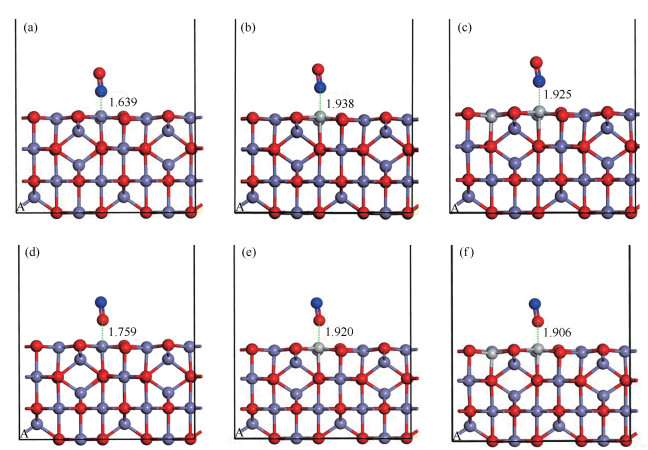
(a): NO adsorbed on γ-Fe2O3 (N); (b): NO adsorbed on Ti-γFe2O3 (N); (c): NO adsorbed on 2Ti-γFe2O3 (N); (d): NO adsorbed on γ-Fe2O3 (O); (e): NO adsorbed on Ti-γFe2O3 (O); (f): NO adsorbed on 2Ti-γFe2O3 (O)
 DownLoad: