
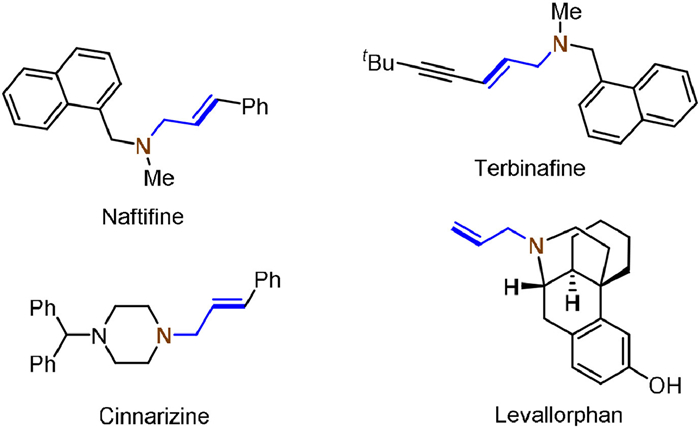
Scheme 1.
Representative pharmaceutical molecules containing the allylic amine motif.


The allylic amine motif is widely present in pharmaceuticals, biologically active molecules, and functionalized organic intermediates, serving as a pivotal scaffold in organic synthesis and medicinal chemistry. Representative drugs such as terbinafine, naftifine, cinnarizine, and levallorphan all contain this motif (Scheme 1) [1]. Consequently, the development of efficient, mild, and highly selective methods for synthesizing allylic amines are crucial for the rapid construction of complex nitrogen-containing molecules. As a class of abundant and structurally diverse building blocks, 1,3-dienes offer a powerful strategy for rapidly increasing molecular complexity through difunctionalization, which enables the simultaneous formation of multiple chemical bonds in a single operation. However, existing radical carboamination reactions of dienes have predominantly focused on 1,2-functionalization involving alkyl radicals, as exemplified by recent Cu-catalyzed systems using activated alkyl halides. Achieving 1,4-arylamination with aryl radicals remains a formidable challenge, primarily due to the lack of suitable aryl radical precursors and efficient catalytic systems that can control chemoselectivity (avoiding direct amination or Heck-type pathways) and regioselectivity (suppressing 1,2-addition). Moreover, most reported systems rely on precious-metal catalysts such as palladium, underscoring the need for more sustainable platforms based on earth-abundant metals.
To address these challenges, the research group of Daoshan Yang at Qingdao University of Science and Technology report a visible-light-driven, copper-catalyzed three-component 1,4-arylamination reaction. This protocol employs aryl thianthrenium salts as aryl radical precursors, along with 1,3-dienes and amines as coupling partners, to achieves the simultaneous construction of C–C and C–N bonds under mild conditions. Systematic optimization identified the optimal conditions: 10 mol% Cu(OAc)2, 15 mol% BINAP, and EtCO2K in DMF at room temperature under N2. Irradiation with a 405 nm violet LED (25 W) for 12 h afforded the desired product in 76% isolated yield. Control experiments confirmed that light, base, and ligand are all essential for reactivity. This method represents the first successful application of aryl thianthrenium salts to the 1,4-arylamination of 1,3-dienes (Scheme 2) [2]. Notably, in contrast to prior work that relied on precious metals or afforded 1,2-adducts, this protocol uses an inexpensive copper catalyst and delivers excellent 1,4-selectivity.
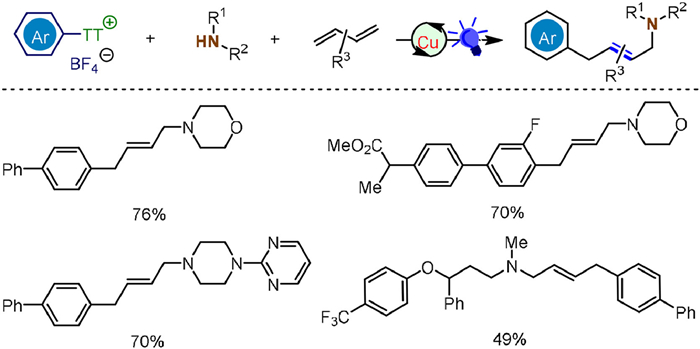
The method exhibits excellent substrate scope and functional group compatibility. A wide range of aryl thianthrenium salts bearing halogens, heterocyclic substituents, and sensitive functional groups participate smoothly in the reaction, delivering products in satisfactory yields. Furthermore, diverse amine substrates, including morpholine, thiomorpholine, piperazines, piperidine derivatives, diisopropylamine, di-tert-butylamine, and even diallylamine, are efficiently converted with excellent chemoselectivity for conjugated dienes over unactivated alkenes. Notably, this strategy can be applied to the late-stage modification of complex bioactive molecules, such as the functionalization of bifenthrin, flurbiprofen, and fluoxetine, further highlighting its potential in drug molecule modification and structural diversification. The practicality and scalability of this protocol were also validated through gram-scale experiments and subsequent transformations.
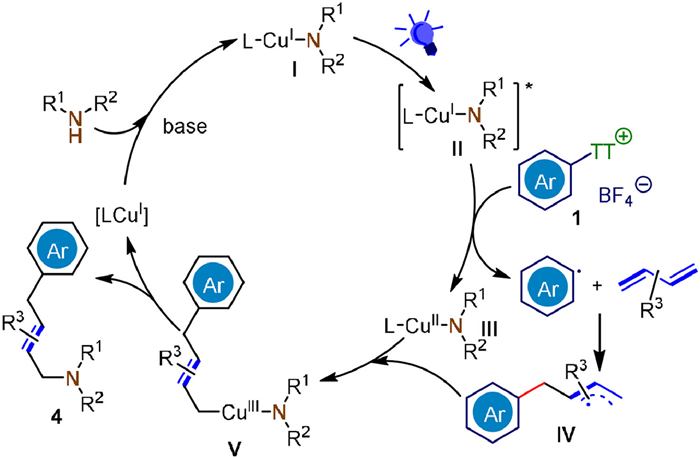
Mechanistic investigations were systematically conducted using radical trapping experiments, XPS, UV–vis absorption spectroscopy, fluorescence quenching, light on/off experiments, and DFT calculations (Scheme 3). The addition of TEMPO completely suppressed the reaction, and the radical-trapped intermediate was identified by HRMS, confirming the involvement of aryl radical species [3]. XPS peak-fitting analyses revealed that the combination of Cu(OAc)2, BINAP, EtCO2K, and morpholine significantly increased the proportion of Cu(I) species, suggesting the formation of a photoactive N–Cu(I) complex. UV–vis studies of this catalytic mixture revealed enhanced absorption above 400 nm, consistent with a photoexcitable species [4]. Fluorescence quenching experiments demonstrated that the emission intensity of the in situ generated excited copper species decreased with increasing concentration of the thianthrenium salt, supporting a single-electron transfer (SET) process [5]. Light on/off experiments confirmed that continuous irradiation is essential for product formation. Furthermore, theoretical calculations elucidate the energetic origins behind the preferential formation of the 1,4-arylamination product, providing crucial insights into the regioselectivity of this multicomponent radical reaction. Building upon these mechanistic insights, we assessed the current limitations and sustainability of this protocol to provide a balanced perspective on its synthetic utility.
Despite broad scope, limitations include high catalyst loading (10 mol% Cu/15 mol% BINAP; 5 mol% gave poor yield), poor compatibility with primary amines and certain acyclic secondary amines, and the use of DMF and stoichiometric base, which undermine greenness. Gram-scale reaction (5 mmol) afforded 72% yield (vs. 76% at small scale), revealing scale-up challenges. Nonetheless, copper offers sustainability advantages over palladium in abundance and toxicity. Future work will target greener solvents, recyclable catalysts, and longer-wavelength photoexcitation. Overall, this protocol provides a practical, operationally simple complement to existing precious-metal-based methods.
In summary, we have developed a visible-light-driven, copper-catalyzed three-component 1,4-arylamination of 1,3-dienes using aryl thianthrenium salts as aryl radical precursors. This method enables concurrent formation of C−C and C−N bonds under mild conditions with excellent 1,4-regioselectivity and accommodates a broad range of aryl thianthrenium salts and amine partners, including complex bioactive molecules. Mechanistic studies support a photoactive N−Cu(I) species that initiates aryl radical generation via single-electron transfer. Despite current limitations, such as catalyst loading, amine scope, and solvent choice, this work provides a distinct copper-based alternative to precious-metal catalysts for allylic amine synthesis and expands the synthetic utility of thianthrenium salts in radical difunctionalization. We anticipate that the insights gained herein will inspire the development of more sustainable and selective multicomponent radical couplings.
Dong-Fang Jiang: Writing – original draft. Rong-Nan Yi: Writing – original draft. Wei-Min He: Writing – review & editing.
The authors declare that they have no known competing financial interests or personal relationships that could have appeared to influence the work reported in this paper.
E.M. Nurminen, M. Pihlavisto, L. Lazar, J. Med. Chem. 53 (2010) 6301–6315. doi: 10.1021/jm100337z
S. Ji, Y. Liu, J. Lv, et al., ACS Catal. 16 (2026) 9529–9537. doi: 10.1021/acscatal.6c02065
X. Li, X. Li, W. Cui, et al., Org. Lett. 25 (2023) 3260–3265. doi: 10.1021/acs.orglett.3c00990
G. Guo, J. Ma, Y. Dong, et al., Org. Lett. 26 (2024) 8383–8388. doi: 10.1021/acs.orglett.4c03182
X. Liu, X. Li, L. Wang, et al., Org. Chem. Front. 11 (2024) 2195–2200. doi: 10.1039/d3qo02009f

Scheme 2 Visible light/copper catalysis promoted three-component 1,4-arylamination of 1,3-dienes.

 扫一扫看文章


扫一扫关注我们
 DownLoad:

 下载:
