Citation: Hanchun Chen, Mingyi Liu, Haodong Ji. Principle of excited state defluorination for perfluorocarboxylic acids in photolysis reaction[J]. Chinese Chemical Letters, ;2026, 37(7): 112273. doi: 10.1016/j.cclet.2025.112273 shu

Principle of excited state defluorination for perfluorocarboxylic acids in photolysis reaction

    * Corresponding author.
    E-mail address: jihaodong@pku.edu.cn (H. Ji).
    1 These authors contributed equally to this work.
  • Received Date: 22 May 2025
    Revised Date: 17 November 2025
    Accepted Date: 11 December 2025
    Available Online: 12 December 2025

Figures(3)

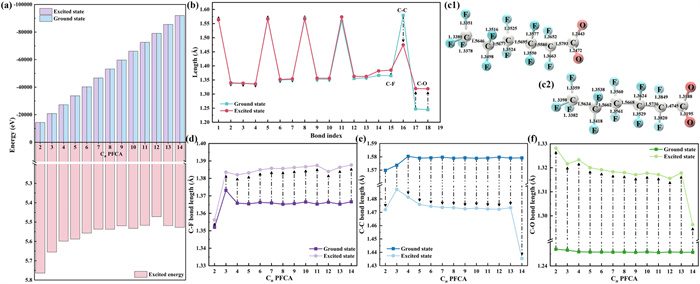
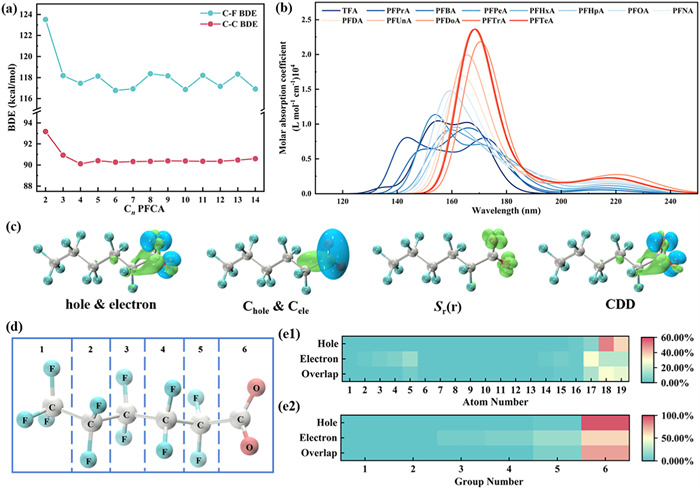
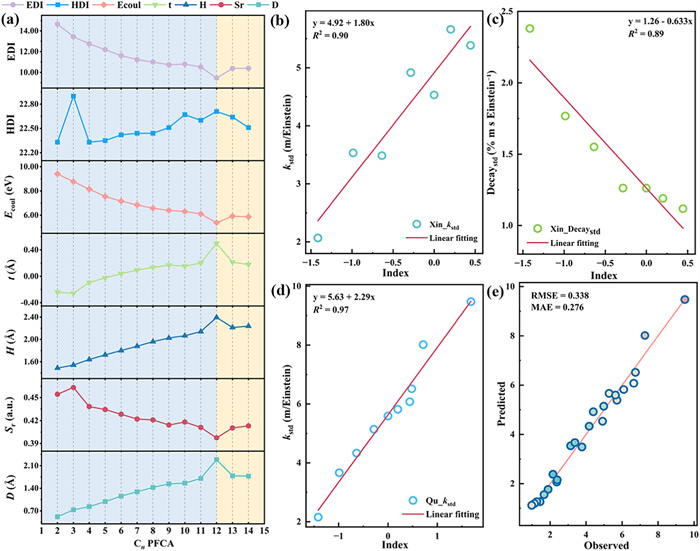
  • The degradation of perfluorocarboxylic acids (PFCAs), persistent organic pollutants, remains a significant environmental challenge. Photolysis represents a key pathway for their degradation, yet the molecular mechanisms driving defluorination and decarboxylation remain unclear. This study investigates the first step of direct PFCA photolysis by analyzing excitation properties using density functional theory (DFT), aiming to elucidate the relationship between electronic structure changes and degradation pathways. To better demonstrate and analyze the impact of internal factors on the first step of PFCAs photolysis, quantum chemical calculations were conducted to quantify and compare the molecule’s properties in the ground state and the excited state, aiming to explore the changes in the molecule’s behavior. Key parameters, including α C–F bond elongation (0.31%–1.62%), α C–C bond contraction (−6.23% to −9.10%), and excitation energy reduction (5.76–5.47 eV), revealed chain-length-dependent trends. The lower bond dissociation energy of α C–C (90–93 kcal/mol) compared to α C–F (116–124 kcal/mol) rationalized the dominance of decarboxylation over defluorination. Charge transfer spectroscopy further indicated localized n → π* excitation at carboxyl groups, promoting decarboxylation. A quantitative structure-activity relationship (QSAR) model linking hole-electron indices to degradation rates (R2 = 0.91) was developed and validated via leave-one-out cross-validation (RMSE = 0.338). These findings not only advance the mechanistic understanding of PFCA photolysis but also provide a predictive tool for optimizing UV-based water treatment systems targeting persistent fluorinated pollutants.
  • 加载中
    1. [1]

      L. Ahrens, M. Bundschuh, Environ. Toxicol. Chem. 33 (2014) 1921–1929.  doi: 10.1002/etc.2663

    2. [2]

      Z. Wang, I.T. Cousins, M. Scheringer, K. Hungerbühler, Environ. Int. 60 (2013) 242–248.  doi: 10.1016/j.envint.2013.08.021

    3. [3]

      X. Dauchy, V. Boiteux, A. Colin, et al., Chemosphere 214 (2019) 729–737.  doi: 10.1016/j.chemosphere.2018.10.003

    4. [4]

      J.C. D’eon, S.A. Mabury, Environ. Health Perspect. 119 (2011) 344–350.  doi: 10.1289/ehp.1002409

    5. [5]

      K.A. Barzen-Hanson, S.E. Davis, M. Kleber, J.A. Field, Environ. Sci. Technol. 51 (2017) 12394–12404.  doi: 10.1021/acs.est.7b03452

    6. [6]

      J.P. Benskin, B. Li, M.G. Ikonomou, J.R. Grace, L.Y. Li, Environ. Sci. Technol. 46 (2012) 11532–11540.  doi: 10.1021/es302471n

    7. [7]

      N. Yamashita, K. Kannan, S. Taniyasu, et al., Mar. Pollut. Bull. 51 (2005) 658–668.  doi: 10.1016/j.marpolbul.2005.04.026

    8. [8]

      Z. Wang, I.T. Cousins, M. Scheringer, R.C. Buck, K. Hungerbühler, Environ. Int. 70 (2014) 62–75.  doi: 10.1016/j.envint.2014.04.013

    9. [9]

      Y. Liu, Y. Zhang, J. Li, et al., China Environ. Pollut. 246 (2019) 34–44.  doi: 10.1016/j.envpol.2018.11.113

    10. [10]

      A.A. Rand, S.A. Mabury, Toxicology 375 (2017) 28–36.

    11. [11]

      J.P. Giesy, J.E. Naile, J.S. Khim, P.D. Jones, J.L. Newsted, Aquatic toxicology of perfluorinated chemicals, in: D.M. Whitacre (Ed.), Reviews of Environmental Contamination and Toxicology, Reviews of Environmental Contamination and Toxicology, 202, Springer, New York, 2010, pp. 1–52.

    12. [12]

      O. US EPA, Chemicals under the Toxic Substances Control Act (TSCA), (2015). https://www.epa.gov/chemicals-under-tsca (accessed June 29, 2023).

    13. [13]

      Stockholm Convention on Persistent Organic Pollutants (POPs), https://chm.pops.int/TheConvention/POPsReviewCommittee/Meetings/POPRC9/POPRC9Followup/PFOSSubmission/tabid/3565/Default.aspx (accessed June 30, 2023).

    14. [14]

      Anon, Candidate list of substances of very high concern for authorisation - ECHA, https://echa.europa.eu/web/guest/candidate-list-table (accessed June 29, 2023).

    15. [15]

      Commission Regulation (EU) 2021/1297 of 4 August 2021 amending annex ⅩⅦ to Regulation (EC) No 1907/2006 of the European Parliament and of the Council as regards perfluorocarboxylic acids containing 9 to 14 carbon atoms in the chain (C9-C14 PFCAs), their salts and C9-C14 PFCA-related substances (Text with EEA relevance), 2021. http://data.europa.eu/eli/reg/2021/1297/oj/eng (accessed June 30, 2023).

    16. [16]

      A. Maimaiti, S. Deng, P. Meng, et al., Chem. Eng. J. 348 (2018) 494–502.  doi: 10.1016/j.cej.2018.05.006

    17. [17]

      Y. Bao, J. Niu, Z. Xu, et al., J. Colloid and Interface Sci. 434 (2014) 59–64.  doi: 10.1016/j.jcis.2014.07.041

    18. [18]

      T.D. Appleman, E.R.V. Dickenson, C. Bellona, C.P. Higgins, J. Hazard. Mater. 260 (2013) 740–746.  doi: 10.1016/j.jhazmat.2013.06.033

    19. [19]

      K. Tahir, A.S. Ali, J. Kim, et al., Chemosphere 328 (2023) 138584.  doi: 10.1016/j.chemosphere.2023.138584

    20. [20]

      J. Blotevogel, R.J. Giraud, A.K. Rappé, Chem. Eng. J. 457 (2023) 141235.  doi: 10.1016/j.cej.2022.141235

    21. [21]

      T. Sidnell, R.J. Wood, J. Hurst, J. Lee, M.J. Bussemaker, Ultrason. Sonochem. 87 (2022) 105944.

    22. [22]

      Z. Chen, X. Wang, H. Feng, et al., Environ. Sci. Technol. 56 (2022) 14409–14417.  doi: 10.1021/acs.est.2c02906

    23. [23]

      J. Cui, P. Gao, Y. Deng, Environ. Sci. Technol. 54 (2020) 3752–3766.  doi: 10.1021/acs.est.9b05565

    24. [24]

      H. Hori, E. Hayakawa, H. Einaga, Environ. Sci. Technol. 38 (2004) 6118–6124.  doi: 10.1021/es049719n

    25. [25]

      S. Vaalgamaa, A.V. Vähätalo, N. Perkola, S. Huhtala, Sci. Total Environ. 409 (2011) 3043–3048.  doi: 10.1016/j.scitotenv.2011.04.036

    26. [26]

      X. Liang, J. Cheng, C. Yang, S. Yang, Chem. Eng. J. 298 (2016) 291–299.

    27. [27]

      J. Cheng, X. Liang, S. Yang, Y. Hu, Chem. Eng. J. 239 (2014) 242–249.

    28. [28]

      N. Merino, Y. Qu, R.A. Deeb, et al., Environ. Eng. Sci. 33 (2016) 615–649.  doi: 10.1089/ees.2016.0233

    29. [29]

      F. Li, J. Duan, S. Tian, et al., Chem. Eng. J. 380 (2020) 122506.

    30. [30]

      S.C. Panchangam, A.Y.C. Lin, K.L. Shaik, C.F. Lin, Chemosphere 77 (2009) 242–248.

    31. [31]

      Z. Cheng, Q. Chen, Z. Liu, Environ. Sci. Technol. Lett. 8 (2021) 645–650.  doi: 10.1021/acs.estlett.1c00403

    32. [32]

      Y. Zhang, J. Liu, S. Ghoshal, A. Moores, Environ. Sci. Technol. 55 (2021) 16655–16664.  doi: 10.1021/acs.est.1c05549

    33. [33]

      L. Bai, Y. Jiang, D. Xia, Environ. Sci. Technol. 56 (2022) 624–633.  doi: 10.1021/acs.est.1c06356

    34. [34]

      Y. Chen, M. Bhati, B.W. Walls, Environ. Sci. Technol. 56 (2022) 8942–8952.  doi: 10.1021/acs.est.2c01637

    35. [35]

      R. Qu, J. Liu, C. Li, Water Res. 104 (2016) 34–43.

    36. [36]

      X. Xin, J. Kim, D.C. Ashley, C.H. Huang, ACS ES&T Water 3 (2023) 2776–2785.  doi: 10.1021/acsestwater.3c00274

    37. [37]

      M.J.F. Scuseria, G.W. Trucks, H.B. Schlegel, et al., Gaussian 16, revision C.01, 2016.

    38. [38]

      T. Lu, F. Chen, J. Comput. Chem. 33 (2012) 580–592.  doi: 10.1002/jcc.22885

    39. [39]

      Z. Liu, T. Lu, Q. Chen, Carbon 165 (2020) 461–467.

    40. [40]

      IBM Corp. (2016). IBM SPSS statistics (Version 24).

    41. [41]

      W.H. Fang, R.Z. Liu, X. Zheng, D.L. Phillips, J. Org. Chem. 67 (2002) 8407–8415.

    42. [42]

      H. Hori, A. Yamamoto, K. Koike, et al., Chemosphere 68 (2007) 572–578.

    43. [43]

      J. Chen, P. Zhang, J. Liu, J. Environ. Sci. 19 (2007) 387–390.  doi: 10.1007/s10967-007-0533-2

    44. [44]

      R. Nandi, A. Sharma, A. Priya, D. Kumar, Mol. Divers. 29 (2025) 3207–3231.  doi: 10.1007/s11030-024-11070-w

    45. [45]

      S. Yang, J. Yang, M. Duan, et al., Trans. Tianjin Univ. 30 (2024) 167–177.  doi: 10.1007/s12209-024-00387-0

  • 加载中
    1. [1]

      Yutong Xiong Ting Meng Wendi Luo Bin Tu Shuai Wang Qingdao Zeng . Molecular conformational effects on co-assembly systems of low-symmetric carboxylic acids investigated by scanning tunneling microscopy. Chinese Journal of Structural Chemistry, 2025, 44(2): 100511-100511. doi: 10.1016/j.cjsc.2025.100511

    2. [2]

      Hanqing Zhang Xiaoxia Wang Chen Chen Xianfeng Yang Chungli Dong Yucheng Huang Xiaoliang Zhao Dongjiang Yang . Selective CO2-to-formic acid electrochemical conversion by modulating electronic environment of copper phthalocyanine with defective graphene. Chinese Journal of Structural Chemistry, 2023, 42(10): 100089-100089. doi: 10.1016/j.cjsc.2023.100089

    3. [3]

      Mingli JiangWeihua XuXin LiXiaofei TanWei Zhang . Fe-bearing clay minerals as catalysts for oxidant activation in organic pollutant degradation: ROS generation driven by Fe(Ⅱ)/Fe(Ⅲ) redox cycling. Chinese Chemical Letters, 2026, 37(7): 112274-. doi: 10.1016/j.cclet.2025.112274

    4. [4]

      Hanqi ZhangBiao GaoYuanyuan FengGuijuan ZhengZhijun LiuLichun KongJunjun LiuHaji Akber AisaGuangmin Yao . DFT calculations and dynamic NMR revealed the coalescent NMR phenomena of the 6/6/6/9 tetracyclic merosesquiterpenoids with an unprecedented 9,15-dioxatetracyclo[8.5.3.04,17.014,18]octadecane core skeleton. Chinese Chemical Letters, 2025, 36(9): 111234-. doi: 10.1016/j.cclet.2025.111234

    5. [5]

      Xu-Hui YueXiang-Wen ZhangHui-Min HeLei QiaoZhong-Ming Sun . Synthesis, chemical bonding and reactivity of new medium-sized polyarsenides. Chinese Chemical Letters, 2024, 35(7): 108907-. doi: 10.1016/j.cclet.2023.108907

    6. [6]

      Jieshuai XiaoYuan ZhengYue ZhaoZhuangzhi ShiMinyan Wang . Asymmetric Nozaki-Hiyama-Kishi (NHK)-type reaction of isatins with aromatic iodides by cobalt catalysis. Chinese Chemical Letters, 2025, 36(5): 110243-. doi: 10.1016/j.cclet.2024.110243

    7. [7]

      Fengqing WangChangxing QiChunmei ChenQin LiQingyi TongWeiguang SunZhengxi HuMinyan WangHucheng ZhuLianghu GuYonghui Zhang . Discovery and enantioselective total synthesis of antitumor agent asperfilasin A via a regio- and diastereoselective Nazarov cyclization. Chinese Chemical Letters, 2025, 36(6): 110252-. doi: 10.1016/j.cclet.2024.110252

    8. [8]

      Youxiang HeYongfa ZhuMing LuoHaiping Xia . A nonalternant analogue of pentacene incorporating a non-terminal azulene unit. Chinese Chemical Letters, 2025, 36(7): 110463-. doi: 10.1016/j.cclet.2024.110463

    9. [9]

      Kun WangTianxue GongYaohuang HuangBoyang HanHanxiao YangPavlo O. DralWeiwei Fang . Bornylimidazo[1,5–a]pyridin-3-ylidene allylic Pd catalyst with optimal electronic and steric properties for synthesis of 3,3′-disubstituted oxindoles. Chinese Chemical Letters, 2025, 36(7): 110539-. doi: 10.1016/j.cclet.2024.110539

    10. [10]

      Ke XuShulai LeiPanshuo WangWeiyi WangYuan FengJunsheng Feng . Unraveling the microscopic origin of out of plane magnetic anisotropy in Ⅵ3. Chinese Chemical Letters, 2025, 36(8): 110257-. doi: 10.1016/j.cclet.2024.110257

    11. [11]

      Huiyuan DengNa ZhaoJunjie YouZhicheng PanBo XingYuling YeBo LaiYuxi WangTongrui LuXiaonan Liu . Removal of bisphenol a through peroxymonosulfate activation with N-doped graphite carbon spheres coated cobalt nanoparticles catalyst: Synergy of nonradicals. Chinese Chemical Letters, 2025, 36(8): 110650-. doi: 10.1016/j.cclet.2024.110650

    12. [12]

      Changming LiHongdan ZhuCan-Can BaoYongjia LinBing-Tao GuanQian Peng . Mechanistic insights for Aryl dilithium base enables the acylation of unactivated Csp3–H. Chinese Chemical Letters, 2025, 36(9): 110809-. doi: 10.1016/j.cclet.2024.110809

    13. [13]

      Guie LiChunyan YangQiu YangQingzhu ZhengMenghan LiJianhua QuGuangshan Zhang . A magnetically recyclable CoFe2O4/BiOBr S-scheme heterojunction for efficient photocatalytic degradation of diuron: Performance, durability and mechanism exploration. Chinese Chemical Letters, 2026, 37(1): 111207-. doi: 10.1016/j.cclet.2025.111207

    14. [14]

      Li LuoXiaohong ChengQi Wu . Ru-modified NiO electrocatalysts for HER: Lower energy barriers and prolonged stability. Chinese Chemical Letters, 2026, 37(1): 111308-. doi: 10.1016/j.cclet.2025.111308

    15. [15]

      Deng PanChuan HeGenping Huang . Mechanism and origins of enantioselectivity of iridium-catalyzed atroposelective intermolecular C(sp2)-H silylation: A ligand-enabled axial chirality transfer strategy. Chinese Chemical Letters, 2026, 37(4): 111217-. doi: 10.1016/j.cclet.2025.111217

    16. [16]

      Zhen-Qi WangLin-Wen WeiZhao-Qing WangYan-Jie YangYu ZhaoSong LiuYuan Huang . Modular synthesis of polyfunctionalized axial-chiral 2-arylpyridines via cobalt-catalyzed asymmetric [2 + 2 + 2] cycloaddition of diynes and nitriles. Chinese Chemical Letters, 2026, 37(4): 111377-. doi: 10.1016/j.cclet.2025.111377

    17. [17]

      Bing ZhangGuoqing JiangWenxin ShiYanei XueWenjun Sun . Vacuum-ultraviolet technology photolysis of aqueous reaction systems for organic pollutants abatement. Chinese Chemical Letters, 2026, 37(2): 111371-. doi: 10.1016/j.cclet.2025.111371

    18. [18]

      Shaohua ZhangLiyao LiuYingqiao MaChong-an Di . Advances in theoretical calculations of organic thermoelectric materials. Chinese Chemical Letters, 2024, 35(8): 109749-. doi: 10.1016/j.cclet.2024.109749

    19. [19]

      Zenggang LinPeng ZhangYuzhu YangWeisheng Liu . Multilevel stimulus-responsive smart organic afterglow materials beyond crystal limitations: Aqueous-phase dual emission afterglow and upconversion afterglow under ultra-wide range excitation. Chinese Chemical Letters, 2025, 36(9): 111194-. doi: 10.1016/j.cclet.2025.111194

    20. [20]

      Ronghao Zhao Yifan Liang Mengyao Shi Rongxiu Zhu Dongju Zhang . Investigation into the Mechanism and Migratory Aptitude of Typical Pinacol Rearrangement Reactions: A Research-Oriented Computational Chemistry Experiment. University Chemistry, 2024, 39(4): 305-313. doi: 10.3866/PKU.DXHX202309101

Metrics
  • PDF Downloads(0)
  • Abstract views(14)
  • HTML views(0)

通讯作者: 陈斌, bchen63@163.com
  • 1. 

    沈阳化工大学材料科学与工程学院 沈阳 110142

  1. 本站搜索
  2. 百度学术搜索
  3. 万方数据库搜索
  4. CNKI搜索
Address:Zhongguancun North First Street 2,100190 Beijing, PR China Tel: +86-010-82449177-888
Powered By info@rhhz.net

/

DownLoad:  Full-Size Img  PowerPoint
Return