
Table 1.
Comparison of major gas-separation techniques.

Roadmap on sustainable materials and technologies
Jing Guo , Chunhui Luo , Peng Li , Mao Ye , Zhihua Qiao , Yubo Wu , Huiqin Hu , Xubiao Luo , Liming Yang , Yulin Cai , Pengwei Li , Kai Zhu , Cheng Fu , Bing Yu , Yueying Chen , Shichang Wang , Ting Wang , Chongchong Qi , Zirou Liu , Dongmei Huang , Zengxi Wei , Fangxin Mao , Yi Wei , Caining Wen , Chao Han , Bo Weng , Han Feng , Junming Hong , Jing Wu , Yu Xiao , Guang Liu , Linlin Song , Rongzheng Ren , Zhenhua Wang , Long Kong , Huaifang Shang , Lihua Wang , Yongzhi Chen , Changjie Ou , Huijun Yang , Xiaoyu Liu , Jin Yi , Siwu Li , Chuang Yu , Yanhui Cao , Zhong Wu , Yida Deng , Wenbin Hu , Jianjian Zhong , Xiong Zhang , Yanwei Ma , Jianmin Ma


Chunhui Luo, Peng Li, Mao Ye, Zhihua Qiao*
The core objective of gas separation is to efficiently extract high-purity target components from gas mixtures or to effectively remove harmful impurities. As an indispensable “refining” step in modern industrial processes, gas separation plays a vital role in key sectors such as energy production, chemical manufacturing, environmental protection, and healthcare. Although traditional techniques like cryogenic distillation and absorption separation have reached a relatively mature stage, they still commonly face challenges including high energy consumption, complex equipment, and high capital and operational costs [1]. Similarly, adsorption and membrane separation methods encounter limitations with conventional adsorbents such as activated carbon and molecular sieves, including low capacity, poor selectivity, difficult regeneration, and scalability issues. Consequently, the development of novel, highly efficient, and low-energy-consumption gas separation materials and technologies has become a major research focus in both academia and industry [2,3].
Novel materials like metal-organic frameworks (MOFs), covalent organic frameworks (COFs), zeolite molecular sieves, and advanced polymeric and hybrid matrix membranes are pivotal to next-generation gas separation technologies [2]. Their structural diversity and tunable functionalities make them superior for specific separation tasks. Converging advancements in materials science, AI, and computational simulation are now revolutionizing this field, steering it toward unprecedented efficiency, energy savings, and integrated operations. Ultimately, the innovation in separation materials and processes serves as the fundamental driver, dramatically enhancing both the efficiency and economic attractiveness of gas separation [2,4].
Current mainstream gas separation technologies face significant challenges. Cryogenic distillation can achieve high-purity separation but requires cooling gases to very low temperatures, leading to high energy consumption, substantial equipment investments, slow startup, and limited operational flexibility [1]. Absorption methods suffer from high energy consumption during solvent regeneration (typically involving heating), resulting in considerable operating costs. Solvents may also degrade, volatilize, foam, or corrode equipment, necessitating frequent replenishment and posing environmental risks [5]. Adsorption methods, including pressure swing adsorption (PSA) and temperature swing adsorption (TSA), are widely used in industry. Their performance depends on adsorbent selectivity, but both capacity and selectivity are sensitive to impurities, leading to performance decline over time [1,6]. The cyclic regeneration process is energy-intensive, requires sophisticated control systems, and often involves large equipment for high-volume applications. The core challenge in membrane separation lies in the trade-off between selectivity and permeability: highly selective membranes often exhibit low flux. Moreover, traditional polymer membranes are prone to plasticization, aging, and fouling, resulting in progressive performance degradation and limiting the ability to produce high-purity products [7,8].
Common challenges across these technologies include reduced efficiency when processing complex gas mixtures, persistently high energy consumption and costs, and significant capital investment. These limitations underscore the difficulty in developing new materials and processes that are both highly efficient and cost-effective. Many novel materials still perform well below expectations in industrial settings. The advantages and disadvantages of its separation principle are shown in Table 1.
 DownLoad:
CSV
DownLoad:
CSV
| Process | Principle | Advantage | Disadvantage |
| Cryogenic distillation | Differences in the volatility of various gases at low temperatures [8] | ⅰ) High product purity ⅱ) Environmentally friendly, no chemical reagents required ⅲ) Suitable for large-scale applications | ⅰ) High operating costs ⅱ) High energy consumption ⅲ) High clogging tendency of processing equipment |
| Absorption | Differences in the solubility of individual components in a gas mixture within specific solvents [8] | ⅰ) Simple operation ⅱ) High processing capacity ⅲ) Mature technology | ⅰ) Equipment susceptibility to corrosion ⅱ) High energy consumption for regeneration ⅲ) Potential environmental pollution risks |
| Adsorption | Differences in the selective adsorption capacity of adsorbents toward various gases [8] | ⅰ) High selectivity ⅱ) Simple and flexible operation ⅲ) Easy to regenerate | ⅰ) High operating costs ⅱ) Adsorption agent performance degradation |
| Membrane-based gas separation | Differences in the permeation rates of individual gas components through a membrane under specified pressure conditions [8] | ⅰ) Low energy consumption, low maintenance costs ⅱ) Simple equipment ⅲ) No secondary pollution | ⅰ) Membrane fouling ⅱ) Poor stability ⅲ) Potential membrane material plasticization and aging |
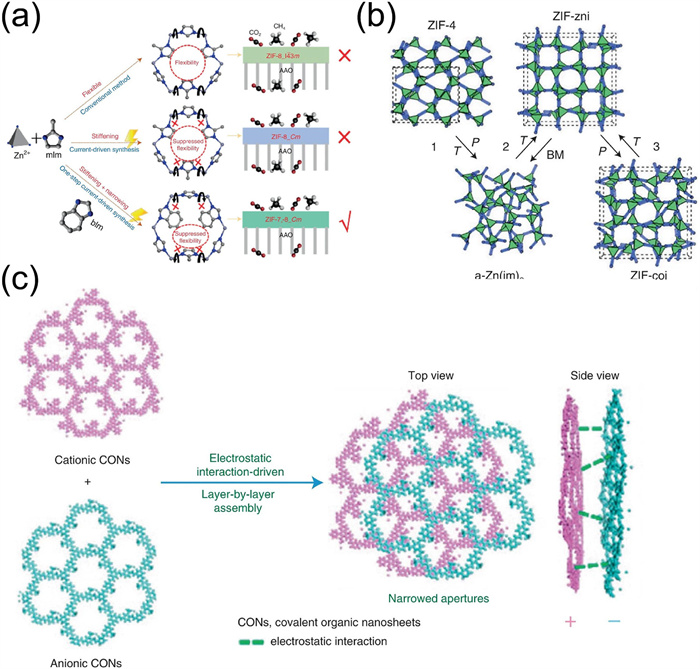
For cryogenic distillation, thermal integration strategies, such as heat pump distillation and multi-effect distillation, significantly reduce refrigeration energy consumption. Tower efficiency is improved through high-performance packing and heat exchangers. The use of renewable energy sources and advanced process control (APC) algorithms helps accommodate load fluctuations. In chemical absorption, novel solvents including phase-change solvents and ionic liquids [5] are being developed to reduce regeneration heat and degradation rates. Process intensification techniques enhance mass and heat transfer; optimized heat exchange networks facilitate energy recovery; regenerative catalysts lower desorption temperatures. For adsorption methods, high-performance adsorbents (e.g., MOFs, activated carbon fibers) are emerging [6,9]. Cyclic processes are optimized through multi-column coupling to improve recovery and energy efficiency, while structured adsorption beds (e.g., honeycomb, 3D-printed) reduce pressure drop and enhance mass transfer. In membrane separation, novel hybrid matrix membranes such as NIGMs [10] overcome performance trade-offs via structural design (Fig. 1); surface coatings improve fouling and plasticization resistance [7]; multi-stage membrane cascades enable higher product purity.

Technological progress is highly dependent on breakthroughs in core materials. Key collaborative research efforts focus on developing novel materials with high selectivity, stability, and poison resistance, such as MOFs, COFs, ZIFs, high-performance polymers, and composite solvents (Fig. 2). This represents a fundamental approach to improving separation efficiency and reducing energy consumption [6]. The coupling and integration of different technologies offer promising solutions. For example, “a ZIF-8/isooctane slurry system combining absorption and adsorption mechanisms achieves efficient separation of CH4/C2H6 in natural gas, yielding C2H6 purity >94.69% with a recovery rate >95.21% and energy consumption as low as 0.456 kWh/Nm3 [11].” Other examples include: “hollow fiber membrane contactors in a membrane-absorption system enhance mass transfer across viscous solvents like ionic liquids, achieving over 90% ammonia absorption efficiency”; and “a hydrate-membrane coupling process for propane/hydrogen separation improves separation efficiency by 31.29% [12].” Such hybrid approaches leverage the strengths of each technology while mitigating their weaknesses, optimizing both energy efficiency and economic performance. The application of big data and artificial intelligence (AI) enables reverse screening of materials and model-based optimization of separation processes. Process control strategies further enhance operational flexibility, accommodate feedstock fluctuations, and unlock energy-saving potential.
The field of gas separation is undergoing a profound transformation toward greater precision and intelligence. Future developments will focus on: Designing novel multifunctional materials with ultra-high separation performance, long-term stability, and low cost; advancing integrated hybrid processes such as membrane-adsorption and membrane-distillation for complex gas mixtures; and leveraging artificial intelligence and big data for high-throughput material screening, process optimization, and control. Ultimately, through deeper integration of materials science and engineering, next-generation gas separation technologies will provide critical support for establishing a green, low-carbon, circular economy.
Yubo Wu, Huiqin Hu*, Xubiao Luo, Liming Yang*
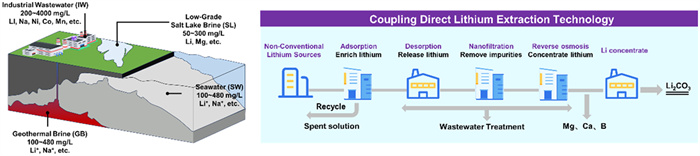
As global decarbonization efforts intensify, lithium has emerged as a critical element for the energy transition. However, conventional lithium resources, mainly hard-rock minerals and continental brines, are struggling to keep pace with soaring demand, which is projected to gap expected to reach 538,000 t by 2030 [13]. This supply gap has heightened interest in non-conventional lithium sources, such as low-grade salt-lake brines, geothermal fluids, seawater, and lithium-containing wastewater [14]. These resources are often challenging to process due to their low lithium concentrations (typically < 0.3 g/L) and high levels of interfering ions (e.g., Mg2+/Li+ mass ratio > 6.15, Na+/Li+ > 77) [15]. Conventional extraction methods like evaporation ponds and solvent extraction are not only inefficient and environmentally damaging when applied to these complex sources, but also often result in significant lithium loss [16]. In response, a paradigm shift is currently underway in lithium extraction technology, moving away from conventional end-of-processing toward more integrated pre-extraction strategies [17]. Among these, direct lithium extraction (DLE) has emerged as the most actively developed and promising approach [18].
DLE technologies including adsorption, solvent extraction, membrane separation, and electrochemical methods, offer promising alternatives but face their own set of constraints [19], as shown in Table 2. Adsorption suffers from slow kinetics and limited mass transfer efficiency, especially in low-Li brines (<100 ppm). Solvent extraction, though effective in certain contexts, often involves high operational costs, potential environmental risks from organic diluents, and difficulty in treating brines with high impurity levels. Membrane-based processes must contend with fouling, concentration polarization, and a significant decline in selectivity due to high concentrations of competing ions (e.g., Mg2+, Na+). Electrochemical methods, while precise, require substantial energy input and struggle with operational stability in complex, variable brine chemistries [20]. These technical and economic barriers currently hinder the widespread adoption of DLE for non-conventional lithium resources. Therefore, addressing these challenges requires two key breakthroughs: enhancing the performance of individual DLE technologies, and more importantly, developing integrated coupled-processes that synergize the advantages of multiple DLE technologies.
DownLoad:
CSV
| Extraction technology | Advantages | Limitations | Example | TRL | Process application |
| Adsorption method | High selectivity,high recovery rate | Service life, dissolution rate, high preprocessing requirements | Lithium-ion sieve, MOFs, LDHs | 7–8 | Low Li+ concentration (<500 mg/L); Low Mg2+/Li+ ratio preferred |
| Membrane separation | High recovery, simple operation | Membrane fouling and scaling issues, membrane lifespan and stability pose challenges | Nanofiltration membrane | 5–7 | Li+: 100–1000 mg/L; Requires pretreatment to reduce scaling ions |
| Electrochemical method | Highly selective, environmentally friendly | High energy consumption, high electrolyte requirements | λ-MnO2, FePO4 electrodes | 4–6 | Li+ > 50 mg/L; Effective under controlled Mg2+/Li+ and low turbidity |
| Solvent extraction | High efficiency | Complex preparation, difficulty in extraction agent recovery | Organic extractants (such as TBP) | 8–9 | High Li+ concentration (> 2000 mg/L); Low impurity content |
The advancement of efficient lithium extraction technologies faces several persistent and emerging challenges that must be overcome to enable scalable and sustainable applications. While key performance indicators such as high capacity, selectivity, stability, and technological maturity remain fundamental, they often compete with one another, making multi-objective optimization difficult. Moreover, low energy consumption and system-level integration are critical yet frequently unattainable with current single-technology approaches [21].
Looking forward, the integration of hybrid processes represents a promising but challenging pathway. Combining, for example, adsorption with membrane concentration or electrodialysis could mitigate individual weaknesses, but such coupling introduces new complexities in interoperability, control, and scaling [22]. Such as Eramet Centenario project and Go2Lithium platform illustrate early successes, yet also highlight the difficulties in maintaining efficiency, reducing energy use, and ensuring operational robustness across variable feedstocks.
Ultimately, the transition from single-unit operations to intelligently integrated DLE systems constitutes both a technical and an engineering challenge. Future advancements will depend not only on improvements in individual technologies but also on innovative process design and system-level optimization to achieve synergies.
Advances in lithium extraction technology are increasingly oriented toward integrated systems that combine multiple complementary processes, moving beyond the limitations of standalone methods. Recent research has expanded into novel coupled configurations such as adsorption-coupled electrochemical (ACEC), liquid-membrane extraction, reaction-coupled separation, and selective electrodialysis (S-ED) [23]. These systems integrate two or more separation principles, for instance, combining selective adsorption with membrane concentration or electrochemical refinement, to simultaneously improve lithium recovery, reduce energy consumption, and mitigate individual technical constraints such as slow kinetics, membrane fouling, or limited ion selectivity [24]. Such integrated approaches allow unit operations to function at their highest efficiency while compensating for each other’s weaknesses, leading to greater adaptability across diverse brine chemistries and non-conventional sources (Fig. 3).
Future progress will depend on co-designing material innovations with system-level engineering. Key directions include developing corrosion-resistant and high-stability materials suited to harsh environments, designing modular and scalable hybrid platforms, and incorporating smart control systems for real-time optimization. Ultimately, the transition from single-technology focus to intelligently coupled processes represents the most promising pathway to achieve economically viable and sustainable lithium extraction from non-conventional resources [25].
Integrated and coupled DLE technologies represent a fundamental shift in lithium production, moving beyond single-process limitations toward synergistic, multi-technology systems. By intelligently combining adsorption, membrane, electrochemical, and solvent extraction processes, integrated DLE systems achieve synergistic effects that are unattainable through any single method. For instance, adsorption can pre-concentrate lithium from dilute brines, membranes selectively separate ions to reduce scaling, and electrochemical methods enable precise recovery with minimal reagent consumption. Furthermore, coupling lithium extraction with complementary operations, such as desalination, mineral recovery, or geothermal energy production, creates multi-output systems that maximize resource utilization, minimize waste, and improve overall economics. This holistic approach not only enhances lithium yield and purity but also reduces energy footprint and operational costs, establishing a new paradigm for sustainable critical metal supply.
Yulin Cai, Pengwei Li*, Kai Zhu*
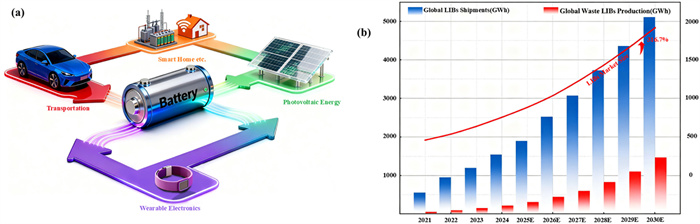
Since their commercialization in the 1990s, lithium-ion batteries (LIBs) have been extensively deployed in transportation, photovoltaic energy storage, and wearable electronics owing to their high specific capacity, long cycle life, and low self-discharge rate (Fig. 4a) [26-28]. With the rapid growth of new energy industries, global LIB production is expected to reach 5127 GWh by 2030, generating over 1546 GWh of spent LIBs (Fig. 4b). These end-of-life LIBs contain not only corrosive and toxic substances that pose environmental risk but also critical metals (Li, Ni), making the recycling both an ecological necessity and an economic opportunity [29].
Current recycling technologies generally involve pretreatment, which mainly includes disassembly and sorting of casings and electrodes, followed by recovery processes such as hydrometallurgy, pyrometallurgy, or direct regeneration. While effective in resource recovery, these processes suffer from high energy consumption, high emissions, operational hazards, and safety risks for workers. Heavy dependence on manual operations further limits efficiency and scalability, creating bottlenecks in handling the rapidly growing volumes of spent LIBs. In the era of informatization and intelligence, the emergence of AI and automation technologies has opened new pathways for the recycling of spent LIBs. Machine learning and data-driven approaches have overcome the limitations of traditional modeling and prediction, enabling the optimization and high-precision forecasting of complex systems. Additionally, the application of AI in image recognition, state assessment, and molecular prediction has facilitated the transition of battery recycling from an exploratory stage reliant on manual expertise to a more advanced stage characterized by intelligence, automation, and industrialization.
When the capacity of a power battery decays to approximately 80% of its rated value, it is typically retired as an entire battery pack. In this context, echelon use has been recognized as a crucial strategy to extend the service value of batteries across their life cycle. By applying retired batteries in energy storage systems, not only can new application scenarios be created, but the integration and efficient utilization of renewable energy can also be facilitated [30]. However, after long-term use, retired batteries often exhibit defects such as physical damage, swelling, and electrolyte leakage [31]. Therefore, before entering the subsequent processing stage, the retired battery packs need to be disassembled and the single cells with poor appearance need to be removed through classification and screening [32]. Cells that fail to meet the criteria for secondary use are directed to recycling or regeneration processes. Disassembly of power batteries into individual cells requires critical steps such as testing, positioning, and inspection, yet this stage involves serious risks of electric shock and fire. Under intensive operations, subtle defects are difficult for workers to detect in time, and practices still rely heavily on manual methods. This not only exposes operators to hazards but also constrains efficiency improvements [30,32].
To address these issues, machine learning and reinforcement learning have been explored within the Industry 5.0 framework. For instance, Gao et al. [33] modeled human–machine collaborative disassembly as a Markov game process in a reinforcement learning environment and extended it to the QMIX-HRC algorithm, which reduced labor costs and improved cooperation efficiency in pack and module disassembly. However, the process remains highly complex, and certain tasks still require manual intervention, meaning workers cannot be fully replaced and efficiency gains are limited. The integration of AI with self-learning and iterative optimization mechanisms offers new pathways. Recently, Mech-Mind achieved autonomous perception, planning, decision-making, and learning by combining automated control with technologies such as 3D dynamic cameras, multi-workspace calibration, and 3D reconstruction. These systems can independently complete complex tasks including pack disassembly and module removal (Fig. 5a) [34,35]. Such computer-assisted methods not only minimize battery damage and risks of short circuits or electrolyte leakage but also enhance material recovery efficiency while reducing resource waste.
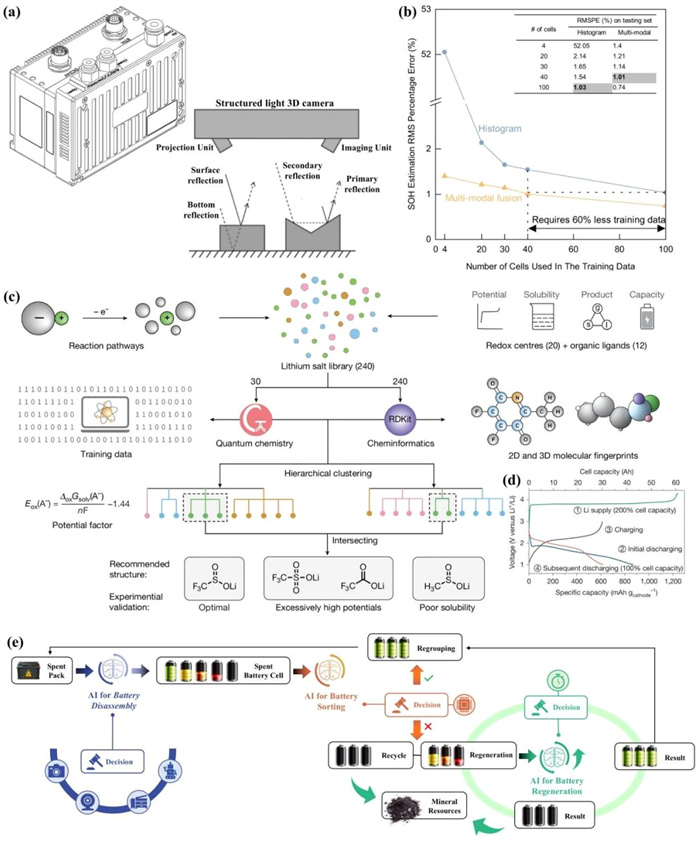
Batteries can be classified using indicators such as state of health (SOH), internal resistance (IR), remaining useful life (RUL), and electrochemical impedance spectroscopy (EIS). These parameters correlate strongly with sorting outcomes, yet high testing costs and long durations limit large-scale application. To improve efficiency, Gu et al. [36] applied partial charge–discharge curves with an optical gradient boosting algorithm, increasing accuracy to 97% and efficiency sixfold. While AI improves sorting and objectivity, it depends on large datasets and often lags in evaluation. To address this, Chen et al. [37] developed a multimodal fusion model for SOH estimation, achieving 99.26% accuracy while reducing training data needs by ~60% (Fig. 5b). In the digital era, methods enabling efficient training with limited data, real-time monitoring, and early warnings are increasingly urgent. Cloud-based service platforms further enhance intelligent sorting, supporting reuse and management of spent LIBs. For batteries with repair potential, performance can be restored through lattice repair and regeneration of active materials, while irreparable batteries require recovery of valuable metals. However, due to complex compositions and structural heterogeneity, traditional pyrometallurgy, hydrometallurgy, and direct regeneration have inherent drawbacks. To reduce energy use and environmental burdens, Maritz et al. [38] optimized hydrometallurgy with life cycle assessment (LCA), using formic acid and nanofiltration to increase cobalt recovery by 2.1% while reducing sodium hydroxide and steam consumption by 54.6% and 68.8%, respectively. Direct regeneration methods such as solid-state sintering, molten salt, and electrochemical repair show promise but remain complex, reagent-intensive, and inefficient [39]. To overcome this, Chen et al. [40] employed machine learning to screen 10,076 molecules, identifying LiSO2CF3 as the best lithium supplement (Fig. 5c). This compound efficiently replenishes lithium via vapor-phase repair, enabling capacity retention of 96.0% after 11,818 cycles, with cycling performance an order of magnitude higher than commercial LFP (Fig. 5d) [40].
Under the framework of the Materials Genome Project, material design is shifting from an experience-driven to a data-driven paradigm, moving beyond the traditional inefficient “trial-and-error” model. This transition not only streamlines experimental processes and reduces resource intensity but also accelerates the discovery of novel compounds and fosters the intelligent and green transformation of industrial production (Fig. 5e). Therefore, it lays a solid foundation for building a sustainable, efficient, and closed-loop value chain for spent LIBs recycling and regeneration.
In the era of rapid advances in intelligence and digital networking, the disassembly, sorting, recycling, and regeneration of batteries are increasingly integrated with AI and automatic control technologies. In disassembly, automation not only couples with conventional chemical processes but also enhances efficiency while ensuring safety. In sorting, AI-driven platforms transcend traditional modular evaluations by enabling holistic performance assessments, with self-iterative algorithms ensuring high accuracy across diverse battery types. For in-service batteries, cloud databases allow real-time prediction and synchronous evaluation of SOH and performance inflection points, providing scientific guidance for replacement cycles and operation–maintenance strategies.
As batteries progress to repair and regeneration, environmental benefits become a priority alongside safety and efficiency. Deep integration of LCA and AI has thus become inevitable. However, because LCA is inherently difficult for AI to directly process, effective coupling requires innovative models and algorithms. Moreover, across recycling pathways, digital tools are increasingly employed to identify optimal chemical reagents, advancing green and sustainable practices. This intelligence- and digitalization-guided model builds a closed-loop value chain for LIB recycling and regeneration while fostering coordination across the battery life cycle. By reinforcing synergies among mining, manufacturing, and recycling sectors, it maximizes economic and social benefits while promoting environmental protection and efficient resource utilization.
Cheng Fu*, Bing Yu
Despite the rapid development of the chemical industry, the large volume of refractory industrial wastewater generated during manufacturing processes has become an increasingly severe issue, particularly in developing countries. Inadequate treatment of industrial wastewater exacerbates both water resource crises and health risks. Due to significant variations in wastewater characteristics across different sectors (e.g., food, textile, chemical, pharmaceutical, steel industries), such as COD, BOD, toxicity, and salinity, there is no universal treatment technology. The selection of treatment technologies highly depends on the specific wastewater source and pollutant composition [41]. In addressing complex industrial wastewater, combining different methods has proven to be the most effective and economical approach. Examples include integrated processes where advanced oxidation processes (AOPs) serve as pretreatment units for biological treatment [42]. After years of development, current treatment systems have evolved into a mature model featuring multi-level and multi-technology integration. A graded treatment approach is widely adopted, following the sequence: “pretreatment → primary treatment → secondary treatment → tertiary (advanced) treatment”. This model ensures effluent compliance by progressively removing various pollutants. Pretreatment aims to remove large solids and grit; primary treatment focuses on eliminating suspended solids and oils; secondary treatment centers on the biodegradation of organic matter; and tertiary treatment targets the advanced removal of specific pollutants [43].
Industrial wastewater treatment technologies are generally categorized into physical, chemical, and biological methods. Physical methods are mainly used to separate suspended solids, colloids, and some dissolved substances. Chemical methods involve the transformation or removal of pollutants through chemical reactions. Biological methods utilize microbial metabolism to degrade organic matter, remove nitrogen, and phosphorus, forming the core of secondary treatment with relatively low costs. The current technological status of industrial wastewater treatment relies on refined, classified management and integrated processes combining multiple technologies (Fig. 6). Future trends will focus on further optimizing the efficiency and energy consumption of these technologies, moving toward resource recovery (water, energy, chemicals) and intelligent operation.
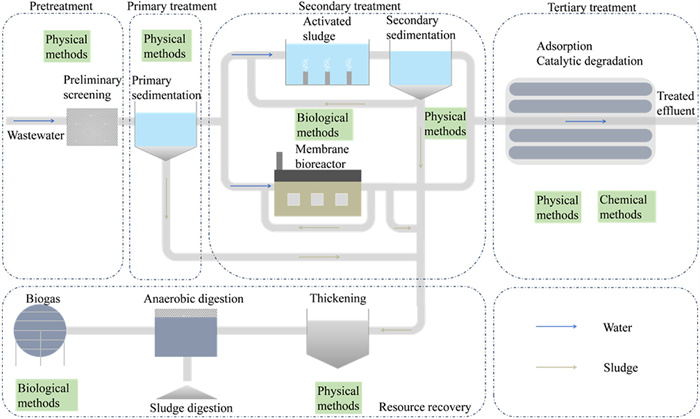
Although significant progress has been made in industrial wastewater treatment technologies, numerous current and future challenges remain. These include treatment efficiency, economic viability, technical adaptability, environmental compatibility, and resource recovery. Industrial wastewater originates from diverse sources and contains a wide variety of pollutants, such as high-concentration organic matter, heavy metals, and recalcitrant toxic substances (e.g., polycyclic aromatic hydrocarbons, pharmaceutical residues, dyes). Wastewater characteristics vary greatly across different industries, making it difficult for a single treatment technology to address all contaminants comprehensively [41]. Many high-efficiency technologies, including reverse osmosis, AOPS, and electrochemical treatment, are energy-intensive and require substantial chemical inputs, resulting in high operational costs [44]. This is particularly problematic in low-income regions, where economic feasibility becomes a major barrier to implementation. Furthermore, AOPs may generate intermediate products with higher toxicity, necessitating additional treatment steps [45]. Despite its excellent performance in wastewater reuse applications, membrane technology is plagued by severe fouling, which leads to reduced flux, necessitates frequent cleaning, and shortens the membrane's service life [46]. The development of novel anti-fouling membrane materials is still largely confined to laboratory-scale research, with limited industrial application. Anaerobic and aerobic biological treatment processes are sensitive to fluctuations in water quality, require long start-up periods, and are vulnerable to shock loads that disrupt microbial community structure. Thus, the adaptability and stability of such biological methods remain challenging [47]. Emerging contaminants, including pharmaceutical residues, microplastics, and per- and polyfluoroalkyl substances (PFAS), are difficult to completely remove through conventional treatment. Their potential risks to ecosystems and human health are not yet fully understood, underscoring the need for more targeted advanced treatment technologies in the future [48]. Future wastewater treatment plants must transition from mere “treatment” to “resource recovery”, for example, producing biogas via anaerobic digestion, recovering resources such as nitrogen, phosphorus, and heavy metals from wastewater, and extracting salts through evaporation and crystallization. However, these technologies still face issues such as low efficiency, high costs, and engineering difficulties [49].
Current challenges primarily revolve around techno-economic feasibility, adaptability to complex water matrices, and byproduct management. Future demands will include addressing emerging contaminants, enhancing resource recovery, implementing intelligent control systems, and meeting higher sustainability standards. Interdisciplinary collaboration, innovations in materials science, process integration, and policy support will be crucial in advancing industrial wastewater treatment technologies.
Industrial wastewater exhibits complex composition, high toxicity, and significant treatment challenges, posing severe threats to both the environment and human health. Conventional treatment technologies often face limitations such as insufficient efficiency, high operational costs, substantial energy consumption, and a tendency to generate secondary pollution. Fortunately, rapid advancements in science and technology have provided new pathways and solutions to address these challenges, primarily reflected in four aspects: material innovation, process intensification/coupling, system integration, and intelligentization.
The development of novel materials serves as a core driving force behind innovations in water treatment technologies. For instance, new-generation membrane materials (e.g., piezoelectric self-cleaning membranes) demonstrate significantly enhanced antifouling properties, chemical stability, and permeation flux. These improvements directly address the critical issue of membrane fouling, reducing cleaning frequency and energy consumption while extending membrane service life [50]. New single-atom catalysts exhibit superior performance and atomic utilization efficiency in AOPs, decreasing the reliance on expensive metals and thereby reducing both energy consumption and cost per unit of pollutant treated [51]. The development of advanced materials represents a crucial step in intensifying industrial wastewater treatment. Building on this foundation, the coupling of different technologies can further enhance degradation processes, forming an essential strategy for tackling complex wastewater systems. Combinations such as Fenton oxidation-aerobic biological treatment, catalytic ozonation-anoxic-oxic membrane bioreactors, and electrochemical-aerobic fixed-bed biofilm reactors have proven more effective in treating nitrogen-containing heterocyclic compounds [42]. Technological progress is manifested not only in individual unit processes but also in the optimization of overall systems. There is a gradual shift towards system integration and intelligentization, moving progressively toward precision control. For example, technological development is no longer confined merely to “treatment” but is increasingly oriented toward “resource recovery”. Initiatives such as recovering nutrients like phosphorus and nitrogen from wastewater, retrieving industrial salts through evaporative crystallization, and utilizing biogas generated from anaerobic digestion for power generation align closely with the principles of the circular economy [49]. The application of sensors, big data analytics, and AI algorithms enables real-time monitoring and predictive control of influent quality and key operational parameters throughout the treatment process. This facilitates dynamic adjustments in chemical dosing, aeration rates, and other variables, achieving precise reagent addition, energy savings, and reduced consumption, thereby ensuring stable operation of the treatment system under optimal conditions [42,52,53]. Future technological developments will continue to focus on green and low-carbon processes, resource recovery, and intelligent operation and maintenance. These advances will propel the industrial wastewater treatment sector from traditional end-of-pipe approaches toward a sustainable closed-loop system for water resource management.
Industrial wastewater exhibits complex and highly variable compositions, rendering the existence of a universal treatment technology implausible. Physical, chemical, and biological methods each possess distinct advantages and limitations, with their efficacy being highly contingent upon the specific types and concentrations of pollutants, as well as the overarching treatment objectives. Frequently, a single technology proves inadequate to meet stringent discharge or reuse standards. In practice, integrated processes, such as advanced oxidation pretreatment coupled with biological treatment, or coagulation combined with membrane filtration, have emerged as core strategies for effective industrial wastewater management. These systems leverage synergistic effects among technologies to achieve cascading removal of contaminants. The selection of appropriate technologies is influenced not only by treatment efficiency but also by factors such as capital and operational costs, energy consumption, technical complexity, and local regulatory frameworks. Although many advanced technologies (e.g., membrane separation, AOPs) demonstrate remarkable performance, their high investment and operational expenses often restrict application in resource-limited regions. Current treatment technologies continue to face several universal challenges, including high energy consumption, chemical usage, difficulties in handling by-products and sludge disposal, membrane fouling, and insufficient removal efficiency for emerging trace contaminants (e.g., pharmaceuticals, endocrine-disrupting compounds).
Given the current status and challenges, future research must focus on developing more efficient, energy-saving, and environmentally benign technologies. Key directions include designing low-cost adsorbents with high capacity and selectivity, developing antifouling and highly stable membrane materials, and engineering efficient and durable electrocatalytic electrodes and catalysts. Optimizing reactor design and operational conditions is also essential to enhance mass transfer efficiency and reaction rates, thereby reducing energy and chemical consumption. Future wastewater treatment plants should transition from mere treatment facilities to resource recovery centers. There is a critical need to advance tertiary treatment technologies capable of effectively degrading persistent and emerging micropollutants, particularly via efficient AOPs that minimize secondary pollution. Finally, future progress must be underpinned by interdisciplinary collaboration, comprehensive life-cycle assessments, system integration, and intelligent automation. Such holistic approaches will systematically optimize industrial wastewater treatment strategies and ultimately contribute to sustainable water environment management.
Yueying Chen, Shichang Wang, Ting Wang*
Industrial waste gas pollution has become one of the major bottlenecks to sustainable industrial transformation worldwide. As industrialization advances across the world, managing emissions such as nitrogen oxides (NOx) and volatile organic compounds (VOCs) has become increasingly challenging. In response to increasingly stringent emission standards and persistent cost-benefit pressures, waste gas treatment technologies have undergone continuous upgrading and diversification in practice [54-56]. As composite atmospheric pollution issues become increasingly prominent, the limitations of single-pollutant treatment technology are becoming more apparent, making the synergistic control of multipollutant an imperative necessity. Research indicates that, under sunlight, NOx and VOCs undergo photochemical reactions to form photochemical smog components such as ozone and aldehydes, and generate secondary organic aerosols (SOA), which are core components of PM2.5 [57]. This process aggravates regional air quality deterioration and poses serious threats to both the ecological environment and human health. In recent years, the synergistic removal of NOx and VOCs has emerged as a key research frontier in industrial waste gas treatment. By integrating material innovations and process coupling, researchers seek to realize efficient co-conversion of both pollutants within a single reaction system. Compared to staged treatment technologies, this integrated approach minimizes mutual interference, reduces equipment investment and operational costs, and aligns with the vision of cost-effective multipollutant control.
Currently, the mainstream industrial technology for NOx removal is selective catalytic reduction with ammonia (NH3-SCR), where NOx in flue gas is selectively reduced to N2 and H2O utilizing NH3 as a reducing agent under catalytic action (Fig. 7a). It primarily includes the following key reactions: the standard SCR reaction (4NO + 4NH3 + O2 → 4N2 + 6H2O) and the fast SCR reaction (2NO + 2NO2 + 4NH3 → 4N2 + 6H2O). The core challenge of SCR technology lies in the design of highly active, durable catalyst. For VOCs abatement, catalytic oxidation is the dominant approach, which uses catalysts to fully oxidize VOCs into CO2, H2O, or other small molecules at significantly lower temperatures than direct combustion (Figs. 7b and c). In this process, catalysts play the decisive role in determining efficiency and selectivity. The key to achieving synergistic control of PM2.5 and ozone lies in the simultaneous reduction of NOx and oxidation of VOCs. Under this background, researchers have discovered that the catalytic oxidation of VOCs and the SCR of NOx are related. Many catalysts exhibit activity for both reactions, and both processes depend on the acid and redox properties of the catalyst, which provides the possibility for synergistic removal [58-63].
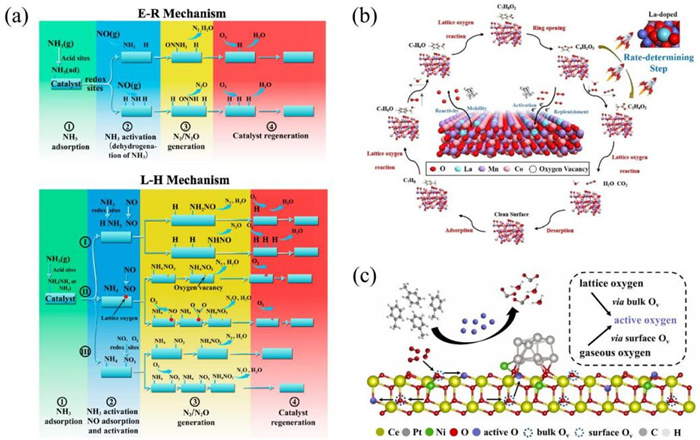
However, existing synergistic technologies still face significant challenges. Firstly, catalysts designed for simultaneous NOx reduction and VOCs oxidation pathways must activate both reaction pathways, yet different reactant molecules often compete for adsorption on the same surface, causing conflicts among active sites. Moreover, the two types of reactions impose distinct requirements for active sites: NH3-SCR demands a large number of acid sites to promote NH3 adsorption and activation, along with moderate-strength redox sites to accommodate effective NOx reduction; in contrast, VOCs oxidation requires stronger redox capability to ensure thorough degradation of organic pollutants.
In the synergistic purification process, cross-interference effects exist between the intermediates of the two reactions further complicate performance. For instance, during simultaneous removal of NOx and chlorinated aromatic compounds, the dissociated Cl may bind with metal active sites, leading to chlorine deposition on the catalyst surface. This results in the deactivation of active sites and limits the continuous progress of the redox cycle [64]. Likewise, aldehyde intermediates formed during VOCs oxidation may react with coordinated ammonia, producing toxic byproducts such as organic nitriles, resulting in secondary pollution [65]. In addition, real industrial flue gases contain impurities such as SO2, water vapor, and heavy metals, which can irreversibly deactivate catalysts. For example, SO2 exposure induces sulfation of the Mn-based catalyst, hindering the formation and migration of active oxygen species to block the catalytic reaction cycle, and ultimately reducing catalytic activity [66].
To achieve efficient synergistic removal of NOx and VOCs while enhancing catalyst resistance to poisoning, researchers have developed a series of new dual-functional catalysts. The underlying strategy is to engineer catalysts with balanced acid and redox dual-functional active sites, thereby minimizing detrimental interactions between different reactants. By precisely designing the distribution and strength of these active sites, catalysts can be tuned to regulate redox capacity, promote the conversion of intermediates, and enable synergistic catalysis of NOx reduction and VOCs oxidation. One representative example is the construction of a Pd1V1 dual single-atom structure on the CeO2 support. Here in this system, the combination of a noble and a transition metal exploits complementary electronic effects that enhance reactant adsorption and balance redox properties. This design suppresses the accumulation of inactive nitrate caused by over-activation of surface lattice oxygen and broadens the active temperature window for synergistic removal [58].
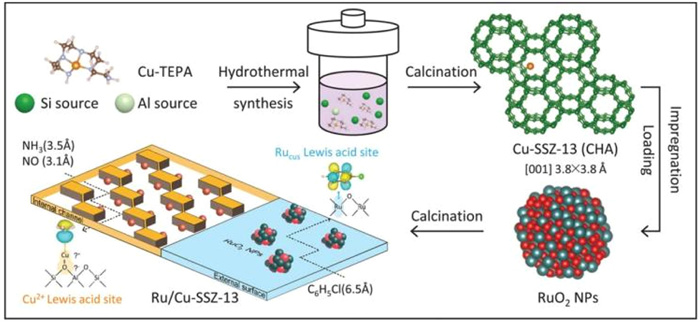
Another promising approach is spatial separation of active sites to reduce pathway interference. By tailoring catalyst architecture, NOx reduction and VOCs oxidation can be confined to distinct reaction domains, avoiding competitive adsorption and improving the selectivity toward target products. The Ru/Cu-SSZ-13 catalyst exploits the shape selectivity of molecular sieves to disperse Ru/Cu active sites outside and inside the zeolite channel (Fig. 8). Chlorobenzene reacts exclusively at Ru4+ Lewis acid sites on the zeolite’s external surface, while the NH3-SCR reaction occurs at the Cu2+ Lewis acid sites within the internal channel [59]. By separating physical spaces and precisely locating functional sites, the adsorption competition of reactant molecules is reduced, and cross-reactions are suppressed.
To address catalyst deactivation caused by flue gas impurities like heavy metals, researchers have advanced the concept of constructing selective poison-capture sites. The addition of sacrificial components with a high affinity towards poisons makes it possible to anchor poisons by forming a stable compound on the catalyst surface, which blocks their interaction with active centers. For example, doping Mo into conventional V2O5-WO3/TiO2 catalysts enables preferential binding of arsenic species to Mo, forming stable arsenate. This not only protects the active vanadium sites but also promotes the VOx polymerization and enriches the V5+ chemical state, thereby synergistically enhancing multipollutant conversion efficiency and oxidation selectivity [60].
Compared to traditional catalysts requiring high temperatures (>250 ℃) for synergistic removal of NOx and VOCs, which result in low product selectivity (<30%) and high operational costs, the new dual-functional catalysts successfully achieve high conversion rates and high product selectivity (both >80%) within a broad temperature window of >100 ℃, particularly without the need for extra heating. This not only effectively reduces the system's overall energy consumption and lowers operational costs, but also translates to lower indirect carbon emissions. Consequently, it demonstrates the potential for reduced environmental impact in terms of global warming potential (GWP) and other metrics.
Collectively, these advances mark a shift from conventional single-function materials toward rationally engineered multifunctional catalysts capable of resisting poisoning, suppressing side reactions, and maintaining efficiency across broader operating windows. Such innovations lay the groundwork for the next generation of intelligent, robust multipollutant treatment systems.
The synergistic removal of NOx and VOCs represents a crucial pathway for controlling industrial waste gas pollution and safeguarding air quality. In recent years, advances in dual-functional catalyst design have effectively addressed long-standing challenges such as reaction-pathway interference and catalyst deactivation, leading to significant improvements in both efficiency and stability of multipollutant conversion. Looking ahead, the development of low-cost and high-efficiency catalysts will be essential. This requires a careful balance of acid and redox dual-functional active sites, strategies to suppress undesirable side reactions, and enhanced resistance against poisoning by complex flue gas components. In addition, deeper mechanistic understanding enabled by in situ characterization combined with theoretical modeling, will be critical to unraveling multipollutant reaction pathways and guiding rational catalyst design.
Future progress will also depend on moving beyond traditional end-of-pipe solutions toward integrated multipollutant purification systems. This includes coupling catalytic processes with digital monitoring, AI-assisted control, and electrified reactors powered by renewable energy, thereby improving adaptability, reducing energy consumption, and aligning with carbon neutrality goals. Industrial-scale demonstration and supportive policy frameworks will further accelerate the translation of laboratory breakthroughs into practical applications. Overall, the field is transitioning from single-pollutant treatment to intelligent, sustainable, and multifunctional waste gas purification platforms, offering a vital contribution to global efforts in environmental protection and sustainable industrial transformation.
Chongchong Qi*, Zirou Liu
Solid waste treatment has become a significant global challenge due to rapid urbanization and industrialization. Municipal solid waste, industrial waste, construction debris, and e-waste are increasing at an alarming rate. Waste treatment is primarily managed through landfilling, incineration, recycling, and composting. However, each of these methods has limitations. Landfills contribute to soil contamination, greenhouse gas emissions, and the loss of biodiversity. Incineration results in air pollutants and contributes to global warming. Recycling is often hindered by material complexity and contamination, especially with plastics, which are particularly difficult to recycle. Composting also faces challenges related to the efficient separation of organic waste.
In recent years, waste-to-energy (WTE) systems and biomass valorization have emerged as promising alternatives to traditional waste management practices [67]. Technologies such as pyrolysis, gasification, and anaerobic digestion are actively being investigated and developed to improve waste processing. These technologies offer potential solutions to the growing waste management problem while simultaneously providing opportunities to recover valuable materials and produce energy from waste.
Solid waste treatment faces a range of complex challenges that hinder effective management and transition toward circular economies. A primary concern is the rapid increase in waste volume, which is further exacerbated by urban migration and the expansion of e-commerce [68]. These factors place significant strain on existing infrastructure, as well as financial support. The heterogeneous composition of waste further complicates its treatment. Landfill space is also increasingly scarce; many landfill sites are nearing their capacity, and new ones face opposition from local communities due to concerns over odor, leachate, and methane emissions.
Looking ahead, future challenges will include adapting to climate change and evolving regulations. Rising temperatures could accelerate waste decomposition, thereby increasing emissions, while extreme weather events may disrupt waste collection efforts. Emerging contaminants such as microplastics, pharmaceuticals, and PFAS (per- and polyfluoroalkyl substances) in waste streams will require advanced detection and treatment methods [69]. Furthermore, achieving zero-waste goals will demand overcoming technological inertia, particularly when scaling WTE technologies without exacerbating air pollution. Data gaps in waste characterization and global supply chains for recycled materials also hinder optimization.
Economic disparities exacerbate these challenges. The high initial costs for advanced technologies (e.g., $100–300 million for a WTE plant) discourage adoption in the Global South. Public resistance, misinformation, and fragmented policies further delay progress. Addressing these issues requires a holistic approach that integrates social, economic, and environmental factors.
Recent innovations in solid waste treatment are crucial for overcoming these barriers, leveraging digitalization, biotechnology, and thermal processes to enhance efficiency and sustainability (Fig. 9). AI and the Internet of Things (IoT) are transforming waste management operations [70]. Machine learning models, which analyze data from drones and satellites, are being used to monitor illegal dumping, improving enforcement.

In the WTE sector, advancements in pyrolysis and gasification have increased the efficiency of converting waste into syngas or biochar, achieving energy recovery rates of up to 80% and producing fewer emissions compared to traditional incineration [71]. Plasma gasification, which uses extreme heat (up to 5000 ℃), has proven effective in breaking down hazardous waste, such as e-waste and medical discards, into inert slag.
Biological treatments, such as enhanced anaerobic digestion, are also advancing. These processes involve the use of microbiomes engineered via CRISPR technology to increase biogas yields by 40%, turning organic waste into renewable natural gas. Material recovery facilities (MRFs) have incorporated robotics and near-infrared (NIR) spectroscopy, which enables precise sorting and has increased recycling rates from 20% to 60% in pilot plants. Furthermore, chemical recycling is now being employed to depolymerize plastics into their original monomers, helping to address contamination issues in mechanical recycling processes.
Zero-waste frameworks, which integrate these advancements with the principles of the circular economy, aim to upcycle textiles and electronics, as demonstrated in pilot projects in least-developed countries. Biodegradable alternatives to traditional plastics and composites are also gaining traction [72]. Research into bioplastics and biodegradable composites derived from renewable sources is advancing rapidly, and these materials could significantly reduce plastic waste volumes and mitigate their environmental impact. These biodegradable materials can be designed to degrade more easily and safely when discarded, helping to alleviate the issue of plastic pollution.
Solid waste treatment technology is undergoing a transformative shift from linear disposal models to circular, resource-efficient systems that are essential for both planetary health and economic resilience. Despite persistent reliance on landfills, the growing volume of waste presents a pressing challenge. Infrastructure deficits and environmental risks demand urgent attention. Advances in AI, WTE technologies, and biotechnology offer significant potential to increase material recovery rates and minimize environmental impacts. Achieving sustainability in waste management requires integrated policies, international collaboration, and inclusive innovation to bridge global divides. By prioritizing these strategies, we can realize zero-waste visions and align with the United Nations’ Sustainable Development Goals (SDGs), fostering a greener and more sustainable future.
Dongmei Huang, Zengxi Wei*
With the global energy transition accelerating and carbon neutrality goals being progressively implemented, hydrogen energy has gained prominence as a highly promising clean energy carrier, characterized by its high energy density, carbon-free combustion, and renewable nature [73]. Among various hydrogen production routes, electrocatalytic water splitting stands out due to its operational flexibility and zero-carbon footprint, attracting extensive research interest [74]. This electrochemical process comprises two fundamental half-reactions: the hydrogen evolution reaction (HER) at the cathode and the oxygen evolution reaction (OER) at the anode, with HER serving as the pivotal step for efficient hydrogen generation [75]. Although water electrolysis technology has been developed for more than a century, its broad commercialization remains hindered by challenges such as limited energy conversion efficiency, high operational costs, and insufficient long-term durability [76]. Recent advances in materials science, electrochemistry, and engineering have led to significant breakthroughs in electrocatalytic HER, enhancing both catalytic activity and operational stability.
Despite significant progress in the development of electrocatalysts for the HER via water electrolysis, several challenges remain. A key issue lies in the difficulty of simultaneously achieving high activity and long-term stability. Many high-performance catalysts demonstrate excellent initial activity but undergo gradual performance degradation over prolonged operation, primarily due to structural changes or deactivation of active sites. Therefore, enhancing the durability of catalysts while maintaining high activity remains an urgent problem to address.
Furthermore, the scalable synthesis and cost control of catalysts present critical hurdles. Currently, the preparation of many high-performance catalysts involves complex processes that are difficult to scale up. The frequent requirement for expensive precursors or sophisticated equipment further increases production costs. To enable the commercial adoption of electrolytic hydrogen production, it is essential to develop simple, scalable synthesis methods and reduce overall costs. Another significant challenge is the high energy consumption associated with HER. The current energy conversion efficiency of water electrolysis is relatively low, necessitating substantial electrical energy input. Improving the energy conversion efficiency and reducing the energy consumption of HER are crucial for sustainable implementation. This requires integrated efforts spanning catalyst design, electrolyzer structural optimization, and electrolyte selection to enhance the overall performance of hydrogen production systems.
To address the aforementioned challenges, researchers have extensively explored novel catalyst designs and synthesis methods.
Designing catalysts with porous structures can enhance hydrogen production performance. Porous architectures increase the specific surface area, providing more active sites while facilitating electrolyte diffusion and gas release. Defect engineering is another powerful approach to enhance catalytic activity [77]. Introducing vacancies or defects through methods such as plasma etching, high-energy ball milling, or chemical treatment can increase active site density and modulate electronic structures [78,79]. This catalyst leverages the built-in electric field from heterojunctions and the local internal field induced by V-doping to accelerate charge transfer, significantly enhancing reaction kinetics. In alkaline electrolyte, it required an overpotential of only 35 mV for HER at 10 mA/cm2 and 192 mV for OER, with a full water-splitting voltage of merely 1.46 V. Optimizing the surface and interfacial microenvironments of catalysts also improves performance. A cooperative strategy of “in situ perturbation and adjacent compensation” was proposed, which restructures the hydrogen-bond network at the catalyst surface via controlled cation penetration coupled with support interface engineering [80]. Using ultra-hydrophilic high-curvature carbon nanocages as carriers, they anchored bimetallic RuNi nanoalloys to construct a tip-enhanced catalytic system. This catalyst exhibited an overpotential of only 12 mV at 10 mA/cm2 in alkaline HER and maintained stability for 1600 h.
High-entropy alloys (HEAs) have shown remarkable breakthroughs in electrocatalytic hydrogen production, demonstrating enhanced activity and stability through multi-element synergy. The as-synthesized PdPtRuRhAu HEA nanoparticles (3.14 nm) that operated stably at −1000 mA/cm2 for 100 h. Their high activity originated from an increased proportion of Pd-Au bridge sites (18.97%), and machine learning was employed to accurately predict the material’s melting point (366 ℃) [81]. Another study achieved structural evolution from nanosheets to nanospheres via gradient Pt doping in PtxFeCoNiCuMn, resulting in an ultralow overpotential of 5.1 mV [82]. These advances highlight the advantages of HEAs in component design, structural regulation, and machine learning-assisted optimization, offering new strategies for developing highly efficient and stable acidic HER catalysts.
Stepwise water electrolysis is an emerging technology centered on the introduction of electron-coupled proton buffers (ECPBs) into the electrolysis system [83]. This approach decouples the HER and OER both temporally and spatially, enabling the separate production of hydrogen and oxygen at different times and locations. This technology not only mitigates the safety risks associated with hydrogen and oxygen crossover in conventional electrolysis but also offers new opportunities for hydrogen storage and transportation. Based on their physical state and applicable electrolyte environment, ECPBs can be categorized into solution-phase and solid-state electrode types, suited for acidic and alkaline/neutral electrolytes, respectively. To reduce the energy consumption of overall water splitting, researchers have proposed replacing the sluggish OER with thermodynamically more favorable oxidation reactions. For instance, a self-powered hydrazine-splitting hydrogen production system based on a “hydrazine-water” battery was developed, which exhibits a high open-circuit voltage (1.37 V) and high energy density (358 Wh/gN2H4) (Fig. 10) [84]. The system achieved a hydrogen production rate of 403.2 L H2 h−1 m−2 without requiring an external power source.
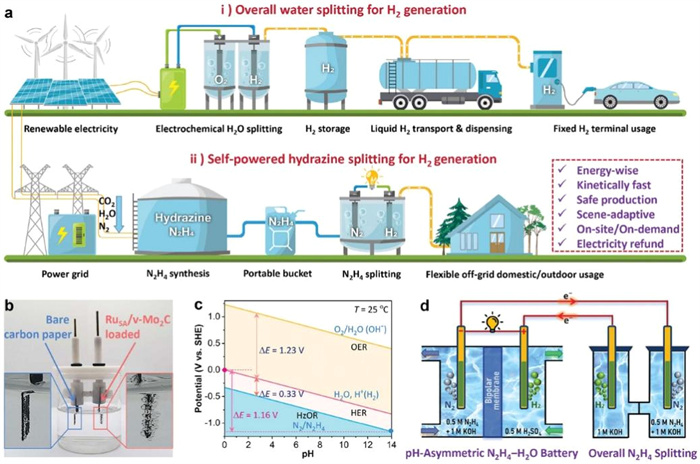
Electrolyzer design plays a critical role in enhancing HER performance. Taking proton exchange membrane water electrolyzers (PEMWE) as an example, these systems employ membrane electrode assemblies (MEA) to achieve efficient energy conversion, with the core reactions being OER at the anode and HER at the cathode. Optimizing electrode structures, flow field design, and operational conditions can significantly improve reaction kinetics and mass transfer efficiency. For instance, a two-step electrodeposition method to construct a multilayer gradient-structured hydrogen evolution electrode on a nickel foam substrate was proposed. This design effectively enhances the stability of the catalytic layer, promotes bubble detachment, and optimizes mass transfer, leading to comprehensive improvement in electrode performance.
In situ characterization techniques enable direct observation of the structural evolution and chemical state changes of catalysts under real reaction conditions, providing critical insights into catalytic mechanisms. For example, in situ X-ray absorption spectroscopy (XAS) and in situ Raman spectroscopy allow real-time tracking of the dynamic reconstruction processes, evolution of electronic structures, and formation and transformation of reaction intermediates during operation. Specifically, these techniques have elucidated the reconstruction of α/β-CoMoO4 [85] into a more catalytically active hydroxide phase under reaction conditions, as well as the transformation of perovskite-type Ca2CoRuO6 [86] into Co-Ru metal nanoclusters. Furthermore, in situ attenuated total reflectance Fourier transform infrared spectroscopy (ATR-FTIR) can be employed to identify adsorbed species on catalyst surfaces and reaction pathways, such as tracing the complete conversion route from methanol to formate on a Ni3N catalyst [87].
In the field of theoretical computation, density functional theory (DFT) has emerged as an essential tool for elucidating reaction mechanisms, predicting material properties, and guiding the rational design of catalysts. By computing key descriptors such as the hydrogen adsorption free energy (ΔGH*), the catalytic activity toward the HER can be effectively assessed. Furthermore, DFT is capable of resolving complex reaction pathways and energy barrier distributions-for instance, determining the activation energies of elementary steps in methanol oxidation-thereby providing deep insights into the underlying reaction mechanisms. Through theoretical analysis of the electronic structure (e.g., d-band center), charge distribution, and nature of active sites, DFT offers a robust theoretical foundation for the design of high-performance electrocatalysts.
Water electrolysis for hydrogen evolution still faces challenges including high catalyst costs, sluggish reaction kinetics, limited system durability, and integration with renewable energy sources. The intrinsic activity and stability of non-noble metal catalysts require further improvement, particularly under acidic conditions and at high current densities. The cost and lifespan of electrolyzers must be optimized to meet commercial requirements. Moreover, the intermittent and fluctuating nature of renewable energy sources demands enhanced dynamic response capabilities from electrolysis systems.
The future development of water electrolysis for hydrogen evolution is likely to focus on the following directions:
(1) Material innovation and precision design: Exploring novel catalyst materials, such as single-atom catalysts, high-entropy alloys, and two-dimensional materials, to achieve a balance between high activity and stability through precise control of defect characteristics and electronic structures. Developing green synthesis routes to reduce the preparation cost and environmental impact of catalysts.
(2) System optimization and integrated innovation: Developing advanced electrolyzers (e.g., AEMWE and SOEC) to improve energy efficiency and reduce costs. Optimizing electrolyzer architecture and operational conditions to enhance reaction kinetics and mass transfer efficiency. Promoting the practical application of stepwise electrolysis and coupled reaction strategies to address safety and energy consumption challenges.
(3) Renewable energy integration and intelligent control: Strengthening the coupling of water electrolysis systems with renewable energy sources and developing intelligent control strategies to accommodate the intermittency and fluctuations of renewables. Advancing direct seawater electrolysis technologies to conserve freshwater resources.
(4) Interdisciplinary collaboration and industrialization: Enhancing interdisciplinary cooperation among materials science, electrochemistry, engineering, and artificial intelligence to accelerate new material screening, performance prediction, and mechanistic analysis. Facilitating large-scale production and demonstration applications, supported by comprehensive life cycle assessment (LCA) and techno-economic analysis (TEA) to evaluate energy consumption, environmental impact, and cost.
In summary, water electrolysis for hydrogen evolution holds strategic significance in achieving carbon neutrality goals and advancing the global energy transition. Through continuous innovation in materials, systems, and mechanisms, this technology is expected to enable more efficient, cost-effective, and large-scale applications, providing critical support for the commercialization of green hydrogen.
Fangxin Mao*
Electrocatalytic water splitting, driven by renewable electricity, is one of the ideal technical routes to produce hydrogen from water without concomitant carbon emission, which is defined as “green hydrogen”. As a mature technology, water electrolysis has performed a comparable high technology readiness level to the conventional steam methane reforming (a major competitor to water electrolysis) and demonstrably operated in some large-scale hydrogen production scenarios [88]. Under standard conditions (1 atm and 298.15 K), a thermodynamic potential difference of 1.229 V is calculated to derive H2O dissociation towards hydrogen and oxygen, along with the HER and OER correspondingly. Endothermic process of the reaction makes energy consumption requirements, including electrical and thermal energy, that Gibbs free energy of 237.1 kJ/mol and thermal energy of 48.7 kJ/mol [89,90]. Reducing energy consumption was the most critical issue to be addressed, apart from equipment investment, in order to achieve the economic viability of green hydrogen before commercialization.
Simple molecular water performs exceptionally complicated physical and chemical properties to be further investigated, which would aggravate in the electrocatalysis process. In addition to hydrogen/oxygen source, it can act as reaction medium and provide reaction spaces, transfer reactive species, etc. for water-involving electrochemical conditions [91]. To understand water electrolysis and optimize its efficiency, four main aspects (Fig. 11) could be summarized in the current and future study. The pivotal issue resides in the material, particularly the electrocatalyst, which stands as the paramount factor alongside electrolytes, membranes/diaphragms, bipolar plates, and other components. Hydrolytic dissociation transpires on the surface of the electrocatalyst, and this process can be expedited through catalysis by reducing the energy barrier or activation energy of reaction. Generally, the total overpotential for water splitting is primarily determined by activation overpotential driven by the electrocatalyst. The Ohmic overpotential associated with charge transfer and the concentration overpotential related to mass transport should also be taken into consideration for potential efficiency losses [92]. Selecting optimized electrocatalysts suitable for the HER and OER half-reactions can effectively lower the kinetic activation barriers. Meanwhile, well-designing the electrolyzer can significantly reduce the Ohmic and mass-transport resistances.
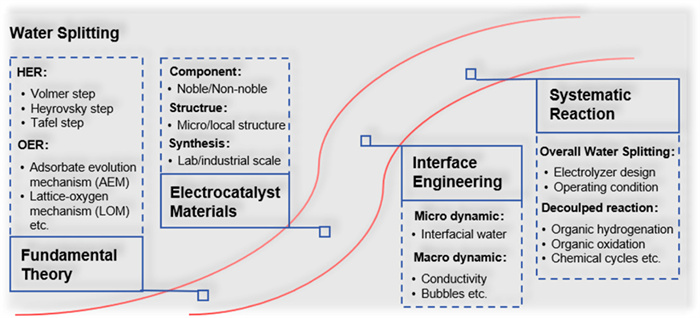
Basic mechanism investigations indicate distinct pathways of water molecule evolution in alkaline and acidic media respectively, during the catalytic processes of HER and OER [90]. Fundamental theoretical investigations offer profound insights into the interaction between water and catalysts at the atomic scale, which is conducive to the efficient design and regulation of electrocatalyst structures. In the context of the HER at the cathode, under acidic conditions, the kinetically favorable Volmer step occurs to generate chemisorbed active H* on the catalytic site. Nevertheless, water dissociation is regarded as an inevitable occurrence in the Volmer step under alkaline conditions, resulting in a rigorous reaction sequence. The Tafel step involves the coupling of another chemisorbed H* to generate a hydrogen molecule, and the Volmer-Tafel mechanism for the HER process is thereby completed. In an alternative Volmer-Heyrovsky mechanism, the Heyrovsky step entails the provision of a proton or a water molecule to the chemisorbed H* for subsequent discharge and the release of H2. A well-recognized Sabatier principle was widely employed to characterize the HER activity of materials in relation to the hydrogen bond strength. Within the context of the anode, the four-electron reaction renders the OER a complex process entailing various intermediates, and the OER mechanism is contingent upon the electrocatalyst structure. The acid-base electrolyte exerts a significant influence on the reaction pathways of the OER, which determines the reaction rate of the entire water-splitting process. Abundant free hydroxyl groups in the alkaline electrolyte can promote the reaction kinetics [93]. Typically, the adsorbate evolution reaction (AEM) and the lattice oxygen mechanism (LOM) are recognized as two extensively acknowledged pathways for dissecting the multiple steps of the OER. The generation and conversion of intermediates, including OH*, O*, OOH*, OO*, on the electrocatalyst surface exert a notable impact on the OER kinetics. The exploration of the catalytic mechanism facilitates the development of novel electrocatalysts with the anticipated structure and activity.
In the realm of catalysts for electrolytic water splitting, noble metals such as Pt and Ir/Ru-based materials are respectively considered as excellent superiors for the HER and the OER. Notably, proton exchange membrane water electrolyzers (PEMWEs) rely on platinum-group elements, in which Ir-based catalysts stand as scarce viable catalysts capable of withstanding the severe anodic conditions. The high cost and limited availability of these precious metals pose significant barriers to their widespread commercial application. Furthermore, the long-term stability of Ir-based catalysts under operating conditions remains a critical issue that needs to be addressed [94]. Enhancing the activity and durability while further reducing the Ir loading continue to pose significant challenges for PEMWEs. Alkaline water electrolyzers (AWEs) exhibit a more advanced stage of development and have been implemented in industrial applications since the mid-19th century. Non-precious metals hold promise as electrocatalysts, and the viable manufacturing requirements contribute to the dominance of AWEs in the water electrolyzer market [95]. Integrating the advantages of PEMWEs and AWEs technologies, anion exchange membrane water electrolyzers (AEMWEs) have attracted substantial attention from both the academic community and the industry [96]. Cathode catalysts based on platinum group metals are likely to remain the primary option in the foreseeable future, given their remarkable catalytic performances reported in numerous studies. Nevertheless, highly active noble metal and low noble metal composite catalysts were designed and prepared by the multifarious strategies, such as crystalline engineering, alloying, doping, strain engineering, supporting effect [93,97]. The development of efficient and low-cost electrocatalysts, even those composed of non-noble materials, continues to pose a significant challenge for large-scale water electrolysis under high operating current density.
At the electrocatalyst-electrolyte interface, a nanoscale electrical double layer is generated through their interaction under applied potential in water electrocatalysis. Interfacial water executes a variety of functions through its characteristic structural and dynamic properties, which can be influenced by the electrode surface and the electric field [98]. The polar molecular nature of water is characterized by a partial negative charge on the oxygen atom and a partial positive charge on the hydrogen atoms. The regulation of interfacial water molecules, encompassing aspects such as orientation, configuration, rigidity, and networks, plays a crucial role in the properties of mass transfer and chemical reactions [99]. Gaseous products result in the adsorption and detachment of bubbles from the surface of electrocatalysts. This phenomenon may block the active sites and cause the catalyst to peel off, thereby deteriorating the performance. Electrode engineering aimed at regulating the three-phase interface has been demonstrated as an effective strategy for mitigating the negative effects of mass transport [100]. The micro-nano structure of electrocatalysts plays a crucial role in determining and significantly influencing the interfacial reaction process.
The efficiency of electrolysis is jointly determined by the two half-reactions occurring at the cathode and anode within an electrolyzer. For acidic and alkaline overall water-splitting reaction, the utilization of optimal electrode materials and a well-designed cell structure represents a conventional enhancement strategy for attaining efficient electrolysis. Nevertheless, the disruptive processes of decoupling water splitting through the substitution of electrochemical and sub-chemical reactions present a prospective approach for reducing electrolysis cost and enhancing product economics. The HER and OER are decoupled temporally and/or spatially to surmount the limitations of water electrolysis. Representative membraneless water electrolysis has been reported through the integration of electrochemical and chemical cycles [101]. Introducing organic species into the water electrolysis system enables electrochemical hydrogenation and oxidation reactions to substitute the sluggish OER, thereby reducing the thermodynamics of overall electrolysis [102]. Innovative reactions coupled with water dissociation have broadened the scope of the electrolytic water catalysis field.
The continuous advancement of theoretical research methodologies and the development of increasingly sophisticated characterization techniques have collectively and significantly expedited the research progress in the field of water electrolysis. Computational chemistry, as a powerful theoretical tool, provides comprehensive guidance for both comprehending the fundamental electrochemical principles underlying water electrolysis processes and for systematically devising and uncovering novel, efficient electrocatalysts. Emerging interdisciplinary approaches, particularly machine learning algorithms and artificial intelligence systems, furnish valuable lead verification capabilities that enable the rapid screening, identification, and fabrication of highly active catalytic materials through data-driven approaches. Furthermore, cutting-edge characterization techniques with high spatiotemporal resolution, combined with in-situ electrochemical analysis methods, offer compelling experimental evidence for elucidating the dynamic active structures of catalysts during operation and for establishing precise structure-activity relationships that are crucial for catalyst design and optimization. These technological advancements collectively form a robust research framework that accelerates both fundamental understanding and practical applications in water electrolysis.
Electrocatalytic water splitting represents a crucial technology for the sustainable production of hydrogen, offering an environmentally friendly and efficient solution for future energy demands. Regarding both the HER and OER, in-depth studies on electrocatalyst design, mechanistic routes, and thorough evaluation methods have narrowed the gap between lab research and industrial application. Through combining experimental analysis with theoretical simulation, significant progress has been achieved in understanding structure-activity correlations and promoting electrocatalysis theories, aided by advanced characterization techniques and computational approaches. The innovative coupled electrolytic water reaction system has presented promising research orientations; however, numerous challenges still persist. In light of the objective of water electrolysis, the refinement of materials and equipment employed in water electrolysis processes remains crucial for enhancing their performance and ensuring the economic viability of energy utilization.
Yi Wei, Caining Wen, Chao Han*
The natural carbon cycle is unable to keep pace with the vast amounts of anthropogenic CO2 emissions due to the large-scale consumption of fossil fuels over the past century. This has led to an increase in atmospheric CO2 concentration from a preindustrial level of ~270 ppm to the current level of over 400 ppm, ultimately causing severe environmental issues such as global warming, ocean acidification [103]. Thus, carbon neutrality is a collective effort of human societies to cope with the crisis. According to statistics, China’s annual carbon absorption capacity in 2025 is estimated to be around 1.3–1.4 billion tons of CO2, which under the carbon neutrality policy, potentially increases to 2–3 billion tons by 2060 [104]. In other words, there is a shortfall of at least 0.7–1.7 billion tons that must be addressed. Recently, renewable energy sources, including solar, wind, nuclear, and hydropower, have been developed as ideal alternatives to fossil fuels to eliminate carbon emissions [105]. Meanwhile, harnessing solar energy and green electricity to convert CO2 into value-added chemicals will not only significantly reduce atmospheric CO2 concentrations but also enhance the diversification of China’s energy sources and chemical feedstock supply. The more economical CO2 conversion approaches are under investigation, including photocatalytic, photoelectrocatalytic, and electrocatalytic CO2 reduction reaction (CO2RR) to produce valuable products using renewable energy (Fig. 12).
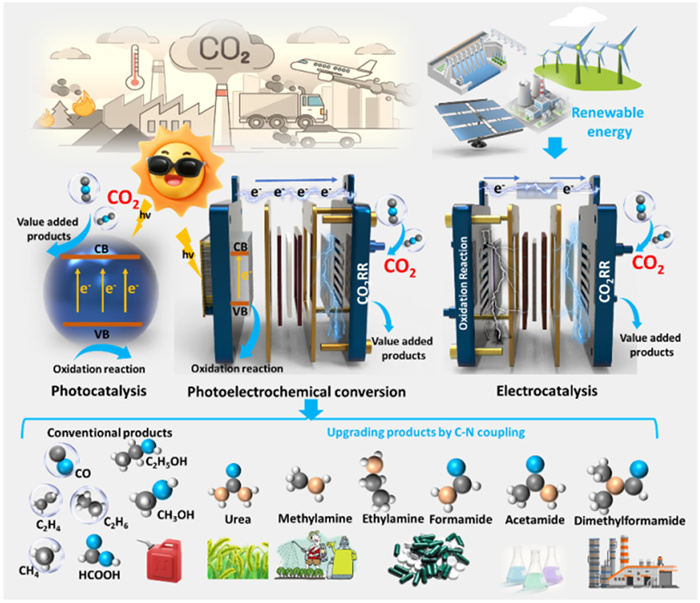
Since Fujishima and Honda first reported the photocatalytic water reduction over TiO2 catalyst [106], researchers have explored derivative systems in which photocatalytic reduction reaction is based on CO2 conversion into value-added chemicals. The process starts with photogeneration of electrons from the valence band (VB) to the conduction band (CB) activated by solar illumination, followed by the reduction of CO2 on the CB, and oxidation reaction on the VB. Although current efficiencies remain low, artificial photosynthesis based on CO2 reduction holds significant promise for future decarbonization [107,108]. Electrocatalytic CO2RR is another innovative technology for CO2 conversion into value-added chemicals, occurring at the cathode of an electrochemical system. When coupled with renewable energy sources such as solar and wind power, it enables the electrosynthesis of chemicals and fuels from CO2 under mild reaction conditions, offering advantages of higher selectivity and activity compared to photocatalytic route [109]. Photo-electrocatalytic CO2 conversion shares similar configuration with electrocatalytic system, except that light is explicitly involved in providing energy from the photoanode to drive cathodic CO2RR more efficiently. It is highly expected that the industrialization of these CO2 conversion technologies could make up the carbon reduction gaps while offering sustainable sources for petrochemical products in the future [110].
CO2 conversion proceeds through multiple pathways involving several electron and proton transfer steps, resulting in a wide distribution of the products. Consequently, the reaction often suffers from low selectivity (low Faradaic efficiency towards certain products), and high energy consumption due to the large potential gap between CO2RR and the coupled oxidation reaction. In photocatalysis, water oxidation on VB as the rate-determining step strongly influences CO2RR on the CB, leading to a low efficiency and poor selectivity of products. In electrocatalysis, the large potential gap between anode and cathode leads to high energy consumption, and it is also challenging but significant to explore a suitable method to decrease the reaction energy barrier and improve the selectivity towards specific products [111]. In photo-electrocatalysis, such a system also suffers from low solar-to-chemical conversion efficiency, rapid recombination of charge carriers, and poor stability of both photosensitive electrodes and electrocatalysts under simultaneous light and electrochemical conditions. These three systems share the common challenges in low product selectivity due to the competing HER, high overpotentials, sluggish multi-electron/proton transfer kinetics, and limited solubility of CO2. The durability of catalysts with large-scale synthesis cannot meet the demand of industrial applications. However, extensive and in-depth research on electrocatalytic conversion of CO2 into chemicals and fuels through C—O, C—N, and C—C bond formation offers numerous anticipated advantages for carbon peaking and neutrality policies [112].
Catalyst design: To enhance the performance of CO2RR, rational design of advanced catalysts is essential. Strategies such as junction engineering, built-in electric fields, and Z-scheme configuration can effectively improve charge-carrier separation, thereby boosting photo-/photoelectrocatalytic performance. In electrocatalysis, the size control, phase engineering, single-atom configuration, crystal engineering, and electronic structure engineering can optimize CO2 adsorption, activate key intermediates, and steer reaction pathways toward desired products. In Fig. 13a, the Ag-Cu Janus nanostructure with (100) facet facilitates *CO spillover from Ag to Cu sites [113], promoting C—C coupling reaction on Cu sites, guaranteeing high selectivity for C2+ products. However, the inability to inexpensively, efficiently, and precisely tune catalyst surface states to suppress surface reconstruction under long-term catalytic conditions remains a perennial challenge in the field.
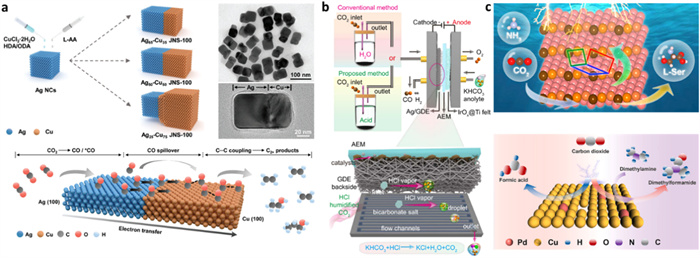
Reactor design: Efficient CO2 conversion requires not only effective catalysts but also optimized mass transport, electrical contact, and product separation [114,115]. Reactor optimization could also significantly bring down the overall cost of these techniques. Photocatalytic systems benefit from slurry reactors for screening and immobilized/structured photoreactors for scale-up, ensuring uniform light distribution and easy product separation. Electrocatalytic performance is boosted by gas-diffusion electrodes and flow cells, overcoming CO2 solubility limits, while zero-gap membrane electrode assemblies minimize ohmic losses and enable high current densities. However, in a flow cell, (bi)carbonate formation strongly hinders the long-term durability test in electrocatalytic CO2RR. As shown in Fig. 13b, introducing acid vapor into the gas-diffusion electrode can effectively prevent salt accumulation, achieving long-term durability of up to 4500 h [114]. The development in reactor design thus paves the platform for large-scale decarbonization in the future. Photoelectrochemical reactors integrate light and electrochemistry, using gas-permeable photocathodes and optofluidic designs for simultaneous photon and reactant delivery.
Valuable reaction design: The low C-products (typically C1 or C2) formed via coupling CO2 with H2O or other proton sources always show limited economic value. Hence, future directions include expanding to the electrosynthesis of value-added chemicals by integrating bond-forming reactions with atoms beyond the common C, H, and O, achieving more valuable utilization of carbon dioxide. For instance, the versatile bonding characteristics of N make it possible to form C—N bonds concurrently with CO2RR, directing CO2 and N precursor to desirable C—N products. As illustrated in Fig. 13c, Che’s group successfully achieved the electrosynthesis of C3+ amino acids from CO2 and NH3 on a chiral Cu film [116]. Similarly, Zou’s team reported an electrocatalytic C—N coupling reaction between CO2 and dimethylamine to produce N,N-dimethylformamide with a high Faradaic efficiency of 37.5% [117]. These representative studies highlight the feasibility of synthesizing desirable, value-added organonitrogen compounds from CO2 by rational reaction design. Notably, such compounds have broad applications in agriculture, pharmaceuticals, and other high-value sectors, distinguishing them from conventional CO2RR products that are primarily utilized as fuels. Compared with traditional C—N bond formation routes, the photo- and electrocatalytic processes consume less energy and yield less pollutants, making these techniques extremely attractive for the industrial applications.
Photo-, electro-, and photoelectro-catalytic CO2RR offer promising strategies to convert CO2 into value-added chemicals, which not only serve as an effective pathway of eliminating gasous carbon in the atmosphere, but also provide more options for getting useful chemicals. Despite significant progress achieved by this technology, there are still many challenges for large-scale applications. Future research should focus on the following aspects: (1) Designing advanced catalysts with high CO2 adsorption and activation capability, facilitating C—C and C—N coupling reaction for C2+ and C—N production. (2) Developing high-performance reactors, such as flow cells, to enhance mass transfer and achieve current densities at the ampere level. (3) Expanding novel reactions to produce high-value products, including amides and amino acids via C—N coupling, beyond conventional C, H, and O as fuel products. The C—N coupling reaction by CO2RR presents a promising approach for the sustainable production of valuable organonitrogen compounds, which are currently generated thermochemically. Further integration with other systems and optimization of reaction conditions will also be important. With continued advances in materials design, characterization techniques, theoretical modeling, and artificial intelligence, CO2RR could achieve transformative breakthroughs shortly. In particular, driven by global carbon neutrality policies and growing market demand, CO2RR holds great promise as a key approach for mitigating CO2 emissions and enabling sustainable chemical production, moving beyond its current role as a primary topic for academic publication.
Bo Weng*
Since the pioneering discovery of photoelectrochemical water splitting on TiO2 electrodes in the 1970s [106], photocatalysis represents a green and sustainable technology for driving chemical reactions using solar energy, with wide-ranging applications in environmental remediation (e.g., degradation of organic pollutants and disinfection) [118], solar fuel production (e.g., H2, CO, CH4) [119], and chemical synthesis. The core of photocatalysis lies in the excitation of semiconductor materials by light to generate electron-hole pairs, which can then participate in redox reactions. In the last five decades, tremendous efforts have been made to develop more efficient and selective photocatalytic materials, including metal oxides (e.g., TiO2, SrTiO3), sulfides (e.g., CdS, ZnIn2S4), nitrides (e.g., g-C3N4), metal-organic (MOF) and covalent organic frameworks (COF) and various heterostructures [120].
While early photocatalysts suffered from low quantum efficiency and poor visible-light response, recent progress in band engineering, heterojunction design, and co-catalyst integration has significantly improved their activity. For example, Domen et al. demonstrate near-unity internal quantum efficiency and up to 96% external quantum efficiency for overall water splitting using a modified SrTiO3: Al photocatalyst with selectively photo-deposited Rh/Cr2O3 and CoOOH cocatalysts [121]. Furthermore, novel concepts such as plasmonic enhancement, defect modulation, and single-atom catalysts (SACs) have been introduced to manipulate charge carrier dynamics and surface reaction pathways [122]. Overall, photocatalysis is emerging as a promising pathway for decentralized, sunlight-driven chemical transformations.
Despite significant advancements, several critical challenges continue to hinder the practical application of photocatalytic technologies [123]. First, most photocatalysts exhibit low solar-to-chemical conversion efficiency and poor quantum yield. This is primarily due to limited light absorption, rapid charge carrier recombination, and suboptimal redox potentials. Second, many photocatalytic processes suffer from poor product selectivity, especially in multi-electron reactions such as CO2 or N2 reduction, where achieving selective conversion to a desired product remains highly challenging. Third, numerous photocatalysts (e.g., CdS, ZnO) are prone to photo-corrosion during catalytic reaction process, significantly limiting their stability and scalability. Fourth, the transition from laboratory-scale research to pilot-scale or industrial applications necessitates the development of cost-effective, long-lasting materials, along with robust photoreactor designs and efficient light management strategies. Addressing these challenges will be essential to fully unlock the potential of photocatalytic technologies for sustainable chemical manufacturing and solar-driven energy conversion.
Recent breakthroughs in photocatalytic materials and system design offer promising routes to tackle the aforementioned barriers (Fig. 14). To improve the charge separation efficiency, the construction of various heterojunctions [124], such as type-ⅱ, Z-scheme, enables effective charge separation and preservation of strong redox potentials. These systems have significantly improved photocatalytic activity for H2 evolution, CO2 reduction, and pollutant degradation. Recently, Yu et al. proposed a new S-scheme heterojunction by which both charge separation and high redox ability can be collectively achieved [125]. Additionally, incorporating single metal atoms cocatalysts into photocatalytic frameworks (e.g., g-C3N4, MOFs) offers atomically dispersed active sites with high selectivity and tunable coordination environments [126]. SACs have shown excellent performance in selective oxidation and reduction reactions. Moreover, engineering defect such as oxygen vacancies, sulfur vacancies, and surface hydroxyls and interface between nanostructured components (e.g., metal/semiconductor) also enhance charge separation and catalytic activity. Morphology control of catalyst materials has been recognized as one of the most promising strategies to enhance photocatalytic performance, since photocatalytic reactions are surface-based processes that are closely related to the morphology and microstructure of the material. For instance, two-dimensional semiconductors have been shown to improve light absorption, shorten electron–hole migration pathways, and provide abundant surface-active sites, thereby significantly promoting overall photocatalytic activity [127].
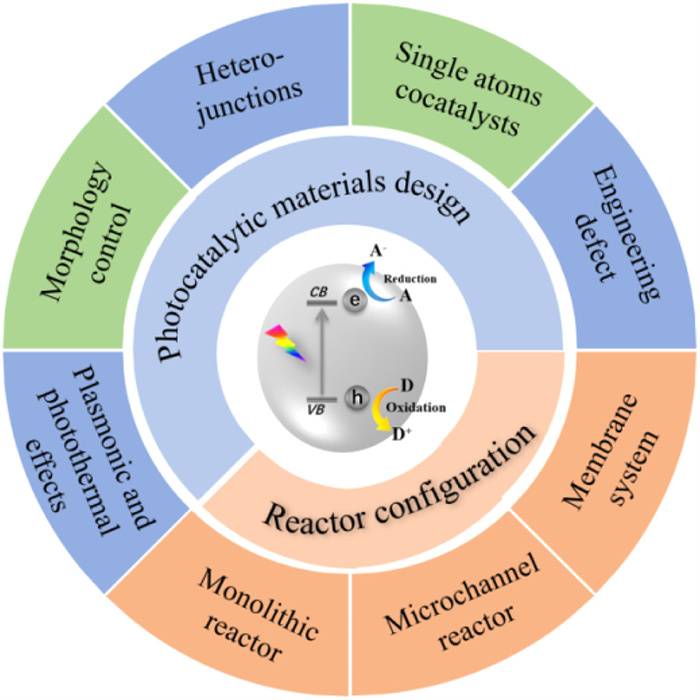
For promoting the light harvesting and reaction kinetics, plasmonic effects and photothermal offer synergistic mechanisms to overcome these limitations [128]. Specifically, plasmonic photocatalysis leverages surface plasmon resonance (SPR) from metals such as Au, Ag, and Cu. When excited by light, these materials generate energetic hot carriers and enhanced local electromagnetic fields [129]. These effects can promote interfacial charge transfer, expand light absorption to the visible/near-infrared range, and even lower activation barriers for key surface reactions. Moreover, photothermal catalysis utilizes solar-induced heating to locally raise the reaction temperature at the catalyst surface. This thermal effect can activate otherwise sluggish reactions, improve mass transport, and modulate reaction selectivity. Notably, materials like black TiO2, MXenes, and carbonized frameworks exhibit excellent solar-thermal conversion capabilities.
Finally, the practical performance of photocatalytic systems depends not only on the intrinsic activity of the catalyst but also on the design and configuration of the reactor [130]. Bridging the gap between academic demonstrations and industrial-scale applications requires integrated engineering strategies. For example, monolithic reactors with immobilized photocatalysts can improve light penetration, facilitate catalyst recovery, and enhance operational stability. Microchannel and membrane-based systems offer superior mass transfer, minimize diffusion limitations, and enable continuous-flow operation, which is critical for scale-up. Moreover, hybrid photothermal–photocatalytic reactors can harness both photonic and thermal energy, providing synergistic effects that enhance overall reaction rates and product yields. These innovations in reactor design are essential to translate lab-scale photocatalysis into viable industrial technologies.
Photocatalytic technologies offer a clean and sustainable approach to driving chemical transformations under ambient conditions, using sunlight as the sole energy input. However, their widespread adoption remains hindered by fundamental and engineering challenges—particularly in solar-to-chemical conversion efficiency, product selectivity, and system scalability. Recent advances in materials science, such as single-atom catalysis, and plasmonic coupling, have significantly enhanced charge separation efficiency and broadened the spectral range of light absorption. Specifically, isolated single atoms that strongly interact with the support can effectively lower interfacial charge-transfer resistance, leading to enhanced charge separation efficiency. In parallel, the integration of photothermal effects and plasmonic enhancement presents promising strategies to accelerate sluggish reactions, enable new selectivity pathways, and harness infrared light that is typically unused in conventional systems. Furthermore, the development of advanced photoreactor technologies, featuring structured catalysts, improved mass transport, and optimized light management, will be essential for translating laboratory-scale success into practical, scalable solutions.
Looking ahead, research efforts should focus on the design of broadband-responsive photocatalysts capable of harvesting the full solar spectrum, guided by artificial intelligence and data-driven materials discovery. Achieving product-specific selectivity through strategies such as site isolation, cocatalyst integration, and engineered reaction microenvironments will be equally critical. In addition, the development of advanced photoreactors for industrially relevant flow systems and the scale-up of production using modular and cost-effective reactor platforms are vital for real-world deployment. Importantly, optimization of the reactor design and chemical process for photocatalytic reactions remains to be explored to achieve greater simplicity and scalability for large-scale applications. With continued interdisciplinary collaboration across materials chemistry, photophysics, and process engineering, photocatalytic technologies are poised to play a pivotal role in achieving carbon neutrality, ensuring clean water, enabling green chemical manufacturing, and supporting decentralized solar energy utilization in the decades to come.
Han Feng*, Junming Hong*, Jing Wu*
Microplastics (MPs), generally defined as plastic fragments smaller than 5 mm, are now ubiquitous in aquatic, terrestrial, and even atmospheric environments [131]. By 2022, global plastic production had exceeded 400 million tons, and >80% of plastics were not properly treated or disposed of after use, thereby exerting profound impacts on the environmental media [132]. Their persistence, bioaccumulation potential, and capacity to adsorb pollutants raise severe ecological and human health concerns [133]. Conventional management strategies, including collection, filtration, or incineration, are largely ineffective at the micro-scale, highlighting the urgent need for degradation-oriented solutions. Current strategies for green degradation of MPs from the environment primarily depend on catalysts capable of generating a variety of reactive oxygen species (ROS), such as advanced oxidation processes (AOPs) and biodegradation processes. Nevertheless, unlike typical dissolved organics contaminants, MPs are orders of magnitude larger in size, rendering early-stage degradation largely confined to surface erosion [134,135]. During this stepwise cleavage, the materials are progressively transformed into less environmentally detrimental species and, under sustained radical attack, are ultimately mineralized into innocuous end products. As a result, complete breakdown is inherently protracted, proceeding through gradual fragmentation into smaller particles by effective ROS, aiming to rapidly and completely degrade MPs, ultimately mineralize them into CO2 and water (Fig. 15).
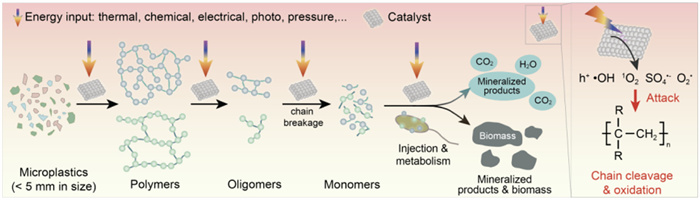
AOPs exploit highly reactive radicals such as hydroxyl (•OH), superoxide (O2•−), and sulfate radicals (SO4•−) to oxidize polymer chains. These radicals possess extremely high redox potentials, enabling them to directly attack polymer chains, thereby inducing chain scission, functional group transformation, and even complete mineralization. Among the various AOP techniques, heterogeneous catalytic approaches such as photocatalysis, persulfate activation, and electrocatalysis are the most extensively investigated [136]. In addition to individual methods, recent research has increasingly focused on the synergistic integration of multiple AOP strategies, such as photoelectrocatalysis or external electric field-assisted AOPs, which can enhance radical generation, improve charge separation efficiency, and ultimately accelerate the degradation kinetics of MPs [137]. These methods typically rely on metal- or nonmetal-based catalysts to accelerate the degradation of MPs. Comparatively, biodegradation leverages enzymatic and microbial pathways to selectively depolymerize plastics. Enzymes such as PETase [138], MHETase [139], and cutinases [140] are capable of cleaving ester bonds in polyesters, generating smaller intermediates that can be further metabolized [141].
Although research on catalytic degradation of MPs is still at an early stage compared with studies on conventional organic pollutants, most state-of-the-art methods exhibit high reactivity or selectivity under well-controlled laboratory conditions. Nevertheless, several critical challenges remain. First, the reaction conditions for efficient MP degradation are often harsh. Photocatalytic methods, while environmentally benign, typically require long irradiation times (e.g., >10 days, Fig. 16a [135]), and the reported studies are largely confined to laboratory setups, leaving their real-world applicability uncertain. AOPs usually take several hours to achieve significant degradation with extra energy (e.g., thermal or electrical energy) input [137,142], whereas biological approaches such as enzyme-mediated catalysis demand even longer timescales (Fig. 16b [134]), sometimes extending to weeks or months [143]. Second, the stability and recyclability of catalysts constitute a major concern. Continuous radical generation under prolonged operation can lead to deactivation, leaching of active sites, or structural collapse of the catalytic material, thereby undermining the long-term performance and economic feasibility.
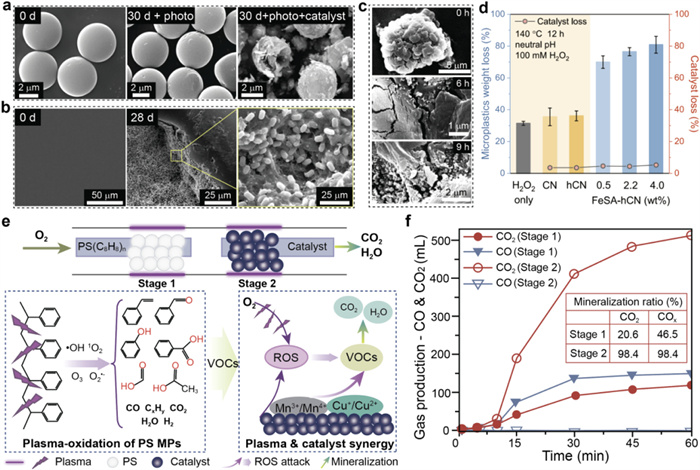
Finally, from a broader perspective, the translation of these methods into practical environmental applications remains highly challenging. The stringent requirements for light intensity, temperature, oxidant supply, or pH adjustment are difficult to replicate in natural aquatic or terrestrial systems. Furthermore, the heterogeneous composition of real plastic waste streams, encompassing diverse polymer types, additives, and environmental foulants, may inhibit catalytic efficiency or induce unpredictable side reactions. Collectively, these challenges underscore that while current strategies demonstrate promising reactivity in controlled conditions, their sustainable deployment in complex, real-world environments will require substantial innovation in catalyst design, process intensification, and system integration.
To address the aforementioned limitations, recent advances in catalytic science, materials engineering, and system design have opened new avenues for more efficient and practical MPs degradation. Rational design of next-generation catalysts is central to overcoming the barriers of reactivity and stability. Atomically dispersed metal sites, defect engineering, and heterostructure construction have emerged as powerful strategies to enhance radical generation while maintaining long-term durability. For instance, 4.0 wt% Fe single-atom decorated hierarchical porous carbon nitride (FSA-hCN) catalysts exhibited not only fast destruction of the surface (Fig. 16c), but retained superior stability over 6 consecutive cycles toward ultrahigh molecular-weight polyethylene (UHMWPE) degradation [132]. The UHMWPE reached a weight loss of about 80.3% in 12 h with the assistance of hydrothermal (140 ℃) conditions upon the addition of hydrogen peroxide (H2O2) (Fig. 16d). Meanwhile, defect engineering and heterostructure architecting normally facilitate charge separation and ROS generation in photocatalysts, improving catalytic efficiency and reducing deterioration of the catalysts. In parallel, bio-inspired enzyme mimics and hybrid catalysts integrating inorganic-biological functionalities are being developed to combine the versatility of natural enzymes with the robustness of inorganic materials.
Beyond single-route catalytic processes, advanced reactor architectures that integrate multiple degradation pathways offer opportunities to achieve synergistic enhancement in MP mineralization. Recently, a plasma-catalyst coupling strategy demonstrated impressive degradation and mineralization efficiency towards PS [144]. In this system (Fig. 16e), plasma oxidation initially functionalizes PS MPs, generating reactive sites and partially oxidized intermediates (Stage 1). Subsequent catalyst-assisted pathways (Stage 2) accelerate ROS generation, enabling efficient chain scission and deeper oxidation, ultimately driving MPs toward complete mineralization into CO2 and H2O. Consequently, plasma oxidation alone yields limited CO2 and CO release, indicative of partial degradation, whereas the integrated plasma-catalyst system substantially elevates CO2 production and achieves mineralization ratios above 98.4% (Fig. 16f). Together, these results highlight that coupling orthogonal degradation mechanisms within a single reactor system is promising to overcome the limitations of conventional processes and provide a viable route toward practical MP abatement. Additionally, inspired by this concept, other hybrid strategies such as the integration of catalyst-driven degradation with enzymatic catalysis [145] have also demonstrated their potential to enhance efficiency and robustness regarding MPs degradation, thereby offering promising avenues for practical applications. These technological advances represent a paradigm shift from isolated methods to multifunctional, integrated platforms that combine efficiency, sustainability, and scalability.
The catalytic degradation of MPs has rapidly emerged as a frontier in environmental remediation, providing a potential pathway to address one of the most persistent forms of pollution. Considerable progress has been made in clarifying degradation mechanisms, engineering advanced catalysts, and integrating physicochemical with biological processes. These efforts have demonstrated that MPs can be fragmented, functionalized, and eventually mineralized under laboratory conditions. However, despite these advances, practical application remains in its infancy. Catalytic and enzymatic strategies still face obstacles, including harsh reaction requirements, catalyst instability, and incompatibility with the heterogeneous nature of environmental matrices.
Future developments should prioritize three directions. First, catalyst design must move toward multifunctional architectures that integrate ROS generation, pollutant resistance, and long-term stability. Defect engineering and atomically dispersed active sites represent promising routes to achieve both efficiency and durability. Second, process intensification through reactor engineering and external-field assistance (e.g., thermal-Fenton catalysis, piezo- or plasma-enhanced catalysis) can accelerate kinetics while reducing energy demands. Third, advances in protein engineering and synthetic biology are opening avenues for engineered enzymes and microbial consortia capable of selective, scalable, and sustainable biodegradation under mild conditions.
At the system level, integration with circular waste management frameworks is essential to ensure complete mineralization and to avoid secondary pollution. Hybrid strategies that combine catalytic degradation with pretreatment or separation steps could further enhance effectiveness in complex environments. Ultimately, the convergence of heterogeneous catalysis, biotechnology, and reactor innovation will be necessary to bridge the gap between laboratory demonstrations and real-world deployment. If successful, these integrated platforms will not only mitigate the environmental risks of MPs but also provide a model for addressing other persistent anthropogenic pollutants, contributing to a more sustainable and resilient future.
Yu Xiao, Guang Liu*
Hydrogen energy, renowned for its high calorific value, environmental friendliness, and renewability, has garnered global attention [146]. In the development and utilization of hydrogen energy, the process encompasses four critical stages: Production, storage, transportation, and application. Among these, hydrogen storage directly impacts the large-scale application of hydrogen energy due to its influence on safety and efficiency. Consequently, developing secure and efficient hydrogen storage methods has become pivotal for advancing hydrogen energy applications [147].
Currently, hydrogen storage primarily relies on two methods: high-pressure gaseous hydrogen storage and cryogenic liquid hydrogen storage. High-pressure gaseous hydrogen storage involves compressing hydrogen gas to pressures ranging from 35 MPa to 70 MPa using compressors and storing it in specialized tanks [148]. While this method is widely adopted due to its technological maturity, cost-effectiveness, and adaptability, it faces challenges such as extremely low storage density (18–19 g/L), high safety risks (e.g., leakage and explosion hazards), and significant energy consumption during compression. Cryogenic liquid hydrogen storage requires cooling hydrogen gas to below −253 ℃ for liquefaction and storing it in ultra-insulated containers [149]. Although this approach achieves higher energy density compared to gaseous storage and enables rapid refueling, it suffers from substantial energy demands during liquefaction (accounting for over 30% of total energy costs), high maintenance expenses due to stringent insulation requirements, and daily evaporation rates of 0.3%–1%, complicating long-term storage.
While both conventional methods have their applications, they are constrained by efficiency and safety bottlenecks. Solid-state hydrogen storage, which utilizes hydrogen-absorbing materials (e.g., metal hydrides), offers a promising solution [150]. This method addresses safety concerns through stable material interactions and enhances storage density by leveraging high surface-area materials or porous structures [151]. For instance, metal-organic frameworks (MOFs) and graphene-based carriers enable reversible hydrogen adsorption with densities exceeding 6.5 wt%. Innovations in phase-change materials (e.g., MgH2 combined with phase-change composites) further mitigate energy losses during hydrogen release, improving system efficiency. In summary, transitioning from gaseous and liquid storage to solid-state hydrogen storage represents a critical step toward overcoming technical barriers and enabling scalable hydrogen energy applications.
Solid-state hydrogen storage materials can be classified into alloy hydrogen storage materials, carbon-based hydrogen storage materials, and complex hydrogen storage materials, etc. [152]. This article takes magnesium-based hydrogen storage materials as an example among alloy hydrogen storage materials to briefly explain the bottlenecks faced by hydrogen storage technology. Although magnesium-based hydrogen storage materials have a high theoretical hydrogen storage capacity (the theoretical value of MgH2 reaches 7.6 wt%), and the global magnesium reserves are abundant, their practical application still faces many challenges.
The main difficulty faced by magnesium-based hydrogen storage materials is the constraint of thermodynamic and kinetic performance [153]. The hydride (MgH₂) itself is relatively stable, which means that its hydrogen release reaction usually requires a temperature above 300 ℃ to proceed effectively; this not only increases the energy consumption of the system but also poses requirements for the high-temperature resistance of the material container. The diffusion and reaction speed of hydrogen atoms in magnesium materials is relatively slow, resulting in poor kinetic performance in hydrogen absorption and release, and a longer time is required to complete a cycle.
The stability and lifespan of the material limit its potential for commercialization. After multiple hydrogen absorption and release cycles, magnesium-based materials may experience particle agglomeration and a decrease in activity [154]. When metallic magnesium is exposed to air, an oxide layer (MgO) is easily formed on the surface, which hinders the dissociation and diffusion of hydrogen molecules, affecting the initial activation performance and subsequent reaction kinetics of the material.
To address the challenges and accelerate the commercialization of magnesium-based hydrogen storage technology, three established approaches have been developed: alloying, nanostructuring, and catalyst doping. Alloying involves introducing elements such as nickel (Ni), copper (Cu), aluminum (Al), and rare-earth elements (e.g., Ce, La) to form intermetallic compounds (e.g., Mg2Ni, Mg2Cu). This process modifies the electronic and crystal structures, weakening the Mg-H bond strength. Consequently, it reduces dehydrogenation temperatures, improves reaction kinetics, and enhances cycling stability, albeit at the potential cost of reduced hydrogen storage capacity [155].
As illustrated in Fig. 17 [156], nanonization represents a pivotal methodology for enhancing the performance characteristics of magnesium hydride. Nanostructuring reduces material particle sizes to the nanoscale, increasing specific surface area and shortening hydrogen diffusion pathways [157]. Nanoscale effects further lower thermodynamic stability, significantly reducing the onset dehydrogenation temperature (to ~200 ℃ or lower), accelerating hydrogen absorption/desorption rates, and decreasing apparent activation energy. Common nanostructuring methods include ball milling (mechanical fracturing), chemical reduction (solution synthesis), vapor deposition, and nanoconfinement (loading onto porous materials like carbon nanotubes or graphene).

Catalyst doping refers to the introduction of catalytic active species that provide reactive sites during hydrogen absorption/desorption, facilitating the dissociation and recombination of hydrogen molecules and lowering reaction energy barriers [158]. This approach can significantly enhance kinetic performance, reduce activation energy, improve conversion efficiency, and prevent particle agglomeration [159]. Its effectiveness is closely tied to the type, size, and distribution of the catalysts. For instance, Wu et al. developed a multilayer Ti3C2 (ML-Ti3C2) catalyst, which reduced the initial desorption temperature of MgH2 to 142 ℃ and achieved a final dehydrogenation capacity of 6.56 wt%, demonstrating outstanding performance [160]. Similarly, Lu et al. synthesized an N/S-Nb2CTx catalyst that markedly improved the de/hydrogenation kinetics and cycling stability of MgH2 [161]. Fig. 18 illustrates its catalytic mechanism.

Solid-state hydrogen storage, particularly magnesium-based materials, has emerged as a pivotal solution to overcome the limitations of traditional gaseous/liquid hydrogen storage, owing to its high theoretical capacity (7.6 wt%) and inherent safety advantages. However, challenges such as high thermodynamic stability (dehydrogenation typically requires >300 ℃), sluggish kinetics, and cycling degradation must be addressed. The synergistic integration of alloying, nanostructuring, and catalyst doping is critical to tackling these issues. Future efforts should focus on multi-strategy optimization (e.g., combining material design with system-level engineering), in-depth exploration of reaction mechanisms, and performance enhancement through advanced characterization. Concurrently, advancing cost-effective large-scale production and developing long-lasting anti-oxidation coatings will accelerate the commercialization of magnesium-based hydrogen storage in applications such as vehicle-mounted energy systems and distributed power grids. This progress will ultimately pave the way for a hydrogen-driven, low-carbon future.
Linlin Song, Rongzheng Ren*, Zhenhua Wang
Fuel cells, as a cornerstone technology in achieving carbon neutrality, offer a clean and efficient pathway to energy conversion by directly transforming chemical energy into electricity with water as the only byproduct [162]. Among these, solid oxide fuel cells (SOFCs) stand out due to their unique working principle: oxygen ions migrate through a solid electrolyte to oxidize fuel at high temperatures (400–800 ℃), generating electricity through electrochemical reactions. This mechanism grants SOFCs unparalleled advantages, including an all-solid-state structure eliminating liquid electrolyte corrosion, high fuel utilization rates (>80%), and broad fuel adaptability capable of processing hydrogen, hydrocarbons, and even biogas [163]. Despite significant progress in cell efficiency and durability, the industrial scalability of SOFC hinges on breakthroughs in key materials and critical technologies. This roadmap focuses specifically on commercially viable material innovations and technological breakthroughs for SOFCs, providing a strategic guide for researchers, policymakers, and industries to accelerate scalability and commercialized deployment, ultimately contributing to sustainable energy systems.
The core components of a single SOFC include a dense electrolyte, porous cathode, and porous anode, with the dense electrolyte sandwiched between the porous cathode and anode to form a tri-layer structure (Fig. 19). Interconnects, as critical components in the stack assembly process, enable the series/parallel connection of multiple single cells to achieve higher output voltage and power in practical applications [164].
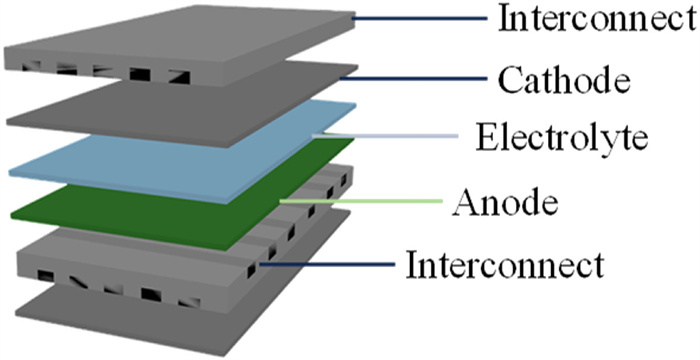
The electrolyte plays a central role in oxygen ion conduction within SOFCs, with its performance directly determining cell efficiency and stability. The primary electrolyte materials in use today are yttria-stabilized zirconia (Y0.08Zr0.92O1.96, YSZ) and gadolinium-doped ceria (Gd0.1Ce0.9O1.95, GDC) [165]. YSZ remains the benchmark electrolyte owing to its exceptional ionic performance, but its performance is constrained by the need for high-temperature operation and potential chemical interactions with cathodes. GDC exhibits superior ionic conductivity at lower temperatures but suffers from electronic leakage, resulting in output voltages below theoretical values. Advancing electrolyte materials requires a concerted effort to achieve higher ionic conductivity and enhanced interfacial compatibility. The bilayer composite electrolyte design, exemplified by YSZ (anode side)-GDC (cathode side), offers a scalable strategy to transcend current performance ceilings [166].
Cathodes serve as the primary active sites for oxygen reduction reactions (ORR). Perovskite-type oxides La0.6Sr0.4Co0.2Fe0.8O3-δ (LSCF) stands out as the most commercially mature cathode material for SOFCs. The mixed ionic-electronic conductivity of LSCF facilitates ORR active site formation across the entire cathode surface, thereby achieving superior catalytic activity. However, LSCF cathodes suffer from performance degradation due to alkaline earth metal segregation during prolonged operation, chromium vapor-induced oxygen vacancy disruption from interconnects, and carbonate formation by surface reactions with impurity gases (e.g., CO2) [167]. Fundamental breakthroughs of LSCF require defect-level segregation analysis, atomic-scale doping engineering, chromium diffusion barrier design based on interface thermodynamics, and surface chemistry modifications for simultaneous carbonate prevention and oxygen pathway optimization.
The anode in SOFCs serves functions of fuel oxidation, necessitating materials with high catalytic activity and carbon resistance. Ni-YSZ remains the most widely used anode material thanks to nickel’s excellent catalytic performance and economic advantages, though it suffers from sulfur poisoning and carbon accumulation issues [168]. For industrial SOFC systems, Ni-YSZ development must prioritize scalable steam ratio control systems, cost-effective internal reforming catalysts, and compact external reformer designs to ensure long-term carbon-free operation.
Interconnects, as essential conductive components in SOFC stacks, simultaneously facilitate current collection and ensure effective separation between fuel and oxidant streams. The current interconnect material landscape presents a dichotomy between two principal options: chromium-based alloys like Crofer 22 APU, which dominate the market due to their superior conductivity and cost-effectiveness but suffer from detrimental Cr2O3 layer formation at elevated temperatures [169]; and perovskite ceramics such as doped LaCrO3, which demonstrate excellent oxidation resistance yet grapple with intrinsic limitations in mechanical fragility, sinterability, and processability. While emerging alloy interconnects show particular promise for low-temperature SOFC applications, achieving commercial viability requires overcoming critical challenges in chromium volatilization mitigation and optimizing the delicate balance between electrical conductivity and long-term durability [170].
Achieving highly consistent, large-scale production of single cells represents the most critical challenge for SOFC commercialization. Current industrial-scale fabrication methods primarily employ tape casting, spraying, or extrusion techniques. For these processes, maintaining strict control over critical parameters, including uniform membrane thickness, precise porosity regulation, high densification, and robust interfacial bonding, is essential to ensure reproducible electrochemical performance and long-term stability [171]. In addition, multi-layer co-sintering processes are being continuously optimized to enhance cost-effectiveness and production throughput [172,173]. However, large-area SOFC cells still face significant limitations from sintering shrinkage, warpage, and defect control. These technical barriers highlight the urgent need for breakthroughs in process control methodologies and microstructural engineering.
During SOFC stack integration, the coupled optimization of flow distribution, thermal management and mechanical stress is pivotal to attain high power density and long-term durability [174]. This requires a holistic design strategy encompassing gas-flow architecture, thermal-stress mitigation, sealant compatibility, and current-collection pathways so as to avert local hot spots, gas leakage, and stress concentration, accelerating degradation. To achieve conformity with this requirement, the dominant SOFC stacks are typically designed in planar, tubular and flat-tube (Fig. 20). Planar designs enable high power density and straightforward modular assembly; tubular cells provide exceptional gas tightness and superior thermal-cycling resilience; while flat-tube configurations partially reconcile the strengths of above. Progress in structural innovation, which coupled with advances in precision manufacturing, remains the decisive route to overcoming the integration bottlenecks that limit large-scale SOFC deployment.
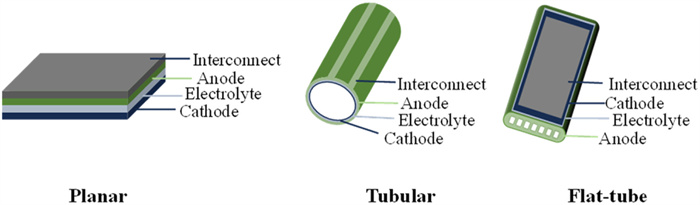
To accelerate the scale development of SOFCs, two strategic approaches can be implemented. The first involves leveraging artificial intelligence and machine learning to design advanced electrolytes with superior ionic conductivity and develop robust electrodes, thereby significantly improving both performance and durability. The second approach focuses on integrating cutting-edge precision manufacturing technologies to optimize co-sintering processes and meticulously control the microstructure of individual cells. These methodologies together address critical technical barriers and pave the way for industrial-scale SOFC development.
Long Kong*
Lithium batteries have aided the portable electronics revolution in recent years [175]. The emergence and dominance of lithium batteries in these fields are due to their high energy density compared to other rechargeable battery systems, enabled by the design and development of high-capacity electrode materials and appropriate voltage. Improving the energy density of batteries lies in exploring new electrode combinations and optimizing the electrolyte compositions [176]. Common cathode materials fall into two categories: intercalation and conversion. Among them, intercalation cathodes (e.g., LiCoO2, LiFePO4, LiMn2O4, and layered ternary oxides) are the mainstream of commercialized lithium batteries. Their working mechanisms rely on lithium ions reversibly inserting/extracting into/from the crystal lattice during charge and discharge while the host structure remains essentially stable, undergoing only slight lattice expanding and shrinking, without significant phase reconstruction. Conversion electrodes experience a redox reaction during lithiation/delithiation, in which the crystalline structure normally needs profound changes, accompanied by the breaking and recombining chemical bonds [177]. Lithium batteries based on intercalation mechanism cannot meet up with the growing demand of energy density (>300 Wh/kg) required for particular applications. It is therefore motivated researchers to engage immense efforts in conversion battery chemistries, such as Li–sulfur, Li–air, Li–CO2, and solid-state batteries with Li metal anodes [178].
The energy density (electricity storage per unit mass/volume) and working voltage (potential difference between positive and negative electrodes) of lithium batteries have a synergistic yet restrictive relationship. Both are determined by the electrochemical properties of the positive and negative electrode materials and need to be reasonably matched to achieve the best performance. From a chemical perspective, the working voltage of a battery is the difference between the redox potential of the cathode and the redox potential of the anode. Principally, the high energy density of a battery requires high capacity of cathode and anode, as well as large voltage gaps. Practically, the electrochemical windows of both materials need to be compatible, and their structural stabilities must be well tailored to guarantee other criteria, such as working/shelf life, safety and power density.
A practical battery to power devices is a quite complex system, demanding assembly of individual cells into module, and finally into pack [179]. This sequential cell assembly provides another route to increase overall energy density of a battery beyond electrode materials: optimizing structure on cell, module and pack structure (Fig. 21) [180,181]. The cell is the “smallest energy carrier” in a battery system, the fundamental unit for energy generation and storage. Just like the basic building blocks of a battery, it only stores and releases electrical energy through electrochemical reactions, serving as the energy source for the entire battery system [182]. A module is an energy unit whose core function is to integrate individual cells, solving the problem of how to combine small-capacity cells into a medium-capacity unit. It has no independent control or safety system and cannot directly power equipment [183]. The main role of a module is to integrate cells, increase energy density, and protect against collision damage. A battery pack is a functional system whose core role is to convert modules into safe, controllable electrical energy. Through the coordination of the BMS, thermal management, and safety components, it directly matches the power-supply requirements of the end device.
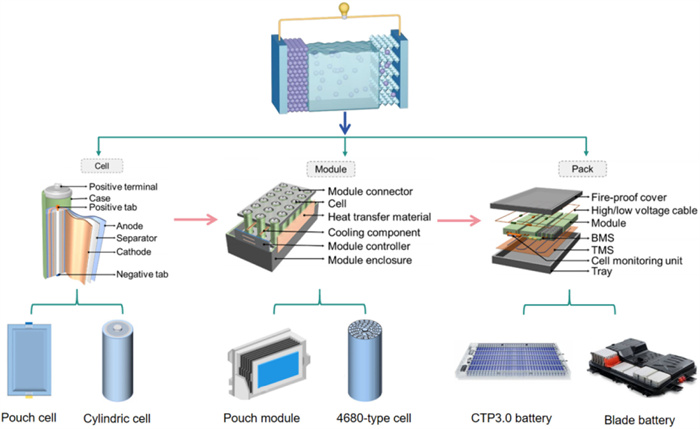
The advent of electric vehicles and the expanding integration of renewable energy sources have substantially increased the requirement for batteries with high storage capacity and superior spatial efficiency. In the battery pack integration, any additional parts incorporated in battery will decrease the battery pack energy density, which inspires battery manufacturers to simplify cell, module and pack structure without compromising other functions. A famous strategy currently been pursued is the 4680-type cylindrical cell proposed by Tesla. The 4680-type cylindrical cell features tab-free structure, which directly uses conductive materials at both ends of the cell to deliver electric current.
At the pack level, several battery modules are integrated into a large housing and supplemented by electrical contacts, a battery management system, and a system for thermal conditioning, as well as other devices. The cell-to-pack (CTP) concept, in other words building the cells directly into the battery pack without modules, has become established as a promising technology in order to increase the energy density at the pack level. A successful example is a so-called blade battery demonstrated by BYD, which enhances CTP integration efficiency [184]. This novel CTP design bypasses the battery module and directly integrates the blade battery into the battery pack, thereby eliminating the module-related components. Another successful example is the CTP 3.0 battery demonstrated by CATL, where the cells are directly arranged in “large-sized modules” without traditional module shells, which enhances the integration efficiency of the battery. Such a battery pack design ensures that the energy efficiency from cell to pack meets the requirements of the electric vehicle battery development roadmap [185]. In the future, it will develop towards high integration, intelligence and adaptation to diverse scenarios, with broad prospects.
With the increasing demand for energy storage, rechargeable batteries designed for operation under extreme conditions must demonstrate durability and safety. The widespread popularity of large-scale electrochemical energy storage systems has brought great convenience to daily life. Especially under extreme conditions, battery systems face unprecedented challenges. High energy density and working voltage have become the core elements to ensure their stable operation. High energy density enables batteries to store more electrical energy within a limited space, effectively meeting the long-term power supply demands in extreme environments [186]. Whether in polar research equipment operating continuously at temperatures dozens of degrees below zero, or in space probes traversing the vast expanse of deep space, batteries must deliver substantial energy capacity within compact volumes. On the other hand, the high working voltage provides an enough power supply for the equipment, facilitating the efficient operation of complex instruments and ensuring that key functions such as signal transmission and data processing are not affected by extreme environments. This stable and powerful output enables various devices to push the performance boundaries under challenging conditions.
The application of lithium batteries in extreme conditions (high temperature, low temperature, high pressure/deep sea and high humidity, etc.) does not rely on a single technology (Fig. 22). Instead, it requires meeting five core conditions: material compatibility, structural design, protection process, management system, and environmental compatibility [187]. Through multi-dimensional technological collaboration, it ensures the safe, stable, and long-term operation of batteries in extreme environments. In high-temperature scenarios such as deserts, tropical outdoor areas, and industrial high-temperature equipment, lithium batteries have to confront challenges such as continuous high temperatures, large temperature differences between day and night, and strong solar radiation. The core lies in addressing issues such as electrolyte decomposition, thermal runaway, and capacity attenuation through three dimensions: material temperature resistance optimization, structural heat dissipation protection, and intelligent system regulation. Under low-temperature conditions, lithium batteries provide a stable and reliable power core for equipment operating in extreme environments such as polar and high-altitude regions, owing to their high energy density, lightweight design, and superior low-temperature performance [188]. This ensures the successful execution of missions in these challenging settings.
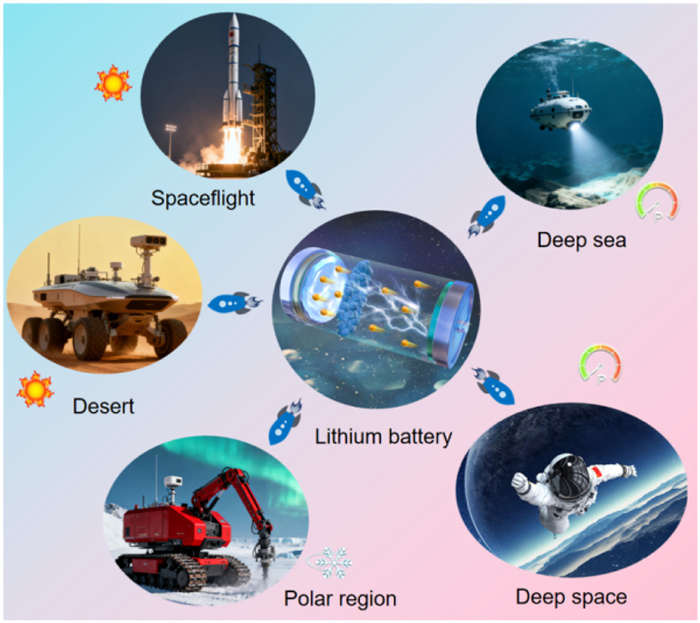
Lithium batteries can operate stably and reliably in deep-sea high-pressure environments due to their high energy density, strong pressure resistance suitable for deep-sea conditions, high safety designed for extreme conditions, and long battery life. Therefore, they are suitable for application in this scenario. Besides, they often serve as a stable and continuous power source for rocket ignition, missiles, and individual soldier equipment, and are a crucial energy source in the fields of military and aerospace [189]. Therefore, in extreme environments, lithium batteries are continuously enhancing their reliability in low temperatures, high temperatures, low pressures, and military applications through material innovation and system optimization. In the future, they will become indispensable energy cores in cutting-edge fields such as deep space, deep sea, polar regions, and aerospace.
In the future, lithium battery materials and technologies will advance in a coordinated manner along the “material-structure-scenario” path. In terms of material chemistry, in addition to optimizing ternary and lithium iron phosphate cathodes and graphite anodes, the large-scale production of silicon-based anodes and the industrialization of solid electrolytes will be accelerated to enhance electrochemical performances and safety. The structural design, from cell to pack, will achieve the integration of thermal management, safety protection and energy consumption optimization through modular design and intelligent BMS. Extreme condition applications rely on material modification and structural strengthening to break through limitations such as high and low temperatures and extend to deep space exploration and polar scientific research. The three mutually empower each other, driving lithium batteries from performance improvement to reliable application in all scenarios.
Yixuan Chen, Huaifang Shang*, Jianmin Ma*
Layered transition metal oxide cathode materials are widely employed as cathodes in high-energy-density lithium-ion batteries. Currently, commercial cathode materials such as lithium cobalt oxide (LiCoO₂), lithium iron phosphate (LiFePO4), and lithium manganese oxide (LiMn2O4) exhibit their respective advantages. However, their discharge capacities fall below 200 mAh/g, resulting in relatively low energy densities that fail to meet current market demands for high-capacity cathode materials [190]. Although nickel-cobalt-manganese (NMC) or nickel-cobalt-aluminum (NCA) ternary layered cathode materials can enhance energy density by increasing nickel content [191], elevated nickel levels intensify surface reactivity. This promotes oxygen generation through reactions with electrolytes, consequently exacerbating thermal runaway risks and compromising cycling stability. Lithium-rich manganese-based layered cathode materials Li[LixNiyCozMn1-x-y-z]O2 (LRMS) are regarded as one of the most promising candidates for next-generation high-energy-density battery cathodes [192-195]. This is attributed to the simultaneous involvement of both transition metals and oxygen in electrochemical redox reactions, enabling an exceptional discharge capacity exceeding 300 mAh/g and a high energy density of ~1000 Wh/kg.
However, anionic redox reactions represent a double-edged sword: While delivering high capacity, they concurrently induce critical drawbacks such as voltage decay and voltage hysteresis. These phenomena progressively diminish the overall energy density of batteries and complicate state-of-charge (SOC) estimation in battery management systems for electric vehicles. The primary cause of voltage decay is attributed to the progressive layered-to-spinel-like phase transformation driven by manganese ion migration during cycling. This structural evolution results in continuous voltage reduction from ~3.4 V to a distinct discharge plateau at 2.8–3.0 V [196]. Voltage hysteresis stems from transition metal ion migration into tetrahedral sites during cycling. This migration alters the energy landscape of lithium insertion sites-a thermodynamic origin for differing charge/discharge paths [197]. Despite diverse interpretations, both voltage decay and hysteresis are fundamentally linked to the ordered honeycomb-type LiM6 superstructure. Consequently, charge-transfer response modes inherent to this superstructure pose persistent scientific challenges impeding practical implementation.
To address these challenges, extensive modification strategies and mechanistic studies have been conducted. Although surface coating and elemental doping can elevate the oxygen evolution energy barrier and partially suppress voltage decay, their long-term cyclability improvements remain limited. Transforming the oxygen stacking configuration from O3 to O2 fundamentally alters the octahedral connectivity [198]. In O2-type structures, edge-sharing MnO6-LiO6 octahedra transition into face-sharing configurations (Fig. 23a). This geometric rearrangement creates direct electrostatic repulsion between central Li ions in lower-layer LiO6 octahedra and Mn ions in upper-layer MnO6 octahedra, effectively blocking Mn migration into lithium sites-currently recognized as the most effective approach for enhancing oxygen stability and mitigating voltage decay. Further breakthroughs involve constructing ribbon-shaped superstructures, which prevent structural rearrangements during charge compensation by anions [199], which eliminates voltage hysteresis (Figs. 23b and c). Collectively, these modifications enable higher energy density, improved efficiency, and enhanced stability-key requirements for commercial viability.
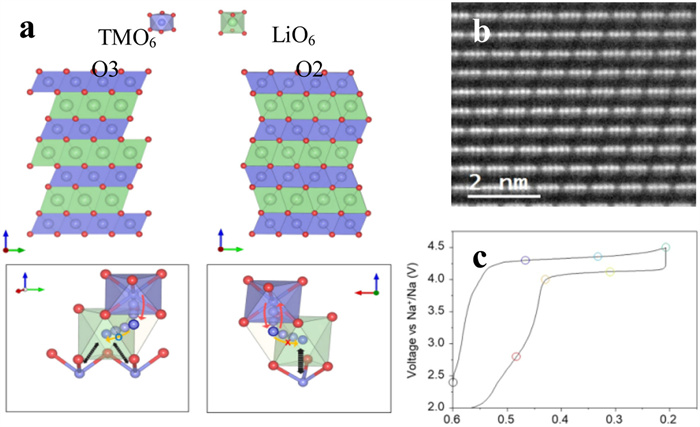
LRM represents a highly promising approach for next-generation high-specific-energy lithium-ion batteries, demonstrating significant commercial and environmental viability. However, voltage decay and hysteresis issues must be effectively mitigated to fully realize their potential. Surface coating and modification technologies have yielded encouraging progress in enhancing both the capacity and cycling stability of these cathodes. Furthermore, research on novel Mn-based superstructures has demonstrated substantial suppression of voltage decay and hysteresis, positioning them as a leading future trend in lithium-ion battery cathode development.
Lihua Wang, Yongzhi Chen*, Changjie Ou*
Sodium-ion batteries (SIBs) have found applications in low-speed vehicles, and energy storage [200-203]. The anode material is a critical component for energy storage and conversion in SIBs, directly influencing their application scenarios. Hard carbon (HC) is particularly promising. The sodium storage modes and mechanisms for different HC remain controversial and not fully unified. Recognized sodium storage modes primarily include: Na+ insertion into layered structures, adsorption at defects (such as atomic vacancies, edge sites, and heteroatoms), and filling within pore structures (closed and partially open pores). HC prepared from precursors such as resins, carbohydrates, biomass and their mixtures have been demonstrated to be explained by these proposed mechanisms. HC synthesized from different precursors exhibit distinct sodium storage mechanisms and varying electrochemical performance. For instance, resin-based HC demonstrates a reversible specific capacity of 480.3 mAh/g and an initial coulombic efficiency (ICE) of 84.6% likely due to its highly tunable and defect-rich structure [204]. In contrast, lignin-based HC demonstrates a reversible specific capacity of 338 mAh/g with an ICE of 87% which can be attributed to its mechanism that includes filling in its inherent pore structure [205].
The microstructure of HC is a key factor influencing its electrochemical performance. Firstly, the amorphous structure of HC determines the low electronic conductivity, leading to poor rate performance. Secondly, a large interlayer spacing reduces the insertion energy barrier and diffusion energy barrier of Na+, facilitating the storage and diffusion of Na+. Furthermore, defects and functional groups in HC can adsorb a relatively large amount of Na+. Finally, the pore structure is also a key factor influencing the electrochemical performance of HC [206]. Therefore, optimizing the microstructure of HC to synergistically enhance the exertion of their overall electrochemical performance directly relates to the practical application scale of HC.
Since the discovery that HC can be used as an anode material for SIBs, numerous preparation methods and process parameters have been extensively studied. A primary focus of this research has been to establish the governing rules linking these preparation strategies to the resulting microstructure, electrochemical performance, and sodium storage mechanisms of hard carbon. For HC, the primary electrochemical performance parameters we typically focus on include: Reversible specific capacity, ICE, rate capability, and cycling performance. Among these, reversible specific capacity and ICE are the most critical indicators.
Advanced preparation methods and modification techniques can yield HC exhibiting high reversible specific capacity and ICE. For example, HC prepared by CVD has demonstrated a reversible specific capacity as high as 457 mAh/g with an ICE of 90.6% [207]. Furthermore, pyridinic N-doped hard carbon combined with carbonyl groups and carbon nanotubes can synergistically enhance the ICE to as high as 98% [208].
The amorphous structure of HC is a key factor contributing to slow Na+ diffusion kinetics and poor rate performance. Therefore, enhancing the Na+ diffusion rate is an effective approach to improve rate capability. Modified HC obtained through a zinc oxide etching method increased the Na+ diffusion coefficient by two orders of magnitude (≈10−7 cm2/s), achieving a reversible specific capacity of 107 mAh/g at a current density of 50 A/g [209]. Optimizing the pore structure of HC can also significantly enhance rate performance. Experiments show that with a closed-pore size of 1.08 nm, the capacity retention after 3000 cycles at 6.5 C is 83%; whereas with a pore size of 1.26 nm, the retention drops to 60%. Molecular dynamics calculations indicate that when the pore volume ratio reaches 50%, Na+ migration completes within 18 ps; two Na+ ions can form a dipole and migrate within 1–3 ps [210]. Additionally, expanding the interlayer spacing, applying a conductive surface coating, and optimizing the electrolyte composition can effectively enhance the rate performance of HC.
The cycling performance of HC directly determines the lifespan of SIBs. Increasing the number of closed-pore structures can significantly enhance the cycling stability of SIBs. Hou et al. employed a cation/anion co-interference approach to prepare phenolic resin-based HC with abundant closed-pore structures. Research indicates that the modified phenolic resin-based HC exhibits sodium storage mechanisms-surface adsorption-intercalation-pore filling, significantly improving the cycling performance of HC. After 5000 cycles at 1 A/g, the material maintains a capacity retention rate as high as 95.7% [211].
The synergistic strategy of ultramicroporous structure (≈0.6 nm) and N/P doping is also recognized as effectively enhancing the cycling performance of HC. The ultramicroporous structure is believed to confine Na+ within the pores while effectively preventing the entry of large solvent molecules. N/P doping significantly increases the Na+ adsorption capacity of HC and enhances the diffusion rate of Na+ within it. By leveraging the synergistic strategy of ultramicroporous structure and N/P doping, HC with outstanding cycling performance was achieved (≈94.6% capacity retention after 10,000 cycles at 10 A/g) [212].
Currently, through rational control strategies, the individual electrochemical performance of HC can be effectively improved. However, determining how to synergistically optimize all the electrochemical performance parameters of HC remains a significant challenge for researchers.
Developing HC with outstanding comprehensive electrochemical properties-such as high capacity/ICE, high rate capability, and long cycle life, is fundamental for advancing these materials from laboratory research to large-scale commercial applications. Currently, a wide variety of precursors are available for preparing HC. However, both preparation techniques and modification strategies significantly influence the microstructure of HC (including pore structure, defects, functional groups). This inevitably leads to substantial variations in the electrochemical performance of different HC. For instance, when phenolic resin is carbonized at 900 ℃, the resulting HC exhibits a high degree of defects and a low number of closed-pore structures. The corresponding first-cycle reversible specific capacity and ICE are 272 mAh/g and 77%, respectively. However, as shown in Fig. 24, the graphitization degree of the HC markedly increases, and the number of closed-pore structures significantly rises when the carbonization temperature is 1500 ℃. The corresponding reversible specific capacity and ICE are 403 mAh/g and 93%, respectively [213].
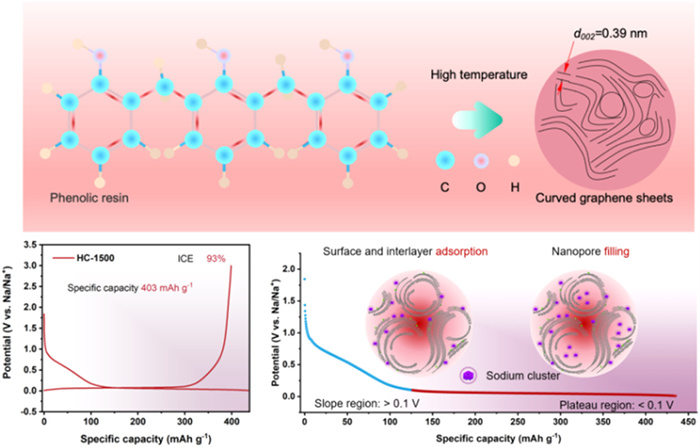
In recent years, advanced characterization techniques and computational materials methods have been increasingly applied to investigate the microstructure and sodium storage mechanisms of HC. The application of in-situ techniques such as XRD, TEM, XAFS [214], and EIS has deepened our understanding of sodium storage mechanisms and interfacial reaction processes. The implementation of methods like density functional theory (DFT) has provided atomic-level insight into the diffusion kinetics and thermodynamics of Na+. The application of these novel methods provides crucial practical and theoretical support for the structural design of HC and the clarification of its sodium storage mechanisms. For example, Substitution Index-Prediction Rules can forecast the theoretical sodium storage capacity based on precursor characteristics [215], offering theoretical guidance for fabricating high-performance HC. Therefore, the challenge of establishing a quantitative structure-property relationship between precursors, preparation techniques, storage mechanisms, and electrochemical performance through these advanced methods to rationally design the optimal high-performance HC represents a critical scientific challenge that researchers must address.
HC demonstrates significant application potential in transportation and grid-scale energy storage due to its abundant raw material supply, low production costs, and compelling electrochemical performance. However, the microstructure of HC-which is critically influenced by the precursor materials and preparation processes-varies considerably, leading to significant disparities in electrochemical properties across different materials. Consequently, enhancing the performance of HC hinges on a precise understanding of the sodium storage mechanism to enable the targeted optimization of their microstructure. The primary goals of this optimization are to improve key metrics: Reversible specific capacity, ICE, rate capability, and long-term cycling stability, etc. While HC derived from precursors such as phenolic resins, bamboo, coconut shells, and reeds have progressed from laboratory research to industrial production, their current production costs and overall electrochemical performance still do not fully meet commercial expectations. Therefore, the paramount challenge for researchers is to develop methods for the precise control of HC's microstructural properties to manufacture low-cost, high-performance anodes. Solving this challenge is a crucial prerequisite for advancing the large-scale commercialization and application of SIBs.
Huijun Yang*, Xiaoyu Liu, Jin Yi*
Since the seminal invention of the first aqueous Voltaic Pile in the late 18th century, aqueous battery technologies have achieved considerable commercial success, exemplified by the widespread adoption of lead-acid batteries for automotive and stationary applications, and alkaline dry cells for portable electronics [216]. In contemporary energy storage landscapes, aqueous battery technologies have experienced a profound re-emergence, positioning themselves as a compelling alternative to conventional non-aqueous lithium-ion batteries. It is fundamentally driven by the intrinsic safety, cost-effectiveness, and environmental benignity [217]. Furthermore, the inherently high ionic conductivity of aqueous electrolytes facilitates fast charge and discharge rates. Presently, the development of aqueous battery technologies is predominantly defined by aqueous flow batteries, aqueous lithium/sodium-ion batteries and aqueous zinc batteries.
Flow batteries represent a sophisticated class of energy storage systems to decouple power and energy capacities. Among these, vanadium redox flow batteries (VRFBs) stand as the most commercially developed. Their inherent design offers a high safety characteristics, including non-flammability, and demonstrates an impressive cycle life over 10,000 cycles. However, the widespread adoption is primarily constrained by the high material cost of vanadium and challenges of electrolyte crossover through the ion-exchange membrane.
Aqueous lithium/sodium-ion battery also attracted attention, especially in “mildly concentrated” or “water-in-salt” electrolytes. The common dilute aqueous solution has a very narrow theoretical electrochemical stability window of 1.23 V, limiting the selection of electrode materials. By increasing salt (anion) concentration, the robust interaction between anion-water strongly reduced the water activity and extends the electrochemical windows above 3 V [218,219]. However, the difficulty in attaining energy densities that are fully competitive with their non-aqueous counterparts. Moreover, ensuring long-term electrochemical stability without appreciable electrolyte degradation or active material dissolution remains a critical area of ongoing research and development.
Aqueous zinc batteries (AZBs) have garnered substantial research attention and zinc (Zn) serving as an ideal anode material for sustainable and economical battery systems. Diverse cathode materials including manganese dioxide (MnO2), various vanadium oxides (e.g., V2O5), and Prussian blue analogs have been rigorously investigated. Among these, MnO2 has emerged as a promising candidate, owing to the high specific capacity and low cost. Nevertheless, the application of AZBs is currently impeded by several technical challenges including Zn dendrite formation, ongoing Zn passivation formation and dissolution of cathode materials.
The development of all-vanadium redox flow batteries (VRFBs) is no longer focused solely on deployment but on enhancing their performance and reducing costs. Firstly, it is essential to maximize the concentration of active materials to minimize the electrolyte volume required for a given energy-storage capacity. Unfortunately, this approach is constrained by the solubility limits of vanadium. Significant efforts are dedicated to pursuing a highly stable electrolytes with high concentrations, which involves regulating solvation shell structure of hydrated vanadyl ion, proton concentration and increasing temperature, and so on. Secondly, the current collectors for anode and cathode in vanadium redox flow batteries also have a significant impact on the electrode loading and battery energy density. Typical carbon-based materials, such as carbon or graphite felts, carbon black, carbon cloth and graphite powder, suffer from poor wetability. The intentional introduction of oxygen (O-), sulfur (S-), nitrogen (N-) or phosphorus (P-) could drastically enhance electrocatalytic activity for the V2+/V3+ and VO2+/VO2+ redox couples. Introducing metals and metal oxides to carbon-based materials is an efficient way to enhance the hydrophilicity of electrodes. Metal species alter the surface charge distribution and strengthen electrode-electrolyte binding, enhancing wettability and ion transport. Beyond the vanadium system, the quest for lower cost and higher energy density has spurred the development of alternative chemistries. Water-soluble organic molecules (e.g., quinones, viologens, TEMPO derivatives) have witnessed revolutionary progress. For instance, zinc-organic hybrid flow batteries have demonstrated exceptional cycling performance, leveraging advantages like elemental abundance, high molecular tunability, and potentially very low cost.
As for the aqueous lithium/sodium-ion battery, the innovative concept of “water-in-salt” electrolytes (WiSE) or namely hydrate melt, has been widely adopted, significantly expanding their practical electrochemical stability windows (>3 V) [218,219]. As the salt-to-solvent ratio increases, a larger proportion of free water molecules and anions become incorporated into the cation solvation shells. This reduces the coordination number of water and ultimately leads to the formation of an anion-dominated solvation structure (Fig. 25a). The improved oxidation stability can be attributed to the coordination of water molecules with cations (Figs. 25b–d), which stabilizes the lone-pair electrons on oxygen. As for the enhanced reduction stability, Suo et al. attributed it to the formation of a protective solid-electrolyte interphase (SEI), which suppresses water decomposition [220]. This process is preceded by a shift in the lowest unoccupied molecular orbital (LUMO), which governs reduction behavior, from water molecules to fluorine-containing anions in the concentrated electrolyte (Figs. 25e–g).
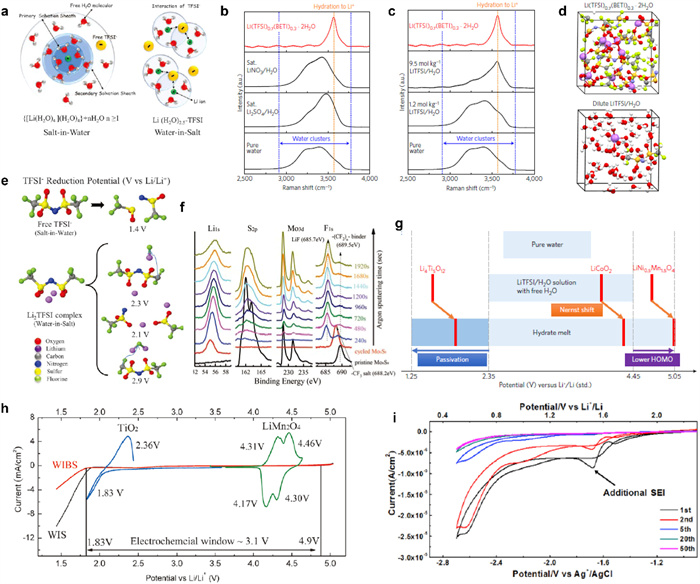
The “water-in-bisalt” (WIBS) strategy has been developed to further break their inherent solubility of sole salt [221]. The incorporation of a supporting salt further reduces the number of free solvent molecules via enhanced coordination effects, significantly widening the electrochemical window of the electrolyte (Fig. 25h). Moreover, salts with asymmetric anions generally demonstrate higher solubility due to the greater vibrational mobility and structural flexibility of their anions. This principle facilitates the formulation of ultrahigh-concentration electrolytes. Moreover, the introduction of organic solvents was employed to mitigate water activity and reconstruct the SEI by regulating the cation solvation shell and hydrogen-bond network. Dimethyl carbonate (DMC) solvent was incorporated into electrolyte to promote the interphase containing LiF and alkylcarbonate and stabilize the interfacial stability to 1.0 V vs. Li/Li+ (Fig. 25i) [222].
Aqueous Zn battery received extensive attention as a rechargeable battery, especially in neutral or near-neutral aqueous electrolytes. Because the Zn2+ ion exerts a stronger Coulombic interaction with anions and limits their solubility, a recent breakthrough achieved an unprecedented salt concentration (up to 23 mol/L) by introducing hydrotropic agents (e.g., urea and acetamide) (Fig. 26a), which modify the coordination structure of acetate anions to enhance solubility [223]. Recently, deep eutectic solvents, or specifically aqueous deep eutectic electrolytes offered a groundbreaking strategy to reconfigure the Zn2+ solvation structure and electrode-electrolyte interface, thereby addressing these chronic challenges. Typically formed by mixing a hydrogen bond acceptor (HBA, e.g., zinc salts like Zn(ClO4)2 or Zn(TFSI)2) with a hydrogen bond donor (HBD, e.g., urea, ethylene glycol, or acetamide) in specific molar ratios, these systems exhibit a significant depression in freezing point compared to their individual components [224,225]. The resulting liquid possesses a notably reduced water activity (Fig. 26b).
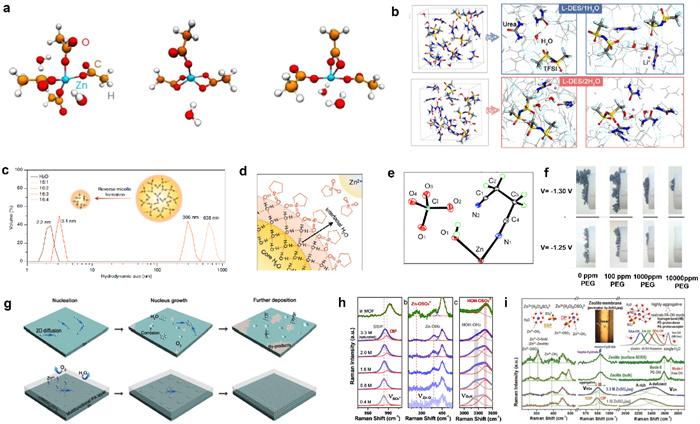
Furthermore, numerous studies have reported that water activity can be substantially diminished by organic solvents. Zhi and his coworkers show an aqueous electrolyte with sulfolane segregating waters in nanodomains and suppressing proton reduction (Figs. 26c and d) [226]. Cui et al. proposed that succinonitrile could participate in cation solvation shell can destroy the hydrated [Zn(OH2)6]2+ to weak water activity (Fig. 26e) [224]. Additives such as organic molecules and inorganic salts have been shown to modulate Zn2+ solvation structures and alter interfacial electrochemistry [227]. Akolkar proposed that additives like polyethylene glycol (PEG) can adsorb onto Zn surfaces, guiding uniform Zn deposition and suppressing dendrites by suppressing the zinc electrodeposition kinetics (Fig. 26f). Meanwhile, additives such as ethylene glycol or glucose by regulating the solvation shell of Zn2+ and disrupting hydrogen bond network reduce water activity, mitigating HER and corrosion. Additionally, certain additives (e.g., LiPF6) form protective interphases on electrodes, enhancing cyclic stability [228].
Consequently, designing a suitable artificial interfacial layer represents a feasible strategy to construct a H2O-deficient environment at the Zn anode surface. Their electrical insulation narrows and confines the zinc plating region near the interface, promoting smoother deposition morphology. For instance, Cui and co-workers developed a “brightener-inspired” polyamide coating that elevates the nucleation barrier and limits two-dimensional Zn2+ diffusion (Fig. 26g). Zhou and colleagues demonstrated that a MOF with narrow channels can strip water molecules from the Zn2+ solvation sheath, preemptively excluding bulk water from the Zn surface and stabilizing deposition (Fig. 26h) [229]. Raman spectroscopy confirmed the migration of highly coordinated Zn2+ complexes with minimal water through the MOF channels. Zeolite molecular sieve was further reported because of its uniform micropores and enriched proton-acceptor sites to depress water reactivity [230]. The zeolite coating not only facilitates aggressive ion associations within its channels but also strongly interacts with and immobilizes water molecules (Fig. 26i).
The re-emergence of aqueous battery technologies marks a pivotal moment in the quest for sustainable and safe energy storage solutions. From their humble beginnings with Volta's pile, these systems have evolved significantly, now offering compelling alternatives to conventional non-aqueous lithium-ion batteries, particularly for large-scale and cost-sensitive applications. The inherent advantages of aqueous electrolytes-including their non-flammability, low cost, and environmental benignity-position aqueous flow batteries, aqueous lithium/sodium-ion batteries and aqueous zinc batteries at the forefront of next-generation energy storage research and development.
Siwu Li, Chuang Yu*
Sulfide solid-state electrolytes, including Li–P–S-based glasses and glass ceramics, Li6PS5X (X = Cl, Br, or I) argyrodites, thio-LISICONs, Li11–xM2–xP1+xS12 (M = Ge, Sn, and Si) compounds and composite SSEs, are considered to be highly promising materials for all-solid-state lithium metal batteries (ASSLMBs) due to their high ionic conductivity and soft mechanical properties [231]. However, their poor air stability and interface-related mechanical issues severely restrict large-scale production and practical applications.
On one hand, sulfide solid electrolytes exhibit poor stability in air, primarily characterized by their sensitivity to moisture and the tendency to react with it to produce hydrogen sulfide gas. This reaction not only leads to structural changes in the electrolyte material but also reduces its ionic conductivity, thereby affecting battery performance. First, the chemical composition of the electrolyte has a significant impact on its air stability. For example, sulfide electrolytes containing P have relatively poor moisture resistance. Besides, the structural characteristics of the electrolyte also affect its air stability. Up till now, there have been various clues revealing the fundamental effects that moisture will bring to a sulfide electrolyte. For example, non-bridging sulfur anions are susceptible to attack by water molecules. By introducing trivalent ions, the non-bridging sulfur units can be bridged, thereby enhancing the air stability of the electrolyte. Thermodynamic analysis based on Gibbs energy changes helps to evaluate the air stability of sulfide electrolytes and screen potential air-stable candidates. For instance, sulfide electrolytes containing central cations such as Sn4+, Sb5+, and As5+ exhibit better water stability [232]. Moreover, according to the interfacial reaction dynamics, the chemical reactions between sulfide electrolytes and air or moisture initially occur at the interface. Research has also shown that certain exposed crystal facets of sulfide electrolytes exhibit higher surface reactivity.
On the other hand, the interfacial mechanical properties of sulfide electrolytes are also vital to the performance in ASSLMBs. Generally, compared to other types of SSEs such as oxide electrolytes, sulfide electrolytes are relatively soft and possess a certain degree of flexibility. They can be compressed to increase interfacial contact and better compensate for volume changes. However, the interface between sulfide electrolytes and electrodes, especially lithium (Li) metal anodes confront severe mechanical and electro-chemo-mechanical issues under practical conditions. In 2017, Porz et al. demonstrated that the interfacial defects and special morphologies in sulfide electrolytes are gradually filled with lithium during charge-discharge cycles. Subsequent deposition causes lithium metal to accumulate at the crack tips. Under the combined driving force of local overpotential and stress, the cracks further extend and propagate in the bulk phase of SSE, ultimately leading to short-circuiting [233]. Thereafter, in terms of the intrinsic mechanical properties, Doux et al. revealed that the yield strength of lithium metal (0.8 MPa) is much lower than that of the Li6PS5Cl SSE (30 MPa). Thus, the deformation of lithium metal occurs before the crack forms in the SSE [234]. In 2021, Fu et al. discovered the relationship between the external stress significantly affects the ionic diffusivity in Li10GeP2S12 (LGPS) via density function theory (DFT) calculation. Specifically, the lattice volume, neck size, Li vacancy formation energy, and Li Bader charge will change along with the change of the external stress: Compressive stress strengthens Li−S bonds, increasing activation energy and reducing ionic diffusivity, while tensile stress has the opposite effect [235].
In recent years, sufficient efforts have been dedicated into promoting the air stability of sulfide SSEs over the world, among which surface modification and physical/chemical doping have been studied much more. Since the decomposition reaction takes place primarily on the surface, surface modification usually provides direct and efficient positive results. For physical coating, various inorganic species have been applied to conduct the modification using their chemical stability toward moisture to block the damage [236,237]. Apart from physical approach, chemical modifications are also an effective pathway, especially using organic reagents that are moisture repellent. Liu et al. applied a long-chain alkyl thiol, 1-undecanethiol, onto the surface of Li6PS5Cl through chemical adsorption [238]. The thiol-modified sulfide SSE can be exposed to air with 33% relative humidity (33% RH) with limited degradation of its structure while retaining a conductivity of above 1 mS/cm for up to 2 days. For chemical doping, researchers have exploited various doping systems based on the hard and soft acids and bases (HSAB) theory, including anions such as oxygen and halide, soft cations such as Cu+, Sn4+, As5+, and Sb5+ [232]. Soft anions are able to bind the S2− (soft acid) more tightly after the substitution of hard acid P5+, which makes the electrolyte exhibit better resistance to the attack of O2− (hard base) and reduce the rate of hydrolysis. Generally, the doping elements can be utilized through either a single-element or multi-element pathway, for multi-element doping, the positive effects from different elements can be integrated into one electrolyte, which usually exhibits a synergistic effect that comprehensively increases its performance. For example, Bi-F, Al-F, and Sn-O have demonstrated their potential in forming stronger covalent bonds to replace the sensitive P-S bonds and suppress H2S release [239-241]. In addition, physical dopants such as MOFs are showing the capability to absorb H2S, realizing a suppressed H2S release to protect sulfide electrolytes indirectly [242]. DFT calculations have identified that the crystal facets of sulfide electrolytes with varied surface energies exhibit different air stability. Therefore, reasonably controlling the exposed crystal facets of the electrolyte during the synthesis process is expected to be another approach to improve the air stability of sulfide SSEs.
In terms of mechanical issues, sulfide electrolytes have witnessed prosperous development on the solving strategies in recent years. Same as the role in addressing air stability issues, surface modification strategy is a common and effective method to relieve the mechanical issues from sulfide SSEs. In 2020, Hood et al. investigated the effect of the thin Al2O3 coatings on Li6PS5Cl SSE by atomic layer deposition. They found that the coating layer prevents side reactions at the Li6PS5Cl/Li metal interface and provides better Li metal wetting, thus increasing the chemical and mechanical stability of Li6PS5Cl toward Li metal during cycling [243]. Notably, similar materials can also work through other methods, including building buffer layer and forming composite electrolytes. In 2022, Su et al. reported the construction of a Li-ion conducting lithium phosphorus oxynitride (LiPON) thin layer between the Li6PS5Cl SSE and Li metal anode via radio frequency (RF) sputtering. This artificial layer enables improved wetting and conformal interfacial contact between Li6PS5Cl and Li metal, thus realizing reduced interfacial resistance and stable Li plating/stripping [244]. Using polymeric binders to design composite sulfide SSEs shows promising results on enhancing mechanical strength and processability of the electrolyte, since the synthesized composite electrolyte film with thoroughly percolated three-dimensional polymer networks can realize stress-dissipation to inhibit the interface detachment and alleviate the uneven local stress during the operation of the battery [245]. Beyond that, chemical/physical doping has shown potential in resolving mechanical issues. Specifically, elemental doping has also been proven to realize enhanced lithium compatibility and dendrite suppression of the doped sulfide SSEs via the formation of a mechanically robust interphase between Li metal and the electrolyte [239,241,246]. Last but not least, structure design is also drawing researchers’ attention in recent years. A special structure design on either the sulfide electrolyte or the composite electrode with sufficient reserved space or gradient structure can effectively address the decomposition of sulfide electrolytes by restricting the volume expansion and increasing the energy barrier of decomposition.
In summary, the issues on air stability and interfacial mechanics are drawing extensive attention in the development of sulfide-electrolyte based all solid-state batteries, which is becoming the major challenge in front of the commercialization and provides plentiful opportunities for the advancement of fundamental understanding and technological innovation toward next-generation batteries. Up till now, researchers have made considerable achievements in characterizing the basic mechanism and designing optimization strategies (Fig. 27), but limitations still remain. Future research interest can be focused on following aspects: (1) The material system and modification strategies for air stability and interfacial mechanics show many similarities (e.g., surface coating, physical/chemical doping), this means that there are great chances to develop multifunctional materials or strategies to solve both issues in one cure. However, the fundamental relationship behind these two properties and the working mechanism of the modification are still unclear, which should be thoroughly investigated via experimental characterizations and theoretical calculations. (2) For most of the works reporting interfacial modifications toward the suppression of lithium dendrites or electrode’s electro-chemo-mechanical failure, there were seldom observations and in-depth discussions of the mechanical evolution, lacking necessary knowledge of the structure-property relationship. Therefore, the integration of monitoring techniques across different scales should be applied, which can provide more holistic view of the mechanical behavior in ASSLMBs. Moreover, real-time monitoring and feedback control systems to adjust battery operation based on mechanical behavior is essential. (3) Judging from the current results, the utilization of single-component materials still leads to limited performance promotion. Consequently, it is necessary to consider composite materials or the combination of multiple strategies for modification to achieve synergistic effects. Additionally, the integration of high-throughput material analysis and theoretical methods can assist in the rapid screening of material systems.
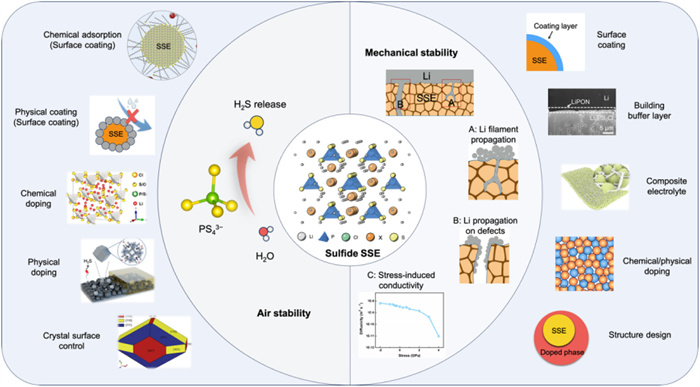
Yanhui Cao, Zhong Wu*, Yida Deng, Wenbin Hu
Aqueous metal-air batteries (AMABs) are regarded as promising candidates for next-generation energy storage systems owing to their high theoretical energy density, inherent safety, and low cost (Fig. 28a). A typical AMABs are mainly composed of air cathode, aqueous electrolyte, and metal anode (Fig. 28b). The air cathode consists of electrocatalyst layer, gas diffusion layer (GDL) and current collector, which collectively enhance the oxygen diffusion ability and reduce the reaction overpotential at the electrode. Depending on the used metal at the anode, AMABs can be classified into Zn-air, Al-air, Mg-air, and Fe-air batteries. Alkaline electrolytes are widely employed in these systems. In recent decades, the significant progress has been made in the AMABs research, accelerated by advances in nanotechnology. However, some challenges, such as low power density and short service life, must still need to be overcome to achieve large-scale application. Further innovation in the materials design and technology remains essential to accelerate the commercial application of AMABs.
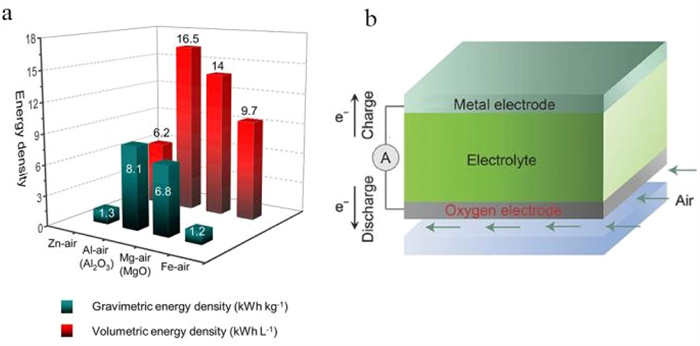
The work principle of AMABs involves converting chemical energy into electrical energy through the redox reactions between oxygen from the atmosphere at the cathode and metal at the anode [247]. Thus, efficient and stable electrocatalysts for ORR and OER play the significant role in determining the power density and round-trip efficiency. Over the past decade, a larger number of ORR and OER catalysts have been reported, including alloys, metallic compounds, atomically dispersed metal materials, and non-metal carbon-based materials [248]. The best-performing reported catalysts have sustained cycling for over 10,000 h with a voltage gap of approximately 0.72 V and achieved a peak power density of 252 mW/cm2 [249]. In addition, the issues such as metal corrosion and the HER, exacerbated by the combination of alkaline electrolyte and active metal anode, also significantly impair the service life and capacity density of AMABs. Our group has effectively inhibited the HER at the anode by introducing ZnO and a series of quaternary ammonium salts into the electrolyte, achieving an anode utilization rate of up to 86.0% [250]. This represents a potential breakthrough for industrial applications of AMABs.
ORR and OER, as the reversible oxygen electrocatalytic reactions, suffer from sluggish kinetics and high thermodynamic energy barrier due to the multistep adsorption and dissociation of reactants, the formation and desorption of products involving 4-electron participation [247]. Therefore, efficient and stable catalysts are required to facilitate ORR/OER and minimize energy losses, in which ORR determines the discharge performance and OER controls the rechargeability of AMABs. Although noble metal-based catalysts such as Pt, Ir and Ru are benchmark materials for catalyzing ORR and OER, their high cost, limited stability, and the lack of bifunctionality have always been the barriers to prevent their commercialization in AMABs [251]. Thus, considerable efforts have been devoted to developing high-performance non-noble metal-based ORR and bifunctional ORR/OER catalysts through rational structural design and compositional regulation, but achieving a round-trip efficiency beyond 65% remains a major bottleneck for AMABs industry [252]. Optimizing ORR and OER continues to be a major obstacle in developing next-generation AMABs with high efficiency, better cycle life, and practical scalability. To bridge the gap between the discharge and charge voltages of AMABs, it is significant to focus on the advanced electrocatalytic material designs. Increasing the exposure of active sites and promoting mass-charge transfer by designing porous and hollow structures, as well as enhancing the intrinsic activity of active sites via modulating the electronic properties are the two important strategies in material designs [253]. In addition, designing GDL with hierarchical porosity can promote oxygen transport and distribution, and reducing the electrode weight can improve the capacity density of AMABs.
Since the reactant at the cathode is oxygen from the air, the theoretical energy density of AMABs is determined by the metal anode. Thus, the metal anode plays a pivotal role in ascertaining the electrochemical performance, energy density, and cycle life of AMABs. The metal corrosion and HER side reaction are the common problems in these systems, which significantly decrease the service life and capacity density. Another major issue is passivation, where an insulating oxide layer forms on the anode surface, preventing efficient charge transfer. This is commonly observed in Al and Mg anodes. For the rechargeable Zn-air batteries, non-uniform Zn metal deposition can lead to the dendrite formation during repeated cycling. Utilizing alloys and protective coatings can effectively mitigate corrosion and passivation, and designing three-dimensional porous structures can inhibit dendrite growth, thereby increasing the utilization rate of the metal. The electrolyte innovation also plays a key role in enhancing anode performance and addressing inherent issues such as evaporation and carbonation. Investigating the solid-liquid interface characteristics during the battery's service period is an important direction for guiding the development of electrolytes.
In order to realize the practical production of AMABs, some technological and engineering challenges also need to be taken into consideration. For example, optimizing the oxygen supply and removal, preventing the electrolyte evaporation and leakage, and cost management related to the large-scale catalysts production and recycling, as well as establishing the circular economy models for the metal production and consumption.
Substantial efforts have been contributed to design and develop efficient and stable ORR and OER electrocatalysts for AMABs. Non-noble metal compounds and carbon-based materials have attracted widespread attention due to their abundance, low cost, and tunable properties [248]. By contrast, carbon-based single-atom catalysts (SACs) have received significant interest for their superior catalytic activity in recent years [254]. Strategies for enhancing performance include the structural modifications of carbon substrates to increase the active site accessibility and promote the mass-charge transfer process, as well as the electronic structure engineering through the local coordination environment regulation to enhance the intrinsic activity of active sites, such as introducing non-metallic heteroatom, surface functional group, and bimetallic site (Fig. 29) [255]. Furthermore, the construction of dual-metal sites could realize the bifunctional ORR/OER catalytic activity and alter the reaction mechanisms, leading to substantial improvements in catalytic performance [256]. In conclusion, the precise control of the coordination environment of metal single-atom sites shows great promise in accurately regulating the adsorption behavior of reaction intermediates.
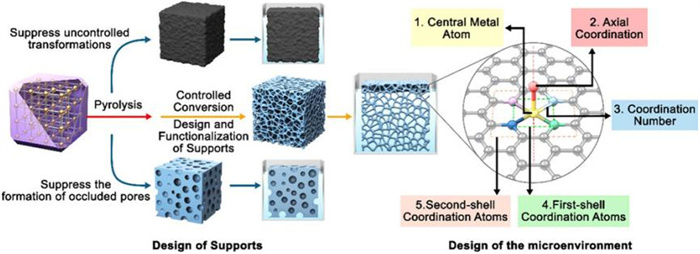
The researches on the metal anode mainly focus on suppressing metal corrosion, HER side reaction, and passivation layer formation, to enhance the charge transfer and improve power output. Electrode modifications based on the material alloying design (e.g., Zn-Mn, Al-Mg) and microstructure design (e.g., 3D porous architectures) strategies are now widely applied to improve the performance of metal anodes [257]. Recent studies have demonstrated that Mg95.28Gd3.72Zn1.00 alloy with a long-period stacking ordered (LPSO) structure can remarkably enhance the performance of Mg anodes in Mg-air batteries [258]. The electrolyte innovations concentrate on the development of more efficient corrosion inhibitors and film-forming additives to stabilize the metal-electrolyte interface. This approach enables the formation of a dense protective film on the anode surface, significantly suppressing HER and promoting the uniform metal deposition.
System-level technological innovations also offer pathways to improve the performance of AMABs. For example, incorporating a liquid storage tank and a peristaltic pump to control the contact between the electrolyte and the electrodes can enable an extremely long service life. Moreover, advanced characterization techniques and theoretical calculation are becoming increasingly indispensable in revealing the reaction mechanisms. In-situ X-ray adsorption fine structure (XAFS), in-situ Raman and Fourier-transform infrared spectroscopy are conductive to reveal the actual structural changes of materials during the reaction process and to track the formation of key intermediates [259]. Machine learning (ML) is emerging as a powerful tool to reduce experimental trial-and-error and accelerate the discovery and optimization of new materials [260].
Due to the high energy density, inherent safety, and cost-effectiveness, AMABs will remain a focal point of energy storage research in the future. However, overcoming limitations in power density and service life requires breakthroughs in the fields of materials science and electrochemistry. In particular, advances in key materials should focus on the development of efficient and stable bifunctional oxygen electrocatalysts. Matel single-/dual-atom catalysts have shown great potential due to their high activity and structural tunability. Systematically exploring precise strategies for tailoring their coordination structures and electronic properties should be taken into consideration in future efforts, thereby achieving a synergistic improvement in both catalytic activity and stability. Such progress would substantially improve the performance and lifespan, accelerating the commercialization of AMABs. Future research on anodes and electrolytes should prioritize interfacial engineering to suppress HER, improve anode utilization, and enhance electrolyte stability. The rational design and functional modification of the interface structures represent a critical pathway to achieve long-term stable operation. Meanwhile, integrating ML and artificial intelligence into the development of novel electrode and electrolyte materials is expected to accelerate the performance optimization and degradation mechanisms prediction, representing a future trend in AMABs research. At the system level, structure design and engineering optimization will also have an impact on the performance of key components, such as the component integration, electrolyte circulation systems, and lightweight shell. Through such a multi-level and interdisciplinary research framework, it is expected to systematically break through the bottlenecks of AMABs in terms of energy conversion efficiency, durability and manufacturing cost, and ultimately promote the paradigm shift from the laboratory to the market.
Jianjian Zhong, Xiong Zhang*, Yanwei Ma
Supercapacitors (SCs) are an important representative of current advanced energy storage technologies, which have attracted a significant research effort. According to the energy storage mechanism, SCs can be classified into three types: electric double-layer capacitors (EDLCs), pseudocapacitors (PCs) and asymmetric supercapacitors (ASCs) [261]. EDLCs exhibit superior power density and outstanding long cycle life, which originates from the rapid adsorption/desorption of ions on the electrode surface. However, the inferior energy density astricts the application of EDLCs in the long-periodic energy supply. The introduction of pseudocapacitance compensates the energy fault of EDLCs, reduces the discrepancy in charge storage between sluggish solid-state ion diffusion in Li-ion batteries and fast surface ion adsorption in electric double-layer. However, PCs still demonstrate relatively slow charge/discharge rates due to the essential of faradaic reactions on the electrode surface. ASCs have therefore emerged as a promising strategy to overcome the challenges of low energy density and narrow operating voltage windows that hinder the commercialization of SCs. A typical ASC consists of a capacitive electrode and a battery-type electrode, immersed in an aqueous or organic electrolyte. Among them, lithium-ion capacitors (LICs) are representative, offering an energy density of ~30 Wh/kg, a power density of ~10 kW/kg, a cycle life of ~100,000 cycles, and an extended operating voltage window of 4.0-4.5 V [262]. Such enhanced performance significantly broadens the application prospects of SCs in various fields, including consumer electronics, electric vehicles, grid frequency regulation, and defense industries.
Next-generation high-performance supercapacitors require a systems engineering approach: simultaneous breakthroughs in the materials science of cathodes/anodes/electrolytes with synergistic matching design, to achieve high energy/power density, long lifespan, safety, and reliability (Fig. 30). EDLCs dominate the commercial supercapacitor market but are limited by lower energy density. Although high specific capacitance for heteroatom-doped carbon can currently be achieved, aqueous EDLCs face a narrow voltage window (~1.5 V) of traditional aqueous electrolytes due to water electrolysis. Commercially available organic EDLCs typically operate at an average voltage of ~2.7 V and rarely exceed 3 V. Meanwhile, EDLCs exhibit significantly higher self-discharge rates than batteries due to charge redistribution from ion diffusion in the electric double layer, and redox reactions induced by surface functional groups or trace water in electrolytes, leading to substantial energy loss in long-term energy storage scenarios. In addition, temperature fluctuations significantly impair EDLC performance. Low temperature leads to increase in viscosity and plummet of ion conductivity for organic electrolytes, elevating internal resistance and diminishing power output. While high temperature accelerates electrolyte decomposition (particularly in ionic liquid) and electrode corrosion, causing capacitance loss, exacerbated self-discharge, and reduced lifespan. Furthermore, thermal management systems must be integrated to dissipate operational heat due to high-power operation in EDLCs.
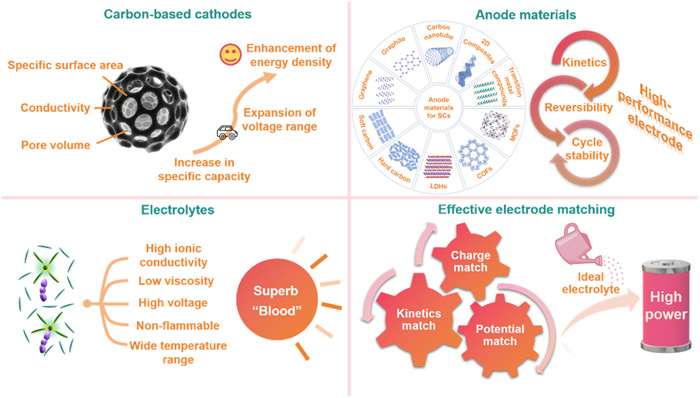
Pseudocapacitive materials hold promise for enhancing the energy density of SCs, yet their widespread commercialization remains limited due to several critical challenges: RuO2 suffers prohibitive costs, lacking economic viability. Metal oxides represented by MnO2 exhibit limited capacitance and low intrinsic electronic conductivity. Such materials are confined to aqueous electrolytes, constraining achievable energy density and practical applications. Conducting polymer electrodes undergo progressive structural degradation during cycling, causing diminished electronic conductivity, impaired mechanical integrity and deteriorated cycle life. Intercalation-type pseudocapacitive materials like orthorhombic Nb2O5 (T-Nb2O5) and MXenes have gained recent attention. However, T-Nb2O5 possesses inherently poor electronic conductivity, impeding electron transport within electrodes. Its high redox potential (vs. Li+/Li) also restricts cathode selection and accelerates electrolyte decomposition, adversely impacting cycling stability. Although MXenes represent an ideal high-rate pseudocapacitive material, substantial improvements are required in initial irreversible capacity loss, surface terminal engineering, and scalable synthesis methods.
A detailed understanding of rationally designed/architected electrode materials is crucial for enabling high-performance ASCs. Activated carbon electrode exhibits substantially lower capacity than battery-type electrodes, necessitating higher mass loading for charge balancing. The high loading reduces accessible active sites and diminishes active material utilization. Furthermore, thicker electrodes impede electron and ion transport, compromising electrochemical performance. High-performance graphene composites serve as battery-type electrode while the scalable and cost-effective production remains key. Emerging alloy-type and conversion-type materials such as Si-based materials, transition metal oxides/sulfides/selenides/phosphides are being progressively developed for applications, but cycling stability remains to be improved. Future research should focus on nanoscaling, combination with advanced carbon materials or MXenes/MOFs/COFs/LDHs, design of porous nanomaterials, eventually enhancing specific capacity and cycle stability. Capacitive and battery-type electrodes exhibit mutual constraints in ASCs. During constant-current operation within a fixed voltage window, performance mismatches between electrodes restrict the respective capabilities. The theoretically calculated mass ratio proves inadequate for achieving optimal matching, remaining practical approaches for effective electrode matching an ongoing research challenge. The stable potential range of electrolytes also impact performance of ASCs, identifying ideal electrolytes for such systems is essential.
The development of novel materials represents a critical focus for enhancing supercapacitor performance, with extensive research already underway including innovative synthesis methods, structure/morphology control, and composite material design. Biomass-derived, particularly black liquor lignin-derived hierarchically porous carbon materials exhibit superior accessible pore structures and broadest transport channels for charge carriers, significantly enhancing specific capacitance and electronic conductivity. Heteroatoms (e.g., sulfur, oxygen) present in black liquor will undergo in situ doping during carbonization, further boosting pseudocapacitive properties and electrochemical stability [263]. Concurrently, certain carbon-containing polymers such as PVDF are utilized to fabricate porous carbons while introducing N, O, F heteroatoms for performance augmentation [264]. Moreover, MOFs, MXenes and transition metal compounds are utilized to engineer high-capacity composite materials, leveraging the synergistic effects among components to enhance overall performance [262,265,266]. Notably, advanced techniques including magnetic field-assisted processing and laser thermal induction have been employed to enable rapid material synthesis and shaping, complemented by machine learning-guided design for optimized material architectures. Thus, advances in novel material architectures and fabrication methodologies substantially enhance electrode performance, accelerating the practical deployment of SCs.
Conventional aqueous electrolytes limit the operating voltage window of SCs. The application of “water-in-salt” (WIS) electrolytes with high salt-concentration has achieved a breakthrough in the electrochemical stability window (~3 V) for aqueous electrolytes [218]. The anion-dominated solvation structure facilitates solid electrolyte interphase (SEI) formation at the anode while protecting the cathode from water-induced degradation. Hybrid electrolyte systems employing organic liquids (such as acetonitrile, methanol [267,268]) as co-solvents have emerged as a novel approach, synergistically combining properties of distinct electrolyte phases or solvents to achieve enhanced electrochemical performance, safety, and stability. The modulation of solvation structures and molecular dynamics in hybrid electrolytes is both critical for optimizing electrolyte performance especially resistance to low temperature (as low as –60 ℃) and pivotal for expanding the operational envelopes of liquid-electrolyte supercapacitors. In addition, ionic liquids have emerged as promising organic electrolytes for SCs by virtue of a wide electrochemical stability window, high ionic conductivity, outstanding thermal stability, non-flammability and low volatility. The representative ionic liquids such as EMIM-TFSI and EMIM-BF4 exhibit high ionic conductivity exceeding 10 mS/cm at room temperature with electrochemical stability window of 4.0-4.5 V. Furthermore, ionic liquids can be incorporated into solid-state electrolytes to extend electrochemical stability window, thereby accelerating the advancement of solid-state supercapacitors.
Advanced characteristic techniques are the important auxiliary means to explore energy storage mechanism in SCs. The electrochemical quartz crystal microbalance (EQCM) is the preferred technology to probe ion fluxes within electrode during polarization (Fig. 31a). It monitors changes in electrode mass in real time based on Sauerbrey’s equation, with a sensitivity reaching nanogram level [269]. This technique provided direct evidence for the partial desolvation of electrolyte ions entering the nanopores. EQCM can also integrate with operando techniques like electrochemical dilatometry and in-situ Raman spectroscopy to study structural transformations of carbon materials during polarization (Figs. 31b and c), linking confined electric double-layer dynamics to charge storage and capacitance [270,271].
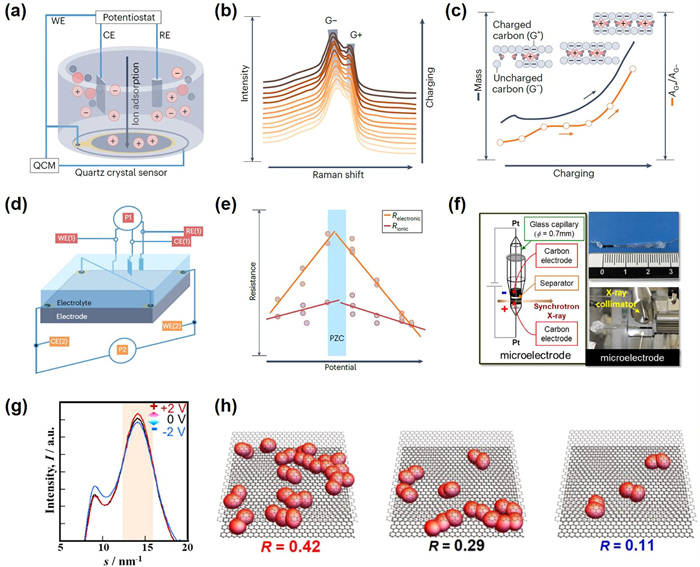
AC in-plane electrochemical impedance spectroscopy (EIS) serves as a powerful technique for operando monitoring of changes at electrode/electrolyte interface to understand kinetics [272]. Electrode thin film is coated onto an insulating substrate, and two potentiostats are employed: one for electrode polarization and the other for measuring electrochemical in-plane impedance (Fig. 31d) [272]. It deconvolves ionic and electronic percolations within electrode plane during polarization. AC in-plane EIS results demonstrate that the reduced electronic/ionic resistance during charge injection primarily arises from the elevated conductivity derived from ionic confinement effect within the porous structure (Fig. 31e) [272].
X-ray scattering techniques equipped with X-ray synchrotron radiation can capture structure changes in electrolyte and electrodes during electrochemical processes, as well as the formation of electric double-layers (Fig. 31f). Wide-angle X-ray scattering (WAXS) provides the structural changes of electrodes related to ion adsorption/desorption, and analyzes the structure of disordered electrodes via electron radial distribution functions (ERDFs). Small-angle X-ray scattering (SAXS) is employed to probe electron density within pores and structural evolution with high sensitivity, enabling real-time monitoring of structural variation in electrodes and electrolytes during cycling. Futamura et al. employed WAXS to study structure changes of EMI-TFSI electrolyte ions confined in carbon micropores, revealing that the electrostatic shielding effect of carbon pore walls critically governs the energy storage mechanism of electric double-layers (Figs. 31g and h) [273]. Prehal et al. constructed a novel carbon model from in-situ SAXS to analyze the voltage-dependent arrangement and ion transport within nanopores of carbon-based EDLCs [274]. Despite its fundamental simplicity, X-ray scattering provides unique insights into the dynamic structure behavior of electric double-layer capacitors, especially the interactions between electrolyte ions and pore structures at the nanoscale. These findings not only deepen the understanding of electric double-layer formation mechanisms, but also guide the design of high-performance electrode materials in capacitors.
Excellent power density, rapid charge-discharge capability, and long cycle life make supercapacitors an ideal high-performance energy storage device, driving transformative advancements across industries. However, achieving broad commercialization of SCs remains a work in progress. Future research should focus on: (1) Performance enhancement: Developing carbon-based derived materials or novel electrode materials with high specific capacitance and enhanced kinetic property, reducing kinetic imbalance between electrodes and boosting power density of device. Exploring high-performance electrolytes or cathode additives to regulate SEI film formation and extend cycle lifespan. (2) Mechanism investigation: Unraveling ion diffusion, interfacial charge dynamics, and electrode structural evolution is critical for performance enhancement. The operando characterization techniques must be applied to identify restrictive chain for targeted optimization of structure and performance. Elucidating the mechanism of anode prelithiation technology including structural changes and interfacial charge transfer to develop efficient, safe, and cost-effective methods. (3) Advanced technologies: Leveraging artificial intelligence and machine learning to accelerate material screening, optimize device design, and predict system performance. Developing bio-inspired materials/structures to construct high-performance, long-life electrochemical capacitors. (4) Application integration: Enhancing grid stability in renewable energy integration via frequency regulation and peak shaving/valley filling, promoting widespread application of renewables. Developing high-performance electrochemical capacitors for electric vehicles to improve acceleration, regenerative braking, and overall vehicle performance. Integrating electrochemical capacitors into IoT devices to provide reliable, long-lasting power for smart homes and industrial automation.
We, herein, declare that there is no conflict of interest.
Jing Guo: Writing – review & editing. Chunhui Luo: Writing – original draft. Peng Li: Writing – original draft. Mao Ye: Writing – original draft. Zhihua Qiao: Writing – original draft. Yubo Wu: Writing – original draft. Huiqin Hu: Writing – original draft. Xubiao Luo: Writing – original draft. Liming Yang: Writing – original draft. Yulin Cai: Writing – original draft. Pengwei Li: Writing – original draft. Kai Zhu: Writing – original draft. Cheng Fu: Writing – original draft. Bing Yu: Writing – original draft. Yueying Chen: Writing – original draft. Shichang Wang: Writing – original draft. Ting Wang: Writing – original draft. Chongchong Qi: Writing – original draft. Zirou Liu: Writing – original draft. Dongmei Huang: Writing – original draft. Zengxi Wei: Writing – original draft. Fangxin Mao: Writing – original draft. Yi Wei: Writing – original draft. Caining Wen: Writing – original draft. Chao Han: Writing – original draft. Bo Weng: Writing – original draft. Han Feng: Writing – original draft. Junming Hong: Writing – original draft. Jing Wu: Writing – original draft. Yu Xiao: Writing – original draft. Guang Liu: Writing – original draft. Linlin Song: Writing – original draft. Rongzheng Ren: Writing – original draft. Zhenhua Wang: Writing – original draft. Long Kong: Writing – original draft. Huaifang Shang: Writing – original draft. Lihua Wang: Writing – original draft. Yongzhi Chen: Writing – original draft. Changjie Ou: Writing – original draft. Huijun Yang: Writing – original draft. Xiaoyu Liu: Writing – original draft. Jin Yi: Writing – original draft. Siwu Li: Writing – original draft. Chuang Yu: Writing – original draft. Yanhui Cao: Writing – original draft. Zhong Wu: Writing – original draft. Yida Deng: Writing – original draft. Wenbin Hu: Writing – original draft. Jianjian Zhong: Writing – original draft. Xiong Zhang: Writing – original draft. Yanwei Ma: Writing – original draft. Jianmin Ma: Writing – review & editing.
This work was supported by the Russian Science Foundation (No. 22–13–00035), the National Outstanding Young Scientists Fund (No. 52125002), the National Key Research and Development Program of China (Nos. 2023YFC3904800 and 2022YFB4002501), the National Natural Science Foundation of China (Nos. 52400228, 52300139, 22308063, 52103340, U22A20418, 22578302, 52202208, 52400163, 52205054, 22075171, 52177214, 22405201, 52371072, 52171078, 52377218), the Key Research and Development Project of Science and Technology Department of Zhejiang Province (No. 2024C03284(SD2)), the Research Development Fund of Zhejiang A&F University (No. 2024LFR042), the President Research Funds from Xiamen University (No. ZK1111), Nanqiang Youth Scholar program of Xiamen University, the Young Elite Scientists Sponsorship Program by CAST (No. 2023QNRC001), Natural Science Foundation of Xiamen (No. 3502Z202471037), Open Fund of the State Environmental Protection Key Laboratory of Urban Air Particulate Matter Pollution Prevention and Control, College of Environmental Science and Engineering, Nankai University (No. NKPMLF202409), the Key Project of Research and Development Plan of Jiangxi Province (No. 20243BBI91001), Natural Science Foundation of Shanghai (No. 23ZR1423400), the Postdoctoral Science Research Program of Shaanxi (No. 2023BSHEDZZ159) and Xidian University Specially Funded Project for Interdisciplinary Exploration (No. TZJH2024062), the Open Project of Yunnan Precious Metals Laboratory Co., Ltd. (No. YPML-20240502058), the Fundamental Research Program of Shanxi Province (No. 202303021212159), the Natural Science Foundation of Shanxi Normal University (No. JCYJ2024017).
R.S.K. Valappil, N. Ghasem, M. Al-Marzouqi, J. Ind. Eng. Chem. 98 (2021) 103–129.
Y.L. Zhao, X. Zhang, M.Z. Li, et al., Chem. Soc. Rev. 53 (2024) 2056–2098. doi: 10.1039/d3cs00285c
D.S. Sholl, R.P. Lively, Nature 532 (2016) 435–437. doi: 10.1038/532435a
L. Yang, S. Qian, X. Wang, et al., Chem. Soc. Rev. 49 (2020) 5359–5406. doi: 10.1039/c9cs00756c
X. Zhang, X. Ding, Z. Song, et al., AIChE J 67 (2021) e17340.
A. Knebel, J. Caro, Nat. Nanotechnol. 17 (2022) 911–923. doi: 10.1038/s41565-022-01168-3
A.A. Uliana, E.O. Velasquez, K.I. Graf, et al., Adv. Mater. (2025) e09150.
H. Mukhtar, B. Shimekit, Natural gas purification technologies-Major advances for CO2 separation and future directions, In: H.A. Al-Megren, (Ed.) Advances in Natural Gas Technology, IntechOpen, London, 2012.
S.M. Wang, P. Duan, Q.Y. Yang, Coord. Chem. Rev. 525 (2025) 216339.
H.N. Li, Z.Y. Sun, Z.J. Yu, et al., Nat. Commun. 16 (2025) 8199.
K. Li, H. Tang, Z. Huang, et al., Sep. Purif. Technol. 319 (2023) 124084.
Z. Xu, J. Gao, Q. Sun, et al., Fuel 387 (2025) 134447.
F. Degen, M. Winter, D. Bendig, et al., Nat. Energy 8 (2023) 1284–1295. doi: 10.1038/s41560-023-01355-z
H. Hu, X. Guo, L. Yang, et al., Adv. Mater. 37 (2025) 2506055.
S. Yang, Y. Wang, H. Pan, et al., Nature 636 (2024) 309–321. doi: 10.1038/s41586-024-08117-1
M.L. Vera, W.R. Torres, C.I. Galli, et al., Nat. Rev. Earth Environ. 4 (2023) 149–165. doi: 10.1038/s43017-022-00387-5
J. Xiao, B. Niu, P. Li, et al., Green Chem. 27 (2025) 10291–10315. doi: 10.1039/d5gc02804c
H. Hu, G. Yang, C. Chen, et al., Adv. Funct. Mater. 35 (2025) e13012. doi: 10.1002/adfm.202513012
L. Zhang, J. Yan, Z. Wang, et al., Adv. Mater. 38 (2026) e12998. doi: 10.1002/adma.202512998
L. Yang, Z. Gao, T. Liu, et al., Environ. Sci. Technol. 57 (2023) 4591–4597. doi: 10.1021/acs.est.3c00287
Y. Song, S. Fang, N. Xu, et al., Science 385 (2024) 1444–1449. doi: 10.1126/science.adm7034
X. Tian, C. Ye, L. Zhang, et al., Adv. Mater. 37 (2025) 2402335.
J. Zhang, Z. Cheng, X. Qin, et al., Desalination 547 (2023) 116225.
Y. Niu, Y. Yuan, Y. Wang, et al., J. Cleaner Prod. 525 (2025) 146535.
Y. Boroumand, S. Abrishami, A. Razmjou, Nat. Sustain. 7 (2024) 1550–1551. doi: 10.1038/s41893-024-01451-2
H. Sun, X. Li, B. Wu, et al., Chin. Chem. Lett. 36 (2025) 110041.
J. Koloch, J. Schneider, M. Seidenfus, et al., e-Prime 12 (2025) 100995.
H. Liu, J. Long, H. Yu, et al., Chin. Chem. Lett. 36 (2025) 109712.
P. Li, S. Luo, Y. Lin, et al., Chem. Soc. Rev. 53 (2024) 11967–12013. doi: 10.1039/d4cs00362d
Y. Zang, M. Qu, D.T. Pham, et al., Comput. Ind. Eng. 198 (2024) 110727.
C. Wu, C. Xu, Y. Zhang, et al., J. Electr. Eng. 20 (2025) 310–322.
J. Luo, L. Chen, G. Cai, Waste Manage. 205 (2025) 115008.
J. Gao, G. Wang, J. Xiao, et al., Rob. Comput. Integr. Manuf. 89 (2024) 102775.
H. Ma, T. Wang, Y. Ding, et al., Patent CN120017814A, 2025.
Q. Song, Y. Ding, T. Shao, Patent CN118037960A, 2024.
X. Gu, J. Li, Y. Zhu, et al., Energy 285 (2023) 129342.
J. Chen, P. Kollmeyer, R. Ahmed, et al., Appl. Energy 391 (2025) 125923.
R.F. Maritz, R.F. van Schalkwyk, N. Elginöz, et al., Waste Manage 200 (2025) 114763.
P. Li, X. Xia, L. Wang, et al., Joule 9 (2025) 102003.
S. Chen, G. Wu, H. Jiang, et al., Nature 638 (2025) 676–683.
Z. Wang, Y. Liu, A. Zhang, et al., J. Environ. Chem. Eng. 13 (2025) 118217.
C. Ma, H. Zhang, Z. Liu, et al., Water Res. 281 (2025) 123575.
M. He, Z. Xu, D. Hou, et al., Nat. Rev. Earth Environ. 3 (2022) 444–460. doi: 10.1038/s43017-022-00306-8
L. Yu, M. Han, F. He, Arabian J. Chem. 10 (2017) S1913–S1922. doi: 10.1016/j.arabjc.2013.07.020
P. Zhang, Y. Yang, X. Duan, et al., Water Res. 255 (2024) 121485.
C. Li, W. Sun, Z. Lu, et al., Water Res. 175 (2020) 115674.
A. Singh, D.B. Pal, A. Mohammad, et al., Bioresour. Technol. 343 (2022) 126154.
F. Wang, L. Xiang, K. Sze-Yin Leung, et al., Innovation 5 (2024) 100612.
V. Shrivastava, I. Ali, M.M. Marjub, et al., Chemosphere 293 (2022) 133553.
Y. Zhao, Y. Gu, B. Liu, et al., Nature 608 (2022) 69–73. doi: 10.1038/s41586-022-04942-4
H. Zhao, W. Qi, X. Tan, et al., Chin. Chem. Lett. 36 (2025) 110898.
K. Shi, B. Liang, H.Y. Cheng, et al., Water Res. 258 (2024) 121778.
Y. Zheng, S. Sun, J. Liu, et al., Chin. Chem. Lett. 36 (2025) 110722.
Q. Yu, Y. Feng, J. Wei, et al., Chin. Chem. Lett. 33 (2022) 3087–3090.
M. Yin, Y. Lin, M. Zhuang, et al., Chin. Chem. Lett. 36 (2025) 109926.
R. Khairova, S. Komaty, A. Dikhtiarenko, et al., Angew. Chem. Int. Ed. 62 (2023) e202311048.
C. He, J. Cheng, X. Zhang, et al., Chem. Rev. 119 (2019) 4471–4568. doi: 10.1021/acs.chemrev.8b00408
P. Chu, L. Zhang, Z. Wang, et al., Environ. Sci. Technol. 58 (2024) 17475–17484. doi: 10.1021/acs.est.4c03049
L. Wei, Y. Liu, S. Cui, et al., Adv. Funct. Mater. 33 (2023) 2306129.
Y. Long, Y. Su, M. Chen, et al., Environ. Sci. Technol. 57 (2023) 7590–7598. doi: 10.1021/acs.est.2c08959
W. Chen, R. Zou, X. Wang, ACS Catal. 12 (2022) 14347–14375. doi: 10.1021/acscatal.2c03508
Y. Ren, X. Lei, H. Wang, et al., ACS Catal. 13 (2023) 8293–8306. doi: 10.1021/acscatal.3c01036
M. Xiao, D. Han, X. Yang, et al., Appl. Catal. B: Environ. 323 (2023) 122173.
L. Ye, P. Lu, Y. Xianhui, et al., Appl. Catal. B: Environ. 331 (2023) 122696.
C. Zhang, J. Zhang, Y. Shen, et al., Environ. Sci. Technol. 56 (2022) 3719–3728. doi: 10.1021/acs.est.1c08009
B. Lin, J. Tang, J. Yang, et al., Appl. Catal. B: Environ. Energy 361 (2025) 124619.
P.H. Brunner, H. Rechberger, Waste Manage 37 (2015) 3–12.
D.M.C. Chen, B.L. Bodirsky, T. Krueger, et al., Environ. Res. Lett. 15 (2020) 074021. doi: 10.1088/1748-9326/ab8659
J. Glüge, M. Scheringer, I.T. Cousins, et al., Environ. Sci. Proc. Imp. 22 (2020) 2345–2373. doi: 10.1039/d0em00291g
C. Qi, T. Hu, J. Zheng, et al., Environ. Res. 249 (2024) 118378.
W. Jiao, K. Li, M. Zhou, et al., Environ. Technol. Innovation 38 (2025) 104154.
M. Mangal, C.V. Rao, T. Banerjee, Polym. Int. 72 (2023) 984–996. doi: 10.1002/pi.6555
K.L. Zhou, Z. Wang, C.B. Han, et al., Nat. Commun. 12 (2021) 3783.
Y. Li, P. Kidkhunthod, Y. Zhou, et al., Adv. Funct. Mater. 32 (2022) 2205985.
M.A. Qadeer, X. Zhang, M.A. Farid, et al., J. Power Sources 613 (2024) 234856.
M. Liu, J.A. Wang, W. Klysubun, et al., Nat. Commun. 12 (2021) 5260.
J. Yan, Y. Lu, G. Chen, et al., Chem. Soc. Rev. 47 (2018) 2518–2533. doi: 10.1039/c7cs00309a
Y. Yan, F. Cai, L. Yang, et al., Adv. Mater. 29 (2017) 1604044.
Y. Sun, J. Dai, H. Lv, et al., Adv. Funct. Mater. 35 (2025) 2505867.
L. Zhang, H. Hu, C. Sun, et al., Nat. Commun. 15 (2024) 7179. doi: 10.1007/s10973-024-13284-4
Q. Wang, Y. Qin, J. Xie, et al., Adv. Mater. 37 (2025) 2420173.
D. Huang, X. Ma, J. Xie, et al., Small 21 (2025) e07002.
L. MacDonald, J.C. McGlynn, N. Irvine, et al., Sustain. Energy Fuels 1 (2017) 1782–1787.
L. Zhang, M. Li, C. Sun, et al., Adv. Funct. Mater. 35 (2025) 2420163.
J. Xiao, Y. Gao, X. Liu, et al., J. Mater. Chem. A 13 (2025) 33716–33728. doi: 10.1039/d5ta04867b
Y. Fan, J. Zhao, J. Zhou, et al., Energy Environ. Sci. 18 (2025) 7527–7540. doi: 10.1039/d5ee01422k
W. Zhang, M. Rafiq, J. Lu, et al., APL Mater. 11 (2023) 051112.
A. Al-Qahtani, B. Parkinson, K. Hellgardt, et al., Appl. Energy 281 (2021) 115958.
P. Millet, Water electrolysis for hydrogen generation, In: R.S. Liu, L. Zhang, X.L. Sun, H.S. Liu, J.J. Zhang (Eds.), Electrochemical Technologies for Energy Storage and Conversion, Wiley-VCH GmbH., Boschstr, 2011, pp. 383–423.
M. Chatenet, B.G. Pollet, D.R. Dekel, et al., Chem. Soc. Rev. 51 (2022) 4583–4762. doi: 10.1039/d0cs01079k
Y. Yuan, J. Li, Y. Zhu, et al., Angew. Chem. Int. Ed. 64 (2025) e202425590.
W. Li, Y. Liu, A. Azam, et al., Adv. Mater. 36 (2024) 2404658.
J. Ge, X. Wang, H. Tian, et al., Chin. Chem. Lett. 36 (2025) 109906.
H.Y. Lin, Z.X. Lou, Y. Ding, et al., Small Methods 6 (2022) 2201130.
H.G. Xu, X.Y. Zhang, Y. Ding, et al., Small Struct. 4 (2023) 2200404.
Y.J. Son, G. Mirshekari, S.J. Raaijman, et al., ACS Energy Lett. 10 (2025) 3058–3063. doi: 10.1021/acsenergylett.5c01366
G. Gao, G. Zhao, G. Zhu, et al., Chin. Chem. Lett. 36 (2025) 109557.
Z. Tang, Z. Dong, L. Yuan, et al., EES Catal. 3 (2025) 943–971. doi: 10.1039/d5ey00161g
Y. Huang, Y. Gao, B. Zhang, Chem 11 (2025) 102533.
W. Yin, L. Yuan, H. Huang, et al., Chin. Chem. Lett. 35 (2024) 108351.
I. Slobodkin, E. Davydova, M. Sananis, et al., Nat. Mater. 23 (2024) 398–405. doi: 10.1038/s41563-023-01767-y
C. Liu, F. Chen, B.H. Zhao, et al., Nat. Rev. Chem. 8 (2024) 277–293. doi: 10.1038/s41570-024-00589-z
J. Albo, M. Alvarez-Guerra, A. Irabien, Electro-, photo-, and photoelectro–chemical reduction of CO2, in: W.Y. Teoh, A. Urakawa, Y.H. Ng, P. Sit (Eds.), Heterogeneous Catalysts, Wiley, Boschstr, 2021, pp. 649–669.
W. Zhao, Natl. Sci. Rev. 9 (2022) nwac115.
L. Li, F. Chen, B. Zhao, et al., Chin. Chem. Lett. 35 (2024) 109240.
A. Fujishima, K. Honda, Nature 238 (1972) 37–38. doi: 10.1038/238037a0
S. Fang, M. Rahaman, J. Bharti, et al., Nat. Rev. Methods Primers 3 (2023) 61.
Y. Li, Y. Wei, W. He, et al., Chin. Chem. Lett. 34 (2023) 108417.
G. Wang, J. Chen, Y. Ding, et al., Chem. Soc. Rev. 50 (2021) 4993–5061. doi: 10.1039/d0cs00071j
V. Kumaravel, J. Bartlett, S.C. Pillai, ACS Energy Lett. 5 (2020) 486–519. doi: 10.1021/acsenergylett.9b02585
Y.Y. Birdja, E. Pérez-Gallent, M.C. Figueiredo, et al., Nat. Energy 4 (2019) 732–745. doi: 10.1038/s41560-019-0450-y
M. Xu, M. Wang, H. Wang, et al., Adv. Mater. (2025), doi: 10.1002/adma.202507144.
Y. Ma, J. Yu, M. Sun, et al., Adv. Mater. 34 (2022) 2110607.
S. Hao, A. Elgazzar, S.K. Zhang, et al., Science 388 (2025) eadr3834.
Y. Yang, F. Li, Curr. Opin. Green Sustain. Chem. 27 (2021) 100419.
Y. Fang, X. Liu, Z. Liu, et al., Chem 9 (2023) 460–471.
Y. Fan, T. Liu, Y. Yan, et al., Chem 10 (2024) 2437–2449.
B. Weng, M. Zhang, Y. Lin, et al., Nat. Rev. Clean Technol. 1 (2025) 201–215. doi: 10.1038/s44359-025-00037-1
G. Yang, P. Qiu, J. Xiong, et al., Chin. Chem. Lett. 33 (2022) 3709–3712.
C. Xu, P. Ravi Anusuyadevi, C. Aymonier, et al., Chem. Soc. Rev. 48 (2019) 3868–3902. doi: 10.1039/c9cs00102f
T. Takata, J. Jiang, Y. Sakata, et al., Nature 581 (2020) 411–414. doi: 10.1038/s41586-020-2278-9
F. Tong, X. Liang, X. Bao, et al., ACS Catal. 14 (2024) 11425–11446. doi: 10.1021/acscatal.4c03566
S.B. Beil, S. Bonnet, C. Casadevall, et al., JACS Au 4 (2024) 2746–2766. doi: 10.1021/jacsau.4c00527
X. Li, Y. Wan, F. Deng, et al., Chin. Chem. Lett. 36 (2025) 111418.
Q. Xu, L. Zhang, B. Cheng, et al., Chem 6 (2020) 1543–1559.
M. Ahmad, J. Chen, J. Liu, et al., Carbon Energy 6 (2024) e382.
Y. Zhao, S. Zhang, R. Shi, et al., Mater. Today 34 (2020) 78–91. doi: 10.1117/12.2561855
Z. Chen, Y. Yan, J. Luo, et al., Chin. Chem. Lett. 36 (2025) 111302.
C. Wang, H. Zhang, F. Lai, et al., J. Energy Chem. 83 (2023) 341–362.
A. Parra-Marfil, G. Blázquez, A.R. Puente-Santiago, et al., Chem. Eng. J. 518 (2025) 164900.
N.P. Ivleva, A.C. Wiesheu, R. Niessner, Angew. Chem. Int. Ed. 56 (2017) 1720–1739. doi: 10.1002/anie.201606957
J. Lin, K. Hu, Y. Wang, et al., Nat. Commun. 15 (2024) 8769.
K.L. Law, R.C. Thompson, Science 345 (2014) 144–145. doi: 10.1126/science.1254065
Y. Yang, J. Yang, W.M. Wu, et al., Environ. Sci. Technol. 49 (2015) 12080–12086. doi: 10.1021/acs.est.5b02661
Z. Yang, H. Wang, Y. Li, et al., J. Colloid Interface Sci. 686 (2025) 327–335. doi: 10.1021/acs.nanolett.4c05070
J. Chen, J. Wu, P.C. Sherrell, et al., Adv. Sci. 9 (2022) 2103764.
K. Hu, P. Zhou, Y. Yang, et al., ACS EST Engg. 2 (2022) 110–120. doi: 10.1021/acsestengg.1c00323
K. Chen, Y. Hu, X. Dong, et al., ACS Catal. 11 (2021) 7358–7370. doi: 10.1021/acscatal.1c01062
S. Feng, Y. Yue, M. Zheng, et al., ACS Sustain. Chem. Eng. 9 (2021) 9823–9832. doi: 10.1021/acssuschemeng.1c02420
N. Flores-Castañón, S. Sarkar, A. Banerjee, J. Hazard. Mater. Lett. 3 (2022) 100063.
X. Wu, P. Liu, X. Zhao, et al., J. Hazard. Mater. Lett. 437 (2022) 129287.
F. Miao, Y. Liu, M. Gao, et al., J. Hazard. Mater. Lett. 399 (2020) 123023.
C.C. Chen, L. Dai, L. Ma, et al., Nat. Rev. Chem. 4 (2020) 114–126. doi: 10.1038/s41570-020-0163-6
J. Sima, J. Song, X. Du, et al., J. Hazard. Mater. 480 (2024) 136313.
A. Zhang, Y. Hou, S. Hou, et al., Chem. Eng. J. 507 (2025) 160579.
X. Yu, Z. Tang, D. Sun, et al., Prog. Mater Sci. 88 (2017) 1–48.
J. Yang, A. Sudik, C. Wolverton, et al., Chem. Soc. Rev. 39 (2010) 656–675.
Z. Hua, W. Gao, S. Chi, et al., Renew. Sust. Energ. Rev. 214 (2025) 115567.
R.K. Ahluwalia, J.K. Peng, Int. J. Hydrogen Energy 33 (2008) 4622–4633.
E. Boateng, A. Chen, Mater. Today Adv. 6 (2020) 100022.
Y. Xu, Y. Li, L. Gao, et al., Nanomaterials 14 (2024) 1036.
M.R. Usman, Renew. Sust. Energ. Rev. 167 (2022) 112743.
C. Zhou, R.C. Bowman Jr., Z.Z. Fang, et al., ACS Appl. Mater. Interfaces 11 (2019) 38868–38879. doi: 10.1021/acsami.9b16076
M. Chen, Y. Pu, Z. Li, et al., Nano Res. 13 (2020) 2063–2071. doi: 10.1007/s12274-020-2808-7
L. Zeng, J. He, J. Li, et al., ACS Sustain. Chem. Eng. 12 (2024) 5819–5830. doi: 10.1021/acssuschemeng.3c07291
L. Ren, Y. Li, N. Zhang, et al., Nano-Micro Lett. 15 (2023) 93.
X. Zhang, Y. Liu, Z. Ren, et al., Energy Environ. Sci. 14 (2021) 2302–2313. doi: 10.1039/d0ee03160g
K. Kajiwara, H. Sugime, S. Noda, et al., J. Alloys Compd. 893 (2022) 162206.
N. Hanada, T. Ichikawa, S. Hino, et al., J. Alloys Compd. 420 (2006) 46–49.
Z. Wu, J. Fang, N. Liu, et al., Micromachines 12 (2021) 1190. doi: 10.3390/mi12101190
H. Lu, J. Li, X. Zhou, et al., J. Mater. Sci. Technol. 190 (2024) 135–144.
A.M. Abdalla, S. Hossain, A.T. Azad, et al., Renew. Sust. Energ. Rev. 82 (2018) 353–368.
N. Han, R. Ren, M. Ma, et al., Chin. Chem. Lett. 33 (2022) 2658–2662.
J. Cheng, R. Lavery, C.S. McCallum, et al., Fuel 358 (2024) 130172.
W. Tang, X. Zhao, Y. Chen, et al., J. Power Sources 646 (2025) 237259.
X. Jia, X. Liu, S. Tong, et al., Int. J. Hydrogen Energy 155 (2025) 150322.
X. Dang, Y. Lu, Z. Fan, et al., J. Mater. Chem. A 13 (2025) 20268–20288. doi: 10.1039/d5ta01308a
X. Yin, X. Qian, X. Zhang, et al., Chem. Eng. J. 520 (2025) 166085.
Y.C. Zhang, X.T. Yu, W. Jiang, et al., Int. J. Hydrogen Energy 45 (2020) 4829–4840.
H. Zhang, S. Geng, G. Chen, et al., Int. J. Hydrogen Energy 64 (2024) 864–869.
D. Dong, M. Liu, K. Xie, et al., J. Power Sources 175 (2008) 272–275.
N. Kostretsova, A. Pesce, S. Anelli, et al., J. Mater. Chem. A 12 (2024) 22960–22970. doi: 10.1039/d4ta02490g
G.D. Han, K. Bae, E.H. Kang, et al., ACS Energy Lett. 5 (2020) 1586–1592. doi: 10.1021/acsenergylett.0c00721
J. Kim, D.H. Kim, W. Lee, et al., Energ. Convers. Manage. 246 (2021) 114682.
J.L. Shi, D.D. Xiao, M. Ge, et al., Adv. Mater. 30 (2018) 1705575.
N. Nasajpour-Esfahani, H. Garmestani, M. Bagheritabar, et al., Renew. Sust. Energ. Rev. 203 (2024) 114783.
A. Manthiram, ACS Cent. Sci. 3 (2017) 1063–1069. doi: 10.1021/acscentsci.7b00288
Y. Cao, M. Li, J. Lu, et al., Nat. Nanotechnol. 14 (2019) 200–207. doi: 10.1038/s41565-019-0371-8
H. Yousuf, M.A. Zahid, M.Q. Khokhar, et al., Energies 15 (2022) 1176. doi: 10.3390/en15031176
Y. Wu, L. Xie, H. Ming, et al., ACS Energy Lett. 5 (2020) 807–816. doi: 10.1021/acsenergylett.0c00211
C. Yang, Appl. Energy 306 (2022) 118116.
E. Hosseinzadeh, S. Arias, M. Krishna, et al., Appl. Energy 282 (2021) 115859.
F. Baronti, G. Fantechi, R. Roncella, et al., Design of a module switch for battery pack reconfiguration in high-power applications, in: 2012 IEEE International Symposium on Industrial Electronics, IEEE, 2012, pp. 1330–1335.
D.U. Eberle, D.R. von Helmolt, Energy Environ. Sci. 3 (2010) 689–699. doi: 10.1039/c001674h
X.G. Yang, T. Liu, C.Y. Wang, Nat. Energy 6 (2021) 176–185. doi: 10.1038/s41560-020-00757-7
T. Kim, W. Song, D.Y. Son, et al., J. Mater. Chem. A 7 (2019) 2942–2964. doi: 10.1039/c8ta10513h
Y. Shang, Y. Huang, L. Li, et al., Chem. Rev. 125 (2025) 5674–5744. doi: 10.1021/acs.chemrev.4c00863
Y. Feng, L. Zhou, H. Ma, et al., Energy Environ. Sci. 15 (2022) 1711–1759. doi: 10.1039/d1ee03292e
J.P. Jones, M.C. Smart, F.C. Krause, et al., Joule 6 (2022) 923–928.
H. Li, Z. Wang, L. Chen, et al., Adv. Mater. 21 (2009) 4593–4607. doi: 10.1002/adma.200901710
S. Yin, W. Deng, J. Chen, et al., Nano Energy 83 (2021) 105854.
H. Yu, H. Zhou, J. Phys. Chem. Lett. 4 (2013) 1268–1280. doi: 10.1021/jz400032v
S. Xu, Z. Chen, W. Zhao, et al., Energy Environ. Sci. 17 (2024) 3807–3818. doi: 10.1039/d3ee04199a
L. Wang, J.L. Shi, H. Su, et al., Small 14 (2018) 1800887.
Y. Wang, C. Li, Y. Li, et al., Angew. Chem. Int. Ed. 64 (2025) e202422789.
B. Xu, C.R. Fell, M. Chi, et al., Energy Environ. Sci. 4 (2011) 2223–2233. doi: 10.1039/c1ee01131f
G. Assat, J.-M. Tarascon, Nat. Energy 3 (2018) 373–386. doi: 10.1038/s41560-018-0097-0
D. Eum, B. Kim, S.J. Kim, et al., Nat. Mater. 19 (2020) 419–427. doi: 10.1038/s41563-019-0572-4
R.A. House, U. Maitra, M.A. Pérez-Osorio, et al., Nature 577 (2020) 502–508. doi: 10.1038/s41586-019-1854-3
X.T. Wang, Z.Y. Gu, J.M. Cao, et al., Natl. Sci. Rev. 12 (2025) nwaf321.
Z.Y. Gu, X.T. Wang, Y.L. Heng, et al., Mat. Sci. Eng. R 165 (2025) 101008.
X. Zhang, K. Ren, Y. Liu, et al., Acta Phys. Chim. Sin. 40 (2024) 2307057.
Z.Y. Gu, J.M. Cao, K. Li, et al., Angew. Chem. Int. Ed. 63 (2024) e202402371.
C. Fan, R. Zhang, X. Luo, et al., Carbon 205 (2023) 353–364.
L. Sun, J. Li, E. Li, et al., Carbon 233 (2025) 119866.
Z. Zhou, Y. Zhang, Q. Zhang, et al., Chin. Chem. Lett. 37 (2026) 111506. doi: 10.1016/j.cclet.2025.111506
W. Deng, Y. Wang, Z. Chen, et al., Adv. Funct. Mater. (2025) 2501721.
Y. He, D. Liu, J. Jiao, et al., Adv. Funct. Mater. 34 (2024) 2403144.
X. Yin, Z. Lu, J. Wang, et al., Adv. Mater. 34 (2022) 2109282.
Y. Li, A. Vasileiadis, Q. Zhou, et al., Nat. Energy 9 (2024) 134–142.
Z. Hou, Y. Zhao, Y. Du, et al., Adv. Funct. Mater. 35 (2025) 2505468.
Z. Song, M. Di, X. Zhang, et al., Adv. Energy Mater. 14 (2024) 2401763.
L. Sun, J. Li, L. Wang, et al., J. Power Sources 624 (2024) 235474.
W. Hou, Z. Yi, H. Yu, et al., Chin. Chem. Lett. (2025), doi: 10.1016/j.cclet.2025.111124.
Y. Xue, Y. Chen, Y. Liang, et al., Adv. Mater. 37 (2025) 2417886.
G. Yang, Z. Hao, C. Fang, et al., Chin. Chem. Lett. 36 (2025) 111185.
J. Zhou, Q. Li, X. Hu, et al., Chin. Chem. Lett. 35 (2024) 109143.
L. Suo, O. Borodin, T. Gao, et al., Science 350 (2015) 938–943. doi: 10.1126/science.aab1595
Y. Yamada, K. Usui, K. Sodeyama, et al., Nat. Energy 1 (2016) 16129.
L. Suo, D. Oh, Y. Lin, et al., J. Am. Chem. Soc. 139 (2017) 18670–18680. doi: 10.1021/jacs.7b10688
L. Suo, O. Borodin, W. Sun, et al., Angew. Chem. Int. Ed. 55 (2016) 7136–7141. doi: 10.1002/anie.201602397
F. Wang, O. Borodin, M.S. Ding, et al., Joule 2 (2018) 927–937.
D. Dong, T. Wang, Y. Sun, et al., Nat. Sustain. 6 (2023) 1474–1484. doi: 10.1038/s41893-023-01172-y
W. Yang, X. Du, J. Zhao, et al., Joule 4 (2020) 1557–1574.
J. Zhao, J. Zhang, W. Yang, et al., Nano Energy 57 (2019) 625–634.
Y. Wang, T. Wang, S. Bu, et al., Nat. Commun. 14 (2023) 1828.
S.J. Banik, R. Akolkar, J. Electrochem. Soc. 160 (2013) D519. doi: 10.1149/2.040311jes
Y. Chu, S. Zhang, S. Wu, et al., Energy Environ. Sci. 14 (2021) 3609–3620. doi: 10.1039/d1ee00308a
H. Yang, Z. Chang, Y. Qiao, et al., Angew. Chem. Int. Ed. 59 (2020) 9377–9381. doi: 10.1002/anie.202001844
H. Yang, Y. Qiao, Z. Chang, et al., Adv. Mater. 33 (2021) 2102415.
Y. Guo, S. Wu, Y.B. He, et al., eScience 2 (2022) 138–163.
Y. Zhu, Y. Mo, Angew. Chem. Int. Ed. 59 (2020) 17472–17476. doi: 10.1002/anie.202007621
L. Porz, T. Swamy, B.W. Sheldon, et al., Adv. Energy Mater. 7 (2017) 1701003.
J.M. Doux, H. Nguyen, D.H.S. Tan, et al., Adv. Energy Mater. 10 (2020) 1903253.
Z.H. Fu, X. Chen, C.Z. Zhao, et al., Energy Fuels 35 (2021) 10210–10218. doi: 10.1021/acs.energyfuels.1c00488
J. Chen, H. Chen, B. Tian, Chin. Chem. Lett. 36 (2025) 109775.
M. Luo, C. Wang, Y. Duan, et al., Energy Environ. Mater. 7 (2024) e12753.
M. Liu, J.J. Hong, E. Sebti, et al., Nat. Commun. 16 (2025) 213.
Z. Jiang, Y. Xiao, L. Li, et al., ChemSusChem 18 (2025) e202401664.
J. Yang, Z. Jiang, C. Liu, et al., Chem. Eng. J. 500 (2024) 157027.
H. Yan, J. Yao, Z. Ye, et al., Chin. Chem. Lett. 36 (2025) 109568.
J.Y. Jung, S.A. Han, H.S. Kim, et al., ACS Nano 17 (2023) 15931–15941. doi: 10.1021/acsnano.3c04014
T. Yabuzaki, M. Sato, H. Kim, et al., J. Ceram. Soc. Jpn. 131 (2023) 675–684. doi: 10.2109/jcersj2.23070
J. Su, M. Pasta, Z. Ning, et al., Energy Environ. Sci. 15 (2022) 3805–3814. doi: 10.1039/d2ee01390h
X. Li, C. Yi, W. Hu, et al., Chin. Chem. Lett. 36 (2025) 110215.
L. Ming, D. Liu, Q. Luo, et al., Chin. Chem. Lett. 35 (2024) 109387.
Z. Zhu, T. Jiang, M. Ali, et al., Chem. Rev. 122 (2022) 16610–16751. doi: 10.1021/acs.chemrev.2c00289
Z.F. Huang, J. Wang, Y. Peng, et al., Adv. Energy Mater. 7 (2017) 1700544.
Y. Li, H. Wang, C. Chen, et al., Nat. Commun. 16 (2025) 8085.
Y. Liu, Z. Gao, Z. Li, et al., Adv. Funct. Mater. 34 (2024) 2315747.
E. Liu, D. Higgins, Nat. Catal. 7 (2024) 469–471. doi: 10.1038/s41929-024-01144-1
T. Cui, Y.P. Wang, T. Ye, et al., Angew. Chem. Int. Ed. 61 (2022) e202115219.
C. Jia, Q. Sun, R. Liu, et al., Adv. Mater. 36 (2024) 2404659.
C.X. Zhao, B.Q. Li, J.N. Liu, et al., Angew. Chem. Int. Ed. 60 (2021) 4448–4463. doi: 10.1002/anie.202003917
W. Chen, B. Ma, R. Zou, Acc. Mater. Res. 6 (2025) 210–220.
W. Zhou, H. Su, W. Cheng, et al., Nat. Commun. 13 (2022) 6414.
J. Ryu, M. Park, J. Cho, Adv. Mater. 31 (2019) 1804784.
X. Chen, H. Wang, Q. Zou, et al., Electrochim. Acta 367 (2021) 137518.
R. Sui, B. Liu, C. Chen, et al., J. Am. Chem. Soc. 146 (2024) 26442–26453. doi: 10.1021/jacs.4c09642
Z. Han, R. Gao, T. Wang, et al., Nat. Catal. 6 (2023) 1073–1086. doi: 10.1038/s41929-023-01041-z
P. Simon, Y. Gogotsi, Nat. Mater. 19 (2020) 1151–1163. doi: 10.1038/s41563-020-0747-z
S.S. Zhao, X. Zhang, C. Li, et al., New Carbon Mater. 39 (2024) 872–895.
X. Guan, X. Li, X. Zhao, et al., J. Energy Storage 111 (2025) 115380.
S. Liu, M. Jia, F. Chu, et al., Energy Environ. Mater. 8 (2025) e70002.
H. Li, G. Kalaiyarasan, X. Cao, et al., Small 21 (2025) e04350.
C. Yang, T. Long, R. Li, et al., Chin. Chem. Lett. 36 (2025) 109675.
Q. Dou, S. Lei, D.W. Wang, et al., Energy Environ. Sci. 11 (2018) 3212–3219. doi: 10.1039/c8ee01040d
M. Zhang, T. Jiang, M. Gao, et al., Energy Storage Mater. 80 (2025) 104414.
K. Ge, H. Shao, Z. Lin, et al., Nat. Nanotechnol. 20 (2025) 196–208. doi: 10.1038/s41565-024-01821-z
K. Ge, H. Shao, E. Raymundo-Piñero, et al., Nat. Commun. 15 (2024) 1935.
B. Chen, Z. Zhai, N. Huang, et al., Adv. Energy Mater. 13 (2023) 2300716.
V. Maurel, K. Brousse, T.S. Mathis, et al., J. Electrochem. Soc. 169 (2022) 120510. doi: 10.1149/1945-7111/aca723
R. Futamura, T. Iiyama, Y. Takasaki, et al., Nat. Mater. 16 (2017) 1225–1232. doi: 10.1038/nmat4974
C. Prehal, C. Koczwara, N. Jäckel, et al., Phys. Chem. Chem. Phys. 19 (2017) 15549–15561.

Figure 1 Fabrication and structure characterization of NIGMs. Reproduced with permission [10]. Copyright 2025, Springer Nature.

Figure 2 (a-c) Scale-up-friendly MOF, ZIF, COF membrane synthesis, respectively. Reproduced with permission [6]. Copyright 2022, Springer Nature.

Figure 3 Schematic of non-conventional lithium resources and coupled direct lithium extraction technologies.

Figure 4 (a) The application of the LIBs. (b) Projected global trends in LIBs production (market size 2021–2030).

Figure 5 (a) The 3D camera invented by Mech-Mind [34,35]. (b) Multimodal fusion model achieving a 60% reduction in training data. Reproduced with permission [37]. Copyright 2025, Elsevier. (c) Core mechanism of machine learning for predicting lithium replenishment agents. Reproduced with permission [40]. Copyright 2025, Springer Nature. (d) Performance of batteries with restored energy storage capacity. Reproduced with permission [40]. Copyright 2025, Springer Nature. (e) AI-powered full-process recycling of spent power batteries.

Figure 7 (a) Two widely accepted NH3-SCR mechanisms. Reproduced with permission [61]. Copyright 2022, American Chemical Society. (b) The possible toluene oxidation mechanism over La-doped CoMn2O4 catalysts. Reproduced with permission [62]. Copyright 2023, American Chemical Society. (c) Illustration of the participation pathway of oxygen species in the process of toluene oxidation on Pt/Ni-CeO2 catalyst. Reproduced with permission [63]. Copyright 2023, Elsevier.

Figure 8 Illustration of synergistic catalytic elimination of NO and chlorobenzene over Ru/Cu‐SSZ‐13. Reproduced with permission [59]. Copyright 2020, Wiley.

Figure 10 Proposed hydrazine splitting route for H2 production and schematic working principle of the conceptual hydrazine-H2O battery. (a) Workflow comparison of the overall water splitting and hydrazine splitting for H2 production and usage. (b) Digital photo demonstrating the spontaneous HzOR/HER galvanic cell with massive bubbles adhered on the RuSA/v-Mo2C-loaded carbon paper electrode in a 1 mol/L KOH and 0.5 mol/L N2H4 electrolyte. (c) E-pH Pourbaix diagram for HzOR, HER, and OER. (d) Schematic illustrating the hybrid self-powered hydrazine splitting system for bilateral H2 production. Reproduced with permission [84]. Copyright 2025, Wiley.

Figure 11 Schematic categorization of the roadmap to be taken into account for the development of efficient electrolytic water splitting.

Figure 12 Schematic of photo-/photoelectro-/electro-catalytic CO2 conversion into valuable products.

Figure 13 The development of CO2 conversion via (a) advanced catalyst design, (b) reactor design, and (c) reaction design. (a) Reproduced with permission [113]. Copyright 2022, Wiley. (b) Reproduced with permission [114]. Copyright 2025, AAAS. (c) Reproduced with permission [116,117]. Copyright 2023 and 2024, Cell Press.

Figure 15 MPs degradation pathway upon the function of the catalyst and microorganisms.

Figure 16 (a) SEM images of pristine polystyrene (PS) (0 d), PS after 30 days of photo-irradiation, and PS after 30 days of photo-irradiation in the presence of a catalyst. (b) SEM images of PS before (0 d) and after 28 days of biodegradation with biofilm covered. (c) SEM images of PS surface variation with the addition of H2O2 at 140 ℃. (d) Quantitative evaluation of PS weight loss and catalyst loss under different FeSA-hCN loadings (0.5–4.0 wt%). Reproduced with permission [132]. Copyright 2025, Springer Nature. (e) Proposed reaction mechanism of plasma-assisted PS degradation: Stage 1, plasma oxidation generating ROS (•OH, 1O2, O3, O2•−) leading to surface functionalization and VOCs formation; Stage 2, synergistic action of plasma and catalyst accelerating ROS attack, bond scission, and eventual mineralization into CO2 and H2O. (f) CO and CO2 production profiles during PS degradation in Stage 1 and Stage 2, with mineralization ratios demonstrating nearly complete PS conversion in the catalytic plasma system. Reproduced with permission [144]. Copyright 2024, Elsevier.

Figure 17 This model demonstrates the energy barriers of the magnesium and magnesium hydride hydrogen absorption and desorption processes at different scales, from macroscopic to nanoscale. Reproduced with permission [157]. Copyright 2021, Royal Society of Chemistry.

Figure 18 The catalytic mechanism of N/S-Nb2CTx catalyst in the process of hydrogen absorption and desorption.

Figure 21 The development of battery technologies from cell to pack. Reproduced with permission [181]. Copyright 2022, Elsevier.

Figure 22 Schematic illustration of lithium battery applications in extreme environments. Reproduced with permission [187]. Copyright 2025, American Chemical Society.

Figure 23 (a) Comparison of transition metal migration paths for O3 and O2 configurations. Reproduced with permission [198]. Copyright 2020, Springer Nature. (b, c) The layered superstructure alleviates voltage hysteresis. Reprinted with permission from. Reproduced with permission [199]. Copyright 2020, Springer Nature.

Figure 24 The structure-performance-sodium storage mechanism of hard carbon. Reproduced with permission [213]. Copyright 2024, Elsevier.

Figure 25 (a) Schematic illustration of Li+ solvation sheath within dilute and water-in-salt electrolytes. (b) Raman spectra of a hydrate melt compared with those of aqueous solutions containing inorganic Li salts. (c) and organic Li salts at various concentrations. (d) Snapshots from equilibrium trajectories. (e) Predicted reduction potentials for free TFSI⁻ and coordinated TFSI−. (f) X-ray photoelectron spectroscopy (XPS) depth profile of the anode at full lithiation. (g) Comparison of the electrochemical stability windows (indicated by light blue bands) for hydrate melt electrolyte, conventional LiTFSI aqueous solution, and pure water. (h) Experimentally measured electrochemical stability windows of WIBS and WiSE electrolytes. (i) Cyclic voltammetry (CV) curves indicating the SEI formation.

Figure 26 (a) Representative Zn2+ solvation structure in an electrolyte containing hydrotropic agents, obtained from MD simulations. (b) Snapshots of equilibrated electrolyte and interaction structures of H₂O molecules. (c) Hydrodynamic size distribution of water clusters in aqueous electrolytes with and without sulfolane. (d) Schematic illustration of the electrolyte structure with sulfolane. (e) Crystal structure of single-crystal solids precipitated from a succinonitrile-containing electrolyte. (f) Optical micrograph of Zn dendrites. (g) Schematic comparison of Zn deposition behavior: Unlike uncoated Zn, the PA coating promotes dense and smooth Zn deposition by refining nucleation size. (h) Raman spectra within the MOF porous. (i) Raman spectra of bulk and surface of a zeolite-modified electrolyte.

Figure 27 Advance of technologies on the optimization of air stability and mechanical issues in sulfide SSEs.


Figure 29 The modification strategies of SACs. Reproduced with permission [255]. Copyright 2025, American Chemical Society.

Figure 31 Advanced characterization techniques for electrochemical capacitors: (a) Schematic illustration of EQCM, (b) in-situ Raman spectra for confined graphene-based electrode during charging and (c) the relationship between electrode mass change and Raman characteristics variation. Reproduced with permission [269,271]. Copyright 2025, Springer Nature. Copyright 2023, Wiley. (d) Experimental setup for AC in-plane EIS, (e) variation of ionic and electronic resistance for a porous carbon electrode in EMITFSI electrolyte. Reproduced with permission [269]. Copyright 2025, Springer Nature. (f) The principle and physical diagram of operando X-ray scattering, (g) WAXS profiles of EMI-TFSI ions confined in carbon micropores and (h) the corresponding images of anion co-ion pairs obtained from HRMC simulation. Reproduced with permission [273]. Copyright 2017, Springer Nature.
Table 1. Comparison of major gas-separation techniques.
| Process | Principle | Advantage | Disadvantage |
| Cryogenic distillation | Differences in the volatility of various gases at low temperatures [8] | ⅰ) High product purity ⅱ) Environmentally friendly, no chemical reagents required ⅲ) Suitable for large-scale applications | ⅰ) High operating costs ⅱ) High energy consumption ⅲ) High clogging tendency of processing equipment |
| Absorption | Differences in the solubility of individual components in a gas mixture within specific solvents [8] | ⅰ) Simple operation ⅱ) High processing capacity ⅲ) Mature technology | ⅰ) Equipment susceptibility to corrosion ⅱ) High energy consumption for regeneration ⅲ) Potential environmental pollution risks |
| Adsorption | Differences in the selective adsorption capacity of adsorbents toward various gases [8] | ⅰ) High selectivity ⅱ) Simple and flexible operation ⅲ) Easy to regenerate | ⅰ) High operating costs ⅱ) Adsorption agent performance degradation |
| Membrane-based gas separation | Differences in the permeation rates of individual gas components through a membrane under specified pressure conditions [8] | ⅰ) Low energy consumption, low maintenance costs ⅱ) Simple equipment ⅲ) No secondary pollution | ⅰ) Membrane fouling ⅱ) Poor stability ⅲ) Potential membrane material plasticization and aging |
 下载: 导出CSV
Table 2. Technology readiness levels (TRLs) for DLE technologies.
| Extraction technology | Advantages | Limitations | Example | TRL | Process application |
| Adsorption method | High selectivity,high recovery rate | Service life, dissolution rate, high preprocessing requirements | Lithium-ion sieve, MOFs, LDHs | 7–8 | Low Li+ concentration (<500 mg/L); Low Mg2+/Li+ ratio preferred |
| Membrane separation | High recovery, simple operation | Membrane fouling and scaling issues, membrane lifespan and stability pose challenges | Nanofiltration membrane | 5–7 | Li+: 100–1000 mg/L; Requires pretreatment to reduce scaling ions |
| Electrochemical method | Highly selective, environmentally friendly | High energy consumption, high electrolyte requirements | λ-MnO2, FePO4 electrodes | 4–6 | Li+ > 50 mg/L; Effective under controlled Mg2+/Li+ and low turbidity |
| Solvent extraction | High efficiency | Complex preparation, difficulty in extraction agent recovery | Organic extractants (such as TBP) | 8–9 | High Li+ concentration (> 2000 mg/L); Low impurity content |
下载: 导出CSV

 扫一扫看文章


扫一扫关注我们


