
Figure 1.
Cartoon illustration of dovetail joints in construction of architecture.

Dovetail joint strategy for constructing giant multi-propeller supramolecular architectures
He Zhao , Qiangqiang Dong , Fengxue Liu , Ning Wang , Lijun Wang , Mingzhao Chen , Zhilong Jiang , Die Liu , Jun Wang , Pingshan Wang , Yiming Li


Coordination-driven self-assembly represents a highly effective approach for spontaneous formation of well-defined supramolecular architectures with precisely controlled geometries and topologies [1–11]. This approach leverages straightforward mixing procedures and precise condition tuning, thereby circumventing intricate chemical reaction pathways. By judiciously selecting diverse metal ions and building blocks, or fine-tuning reaction parameters (including solvent type, temperature, and concentration), it empowers researchers to exert meticulous control over the resultant product’s structural morphology [12–17]. These metal-organic supramolecular assemblies featuring various metal ions and functionalizable organic ligands, exhibit diverse physical and chemical properties and possess significant application values in fields such as catalysis, sensing, and drug delivery [18–24]. However, as the complexity of ligands and target assembly products increases, achieving precise regulation at the nanoscale through non-covalent interactions remains a key scientific problem in this field [25–31].
The mortise-and-tenon joint is a Chinese traditional woodworking technique that integrates superb craftsmanship aesthetics and practicality [32–34]. Such joints consist of tenons (protruding parts) and corresponding mortises (recessed parts). Tenons, usually in unique trapezoidal or wedge shapes, precisely interlock with mortises [32]. This modular and structurally interlocking design endows the joints with excellent stability. Such joints are composed of two complementary components: tenons as the protruding parts and mortises as the recessed parts. The tenons, often shaped as distinctive trapezoids or wedges, fit precisely into the mortises to create a secure interlock, endowing the overall architecture remarkable stability [32,35]. In the design and construction of supramolecular structures, a similar design principle is also applicable to enhance the stability by precisely designing the geometric arrangement of intermolecular interactions, such as hydrogen bonds, coordination bonds, and other non-covalent forces [36–41]. Therefore, the design principle of mortise-and-tenon joints provides new ideas and strategic references for constructing complex and stable supramolecular structures.
The dovetail joint, a type of mortise-and-tenon structure, is composed of a tenon-shaped like a swallow’s tail and a corresponding mortise. It can generate strong tensile resistance and stability due to its unique geometric structure and is widely used in the structural connections of wooden boxes, furniture, and ancient buildings (Fig. 1) [42,43]. Herein, we successfully constructed three rhombic supramolecular structures of increasing complexity by drawing on the design concept of dovetail joints. Through a stepwise synthesis method [44–46], a W-shaped multidentate metallo-organic ligand L1 was designed and prepared as the mortise (Fig. 2a). In the presence of Cd2+ ions, L1 was combined with the geometrically complementary V-shaped dovetail tenon ligand L2, successfully obtaining fundamental bis-rhombic supramolecule R1 (Fig. 2b). Different from previously reported rhombic structures, R1 connects two rhombic units via a central benzene ring. The subsequent elucidation of the dovetail motif structure led to the development of ligands L3 and L4, containing multiple tenons. These ligands enabled the construction of larger-scale extended architectures, specifically the bis-propeller-shaped supramolecule R2 and the tris-propeller-shaped supramolecule R3 (Fig. 2b). R2 and R3 incorporate two and three R1 structural units, respectively. These units were coupled by bridging ligands extended from the central tenon ligands, further facilitating the construction of giant supramolecular structures.
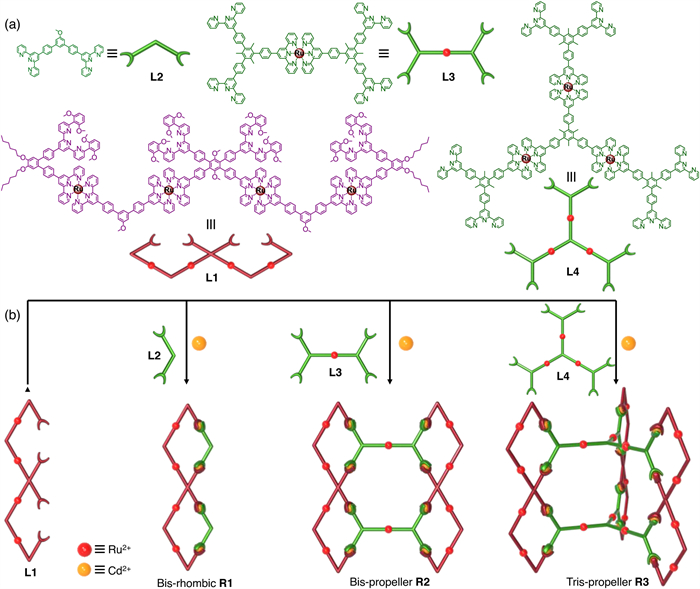
The critical W-shaped bis-mortise ligand L1 was synthesized in a stepwise manner, and the final step was a four-fold Suzuki-coupling between tetra–bromo complex 9 and boronic ester 10. L1 incorporates four free terpyridine (tpy) units, each bearing bulky groups at the 6-position to promote heteroleptic coordination with ordinary tpy units (Scheme S1 in Supporting information) [47,48]. The 1H NMR spectrum of L1 (Fig. 3a and Fig. S25 in Supporting information) showed two partially overlapping resonances at 9.12 and 9.00 ppm with an integration ratio of 1:1. These are assigned to four kinds distinct H3′,5′ protons from the Ru2+-coordinated tpy units (two pairs accidentally overlapping). In the non-aromatic region, five singlets at 4.10, 3.71, 3.70, 3.17, and 3.02 ppm were observed with an integration ratio of 2:8:8:1:1, corresponding to five types of –OCH3 protons. All other protons were assigned based on 2D COSY and 2D NOESY NMR experiments (Figs. S26 and S27 in Supporting information) [49,50]. To confirm the molecular structure of ligand L1, high-resolution ESI-MS was conducted [51–53]. The ESI-MS spectrum exhibits five prominent signals at m/z 761.63, 910.46, 1108.89, 1386.70, and 1803.41, with isotope patterns matching the calculated distributions, corroborating the successful synthesis of L1 (Fig. S57 in Supporting information).

The V-shaped dovetail tenon ligand L2 was next prepared in one step by Suzuki coupling 3,5-dibromoanisole with 4′-(4-boronatophenyl)-2,2′:6′,2′′-terpyridine (Scheme S1 in Supporting information) [54–56]. A mixture of L2, the W-shaped bis-mortise ligand L1 and Cd(NO3)2 (2:1:4 molar ratio) in CHCl3/CH3CN (v/v, 1/2) was stirred at 70 ℃ for 12 h. After cooling to the room temperature, excess saturated methanolic LiNTf2 was added to exchange counter-anions, giving the red precipitate R1 in nearly quantitative yield (97%). The composition of assembled product R1 was unambiguously ensured by NMR and MS analysis. As shown in Fig. 3a, the 1H NMR spectrum of R1 exhibited one set of overlapping aromatic signals (9.15–9.13 ppm) and three singlets (9.09, 9.07, and 9.04 ppm), corresponding to the eight magnetically distinct H3′,5′ protons of the tpy moieties. In the non-aromatic region, two overlapped signal peaks (4.27–4.24 ppm and 2.89 ppm) and four well-resolved singlets (4.14, 4.11, 3.33, and 3.32 ppm) were observed, with an integral ratio of 8:48:6:6:3:3, consistent with two kinds of –OCH2- protons and six kinds of –OCH3 protons (Fig. S37 in Supporting information). Notably, the H6,6" protons of the tpy moiety in R1 exhibited a pronounced upfield shift compared to free ligand L2 [57,58], attributed to electron shielding effects upon coordination with Cd2+, thereby confirming the successful assembly of L1, L2, and Cd2+. The remaining assignments were verified by 2D COSY and 2D NOESY spectra (Figs. S38 and S39 in Supporting information).
ESI-MS and TWIM-MS analyses were carried out to determine the exact composition of R1. As shows in Fig. 3b, the ESI-MS spectrum exhibits a series of continue charge states from 6+ to 14+ at m/z 1798.72, 1501.62, 1278.89, 1105.41, 967.09, 853.70, 759.21, 679.19, and 610.61, arising from sequential loss of NTf2− counter-ions. Deconvolution of the ESI-MS data gives a molecular weight of 12,472 Da for R1, in excellent agreement with the theoretical value calculated for [(Cd4L1L22)(NTf2−)16], thereby confirming the successful formation of the targeted bis-rhombic supramolecule. Moreover, the isotope patterns for all charge states are in excellent agreement with simulations (Fig. S61 in Supporting information). The TWIM-MS plot shows a narrow drift-time distribution for each charge state from 8+ to 13+, confirming the exclusive presence of the target discrete structure and the absence of other isomers (Fig. 3b).
Building on the successful construction of the bis-rhombic supramolecule R1 via the dovetail joint strategy, we redesigned a structurally expanded bis-tenon ligand to further assemble propeller-shaped supramolecules featuring united bis-rhombus motifs. The corresponding metallo-organic ligand L3, bearing the requisite dual-dovetail modules, was then rationally designed and synthesized via an analogous stepwise method (Scheme S2, Figs. S31-S33 and S59 in Supporting information).
Upon addition of ligands L1, L3 and Cd(NO3)2 in CH3CN/CH3OH (v/v, 1/1) in a 1:1:4 stoichiometric ratio, the mixture was refluxed for 8 h (Scheme S5 in Supporting information). After adding an excess methanolic solution of LiNTf2 to exchange the counter-anions, a red precipitate, R2, was obtained in nearly quantitative yield (97%). NMR spectroscopy was preliminarily used to provide structural information. As shown in Fig. 3c, the aromatic region displays one overlapping multiplet (9.03–9.02 ppm) and four singlets (9.06, 8.97, 8.96, and 8.94 ppm) assigned to the nine kinds of tpy-H3′,5′ protons. Signals for the –OCH3 and –OCH2- groups in the non-aromatic region are also consistent with the expected structure (Fig. 3c and Fig. S41 in Supporting information). Compared with L3, the tpy-H6,6" protons of R2 are shifted upfield because of the electron-shielding effect, confirming successful combination of L1 and L3 with Cd2+. All other resonances were unambiguously assigned with the aid of 2D COSY and NOESY analyses (Figs. S42 and S43 in Supporting information). Here, the collective data support the successful assembly of the intended bis-propeller supramolecule.
To confirm the successful assembly of the bis-propeller supramolecule, ESI-MS and TWIM-MS analyses were further performed. The ESI-MS spectrum displayed a continuous series of charge states from 13+ to 23+, generated by sequential loss of NTf2− anions. The observed m/z values matched the theoretical isotope pattern calculated for [(Cd8L12L32)(NTf2−)36], corresponding to a molecular weight of 27,511 Da, thereby corroborating the formation of the target bis-propeller (Fig. 3d). TWIM-MS revealed a single, narrow drift-time distribution for charge states ranging from 15+ to 25+, confirming the sole exist of bis-propeller supramolecule R2 and the absence of isomers or oligomers (Fig. 3d).
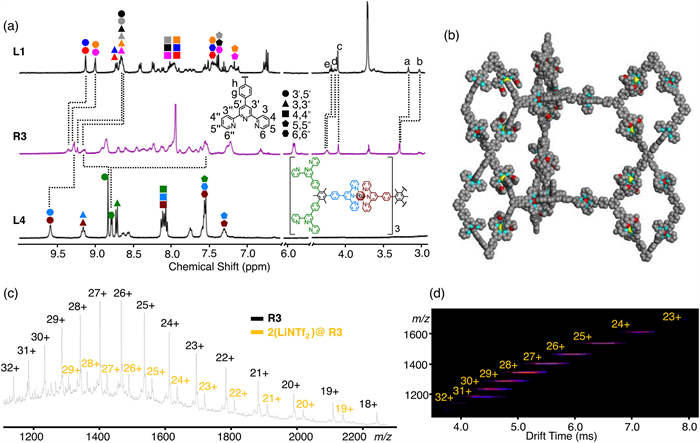
With the planar bis-propeller supramolecule R2 in hand, we now aim to construct multi-propeller architectures and explore more complex three-dimensional tris-propeller systems. Herein, we designed a triple-dovetail metallo-organic ligand L4, constructed from three L2 units interconnected via a〈tpy-Ru2+-tpy〉 coordinated triangular scaffold, exhibiting a fractal-like dendritic architecture. The detailed synthetic procedures and comprehensive characterization data for ligand L4 are provided in Figs. S34-S36 (Supporting information). Similarly, we employed the same strategy to assemble ligands L1 and L4 with Cd(NO3)2, yielding the supramolecular product R3 in nearly quantitative yield (98%). Compared to R1 and R2, R3 displayed markedly reduced solubility in CD3CN, requiring the addition of DMF-d7 to obtain adequate sample concentrations for NMR spectroscopic analysis. The 1H NMR spectra of L1, R3, and L4 are comparatively displayed in Fig 4a. Notably, R3 exhibits broadened signal peaks, consistent with the formation of a high-molecular-weight assembly. All proton resonances were unambiguously assigned using 2D COSY and NOESY spectroscopy (Figs. S46 and S47 in Supporting information). In contrast to ligand L4, assembly product R3 displays significant upfield shifts for the characteristic tpy-H6,6′’ protons, confirming successful coordination to Cd2+ ions. The ESI-MS spectrum of R3 exhibited a consecutive series of m/z peaks corresponding to 18+ to 32+ charge states, resulting from the progressive loss of NTf2− anions (Fig. 4c). Additional low-intensity peaks were attributed to adducts formed with two LiNTf2 units (Figs. S63 and S64 in Supporting information). The experimental data showed excellent agreement with the theoretical values calculated for the tris-propeller supramolecule [(Cd12L13L42)(NTf2−)60] (Fig. 4b), which has a molecular mass of 45,380 Da. TWIM-MS analysis further confirmed the monodisperse nature of R3, as evidenced by a single narrow drift time distribution across the 23+ to 32+ charge states (Fig. 4d). This observation definitively excludes the presence of isomeric or oligomeric species. Taken together, these comprehensive analytical results provide conclusive evidence for the successful assembly of the well-defined, tris-propeller supramolecule R3.
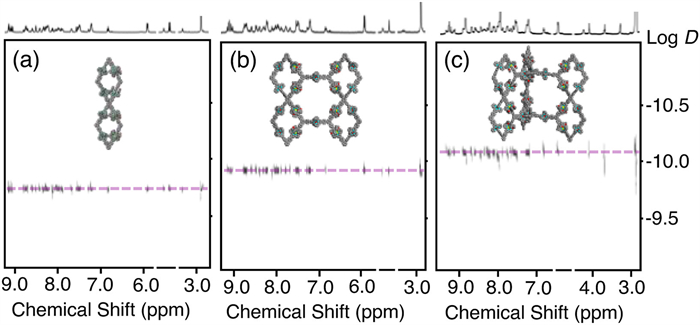
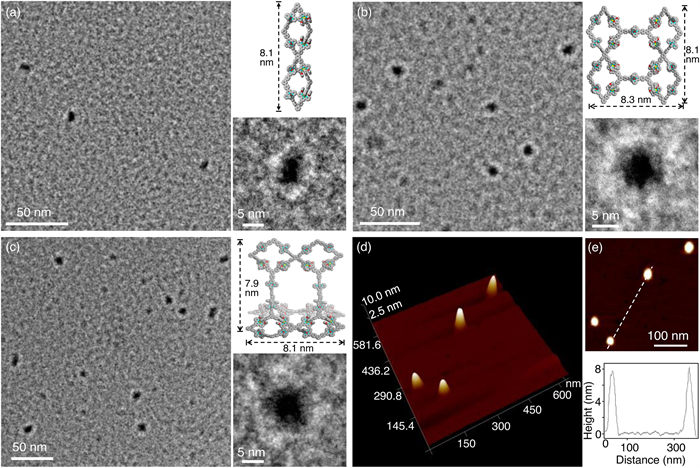
Numerous crystallization attempts were made for R1-R3, but only precipitates were obtained. To elucidate the detail size and height information of the assembly products, we employed diffusion-ordered spectroscopy (DOSY) and transmission electron microscopy (TEM) analysis to characterize the shape and size of R1-R3, while atomic force microscopy (AFM) was utilized for precise height measurements of R3 [59–62]. As illustrated in Fig. 5, the DOSY experiments revealed three distinct bands with diffusion coefficients (LogD) of −9.74, −9.88, and −10.05 for R1-R3, respectively (Table S1 and Fig. S49 in Supporting information). These well-resolved signals clearly indicate the presence of discrete and well-defined species in solution. TEM characterization was performed on supramolecular assemblies R1-R3 by drop-casting their CH3CN solutions (~10–6 mol/L) onto carbon-coated copper grids (400 mesh). As evidenced in Figs. 6a-c, all three assemblies exhibited uniform dispersion on the carbon support. High-resolution imaging showed that R1 exhibited dimensions comparable to its geometry-optimized structure, while R2 and R3 displayed well-defined nanoparticles with diameters of 8.1 ± 0.2 nm and 8.0 ± 0.2 nm, respectively (Fig. S66 in Supporting information). These measurements show excellent agreement with the predicted molecular dimensions from computational modeling (Figs. S67 and S68 in Supporting information), confirming the structural integrity of all three supramolecules in the solid state. AFM topographic imaging clearly resolved monodisperse R3 assemblies on mica with a uniform height of 8.0 ± 0.2 nm (Figs. 6d and e), in excellent agreement with molecular modeling predictions (Fig. S68 in Supporting information). Collectively, these analytical results demonstrate the successful construction of three designed supramolecular architectures: the bis-rhombic R1, bis-propeller R2, and tris-propeller R3.
In summary, we have successfully constructed giant 2D and 3D supramolecular architectures through a bioinspired dovetail joint assembly strategy. Both the fundamental bis-rhombic R1 and expanded bis-propeller R2/tris-propeller R3 demonstrated precise structural control and exceptional stability via rationally designed multi-site ligands. Comprehensive characterization by NMR, ESI-MS, TWIM-MS, TEM, and AFM unequivocally confirmed the well-defined architectures of these supramolecular assemblies. The controlled structural evolution from simple building blocks to complex architectures revealed that enhanced binding interactions and spatial organization contribute significantly to structural integrity. This work provides a new approach for supramolecular engineering and paves the way for developing functional nanomaterials with practical applications.
We declare that we have no financial and personal relationships with other people or organizations that can inappropriately influence our work, there is no professional or other personal interest of any nature or kind in any product, service and/or company that could be construed as influencing the position presented in, or the review of, the manuscript entitled.
He Zhao: Writing – original draft, Formal analysis, Data curation, Conceptualization. Qiangqiang Dong: Methodology, Data curation, Conceptualization. Fengxue Liu: Data curation. Ning Wang: Data curation. Lijun Wang: Data curation. Mingzhao Chen: Methodology, Data curation. Zhilong Jiang: Methodology, Data curation. Die Liu: Supervision, Methodology. Jun Wang: Writing – review & editing, Methodology, Conceptualization. Pingshan Wang: Writing – original draft. Yiming Li: Writing – review & editing, Methodology, Funding acquisition, Conceptualization.
This research was supported by the Hunan Science and Technology Innovation Plan (No. 2024RC3015), the National Natural Science Foundation of China (No. 22501053), National Key Research and Development Program (Nos. 2022YFC3900902 and 2024YFC3907900), Major Science and Technology Projects of Yunnan Province (No. 202302AB080016). The authors gratefully acknowledge the Center for Advanced Research in CSU for the NMR measurements.
Supplementary material associated with this article can be found, in the online version, at doi:
S.R. Seidel, P.J. Stang, Acc. Chem. Res. 35 (2002) 972–983. doi: 10.1021/ar010142d
M. Fujita, M. Tominaga, A. Hori, et al., Acc. Chem. Res. 38 (2005) 369–378. doi: 10.1021/ar040153h
R. Chakrabarty, P.S. Mukherjee, P.J. Stang, Chem. Rev. 111 (2011) 6810–6918. doi: 10.1021/cr200077m
H. Li, Z.J. Yao, D. Liu, et al., Coord. Chem. Rev. 293-294 (2015) 139–157. doi: 10.1016/j.ccr.2014.08.014
T.R. Cook, P.J. Stang, Chem. Rev. 115 (2015) 7001–7045. doi: 10.1021/cr5005666
S. Chakraborty, G.R. Newkome, Chem. Soc. Rev. 47 (2018) 3991–4016. doi: 10.1039/c8cs00030a
W.X. Gao, H.J. Feng, B.B. Guo, et al., Chem. Rev. 120 (2020) 6288–6325. doi: 10.1021/acs.chemrev.0c00321
X.Z. Li, C.B. Tian, Q.F. Sun, Chem. Rev. 122 (2022) 6374–6458. doi: 10.1021/acs.chemrev.1c00602
W. Xue, E. Benchimol, A. Walther, et al., J. Am. Chem. Soc. 146 (2024) 32730–32737. doi: 10.1021/jacs.4c12320
Z. Li, Y. Yan, Z. Chen, et al., CCS Chem. 7 (2025) 2381–2393. doi: 10.31635/ccschem.024.202404796
N. Han, J. Ma, H. Yu, et al., CCS Chem. 6 (2024) 1264–1277. doi: 10.31635/ccschem.023.202303304
B. Olenyuk, M.D. Levin, J.A. Whiteford, et al., J. Am. Chem. Soc. 121 (1999) 10434–10435. doi: 10.1021/ja9931933
X. Lu, X. Li, K. Guo, et al., J. Am. Chem. Soc. 136 (2014) 18149–18155. doi: 10.1021/ja511341z
J.F. Ayme, J.E. Beves, C.J. Campbell, et al., J. Am. Chem. Soc. 141 (2019) 3605–3612. doi: 10.1021/jacs.8b12800
R.G. DiNardi, A.O. Douglas, R. Tian, et al., Angew. Chem. Int. Ed. 61 (2022) e202205701. doi: 10.1002/anie.202205701
F. Su, S. Zhang, Z. Chen, et al., J. Am. Chem. Soc. 144 (2022) 16559–16571. doi: 10.1021/jacs.2c06251
Y. Yang, Y. Du, A.W. Heard, et al., Nat. Synth. 4 (2025) 537–551. doi: 10.1038/s44160-025-00799-3
Y. Tamaki, O. Ishitani, ACS Catal. 7 (2017) 3394–3409. doi: 10.1021/acscatal.7b00440
M. Pan, K. Wu, J.H. Zhang, et al., Coord. Chem. Rev. 378 (2019) 333–349. doi: 10.1016/j.ccr.2017.10.031
Y. Xue, X. Hang, J. Ding, et al., Coord. Chem. Rev. 430 (2021) 213656. doi: 10.1016/j.ccr.2020.213656
D. Xu, Y. Li, S. Yin, et al., Chem. Soc. Rev. 53 (2024) 3167–3204. doi: 10.1039/d3cs00926b
H.J. Feng, L. Zeng, J.Y. Li, et al., J. Am. Chem. Soc. 146 (2024) 21791–21805. doi: 10.1021/jacs.4c06012
Y. Du, A. Ghosh, P.C.P. Teeuwen, et al., J. Am. Chem. Soc. 147 (2025) 20205–20211. doi: 10.1021/jacs.5c05885
H. Yin, J. Yuan, J. Wang, et al., Energy Environ. Sci. 18 (2025) 2231–2242. doi: 10.1039/d4ee05796a
Q.F. Sun, J. Iwasa, D. Ogawa, et al., Science 328 (2010) 1144–1147. doi: 10.1126/science.1188605
D. Fujita, Y. Ueda, S. Sato, et al., Nature 540 (2016) 563–566. doi: 10.1038/nature20771
Z. Zhang, Y. Li, B. Song, et al., Nat. Chem. 12 (2020) 468–474. doi: 10.1038/s41557-020-0454-z
Y. Liu, Z. Jiang, Y. Guan, et al., Cell Rep. Phys. Sci. 3 (2022) 101056. doi: 10.1016/j.xcrp.2022.101056
L. He, H.K. Hsu, L. Li, et al., Chem 8 (2022) 494–507. doi: 10.1016/j.chempr.2021.11.013
H. Zhao, A.M.S.D. Wijerathna, Q. Dong, et al., Angew. Chem. Int. Ed. 63 (2024) e202318029. doi: 10.1002/anie.202318029
W. He, Y. Yu, K. Iizuka, et al., Nat. Chem. 17 (2025) 653–662. doi: 10.1038/s41557-025-01750-x
M. Chen, J. Wang, S.C. Wang, et al., J. Am. Chem. Soc. 140 (2018) 12168–12174. doi: 10.1021/jacs.8b07248
X. Tan, Z. Chen, T. Liu, et al., Adv. Mater. 35 (2023) 2301096. doi: 10.1002/adma.202301096
Y. Tang, X. Zhao, Y. Li, et al., Adv. Funct. Mater. 34 (2024) 2408693. doi: 10.1002/adfm.202408693
Z. Li, K. Lin, H. Fang, et al., J. Mater. Sci. Technol. 133 (2023) 249–258. doi: 10.3390/f14020249
T. Fukino, H. Joo, Y. Hisada, et al., Science 344 (2014) 499–504. doi: 10.1126/science.1252120
C. Zhou, X. Li, Z. Gong, et al., Nat. Commun. 9 (2018) 807. doi: 10.1038/s41467-018-03203-1
G.L. Li, Z. Zhuo, B. Wang, et al., J. Am. Chem. Soc. 143 (2021) 10920–10929. doi: 10.1021/jacs.1c01161
L. Liang, W. Zhao, X.J. Yang, et al., Acc. Chem. Res. 55 (2022) 3218–3229. doi: 10.1021/acs.accounts.2c00435
D. Xiao, Z. Jin, G. Sheng, et al., Nat. Chem. 16 (2024) 1906–1914. doi: 10.1038/s41557-024-01580-3
Z. Du, S. Shen, X. Su, et al., Adv. Mater. 37 (2025) 2502328. doi: 10.1002/adma.202502328
D.W. Binzel, X. Li, N. Burns, et al., Chem. Rev. 121 (2021) 7398–7467. doi: 10.1021/acs.chemrev.1c00009
R. Aqel, P. Severson, R. Elhajjar, Compos. Struct. 327 (2024) 117700. doi: 10.1016/j.compstruct.2023.117700
B. Song, S. Kandapal, J. Gu, et al., Nat. Commun. 9 (2018) 4575. doi: 10.1038/s41467-018-07045-9
H. Zhao, L. Huang, W. Liu, et al., Inorg. Chem. 63 (2024) 4152–4159. doi: 10.1021/acs.inorgchem.3c03899
Z. Jiang, B. Chen, H. Zhao, et al., J. Am. Chem. Soc. 146 (2024) 16721–16728. doi: 10.1021/jacs.4c04310
S.Y. Wang, J.H. Fu, Y.P. Liang, et al., J. Am. Chem. Soc. 138 (2016) 3651–3654. doi: 10.1021/jacs.6b01005
J.H. Fu, S.Y. Wang, Y.S. Chen, et al., J. Am. Chem. Soc. 141 (2019) 16217–16221. doi: 10.1021/jacs.9b08731
G. Wang, M. Chen, J. Wang, et al., J. Am. Chem. Soc. 142 (2020) 7690–7698. doi: 10.1021/jacs.0c00754
J. Wang, H. Zhao, M. Chen, et al., J. Am. Chem. Soc. 142 (2020) 21691–21701. doi: 10.1021/jacs.0c08020
S. Perera, X. Li, M. Soler, et al., Angew. Chem. Int. Ed. 49 (2010) 6539–6544. doi: 10.1002/anie.200906198
X. Li, Y.T. Chan, M. Casiano-Maldonado, et al., Anal. Chem. 83 (2011) 6667–6674. doi: 10.1021/ac201161u
L. Wang, B. Song, Y. Li, et al., J. Am. Chem. Soc. 142 (2020) 9809–9817.
Q. Dong, F. Liu, J. Wang, et al., Angew. Chem. Int. Ed. 64 (2025) e202416327. doi: 10.1002/anie.202416327
Y.Q. Li, H. Zhao, E. Han, et al., Chem. Sci. 16 (2025) 364–370. doi: 10.1039/d4sc07105k
Y.Q. Li, L. Fu, Z. Jiang, et al., Angew. Chem. Int. Ed. 64 (2025) e202503833. doi: 10.1002/anie.202503833
S. Chakraborty, W. Hong, K.J. Endres, et al., J. Am. Chem. Soc. 139 (2017) 3012–3020. doi: 10.1021/jacs.6b11784
H. Wang, Y. Li, H. Yu, et al., J. Am. Chem. Soc. 141 (2019) 13187–13195. doi: 10.1021/jacs.9b05682
G.R. Newkome, P. Wang, C.N. Moorefield, et al., Science 312 (2006) 1782–1785. doi: 10.1126/science.1125894
T. Fukino, H. Joo, Y. Hisada, et al., Science 344 (2014) 499–504. doi: 10.1126/science.1252120
Z. Li, M. Chen, Z. Chen, et al., J. Am. Chem. Soc. 144 (2022) 22651–22661. doi: 10.1021/jacs.2c09726
K. Li, W.M. Qin, W.X. Su, et al., Nat. Commun. 15 (2024) 2799. doi: 10.1038/s41467-024-47150-6

Figure 2 Mortise-and-tenon type ligands and their self-assembly. (a) Mortise-shaped building blocks L1 and tenon-shaped building blocks L2-L4. (b) Self-assembly of bis-rhombic supramolecule R1, bis-propeller supramolecule R2, and tris-propeller supramolecule R3.

Figure 3 1H NMR spectra (400 MHz, 298 K, CD3CN) of (a) L1, R1, and L2, and (c) L1, R2, and L3. ESI-MS spectra and TWIM-MS plots of supramolecules (b) R1 and (d) R2.

Figure 4 1H NMR spectra (400 MHz, 298 K) of (a) L1 in CD3CN, R3 in CD3CN/DMF-d7 (v/v, 4/1), and L4 in CD3CN. (c) Representative energy-minimized structures from molecular model of R3. (b) ESI-MS spectrum and (d) TWIM-MS plot of R3.

Figure 5 DOSY spectra (500 MHz, 298 K) of (a) R1 in CD3CN, (b) R2 in CD3CN, and (c) R3 in CD3CN/DMF-d7 (v/v, 4/1).

 扫一扫看文章


扫一扫关注我们
 DownLoad:

 下载:
下载:
