Solid-state lithium (Li) batteries are hailed as the next-generation energy storage technology, garnering significant attention for their potential high energy density and safety. Particularly when using Li-rich manganese layered oxide (LRMO) as cathodes (theoretical capacity exceeding 250 mAh/g), energy densities over 600 Wh/kg can be theoretically achieved [1,2]. However, reality often falls short of such ideals. Solid-state batteries face significant interfacial challenges in practical applications. The core issues include high interfacial impedance from poor solid-solid contact and the instability of electrolytes against both high-voltage cathodes (above 4.5 V) and strongly reductive anodes [3,4]. For example, conventional polyether (PE)-based electrolytes undergo oxidative decomposition at voltages exceeding 4.0 V, triggering persistent interfacial side reactions. This incompatibility is further exacerbated in LRMO cathodes under high voltages, where irreversible oxygen-involved redox reactions occur, leading to oxygen loss, structural degradation, and severe electrolyte decomposition. Concurrently, the poor oxidation resistance and insufficient Li-ion transport kinetics of conventional PE electrolytes accelerate battery failure. Although applying high external pressure and designing multi-layer electrolytes were shown to improve interfacial contact, these methods introduce practical complications. Sustaining high pressure is difficult, and complex structures often create new interfacial resistances, layer-matching issues, and impaired ion transport. Therefore, the key scientific challenge for practical solid-state batteries lies in constructing stable and efficient solid-solid interfaces without resorting to high external pressure or structural complexity.
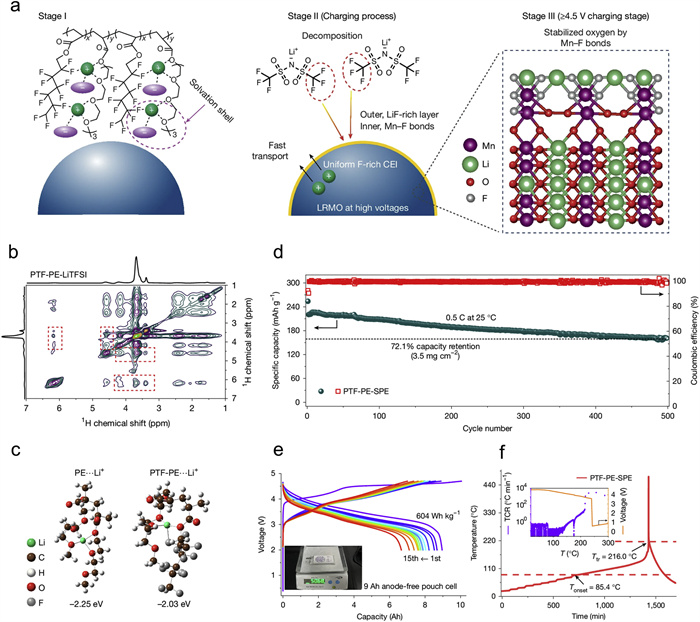
In a recent Nature paper, Zhang, Zhao, and colleagues proposed an innovative “anion-rich solvation structure” design strategy for solid-state batteries within the key principles of Li-bond chemistry (Fig. 1a) [5]. Through precise molecular design, a series of in-built solid polymer electrolytes (SPEs) were obtained via thermally initiated in-situ copolymerization of a strongly solvating PE monomer (poly(ethylene glycol) methyl ether acrylate) with weakly solvating fluorohydrocarbon monomers of varying side-chain lengths. Among them, the PTF-PE copolymer, incorporating the longest fluorohydrocarbon monomer of 2,2,3,3,4,4,5,5,6,6,7,7-dodecafluoroheptyl acrylate, exhibits optimal thermal and oxidation stability. Upon incorporation of Li salt, a unique “−F⋯Li+⋯O−” three-center coordination structure forms induced by intermolecular Li bonding. 2D 1H−1H NOESY nuclear magnetic resonance (NMR) spectra of PTF-PE-salt reveal strong cross-peaks that are absent in the copolymer, confirming a close proximity (< 10 Å) between PTF and PE chains induced by Li+ (Fig. 1b). Complementary 1H and 19F solid-state NMR spectra further validate the direct interaction between Li+ and –CF2 fluorine atoms. Such an interaction upon chain proximity is verified by density functional theory (DFT) calculations, and the F···Li+ bond formation is shown to weaken the initially strong interaction between Li+ and PE chains (Fig. 1c). Thus, the unique coordination structure regulates the Li+ solvation microenvironment, facilitating Li+ dissociation from polymer chains and promoting anion participation in contact ion pairs and aggregates, thereby shifting the solvation structure from “solvent-rich” to “anion-rich”. This Li-bond-based distinct solvation structure drives the spontaneous formation of uniform, stable F-rich interphases at both electrodes, simultaneously suppressing lattice oxygen escape and side reactions at the cathode and guiding uniform Li deposition at the anode. Moreover, with the strongly electron-withdrawing fluorinated groups, the oxidation stability of SPEs is significantly enhanced, resulting in widened voltage window to 4.7 V. Through above Li-bond-motivated dual-interfacial stabilization strategies, this electrolyte system successfully resolves the compatibility issues between high-voltage cathodes and highly reductive anodes in solid-state batteries.
Figure 1
Figure 1.
(a) Schematic illustration of stabilization mechanism of LRMO surface oxygen by the Li-bond-motivated SPE design. Stage Ⅰ is Li-bond-driven formation of anion-rich solvation structures within PTF-PE-SPE; stage Ⅱ is anion decomposition at the charging process; and stage Ⅲ is surface Mn—F bonds formation that suppresses oxygen escape. (b) 2D 1H−1H NOESY NMR spectrum of PTF-PE/LiTFSI (lithium bis(trifluoromethanesulfonyl)imide). (c) DFT calculations for PE⋯Li+ and PTF-PE⋯Li+. (d) Long-term cycling performance of a Li|PTF-PE-SPE|LRMO battery at 0.5 C. (e) The voltage profiles of a 9 Ah anode-free Cu|PTF-PE-SPE|LRMO pouch cell at 0.05 C. The inset shows an optical image taken during the weighting process for an energy density calculation. (f) Thermal runaway features of fully charged Li|PTF-PE-SPE|LRMO pouch cell in extended volume accelerated rate calorimeter (EV-ARC) tests. Tonset is the heat-releasing onset temperature and Ttr is the thermal runaway temperature. TCR, temperature change rate. Reproduced and adapted with permission [5]. Copyright 2025, Springer Nature.
Based on the innovative electrolyte structure and interface regulation strategy, LRMO-based solid-state Li metal batteries using PTF-PE-SPE demonstrate outstanding electrochemical performance. Specifically, after 500 cycles at a 1.0 C rate, the Li|PTF-PE-SPE|LRMO cell retains 72.1% of its capacity with an average coulombic efficiency of 99.5% (Fig. 1d). More notably, a 9-Ah anode-free pouch cell (Cu|PTF-PE-SPE|LRMO) achieves a gravimetric energy density of 604 Wh/kg and a volumetric energy density of 1027 Wh/L under low external pressure of only 1 MPa, substantially exceeding commercial Li iron phosphate batteries (150–190 Wh/kg) and Li nickel cobalt manganese oxide batteries (240–320 Wh/kg) (Fig. 1e). This achievement places its specific energy far above the reported state-of-the-art Li metal pouch cells with polymer or inorganic electrolytes, illustrating the extraordinary effectiveness of PTF-PE-SPE in practical Li batteries. Another significant breakthrough of this work lies in successfully resolving the inherent trade-off between high energy density and safety. Experimental results confirm that even in the fully charged state, the Li|PTF-PE-SPE|LRMO pouch cell passes both nail penetration and 120 ℃ thermal box tests without combustion or explosion. EV-ARC data reveals a thermal runaway temperature of 216.0 ℃, significantly higher than the 122.6 ℃ threshold for liquid electrolyte batteries, demonstrating intrinsic safety characteristics (Fig. 1f). By enhancing the insulating layer and separator through PTF-PE-SPE technology, potential damage during thermal runaway in LRMO-based Li metal batteries can be effectively mitigated.
In summary, this Nature study elevates the voltage tolerance window of PE electrolytes to 4.7 V through Li-bond-based molecular-scale design. Using in-situ polymerization to achieve intimate electrode contact, it simultaneously stabilizes both high-voltage cathode and Li metal anode interfaces within a single electrolyte system. The innovation employs a functional upgrade strategy by modulating the solvation structure toward an anion-rich regime via Li bonds in established PE systems, resolving dual interface challenges through an elegant solution and thus establishing a new paradigm for electrolyte engineering. For industrial implementation, further technical challenges are considered to be resolved. First, fluorinated monomers remain costly, and the thermally initiated in-situ polymerization requires precise environmental control. Future research could explore copolymerization with low-cost monomers able to form Li bonds and investigate efficient polymerization compatible with roll-to-roll manufacturing. Second, interfacial ion transport kinetics under extreme conditions such as at low temperature and under fast charging could be further optimized to meet the requirement by terminal applications such as electrical vehicles and aircrafts. Third, overcoming the challenges of electrochemical fatigue induced by repeated high-stress cycles will be crucial for translating these promising systems into durable and safe real-world batteries. Additionally, machine learning and high-throughput experimentation and computation are potentially promising methods to accelerate upcoming research, forming an efficient closed-loop design and manufacture pipelines towards better solid-state Li batteries. Overall, this research undoubtedly charts a promising course for high-energy-density solid-state batteries. Collaborative efforts across academia and industry are anticipated to optimize materials, innovate manufacturing processes, and integrate multiple strategies, ultimately enabling fundamental transformation of energy and transportation sectors.
Declaration of competing interest
The authors declare that they have no known competing financial interests or personal relationships that could have appeared to influence the work reported in this paper.
Figure 1
(a) Schematic illustration of stabilization mechanism of LRMO surface oxygen by the Li-bond-motivated SPE design. Stage Ⅰ is Li-bond-driven formation of anion-rich solvation structures within PTF-PE-SPE; stage Ⅱ is anion decomposition at the charging process; and stage Ⅲ is surface Mn—F bonds formation that suppresses oxygen escape. (b) 2D 1H−1H NOESY NMR spectrum of PTF-PE/LiTFSI (lithium bis(trifluoromethanesulfonyl)imide). (c) DFT calculations for PE⋯Li+ and PTF-PE⋯Li+. (d) Long-term cycling performance of a Li|PTF-PE-SPE|LRMO battery at 0.5 C. (e) The voltage profiles of a 9 Ah anode-free Cu|PTF-PE-SPE|LRMO pouch cell at 0.05 C. The inset shows an optical image taken during the weighting process for an energy density calculation. (f) Thermal runaway features of fully charged Li|PTF-PE-SPE|LRMO pouch cell in extended volume accelerated rate calorimeter (EV-ARC) tests. Tonset is the heat-releasing onset temperature and Ttr is the thermal runaway temperature. TCR, temperature change rate. Reproduced and adapted with permission [5]. Copyright 2025, Springer Nature.



 DownLoad:

 下载:
下载: