Citation: Xinjuan He, Zishuo Wang, Boyang Wang, Yongqiang Zhang, Xiaokai Xu, Huijuan Cai, Siyu Lu. Recent advances in carbon dots imaging at the subcellular level: Synthesis strategies, properties, and organelle imaging[J]. Chinese Chemical Letters, ;2026, 37(2): 111957. doi: 10.1016/j.cclet.2025.111957 shu

Recent advances in carbon dots imaging at the subcellular level: Synthesis strategies, properties, and organelle imaging

Figures(3)

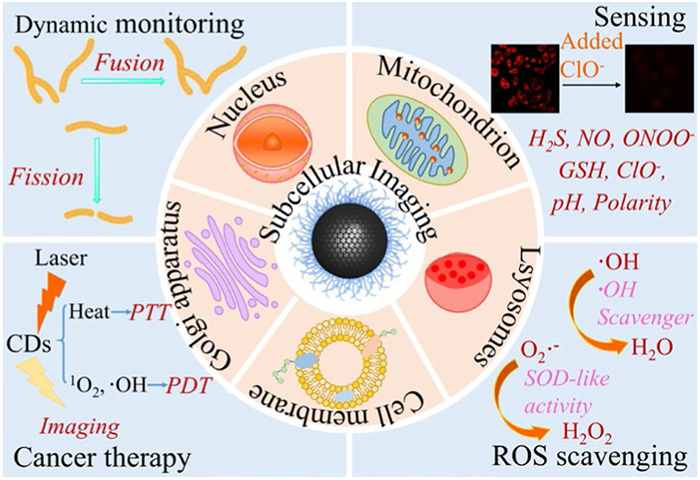
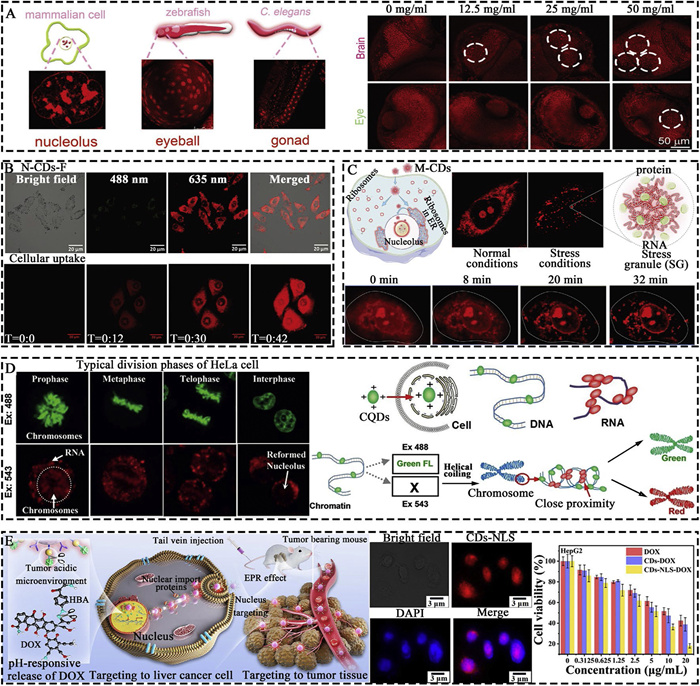
  • Carbon dots (CDs), a class of emerging fluorescent nanomaterials, have garnered notable attention in the biomedical field owing to their outstanding photoluminescence properties, excellent biocompatibility, and ease of synthesis and functionalization. Recently, numerous CDs have been developed that allow precise subcellular localization through surface modifications or covalent conjugation with targeting ligands such as peptides, small molecules, Golgi-specific agents, and cell membrane-specific agents. This review begins with an overview of the synthesis strategies of CDs, highlighting their exceptional optical properties, stability, biocompatibility, and significance for subcellular imaging. The mechanisms by which CDs target specific organelles, including the nucleus, mitochondrion, lysosomes, Golgi apparatus, and cell membrane, are discussed. These mechanisms include specific targeting molecules, pH-sensitive targeting, charge-driven interactions, and hydrophobic and hydrophilic dynamics. Furthermore, we summarize their applications in subcellular imaging, such as the long-term dynamic monitoring of organelles, sensing, reactive oxygen species scavenging, and therapy. By presenting a comprehensive review of CDs in subcellular imaging, we aim to pave the way for further development of CDs in bioimaging and related biomedical applications.
  • 加载中
    1. [1]

      D.E. Gottschling, T. Nystrom, Cell 169 (2017) 24–34.

    2. [2]

      N. Chou, H. Shin, K. Kim, et al., Adv. Sci. 9 (2022) 2103564.

    3. [3]

      H. Fang, Y. Chen, Z. Jiang, W. He, Z. Guo, Acc. Chem. Res. 56 (2023) 258–269.  doi: 10.1021/acs.accounts.2c00643

    4. [4]

      E.A. Specht, E. Braselmann, A.E. Palmer, Annu. Rev. Physiol. 79 (2017) 93–117.  doi: 10.1146/annurev-physiol-022516-034055

    5. [5]

      H. Ali, S. Ghosh, N. Jana, WIREs Nanomed. Nanobiotechnol. 12 (2020) e1617.

    6. [6]

      B. Unnikrishnan, R.S. Wu, S.C. Wei, C.C. Huang, H.T. Chang, ACS Omega 5 (2020) 11248–11261.  doi: 10.1021/acsomega.9b04301

    7. [7]

      V.G. Reshma, P.V. Mohanan, J. Lumin. 205 (2019) 287–298.

    8. [8]

      B. Chen, F. Wang, Trends Chem. 2 (2020) 427–439.

    9. [9]

      F. An, N. Chen, W. Conlon, et al., Int. J. Biol. Macromol. 153 (2020) 100–106.

    10. [10]

      C. Shen, Q. Lou, K. Liu, L. Dong, C. Shan, Nano Today 35 (2020) 100954.

    11. [11]

      B. Wang, Z. Wei, L. Sui, et al., Light Sci. Appl. 11 (2022) 172.

    12. [12]

      Z. Peng, X. Han, S. Li, et al., Coord. Chem. Rev. 343 (2017) 256–277.

    13. [13]

      Y. Zhang, S. Lu, Chem 10 (2024) 134–171.

    14. [14]

      L. Shi, L. Ding, Y. Zhang, S. Lu, Nano Today 55 (2024) 102200.

    15. [15]

      Y. Jiang, T. Zhao, W. Xu, Z. Peng, Carbon 219 (2024) 118838.

    16. [16]

      B. Wang, H. Cai, G.I.N. Waterhouse, et al., Small Sci. 2 (2022) 2200012.

    17. [17]

      Y. Song, C. Zhu, J. Song, et al., ACS Appl. Mater. Interfaces 9 (2017) 7399–7405.  doi: 10.1021/acsami.6b13954

    18. [18]

      Z. Wang, K.F. Xu, G. Wang, et al., Chem. Eng. J. 457 (2023) 140997.

    19. [19]

      C. Shen, H. Liu, Q. Lou, et al., Theranostics 12 (2022) 2860–2893.  doi: 10.7150/thno.70721

    20. [20]

      J. Liu, R. Li, B. Yang, ACS Cent. Sci. 6 (2020) 2179–2195.  doi: 10.1021/acscentsci.0c01306

    21. [21]

      S. Li, L. Li, H. Tu, et al., Mater. Today 51 (2021) 188–207.

    22. [22]

      C. Xia, S. Zhu, T. Feng, M. Yang, B. Yang, Adv. Sci. 6 (2019) 1901316.

    23. [23]

      Y. Ru, G.I.N. Waterhouse, S. Lu, Aggregate 3 (2022) e296.

    24. [24]

      J. Li, X. Gong, Small 18 (2022) 2205099.

    25. [25]

      N. Wang, A. Zheng, X. Liu, et al., ACS Appl. Mater. Interfaces 10 (2018) 7901–7909.  doi: 10.1021/acsami.8b00947

    26. [26]

      T.C. Wareing, P. Gentile, A.N. Phan, ACS Nano 15 (2021) 15471–15501.  doi: 10.1021/acsnano.1c03886

    27. [27]

      R. González-González, L. González, M. Madou, et al., Nanomaterials 12 (2022) 298.  doi: 10.3390/nano12030298

    28. [28]

      E. Liu, J. Wu, T. Liang, et al., Chin. J. Chem. 41 (2023) 1994–2001.  doi: 10.1002/cjoc.202300101

    29. [29]

      C.P. Satori, M.M. Henderson, E.A. Krautkramer, et al., Chem. Rev. 113 (2013) 2733–2811.  doi: 10.1021/cr300354g

    30. [30]

      J. Huang, P. Meng, C. Wang, Y. Zhang, L. Zhou, Theranostics 12 (2022) 2445–2464.  doi: 10.7150/thno.70588

    31. [31]

      R. Yao, C. Ren, Z. Xia, Y. Yao, Autophagy 17 (2021) 385–401.  doi: 10.1080/15548627.2020.1725377

    32. [32]

      R. Boon, G.G. Silveira, R. Mostoslavsky, Nat. Metab. 2 (2020) 1190–1203.  doi: 10.1038/s42255-020-00285-4

    33. [33]

      A. Parra-Damas, C.A. Saura, Biol. Psychiatry 86 (2019) 87–96.

    34. [34]

      K. Xu, H. Jia, Z. Wang, et al., Small 19 (2023) 2205890.

    35. [35]

      L. Wang, M. Li, Y. Li, et al., Carbon 180 (2021) 48–55.

    36. [36]

      L. Jiang, H. Ding, M. Xu, et al., Small 16 (2020) 2000680.

    37. [37]

      L. Yue, Y. Wei, J. Fan, et al., New Carbon Mater. 36 (2021) 373–389.

    38. [38]

      X. Hua, Y. Bao, J. Zeng, F. Wu, ACS Appl. Mater. Interfaces 11 (2019) 32647–32658.  doi: 10.1021/acsami.9b09590

    39. [39]

      P. Tan, T. Hong, X. Cai, et al., Nucleic Acids Res. 50 (2022) e69.  doi: 10.1093/nar/gkac191

    40. [40]

      H. He, X. Chen, Z. Feng, et al., Nano Lett. 21 (2021) 5689–5696.  doi: 10.1021/acs.nanolett.1c01420

    41. [41]

      L. Jiang, H. Cai, W. Zhou, et al., Adv. Mater. 35 (2023) 2210776.

    42. [42]

      H. Li, H. Wang, J. Guo, et al., Sens. Actuator. B: Chem. 311 (2020) 127891.

    43. [43]

      G. Han, J. Zhao, R. Zhang, et al., Angew. Chem. Int. Ed. 58 (2019) 7087–7091.  doi: 10.1002/anie.201903005

    44. [44]

      T. Feng, X. Ai, G. An, P. Yang, Y. Zhao, ACS Nano 10 (2016) 4410–4420.  doi: 10.1021/acsnano.6b00043

    45. [45]

      S. Li, W. Su, H. Wu, et al., Nat. Biomed. Eng. 4 (2020) 704–716.

    46. [46]

      L. Pan, J. Liu, J. Shi, Chem. Soc. Rev. 47 (2018) 6930–6946.  doi: 10.1039/c8cs00081f

    47. [47]

      X. Liu, Z. Zhao, X. Xu, et al., Adv. Funct. Mater. 35 (2024) 2416406.

    48. [48]

      C.F. Thorn, C. Oshiro, S. Marsh, et al., Pharmacogenet. Genomics 21 (2011) 440–446.

    49. [49]

      Q. Li, J. Fan, H. Mu, et al., Chin. Chem. Lett. 35 (2024) 108947.

    50. [50]

      J. Chen, F. Li, J. Gu, et al., J. Colloid Interface Sci. 637 (2023) 193–206.

    51. [51]

      J. Rahman, S. Rahman, Lancet 391 (2018) 2560–2574.

    52. [52]

      R.P. Chakrabarty, N.S. Chandel, Cell Stem Cell 28 (2021) 394–408.

    53. [53]

      D.C. Wallace, Nat. Genet. 50 (2018) 1642–1649.  doi: 10.1038/s41588-018-0264-z

    54. [54]

      K.F. Macleod, Annu. Rev. Cancer Biol. 4 (2020) 41–60.  doi: 10.1146/annurev-cancerbio-030419-033405

    55. [55]

      P. Zhu, W. Li, Y. Zhang, et al., Chin. Chem. Lett. 34 (2023) 108239.

    56. [56]

      C. Liu, W. Fan, W.X. Cheng, et al., Adv. Funct. Mater. 33 (2023) 2213856.

    57. [57]

      S. He, N. Sharpless, Cell 169 (2017) 1000–1011.

    58. [58]

      W. Yang, K. Li, Q. Pan, et al., ACS Nano 18 (2024) 3053–3072.  doi: 10.1021/acsnano.3c08097

    59. [59]

      C. Rizzo, F. Arcudi, L. Đorđević, et al., ACS Nano 12 (2018) 1296–1305.  doi: 10.1021/acsnano.7b07529

    60. [60]

      Y. Shi, W. Bu, D. Chu, et al., Adv. Healthcare Mater. 13 (2024) 2303206.

    61. [61]

      J. Yin, X. Zheng, Y. Zhao, et al., Angew. Chem. Int. Ed. 63 (2024) e202402537.

    62. [62]

      K. Zhang, X. Mao, H. Zhao, et al., Chem. Eng. J. 499 (2024) 156544.

    63. [63]

      S.S. Liew, X. Qin, J. Zhou, et al., Angew. Chem. Int. Ed. 60 (2021) 2232–2256.  doi: 10.1002/anie.201915826

    64. [64]

      H. Kimura, Antioxid. Redox Signal. 20 (2014) 783–793.  doi: 10.1089/ars.2013.5309

    65. [65]

      H. Cai, A. Liu, M. Zhang, et al., Sens. Actuator. B: Chem. 367 (2022) 132048.

    66. [66]

      N.A. Burmistrova, R.J. Meier, S. Schreml, A. Duerkop, Sens. Actuator. B: Chem. 193 (2014) 799–805.

    67. [67]

      B. Cheng, L. Cao, C. Li, et al., Chin. Chem. Lett. 35 (2024) 108969.

    68. [68]

      X. Geng, Y. Sun, Z. Li, et al., Small 15 (2019) 1901517.

    69. [69]

      D.C. Chan, Annu. Rev. Pathol. Mech. Dis. 15 (2020) 235–259.  doi: 10.1146/annurev-pathmechdis-012419-032711

    70. [70]

      L. Tábara, M. Segawa, J. Prudent, Nat. Rev. Mol. Cell Biol. 26 (2024) 123–146.

    71. [71]

      Z. Ye, L. Wei, X. Geng, et al., ACS Nano 13 (2019) 11593–11602.  doi: 10.1021/acsnano.9b05354

    72. [72]

      N. Xin, D. Gao, B. Su, et al., ACS Sens. 8 (2023) 1161–1172.  doi: 10.1021/acssensors.2c02451

    73. [73]

      P.E. Porporato, N. Filigheddu, J.M.B. Pedro, G. Kroemer, L. Galluzzi, Cell Res. 28 (2018) 265–280.  doi: 10.1038/cr.2017.155

    74. [74]

      Y. Shen, X. Zhang, L. Liang, et al., Carbon 156 (2020) 558–567.

    75. [75]

      Q. Xiang, W. Li, Y. Tan, et al., Chem. Eng. J. 444 (2022) 136706.

  • 加载中
    1. [1]

      Ping WangChunmao ChenHongwei RenErhong Duan . A review of carbon dots in synthesis strategies, photoluminescence mechanisms, and applications in wastewater treatment. Chinese Chemical Letters, 2025, 36(9): 110725-. doi: 10.1016/j.cclet.2024.110725

    2. [2]

      Tiantian Gong Yanan Chen Shuo Wang Miao Wang Junwei Zhao . Rigid-flexible-ligand-ornamented lanthanide-incorporated selenotungstates and photoluminescence properties. Chinese Journal of Structural Chemistry, 2024, 43(9): 100370-100370. doi: 10.1016/j.cjsc.2024.100370

    3. [3]

      Xuan Zhu Lin Zhou Xiao-Yun Huang Yan-Ling Luo Xin Deng Xin Yan Yan-Juan Wang Yan Qin Yuan-Yuan Tang . (Benzimidazolium)2GeI4: A layered two-dimensional perovskite with dielectric switching and broadband near-infrared photoluminescence. Chinese Journal of Structural Chemistry, 2024, 43(6): 100272-100272. doi: 10.1016/j.cjsc.2024.100272

    4. [4]

      Xiao-Tong Sun Hao-Fei Ni Yi Zhang Da-Wei Fu . Hybrid perovskite shows temperature-dependent photoluminescence and dielectric response triggered by halogen substitution. Chinese Journal of Structural Chemistry, 2024, 43(6): 100212-100212. doi: 10.1016/j.cjsc.2023.100212

    5. [5]

      Qiang LiJiangbo FanHongkai MuLin ChenYongzhen YangShiping Yu . Nucleus-targeting orange-emissive carbon dots delivery adriamycin for enhanced anti-liver cancer therapy. Chinese Chemical Letters, 2024, 35(6): 108947-. doi: 10.1016/j.cclet.2023.108947

    6. [6]

      Boran ChengLei CaoChen LiFang-Yi HuoQian-Fang MengGanglin TongXuan WuLin-Lin BuLang RaoShubin Wang . Fluorine-doped carbon quantum dots with deep-red emission for hypochlorite determination and cancer cell imaging. Chinese Chemical Letters, 2024, 35(6): 108969-. doi: 10.1016/j.cclet.2023.108969

    7. [7]

      Bohan ZhangBingzhe WangGuichuan XingZikang TangSongnan Qu . Regulation of the multi-emission centers in carbon dots via a bottom-up synthesis approach. Chinese Chemical Letters, 2024, 35(9): 109358-. doi: 10.1016/j.cclet.2023.109358

    8. [8]

      Xiaoqin DuPeiyao PanHaoqi LiDi ZhangWentao HuangXi KangManzhou Zhu . Assessing the photoluminescence of metal nanoclusters: The individual versus the collective. Chinese Chemical Letters, 2026, 37(2): 111155-. doi: 10.1016/j.cclet.2025.111155

    9. [9]

      Yupeng LiuHui WangSongnan Qu . Review on near-infrared absorbing/emissive carbon dots: From preparation to multi-functional application. Chinese Chemical Letters, 2025, 36(5): 110618-. doi: 10.1016/j.cclet.2024.110618

    10. [10]

      Qiang FuShouhong SunKangzhi LuNing LiZhanhua Dong . Boron-doped carbon dots: Doping strategies, performance effects, and applications. Chinese Chemical Letters, 2024, 35(7): 109136-. doi: 10.1016/j.cclet.2023.109136

    11. [11]

      Chenghao LiuXiaofeng LinJing LiaoMin YangMin JiangYue HuangZhizhi DuLina ChenSanjun FanQitong Huang . Carbon dots-based dopamine sensors: Recent advances and challenges. Chinese Chemical Letters, 2024, 35(12): 109598-. doi: 10.1016/j.cclet.2024.109598

    12. [12]

      Quan ZhangShunjie XingJingqian HanLi FengJianchun LiZhaosheng QianJin Zhou . Organic pollutant sensing for human health based on carbon dots. Chinese Chemical Letters, 2025, 36(1): 110117-. doi: 10.1016/j.cclet.2024.110117

    13. [13]

      Yuan LiuBoyang WangYaxin LiWeidong LiSiyu Lu . Understanding excitonic behavior and electroluminescence light emitting diode application of carbon dots. Chinese Chemical Letters, 2025, 36(2): 110426-. doi: 10.1016/j.cclet.2024.110426

    14. [14]

      Jianye KangXinyu YangXuhao YangJiahui SunYuhang LiuShutao WangWenlong Song . Carbon dots-enhanced pH-responsive lubricating hydrogel based on reversible dynamic covalent bondings. Chinese Chemical Letters, 2024, 35(5): 109297-. doi: 10.1016/j.cclet.2023.109297

    15. [15]

      Rui ChengTingting ZhangXin HuangJian Yu . Facile synthesis of high-brightness green-emitting carbon dots with narrow bandwidth towards backlight display. Chinese Chemical Letters, 2024, 35(5): 108763-. doi: 10.1016/j.cclet.2023.108763

    16. [16]

      Wu-Jian LongYang YuChuang He . A novel and promising engineering application of carbon dots: Enhancing the chloride binding performance of cement. Chinese Chemical Letters, 2024, 35(6): 108943-. doi: 10.1016/j.cclet.2023.108943

    17. [17]

      Xiaoning LiQuanyu ShiMeng LiNingxin SongYumeng XiaoHuining XiaoTony D. JamesLei Feng . Functionalization of cellulose carbon dots with different elements (N, B and S) for mercury ion detection and anti-counterfeit applications. Chinese Chemical Letters, 2024, 35(7): 109021-. doi: 10.1016/j.cclet.2023.109021

    18. [18]

      Hao CaiXiaoyan WuLei JiangFeng YuYuxiang YangYan LiXian ZhangJian LiuZijian LiHong Bi . Lysosome-targeted carbon dots with a light-controlled nitric oxide releasing property for enhanced photodynamic therapy. Chinese Chemical Letters, 2024, 35(4): 108946-. doi: 10.1016/j.cclet.2023.108946

    19. [19]

      Liwen WangBoyang WangSiyu LuShubo LvXiaoli Qu . High quantum yield yellow emission carbon dots for the construction of blue light blocking films. Chinese Chemical Letters, 2025, 36(2): 110497-. doi: 10.1016/j.cclet.2024.110497

    20. [20]

      Meiling XuXinyang LiPengyuan LiuJunjun LiuXiao HanGuodong ChaiShuangling ZhongBai YangLiying Cui . A novel and visible ratiometric fluorescence determination of carbaryl based on red emissive carbon dots by a solvent-free method. Chinese Chemical Letters, 2025, 36(2): 109860-. doi: 10.1016/j.cclet.2024.109860

Metrics
  • PDF Downloads(0)
  • Abstract views(10)
  • HTML views(1)

通讯作者: 陈斌, bchen63@163.com
  • 1. 

    沈阳化工大学材料科学与工程学院 沈阳 110142

  1. 本站搜索
  2. 百度学术搜索
  3. 万方数据库搜索
  4. CNKI搜索
Address:Zhongguancun North First Street 2,100190 Beijing, PR China Tel: +86-010-82449177-888
Powered By info@rhhz.net

/

DownLoad:  Full-Size Img  PowerPoint
Return