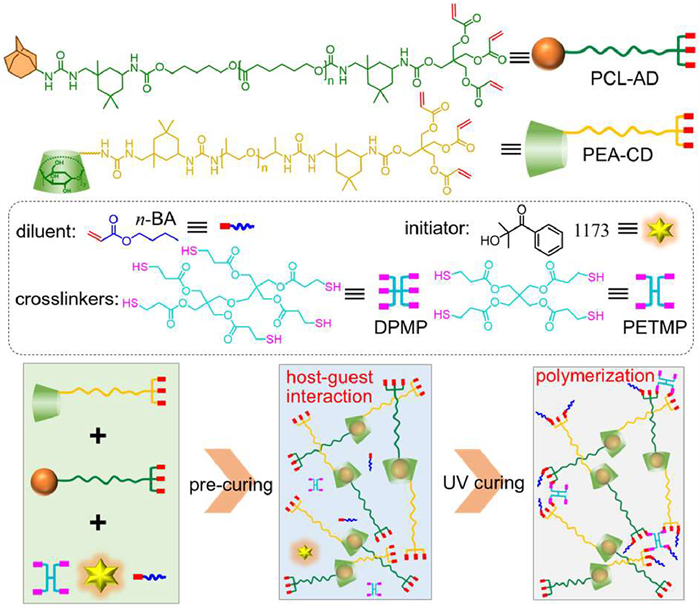
Scheme 1.
Schematic illustration of UV curing adhesives.

Host-guest interaction mediated low-shrinkage photosensitive positioning adhesive
Zhao Liu , Junjian Xie , Xiaoming Ren , Muhammad Tahir , Shixin Fa , Qiuyu Zhang


UV curing adhesives are receiving increasing attention for their use in precision bonding, particularly in the electronics industry [1–9]. The assembly of electronic products requires precise positioning of multiple parts at room temperature, which is often time-consuming and sensitive to moisture and solvents. These needs have prompted the use of UV curing adhesives [10–14]. UV curing adhesives are mainly divided into epoxy type [15] and polyurethane acrylate type [16] according to reactive functional groups. They achieve curing based on the epoxy ion ring-opening mechanisms and free-radical chain reactions of olefinic groups, respectively. In general, epoxy-based adhesives have good adhesion to metals, but their brittleness and weak impact strength make them less suitable for silicon-based electronics [17–28]. In contrast, polyurethane acrylate adhesives can be used on many occasions due to their good flexibility and weather resistance [29–35]. A variety of polyurethane acrylates have been developed and used in electronic packaging. However, most polyurethane acrylate adhesives are still limited in two important ways. First, the viscosity of the adhesive before UV curing cannot be controlled precisely. The low viscosity of adhesive facilitates wetting on silicon-based surfaces, but since the bonding work is often carried out on non-horizontal surfaces and not for short periods of time, loss of adhesive due to flow is unavoidable. Secondly, rapid free-radical polymerization of olefins during the curing process produces single bonds that leads to adhesive shrinkage and inaccurate or even misalignment of electronic components [36,37]. Although the incorporation of specific additives [38] and expanding monomers [39] can help reduce adhesive shrinkage, this often involves tedious molecular design or complicated system.
Here, we develop a supramolecular interaction mediated UV curing adhesive, enabling low volume shrinkage after curing. The main components of this adhesive are two prepolymers, polyurethane adamantane (PCL-AD) and polyurea-cyclodextrin (PEA-CD), which are stored separately until use (Scheme 1). The ends of both prepolymers contain triacrylate groups, while other ends of PCL-AD and PEA-CD are adamantane (AD) and cyclodextrin (CD), respectively. The curing process includes two steps: Supramolecular pre-curing and UV-driven curing. In the pre-curing step, the host-guest interaction between CD and AD promotes the thorough mixing of the two prepolymers to form a supramolecular assembly and to increase the viscosity significantly, thus preventing adhesive loss and making preliminary positioning. Subsequently, the triacrylate at both ends of the supramolecular assembly and the additive thiol would undergo thiol-ene "click" polymerization under UV irradiation to complete curing. The supramolecular pre-organization during pre-curing presets the internal network of the adhesive, reducing the space for further shrinkage. Moreover, different from other UV curing adhesives, the thiol-ene “click” reaction is a stepwise polymerization process that reduces the shrinkage stress. Therefore, the volume shrinkage rate of the adhesive is < 2% after curing. More importantly, the photosensitive adhesive endows excellent UV lithography performance, which can realize high-volume lithography.
The two prepolymers (PCL-AD and PEA-CD) were synthesized from polycaprolactone (PCL, MW = 1000) and polyetheramine (PEA, MW = 400) respectively, to ensure the flexibility and mechanical strength of the adhesive. The terminal hydroxyl and amino groups of the PCL and PEA were first reacted with excess isophorone diisocyanate (IPDI) to introduce isocyanate groups at both ends. Next, 1-amantadine or amino-modified CD was added by peristaltic pump to condense with isocyanate groups. Finally, the remaining isocyanates are subjected to end capping reaction with triacrylate (Scheme S1 in Supporting information). The synthesis process was initially monitored with FTIR (Fig. S8 in Supporting information). The characteristic peak of the isocyanate group at 2267 cm-1 was observed after introduction of IPDI in PCL and PEA, and it was disappeared when interacted with 1-adamantanamine, amino-modified CD and pentaerythritol triacrylate, indicating successful end-capping of the terminal isocyanate group. The NMR spectra also revealed the successful synthesis of the prepolymers (Figs. S4-S7 in Supporting information). For example, characteristic resonances of terminal allyl groups at the end of both prepolymers can be observed at around 6 ppm on the 1H NMR spectra (Figs. S4 and S6). On the 13C NMR spectra of PCL-AD, the peaks at 29.4 and 36.6 ppm revealed the fusing with adamantane (Fig. S5), while the characteristic peaks of CD were also observed on the 13C NMR spectra of PEA-CD (Fig. S7).
Before use, the two prepolymers were separately mixed with functional additives to make stock solutions and stored individually. Stock solution A contains PEA-CD (1.2 g), diluent n–butyl acrylate (n-BA, 0.5 g) and photoinitiator 1173 (0.04 g). Stock solution B contains PCL-AD (1.0 g), diluent n-BA (0.5 g) and thiol for subsequent photopolymerization. Two different thiols, pentaerythritol tetra(3-mercaptopropionate) (PETMP) and dipentaerythritol hexakis(3-mercaptopropionate) (DPMP) were systematically studied with the dosage of 0.2, 0.4, 0.6, 0.8, and 1.0 g, respectively.
The two stock solutions are thoroughly mixed and evenly coated in a petri dish with a diameter of 60 mm. After standing for 28 min, the mixture was irradiated under 365 nm for 3 min. UV cured polymer films were obtain for various performance tests. The combinations using PETMP and DPMP were hereinafter denoted as P-n and D-n (n = 0.2, 0.4, 0.6, 0.8, 1.0), respectively (Table 1, Tables S1 and S2 in Supporting information).

 DownLoad:
CSV
DownLoad:
CSV
| Entry (P or D) | Solution A (PEA-CD/n-BA/1173) (g) | Solution B (PCL-AD/n-BA/PETMP) or (PCL-AD/n-BA/DPMP) (g) |
| 0.2 | 1.2/0.5/0.04 | 1.0/0.5/0.2 |
| 0.4 | 1.2/0.5/0.04 | 1.0/0.5/0.4 |
| 0.6 | 1.2/0.5/0.04 | 1.0/0.5/0.6 |
| 0.8 | 1.2/0.5/0.04 | 1.0/0.5/0.8 |
| 1.0 | 1.2/0.5/0.04 | 1.0/0.5/1.0 |
The curing efficiency was initially determined by testing the solid content of the films (Fig. 1a). The solid content of the P-series reached the maximum (97%) when 0.4 g of thiol was added, because the crosslinking density of the adhesives initially enhanced as increasing the thiols. In contrary, excess thiols enhanced the opportunity that both ends of the prepolymers were end-capped by thiols, thereby reducing the cross-linking density and hindering the UV curing of the system. When the hexafunctional thiol (DPMP) was used, the highest solid content was achieved with 0.2 g of thiol because the hexafunctional thiol possesses more reactive groups than the tetrafunctional thiol (PETMP). These observations indicated that fine-tuning the ratio of each component has a great impact on material properties. The mechanical properties of the films were also investigated via tensile tests (Fig. 1b and Fig. S9 in Supporting information). P-0.4 and D-0.2 achieved the maximization of both the tensile strength and elongation at break in the P-series and D-series respectively, which was aligned with the trend of curing efficiency. Moreover, all films were found to possess good heat resistance and water resistance (Figs. S10 and S11 in Supporting information). Their temperature at 5% weight loss (T5%) during thermogravimetric analysis measurement reached around 300 ℃, while the water absorption rate in boiling water for 8 h were < 10%. Compared with other literature reports, the combined host-guest interaction and thiol-ene click chemistry significantly enhanced the thermal stability of the adhesive (Fig. S12 in Supporting information). Notably, the highest T5% and lowest water absorption of the P-and D-series were obtained when 0.4 g of PETMP and 0.2 g of DPMP were adopted respectively (Tables S1 and S2), which was in good consistent with their curing efficiency. These properties provided basic conditions for the application of photosensitive adhesives in the bonding of electronic components.
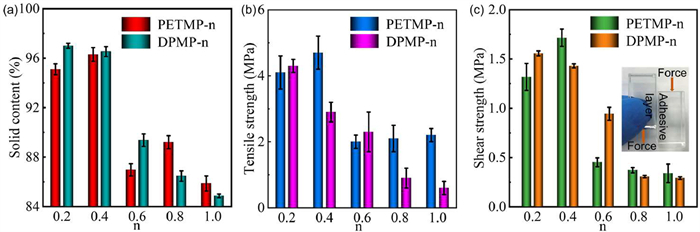
Subsequently, the bonding performance of photosensitive adhesives was further investigated through the peak shear strength of the glass block bonding with the adhesive (Fig. 1c). The stock solutions A and B of the photosensitive adhesive were evenly spread on the surface of one glass block that has been cleaned with alcohol, covered with another glass block and pressed lightly to make the adhesive immersed in the glass blocks. Then, the adhesive was cured under UV light for 3 min. As shown in Fig. 1c, the shear strength reaches a maximum of 1.72 MPa when the film contains 0.4 g of the tetrafunctional thiol, which can meet the bonding requirements of most electronic components. For the hexafunctional thiol system, the adhesive strength of the photosensitive adhesive gradually decreases with the increase of thiol addition. A higher crosslinking density makes the film harder and resist slippage better when the film is subjected to shearing, so as to carry more force. As more thiol was used, the prepared layer was softer and weaker, and the shear strength showed a decreasing trend due to the effect of excess thiol plasticization.
The shrinkage rate of adhesives is particularly important for the positioning effect when electronic components are bonded. We characterized the shrinkage rate of the P- and D-series of the photosensitive adhesives after UV curing. As illustrated in Fig. 2a, all the adhesives demonstrated here possess excellent low shrinkage performance. With increasing the thiol addition, the curing shrinkage of the adhesive decreased as low as ca. 1.2%, because excess thiol improved the adaptability of the polymer chain and was beneficial to release of the entire system. Nevertheless, the optimized mechanical properties and low shrinkage rate could be achieved by controlling thiol addition. The excellent low UV-curing shrinkage of the two series of adhesives is likely to come from the supramolecular interaction between the two prepolymers. It is probable that the adamantane and cyclodextrin in the two prepolymers complexed through host-guest interaction when no UV light is applied at the initial stage, thereby forming supramolecular cross-linked network in the adhesive. This pre-curing process increased the viscosity of the adhesive and built up the framework of the system, ensuring the low shrinkage when irradiated with UV light.
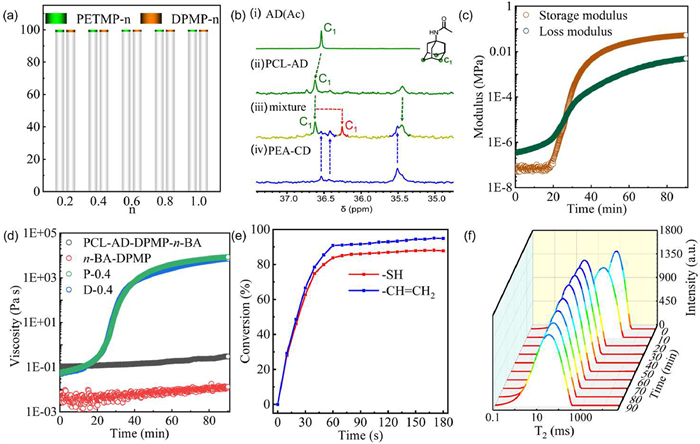
The complexation between the CD and AD moieties was preliminarily verified with 13C NMR measurement (Fig. 2b). The characteristic peak of AD at 36.6 ppm was partially up-field shifted to 36.2 ppm in the mixture of PCL-AD and PEA-CD in DMSO–d6 due to the shielding effect, suggesting the considerable host-guest complexation of PCL-AD and PEA-CD even in a high-permittivity organic solvent. In addition, the supramolecular interaction in the adhesive mixture was further investigated via rheological tests. As shown in Fig. S13a (Supporting information), the storage modulus and loss modulus after mixing PCL-AD and PEA-CD in DMF intersect with each other at approximate 70 min without any external stimulation, indicating gradual gelation of the system. This observation strongly suggests the supramolecular interactions between the AD and CD moieties in the system. Adding diluent n-BA in the above mixture can greatly shorten the gelation time to ca. 28 min (Fig. 2c). This is because the diluent decreases the viscosity and promoted molecular motion, which is conducive to the supramolecular interaction in the system. We explored the difference of gelation behavior by changing the amount of diluent added. When the amount of diluent is 0.3 g for each of the two components, the gelation degree was accelerated and maintained at a high rate at the initial stage, but the final gelation degree became lower, which cannot guarantee the lower shrinkage rate in the UV-curing process. When the amount of diluent was increased to 0.8 g, the gelation time was further prolonged, and it needed to wait for 37 min, which raised the time cost (Figs. S13b and c in Supporting information). In the presence of other additives (i.e., the cross-linker DPMP and the photo-initiator 1173), the photosensitive adhesive D-0.4 (before UV irradiation) shows unchanged gelation speed (Fig. S13d in Supporting information), indicating that the gelation time is only related to the viscosity of the system and the supramolecular interaction between PCL-AD and PEA-CD. Fig. 2d displayed that the viscosity of P-0.4 and D-0.4 before UV irradiation was much higher than the mixture of n-BA and DPMP. The viscosity of the latter mixture was as low as 0.01 Pa s and barely changed with time. Addition of PCL-AD in the mixture slightly increased the viscosity. When both PCL-AD and PEA-CD existed in the system, the viscosity gradually increased to around 100,000-fold within ca. 40 min, indicating supramolecular interaction between the prepolymers.
The conversion kinetics of subsequent thiol-ene click reaction in P-0.4 was determined by real-time FTIR (Fig. 2e). Under the UV light, the curing reaction could be completed within 2 min, and the reaction degree of ene (95%) was higher than that of thiol (88%) due to the competitive reaction of double bond self-polymerization. Furthermore, the relaxation time of different processes of the P-0.4 was measured. It can be seen from Fig. 2f that the relaxation time of the adhesive became shorter with the change of time, indicating that the cross-linking density of the system changed and showed a trend of gradual increase.
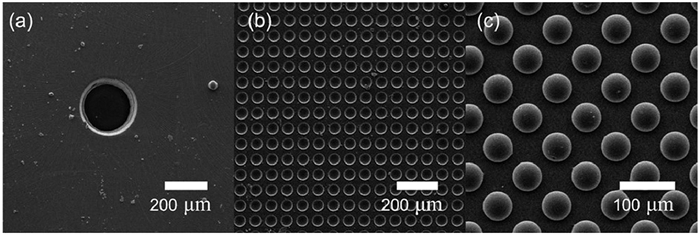
The low shrinkage of the photosensitive adhesive makes them potentially useful in performance (Figs. S14 and S15 in Supporting information). The mixture according to the P-0.4 was carefully spread on PDMS template and cured after UV irradiation. The microstructure of the obtained film showed a single channel with neat edges, demonstrating the good lithographic performance of the adhesive (Fig. 3a). Furthermore, both groove and projection lithography in a large area can be achieved as well (Figs. 3b and c). The imprints showed excellent regularity and uniformity, confirming the excellent low shrinkage characteristics of the adhesive after UV curing.
In conclusion, we designed a series of polyurethane photosensitive adhesives based on the supramolecular interaction of cyclodextrin and adamantane. The supramolecular interaction was systematically confirmed with 13C NMR measurement and rheological test. The prepared photosensitive adhesive possesses good heat resistance and water resistance after curing. All systems have very low volume shrinkage rate (< 2%) and outstanding lithographic performance (with excellent regularity and uniformity), which is expected to be used in adhesives for electronic positioning and packaging.
The authors declare that they have no known competing financial interests or personal relationships that could have appeared to influence the work reported in this paper.
Zhao Liu: Writing – review & editing, Writing – original draft, Methodology, Investigation, Conceptualization. Junjian Xie: Writing – review & editing, Supervision, Methodology. Xiaoming Ren: Writing – review & editing, Methodology. Muhammad Tahir: Writing – review & editing. Shixin Fa: Writing – review & editing, Methodology. Qiuyu Zhang: Writing – review & editing, Supervision.
We acknowledge the financial support from the National Natural Science Foundation of China (No. 22308279), Guangdong Basic and Applied Basic Research Foundation (No. 2021A1515110695), Natural Science Foundation of Chongqing (No. 2023NSCQ-MSX2773).
Supplementary material associated with this article can be found, in the online version, at doi:
H.W. Zhou, J.L. Lai, B.H. Zheng, et al., Adv. Funct. Mater. 32 (2021) 2108423. doi: 10.1002/adfm.202108423
S.W. Zhou, C. Yu, M. Chen, et al., Smart Molecules 1 (2023) e20220009. doi: 10.1002/smo.20220009
J. Zhang, Z.Y. Chen, Y. Zhang, et al., Adv. Mater. 33 (2021) 2100962. doi: 10.1002/adma.202100962
Z.H. Liao, F. Wang, Smart Molecules 2 (2024) e20240036. doi: 10.1002/smo.20240036
X.Y. Wang, Y.D. Feng, L. Zhang, et al., Chem. Eng. J. 382 (2020) 122927. doi: 10.1016/j.cej.2019.122927
C. Li, J.W. Liu, Y.Z. Chen, et al., Chem. Eng. J. 336 (2018) 54–63. doi: 10.1016/j.cej.2017.11.055
P.J. Liu, P. Zhang, H.Q. Wei, Z. Lu, Y. Yu, Adv. Funct. Mater. 32 (2022) 2107732. doi: 10.1002/adfm.202107732
W.Q. Xiao, J.P. Liu, Z. Lu, et al., ACS Macro Lett. 12 (2023) 433–439. doi: 10.1021/acsmacrolett.2c00759
Y.F. Lei, X.L. Wang, B.W. Liu, L. Chen, Y.Z. Wang, Chin. Chem. Lett. 32 (2021) 875–879. doi: 10.1016/j.cclet.2020.06.015
M.J. Coady, M. Wood, G.Q. Wallace, et al., ACS Appl. Mater. Interfaces 10 (2018) 2890–2896. doi: 10.1021/acsami.7b14433
G.S. Batibay, E. Ozcelik Kazancioglu, E. Kose, N. Arsu, Prog. Org. Coat. 152 (2021) 106113. doi: 10.1016/j.porgcoat.2020.106113
A. Hermann, S. Giljean, M.J. Pac, et al., Prog. Org. Coat. 161 (2021) 106504. doi: 10.1016/j.porgcoat.2021.106504
R.S. Scotton, L.M. Guerrini, M.P. Oliveira, Prog. Org. Coat. 158 (2021) 106389. doi: 10.1016/j.porgcoat.2021.106389
R. Anastasio, E.E.L. Maassen, R. Cardinaels, G.W.M. Peters, L.C.A. van Breemen, Polymer (Guildf) 150 (2018) 84–94. doi: 10.1016/j.polymer.2018.07.015
M. Sangermano, R.A. Ortiz, B.A.P. Urbina, et al., Eur. Polym. J. 44 (2008) 1046–1052. doi: 10.1016/j.eurpolymj.2008.01.039
C. Mendes-Felipe, J. Oliveira, P. Costa, et al., Eur. Polym. J. 120 (2019) 109226. doi: 10.1016/j.eurpolymj.2019.109226
U. Lee, E. Heo, T.H. Le, et al., Chem. Eng. J. 405 (2021) 126988. doi: 10.1016/j.cej.2020.126988
X.M. Ren, G.M. Zhu, J. Reinf. Plast. Comp. 41 (2022) 851–860. doi: 10.1177/07316844221075387
S. Pruksawan, S. Samitsu, H. Yokoyama, M. Naito, Macromolecules 52 (2019) 2464–2475. doi: 10.1021/acs.macromol.8b02450
X. Ni, J. Luo, R. Liu, X.Y. Liu, Sensor. Actuat. B: Chem. 329 (2021) 129149. doi: 10.1016/j.snb.2020.129149
X.M. Ren, G.M. Zhu, Polym. Composite. 43 (2022) 1718–1729. doi: 10.1002/pc.26491
S.M. Zhang, W.X. Shi, B. Yu, X. Wang, J. Am. Chem. Soc. 144 (2022) 16389–16394. doi: 10.1021/jacs.2c03511
Y.Z. Tian, Q. Wang, L.J. Shen, et al., Chem. Eng. J. 383 (2020) 123124. doi: 10.1016/j.cej.2019.123124
C. Li, H. Fan, T. Aziz, et al., ACS Sustainable Chem. Eng. 6 (2018) 8856–8867. doi: 10.1021/acssuschemeng.8b01212
T. Aziz, H. Fan, X. Zhang, et al., J. Polym. Eng. 40 (2020) 314–320. doi: 10.1515/polyeng-2019-0255
Y.J. Hu, Y.Z. Tian, J. Cheng, et al., ACS Sustainable Chem. Eng. 8 (2020) 4158–4166. doi: 10.1021/acssuschemeng.9b06867
X.M. Ren, G.M. Zhu, Smart Mater. Struct. 30 (2021) 125016. doi: 10.1088/1361-665x/ac32e8
Y. Liu, Y.S. Huang, C. Li, G.F. Si, M. Chen, Chin. Chem. Lett. 35 (2024) 108874. doi: 10.1016/j.cclet.2023.108874
S. Xia, Y.K. Chen, J.F. Tian, et al., Adv. Funct. Mater. 31 (2021) 2101143. doi: 10.1002/adfm.202101143
D.W. Kim, K.I. Song, D. Seong, et al., Adv. Mater. 34 (2021) 2105338. doi: 10.1002/adma.202105338
S.G. Lee, J.M. Cheon, J.H. Chun, et al., J. Appl. Polym. Sci. 133 (2016) 43758. doi: 10.1002/app.43758
J.K. Kim, N. Krishna-Subbaiah, Y. Wu, et al., Adv. Mater. 35 (2022) 2207257. doi: 10.1002/adma.202207257
Y.J. Wang, Y. He, S.Y. Zheng, et al., Adv. Funct. Mater. 31 (2021) 2104296. doi: 10.1002/adfm.202104296
Y.F. Zhang, H. Ying, K.R. Hart, et al., Adv. Mater. 28 (2016) 7646–7651. doi: 10.1002/adma.201601242
S.G. Wu, W.B. Wang, C.Y. Cai, et al., Chin. Chem. Lett. 34 (2023) 107830. doi: 10.1016/j.cclet.2022.107830
T. Harper, R. Slegeris, I. Pramudya, H. Chung, ACS Appl. Mater. Interfaces 9 (2017) 1830–1839. doi: 10.1021/acsami.6b14599
Y.S. Li, H. Shao, P.F. Lv, et al., Chem. Eng. J. 338 (2018) 440–449. doi: 10.1016/j.cej.2018.01.044
L.R. Bhagavathi, A.P. Deshpande, G.D.J. Ram, S.K. Panigrahi, Int. J. Adhes. Adhes. 108 (2021) 102871. doi: 10.1016/j.ijadhadh.2021.102871
Z.H. Wang, X.R. Zhang, S. Yao, et al., J. Mech. Behav. Biomed. Mater. 133 (2022) 105308. doi: 10.1016/j.jmbbm.2022.105308

Figure 1 (a) Solid content and (b) the tensile strength of UV-cured films with different formulations. (c) Shear strength of photosensitive adhesives with different formulations.

Figure 2 (a) Volume shrinkage of photosensitive adhesives with different formulations. (b) Partial 13C NMR spectra of (ⅰ) 1-acetamidodamantane, (ⅱ) PCL-AD, (ⅲ) the mixture of PCL-AD and PEA-CD, and (ⅳ) PEA-CD in DMSO–d6, Storage and loss modulus of (c) the mixture of PCL-AD, PEA-CD and 0.5 g n-BA, and (d) viscosity of various mixture. (e) The conversion rate of thiol and ene in P-0.4 with irradiation time. (f) The curve of relaxation time T2 of P-0.4 with gelation process.

Figure 3 SEM images of templated films with (a) a single channel, (b) pores, and (c) bulges.
Table 1. Formulation of various adhesives.
| Entry (P or D) | Solution A (PEA-CD/n-BA/1173) (g) | Solution B (PCL-AD/n-BA/PETMP) or (PCL-AD/n-BA/DPMP) (g) |
| 0.2 | 1.2/0.5/0.04 | 1.0/0.5/0.2 |
| 0.4 | 1.2/0.5/0.04 | 1.0/0.5/0.4 |
| 0.6 | 1.2/0.5/0.04 | 1.0/0.5/0.6 |
| 0.8 | 1.2/0.5/0.04 | 1.0/0.5/0.8 |
| 1.0 | 1.2/0.5/0.04 | 1.0/0.5/1.0 |
 下载: 导出CSV

 扫一扫看文章


扫一扫关注我们
