Citation: Zicheng Wan, Sisi Lao, Weifeng Zhang, Qiuju Zhang, Ziqi Tian. Convolutional neural network enabled prediction of surface features in CuAgAu alloys[J]. Chinese Chemical Letters, ;2026, 37(12): 111911. doi: 10.1016/j.cclet.2025.111911 shu

Convolutional neural network enabled prediction of surface features in CuAgAu alloys

    * Corresponding authors.
    E-mail addresses: zhangweifeng0506@163.com (W. Zhang), tianziqi@nimte.ac.cn (Z. Tian).
  • Received Date: 21 July 2025
    Revised Date: 23 September 2025
    Accepted Date: 27 September 2025
    Available Online: 30 September 2025

Figures(4)

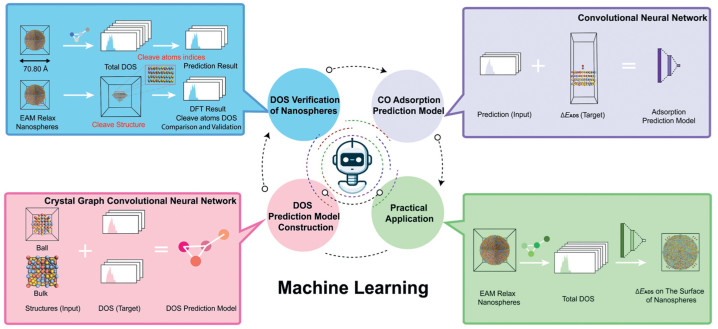
  • The rational design of high-performance alloy materials requires a deep understanding of electronic structures, which governs key material properties. The electronic density of states (DOS) is an expression of the electronic structure, normally derived from conventional first principle calculation. However, simulation of multi-component alloy requires consideration of a huge phase space, which is computationally prohibitive. Here, we present a machine learning (ML) combining a modified crystal graph convolutional neural network (CGCNN) and a convolutional neural network (CNN) to predict DOS and related surface features in CuAgAu alloy system. The CGCNN model, trained on 800 calculated structures, predicts site-resolved DOS with mean absolute error below 0.1 and median R2 values approaching 0.98. By integrating predicted DOS with a CNN model, CO adsorption energies on various surface sites were predicted, achieving MAE < 0.05 eV. The integrated model generalizes well to ternary and binary alloy compositions, demonstrating utility in high-throughput screening. This work bridges ML with physical insights, enabling rapid exploration of alloy surfaces for catalytic applications while circumventing computational costs of ab initio methods.
  • 加载中
    1. [1]

      E.A. Starke Jr., J.T. Staley, Prog. Aero