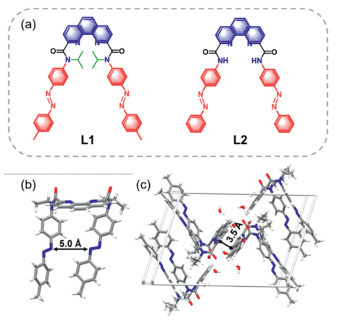
Figure 1.
(a) Chemical structure of the azobenzene-winged phenanthrolines L1 and L2. (b) Crystal structure and (c) unit cell packing diagram of probe L1 (CCDC: 2445719).

Azobenzene-winged phenanthroline for supramolecular chirality sensing and multidimensional chiroptical manipulation via solvent, light, temperature, and redox
Xiaoqian Wang , Yanling Shen , Long Chen , Lizhi Fang , Kuppusamy Kanagaraj , Ming Rao , Chunying Fan , Wanhua Wu , Cheng Yang


Chiral compounds are fundamentally important across a wide range of disciplines, including the life sciences, pharmaceuticals, food and agrochemicals, chemical synthesis, and materials science [1-5]. Traditional methods for chiral detection, such as chromatographic analysis and chemical derivatization, are often time-consuming and labor-intensive. In recent years, supramolecular self-assembly-based chiral sensing has emerged as a promising alternative [6-8]. This approach utilizes non-covalent interactions to facilitate molecular recognition and aggregation, offering several advantages: reversible assembly, rapid response kinetics, high selectivity, and broad applicability [9-11]. Compared to conventional methods, supramolecular chiral sensors enable real-time detection, simplified operation, non-destructive analysis, and reduced sample requirements, features that make them highly attractive for chiral recognition and sensing applications.
Typically, an absorption- or emission-based spectroscopic molecular sensor comprises a recognition site and a chromophoric reporter, often connected by a linker. An ideal sensor requires both strong analyte binding and a clear, measurable spectroscopic signal output. Among the various spectroscopic approaches for chirality sensing, circular dichroism (CD)-based detection stands out for its high sensitivity in distinguishing enantiomers and its capacity for direct analysis without the need for inherently chiral sensor molecules. As a result, CD detection has become a particularly valuable technique in this field [12,13]. A number of sophisticated coordination-based CD-active host systems, such as bis(metalloporphyrin) derivatives, have been developed to determine the absolute stereochemistry of chiral analytes including amines, carboxylates, and hydroxyl-containing bifunctional substrates [14-21].
CD detection is highly sensitive to the conformation and assembly structure of supramolecular systems [22,23]. Controlling and switching the chiroptical properties of such assemblies is critical for advancing technologies in optical data storage, chiral sensing, and asymmetric catalysis [24,25]. This modulation is commonly achieved via external stimuli. The ability to reversibly tune CD signals offers a non-destructive method to probe and manipulate molecular chirality and supramolecular architectures. Various external stimuli, such as solvent polarity, light, pH, redox conditions, chemical additives, temperature, and pressure, have been applied to regulate chiroptical responses in molecular devices [26,27]. Notably, multidimensional spectral modulation introduces new functionalities and intelligent responsiveness at the molecular level. For example, by integrating dual stimuli-responsive chiroptical elements, we have previously constructed a molecular device capable of over-temperature protection, showcasing the potential of such systems in smart material design [28].
In this study, we designed and synthesized two novel phenanthroline-based chiral sensors, L1 and L2 (Fig. 1a), each featuring two azobenzene moieties as peripheral "wings". The phenanthroline core serves as a strong chelating ligand for various metal ions, which in turn can coordinate with chiral amino alcohols. Notably, the binding of chiral amino alcohols induces pronounced exciton-coupling circular dichroism (ECCD) signals at the azobenzene absorption bands, thereby enabling effective chirality sensing. Furthermore, the induced ECCD signals can be modulated, or even inverted, by external stimuli, including cis/trans photoisomerization of the azobenzene units, changes in solvent composition, temperature variation, and redox reactions.
By employing a slow evaporation method, we successfully obtained single crystals of L1 and carried out structural analysis (Fig. 1b). It was found that, due to the significant steric hindrance introduced by the isopropyl groups, both amide bonds adopted a trans configuration in the crystal packing. Within the crystal structure, π-π stacking interactions were observed between adjacent phenanthroline moieties. The planes of the azobenzene and phenanthroline units are arranged nearly perpendicular to each other, forming an angle close to 90° (Fig. 1b). L1 adopts a conformation in which the two azobenzene units are aligned in a parallel orientation, with an interplanar distance of 5.0 Å. This close proximity is conducive to electronic coupling between transition dipoles.
L2 exhibited aggregation in acetonitrile (ACN) and chloroform (CHCl3), characterized by the formation of fine particulates and the Tyndall effect, which limited its chiral sensing capabilities. The aggregation of L2 is attributed to its amide bond, which functions as both a potent hydrogen-bond donor and acceptor. Furthermore, the extended π-systems of the phenanthroline and azobenzene moieties likely promote intermolecular stacking. In contrast, the N-substituted isopropyl group in L1 sterically hinders hydrogen bonding, effectively inhibiting intermolecular aggregation.
L1 is designed to coordinate with metal cations such as Cu2+, Ni2+, and Co2+ through its chelating phenanthroline nitrogen atoms and amide functionalities. These metal complexes are intended to utilize the metal center as a binding site for chiral substrates, with the azobenzene moieties acting as signal transducers. This approach is expected to generate ECCD signals, facilitating the determination of the absolute configuration of the substrates. In the absence of a chiral guest, L1 and its metal complexes are CD silent in different solvents of various polarity. A series of chiral amino alcohols, including 2-amino-1-phenylethanol (AA), 1-amino-2-indanol (AH), alaninol (LA), 2-aminobutan-1-ol (AB), leucinol (DL), and tert-leucinol (STL) were investigated for chiral sensing (Fig. 2).
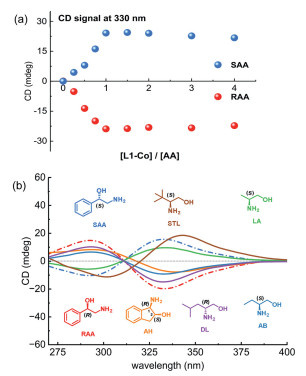
Upon the addition of chiral amino alcohols to the metal complexes, strong induced CD signals were observed when Co(ClO4)2 as the metal source. Taking (R)-2-amino-1-phenylethanol (RAA) as an example, the introduction of the R-enantiomer led to a pronounced negative ECCD signal, with characteristic bisinuate peaks at 332 nm and 291 nm, corresponding to the absorption bands of the azobenzene chromophores. In the absence of the metal, mixing RAA with L1 did not generate any CD signal (Fig. S12 in Supporting information). The chiroptical induction enhances with the increasing concentration of chiral amino alcohol, reaching its maximum value when the molar ratio with the L1–Co2+ complex reaches 1:1 (Fig. 2a). Further addition of amino alcohol does not result in a significant increase in the ECCD signal, suggesting that the binding stoichiometry of the L1–Co2+ complex and amino alcohol is 1:1.
Furthermore, all examined amino alcohols were found to induce distinct and strong ECCD responses, highlighting the general applicability of L1 as a chiral sensing platform (Fig. 2b). Interestingly, despite sharing the same S-configuration, amino alcohols such as LA, AB, and STL exhibited markedly different ECCD signatures. While LA and STL gave rise to positive ECCD signals with varying intensities, AB induced a negative ECCD response. Particularly noteworthy is the fact that LA and AB differ by only a single methylene group, underscoring the high sensitivity of L1-based chiral sensing to subtle structural variations in the chiral guest molecules.
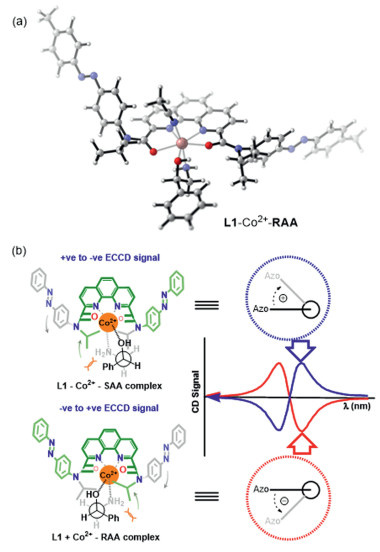
The chiroptical induction observed for the L1–Co2+ complex can be rationalized by the chiral arrangement of the two azobenzene moieties upon coordination with a chiral guest. Based on the coordination mode of Co2+ with phenanthroline and the crystal structure of the Co2+–RAA complex, the L1–Co2+–RAA complex was calculated by Gaussian (Fig. 3a and Fig. S22 in Supporting information) [29]. The amide group may participate in metal coordination, facilitating the organization of the two azobenzene units into either a left-handed or right-handed helical conformation [16,19]. Coordination with a chiral amino alcohol disrupts the planar symmetry of the L1–Co2+ complex and introduces steric interactions in the isopropyl groups (Fig. 3b). This interaction perturbs the equilibrium between the chiral conformers, favoring one helical arrangement over the other and resulting in a detectable chiroptical response.
Azobenzene, a well-known photochromic compound, undergoes significant changes in its absorption spectrum due to trans-cis isomerization. Light-based chiroptical manipulation offers advantages such as non-invasiveness, spatial definition, and ease of control. Previous studies have demonstrated several photo-controlled chiral molecular switches [30,31]. We first investigated the effect of light irradiation on the spectra. Indeed, upon irradiation of L1-Co2+-SAA at 330 nm, the ultraviolet absorption peak at 345 nm decreased significantly, while the absorption at 445 nm increased correspondingly, indicating trans-to-cis photoisomerization in the azobenzene units (Fig. 4a). Upon further irradiation of the 330 nm-irradiated sample with a 440 nm LED, the original absorption spectrum was fully restored within one minute. Moreover, when the sample was stored in the dark at room temperature, its absorption spectrum gradually reverted to the original state, confirming the reversibility of the isomerization process and recovery to the trans conformation.

Concurrently, during irradiation, the original positive ECCD signals exhibited a significant reduction, reaching a stable photostationary state after approximately 15 min of exposure (Fig. 4b). Importantly, even at equilibrium, the spectra remained positive, suggesting that the photoisomerization process did not significantly disrupt the chiral arrangement between the two azobenzene moieties. This is possibly due to the predominant steric interactions occurring at the benzene rings directly connected to the amide nitrogen. Hence, the transition from trans to cis configuration does not substantially enhance or modify the steric interaction between the azobenzenes and the coordinated chiral guest.
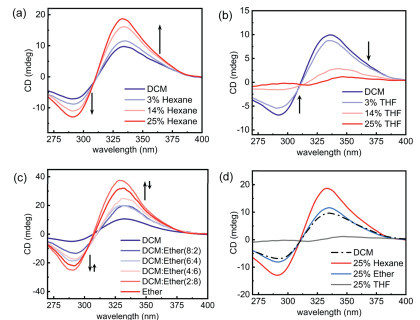
The influence of solvent on the CD spectra of chiral assemblies is crucial for understanding the assembly structure and for selecting solvents which can elicit a high response. In chiral supramolecular systems, the solvent could play the role of a guest to participate in competitive complexation and thus significantly influence the chiroptical response [32]. We examined the CD spectra of the L1-Co2+-SAA complex in various solvents and investigated the impact of adding different proportions of mixed solvents on the CD spectra. The positive ECCD in dichloromethane (DCM) was further enhanced with increasing amounts of hexane, suggesting a trend towards increased right-handed helical ordering in less polar solvents (Fig. 5a). Conversely, adding tetrahydrofuran (THF) to DCM resulted in a rapid decrease in the ECCD, leading to almost complete signal disappearance upon reaching 25% THF (Fig. 5b). This effect is likely due to the displacement of the amino alcohol by the coordinating solvent molecules [33]. Notably, the CD signal in pure ether was markedly higher than in DCM, and increasing the ether content to 60% led to a substantial increase in ECCD intensity. Interestingly, the CD intensity in 80% ether was even higher than in pure ether (Fig. 5c). This indicates that the solvent effect is not solely dependent on solvent polarity (Fig. 5d) but is more significantly influenced by steric effects arising from the solvation of the azobenzene and chiral amino alcohol moieties.
Temperature-driven CD switching holds significant value due to the universal, additive-free, and easily controllable nature of temperature as a stimulus. Its ability to modulate stereochemical outcomes, such as inverting product chirality or enhancing enantioselectivity, has been demonstrated in various molecular systems, including photoisomerizations, polymers, and supramolecular aggregates. We have demonstrated temperature-driven chiroptical inversion of pillar[n]arene-based molecular universal joints [34]. The pronounced temperature dependence can be primarily attributed to the entropically significant balance between solvent molecule inclusion and solvation of the side chains, leading to a strong temperature responsiveness of the system.
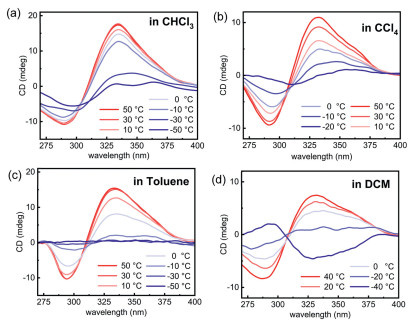
We observed that the chiral complex formed by L1-Co2+ and amino alcohol exhibits remarkable sensitivity to temperature. For instance, the L1-Co2+-SAA complex in chloroform displays a positive ECCD signal at 339 nm, which intensity as the temperature increases from 0 ℃ to 50 ℃ (Fig. 6a). Conversely, as the temperature decreases, the CD intensity diminishes, becoming nearly undetectable at –50 ℃. A similar temperature-dependent enhancement of the CD signal upon heating, and attenuation upon cooling, is also observed in toluene and carbon tetrachloride solutions (Figs. 6b and c). These observations suggest that the right-handed helical conformation becomes more predominant at elevated temperatures, indicating that this conformation is entropically favored. On the other hand, the rate of CD signal enhancement slows at higher temperatures, likely due to an increase in the number of accessible molecular conformations, thereby reducing the overall chiral bias. Interestingly, in DCM, the CD signal decreases with cooling and nearly vanishes at –20 ℃. Upon further cooling to –40 ℃, a reversed, negative ECCD signal emerges, indicating a temperature-induced inversion of the chiral arrangement of the two azobenzene moieties—from a right-handed to a left-handed helical configuration (Fig. 6d). We further investigated two additional chiral amino alcohols. Such a reversible temperature-driven chirality inversion is unprecedented for a coordinated chiral system (Fig. S15 in Supporting information).
These results collectively demonstrate the high temperature sensitivity of this class of chiral cobalt complexes. We speculate that one contributing factor is the multicomponent nature of the system, which allows for substantial entropy-driven conformational changes.
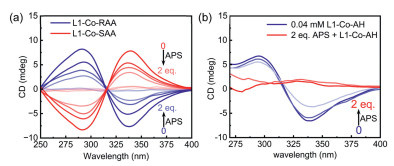
Finally, we investigated the effect of redox on the system. The addition of ammonium persulfate (APS) oxidized the divalent cobalt to trivalent cobalt. As the equivalents of APS increased, the ECCD signals induced by L1-Co2+-RAA/SAA gradually weakened and completely vanished upon the addition of one equivalent of APS (Fig. 7). Upon oxidation of Co2+, the coordination mode of L1 was altered [35]. In addition, the oxidation may lead to a change in coordination geometry from seven-coordinate Co2+ to six-coordinate Co3+ [36]. Thereby disrupting the chiral transfer from the amino alcohol to L1.
In conclusion, based on the concept of integrating molecular recognition sites with spectroscopic sensing output domains, we have synthesized a molecular chiral sensor derived from azobenzene-winged phenanthroline. This sensor can coordinate with Co2+ ions and subsequently bind with chiral amino alcohols, thereby inducing a CD response at the azobenzene absorption band. In this manner, a CD-based chiral sensing function is achieved. This chiral sensor not only coordinates with a variety of chiral amino alcohols to generate CD responses, but also exhibits multidimensional and versatile stimuli-responsive behavior. The CD spectrum of this system can respond to diverse external stimuli, including light, temperature, solvent, and redox conditions. It is noteworthy that such multi-modal modulation of chiroptical signals holds the potential for orthogonal control and novel responsive functionalities, offering new opportunities for the development of intelligent molecular machines and advanced molecular materials.
The authors declare that they have no known competing financial interests or personal relationships that could have appeared to influence the work reported in this paper.
Xiaoqian Wang: Writing – review & editing. Yanling Shen: Writing – review & editing, Formal analysis. Long Chen: Writing – review & editing. Lizhi Fang: Writing – review & editing. Kuppusamy Kanagaraj: Writing – original draft, Conceptualization. Ming Rao: Conceptualization. Chunying Fan: Writing – review & editing. Wanhua Wu: Writing – review & editing, Funding acquisition. Cheng Yang: Writing – review & editing, Funding acquisition.
We acknowledge the support of this work by the National Natural Science Foundation of China (Nos. 22471182, 22271201, 22422108, 22171194), the Science & Technology Department of Sichuan Province (No. 2025ZNSFSC0125), the Fundamental Research Funds for the Central Universities (No. 20826041D4117), the Comprehensive Training Platform of Specialized Laboratory, College of Chemistry, Prof. Peng Wu of the Analytical & Testing Center, Sichuan University.
Supplementary material associated with this article can be found, in the online version, at doi:
L.J. Chen, H.B. Yang, M. Shionoya, Chem. Soc. Rev. 46 (2017) 2555-2576. doi: 10.1039/C7CS00173H
K. Zhu, L. Yang, Y. Yang, et al., Chin. Chem. Lett. 36 (2025) 110678. doi: 10.1016/j.cclet.2024.110678
H. Duan, T. Yang, Q. Li, et al., Chin. Chem. Lett. 35 (2024) 108878. doi: 10.1016/j.cclet.2023.108878
D. Wang, J. Zong, B. Wang, et al., Green Synth. Catal. 6 (2025) 211-215.
K. Lin, J. Lan, L. Hao, et al., Green Synth. Catal. 6 (2025) 183-186.
C. Shi, H. Li, W. Xie, et al., Org. Lett. 26 (2024) 6910-6914. doi: 10.1021/acs.orglett.4c02572
C. -D. Zhao, H. Yao, S. -Y. Li, et al., Chin. Chem. Lett. 35 (2024) 108879. doi: 10.1016/j.cclet.2023.108879
T. Mądry, J. Gajewy, M. Kwit, Symmetry 17 (2025) 293. doi: 10.3390/sym17020293
G.A. Hembury, V.V. Borovkov, Y. Inoue, Chem. Rev. 108 (2008) 1-73. doi: 10.1021/cr050005k
C. Wolf, K.W. Bentley, Chem. Soc. Rev. 42 (2013) 5408-5424. doi: 10.1039/c3cs35498a
M. Quan, X.Y. Pang, W. Jiang, Angew. Chem. Int. Ed. 61 (2022). e202201258. doi: 10.1002/anie.202201258
X. Liang, W. Liang, P. Jin, et al., Chemosensors 9 (2021) 279. doi: 10.3390/chemosensors9100279
Y. Shen, W. Wu, Z. Yu, et al., Sci. China Chem. 67 (2024) 2842-2863. doi: 10.1007/s11426-024-2008-y
V.V. Borovkov, J.M. Lintuluoto, Y. Inoue, J. Am. Chem. Soc. 123 (2001) 2979-2989. doi: 10.1021/ja0032982
V.V. Borovkov, J.M. Lintuluoto, H. Sugeta, et al., J. Am. Chem. Soc. 124 (2002) 2993-3006. doi: 10.1021/ja0172520
H. Kim, S.M. So, C.P.H. Yen, et al., Angew. Chem. Int. Ed. 47 (2008) 8657-8660. doi: 10.1002/anie.200803116
N. Berova, G. Pescitelli, A.G. Petrovic, et al., Chem. Commun. (2009) 5958-5980. doi: 10.1039/b909582a
S.J. Wezenberg, G. Salassa, E.C. Escudero-Adán, et al., Angew. Chem. Int. Ed. 50 (2010) 713-716.
L.A. Joyce, M.S. Maynor, J.M. Dragna, et al., J. Am. Chem. Soc. 133 (2011) 13746-13752. doi: 10.1021/ja205775g
B. Saha, S.A. Ikbal, A.G. Petrovic, et al., Inorg. Chem. 56 (2017) 3849-3860. doi: 10.1021/acs.inorgchem.6b02686
N. Sunaga, T. Haraguchi, T. Akitsu, Symmetry 11 (2019) 1094. doi: 10.3390/sym11091094
N. Berova, L.D. Bari, G. Pescitelli, Chem. Soc. Rev. 36 (2007) 914-931. doi: 10.1039/b515476f
J.S.S.K. Formen, J.R. Howard, E.V. Anslyn, et al., Angew. Chem. Int. Ed. 63 (2024) e202400767. doi: 10.1002/anie.202400767
J. Crassous, Chem. Soc. Rev. 38 (2009) 829-845.
J. Crassous, Chem. Commun. 48 (2012) 9687-9695.
F. Gao, X. Yu, L. Liu, et al., Chin. Chem. Lett. 34 (2023) 107558. doi: 10.1016/j.cclet.2022.05.072
B.T. Herrera, S.L. Pilicer, E.V. Anslyn, et al., J. Am. Chem. Soc. 140 (2018) 10385-10401. doi: 10.1021/jacs.8b06607
J. Yao, W. Wu, C. Xiao, et al., Nat. Commun. 12 (2021) 2600. doi: 10.1038/s41467-021-22880-z
M. Peng, X.F. Wu, L.X. Wang, et al., Dalton Trans. 50 (2021) 15327-15335. doi: 10.1039/d1dt02575a
Y. Mao, J. Ma, J. Ji, et al., Chin. Chem. Lett. 35 (2024) 109927. doi: 10.1016/j.cclet.2024.109927
C. Yang, W. Wu, T. Hao, et al., Chinese J. Org. Chem. 43 (2023) 2189-2196. doi: 10.1007/s00431-023-04899-0
C. Liu, X. Chen, Y. Shen, et al., Sci. China Chem. 68 (2025) 610-621. doi: 10.1007/s11426-024-2190-5
K.Y. Kim, J. Kim, H. Park, et al., Bull. Korean Chem. Soc. 39 (2018) 988-994. doi: 10.1002/bkcs.11540
J. Yao, W. Wu, W. Liang, et al., Angew. Chem. Int. Ed. 56 (2017) 6869-6873. doi: 10.1002/anie.201702542
J. Gregoliński, M. Hikita, T. Sakamoto, et al., Inorg. Chem. 55 (2016) 633-643. doi: 10.1021/acs.inorgchem.5b01902
R.P. Sharma, A. Singh, P. Venugopalan, et al., Polyhedron 47 (2012) 173-181. doi: 10.1016/j.poly.2012.06.092

Figure 1 (a) Chemical structure of the azobenzene-winged phenanthrolines L1 and L2. (b) Crystal structure and (c) unit cell packing diagram of probe L1 (CCDC: 2445719).

Figure 2 CD spectra of the solution containing L1-Co2+ complex (0.04 mmol/L) and AA (0.04 mmol/L) of (a) RAA and SAA, (b) AH, LA, AB, DL and STL in carbon tetrachloride.

Figure 3 (a) Calculated structure of L1–Co2+–RAA complex. (b) Chiroptical induction mechanism of L1-Co2+ upon coordination with an amino alcohol.

Figure 4 (a) UV-vis and (b) CD spectra (25 ℃) changes observed for L1-Co2+-SAA complex (0.04 mmol/L), upon irradiation of the solution at 330 nm in dichloromethane at different time intervals.

Figure 5 CD spectral (25 ℃) changes observed for L1-Co2+-SAA complex (0.04 mmol/L) in (a) DCM: n-hexane, (b) DCM: THF and (c) DCM: Ether solvent mixtures at different ratios. (d) Comparison of CD spectral signals (25 ℃) of L1-Co2+-SAA complex (0.04 mmol/L) in DCM solutions containing 25% different solvents.

Figure 6 CD spectral changes of L1-Co2+-SAA complex (0.04 mmol/L) in different solvents: (a) CHCl3, (b) CCl4, (c) toluene and (d) DCM at various temperatures (℃).

 扫一扫看文章


扫一扫关注我们
 DownLoad:
 下载:
下载:
