Citation: Yuhong Luo, Tian Chen, Yingde Huang, Peiyao Li, Yujing Chen, Zhenyu Wang, Qing Wu, Xiahui Zhang, Junchao Zheng. Quantifying the pillar effect of cations in ion-exchanged Ni-rich oxide cathodes for lithium-ion batteries[J]. Chinese Chemical Letters, ;2026, 37(12): 111700. doi: 10.1016/j.cclet.2025.111700 shu

Quantifying the pillar effect of cations in ion-exchanged Ni-rich oxide cathodes for lithium-ion batteries

    * Corresponding authors.
    E-mail addresses: xhzhang@csu.edu.cn (X. Zhang), jczheng@csu.edu.cn (J. Zheng).
  • Received Date: 15 May 2025
    Revised Date: 5 August 2025
    Accepted Date: 9 August 2025
    Available Online: 10 August 2025

Figures(6)

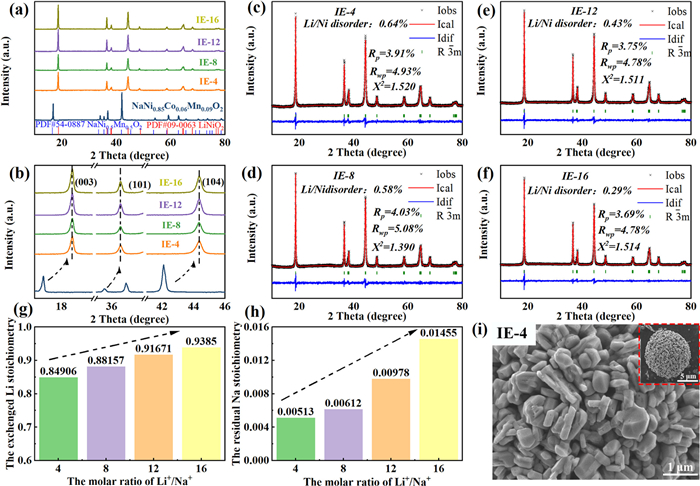
  • Li+/Na+ ion exchange has made a breakthrough in the synthesis of Ni-rich layered cathode oxide, which can effectively mitigate the severe Li/Ni disorder that occurs in the traditional solid-phase sintering method. However, the comparative study of the cations presents in the Li layer as pillars is rarely reported. Herein, a series of Ni2+/Na+ co-substituted Ni-rich materials are designed by ion exchange at ∼200 °C with varying Li+/Na+ molar ratios (4, 8, 12, 16), which is used as a platform to quantitatively decipher the pillar effect contributed by Ni2+ and Na+ in the Li layer. We found that Ni2+ is approximately 3.5 times more effective as pillar than Na+. Theoretical calculations further reveal that Ni2+ in Li slab provides the higher mechanical strength than Na+ in the deeply delithiated state of Ni-rich materials. Besides, the results of structural evolution over cycling reveals that Ni2+ plays a greater role of pillar in stabilizing the structure with higher lattice energy compared to Na+, attributed to its higher mechanical strength (bulk modulus: 56.9 vs. 43.8 GPa). The PL-4 cathode (Li+/Na+ molar ratios = 4) exhibited optimal electrochemical performance, retaining 90.4% capacity after 70 cycles at 1 C and delivering a high specific capacity of 141.7 mAh/g at 10 C. This work provides design principles for the synthesis of layered oxides with high structural stability via ion exchange, potentially leading to the development of advanced cathode materials for high-energy lithium-ion batteries.
  • 加载中
    1. [1]

      G. Assat, D. Foix, C. Delacourt, et al., Nat. Commun. 8 (2017) 2219.  doi: 10.1038/s41467-017-02291-9

    2. [2]

      B.G. Chae, S.Y. Park, J.H. Song, et al., Nat. Commun. 12 (2021) 3814.  doi: 10.1038/s41467-021-24120-w

    3. [3]

      M. Jiang, P. Wang, Q. Chen, et al., Chin. Chem. Lett. 36 (2025) 110040.  doi: 10.1016/j.cclet.2024.110040

    4. [4]

      L. Wang, X. Lei, T. Liu, et al., Adv. Mater. 34 (2022) e2200744.  doi: 10.1002/adma.202200744

    5. [5]

      F. Zhang, Y. Liang, Z. Ye, et al., Chin. Chem. Lett. 35 (2024) 108655.  doi: 10.1016/j.cclet.2023.108655

    6. [6]

      H.X. Wei, L.B. Tang, Y.D. Huang, et al., Mater. Today 51 (2021) 365–392.  doi: 10.1016/j.mattod.2021.09.013

    7. [7]

      Y.H. Luo, Q.L. Pan, H.X. Wei, et al., Adv. Energy Mater. 13 (2023) 2300125.  doi: 10.1002/aenm.202300125

    8. [8]

      Y.H. Luo, Q.L. Pan, H.X. Wei, et al., Nano Energy 102 (2022) 107626.  doi: 10.1016/j.nanoen.2022.107626

    9. [9]

      Y. Cho, P. Oh, J. Cho, Nano Lett. 13 (2013) 1145–1152.  doi: 10.1021/nl304558t

    10. [10]

      W. He, D. Yuan, J. Qian, et al., J. Mater. Chem. A 1 (2013) 11397.  doi: 10.1039/c3ta12296d

    11. [11]

      W. Hua, J. Zhang, Z. Zheng, et al., Dalton Trans. 43 (2014) 14824–14832.  doi: 10.1039/C4DT01611D

    12. [12]

      B. Cao, Z. Chen, H. Cao, et al., Adv. Funct. Mater. (2023) 2214921.  doi: 10.1002/adfm.202214921

    13. [13]

      Z. Tan, Y. Li, X. Xi, et al., Nano Res. 16 (2023) 4950–4960.  doi: 10.1007/s12274-022-5161-1

    14. [14]

      G.T. Park, B. Namkoong, S.B. Kim, et al., Nat. Energy 7 (2022) 946–954.  doi: 10.1038/s41560-022-01106-6

    15. [15]

      M.C. Liu, Q.S. Liu, Y.Z. Quan, et al., Chin. Chem. Lett. 35 (2024) 109123.  doi: 10.1016/j.cclet.2023.109123

    16. [16]

      Y.J. Guo, C.H. Zhang, S. Xin, et al., Angew. Chem. Int. Ed. 61 (2022) e202116865.  doi: 10.1002/anie.202116865

    17. [17]

      A. Rougier, C. Delmas, A.V. Chadwick, Solid State Commun 94 (1995) 123–127.  doi: 10.1016/0038-1098(95)00020-8

    18. [18]

      P. Yan, J. Zheng, J. Liu, et al., Nat. Energy 3 (2018) 600–605.  doi: 10.1038/s41560-018-0191-3

    19. [19]

      H.X. Wei, Y.D. Huang, L.B. Tang, et al., Nano Energy 88 (2021) 106288.  doi: 10.1016/j.nanoen.2021.106288

    20. [20]

      W. He, P. Liu, B. Qu, et al., Adv. Sci. 6 (2019) 1802114.  doi: 10.1002/advs.201802114

    21. [21]

      H. Yang, R.M. Gao, X.D. Zhang, et al., Adv. Mater. 34 (2022) e2204835.  doi: 10.1002/adma.202204835

    22. [22]