Citation: Qi Li, Minqiao Liang, Huifen Zhuang, Zhengyang Chen, Yuxiang Jiang, Xiaofei Chen, Yifa Chen, Ya-Qian Lan. Underscoring the polyimide-linkage in covalent organic frameworks and related applications[J]. Chinese Chemical Letters, ;2026, 37(2): 111593. doi: 10.1016/j.cclet.2025.111593 shu

Underscoring the polyimide-linkage in covalent organic frameworks and related applications


  • Author Bio: Qi Li received his M.S. degree (2019) from Nanjing Normal University and his Engineering Ph.D. degree (2024) from Southeast University under the supervision of Prof. Zeng-Mei Wang and in collaboration with Prof. Ya-Qian Lan. Since 2024, he has been conducting postdoctoral research at South China Normal University with Prof. Yifa Chen. His current research focuses on the syntheses of COF-based crystalline porous materials and their applications in energy storage and conversion
    Minqiao Liang was born in 2004 in Guangdong, China. She is now a chemistry undergraduate at South China Normal University under the supervision of Prof. Ya-Qian Lan and Prof. Yifa Chen. Her research interest focuses on the syntheses of crystalline porous materials (COF-based composites) and their applications in energy storage and conversion


    Xiaofei Chen received her Ph.D. degree in polymer chemistry and physics from Jilin University under the supervision of Prof. Lixin Wu in 2021. Currently, she works at the Key Laboratory for Special Functional Materials of the Ministry of Education, Henan University, China. Her current research focuses on the syntheses of polyoxometalate based supramolecular complexes as well as COF and their applications in photocatalysis and photothermal catalysis
    Yifa Chen received his B.S. degree from School of Chemistry, Beijing Institute of Technology. He subsequently obtained his Ph.D. degree from School of Chemistry and Chemical Engineering, Beijing Institute of Technology under the supervision of Prof. Bo Wang. In 2022, he joined South China Normal University (SCNU, China) as a professor of chemistry. His research interest focuses on the fabrication of porous crystalline material based devices like membranes, foams and fibers that can be applicable in photo-/electro-catalysis, energy storage or environment treatment
    Ya-Qian Lan received his B.S. and Ph.D. degrees (2009) from Northeast Normal University under the supervision of Prof. Zhong-Min Su. In 2010, he joined the National Institute of Advanced Industrial Science and Technology (AIST, Japan) as a JSPS postdoctoral fellow. In 2012, he became a professor of chemistry at Nanjing Normal University (NNU, China). In 2021, he joined South China Normal University (SCNU, China) as a professor of chemistry. His current research interest focuses on the synthesis of new crystalline materials and catalytic research related to clean energy applications
  • * Corresponding authors.
    E-mail addresses: chenxf22@henu.edu.cn (X. Chen), chenyf927821@163.com (Y. Chen), yqlan@m.scnu.edu.cn (Y.-Q. Lan).
    1 These authors contributed equally to this work.
  • Received Date: 11 May 2025
    Revised Date: 8 July 2025
    Accepted Date: 16 July 2025
    Available Online: 18 July 2025

Figures(11)

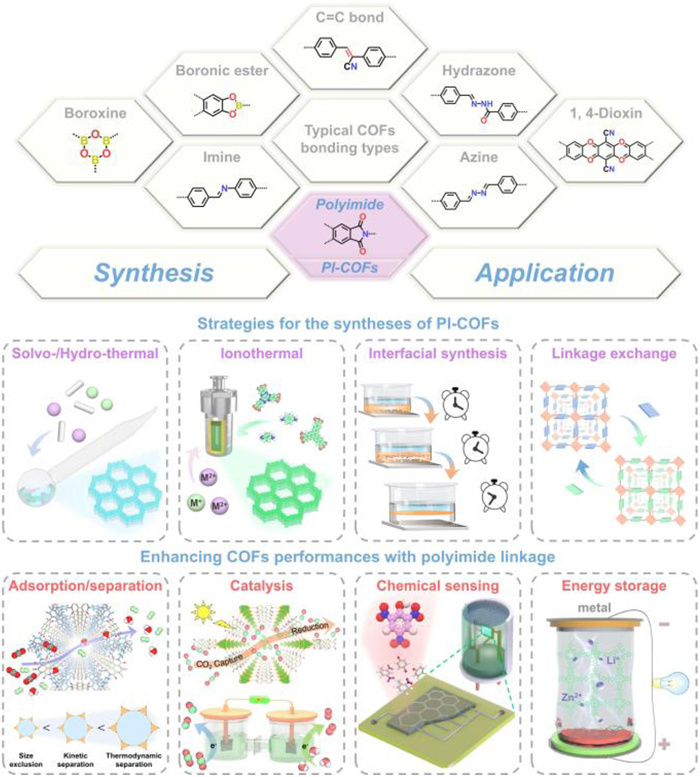
  • Polyimide-linkage covalent organic frameworks (PI-COFs), as a subclass of the COFs material family, featuring the unique combination of excellent thermal stability of polyimide, tunable pore sizes, as well as high crystallinity and surface area of COFs, are expected to be a novel type of promising crystalline porous material with potential applications in adsorption and separation, catalysis, chemical sensing, and energy storage. Therefore, it is increasingly important to summarize polyimide-linkage in COFs and related applications and provide in-depth insight to accelerate future development. In this review, we offer a comprehensive overview of recent advancements in PI-COFs, emphasizing their synthesis methods, design principles and applications. Finally, our brief outlooks on the current challenges and future developments of PI-COFs are provided. Overall, this review aims to guide the recent and future development of PI-COFs.
  • 加载中
    1. [1]

      M.T. Bogert, R.R. Renshaw, J. Am. Chem. Soc. 30 (1908) 1135–1144.  doi: 10.1021/ja01949a012

    2. [2]

      F.M. Toma, F. Puntoriero, T.V. Pho, et al., Angew. Chem. Int. Ed. 54 (2015) 6775–6779.  doi: 10.1002/anie.201501298

    3. [3]

      V.L. Bell, B.L. Stump, H. Gager, J. Polym. Sci. Pol. Chem. 14 (1976) 2275–2291.

    4. [4]

      I. Gouzman, E. Grossman, R. Verker, et al., Adv. Mater. 31 (2019) 1807738.

    5. [5]

      X.J. Liu, M.S. Zheng, G. Chen, et al., Energy Environ. Sci. 15 (2022) 56–81.  doi: 10.1039/d1ee03186d

    6. [6]

      Y. Wang, Y. Cui, Z. Shao, et al., Chem. Eng. J. 390 (2020) 124623.

    7. [7]

      T.B. Schon, A.J. Tilley, E.L. Kynaston, et al., ACS Appl. Mater. Interfaces 9 (2017) 15631–15637.  doi: 10.1021/acsami.7b02336

    8. [8]

      B.S. Ghanem, N.B. McKeown, P.M. Budd, et al., Adv. Mater. 20 (2008) 2766–2771.  doi: 10.1002/adma.200702400

    9. [9]

      O.K. Farha, A.M. Spokoyny, B.G. Hauser, et al., Chem. Mater. 21 (2009) 3033–3035.  doi: 10.1021/cm901280w

    10. [10]

      J. Weber, Q. Su, M. Antonietti, et al., Macromol. Rapid Commun. 28 (2007) 1871–1876.  doi: 10.1002/marc.200700346

    11. [11]

      Q. Fang, Z. Zhuang, S. Gu, et al., Nat. Commun. 5 (2014) 4503.

    12. [12]

      Q. Fang, J. Wang, S. Gu, et al., J. Am. Chem. Soc. 137 (2015) 8352–8355.  doi: 10.1021/jacs.5b04147

    13. [13]

      D. Yang, Z. Yao, D. Wu, et al., J. Mater. Chem. A 4 (2016) 18621–18627.

    14. [14]

      C. Zhang, S. Zhang, Y. Yan, et al., ACS Appl. Mater. Interfaces 9 (2017) 13415–13421.  doi: 10.1021/acsami.6b16423

    15. [15]

      B. Sun, X. Li, T. Feng, et al., ACS Appl. Mater. Interfaces 12 (2020) 51837–51845.  doi: 10.1021/acsami.0c15789

    16. [16]

      H. Duan, K. Li, M. Xie, et al., J. Am. Chem. Soc. 143 (2021) 19446–19453.  doi: 10.1021/jacs.1c08675

    17. [17]

      X. Yang, L. Gong, X. Liu, et al., Angew. Chem. Int. Ed. 61 (2022) e202207043.

    18. [18]

      T. Kim, S.H. Joo, J. Gong, et al., Angew. Chem. Int. Ed. 61 (2022) e202113780.

    19. [19]

      M. Zhang, J.P. Liao, R.H. Li, et al., Nat. Sci. Rev. 10 (2023) nwad226.

    20. [20]

      X. Yang, L. Gong, Z. Liu, et al., Sci. China Chem. 67 (2024) 1300–1310.  doi: 10.1007/s11426-023-1853-x

    21. [21]

      A.P. Côté, A.I. Benin, N.W. Ockwig, et al., Science 310 (2005) 1166–1170.  doi: 10.1126/science.1120411

    22. [22]

      Y. Yang, Q. Li, P. Liu, et al., Adv. Mater. 37 (2025) 2415799.

    23. [23]

      H. Dong, L. Fang, K.-X. Chen, et al., Angew. Chem. Int. Ed. 64 (2025) e202414287.

    24. [24]

      J. Lv, Y.X. Tan, J. Xie, et al., Angew. Chem. Int. Ed. 57 (2018) 12716–12720.  doi: 10.1002/anie.201806596

    25. [25]

      R. Xu, D.H. Si, S.S. Zhao, et al., J. Am. Chem. Soc. 145 (2023) 8261–8270.  doi: 10.1021/jacs.3c02370

    26. [26]

      W. Feng, C. Guo, R. Xu, et al., Coord. Chem. Rev. 515 (2024) 215965.

    27. [27]

      K.V. Rao, R. Haldar, C. Kulkarni, et al., Chem. Mater. 24 (2012) 969–971.  doi: 10.1021/cm203599q

    28. [28]

      K.V. Rao, R. Haldar, T.K. Maji, et al., Polymer 55 (2014) 1452–1458.

    29. [29]

      Y. Zhang, Z. Huang, B. Ruan, et al., Macromol. Rapid Commun. 41 (2020) 2000402.

    30. [30]

      B. Yao, G. Li, X. Wu, et al., Chem. Comm. 60 (2024) 793–803.  doi: 10.1039/d3cc05214a

    31. [31]

      L. Jiang, Y. Tian, T. Sun, et al., J. Am. Chem. Soc. 140 (2018) 15724–15730.  doi: 10.1021/jacs.8b08174

    32. [32]

      G. Zhao, H. Li, Z. Gao, et al., Adv. Funct. Mater. 31 (2021) 2101019.

    33. [33]

      Y. Liu, Y. Lu, A.H. Khan, et al., Angew. Chem. Int. Ed. 62 (2023) e202306091.

    34. [34]

      R. Van der Jagt, A. Vasileiadis, H. Veldhuizen, et al., Chem. Mater. 33 (2021) 818–833.  doi: 10.1021/acs.chemmater.0c03218

    35. [35]

      Y. Luo, Z. Chang, J. Pei, et al., Nano Lett. 23 (2023) 9266–9271.  doi: 10.1021/acs.nanolett.3c02222

    36. [36]

      S.K. Upadhyay, S.R.K. Pingali, B.S. Jursic, Tetrahedron Lett. 51 (2010) 2215–2217.

    37. [37]

      L. Kurti, B. Czako, Strategic Applications of Named Reactions in Organic Synthesis, Elsevier Academic Press, Burlington, MA, 2005, pp. 202–203.

    38. [38]

      K. Geng, T. He, R. Liu, et al., Chem. Rev. 120 (2020) 8814–8933.  doi: 10.1021/acs.chemrev.9b00550

    39. [39]

      J. Maschita, T. Banerjee, G. Savasci, et al., Angew. Chem. Int. Ed. 59 (2020) 15750–15758.  doi: 10.1002/anie.202007372

    40. [40]

      L. Yao, C. Ma, L. Sun, et al., J. Am. Chem. Soc. 144 (2022) 23534–23542.  doi: 10.1021/jacs.2c10534

    41. [41]

      J. Maschita, T. Banerjee, B.V. Lotsch, Chem. Mater. 34 (2022) 2249–2258.  doi: 10.1021/acs.chemmater.1c04051

    42. [42]

      J. Li, J. Zhang, Y. Hou, et al., Angew. Chem. Int. Ed. 63 (2024) e202412452.

    43. [43]

      X. Zhan, Y. Jin, B. Han, et al., Chin. J. Catal. 69 (2025) 271–281.

    44. [44]

      M. Li, B. Han, S. Li, et al., Small 20 (2024) 2310147.

    45. [45]

      J. Yuan, S. Chen, Y. Zhang, et al., Adv. Mater. 34 (2022) 2203139.

    46. [46]

      T. Wang, R. Xue, H. Chen, et al., New J. Chem. 41 (2017) 14272–14278.

    47. [47]

      K. Liu, H. Qi, R. Dong, et al., Nat. Chem. 11 (2019) 994–1000.  doi: 10.1038/s41557-019-0327-5

    48. [48]

      J. Shi, W. Tang, B. Xiong, et al., Chem. Eng. J. 453 (2023) 139607.

    49. [49]

      Y. Li, J. Tan, X. Zhao, et al., Mater. Today Commun. 37 (2023) 107157.

    50. [50]

      M. Yu, N. Chandrasekhar, R.K.M. Raghupathy, et al., J. Am. Chem. Soc. 142 (2020) 19570–19578.  doi: 10.1021/jacs.0c07992

    51. [51]

      B. Han, Y. Jin, B. Chen, et al., Angew. Chem. Int. Ed. 61 (2022) e202114244.

    52. [52]

      S. Kandambeth, K. Dey, R. Banerjee, J. Am. Chem. Soc. 141 (2019) 1807–1822.  doi: 10.1021/jacs.8b10334

    53. [53]

      R. Liu, K.T. Tan, Y. Gong, et al., Chem. Soc. Rev. 50 (2021) 120–242.  doi: 10.1039/d0cs00620c

    54. [54]

      H. Zhuang, C. Guo, J. Huang, et al., Angew. Chem. Int. Ed. 63 (2024) e202404941.

    55. [55]

      C.S. Diercks, O.M. Yaghi, Science 355 (2017) eaal1585.

    56. [56]

      O. Rahmanian, M. Falsafin, M. Dinari, Polym. Int. 69 (2020) 712–718.  doi: 10.1002/pi.6007

    57. [57]

      Z. Wang, Y. Zhang, J. Liu, et al., Nat. Protocols 19 (2024) 3489–3519.  doi: 10.1038/s41596-024-01028-5

    58. [58]

      T. Kim, B. Park, K.M. Lee, et al., ACS Macro Lett. 7 (2018) 1480–1485.  doi: 10.1021/acsmacrolett.8b00680

    59. [59]

      P. Deria, J.E. Mondloch, O. Karagiaridi, et al., Chem. Soc. Rev. 43 (2014) 5896–5912.

    60. [60]

      C. Qian, Q.Y. Qi, G.F. Jiang, et al., J. Am. Chem. Soc. 139 (2017) 6736–6743.  doi: 10.1021/jacs.7b02303

    61. [61]

      G. Zhang, M. Tsujimoto, D. Packwood, et al., J. Am. Chem. Soc. 140 (2018) 2602–2609.  doi: 10.1021/jacs.7b12350

    62. [62]

      P.J. Waller, S.J. Lyle, T.M. Osborn Popp, et al., J. Am. Chem. Soc. 138 (2016) 15519–15522.  doi: 10.1021/jacs.6b08377

    63. [63]

      Y. Zhai, G. Liu, F. Jin, et al., Angew. Chem. Int. Ed. 58 (2019) 17679–17683.  doi: 10.1002/anie.201911231

    64. [64]

      M.K. Shehab, K.S. Weeraratne, O.M. El-Kadri, et al., Macromol. Rapid Commun. 44 (2023) 2200782.

    65. [65]

      V.A. Kuehl, M.J. Wenzel, B.A. Parkinson, et al., J. Mater. Chem. A 9 (2021) 15301–15309.  doi: 10.1039/d1ta01954f

    66. [66]

      X. Yuan, Y. Wang, G. Deng, et al., Polym. Adv. Technol. 30 (2019) 417–424.  doi: 10.1002/pat.4479

    67. [67]

      X. Chen, Q. Dang, R. Sa, et al., Chem. Sci. 11 (2020) 6915–6922.  doi: 10.1039/d0sc01747g

    68. [68]

      T. Kim, D.Y. Lee, E. Choi, et al., Appl. Catal. B: Environ. Energy 357 (2024) 124264.

    69. [69]

      W. Chi, B. Liu, Y. Dong, et al., Appl. Catal. B: Environ. Energy 355 (2024) 124077.

    70. [70]

      Y. Zhu, D. Huang, W. Wang, et al., Angew. Chem. Int. Ed. 63 (2024) e202319909.

    71. [71]

      X. Yao, G. Liu, Y. Huang, et al., Angew. Chem. Int. Ed. 64 (2025) e202417439.

    72. [72]

      Y. Wang, M. Yue, G. Liu, et al., Angew. Chem. Int. Ed. 64 (2025) e202413030.

    73. [73]

      B. Han, X. Ding, B. Yu, et al., J. Am. Chem. Soc. 143 (2021) 7104–7113.  doi: 10.1021/jacs.1c02145

    74. [74]

      G. Lin, H. Ding, D. Yuan, et al., J. Am. Chem. Soc. 138 (2016) 3302–3305.  doi: 10.1021/jacs.6b00652

    75. [75]

      M. Li, B. Han, L. Gong, et al., Chin. Chem. Lett. 37 (2026) 110590.  doi: 10.1016/j.cclet.2024.110590

    76. [76]

      Z. Dong, H. Pan, P. Gao, et al., Catal. Lett. 152 (2022) 299–306.  doi: 10.1007/s10562-021-03637-1

    77. [77]

      M. Sedaghat, F. Moeinpour, F.S. Mohseni-Shahri, Anal. Sci. Adv. 4 (2023) 302–311.  doi: 10.1002/ansa.202300012

    78. [78]

      Y. Han, M. Zhang, Y.Q. Zhang, et al., Green Chem. 20 (2018) 4891–4900.  doi: 10.1039/c8gc02611d

    79. [79]

      L. Yu, L. Bai, J. Liu, et al., Talanta 295 (2025) 128346.

    80. [80]

      N. Zhao, J.M. Liu, F.E. Yang, et al., ACS Appl. Bio Mater. 4 (2021) 995–1002.  doi: 10.1021/acsabm.0c01448

    81. [81]

      J. Ma, C. Wang, Q. Liu, et al., Adv. Funct. Mater. 35 (2025) 2419752.

    82. [82]

      H. Schlomberg, J. Kröger, G. Savasci, et al., Chem. Mater. 31 (2019) 7478–7486.  doi: 10.1021/acs.chemmater.9b02199

    83. [83]

      S. Gu, Y. Chen, R. Hao, et al., Chem. Comm. 57 (2021) 7810–7813.  doi: 10.1039/d1cc02426d

    84. [84]

      L. Xu, X. Wang, Y. Wu, et al., J. Energy Chem. 102 (2025) 63–72.

    85. [85]

      X. Wu, S. Zhang, X. Xu, et al., Angew. Chem. Int. Ed. 63 (2024) e202319355.

    86. [86]

      Y. Qian, Z. Liu, H. Song, et al., Chin. Chem. Lett. 35 (2024) 108785.

    87. [87]

      Z. Wang, Y. Li, P. Liu, et al., Nanoscale 11 (2019) 5330–5335.  doi: 10.1039/c9nr00088g

    88. [88]

      L. Wang, J. Zhao, J. Chen, et al., Phys. Chem. Chem. Phys. 25 (2023) 8050–8063.  doi: 10.1039/d3cp00007a

    89. [89]

      P. Chen, Z. Wu, T. Guo, et al., Adv. Mater. 33 (2021) 2007549.

    90. [90]

      Z.L. Xu, S. Lin, N. Onofrio, et al., Nat. Commun. 9 (2018) 4164.

    91. [91]

      X. Xiao, L. Zou, H. Pang, et al., Chem. Soc. Rev. 49 (2020) 301–331.  doi: 10.1039/c7cs00614d

    92. [92]

      F. Ji, S. Gou, J. Tang, et al., Chem. Eng. J. 474 (2023) 145786.

    93. [93]

      Y. An, H. Zhang, D. Geng, et al., Chem. Eng. J. 477 (2023) 147275.

    94. [94]

      C. Guo, X. Huang, J. Huang, et al., Angew. Chem. Int. Ed. 63 (2024) e202403918.

    95. [95]

      S.W. Ke, W. Li, L. Gao, et al., Angew. Chem. Int. Ed. 64 (2025) e202417493.

    96. [96]

      Y. Park, D.S. Shin, S.H. Woo, et al., Adv. Mater. 24 (2012) 3562–3567.  doi: 10.1002/adma.201201205

    97. [97]

      C. Wang, Y. Xu, Y. Fang, et al., J. Am. Chem. Soc. 137 (2015) 3124–3130.  doi: 10.1021/jacs.5b00336

    98. [98]

      Y. Zang, D.Q. Lu, Y.Q. Lan, Sci. Bull. 67 (2022) 1621–1624.

    99. [99]

      K. Hua, L. Zhang, Q. Ma, et al., Chem. Eng. J. 498 (2024) 155289.

    100. [100]

      D. Geng, H. Zhang, Z. Fu, et al., Adv. Sci. 11 (2024) 2407073.

    101. [101]

      S. Jindal, Z. Tian, A. Mallick, et al., Small 21 (2025) 2407525.

    102. [102]

      X.X. Luo, W.H. Li, H.J. Liang, et al., Angew. Chem. Int. Ed. 61 (2022) e202117661.

    103. [103]

      L. Cai, L. Lu, Y. Lan, et al., Adv. Energy Mater. 13 (2023) 2301631.

    104. [104]

      Y. Yang, S. Wang, Y. Duan, et al., Angew. Chem. Int. Ed. 137 (2025) e202418394.

    105. [105]

      P.Y. Zhao, Y.H. Zhang, B.Y. Sun, et al., Angew. Chem. Int. Ed. 64 (2024) e202317106.

  • 加载中
    1. [1]

      Jingyu ShiXiaofeng WuYutong ChenYi ZhangXiangyan HouRuike LvJunwei LiuMengpei JiangKeke HuangShouhua Feng . Structure factors dictate the ionic conductivity and chemical stability for cubic garnet-based solid-state electrolyte. Chinese Chemical Letters, 2025, 36(5): 109938-. doi: 10.1016/j.cclet.2024.109938

    2. [2]

      Guizhi ZhuJunrui TanLongfei TanQiong WuXiangling RenChanghui FuZhihui ChenXianwei Meng . Growth of CeCo-MOF in dendritic mesoporous organosilica as highly efficient antioxidant for enhanced thermal stability of silicone rubber. Chinese Chemical Letters, 2025, 36(1): 109669-. doi: 10.1016/j.cclet.2024.109669

    3. [3]

      Shi LiWenshuai ZhaoYong QiWenbin NiuWei MaBingtao TangShufen Zhang . Hydrogen bonding induced ultra-highly thermal stability of azo dyes for color films. Chinese Chemical Letters, 2025, 36(9): 110653-. doi: 10.1016/j.cclet.2024.110653

    4. [4]

      Liying OuZhenluan XueBo LiZhiwei JinJiaochan ZhongLixia YangPenghui ShaoShenglian Luo . Nitrogen-containing linkage-bonds in covalent organic frameworks: Synthesis and applications. Chinese Chemical Letters, 2025, 36(6): 110294-. doi: 10.1016/j.cclet.2024.110294

    5. [5]

      Jiaqi Ma Lan Li Yiming Zhang Jinjie Qian Xusheng Wang . Covalent organic frameworks: Synthesis, structures, characterizations and progress of photocatalytic reduction of CO2. Chinese Journal of Structural Chemistry, 2024, 43(12): 100466-100466. doi: 10.1016/j.cjsc.2024.100466

    6. [6]

      Xinrui Chen Wenjian Huang Xiaoyang Zhao Songyao Zhang Xinrui Miao . Structural regulation of alkynyl-based covalent organic frameworks for multi-stimulus fluorescence sensing. Chinese Journal of Structural Chemistry, 2025, 44(7): 100604-100604. doi: 10.1016/j.cjsc.2025.100604

    7. [7]

      Weixu Li Yuexin Wang Lin Li Xinyi Huang Mengdi Liu Bo Gui Xianjun Lang Cheng Wang . Promoting energy transfer pathway in porphyrin-based sp2 carbon-conjugated covalent organic frameworks for selective photocatalytic oxidation of sulfide. Chinese Journal of Structural Chemistry, 2024, 43(7): 100299-100299. doi: 10.1016/j.cjsc.2024.100299

    8. [8]

      Yuting Wu Haifeng Lv Xiaojun Wu . Design of two-dimensional porous covalent organic framework semiconductors for visible-light-driven overall water splitting: A theoretical perspective. Chinese Journal of Structural Chemistry, 2024, 43(11): 100375-100375. doi: 10.1016/j.cjsc.2024.100375

    9. [9]

      Zhilei ZhangYanan SunXiaosong ShiXiaozhe YinDawei LiuErjing WangJie LiuYuanyuan HuLang Jiang . Molecular tailoring towards two-dimensional organic crystals at the thickness limit. Chinese Chemical Letters, 2025, 36(9): 110786-. doi: 10.1016/j.cclet.2024.110786

    10. [10]

      Deshuai ZhenChunlin LiuQiuhui DengShaoqi ZhangNingman YuanLe LiYu Liu . A review of covalent organic frameworks for metal ion fluorescence sensing. Chinese Chemical Letters, 2024, 35(8): 109249-. doi: 10.1016/j.cclet.2023.109249

    11. [11]

      Yujie WangHaoran WangYanni LiuManhua PengHongwei FanHong Meng . A comprehensive review on the scalable and sustainable synthesis of covalent organic frameworks. Chinese Chemical Letters, 2025, 36(8): 110189-. doi: 10.1016/j.cclet.2024.110189

    12. [12]

      Bo LiYuanzhe ChengXuyang MaDongxu ZhaoYang ZhangYongxing SunJia ChenLi WuLiang ZhaoHongdeng QiuYujian He . Facile and scale-up synthesis of cyano-functionalized covalent organic frameworks for selective gold recovery. Chinese Chemical Letters, 2026, 37(1): 111134-. doi: 10.1016/j.cclet.2025.111134

    13. [13]

      Qiang FangYingbo LuJianying HuangCheng ZhangJing WuShijun Li . An electrochemical immunosensor based on an antibody-ferrocene-functionalized covalent organic framework. Chinese Chemical Letters, 2026, 37(2): 111218-. doi: 10.1016/j.cclet.2025.111218

    14. [14]

      Shiyan AiYaning XuHui ZhouZiwei CuiTiantian WuDan Tian . Superelastic and ultralight covalent organic framework composite aerogels modified with different functional groups for ultrafast adsorbing organic pollutants in water. Chinese Chemical Letters, 2025, 36(10): 110761-. doi: 10.1016/j.cclet.2024.110761

    15. [15]

      Guorong LiYijing WuChao ZhongYixin YangZian Lin . Predesigned covalent organic framework with sulfur coordination: Anchoring Au nanoparticles for sensitive colorimetric detection of Hg(Ⅱ). Chinese Chemical Letters, 2024, 35(5): 108904-. doi: 10.1016/j.cclet.2023.108904

    16. [16]

      Yue QianZhoujia LiuHaixin SongRuize YinHanni YangSiyang LiWeiwei XiongSaisai YuanJunhao ZhangHuan Pang . Imide-based covalent organic framework with excellent cyclability as an anode material for lithium-ion battery. Chinese Chemical Letters, 2024, 35(6): 108785-. doi: 10.1016/j.cclet.2023.108785

    17. [17]

      Shunshun JiangJi ZhangJing WangShan-Tao Zhang . Excellent energy storage properties in non-stoichiometric Bi0.5Na0.5TiO3-based relaxor ferroelectric ceramics. Chinese Chemical Letters, 2024, 35(7): 108955-. doi: 10.1016/j.cclet.2023.108955

    18. [18]

      Bo YangPu-An LinTingwei ZhouXiaojia ZhengBing CaiWen-Hua Zhang . Facile surface regulation for highly efficient and thermally stable perovskite solar cells via chlormequat chloride. Chinese Chemical Letters, 2024, 35(10): 109425-. doi: 10.1016/j.cclet.2023.109425

    19. [19]

      Ming YueYi-Rong WangJia-Yong WengJia-Li ZhangDa-Yu ChiMingjin ShiXiao-Gang HuYifa ChenShun-Li LiYa-Qian Lan . Multi-metal porous crystalline materials for electrocatalysis applications. Chinese Chemical Letters, 2025, 36(6): 110049-. doi: 10.1016/j.cclet.2024.110049

    20. [20]

      Lu ZhangBaohua WangWei YangLunan JuZihan FuLei ZhaoYunqi JiangHongyan WangXiansheng WangCong Lyu . CoOOH@COFs S−scheme heterojunction for efficient triclosan degradation in photocatalytic-peroxymonosulfate activation system: Enhanced interfacial electron transfer mechanism. Chinese Chemical Letters, 2026, 37(1): 111142-. doi: 10.1016/j.cclet.2025.111142

Metrics
  • PDF Downloads(0)
  • Abstract views(10)
  • HTML views(0)

通讯作者: 陈斌, bchen63@163.com
  • 1. 

    沈阳化工大学材料科学与工程学院 沈阳 110142

  1. 本站搜索
  2. 百度学术搜索
  3. 万方数据库搜索
  4. CNKI搜索
Address:Zhongguancun North First Street 2,100190 Beijing, PR China Tel: +86-010-82449177-888
Powered By info@rhhz.net

/

DownLoad:  Full-Size Img  PowerPoint
Return