Scheme 1.
Synthesis of dihydroisoquinolino[1,2-b]quinazolinones in environmentally friendly solvents.

Visible-light induced cascade sulfonation/cyclization reaction in water towards sulfonated dihydroisoquinolino[1,2-b]quinazolinones
Jun Huang , Jiangping Qin , Caijin Ban , Jingmei Yuan , Jing Yang , Guoping Yang


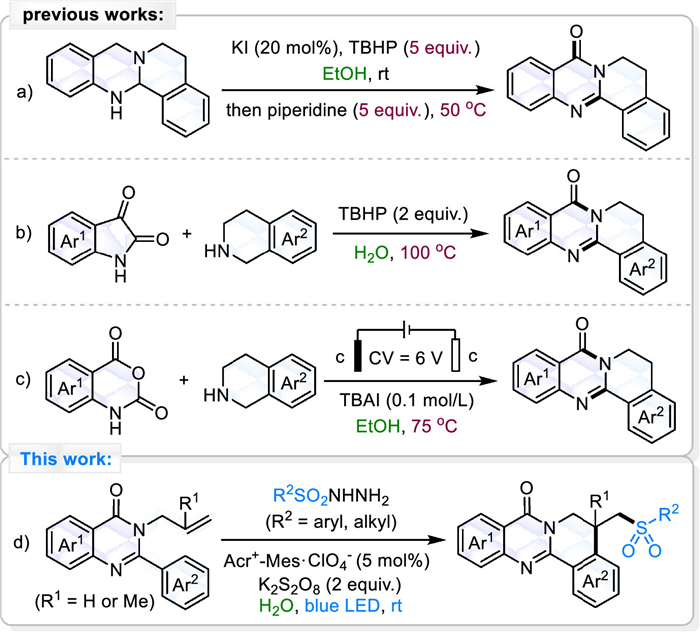
Polycyclic quinazolinones are widely existed in natural products and bioactive compounds [1–8]. Notably, dihydroisoquinolino[1,2-b]quinazolinone derivatives exhibit a range of biological activities, such as antitumor [7] and antimalarial effects [8], making the exploration of their synthetic methodologies a focal point in organic synthesis research [7–28]. The main synthetic strategies encompass transition-metal-catalyzed C–H activation reactions involving pre-synthesized quinazolinones [11–13], intramolecular cyclization of N-substituted tetrahydroisoquinolines (THIQs) [7,14–19], and intermolecular oxidative annulation reactions between THIQs and various synthons [8,20–26], among others [27,28]. To enhance the alignment of these synthetic approaches with green chemistry principles [29–39], it is crucial to develop methodologies that utilize environmentally friendly solvents as reaction media. However, effective strategies for the synthesis of dihydroisoquinolino[1,2-b]quinazolinone derivatives in environmentally friendly solvents, especially in water, remain limited. In 2013, Daniel Seidel's group [27] established a selective oxidation of ring-fused aminals using potassium iodide/tert–butyl hydroperoxide catalytic system, resulting in the formation of dihydroisoquinolino[1,2-b]quinazolinone (Scheme 1a). Although this reaction was conducted in ethanol, its further application was hindered by the reliance on pre-synthesized polycyclic substrates and excessive amounts of tert–butyl hydroperoxide (TBHP) and piperidine. In 2020, Sun's group [8] reported a TBHP-mediated oxidative decarboxylative cyclization of THIQs with isatins in water at 100 ℃, yielding dihydroisoquinolino[1,2-b]quinazolinones (Scheme 1b). Furthermore, isatoic anhydrides were identified as crucial intermediates in this procedure. As a result, a direct decarboxylative cyclization between THIQs and isatoic anhydrides was developed employing electrochemical methods in ethanol at 75 ℃ (Scheme 1c) [21].
Sulfonyl groups, crucial structural moieties with distinct physical, chemical, and biological properties, are abundantly present in various natural products and play important roles in the field of pharmaceutical, agrochemical, material science and organic synthesis [40–44]. Consequently, a variety of effective methodologies utilizing transition-metal catalysis, photocatalysis, electrocatalysis, and other catalytic systems have been developed for synthesizing sulfone-containing compounds [45–50]. Nevertheless, a suitable method for the preparation of sulfonylated dihydroisoquinolino[1,2-b]quinazolinones has yet to be identified, warranting further exploration due to the potential for discovering novel active compounds. Recently, we successfully established 3-allyl-2-arylquinazolinones as a new class of radical acceptors for the construction of phosphorylated dihydroisoquinolino[1,2-b]quinazolinones in 1,2-dichloroethane [51], providing an efficient and mild photocatalytic strategy for synthesizing polycyclic fused quinazolinone derivatives. Nonetheless, this strategy is still not well compatible with environmentally friendly solvents. Building upon our investigation into heterocyclic synthesis [52–57], we present herein the utilization of sulfonyl hydrazides as sulfonyl radical precursors to develop a visible-light-induced, transition metal-free radical cascade cyclization reaction in water at room temperature, targeting sulfonated dihydroisoquinolino[1,2-b]quinazolinone derivatives (Scheme 1d).
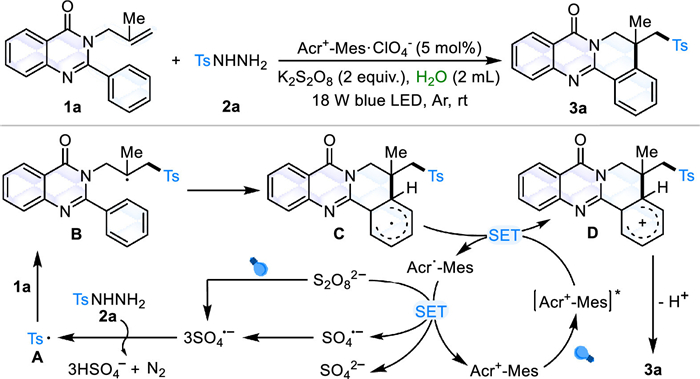
Initially, sulfonyl hydrazide 2a was chosen as the source of p-toluenesulfonyl (Ts) radical for the cascade sulfonation/cyclization reaction involving the model substrate 3-allyl-2-phenylquinazolinone 1a, in order to optimize the reaction conditions. To our delight, the target product, sulfonated dihydroisoquinolino[1,2-b]quinazolinone 3a, was successfully synthesized with an 88% yield under a photocatalytic aqueous phase reaction system utilizing 9-mesityl-10-methylacridinium perchlorate (Acr+-Mes·ClO4–) as the photocatalyst (PC) and K2S2O8 as the oxidant, irradiated by an 18 W blue LED at room temperature (entry 1, Table 1). Subsequently, we attempted to employ several common organic dyes (4CzIPN, Eosin B, Eosin Y, and Rhodamine B) as photocatalysts for this aqueous phase reaction, however, the results were unsatisfactory (entries 2–5). Other persulfates and frequently-used peroxides, such as Na2S2O8, (NH4)2S2O8, lauroyl peroxide (LPO), benzoyl peroxide (BPO) and tert–butyl hydroperoxide (TBHP), were also proved effective for this reaction, giving 3a in moderate yields (entries 6–10). In contrast, green oxidants such as hydrogen peroxide and oxygen were found to be incompatible with this reaction (entries 11 and 12). Additionally, the yield of the desired product significantly decreased when the amount of K2S2O8 was reduced by half (entry 13). We also examined alternative green solvents (entries 14–20), finding that a mixed solvent of ethanol and water produced quinazolinone 3a in 83% yield. Finally, control experiments conducted without the photocatalyst and in the absence of light confirmed the critical role of both the photocatalyst and light irradiation in facilitating this radical cascade cyclization reaction in water.

 DownLoad:
CSV
DownLoad:
CSV
 |
||
| Entry | Conditions | Yield (%)b |
| 1 | None | 88 |
| 2 | 4CzIPN as PC | 13 |
| 3 | Eosin B as PC | 8 |
| 4 | Eosin Y as PC | 10 |
| 5 | Rhodamine B as PC | 22 |
| 6 | Na2S2O8 as oxidant | 66 |
| 7 | (NH4)2S2O8 as oxidant | 62 |
| 8 | LPO as oxidant | 40 |
| 9 | BPO as oxidant | 55 |
| 10 | TBHP as oxidant | 73 |
| 11 | H2O2 as oxidant | trace |
| 12 | O2 as oxidant | trace |
| 13 | 1 equiv. of K2S2O8 | 41 |
| 14 | DMC as solvent | 71 |
| 15 | AcOEt as solvent | 25 |
| 16 | 2-MeTHF as solvent | 13 |
| 17 | EtOH as solvent | 30 |
| 18 | Ethylene glycol as solvent | 65 |
| 19 | Ethylene glycol/H2O (v/v = 1/5) as solvent | 71 |
| 20 | EtOH/H2O (v/v = 1/5) as solvent | 83 |
| 21 | Without PC | trace |
| 22 | In the dark | 0 |
| a Reaction conditions: 1a (0.2 mmol), 2a (2 equiv.), Acr+-Mes·ClO4– (5 mol%) and K2S2O8 (2 equiv.) in H2O (2 mL) under argon with the irradiation of 18 W blue LED at room temperature for 48 h. b Isolated yields. | ||
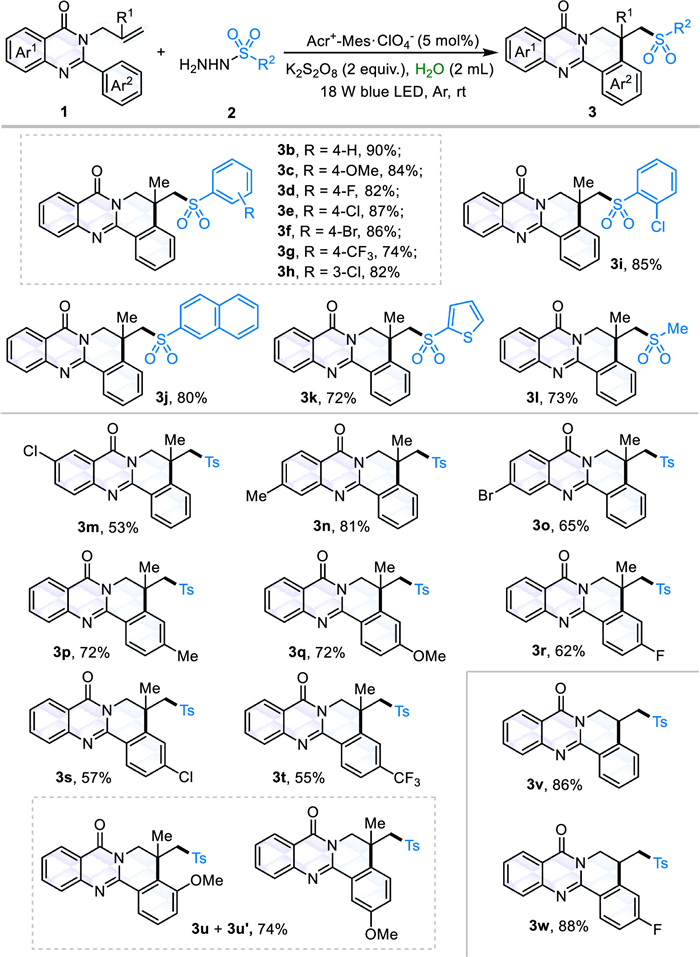
After determining the optimal reaction conditions, the substrate scope of this aqueous conversion was expanded by sequentially utilizing diverse arylsulfonyl hydrazides 2 and 3-allyl-2-arylquinazolinones 1. As shown in Scheme 2, various substituted arylsulfonyl hydrazides with different functional groups (e.g., 4-H, 4-OMe, 4-F, 4-Cl, 4-Br, 4-CF3, 3-Cl, 2-Cl, 2-naphthyl, and 2-thienyl) were employed as sources of sulfonyl radicals, giving the corresponding products 3b-3k in good to excellent yields. And the electronic and steric effects of the substituents on the aryl moiety of the sulfonyl hydrazides appeared to be inapparent. Notably, the alkyl sulfonyl hydrazide demonstrated acceptable adaptability as a reaction partner, affording 3l in a 73% yield. Subsequently, the limitations and scope of 3-allyl-2-arylquinazolinones were also investigated under aqueous conditions, revealing good compatibility with both electron-donating groups (-Me and -OMe) and electron-withdrawing groups (-F, -Cl, -Br, and -CF3) on either Ar1 or Ar2, resulting in moderate yields of the corresponding products 3m-3u Furthermore, the use of substrates with a hydrogen atom as R1 was proved to be suitable for this sulfonation/cyclization reaction, as evidenced by the successful synthesis of dihydroisoquinolino[1,2-b]quinazolinones 3v and 3w in good yields.
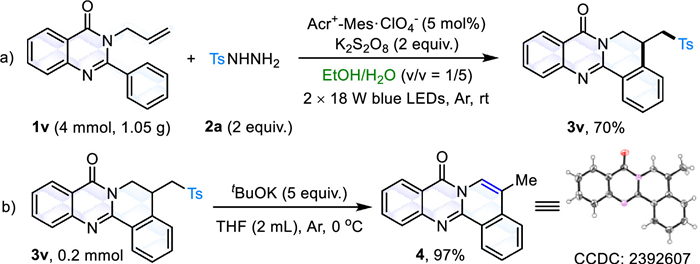
Subsequently, to demonstrate the potential utility of this strategy, the sulfonation/cyclization reaction of quinazolinone 1v and TsNHNH2 2a was conducted on a gram scale. As shown in Scheme 3a, the desired product 3v was synthesized smoothly in 70% yield using a mixed solvent of ethanol and water, indicating the procedure's practical application value. Moreover, under tBuOK-promoted conditions, the synthetic product 3v can be readily converted into isoquinolino[1,2-b]quinazolinone 4, whose structure was definitively established through X-ray crystallography (Scheme 3b).
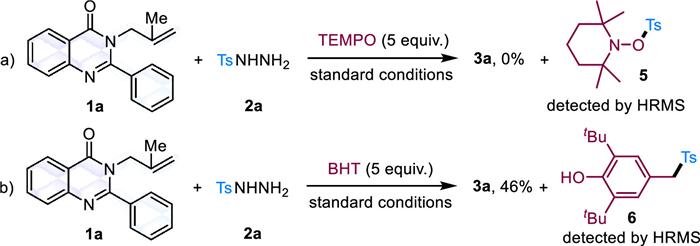
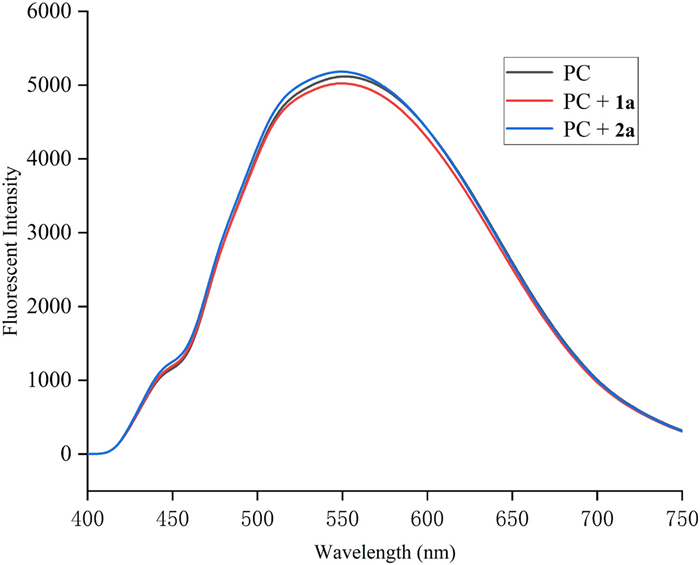
And then, we performed systematic control experiments to elucidate the reaction mechanism by introducing established radical scavengers 2,2,6,6-tetramethyl-1-piperidinyloxy (TEMPO) and butylated hydroxytoluene (BHT) under standard conditions (Scheme 4) [58]. These experiments revealed two critical observations: a marked decrease in the formation efficiency of target product 3a, and the successful identification of sulfonyl radical-trapping adducts 5 and 6 through high-resolution mass spectrometry (HRMS) analysis. These compelling experimental evidences strongly indicate that a free radical process may be involved in this visible-light-induced reaction. Furthermore, Stern-Volmer fluorescence quenching experiments were performed by mixing the photocatalyst with substrates 1a and 2a, respectively. Consequently, neither of them displayed an obvious luminescence quenching effect (Fig. 1). Thus, we hypothesize that neither substrate 1a nor 2a acts as a quencher of the excited state of Acr+-Mes·ClO4– [59].
Based on the relevant experimental results and previous reports [59–61], a plausible mechanism for this conversion is proposed as illustrated in Scheme 5. Firstly, K2S2O8 undergoes homolysis and converts to sulfate radical anion (SO4•–) upon irradiation with blue LED light. Through the processes of hydrogen atom transfer and subsequent nitrogen removal, SO4•– interacts with p-toluenesulfonyl hydrazide 2a to generate hydrogen sulfate anion (HSO4–) and p-toluenesulfonyl radical A. And then, this radical adducts to the C=C bond of 3-allyl-2-phenylquinazolinone 1a, facilitating sulfonation to produce the sulfone-containing alkyl radical intermediate B, which then undergoes intramolecular cyclization to yield radical intermediate C. Next, a single-electron transfer (SET) process between C and the excited state of Acr+-Mes·ClO4– generates cationic intermediate D and the radical Acr•-Mes. Finally, the target product 3a is produced via deprotonation of D. The regeneration of the ground state of the photocatalyst is achieved through another SET involving Acr•-Mes and K2S2O8, offering SO4•– and SO42–.
In conclusion, we have developed an innovative and efficient cascade sulfonation/cyclization reaction of 3-allyl-2-arylquinazolinones with sulfonyl hydrazides utilizing a photocatalytic system in water. This transition metal-free protocol features mild reactions, facile operation, broad substrate scope, and gram-scale synthesis, allowing for the successful synthesis of a series of sulfonated dihydroisoquinolino[1,2-b]quinazolinones under blue LED irradiation at room temperature. Ongoing investigations in our laboratory are focused on leveraging this photocatalytic system in environmentally friendly solvents to synthesize additional significant heterocycles.
The authors declare that they have no known competing financial interests or personal relationships that could have appeared to influence the work reported in this paper.
Jun Huang: Writing – original draft, Methodology, Funding acquisition. Jiangping Qin: Investigation, Formal analysis. Caijin Ban: Investigation. Jingmei Yuan: Methodology, Investigation. Jing Yang: Investigation. Guoping Yang: Writing – review & editing, Project administration, Methodology.
We gratefully acknowledge the funds from Natural Science Foundation of Guangxi Province (Nos. 2023GXNSFBA026304, 2023GXNSFDA026063), the Guangxi Science and Technology Base and Special Talents (No. Guike AD20159047).
Supplementary material associated with this article can be found, in the online version, at doi:
U.A. Kshirsagar, Org. Biomol. Chem. 13 (2015) 9336–9352.
K.M. Shakhidoyatov, B.Z. Elmuradov, Chem. Nat. Compd. 50 (2014) 781–800. doi: 10.1007/s10600-014-1086-6
Z. Ma, Y. Hano, T. Nomura, Y. Chen, Bioorg. Med. Chem. Lett. 14 (2004) 1193–1196.
S. Eguchi, Top. Heterocycl. Chem. 6 (2006) 113–156. doi: 10.1007/7081_022
I. Khan, A. Ibrar, N. Abbas, A. Saeed, Eur. J. Med. Chem. 76 (2014) 193–244.
D. He, M. Wang, S. Zhao, et al., Fitoterapia 119 (2017) 136–149.
D. Jing, C. Lu, Z. Chen, et al., Angew. Chem. Int. Ed. 58 (2019) 14666–14672. doi: 10.1002/anie.201906112
X. Chen, F. Xia, Y. Zhao, et al., Chin. J. Chem. 38 (2020) 1239–1244. doi: 10.1002/cjoc.202000154
P. Ghosh, B. Ganguly, S. Das, Org. Biomol. Chem. 18 (2020) 4497–4518. doi: 10.1039/d0ob00742k
W. Wang, P.S. Zou, L. Pang, et al., Org. Biomol. Chem. 20 (2022) 6293–6313. doi: 10.1039/d2ob00778a
Y. Feng, N. Tian, Y. Li, et al., Org. Lett. 19 (2017) 1658–1661. doi: 10.1021/acs.orglett.7b00452
G. Bairy, S. Das, H.M. Begam, R. Jana, Org. Lett. 20 (2018) 7107–7112. doi: 10.1021/acs.orglett.8b03048
Z.H. Wang, H. Wang, H. Wang, L. Li, M.D. Zhou, Org. Lett. 23 (2021) 995–999. doi: 10.1021/acs.orglett.0c04200
Q.Y. Li, S.Y. Cheng, H.T. Tang, Y.M. Pan, Green Chem. 21 (2019) 5517–5520.
C. Lu, Z. Su, D. Jing, et al., Org. Lett. 21 (2019) 1438–1443. doi: 10.1021/acs.orglett.9b00191
C.L. Lee, L. Wu, J.S. Huang, C.M. Che, Chem. Commun. 55 (2019) 3606–3609. doi: 10.1039/c8cc10220a
L. Xie, C. Lu, D. Jing, X. Ou, K. Zheng, Eur. J. Org. Chem. 22 (2019) 3649–3653. doi: 10.1002/ejoc.201900469
S.M. Patel, H. Chada, S. Biswal, S. Sharma, D.S. Sharada, Synthesis 51 (2019) 3160–3170.
M. Wang, W. Ye, N. Sun, W. Yu, J. Chang, J. Org. Chem. 88 (2023) 1061–1074. doi: 10.1021/acs.joc.2c02509
F.C. Jia, T.Z. Chen, X.Q. Hu, Org. Chem. Front. 7 (2020) 1635–1639. doi: 10.1039/d0qo00345j
X. Chen, X. Zhang, S. Lu, P. Sun, RSC Adv. 10 (2020) 44382–44386. doi: 10.1039/d0ra09382c
D. Wang, F. Xiao, F. Zhang, H. Huang, G.J. Deng, Chin. J. Chem. 39 (2021) 87–92. doi: 10.1002/cjoc.202000368
L. Liu, Z. Xu, J. Lin, et al., Adv. Synth. Catal. 365 (2023) 2248–2254. doi: 10.1002/adsc.202300324
F. Xie, Q.H. Chen, R. Xie, H.F. Jiang, M. Zhang, ACS Catal. 8 (2018) 5869–5874. doi: 10.1021/acscatal.8b01366
J. Li, Z.B. Wang, Y. Xu, et al., Chem. Commun. 55 (2019) 12072–12075. doi: 10.1039/c9cc06160f
X. Chen, L. Jin, Y. Wang, et al., Org. Biomol. Chem. 21 (2023) 3863–3870. doi: 10.1039/d3ob00198a
M.T. Richers, C. Zhao, D. Seidel, Beilstein J. Org. Chem. 9 (2013) 1194–1201. doi: 10.3762/bjoc.9.135
M. Yamashita, Y. Nishizono, S. Himekawa, A. Iida, Tetrahedron 72 (2016) 4123–4131.
K. Sun, Q.Y. Lv, X.L. Chen, L.B. Qu, B. Yu, Green Chem. 23 (2021) 232–248. doi: 10.1039/d0gc03447a
W.T. Ouyang, F. Xiao, L.J. Ou, W.M. He, Curr. Opin. Green Sustain. Chem. 40 (2023) 100760.
H.Y. Song, F. Xiao, J. Jiang, et al., Chin. Chem. Lett. 34 (2023) 108509.
Y.H. Lu, C. Wu, J.C. Hou, et al., ACS Catal. 13 (2023) 13071–13076. doi: 10.1021/acscatal.3c02268
H.Y. Song, J. Jiang, C. Wu, et al., Green Chem. 25 (2023) 3292–3296. doi: 10.1039/d2gc04843d
J. Bai, X. Xu, Y. Zheng, W. Song, N. Zheng, Green Synth. Catal. 5 (2024) 186–190.
L. Tian, J.P. Wan, Y. Liu, Green Synth. Catal. (2024), doi: 10.1016/j.gresc.2024.09.002.
W.T. Ouyang, J. Jiang, Y.F. Jiang, et al., Chin. Chem. Lett. 35 (2024) 110038.
T. Zhou, J. Zhou, Y. Liu, J.P. Wan, F.E. Chen, Chin. Chem. Lett. 35 (2024) 109683.
Z. Wang, L. Gan, Z. Song, Y. Liu, J.P. Wan, Chin. J. Chem. 42 (2024) 3041–3046. doi: 10.1002/cjoc.202400664
H.T. Ji, Y.H. Lu, Y.T. Liu, et al., Chin. Chem. Lett. 36 (2025) 110568.
E.A. Ilardi, E. Vitaku, J.T. Njardarson, J. Med. Chem. 57 (2014) 2832–2842. doi: 10.1021/jm401375q
M. Wang, X. Jiang, ACS Sustain. Chem. Eng. 10 (2022) 671–677. doi: 10.1021/acssuschemeng.1c07636
K. Takimiya, S. Shinamura, I. Osaka, E. Miyazaki, Adv. Mater. 23 (2011) 4347–4370. doi: 10.1002/adma.201102007
N. Wang, P. Saidhareddya, X. Jiang, Nat. Prod. Rep. 37 (2020) 246–275. doi: 10.1039/c8np00093j
S. Huang, M. Wang, X. Jiang, Chem. Soc. Rev. 51 (2022) 8351–8377. doi: 10.1039/d2cs00553k
A.X. Huang, R. Li, Q.Y. Lv, B. Yu, Chem. Eur. J. 30 (2024) e202402416.
D. Zeng, M. Wang, W.P. Deng, X. Jiang, Org. Chem. Front. 7 (2020) 3956–3966. doi: 10.1039/d0qo00987c
S. Zhao, K. Chen, L. Zhang, W. Yang, D. Huang, Adv. Synth. Catal. 362 (2020) 3516–3541. doi: 10.1002/adsc.202000466
F.S. He, M. Yang, S. Ye, J. Wu, Chin. Chem. Lett. 32 (2021) 461–464.
D. Joseph, M.A. Idris, J. Chen, S. Lee, ACS Catal. 11 (2021) 4169–4204. doi: 10.1021/acscatal.0c05690
G. Chen, Z. Lian, Eur. J. Org. Chem. 26 (2023) e202300217.
J. Huang, C. Ban, J. Qin, et al., Chem. Commun. 60 (2024) 8119–8122. doi: 10.1039/d4cc02915a
J. Huang, F. Zhu, J. Wen, et al., Org. Chem. Front. 11 (2024) 3855–3860. doi: 10.1039/d4qo00458b
Q. Hu, K. Li, X. Chen, Y. Liu, G. Yang, Polyoxometalates 3 (2024) 9140048. doi: 10.26599/pom.2023.9140048
K. Li, Y. Liu, G. Yang, et al., Green Chem. 26 (2024) 6454–6460. doi: 10.1039/d4gc00877d
Y.F. Liu, X.L. Lin, B.M. Ming, et al., Inorg. Chem. 63 (2024) 5681–5688. doi: 10.1021/acs.inorgchem.4c00114
J.H. Ding, Y.F. Liu, Z.T. Tian, et al., Inorg. Chem. Front. 10 (2023) 3195–3201. doi: 10.1039/d2qi02653h
J.M. Yuan, J. Li, H. Zhou, et al., New J. Chem. 44 (2020) 3189–3193. doi: 10.1039/c9nj05248h
L. Guo, Z. Zhang, F. Zhang, K. Sun, B. Yu, Org. Lett. 26 (2024) 10982–10987. doi: 10.1021/acs.orglett.4c04145
Y.Q. Jiang, J. Li, Z.W. Feng, et al., Adv. Synth. Catal. 362 (2020) 2609–2614. doi: 10.1002/adsc.202000233
F.L. Zeng, L. Wang, Y. Luo, et al., Chem. Commun. 60 (2024) 7228–7231. doi: 10.1039/d4cc01970a
N.P. Ramirez, I. Bosque, J.C. Gonzalez-Gomez, Org. Lett. 17 (2015) 4550–4553. doi: 10.1021/acs.orglett.5b02269

Scheme 1 Synthesis of dihydroisoquinolino[1,2-b]quinazolinones in environmentally friendly solvents.

Scheme 2 Substrate scope for the cascade sulfonation/cyclization reaction in water. Reaction conditions: 1 (0.2 mmol), 2 (2 equiv.), Acr+-Mes·ClO4– (5 mol%) and K2S2O8 (2 equiv.) in H2O (2 mL) under argon with the irradiation of 18 W blue LED at room temperature for 48 h.
Table 1. Screening of the reaction conditions.a
|
||
| Entry | Conditions | Yield (%)b |
| 1 | None | 88 |
| 2 | 4CzIPN as PC | 13 |
| 3 | Eosin B as PC | 8 |
| 4 | Eosin Y as PC | 10 |
| 5 | Rhodamine B as PC | 22 |
| 6 | Na2S2O8 as oxidant | 66 |
| 7 | (NH4)2S2O8 as oxidant | 62 |
| 8 | LPO as oxidant | 40 |
| 9 | BPO as oxidant | 55 |
| 10 | TBHP as oxidant | 73 |
| 11 | H2O2 as oxidant | trace |
| 12 | O2 as oxidant | trace |
| 13 | 1 equiv. of K2S2O8 | 41 |
| 14 | DMC as solvent | 71 |
| 15 | AcOEt as solvent | 25 |
| 16 | 2-MeTHF as solvent | 13 |
| 17 | EtOH as solvent | 30 |
| 18 | Ethylene glycol as solvent | 65 |
| 19 | Ethylene glycol/H2O (v/v = 1/5) as solvent | 71 |
| 20 | EtOH/H2O (v/v = 1/5) as solvent | 83 |
| 21 | Without PC | trace |
| 22 | In the dark | 0 |
| a Reaction conditions: 1a (0.2 mmol), 2a (2 equiv.), Acr+-Mes·ClO4– (5 mol%) and K2S2O8 (2 equiv.) in H2O (2 mL) under argon with the irradiation of 18 W blue LED at room temperature for 48 h. b Isolated yields. | ||
 下载: 导出CSV

 扫一扫看文章


扫一扫关注我们


