
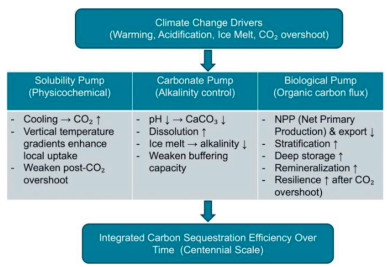
Figure 1.
A chemical framework for the solubility, carbonate, and biological pumps.


The accelerated pace of natural and human-driven climate change presents profound challenges for Earth’s systems. Oceans and ice sheets are critical regulators of climate systems, functioning as carbon sinks and thermal reservoirs. However, they are increasingly vulnerable to warming and greenhouse gas emissions. Understanding the interrelations among oceanic carbon dynamics, ice sheet stability, and feedback mechanisms is essential for effective climate action. There are three primary carbon pumps in the global ocean that regulate carbon exchange. The solubility pump (physicochemical carbon pump) is controlled by Henry’s Law and the temperature-dependent solubility of CO2 in seawater. The biological pump is driven by the transformation of dissolved CO2 into organic carbon via photosynthesis, followed by its sequestration in deep-sea reservoirs. The carbonate pump involves the precipitation and dissolution of calcium carbonate (CaCO3), affecting ocean alkalinity and carbon storage. Recent studies [1–3] suggest that climate change is altering the efficiency and balance of these carbon pumps through rising ocean temperatures, increased acidification, and ice sheet destabilization. We evaluate these findings from a chemical perspective, focusing on reaction kinetics, equilibrium shifts, and biogeochemical feedback loops that govern oceanic carbon sequestration.
For the solubility pump (the role of temperature and CO2 solubility), Ford et al. [1] demonstrate that near-surface temperature gradients significantly enhance CO2 uptake, a process governed by Henry’s Law:
|
|
where Cco2 is the dissolved CO2 concentration, k is the Henry’s Law constant (which decreases with temperature), Pco2 is the partial pressure of CO2 in the atmosphere. The dissolution of CO2 in seawater follows:
|
|
A cooler near-surface layer favors CO2 dissolution, shifting the equilibrium toward bicarbonate (HCO3−) formation. This has implications for ocean acidification and carbonate compensation depth variations. As sea surface temperatures rise, CO2 solubility decreases, reducing oceanic carbon uptake. However, Ford et al. [1] show that vertical temperature gradients create micro-scale regions where cooler surface layers enhance CO2 solubility, contradicting conventional bulk estimates. This effect leads to an underestimation of global oceanic CO2 uptake by 7% in the Atlantic and possibly 10%−31% globally. It reveals the underestimated role of near-surface temperature gradients in enhancing global CO2 uptake (physical gas exchange carbon pump), challenging the conventional understanding of oceanic CO2 uptake, emphasizing the role of near-surface temperature gradients in air-sea gas exchange. Incorporating micro-scale processes into broader oceanographic studies is meaningful for improving global carbon budget estimates.
For the biological pump, Koeve et al. [2] uncover the dominance of the biological carbon pump as a carbon sink under net-negative CO2 emissions, focusing on the biological carbon pump’s resilience during temperature overshoot scenarios. Biological carbon storage is closely tied to changes in upper-ocean stratification and vertical density gradients. These factors isolate organic carbon in the ocean interior, delaying outgassing to the atmosphere. While solubility-driven CO2 uptake (physical pump) decreases during temperature overshoots, the biological pump continues sequestering carbon over multi-centennial timescales. Increased ocean stratification enhances organic matter degradation and CO2 storage in deep waters, enhancing the biological pump’s efficacy. The biological pump retains CO2 storage capacity even as physical processes weaken, ensuring oceanic sequestration during prolonged overshoot periods. The resilience of the biological pump under net-negative CO2 emissions shows that organic carbon sequestration persists for centuries even as atmospheric CO2 declines as being caused by thermally enhanced stratification reducing deep-ocean ventilation and increased organic matter remineralization at depth, preventing CO2 from reentering the atmosphere. Therefore, maintaining biological pump efficiency requires policies that reduce nutrient runoff and deep-sea disturbance.
The carbonate pump regulates ocean alkalinity through calcium carbonate formation and dissolution:
|
|
Under increasing ocean acidification, this reaction shifts left, reducing CaCO3 deposition, increasing carbonate dissolution, and further lowering pH. Hill et al. [3] identify a direct chemical feedback between melting ice sheets and oceanic carbon cycling. Freshwater influx from melting ice dilutes ocean alkalinity, lowering carbonate saturation states. Iron-rich sediment exposure from ice sheet retreat stimulates phytoplankton blooms, which increase biological CO2 drawdown but may also promote localized deoxygenation. It suggests that ice sheet stability is chemically linked to oceanic carbon sequestration efficiency, reinforcing the need for integrated climate-carbon models.
While the solubility pump, biological pump, and carbonate pump are well-established components of the marine carbon cycle, recent advances suggest the need to revisit their interactions under climate change. The solubility and carbonate pumps are chemically integrated through temperature-dependent CO2 solubility, carbonate equilibria, and buffering capacity. Ford et al. [1] demonstrate that micro-scale vertical temperature gradients near the sea surface significantly enhance CO2 uptake by increasing solubility locally, refining classical solubility pump estimates and revealing an underappreciated interface with carbonate chemistry. Meanwhile, Koeve et al. [2] show that during temperature overshoot and net-negative CO2 emission phases, the biological pump becomes the dominant mechanism for long-term carbon retention, as enhanced ocean stratification slows deep water ventilation, promoting organic matter remineralization and deep-sea carbon storage. This highlights a temporal decoupling. As the solubility and carbonate pumps weaken or reverse, the biological pump continues to sequester carbon on centennial timescales. Additionally, Hill et al. [3] demonstrate that ice sheet meltwater alters carbonate saturation and supplies bioavailable iron, indirectly stimulating phytoplankton blooms and enhancing the biological pump. These findings underscore the importance of viewing the ocean carbon system not as three isolated pumps but as a chemically and physically integrated network that evolves dynamically under climate stressors. We plot the following diagram to illustrate these relationships (Fig. 1).
In summary, we integrate recent research through a chemical framework, demonstrating that temperature-dependent solubility, biogeochemical stratification, and acidification feedbacks significantly influence global carbon sequestration. Temperature gradients in CO2 uptake must be integrated into global carbon models. Biological pump resilience must be preserved through sustainable ocean management. Preventing Antarctic ice melt is crucial for maintaining carbonate pump stability. Addressing these processes within climate models is critical for accurate projections and effective mitigation strategies. By integrating chemical perspectives into climate action, policymakers can refine carbon sink efficiency and develop sustainable approaches to climate resilience and global futures.
The authors declare that they have no known competing financial interests or personal relationships that could have appeared to influence the work reported in this paper.
Dongping Song: Writing – original draft, Investigation. Tao Tu: Writing – review & editing.
D.J. Ford, J.D. Shutler, J. Blanco-Sacristán, et al., Nat. Geosci. 17 (2024) 1135–1140. doi: 10.1038/s41561-024-01570-7
W. Koeve, A. Landolfi, A. Oschlies, I. Frenger, Nature Geosci. 17 (2024) 1093–1099. doi: 10.1038/s41561-024-01541-y
E.A. Hill, G.H. Gudmundsson, D.M. Chandler, Nat. Clim. Change 14 (2024) 1165–1171. doi: 10.1038/s41558-024-02134-8

 扫一扫看文章


扫一扫关注我们
 DownLoad:

 下载:
下载: