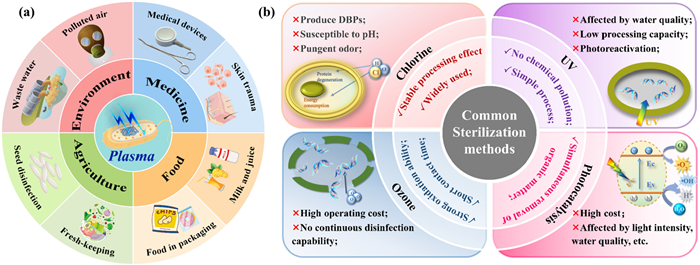
Figure 1.
(a) The applications of plasma in the field of disinfection. (b) Comparison of common disinfection technologies.

Review on application of non-thermal plasma for disinfection: Direct plasma and indirect plasma-activated water
He Guo , Yongchun Wang , Junlei Wang , Shoufeng Tang , Tiecheng Wang


Microorganisms are widely distributed in the natural world, among which pathogenic microorganisms play a crucial role in human health and disease. They can be transmitted to humans through various means, such as surface contact, water sources, airborne transmission, or insect bites, leading to infections and diseases [1]. In particular, waterborne and foodborne diseases can spread rapidly [2]. Among them, water, serving as a medium for transmitting pathogenic microorganisms, has become one of the primary factors leading to mortality [3]. With the emergence of COVID-19 [4], there has been a growing focus on disinfection. The main pathogenic microorganisms in the water are bacteria [5], viruses [6], and parasites [7]. These are invisible killers of human health and may cause typhoid, dysentery, pneumonia, food poisoning, and various other diseases [8]. In addition, these pathogenic microorganisms are also widely present on various surfaces of objects, such as food and medical equipment [9,10]. This increases the risk of infection because when people come into contact with these surfaces, they may be exposed to and infected by pathogenic microorganisms. Therefore, controlling and cleaning surface microorganisms are also crucial to ensure public and personal health. This research focuses on NTP sterilization technology, whose target media include water bodies and object surfaces. In terms of water bodies, traditional water treatment methods face challenges such as chemical residues, disinfection byproducts, and difficulty in dealing with drug-resistant microorganisms, while NTP technology can directly and efficiently treat wastewater contaminated by pathogenic microorganisms without pollution. In the surface treatment of objects, the PAW generated by NTP can be used to treat pathogenic microorganisms on the surface of various objects. A variety of active species contained in PAW can penetrate microbial cell membranes, destroy their metabolic functions, and achieve inactivation purposes, providing a non-contact and environmentally friendly sterilization method for the surface of objects.
As an advanced oxidation technology, plasma technology integrates the effects of active species, high-energy electrons, ultraviolet radiation, and pyrolysis [11]. It has emerged as a novel technology in the field of disinfection and is currently widely used in fields such as biomedical, air, and food (Fig. 1a). In these applications, traditional methods of water treatment and food sterilization are facing many challenges, such as chemical residues, the impact of high temperatures on product quality, and the threat posed by antibiotic-resistant microorganisms. These challenges urgently require gentler, more effective, and more environmentally friendly solutions. In plasma technology, non-thermal plasma (NTP) technology can avoid some drawbacks of traditional methods because it does not need high temperature in the processing process, and just shows its unique advantages. It can use plasma to directly treat wastewater contaminated with pathogenic microorganisms, as well as generate plasma-activated water (PAW) to treat pathogenic microorganisms on object surfaces [12]. Compared with traditional disinfection techniques, NTP boasts a range of merits, including high disinfection efficiency, absence of secondary contamination, and wide applicability, which indicates promising prospects for its extensive application [13].
Therefore, this review will focus on the application of NTP in disinfection, summarizing two main aspects: Plasma disinfection in water and PAW disinfection for object surface. Firstly, the limitations of traditional disinfection techniques and disinfectants will be reviewed to highlight the advantages of NTP disinfection technology. Next, the basic concept and generation of NTP will be introduced, and the application of NTP in disinfection will be discussed from the perspectives of plasma and PAW. In addition, this review will also discuss the influencing factors and mechanisms of NTP disinfection. Finally, the development direction of NTP technology in the field of disinfection was prospected. By deeply discussing the principles and applications of NTP disinfection technology, we hope to provide a reference for the research and practice of bacterial pollution issues.
At present, wastewater disinfection methods are primarily categorized into physical disinfection and chemical disinfection. The most widely utilized methods include chlorine disinfection, ultraviolet disinfection, ozone disinfection, and photocatalysis. Fig. 1b shows both the strengths and weaknesses of these technologies. Chlorine disinfection is the earliest and most widely used disinfection technology [14,15]. However, it poses safety concerns due to the generation of potentially carcinogenic DBPs [16,17]. Therefore, it is necessary to enhance the regulation of DBPs to minimize their hazards. Correspondingly, UV disinfection is a physical method [18–20]. It disrupts the genetic material structure in pathogenic bacteria through UV irradiation, hindering cell division and replication. This ultimately leads to the loss of microorganisms’ reproductive capacity and their demise [21,22]. UV can produce good bactericidal effects in a short period and has a high broad-spectrum efficiency against various pathogens [23]. However, UV disinfection is influenced by the turbidity of the water, lacks continuous disinfection ability, and may exhibit the phenomenon of photo-reanimation [14]. Ozone is a potent oxidizing agent known for its robust disinfection capabilities, highly effective in eliminating viruses, bacteria, and spores [24–26]. It has the advantage of being fast, efficient, environmentally friendly, and clean [27–29]. However, ozone exhibits instability and a limited capacity for continuous disinfection [30,31], but also generates numerous disinfection byproducts [32,33]. Initially, ozone oxidizes bromide ions to hypobromous acid and bromite ions. When ozone reacts with water containing bromine ions, a complex series of chemical reactions occur to produce bromate, which is a potential human carcinogen. In addition, ozone reacts with natural organic matter in water to produce organic bromine disinfection byproducts. These organic Br-DBPs may have potential negative impacts on human health and the environment. On-site preparation and a high degree of operational management expertise are essential requisites. In addition, ozone may irritate the human respiratory mucosa and damage human health. In recent years, photocatalysis has also been proven to have the ability of disinfection [34,35]. One of the most frequently employed photocatalysts is TiO2, which is inherently insoluble in water, non-toxic, and environmentally benign, rendering it suitable for water disinfection [36,37]. However, photocatalysis takes a long time to achieve a good disinfection effect, and the energy utilization rate is low. In addition, photocatalysis lacks broad-spectrum specificity and has weak killing ability against viruses and spores [38,39].
In addition, the disinfection of the surface of the object mainly includes chemical disinfectant disinfection and physical disinfection. In terms of chemical disinfectants, peracetic acid is a typical peroxide. In the process of disinfection, new ecological oxygen is released, which can attack the cell wall and cell membrane, oxidize and denature the cell biomacromolecules, and destroy their metabolism and reproduction ability [40]. Commonly used in hospitals, laboratories, medical equipment and environmental surface disinfection. However, peracetic acid has poor stability and needs to be stored at low temperature and away from light. In addition, it is corrosive and irritating, will corrode metal, contact with human skin, eyes and respiratory tract can cause damage [41]. In the physical disinfection method, Gamma ray disinfection of ionizing radiation disinfection, the use of cobalt-60 and other gamma rays, because of its strong penetration, often used for disposable medical equipment, food, medicine and other disinfection. But the equipment is professional, high cost, there are radioactive safety risks [42]. Electron beam radiation disinfection produces high-energy electron beams through electron accelerators. The disinfection speed is fast and the dose can be accurately controlled, but the equipment investment is large and the professional requirements for operators are high [43].
Plasma is a form of matter consisting mainly of free electrons and charged ions, which is electrically neutral as a whole and is considered to be the fourth form of matter. For the classification of plasma, it can be categorized into thermal plasma and NTP based on the relative temperatures of electrons, ions, and neutral particles [44]. Among them, the ion temperature of NTP is much smaller than the electron temperature and remains in a non-equilibrium state at low or atmospheric pressure [45]. NTP technology is widely used to degrade various toxic substances in water, such as dye [46], antibiotics [47], and pesticides [48]. Plasma disinfection technology has been used for sterilizing medical devices since the 1960s. In 1996, the Plasma Science Laboratory of the University of Tennessee adopted glow discharge plasma for disinfection [49]. Since then, plasma disinfection technology has gained much attention and is flourishing in several fields [50].
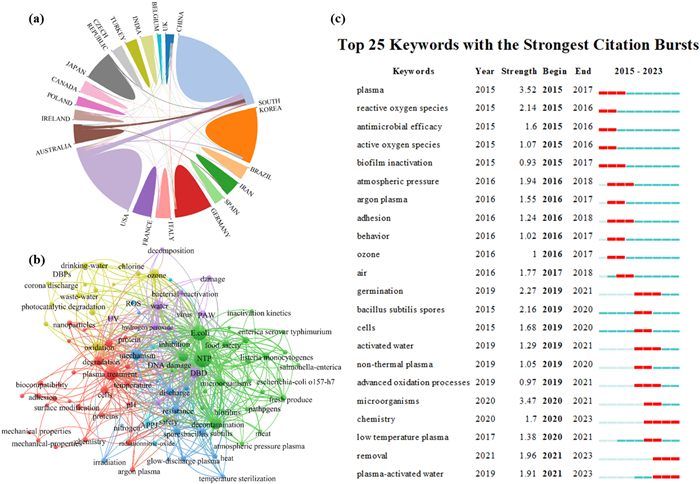
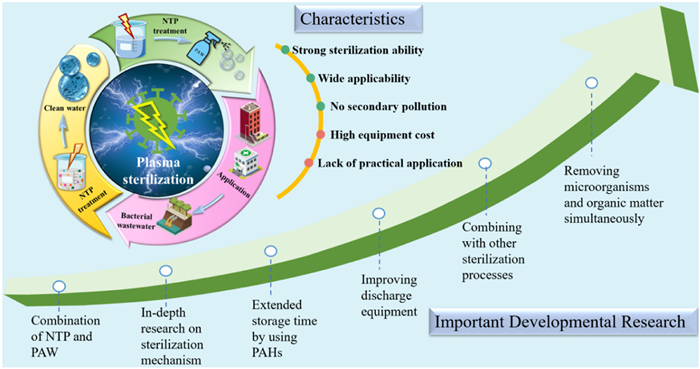
Fig. 2a shows the top 20 countries based on publication volume and their cooperative relationships. Among them, the United States and China have the highest number of publications and are closely connected. In order to showcase the research hotspots in the field of NTP disinfection, we conducted a visual analysis of the keywords (Fig. 2b) [51]. As shown in the figure, except for “NTP” and “PAW”, the nodes where words such as “ROS”, “DNA damage”, “E. coli”, “DBD” and “mechanism” are located and relatively large, reflecting the hotspots of NTP disinfection. In addition, according to the keyword emergence graph (Fig. 2c), there has been a gradual increase in research on PAW in recent years. The timeline chart is mainly used to outline the relationships between clusters and the period of a certain cluster. With the increasing demand for microbiological safety, NTP technology has been widely applied in disinfection. It serves as an efficient approach to address the challenges related to chemical residues and harmful substances in conventional water treatment methods, and can also be used to produce PAW as a disinfectant. However, NTP disinfection also has certain limitations. Researchers are constantly innovating and improving NTP disinfection technology. Fig. 3 shows research with innovative and developmental significance in recent years. They have achieved some significant research results by fully understanding the inactivation mechanism to improve activation efficiency and stability and then expanding their scale. These have laid a certain foundation for the application of NTP disinfection.
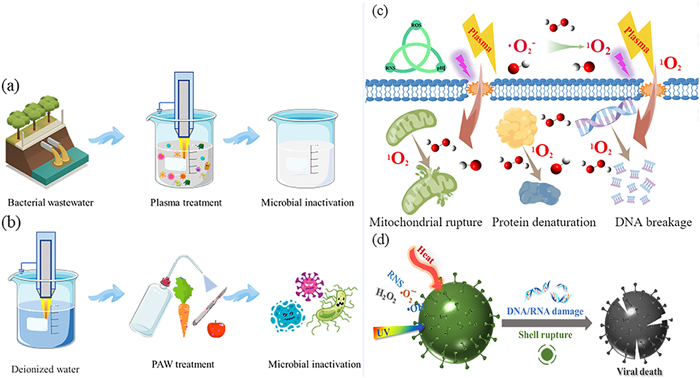
Food and water are one of the main ways humans are infected with bacteria [52,53]. Given the potential for gastrointestinal illness, severe water loss, long-term health problems, and public health crises, it is critical to address foodborne and waterborne pathogens. Plasma technology shows its special advantages. On the one hand, as shown in Fig. 4a, NTP can act directly on microbially contaminated water, destroying the structure of bacteria in the water and inactivating them. On the other hand, PAW can be used as a disinfectant to inactivate pathogenic microorganisms on the surface of food (Fig. 4b). The former can effectively purify water in a short period; the latter not only does not damage the nutrients and taste of food but also helps to extend the freshness period while reducing the environmental burden.
NTP disinfection technology can overcome the shortcomings of traditional disinfection technology, effectively inactivate bacteria in water without producing DBPs, and is a promising technology. At present, there is no widely accepted consensus regarding the disinfection mechanism of NTP. The prevailing belief is that the mechanism by which NTP deactivates microorganisms may primarily involve electromagnetic fields, thermal effects, ultraviolet radiation, charged particles, and active species.
The mechanism of NTP disinfection may vary slightly for different microorganisms. For bacteria, a series of chemical reactions and physical effects generated during NTP treatment can damage their cell walls and membranes. Active species can trigger oxidation reactions of nucleic acids, leading to the incapacitation of bacteria in terms of survival and reproduction, thereby achieving the goal of inactivation. Because the cell structure of fungi is more complex than that of bacteria, it is usually more difficult to kill. However, many studies have confirmed that NTP can effectively inactivate fungi [54,55], and the inactivation mechanism is shown in Fig. 4c. Among them, mitochondria are important organs within fungal cells, participating in cellular metabolic processes and providing energy. NTP can destroy mitochondria in fungi, thereby inhibiting their growth and reproduction. Patange et al. [56] used NTP to treat food industry wastewater. The research results showed that it can effectively inactivate a variety of key indicator microorganisms, and it is expected to be applied to large-scale industrial equipment. Since the outbreak of COVID-19 in 2019, many scholars have carried out research on NTP inactivation of viruses. Compared to bacteria and fungi, viruses do not have cell walls or membranes. RONS generated during NTP processing, such as •OH, •O2-, H2O2, NO, ONOO−, mainly react with viral proteins and nucleic acids. H2O2 can penetrate the capsid or envelope of the virus and decompose into •OH. For viruses, •OH can react with the amino acid residues in proteins, triggering oxidative modifications and thus leading to protein denaturation. Regarding nucleic acids, •OH can cause strand breaks and cleavage of the nucleic acid structure [57,58]. In addition, NO can modify the amino acid residues in proteins through nitrosation or nitration reactions, thereby affecting the structure and function of proteins. ONOO- can cause strand breaks and base modifications, ultimately resulting in the loss of viral activity (Fig. 4d) [59]. Chen et al. [60] were the first to employ atmospheric pressure plasma jet (APPJ) for the treatment of SARS-CoV-2 and demonstrated its inactivation by NTP. In their study, SARS-CoV-2 at a concentration of 2 × 10⁵ PFU/mL was all inactivated within 180 s when the voltage was 12 kV and the frequency was 30 kHz. These provided a detailed basis for NTP inactivation of coronavirus.
Plasma interacts with water molecules on the surface or in water, and the molecules, charged particles, photons, free radical groups, and other active components generated by the induced gas ionization are transferred to the water, causing a series of physical and chemical reactions, producing active species such as active oxygen, active nitrogen. In the plasma environment, high-energy electrons are able to break O—H bonds in water molecules, resulting in •OH and H• (Eq. 1). •OH cannot exist stably in solution and will be quickly converted to H2O2 (Eq. 2). O2 in the plasma system is ionized to form O3 (Eqs. 3-5), which leads to a series of free radical chain reactions to form •OH, 1O2 and •O2- (Eqs. 5-9). When N2 is present in the feed gas, RNS (Eqs. 10-13) is produced. O3 can also react with a variety of active particles in PAW (Eqs. 14-17). We have inserted these summarized reactions into the manuscript. Each reaction is accompanied by a brief explanation to help readers better understand the mechanisms of the generation of active species in PAW. The water solution formed by the diffusion and activation of active species in the water is PAW. Previous studies have demonstrated that PAW has the ability to disinfect various microorganisms. Heng et al. [61] used plasma activated acidic electrolytic water (AEW) for the first time. Compared with PAW alone, PA-AEW could increase the inactivation effect of Bacillus subtilis from 0.58 log10CFU/mL to 2.33 log10CFU/mL within 10 s of treatment time. Among them, active chlorine (RCS), the main bactericidal factor in AEW, had a synergistic effect with reactive oxygen species (ROS). With the increase of RCS from 12.09 mg/L to 28.76 mg/L, the kill logarithm increased from 0.3 log10CFU/mL to 1.81 log10CFU/mL. Guo et al. [62] took pseudovirus with SARS-CoV-2 S protein as the research object. After treatment with PAW-5 min and PAW-10 min, the relative light unit of receptor cells decreased from 24,071 and 271,295 to 21.2 and 16.8, respectively. This strongly confirmed PAW’s antiviral ability against SARS-CoV-2.
|
|
(1) |
|
|
(2) |
|
|
(3) |
|
|
(4) |
|
|
(5) |
|
|
(6) |
|
|
(7) |
|
|
(8) |
|
|
(9) |
|
|
(10) |
|
|
(11) |
|
|
(12) |
|
|
(13) |
|
|
(14) |
|
|
(15) |
|
|
(16) |
|
|
(17) |
The above research shows that PAW alone has significant disinfection effect. However, in practical applications, especially in water disinfection and related fields, in order to improve disinfection effect and optimize energy consumption, the combination of NTP and PAW has attracted much attention. Microorganisms in wastewater primarily originate from domestic sewage, medical wastewater, and industrial wastewater. Wastewater treatment aims to effectively prevent or inactivate these microorganisms to safeguard the environment and public health. Although the use of PAW increases the processing time, it effectively improves disinfection efficiency and reduces energy consumption. Patange et al. [56] proposed that post-treatment residence time is a crucial factor in enhancing the effectiveness of NTP disinfection. Short-term NTP treatment and long-term continuous PAW treatment can significantly improve the inactivation efficiency. Xu et al. [63] investigated the inactivation effect of NTP combined with PAW on S. cerevisiae and A. flavus. When treating S. cerevisiae and A. flavus, both with an initial concentration of 107 CFU/mL, the power consumption for NTP treatment alone was 0.16 kWh for S. cerevisiae and 0.15 kWh for A. flavus. However, when using a combined treatment of NTP and PAW to achieve the same sterilization effect, the power required was 0.07 kWh for S. cerevisiae and 0.07 kWh for A. flavus.
Based on the unique physical and chemical properties of PAW, its application in the food sterilization field is also worthy of in-depth exploration. Compared with the water sterilization scenario, PAW can not only play a similar role in inactivating microorganisms in food sterilization but also has its unique application advantages. For food disinfection, plasma treatment may be affected by the irregular shape of the food surface and cannot achieve the disinfection effect. PAW has better fluidity, can be fully mixed with a bacterial solution, and is evenly covered on the surface of the biofilm, achieving a significant antibacterial effect [64]. Previous studies have shown that PAW has strong antibacterial activity on vegetables, fruits, meat, and other foods, and does not affect food quality [65,66]. Furthermore, PAW disinfection is gentler, which can avoid direct damage caused by charged ions, ultraviolet light, etc. It offers advantages such as ease of operation and the absence of secondary contamination, rendering it a potential substitute for traditional disinfectants.
Although PAW has achieved many successful applications in disinfection, its disinfection efficiency still needs to be further improved. Faced with the problem of low efficiency in activated water treatment, Koentadi et al. [67] designed a hybrid plasma discharge (HPD) reactor in which two plasma discharges are generated simultaneously within a single power source. With a resonance frequency of 60 kHz, an input voltage of 200 V, a discharge frequency of 2500 Hz, a duty cycle of 50 µs, and a discharge time of 30 min, the total concentration of RONS increased from 41 mg/L to 102 mg/L when the NaCl concentration changed from 0 mmol/L to 8 mmol/L. It is demonstrated that this reactor can effectively increase the content of RONS, thereby improving energy efficiency and disinfection efficiency. In addition, the RONS in PAW have a relatively short lifespan and are prone to react with substances in the surrounding environment, leading to their deactivation [68]. Therefore, the activity of PAW rapidly decreases over time. In order to better apply PAW disinfection technology, further research is needed on the preservation and stability of activated water. In this context, plasma-activated hydrogels (PAHs) emerge as a promising alternative. In recent years, PAHs have found extensive applications in the medical domain [69,70]. PAHs refer to the treatment of hydrogels directly or indirectly through NTP technology and the conversion of hydrogels into a material with the function of an active material carrier. Compared to PAW, PAHs have higher stability and can maintain activity for a longer period. And PAHs can also serve as a carrier to add other antibacterial drugs and enhance their bactericidal effect. The network structure of PAHs effectively reduces the loss of active species and prolongs their antibacterial activity [71].
At present, NTP used for water disinfection is mainly produced by dielectric barrier discharge (DBD), corona discharge, and APPJ. Fig. S1 (Supporting information) shows their structure. These discharge methods have their advantages and disadvantages. Different discharge methods produce different NTP compositions and concentrations, with different disinfection effects and energy efficiency. The comparison of these methods is shown in Table S1 (Supporting information). In addition, when it comes to plasma systems, the discharge types, important discharge parameters, and disinfection efficiency are listed in Table S2 (Supporting information). These discharge modes are described in detail in Text S1 (Supporting information). More NTP technologies will be used in the field of disinfection and purification in the future thanks to the ongoing development and invention of NTP technology, improving human health. More innovation and technological advancements in the field of disinfection and purification will result from the continued emergence of new materials and reactors. As a result, NTP technology will become more significant in the field of disinfection in the future.
In theory, PAW can be activated by various ways that can produce NTP. According to the discharge structure, the common types are DBD, APPJ [72] and sliding arc discharge [73]. The selection of NTP reactor significantly affects the disinfection performance of the produced PAW.
In addition, PAW can be formed by two discharge modes: One is to generate NTP on the water surface, and the other is to directly charge the NTP into the water. Tian et al. [74] measured the physicochemical properties and biological effects of PAW under the two modes respectively. These findings suggest that the bactericidal efficacy of underwater discharge is greater than that of non-underwater discharge under underwater discharge conditions. This is due to the fact that more ROS build in underwater discharge, increasing the PAW’s oxidation–reduction potential and conductivity. Moreover, as the voltage changes during the underwater discharge, a streamer and spark will be produced. According to Li et al.’s research [75], the disinfection effect of spark zone was significantly higher than that of streamer zone. This might be connected to the increased heat emission and discharge volume in the spark region. Based on this, in the actual NTP sterilization application, for large-scale water treatment, the reactor with large discharge area can be selected, such as the DBD reactor with expanded electrode area in industrial water treatment. In small-scale and high-precision sample sterilization scenarios, the underwater discharge mode is more advantageous. By accurately controlling the voltage, the discharge is in the spark area, which can maximize the disinfection efficiency while ensuring that the sample is not too affected.
Various microorganisms can be treated with NTP, and various bacteria respond to it in different ways. At present, the bacteria used in the study of NTP disinfection are still very limited, and the bacteria used are mostly concentrated in E. coli and S. aureus. In order to assess the effectiveness of NTP system in sterilizing water pathogens, Hong et al. [76] used DBD to treat a variety of pathogens (Edwardsiella tarda, Vibrio harveyi, Strepcocuus parauberis, Vibrio damsela and Vibrio ichthyoenteri), and confirmed its significant disinfection effect on a variety of pathogens. William et al. [77] tested different bacteria using PAW activated by sliding arc NTP. The study discovered that the PAW may successfully inactivate E. coli and S. aureus under the same circumstances and has a stronger inactivation impact on E. coli. However, it cannot inactivate C. albicans. Gram-negative bacteria are generally more probable to be inactivated due to the variance in cell wall construction. Gram-negative bacteria have multi-layered cell walls with few peptidoglycans and an outer membrane layer made of lipopolysaccharide, lipid bilayer, and lipoprotein. In contrast, Gram-positive bacteria have thick and dense peptidoglycan and phosphoteichoic acid without charge. Gram-negative bacteria’s cell walls are more severely destroyed by NTP because of the relatively loose structure. When dealing with known types of microorganisms, the NTP sterilization process can be optimized based on their cell wall structure. For example, for Gram-negative bacteria, a relatively low NTP energy input may be sufficient for effective disinfection, given their vulnerability. This saves energy and reduces the cost of the sterilization process.
Generally speaking, the inactivation effect and time are positively associated during the NTP sterilizing process. Additionally, the length of processing time often determines the size of energy consumption. Patange and his colleagues [56] pointed out that both the treatment time and the retention time after treatment are the key factors of the NTP when studying the disinfection ability of NTP, which is conducive to the development of efficient wastewater disinfection schemes. For PAW, the impact of time is divided into two aspects. One is the time when PAW is generated by discharge, and the other is the time when microorganisms soaked in PAW after treatment are used for disinfection. The outcomes demonstrated that extending the NTP treatment duration and lengthening the PAW soaking time could improve the sterilizing effect [64]. Jun et al. [78] developed an ultraviolet visible spectroscopy, which uses an automatic curve fitting program to calculate changes in H2O2, NO2-, NO3- and O2 concentrations. It is discovered that the intensity of absorption spectrum increases with the increase of NTP exposure time, which indicates RONS concentration rises over time. The authors found that it is possible to alter the RONS concentration by merely modifying the NTP exposure duration, which has little impact on the concentration ratio of the RONS composition of PAW.
Studies have shown that when the oxidation–reduction potential (ORP) is high, the exterior and inner membrane of microbial cells will be destroyed [79]. At the same time, ORP can also be used as an indicator of PAW inactivation capacity. Guo et al. [73] found that the content of ROS increased with time, that is, the inactivation capacity increased. After 60 min of plasma treatment, the ORP of PAW increased from 235.5 mV to a maximum value of 442 mV at 120 min. As processing times lengthen, energy use efficiency will decline. Therefore, appropriate treatment time should be selected in combination with disinfection efficiency and energy efficiency. In addition, the residence time of water in PAW can be regulated to ensure efficient disinfection and reasonable energy consumption.
One of the primary causes of microbial inactivation during NTP disinfection is the presence of active ions. NTP technology will produce a variety of active particles at the gas-liquid contact surface, which will react with microorganisms to achieve the purpose of disinfection. The commonly used discharge gases include air, O2, Ar, He or two or more kinds of mixed gases [80]. Due to the different nature of these working gases, the types of active ions created by discharge are also different [81]. Chandana et al. [82] measured the concentration of active species under various gas conditions, and found that Ar produced the highest amount of H2O2, but hardly produced HNO3 and O3. Additionally, the working gas is very important in influencing the degree of PAW reactivity, and numerous studies have shown the advantages of working in an inert gas environment with a tiny proportion of oxygen mixture [83]. In practical applications, if a variety of active species need to cooperate, Ar and a small amount of O2 gas can be used. For general disinfection applications, air can be used as discharge gas to save costs.
Numerous more elements, such as pH, beginning water quality, and others, have an impact on NTP’s sterilizing effectiveness in addition to those mentioned above. Stephane obtained drinking water samples from France, Norway, Palestine, Slovenia, and the United Kingdom while researching the effects of water sources on PAW. The same air NTP was used to treat all water samples [84]. The findings demonstrate that PAW is very sensitive to the initial composition of the used water source, and that drinking water composition from various geographic regions would significantly affect PAW’s overall impact. Chandana et al. [82] investigated how pH affects antibacterial activity. The results showed that an acidic environment promotes bacterial cell membrane disruption and protein denaturation, and that disinfection is more effective at pH < 4.7.
In the study of plasma disinfection experiments, taking E. coli as an example, and combining with machine learning, the aim is to deeply analyze the complex relationships between the degradation rate of E. coli under plasma experimental conditions and key parameters such as E. coli cell concentration, gas flow rate, and voltage using machine learning techniques.
In this study, machine learning was utilized to explore which factors significantly influence the degradation rate of E. coli. A total of 679 data points were collected from the references in this review, listing five influencing factors: The impact of E. coli cell concentration, gas flow rate, pH value, plasma discharge voltage, and plasma treatment time on the degradation rate of E. coli.
In this experiment, four machine learning models were utilized, which are the Support Vector Machine model, the XGBoost model, the linear regression model, and the random forest model.
The accuracy of machine learning (ML) prediction results is determined using the coefficient of determination (R2), root mean squared error (RMSE), mean absolute error (MAE), and pearson correlation coefficient (Eqs. 18 and 19) [85]. The model performance is as shown in Fig. 5a.
|
|
(18) |
|
|
(19) |
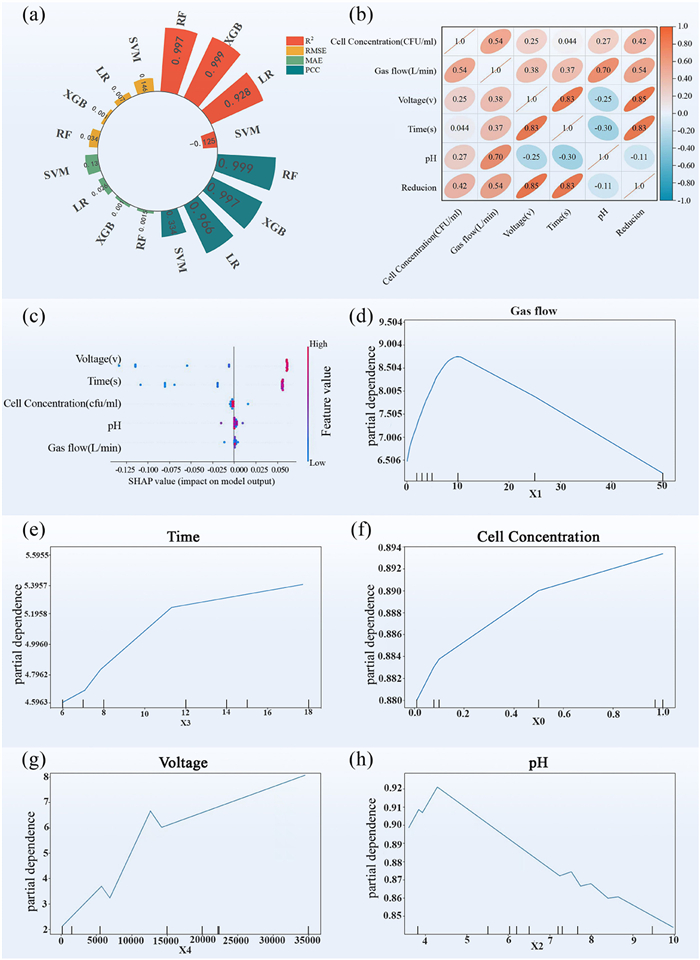
Based on XGBoost predictions, combined with the correlation matrix heatmap. The correlation results are shown in Fig. 5b. To elucidate the key practical parameters for the degradation of E. coli, Shapley additive explanation (SHAP) values were employed to determine feature importance and visualize the inner workings of the ML models [86]. The SHAP analysis is shown in Fig. 5c. The magnitude of SHAP values indicates the importance of a feature, with larger values signifying greater importance. Additionally, SHAP values can reveal whether a feature has a positive or negative impact on predictions.
Univariate PDP analysis reveals that increasing voltage and treatment time both enhance the plasma degradation efficiency of E. coli. The relationship between gas flow rate and degradation efficiency is nonlinear, with an optimal value existing [87]. As E. coli concentration increases, the degradation efficiency rises initially and then declines, suggesting that higher concentrations require longer times or higher energy treatments for better inactivation. The pH value is negatively correlated with degradation efficiency, with the best disinfection effect occurring in an acidic environment (around pH 4). The PDP charts are shown in Figs. 5d-h.
The study utilized machine learning to analyze the factors affecting the plasma degradation of E. coli, finding the XGBoost model to be the most accurate for prediction. Results indicated that voltage has the greatest impact on degradation efficiency, followed by treatment time, gas flow rate, cell concentration, and pH value. High voltage, extended treatment time, acidic environment, and appropriate bacterial concentration and gas flow rate can significantly enhance degradation efficiency.
In plasma disinfection, the generation of RONS is considered as a key element. During the plasma water treatment process, the high-energy reactive species produced by high-voltage discharge are deposited into the water. For plasma disinfection, RONS are considered a key factor. RONS mainly include long-lived species such as H2O2, O3, NO2- and NO3-, as well as short-lived species like •OH, •O2-, 1O2 and ONOO-. Various research findings indicate that in an aqueous environment, short-lived RONS are crucial for plasma inactivation. Xu et al. [88] explored the inactivation of yeast cells by several short-lived ROS using scavengers. The •OH, •O2- and 1O2 were captured by D-Man, SOD, and L-His, respectively. Scavengers were added, which improved the yeast survival rate as shown in Fig. S3a (Supporting information). This indicated that •OH, •O2- and 1O2 were involved in the inactivation process of yeast. Furthermore, it is evident from the degree of increase in survival that 1O2 has the greatest effect on yeast inactivation. Among them, •OH disrupts the integrity of the cell membrane by attacking it. In comparison, 1O2, with a longer lifespan, is more prone to diffuse into the cell membrane and react with cellular components such as unsaturated lipids and protein fractions. 1O2 plays a crucial regulatory role in the transition between cell apoptosis and necrosis. Subsequently, the authors also analyzed DNA fragments from yeast cells by flow cytometry PI staining [89]. As can be seen from Fig. S3b (Supporting information), the percentage of SubG1 increased from 2.83% to 10.41% after 10 min of NTP treatment. This increase suggested a gradual accumulation of DNA fragments in the cells, indicating potential DNA damage or cell death. The scavenger can effectively alleviate the DNA damage situation, which again proves that ROS can inactivate microorganisms by oxidizing DNA.
The destruction of proteins and nucleic acids by ROS through oxidation reactions is the main mechanism of virus inactivation. 1O2 can oxidize DNA bases, including adenine, cytosine, guanine, and thymine, with guanine being the most susceptible to oxidation [90]. Song et al. [91] analyzed the inactivation of viral proteins using three-dimensional fluorescence spectroscopy. During the pulse corona discharge, the contents of H2O2, O3, 1O2, and •OH gradually increased. With passing time, the fluorescence’s intensity steadily decreased (Fig. S3c in Supporting information). Meanwhile, the results of peptide spectrum matching and mass spectrometry bottom peaks indicated that all five proteins of the virus were disrupted by pulsed corona discharge, but their response rates were different. This may be related to the fact that ROS crosses the outermost layer of the virus (G and M proteins) before reacting with other proteins (Fig. S3d in Supporting information). In addition, by PCR amplification of SVCV particles, it was found that P, G, N and L genes were significantly lost to amplification in a short period of time, while M genes were more resistant to damage by treatment. However, after 180 s, all these genes were severely damaged and could no longer be amplified. RON induces oxidative damage to specific residues of the virus protein. By affecting the binding capacity of the virus protein, it prevents its binding to cell receptors, thereby inhibiting the virus’s infection of host cells. Qin et al. [92] carried out experimental research on the inactivation of coronavirus by NTP using NTP jet. Specifically, ONOO- and •O2- oxidize tyrosine, tryptophan, and histidine on the receptor binding domain. The results showed that RONS could induce oxidative damage of virus S protein, and ONOO- was the main reaction substance.
As shown in Fig. 6a, the active substances that play a major role are different for plasma treatment and PAW treatment. Both plasma and PAW have been reported to cause phage aggregation, resulting in damage to the DNA and proteins of the phage, thus affecting their biological activity and achieving bactericidal effects. However, NTP treatment can inactivate phages in a short time (60–120 s), while PAW requires a certain time (4–8 h) for maximum bactericidal effect [93]. PAW contains abundant RONS, which gives PAW a high redox potential and acidic pH. This is the key to the inactivation of microorganisms by PAW. However, there is still controversy about the exact mechanism of PAW inactivation of biological activity. Xiang et al. [94] studied the inactivation effect of PAW on P. deceptionensis CM2. They concluded that H2O2, NO3-, and NO2- were the most critical factors for inactivation. It has also been reported that ONOO- is the key active species formed in PAW [95]. ONOO- has a high permeability, which enables it to pass through the cell membrane and enter the inside, where it interacts with the biomolecules and damages them by oxidation.
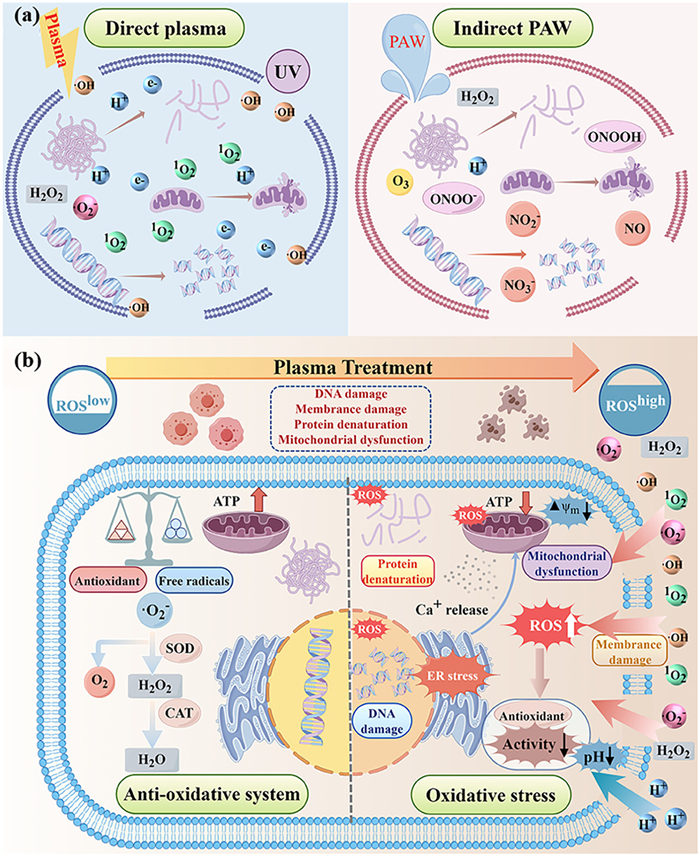
In the PAW investigation on biofilm treatment, Park et al. [96] came to the conclusion that •OH, H2O2, HNO2, and O3 were the reactive compounds that reduced biofilm the most. H2O2 had the highest impact on the biofilm. Anne et al. [97] also studied the interaction of PAW with biological membranes. They concluded that both short- and long-lived RONS increase the activity of PAW and damage cellular DNA, RNA, lipids, and proteins. The biofilm matrix can be disrupted by RONS, which also kills biofilm cells inside microcolonies and releases cells from the biofilm.
The antioxidant system is a complex biological mechanism within living organisms aimed at maintaining the cellular redox balance and protecting the organism from oxidative damage [98]. This system primarily functions through the synergistic action of antioxidant enzymes (such as superoxide dismutase (SOD) and Catalase (CAT)) and non-enzymatic antioxidants to neutralize or eliminate oxidative molecules like free radicals, thereby preserving cellular functionality. As shown in Fig. 6b, SOD can catalyze •O2- to generate O2 and H2O2, and CAT can catalyze the decomposition of H2O2 into H2O. However, when the production of ROS exceeds the cell’s own clearance capacity, it can cause damage to the cell, a phenomenon known as oxidative stress (OS) [99]. OS is a state in which the imbalance between oxidation and antioxidant action in the body leads to oxidative harm to biomolecules like proteins, lipids and nucleic acids in cells, thus affecting their physiological functions and metabolic processes [100]. Xu et al. [89] reported that the activity of antioxidants decreases with plasma treatment time, indicating that the ROS-reduced by plasma gradually disrupt the redox balance within cells. Among them, •OH and 1O2 play the main role.
This review summarizes the research progress of NTP disinfection. Traditional disinfection technologies are summarized and compared. The concept and generation mode of NTP are summarized. In addition, the application of plasma water disinfection and PAW disinfection is introduced respectively, and the factors affecting the disinfection effect are analyzed. Compared to traditional disinfection methods, the NTP disinfection process does not require chemical fungicides, making it a cost-effective, waste-free, and environmentally friendly option with no drug residues. It is a green and efficient method with promising application prospects. Greater sterilizing effects can be accomplished with the NTP generator in a shorter amount of time, effectively getting rid of various pathogenic microorganisms. NTP technology is a promising method for the issue of water disinfection and can also be used to produce efficient and environmentally friendly disinfectants. However, there are still many challenges to overcome, such as the uncertainty of the mechanism and influencing factors of NTP disinfection, the high energy consumption of devices such as DBD, and the need to optimize the reactor structure, which requires more development and research.
To fully exploit the benefits of NTP technology and encourage its use in the field of disinfection, some expectations are put forward for further research on this technology, which is also summarized in Fig. 7.
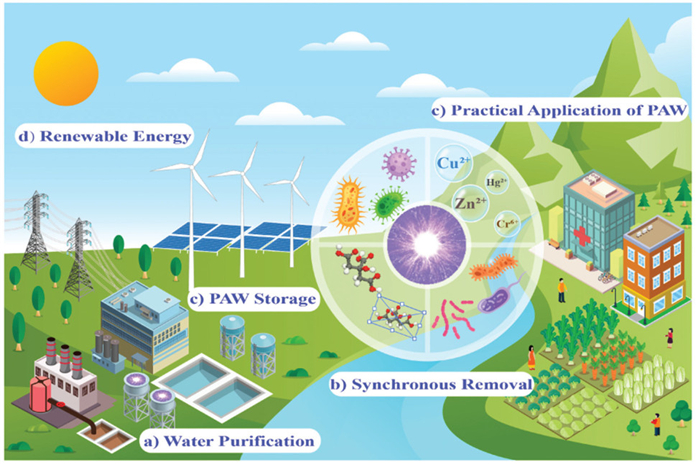
(a) For bacteria, viruses, etc., it is required to better understand the role of NTP and its lethal mechanism, to optimize NTP disinfection technology. And constantly optimize the process, improve the efficiency of equipment, reduce costs, design a large-scale NTP disinfection system suitable for industrial applications.
(b) In addition to microorganisms, there are all kinds of harmful substances in water. In the future, NTP technology suitable for a variety of pollutants can be researched and developed to achieve collaborative removal of organic matter, heavy metals, and microorganisms. In addition, it can be considered to combine with photocatalysis and ozone to form a mixed process, which can improve the removal effect of different pollutants by adjusting the reaction conditions and adding appropriate catalysts.
(c) At present, the storage of PAW is still a challenge. In the future, we can explore new storage methods, such as using high-pressure, low-temperature, and other technologies to extend the shelf life of PAW. In addition, activated hydrogel is a promising storage method of activated water, which provides better guarantee for the application of NTP disinfection technology.
(d) NTP disinfection needs to consume a lot of electricity, in addition to the development of energy-efficient power supplies, can also use renewable energy, such as solar, wind, etc., to provide the required energy. This will reduce dependence on traditional energy sources, meet energy saving targets and promote more sustainable and environmentally friendly water treatment.
The authors declare that they have no known competing financial interests or personal relationships that could have appeared to influence the work reported in this paper.
He Guo: Writing – review & editing, Writing – original draft, Supervision, Project administration, Investigation, Data curation, Conceptualization. Yongchun Wang: Writing – original draft, Software, Investigation, Data curation. Junlei Wang: Software, Investigation, Formal analysis, Data curation. Shoufeng Tang: Writing – review & editing, Supervision, Project administration, Investigation, Conceptualization. Tiecheng Wang: Writing – review & editing, Supervision, Project administration.
The author thanks for the financial support by National Natural Science Foundation of China (No. 22006069) and Natural Science Foundation of Jiangsu Province in China (No. BK20200801), and Jiangsu Special Foundation on Technology Innovation of Carbon Dioxide Peaking and Carbon Neutrality (No. BK20220016).
Supplementary material associated with this article can be found, in the online version, at doi:
C. Yuxiang, A. Ji, Z. Jiteng, et al., Mater. Today 67 (2023) 468–494. doi: 10.1016/j.mattod.2023.06.006
P. Rajapaksha, A. Elbourne, S. Gangadoo, et al., Analyst 144 (2018) 396.
Z. Yanmei, H. Fang, W. Wenxiu, et al., Sci. Total Environ. 900 (2023) 165867. doi: 10.1016/j.scitotenv.2023.165867
D. Zhang, H. Ling, X. Huang, et al., Sci. Total Environ. 741 (2020) 140445. doi: 10.1016/j.scitotenv.2020.140445
S. Rodríguez-Martínez, Y. Sharaby, M. Pecellín, et al., Water Res. 77 (2015) 119–132. doi: 10.1016/j.watres.2015.03.010
C. Masciopinto, O. De Giglio, M. Scrascia, et al., Sci. Total Environ. 666 (2019) 559–571. doi: 10.1016/j.scitotenv.2019.02.107
S.H. Sara, M.M. Fazel, M.-H. Abdollah, et al., J. Clean Prod. 378 (2022) 134555. doi: 10.1016/j.jclepro.2022.134555
E. Sib, F. Lenz-Plet, V. Barabasch, et al., Sci. Total Environ. 746 (2020) 140894. doi: 10.1016/j.scitotenv.2020.140894
C.M.A.P. Franz, H.M.W. den Besten, C. Böhnlein, et al., Trends Food Sci. Technol. 81 (2018) 155–158. doi: 10.1016/j.tifs.2018.09.019
F. Lanyi, H. Tao, P. Paul, et al., Chem. Eng. J. 467 (2023) 143546. doi: 10.1016/j.cej.2023.143546
J. Fan, H. Wu, R. Liu, L. Meng, Y. Sun, Environ. Sci. Pollut. Res. 28 (2020) 2522–2548.
Z. Wang, S. Xu, X. Wang, et al., J. Hazard. Mater. 480 (2024) 135833. doi: 10.1016/j.jhazmat.2024.135833
X. Lin, S. Huang, L. Li, J. Guo, Food Sci. Biotechnol. 3 (2024) 01799.
Q. Shi, Z. Chen, H. Liu, et al., Sci. Total Environ. 758 (2020) 143641.
Y. Mao, Z. Chen, Z.W. Zhang, et al., Sci. Total Environ. 848 (2022) 157712. doi: 10.1016/j.scitotenv.2022.157712
Z. Xu, J. Shen, Y. Qu, et al., Chemosphere 286 (2021) 131586.
H. Weng, C. Wang, T. Ye, et al., Chemosphere 301 (2022) 134689. doi: 10.1016/j.chemosphere.2022.134689
M. Raeiszadeh, B. Adeli, ACS Photonics 7 (2020) 2941–2951. doi: 10.1021/acsphotonics.0c01245
M. Herraiz-Carboné, S. Cotillas, E. Lacasa, et al., J. Hazard. Mater. 410 (2020) 124548.
Z. Yang, P. Liu, H. Wei, et al., Sci. Total Environ. 825 (2022) 153918. doi: 10.1016/j.scitotenv.2022.153918
Y.H. Wu, Z. Chen, X. Li, et al., Water Res. 195 (2021) 116995. doi: 10.1016/j.watres.2021.116995
G. Ying, S. Zhe, G. Ying, Q. Zhimin, B.W. Wei, Chemosphere 314 (2022) 137632.
K. Song, M. Mohseni, F. Taghipour, Water Res. 94 (2016) 341–349. doi: 10.1016/j.watres.2016.03.003
A. Mahfoudh, J. Barbeau, M. Moisan, A. Leduc, J. Séguin, Appl. Surf. Sci. 256 (2010) 3063–3072.
G. Crini, E. Lichtfouse, Environ. Chem. Lett. 17 (2018) 145–155.
D.B. Miklos, C. Remy, M. Jekel, et al., Water Res. 139 (2018) 118–131. doi: 10.1016/j.watres.2018.03.042
A.C. Mecha, M.N. Chollom, Environ. Chem. Lett. 18 (2020) 1491–1507. doi: 10.1007/s10311-020-01020-x
S. Singh, V. Kumar, D. Kapoor, et al., Environ. Chem. Lett. 19 (2021) 1917–1933. doi: 10.1007/s10311-021-01202-1
I. Zucker, Y. Lester, J. Alter, et al., Environ. Chem. Lett. 19 (2021) 1779–1785. doi: 10.1007/s10311-020-01160-0
P. Seridou, N. Kalogerakis, Environ. Sci. 8 (2021) 3493–3510. doi: 10.1039/d1en00700a
K.F. Cao, Z. Chen, Q. Shi, et al., Sci. Total Environ. 793 (2021) 148563. doi: 10.1016/j.scitotenv.2021.148563
W. D.X, Y. Lu, B. Ye, et al., Environ. Sci. Technol. 58 (2024) 1700–1708. doi: 10.1021/acs.est.3c06972
E.A. Fatima, Z. Lisa, K. Alexander, et al., Water Res. 204 (2021) 117648-117648. doi: 10.1016/j.watres.2021.117648
J. Hao, C. Hao, Y.F. Yutuo, et al., Appl. Surf. Sci. 611 (2022) 155555.
Z. Xin, F.T. Yang, L. Xiao, et al., Chem. Eng. J. 429 (2021) 132588.
C. Lachlan, N. Song Ha, K.W. Hayden, et al., Catal. Sci. Technol. 13 (2022) 62–71.
H. Yan, R. Wang, R. Liu, et al., Appl. Catal. B: Environ. 291 (2021) 120096. doi: 10.1016/j.apcatb.2021.120096
C. Zhang, Y. Li, C. Wang, et al., Sci. Total Environ. 755 (2020) 142588.
C. Zhang, Y. Li, J. Li, Chem. Eng. J. 392 (2019) 123687.
W.S.Lin L.Yuan, Y. Cao, et al., J. Hazard. Mater. 487 (2025) 127148.
D.B. Liu, D.L. Straus, L.F. Pedersen, et al., Rev. Aquacult. 16 (2024) 1621–1646. doi: 10.1111/raq.12915
A. Rodriguez, O.M. Olanya, D.O. Ukuku, et al., LWT Food Sci. Technol. 118 (2020) 108805. doi: 10.1016/j.lwt.2019.108805
R. Velasco, J.A. Ordóñez, M.C. Cabeza, M.I. Cambero, LWT Food Sci. Technol. 70 (2016) 1–8.
S. Li, X. Dang, X. Yu, et al., Chem. Eng. J. 388 (2020) 124275. doi: 10.1016/j.cej.2020.124275
P. Gururani, P. Bhatnagar, B. Bisht, et al., Environ. Sci. Pollut. Res. 28 (2021) 65062–65082. doi: 10.1007/s11356-021-16741-x
K.N. Pandiyaraj, D. Vasu, R. Ghobeira, P.S.E. Tabaei, et al., J. Hazard. Mater. 405 (2020) 124264.
A. Zhang, X. Jiang, Y. Ding, et al., J. Hazard. Mater. 452 (2023) 131357. doi: 10.1016/j.jhazmat.2023.131357
X. Zimu, X. Xueyan, J. Xin, et al., Chem. Eng. J. 473 (2023) 144755. doi: 10.1016/j.cej.2023.144755
M. Laroussi, IEEE Trans. Plasma Sci. 24 (1996) 1188–1191. doi: 10.1109/27.533129
M. Moisan, J. Barbeau, M. Crevier, et al., Pure Appl. Chem. 74 (2002) 349–358. doi: 10.1351/pac200274030349
W. Liu, Q. Wang, J. Yeerlan, et al., Front. Immunol. 15 (2024) 1413466. doi: 10.3389/fimmu.2024.1413466
P. Antunes, C. Novais, L. Peixe, Microbial Transmission 8 (2019) 161–193. doi: 10.1128/9781555819743.ch9
E. Beshearse, B.B. Bruce, G.F. Nane, et al., Emerg. Infect. Dis. 27 (2021) 200316.
Y. Wu, J.H. Cheng, D.W. Sun, Food Chem. 381 (2022) 132197. doi: 10.1016/j.foodchem.2022.132197
H. Xu, C. Fang, C. Shao, L. Li, Q. Huang, Sci. Total Environ. 838 (2022) 156576. doi: 10.1016/j.scitotenv.2022.156576
A. Patange, D. Boehm, M. Giltrap, et al., Sci. Total Environ. 631–632 (2018) 298–307.
Y. Gorbanev, D. O’Connell, V. Chechik, Chem. Eur. J. 22 (2016) 3496–3505. doi: 10.1002/chem.201503771
X.W. Sheng, J. Wang, L. Zhao, et al., J. Hazard. Mater. 465 (2024) 133458. doi: 10.1016/j.jhazmat.2024.133458
R. Yamashiro, T. Misawa, A. Sakudo, Sci. Rep. 8 (2018) 17947. doi: 10.1038/s41598-018-36779-1
Z. Chen, G. Garcia, V. Arumugaswami, R.E. Wirz, Phys. Fluids 32 (2020) 111702. doi: 10.1063/5.0031332
Y. Heng, M. Wang, H. Jiang, et al., Foods 11 (2022) 3241. doi: 10.3390/foods11203241
L. Guo, Z. Yao, L. Yang, et al., Chem. Eng. J. 421 (2021) 127742. doi: 10.1016/j.cej.2020.127742
H.B. Xu, C. Liu, Q. Huang, Chem. Eng. J. 452 (2022) 139596.
Z. Xu, X. Zhou, W. Yang, et al., Plasma Process. Polym. 17 (2020) 1900270. doi: 10.1002/ppap.201900270
K. Hadinoto, B.A. Niemira, F.J. Trujillo, Compr. Rev. Food Sci. Food Saf. 22 (2023) 4993–5019. doi: 10.1111/1541-4337.13250
S. Perinban, V. Orsat, D. Lyew, V. Raghavan, Food Chem. 397 (2022) 133793. doi: 10.1016/j.foodchem.2022.133793
H. Koentadi, N.R.H. Rao, A.Javiera Barrales, et al., Chem. Eng. J. 451 (2022) 138643.
M. Zhu, R. Zhou, M. Zhang, et al., Water Res. 273 (2025) 123081. doi: 10.1016/j.watres.2024.123081
N. Gaur, B.L. Patenall, B. Ghimire, et al., ACS Appl. Mater. Interfaces 15 (2023) 19989–19996. doi: 10.1021/acsami.3c01208
S. Zhai, M. Xu, Q. Li, et al., J. Invest. Dermatol. 141 (2021) 2710–2719. doi: 10.1016/j.jid.2021.04.019
J. Chen, Z. Wang, J. Sun, et al., Adv. Sci. 10 (2023) 2207407. doi: 10.1002/advs.202207407
Y. Hu, W. Zhu, K. Liu, et al., Plasma Sci. Technol. 20 (2018) 044011. doi: 10.1088/2058-6272/aaa8da
J. Guo, K. Huang, X. Wang, et al., J. Food Prot. 80 (2017) 225–230. doi: 10.4315/0362-028X.JFP-16-116
Y. Tian, R. Ma, Q. Zhang, et al., Plasma Process. Polym. 12 (2015) 439–449. doi: 10.1002/ppap.201400082
Y. Li, J.Y. Wen, Q.Y. Jiang, et al., AIP Adv. 10 (2020) 025207. doi: 10.1063/1.5126378
Y.C. Hong, S.H. Ma, K. Kim, Y.W. Shin, Chem. Eng. J. 374 (2019) 133–143. doi: 10.1016/j.cej.2019.05.178
W. Chiappim, A.d.G. Sampaio, F. Miranda, et al., Water 13 (2021) 1480. doi: 10.3390/w13111480
S.O. Jun, J.S. Endre, O. Kotaro, et al., Jpn. J. Appl. Phys. 57 (2017) 0102b9.
R. Ma, S. Yu, Y. Tian, et al., Chen, J. Fang, Food Bioprocess Technol. 9 (2016) 1825–1834. doi: 10.1007/s11947-016-1761-7
G. Yang, T. Jiang, J. Wen, et al., Chem. Eng. J. 499 (2024) 154098.
L.M.D. Rosario, H.V. Lee, E. Penafiel, et al., IEEE Trans. Plasma Sci. 45 (2017) 301–309. doi: 10.1109/TPS.2016.2638833
L. Chandana, C.J. Sangeetha, T. Shashidhar, C. Subrahmanyam, Sci. Total Environ. 640 (2018) 493–500.
Z. Machala, B. Tarabová, D. Sersenová, M. Janda, K. Hensel, J. Phys. D 52 (2019) 034002. doi: 10.1088/1361-6463/aae807
S. Simon, B. Salgado, M.I. Hasan, et al., Plasma Chem. Plasma Process. 42 (2022) 377–393. doi: 10.1007/s11090-021-10221-3
H. Mahboobi, A. Shakiba, B. Mirbagheri, J. Environ. Manag. 345 (2023) 113782.
M. Ye, L. Li, D.Y. Yoo, et al., Constr. Build. Mater. 408 (2023) 133752. doi: 10.1016/j.conbuildmat.2023.133752
L. Xue, R. Jing, N. Zhong, et al., J. Hazard. Mater. 480 (2024) 135787. doi: 10.1016/j.jhazmat.2024.135787
H. Xu, R. Ma, Y. Zhu, et al., Sci. Total Environ. 703 (2020) 134965. doi: 10.1016/j.scitotenv.2019.134965
H. Xu, Y. Zhu, M. Du, et al., Water Res. 188 (2021) 116513. doi: 10.1016/j.watres.2020.116513
P.D. Mascio, G.R. Martinez, S. Miyamoto, et al., Chem. Rev. 119 (2019) 2043–2086. doi: 10.1021/acs.chemrev.8b00554
K. Song, H. Wang, Z. Jiao, et al., J. Hazard. Mater. 422 (2021) 126906.
H. Qin, H. Qiu, S.T. He, et al., J. Hazard. Mater. 430 (2022) 128414. doi: 10.1016/j.jhazmat.2022.128414
L. Guo, R. Xu, L. Gou, et al., Appl. Environ. Microbiol. 84 (2018) 00726-00718.
Q. Xiang, C. Kang, L. Niu, et al., LWT Food Sci. Technol. 96 (2018) 395–401. doi: 10.1016/j.lwt.2018.05.059
R. Zhou, R. Zhou, K. Prasad, et al., Green Chem. 23 (2018) 5276–5284. doi: 10.1039/c8gc02800a
J.Y. Park, S. Park, W. Choe, et al., ACS Appl. Mater. Interfaces 50 (2017) 43470–43477. doi: 10.1021/acsami.7b14276
A.M. Prochnow, R. Zhou, T. Zhang, et al., NPJ Biofilms Microbiol. 7 (2021) 11. doi: 10.1038/s41522-020-00180-6
Y. Huang, Z. Liu, C.Q. Liu, et al., Angew. Chem. Int. Ed. 55 (2016) 6646–6650. doi: 10.1002/anie.201600868
N. Kaushik, S. Mitra, E.J. Baek, et al., J. Adv. Res. 43 (2023) 59–71. doi: 10.1016/j.jare.2022.03.002
B. Ezraty, A. Gennaris, F. Barras, J.F. Collet, Nat. Rev. Microbiol. 15 (2017) 385–396. doi: 10.1038/nrmicro.2017.26

Figure 1 (a) The applications of plasma in the field of disinfection. (b) Comparison of common disinfection technologies.

Figure 2 (a) National publication volume and cooperation relationship. (b) Average year publication volume and keyword frequency of plasma disinfection. (c) Keywords with the strongest citation burs. The data in this figure is sourced from Web of Science, with the keywords “plasma or PAW” and “disinfection, and the retrieval date is from 2015 to 2021.

Figure 3 The characteristics of plasma disinfection and researches with developmental significance in recent years.

Figure 4 (a) Treatment of microorganisms in water by NTP. (b) PAW disinfection. The inactivation mechanism of (c) fungi and (d) virus.

Figure 5 (a) The radial cylinder chart compares the performance of machine learning models. (b) The correlation heatmap demonstrates the correlation between influencing factors and the degradation rate. (c) The five most important factors associated with the plasma degradation efficiency of E. coli determined by Tree SHAP. The PDP analysis chart shows the impact of individual factors on the degradation rate: (d) Gas flow, (e) time, (f) cell concentration, (g) voltage, (h) pH.

Figure 6 (a) Important active species in the treatment of plasma and PAW. (b) Antioxidant system in the plasma treatment process (By Figdraw).

 扫一扫看文章


扫一扫关注我们
 DownLoad:
 下载:
下载:
