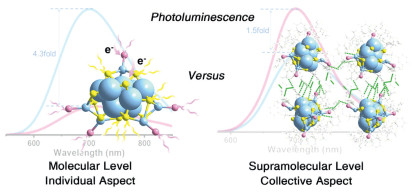
Scheme 1.
Assessing the photoluminescence of metal nanoclusters from both the individual (molecular) and collective (supramolecular) aspects.

Assessing the photoluminescence of metal nanoclusters: The individual versus the collective
Xiaoqin Du , Peiyao Pan , Haoqi Li , Di Zhang , Wentao Huang , Xi Kang , Manzhou Zhu


Metal nanoclusters, also known as ultra-small metal nanoparticles, represent an emerging class of atomically precise nanomaterials that bridge the gap between discrete atoms and plasmonic nanomaterials [1-7]. Due to their quantum size effects and unique electronic states, nanoclusters exhibit fascinating physical and chemical properties, such as photoluminescence (PL), chirality, magnetism, catalysis, and electrochemistry [8-28]. Among these properties, PL stands out as one of the most intriguing characteristics of metal nanoclusters. The well-defined composition and atomically precise structures of these clusters are essential for understanding the relationship between structure and photoluminescence. This understanding is also critical for the rational design of cluster-based nanomaterials that can achieve enhanced PL quantum yields (QY) and tunable emission wavelengths, setting them apart from conventional PL materials.
So far, various emissive nanoclusters have been synthesized, and several effective strategies have been developed to control their PL properties [29-34]. These strategies include alloying, ligand engineering, aggregation-induced emission (AIE), and the construction of cluster-based networks. Among these methods, ligand engineering has emerged as a particularly effective approach for enhancing PL QY and adjusting the emission wavelengths of nanoclusters. The electronic and steric properties of the peripheral ligands significantly influence the electronic and geometric structures of the nanoclusters, as well as their optical performance. It is also important to note that the discussions thus far primarily focus on the PL behavior of nanoclusters in their solution states, emphasizing their individual molecular characteristics [35-38].
Indeed, most emissive nanoclusters exhibit complex PL behavior in various states, which requires analyzing their PL from a supramolecular perspective, especially when in crystalline states. Typically, the energy dissipation of excited nanoclusters occurs through two main pathways: (1) Radiative transitions, primarily via PL, and (2) non-radiative transitions, which are influenced by intramolecular or intermolecular vibrations. It is generally accepted that ordered aggregation reduces energy loss from excited clusters through non-radiative transitions, thereby enhancing energy dissipation through radiative transitions, i.e., via PL. Previous studies have indicated that the enhanced intermolecular and intramolecular interactions, regulated by the arrangement of ligands, are the primary reasons for the PL enhancement of metal nanoclusters in their aggregated states, with the restriction of intermolecular motion playing a crucial role. In this context, the factors influencing the PL of metal nanoclusters can be understood through two aspects: the electronic and geometric structures are related to the molecular chemistry of nanocluster solutions, while supramolecular chemistry primarily pertains to their aggregated states. These two aspects are complementary and should be considered together to fully understand the PL behavior of metal nanoclusters [39-44].
In this study, we prepared two structurally comparable Ag14 nanoclusters that have the same metallic core but different phosphine peripheral ligands: Ag14[SPh(CF3)2]12[P(Ph-OMe)3]5 (referred to as Ag14-OMe) and Ag14[SPh(CF3)2]12[P(Ph-F)3]5 (referred to as Ag14-F). We assessed the PL of these two nanoclusters in both their solution and crystalline states, examining how different structural factors influence their emission properties (Scheme 1). In the solution state, Ag14-OMe exhibited a higher PL intensity than Ag14-F. This difference was attributed to the stronger electron-donating ability of the P(Ph-OMe)3 ligand compared to P(Ph-F)3, which affected the ligand-to-metal charge transfer efficiency. However, when comparing the crystalline states, Ag14-F displayed a stronger PL intensity than Ag14-OMe. This enhancement was due to greater intermolecular interactions within the Ag14-F lattice, which restricted non-radiative energy loss and thus boosted PL. These findings provide important insights into the fluorescence behavior of metal nanoclusters at both the molecular and supramolecular levels.
The Ag14-OMe nanocluster was synthesized by directly reducing the Ag-SPh(CF3)2-P(Ph-OMe)3 complexes with NaBH4 (see Supporting information for more details). The synthesis of the Ag14-F nanocluster was the same as that of Ag14-OMe except that P(Ph-OMe)3 was replaced by P(Ph-F)3. Single crystals of the two nanoclusters were cultivated at room temperature by liquid diffusing the n-hexane into a CH2Cl2 solution containing each nanocluster. After 14 days, red crystals were collected, and the structures of the two nanoclusters were determined by single-crystal X-ray diffraction (SC-XRD). The Ag14-OMe nanocluster was crystallized in a triclinic crystal system with a P-1 space group, whereas Ag14-F nanocluster was crystallized in a monoclinic crystal system with a I2/a space group (Tables S1 and S2 in Supporting information). The compositions of Ag14-OMe and Ag14-F nanoclusters were further confirmed by X-ray photoelectron spectroscopy measurements (Fig. S1 in Supporting information).
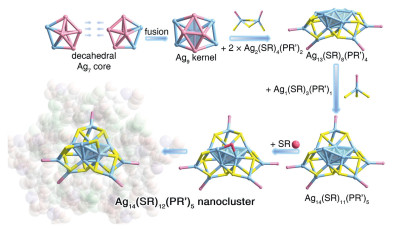
Structurally, the Ag14-OMe and Ag14-F nanoclusters exhibited the same overall framework but different peripheral phosphine ligands. Specifically, the Ag14 nanocluster featured an Ag9 kernel, which could be viewed as two Ag7 decahedra fused by sharing a common Ag4 face. The Ag9 kernel was stabilized by two Ag2(SR)4(PR')2 motif-like units through Ag-S and Ag-Ag interactions, forming an Ag13(SR)4(PR'3)4 structure (SR = SPh(CF3)2; PR' = P(Ph-OMe)3 or P(Ph-4-F)3). Furthermore, a single Ag1(SR)3(PR')1 surface unit was anchored onto the top of the nanocluster framework, resulting in the Ag14(SR)11(PR'3)5 framework. Moreover, a bare thiol ligand connected the Ag9 kernel via µ2-S interactions, giving rise to the overall structure of the Ag14 nanocluster (Fig. 1).
Although the two Ag14 nanoclusters exhibited the same cluster framework, their different peripheral phosphine ligands led to comparable configurations in terms of the corresponding bond lengths. The average Ag-Ag bond length in the Ag9 kernel of Ag14-OMe was 2.965 Å, which decreased to 2.943 Å in Ag14-F. In addition, the corresponding bond lengths of peripheral subunits were similar―the average bond lengths of Ag(kernel)-S(motif), Ag(motif)-P(motif), and Ag(motif)-S(motif) for the Ag14-OMe nanocluster was determined as 2.559, 2.398, and 2.693 Å, respectively, and those of the Ag14-F nanocluster was 2.559, 2.398, and 2.693 Å, respectively (Fig. S2 in Supporting information). In this context, the change of peripheral phosphine ligands slightly altered the geometric structure of Ag14 nanoclusters while maintaining their overall framework.
The Ag14-OMe and Ag14-F nanoclusters exhibited similar crystalline packing patterns. As shown in Figs. S3 and S4 (Supporting information), each crystal unit contained two nanocluster molecules that were assigned as enantiomeric isomers. In this context, the cluster crystals were racemic. The cluster enantiomers were organized into a lamellar eutectic in the (010), (100), and (001) planes via a layer-by-layer arrangement. Fig. S5 (Supporting information) showed the crystalline arrangement of the Ag14-OMe nanocluster superlattices. Notably, the cluster molecules with the same chiral configurations were neatly and linearly assembled along all three directions, and the stacking sequence was the "ABAB". The average interlayer distance of the lamellar eutectic for Ag14-OMe was determined as 18.207 Å. In comparison, although Ag14-F showed the same "ABAB" crystalline packing as that of Ag14-OMe, the average interlayer distance of the lamellar eutectic for Ag14-F decreased to 17.724 Å (Fig. S6 in Supporting information), indicating its more compact intramolecular packing mode relative to that of Ag14-OMe. Indeed, the abundant fluoride-triggered i1ntercluster interactions contributed to the more compact supramolecular packing of the Ag14-F (discussed below), which in turn reduced the interlayer distance of its crystalline lattice.
Electrospray ionization mass spectrometry (ESI-MS) was performed to analyze the chemical composition of the nanoclusters. As illustrated in Fig. S7 (Supporting information), the mass result in the negative mode for the Ag14-F nanocluster presented three peaks at 2519.31, 2677.35, and 2835.38 Da. The interval between the isotope peaks was m/z = 0.5, confirming the "-2"-charge state of the detected molecules. In this context, the three mass signals corresponded well to [Ag14(C18H12F3P)x((CF3)2C6H3S)11(CH2Cl2)1(CH3OH)1(CH3CH2OH)1Cl1]2-, where x ranged from 2-4. Due to the instability of Ag14-OMe in the presence of methanol, the ESI-MS detection of this nanocluster was unsuccessful. However, the same configuration and composition of the two nanoclusters suggested their identical numbers of free valence electrons as 4, i.e., 14(Ag) – 11(SR) – 1(Cl) + 2(charge) = 4 electrons.
The same framework of the two Ag14 nanoclusters rendered them ideal platforms for assessing the structure-property correlations. The ultraviolet-visible (UV-vis) spectrum of Ag14-OMe (dissolved in CH2Cl2) displayed continuous optical absorptions with three distinct peaks at 375, 440, and 525 nm. In comparison, Ag14-F exhibited absorption peaks at 375, 430, and 520 nm. In this context, the optical absorptions of Ag14-F showed a slight blue shift relative to those of Ag14-OMe, which originated from their different peripheral phosphine ligands (Fig. 2A). In addition, the very analogous UV-vis spectrum profile of the two nanoclusters demonstrated their similar electronic structures. Besides, the optical absorptions of the two nanoclusters remained unchanged after 9 months in the air, demonstrating their high stability (Figs. S8A and B in Supporting information).
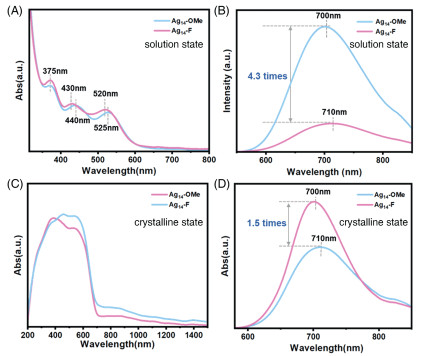
The two Ag14 nanoclusters fluoresced when illuminated at 375 nm. The PL excitation spectra of the nanoclusters resembled their absorption spectra (Fig. S8C in Supporting information), which further suggested their molecular nature and have been observed in several previously reported metal nanoclusters [45,46]. Through the modification of their peripheral phosphine ligands, the PL emission of Ag14-OMe was observed at 700 nm in its CH2Cl2 solution, whereas the emission of Ag14-F exhibited a red shift to 710 nm (Fig. 2B). Besides, the PL intensity of Ag14-OMe was 4.3 times greater than that of Ag14-F. First, since the 4.3-fold PL emissions were detected from their solution states, the origin of such a PL difference should be rationalized from the molecular level. Second, the homologous geometric/electronic structures and PL lifetimes (Figs. S9A and B in Supporting information) of the two Ag14 nanoclusters demonstrated their similar electronic transition from the lowest unoccupied molecular orbital (LUMO) to the highest occupied molecular orbital (HOMO), and the different PL emission was not from their HOMO-LUMO gap differences. In this context, the superior PL intensity of Ag14-OMe in the solution state could be attributed to its peripheral P(Ph-OMe)3 ligand. Compared to P(Ph-F)3 ligands, P(Ph-OMe)3 ligands, which contain -OMe terminal groups, demonstrated a greater ability to donate electrons. This strengthened electron-donating capability probably increased the electronic transitions between ligands and metals in the cluster framework and thus enhanced the emission intensity of Ag14-OMe at the molecular level. Accordingly, the PL of the Ag14 nanocluster was caused by charge transfer between the aromatic groups on phosphine ligands and the metallic kernel of the nanocluster, i.e., the ligand-to-metal charge transfer (LMCT), which was frequently determined as the PL mechanism of previously reported fluorescent nanoclusters [47,48]. In this context, the PL intensity of the Ag14 nanocluster in the solution state was manipulated by modulating the electron-donating ability of the peripheral phosphine ligands.
The photophysical properties of nanocluster crystals were further evaluated. The optical absorptions were similar for the two clusters in their crystalline state, further demonstrating their analogous electronic structures and crystalline packing modes (Fig. 2C). Besides, for the PL, the emission wavelength of Ag14-OMe crystals showed a 10 nm red shift compared with its solution; however, a 10 nm blue shift was observed by comparing the emission wavelength of Ag14-F crystals with its solution (Figs. 2B and D). In addition, the PL lifetimes of Ag14-OMe and Ag14-F crystals were 28.3 and 1.1 µs (Figs. S9C and D in Supporting information), respectively, both falling in the microsecond range, which were remarkably longer than the cluster solutions (5 and 1.5 ns, respectively). In this context, the nanocluster crystals exhibited apparent differences in optical absorptions, emission wavelengths, and PL lifetimes relative to their solutions. Such differences in photophysical properties of Ag14 nanoclusters in different forms, i.e., solution and crystalline states, arose from distinct combinations of the electronic coupling and the lattice-origin, non-radiative decay pathways occurring through electron-phonon interactions [49-51].
Significantly, the PL intensity of Ag14-F crystals displayed a 1.5-fold enhancement relative to that of Ag14-OMe crystals, which was in sharp contrast to the PL intensity tendency in cluster solutions (Figs. 2B and D). Different from the difference in the PL intensity of cluster solutions that was rationalized from the individual aspect (or the molecular level), the remarkably different PL intensity tendency in cluster crystals should be analyzed from the collective aspect (or the supramolecular level). Therefore, it is safe to propose that the collective effect outweighs the individual effect in the crystal lattice, leading to the opposite trends in emission intensity of the two Ag14 nanoclusters in solution or crystalline states. Indeed, the energy dissipation of photo-excited nanoclusters includes two pathways including non-radiative transitions (mainly affected by intramolecular vibrations) and radiative transitions (through PL). From a supramolecular perspective, the fluoride-triggered intercluster interactions would significantly reduce the intramolecular rotations and vibrations of Ag14-F, which would weaken the energy dissipation from non-radiative energy loss [52,53]. Accordantly, the radiative transitions of Ag14-F crystals would be strengthened, resulting in their superior PL intensity relative to Ag14-OMe.
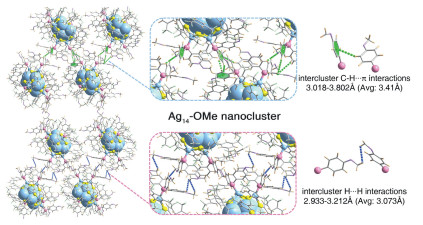
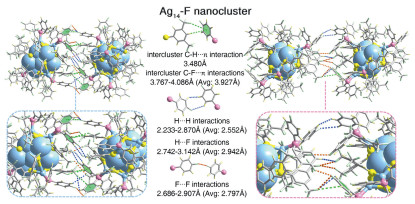
The above-mentioned discussions urged us to further evaluate the intercluster interactions from a supramolecular level of the two Ag14 nanoclusters in their crystalline lattices. As depicted in Figs. S10 and S11 (Supporting information), several intracluster interactions were found in both cluster crystal lattices, including π···π, C-H···π, H···H, and H···F interactions. However, from the intermolecular aspects, the intercluster interactions of Ag14-F were significantly richer than those in Ag14-OMe. Specifically, the intermolecular interactions in Ag14-OMe were primarily characterized by C-H···π and H···H interactions (Fig. 3), with C-H···π bond lengths ranging from 3.018 Å to 3.802 Å (averagely, 3.41 Å) and H···H bond lengths ranging from 2.933 Å to 3.212 Å (averagely, 3.07 Å). In contrast, Ag14-F displayed richer intermolecular interactions, including C-H···π, C-F···π, H···H, H···F, and F···F interactions (Fig. 4). Specifically, the average C-H···π bond length in Ag14-F was 3.480 Å, and H···H bond lengths ranged from 2.233 Å to 2.87 Å (averagely, 2.552 Å). Besides, the C-F···π bond lengths ranged from 3.767 Å to 4.086 Å (averagely, 3.927 Å), and the average H···F and F···F bond lengths were 2.942 and 2.797 Å, respectively. Furthermore, the number of these intercluster interactions in Ag14-F was significantly larger than those in Ag14-OMe (Table S3 in Supporting information). In this context, the abundant intermolecular interactions in Ag14-F gave rise to its more compact packing arrangement in the crystal lattice (Figs. S5 and S6 in Supporting information). Such a more compact packing arrangement of Ag14-F could be further inferred from its lower crystalline packing density relative to that of Ag14-OMe (1.737 versus 1.819 g/cm3). More significantly, although the PL intensity of Ag14-F was much lower than that of Ag14-OMe in the molecular level, the rich intercluster interactions in Ag14-F significantly weakened the intramolecular rotations and vibrations, contributing to a reverse PL intensity tendency, i.e., the superior PL intensity of Ag14-F relative to Ag14-OMe in the crystal lattice.
In summary, based on a structurally comparable Ag14 cluster system, we demonstrated that the photoluminescence of metal nanoclusters should be assessed from both the individual and collective aspects. The structure of Ag14-F and Ag14-OMe were essentially identical, with the only difference being the substitution of peripheral phosphine ligands. From the molecular level, the PL intensity of Ag14-OMe was superior to that of Ag14-F due to the stronger electron-donating capability of the P(Ph-OMe)3 ligand, which contributed to a more efficient LMCT process. By comparison, from the supramolecular level, the intermolecular interactions in Ag14-F were significantly stronger than those in Ag14-OMe, limiting the former crystal's non-radiative energy loss and enhancing its PL intensity. Overall, this work presented an interesting cluster pair with comparable molecular/supramolecular structures and interactions, allowing for some new insights into the photoluminescence of cluster-based nano-systems.
The authors declare no conflict of interest.
Xiaoqin Du: Investigation. Peiyao Pan: Investigation. Haoqi Li: Investigation. Di Zhang: Investigation. Wentao Huang: Investigation. Xi Kang: Writing – review & editing, Writing – original draft, Supervision. Manzhou Zhu: Supervision.
We acknowledge the financial support of the National Natural Science Foundation of China (NSFC, Nos. 22371003, 22101001, and 22471001), the Ministry of Education, Natural Science Foundation of Anhui Province (No. 2408085Y006), the University Synergy Innovation Program of Anhui Province (No. GXXT-2020-053), and the Scientific Research Program of Universities in Anhui Province (No. 2022AH030009).
Supplementary material associated with this article can be found, in the online version, at doi:10.1016/j.cclet.2025.111155.
R.C. Jin, C.J. Zeng, M. Zhou, et al., Chem. Rev. 116 (2016) 10346-10413. doi: 10.1021/acs.chemrev.5b00703
M.F. Matus, H. Häkkinen, Nat. Rev. Mater. 8 (2023) 372-389. doi: 10.1038/s41578-023-00537-1
W.T. Jing, H. Shen, R.X. Qin, et al., Chem. Rev. 123 (2023) 5948-6002. doi: 10.1021/acs.chemrev.2c00569
M. Chi, J. Wei, Z. Zhao, et al., Angew. Chem. Int. Ed. 64 (2025) e202424499. doi: 10.1002/anie.202424499
I. Chakraborty, T. Pradeep, Chem. Rev. 117 (2017) 8208-8271. doi: 10.1021/acs.chemrev.6b00769
R.C. Jin, G. Li, S. Sharma, et al., Chem. Rev. 121 (2021) 567-648. doi: 10.1021/acs.chemrev.0c00495
Y. Du, H. Sheng, D. Astruc, et al., Chem. Rev. 120 (2020) 526-622. doi: 10.1021/acs.chemrev.8b00726
K.Y. Huang, Z.Q. Yang, M.R. Yang, et al., J. Am. Chem. Soc. 146 (2024) 8706-8715. doi: 10.1021/jacs.4c01180
Y.Q. Feng, F.Y. Fu, L.L. Zeng, et al., Angew. Chem. Int. Ed. 63 (2024) e202317341. doi: 10.1002/anie.202317341
X. Wang, B. Yin, L. Jiang, et al., Science 381 (2023) 784-790. doi: 10.1126/science.adh2365
Y. Horita, S. Hossain, M. Ishimi, et al., J. Am. Chem. Soc. 145 (2023) 23533-23540. doi: 10.1021/jacs.3c07194
D. Arima, M. Mitsui, J. Am. Chem. Soc. 145 (2023) 6994-7004. doi: 10.1021/jacs.3c00870
D. Arima, Y. Niihori, M. Mitsui, J. Mater. Chem. C 10 (2022) 4597-4606. doi: 10.1039/d1tc04591a
W. Shi, L. Zeng, R. He, et al., Science 383 (2024) 32-33. doi: 10.3847/1538-4357/ad4b13
S. Masuda, K. Sakamoto, T. Tsukuda, Nanoscale 16 (2024) 4514-4528. doi: 10.1039/d3nr05857c
X.J. Zou, X. Kang, M.Z. Zhu, Chem. Soc. Rev. 52 (2023) 5892-5967. doi: 10.1039/d2cs00876a
B. D. Peter, W. Pei, G. N. Andrew, et al., Nanoscale 16 (2024) 8090-8095. doi: 10.1039/d4nr00527a
T. Chiu, J.H. Liao, Y.Y. Wu, et al., J. Am. Chem. Soc. 145 (2023) 16739-16747. doi: 10.1021/jacs.3c04482
X.X. Pan, Y.D. Yao, M.X. Zhang, et al., Nanoscale 16 (2024) 8196-8215. doi: 10.1039/d4nr00282b
J.T. Zhao, A. Ziarati, A. Rosspeintner, et al., Angew. Chem. Int. Ed. 63 (2024) e202316649. doi: 10.1002/anie.202316649
L.J. Liu, F. Alkan, S.L. Zhuang, et al., Nat. Commun. 14 (2023) 2397. doi: 10.1038/s41467-023-38179-0
Z.K. Wang, M.H. Du, P. Braunstein, et al., J. Am. Chem. Soc. 145 (2023) 9982-9987. doi: 10.1021/jacs.3c01831
J.S. Kim, H. Chang, S. Kang, et al., Nat. Commun. 14 (2023) 3201. doi: 10.1038/s41467-023-38955-y
W. Suzuki, R. Takahata, Y. Chiga, S. Kikkawa, et al., J. Am. Chem. Soc. 144 (2022) 12310-12320. doi: 10.1021/jacs.2c03670
Y.N. Wang, B. Nieto-Ortega, T. Burgi, Nat. Commun. 11 (2020) 4562. doi: 10.1038/s41467-020-18357-0
Y.W. Li, M. Zhou, R.C. Jin, Adv. Mater. 33 (2021) 2006591. doi: 10.1002/adma.202006591
X. Wei, K. Chu, J.R. Adsetts, et al., J. Am Chem. Soc. 144 (2022) 20421-20433. doi: 10.1021/jacs.2c08632
Y. Jin, C. Zhang, X.Y. Dong, et al., Chem. Soc. Rev. 50 (2019) 2297-2319.
W. Ishii, Y. Okayasu, Y. Kobayashi, et al., J. Am. Chem. Soc. 145 (2023) 11236-11244. doi: 10.1021/jacs.3c01259
Q. Li, C. J. Zeman IV, G. C. Schatz, et al., ACS Nano 15 (2021) 16095-16105. doi: 10.1021/acsnano.1c04759
L. Fang, W. Fan, G. Bian, et al., Angew. Chem. Int. Ed. 62 (2023) e202305604. doi: 10.1002/anie.202305604
Y.X. Chen, M. Zhou, Q. Li, et al., Chem. Sci. 11 (2020) 8176-8183. doi: 10.1039/d0sc01270j
K. Kwak, D. Lee, Acc. Chem. Res. 52 (2019) 12-22. doi: 10.1021/acs.accounts.8b00379
Q. Li, F. Y. Fu, M. Y. Zhao, et al., Chin. Chem. Lett. 36 (2025) 110090. doi: 10.1016/j.cclet.2024.110090
X. Ouyang, Y.L. Wu, L.J. Guo, et al., Angew. Chem. Int. Ed. 62 (2023) e202300893. doi: 10.1002/anie.202300893
Y.Q. Feng, N.N. Wang, H.X. Ju, Sci. China: Chem. 65 (2022) 2417-2436. doi: 10.1007/s11426-022-1329-5
D.Y. Wang, X.W. Gao, J.N. Jia, et al., ACS Nano, 17 (2023) 355-362. doi: 10.1021/acsnano.2c08474
J. Foxley, K. L. Knappenberger, Annu. Rev. Phys. Chem. 74 (2023) 53-72. doi: 10.1146/annurev-physchem-062322-043108
Y. Liu, W. Luo, Q.S. Fan, et al., Adv. Funct. Mater. 33 (2023) 2303470. doi: 10.1002/adfm.202303470
O. López-Estrada, B. Zuniga-Gutierrez, E. Selenius, Nat. Commun. 12 (2021) 2477. doi: 10.1038/s41467-021-22715-x
Y.W. Li, S. Biswas, T.Y. Luo, et al., Chem. Mater. 32 (2020) 9238-9244. doi: 10.1021/acs.chemmater.0c02984
R.W. Huang, Y.S. Wei, X.Y. Dong, et al., Nat. Chem. 9 (2017) 689-697. doi: 10.1038/nchem.2718
M.M. Zhang, X.Y. Dong, Z.Y. Wang, et al., Angew. Chem. Int. Ed. 59 (2020) 10052-10058. doi: 10.1002/anie.201908909
X. Wei, X. Kang, S. Jin, et al., CCS Chem. 3 (2021) 1929-1939. doi: 10.31635/ccschem.020.202000372
S.X. Wang, X.M. Meng, A. Das, et al., Angew. Chem. Int. Ed. 53 (2014) 2376-2380. doi: 10.1002/anie.201307480
X. Kang, S.X. Wang, Y.B. Song, et al., Angew. Chem. Int. Ed. 55 (2016) 3611-3614. doi: 10.1002/anie.201600241
X. Kang, M.Z. Zhu, Chem. Soc. Rev. 48 (2019) 2422-2457. doi: 10.1039/c8cs00800k
X. Kang, X. Wei, S.X. Wang, et al., Inorg Chem. 59 (2020) 8736-8743. doi: 10.1021/acs.inorgchem.0c00350
H. Döllefeld, H. Weller, A. Eychmüller, J. Phys. Chem. B 106 (2002) 5604-5608. doi: 10.1021/jp013234t
J. Zhang, C. Rowland, Y.Z. Liu, et al. J. Am. Chem. Soc. 137 (2015) 742-749. doi: 10.1021/ja509782n
X. Wei, X. Kang, Z.W. Zuo, et al., Natl. Sci. Rev. 8 (2021) nwaa077. doi: 10.1093/nsr/nwaa077
X. Kang, S.X. Wang, M.Z. Zhu, Chem. Sci. 9 (2018) 3062-3068. doi: 10.1039/c7sc05317g
J.S. Xin, J. Xu, C. Zhu, et al., Chem. Sci. 14 (2023) 8474-8482. doi: 10.1039/d3sc01698f

Scheme 1 Assessing the photoluminescence of metal nanoclusters from both the individual (molecular) and collective (supramolecular) aspects.

Figure 1 Structural anatomy of Ag14-OMe and Ag14-F nanoclusters. Color labels: blue/pink = Ag; yellow/red = S; Pale pink = P. All C and H atoms were omitted for clarity.

Figure 2 Optical properties of Ag14-OMe (blue lines) and Ag14-F (pink lines) nanoclusters. (A) Comparison of optical absorption of Ag14-OMeand Ag14-F nanoclusters dissolved in CH2Cl2. (B) Comparison of PL properties of Ag14-OMe and Ag14-F nanoclusters dissolved in CH2Cl2. (C) Comparison of optical absorption of Ag14-OMe and Ag14-F nanocluster crystals. (D) Comparison of PL properties of Ag14-OMe and Ag14-F nanocluster crystals.

Figure 3 Schematic diagram of intercluster interactions in the Ag14-OMe nanocluster crystal lattice, including C-H···π (highlighted in green) and H···H (highlighted in blue) interactions.

 扫一扫看文章


扫一扫关注我们
 DownLoad:
 下载:
下载:
