Citation: Tong Liu, Youdong Xu, Yajie Jiao, Jinguo Zhao, Bin Fu, Xianyu Li, Hongjun Yang, Weijie Qin. A dual-crosslinking and thiol-yne "click reaction"-based tagging method for mouse liver RNA binding proteome enrichment and identification by mass spectrometry[J]. Chinese Chemical Letters, ;2026, 37(1): 111154. doi: 10.1016/j.cclet.2025.111154 shu

A dual-crosslinking and thiol-yne "click reaction"-based tagging method for mouse liver RNA binding proteome enrichment and identification by mass spectrometry

Figures(7)

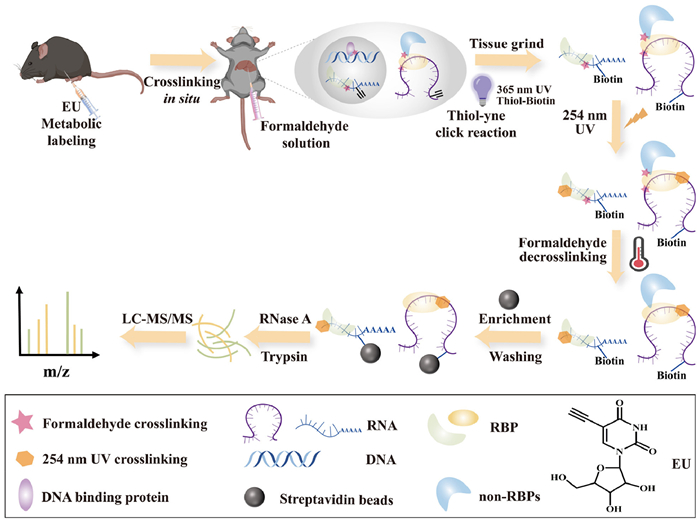
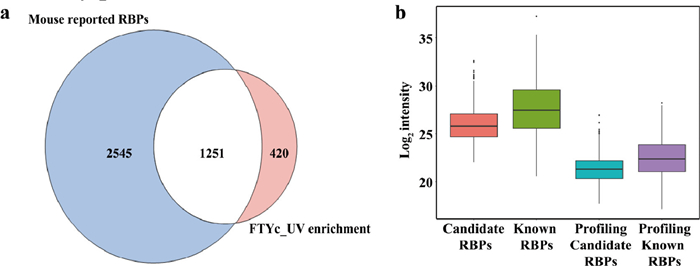
  • RNA binding proteins (RBPs) are a crucial class of proteins that interact with RNA and play a key role in various biological process. Deficiencies or abnormalities of RBPs are closely linked to the occurrence and progression of numerous diseases, making RBPs potential therapeutic targets. However, the limited tissue penetration of 254 nm UV irradiation makes it difficult to efficiently crosslink weak and dynamic RNA–protein interactions in mammal tissues. Additionally, RNA degradation in metal catalyzed click reaction further hinders the enrichment of RNA-protein complexes (RPCs). Due to these inherent limitations, globally profiling the RNA binding proteome in mammal organs has long been a challenge. Herein, we proposed a novel method, which utilized a dual crosslinking with formaldehyde and 254 nm UV irradiation, metabolic labeling and metal-free thiol-yne click reaction to enable large-scale enrichment and identification of RBPs in mouse liver, called FTYc_UV. In this method, formaldehyde is first used to crosslink the crude RNA-protein complexes (cRPCs) in situ to address the problem of poor tissue penetration of 254 nm UV irradiation. Furthermore, this method integrates metabolic labeling with a metal-free thiol-yne click reaction to achieve non-destructive RNA tagging. After specifically RNA-RBPs crosslinking by 254 nm UV irradiation in tissue lysates, formaldehyde decrosslinking is employed to remove non-specific proteins, leading to effective enrichment of RPCs from mouse liver and thereby overcoming the poor specificity of formaldehyde crosslinking. Application of FTYc_UV in mouse liver successfully identified over 1600 RBPs covering approximately 75% of previously reported RBPs. Furthermore, 420 candidate RBPs, including 151 metabolic enzymes, were also obtained, demonstrating the sensitivity of FTYc_UV and the potential of this method for in-depth exploration of RNA–protein interactions in biological and clinical research.
  • 加载中
    1. [1]

      S.F. Mitchell, R. Parker, Mol. Cell 54 (2014) 547–558.

    2. [2]

      G. Singh, G. Pratt, G.W. Yeo, et al., Ann. Rev. Biochem. 84 (2015) 325–354.

    3. [3]

      Y.Y. Chen, Z. Gui, D. Hu, et al., Chin. Chem. Lett. 35 (2024) 108522.

    4. [4]

      M.W. Hentze, A. Castello, T. Schwarzl, et al., Nat. Rev. Mol. Cell Biol. 19 (2018) 327–341.

    5. [5]

      S. Gerstberger, M. Hafner, T. Tuschl, Nat. Rev. Genet. 15 (2014) 829–845.

    6. [6]

      T. Feng, Y.L. Gao, D. Hu, et al., Chin. Chem. Lett. 35 (2024) 109259.

    7. [7]

      W.B. Tao, N.B. Xie, Q.Y. Cheng, et al., Chin. Chem. Lett. 34 (2023) 108243.

    8. [8]

      F. Gebauer, T. Schwarzl, J. Valcárcel, et al., Nat. Rev. Genet. 22 (2021) 185–198.

    9. [9]

      J.B. Bertoldo, S. Müller, S. Hüttelmaier, Drug Discov. Today 28 (2023) 103580.

    10. [10]

      Q. Zeng, S. Saghafinia, A. Chryplewicz, et al., Science 378 (2022) eabl7207.

    11. [11]

      K. Shi, X. Hong, D. Xu, et al., Chin. Chem. Lett. 36 (2025) 110079.

    12. [12]

      A. Castello, B. Fischer, K. Eichelbaum, et al., Cell 149 (2012) 1393–1406.

    13. [13]

      A.G. Baltz, M. Munschauer, B. Schwanhäusser, et al., Mol. Cell 46 (2012) 674–690.

    14. [14]

      B.M. Beckmann, R. Horos, B. Fischer, et al., Nat. Commun. 6 (2015) 10127.

    15. [15]

      A.M. Matia-González, E.E. Laing, A.P. Gerber, Nat. Struct. Mol. Biol. 22 (2015) 1027–1033.

    16. [16]

      X. Bao, X. Guo, M. Yin, et al., Nat. Methods 15 (2018) 213–220.

    17. [17]

      R. Huang, M. Han, L. Meng, et al., Proc. Natl. Acad. Sci. U. S. A. 115 (2018) E3879–E3887.

    18. [18]

      R.M. Queiroz, T. Smith, E. Villanueva, et al., Nat. Biotechnol. 37 (2019) 169–178.

    19. [19]

      J. Trendel, T. Schwarzl, R. Horos, et al., Cell 176 (2019) 391–403. e319.

    20. [20]

      E.C. Urdaneta, C.H. Vieira-Vieira, T. Hick, et al., Nat. Commun. 10 (2019) 990.

    21. [21]

      Z. Zhang, T. Liu, H. Dong, et al., Nucleic Acids Res. 49 (2021) e65 -e65.

    22. [22]

      H. Sun, B. Fu, X. Qian, et al., Nat. Commun. 15 (2024) 852.

    23. [23]

      W. Qin, S.A. Myers, D.K. Carey, et al., Nat. Commun. 12 (2021) 4980.

    24. [24]

      J. Yang, Y. Xu, Chin. Chem. Lett. 33 (2022) 2799–2806.

    25. [25]

      K. Yu, B. Chen, D. Aran, et al., Nat. Commun. 10 (2019) 3574.

    26. [26]

      A.F. Jarnuczak, H. Najgebauer, M. Barzine, et al., Sci. Data 8 (2021) 115.

    27. [27]

      R.P. Elinson, P. Pasceri, Development 106 (1989) 511–518.

    28. [28]

      V.O. Sysoev, B. Fischer, C.K. Frese, et al., Nat. Commun. 7 (2016) 12128.

    29. [29]

      A.T. LaPointe, N.N. Gebhart, M.E. Meller, et al., J. Virol. 92 (2018) e02171-17.

    30. [30]

      N.N. Gebhart, R.W. Hardy, K.J. Sokoloski, PLoS One 15 (2020) e0238254.

    31. [31]

      R.A. Flynn, J.A. Belk, Y. Qi, et al., Cell 184 (2021) 2394–2411 e2316.

    32. [32]

      T. Tayri-Wilk, M. Slavin, J. Zamel, et al., Nat. Commun. 11 (2020) 3128.

    33. [33]

      D.S. Johnson, A. Mortazavi, R.M. Myers, et al., Science 316 (2007) 1497–1502.

    34. [34]

      N.Z. Fantoni, A.H. El-Sagheer, T. Brown, Chem. Rev. 121 (2021) 7122–7154.

    35. [35]

      D.C. Kennedy, C.S. McKay, M.C. Legault, et al., J. Am. Chem. Soc. 133 (2011) 17993–18001.

    36. [36]

      M.K. Singha, J. Zimak, S.R. Levine, et al., Biochemistry 61 (2022) 2638–2642.

    37. [37]

      M. Gupta, S.R. Levine, R.C. Spitale, Acc. Chem. Res. 55 (2022) 2647–2659.

    38. [38]

      R. Hoogenboom, Angew. Chem. Int. Ed. 20 (2010) 3415–3417.

    39. [39]

      J. Kaur, M. Saxena, N. Rishi, Bioconjugate Chem. 32 (2021) 1455–1471.

    40. [40]

      C.Y. Jao, A. Salic, Proc. Natl. Acad. Sci. U. S. A. 105 (2008) 15779–15784.

    41. [41]

      E.A. Hoffman, B.L. Frey, L.M. Smith, et al., J. Biol. Chem. 290 (2015) 26404–26411.

    42. [42]

      V. Jackson, Cell 15 (1978) 945–954.

    43. [43]

      M.F. Carey, C.L. Peterson, S.T. Smale, Cold Spring Harb. Protoc. 2009 (2009) prot5279 pdb.

    44. [44]

      P.J. Boersema, R. Raijmakers, S. Lemeer, et al., Nat. Protoc. 4 (2009) 484–494.

    45. [45]

      A. Castello, M.W. Hentze, T. Preiss, Trends Endocrinol. Metab. 26 (2015) 746–757.

    46. [46]

      J. Boucas, C. Fritz, A. Schmitt, et al., PLoS One 10 (2015) e0125745.

    47. [47]

      S.C. Kwon, H. Yi, K. Eichelbaum, et al., Nat. Struct. Mol. Biol. 20 (2013) 1122–1130.

    48. [48]

      Y. Liao, A. Castello, B. Fischer, et al., Cell Rep. 16 (2016) 1456–1469.

    49. [49]

      A. Liepelt, I.S. Naarmann-de Vries, N. Simons, et al., Mol. Cell. Proteomics 15 (2016) 2699–2714.

    50. [50]

      M. Ignarski, C. Rill, R.W. Kaiser, et al., J. Am. Soc. Nephrol. 30 (2019) 564–576.

    51. [51]

      G. Du, X. Wang, M. Luo, et al., Development 147 (2020) dev184655.

    52. [52]

      C. He, S. Sidoli, R. Warneford-Thomson, et al., Mol. Cell 64 (2016) 416–430.

    53. [53]

      A.L. Mallam, W. Sae-Lee, J.M. Schaub, et al., Cell Rep. 29 (2019) 1351–1368. e1355.

    54. [54]

      Y. Na, H. Kim, Y. Choi, et al., Nucleic Acids Res. 49 (2021) e28 -e28.

    55. [55]

      J.I. Perez-Perri, D. Ferring-Appel, I. Huppertz, et al., Nat. Commun. 14 (2023) 2074.

    56. [56]

      K.B. Cook, H. Kazan, K. Zuberi, et al., Nucleic Acids Res. 39 (2010) D301–D308.

    57. [57]

      M. Caudron-Herger, R.E. Jansen, E. Wassmer, et al., Nucleic Acids Res. 49 (2021) D425–D436.

  • 加载中
    1. [1]

      Yimin GuoYiting LuoShuwen HuaChuan-Fan DingYinghua Yan . Application of magnetic nanomaterials in peptidomics: A review in the past decade. Chinese Chemical Letters, 2025, 36(6): 110070-. doi: 10.1016/j.cclet.2024.110070

    2. [2]

      Hyoseok KimChangyi CuiKohei TohGenyir AdoTetsuya OgawaYixin ZhangShin-ichi SatoYong-Beom LimHiroki KurataLu ZhouMotonari Uesugi . Discovery of a self-assembling small molecule that sequesters RNA-binding proteins. Chinese Chemical Letters, 2025, 36(5): 110135-. doi: 10.1016/j.cclet.2024.110135

    3. [3]

      Tian FengYun-Ling GaoDi HuKe-Yu YuanShu-Yi GuYao-Hua GuSi-Yu YuJun XiongYu-Qi FengJie WangBi-Feng Yuan . Chronic sleep deprivation induces alterations in DNA and RNA modifications by liquid chromatography-mass spectrometry analysis. Chinese Chemical Letters, 2024, 35(8): 109259-. doi: 10.1016/j.cclet.2023.109259

    4. [4]

      Keqiang ShiXiujuan HongDongyan XuTao PanHuiwen WangHongru FengCheng GuoYuanjiang Pan . Analysis of RNA modifications in peripheral white blood cells from breast cancer patients by mass spectrometry. Chinese Chemical Letters, 2025, 36(3): 110079-. doi: 10.1016/j.cclet.2024.110079

    5. [5]

      Peng LiuShengli ZhangTingting ZhangYu SiZiang LiuXiao QianYingxu WuYuan LiangWen SunEngin U. AkkayaLei Wang . Near-infrared light activatable nanoplatform for proteins labeling, enrichment and visualization in living systems. Chinese Chemical Letters, 2026, 37(1): 110966-. doi: 10.1016/j.cclet.2025.110966

    6. [6]

      Lu HuangJiang WangHong JiangLanfang ChenHuanwen Chen . On-line determination of selenium compounds in tea infusion by extractive electrospray ionization mass spectrometry combined with a heating reaction device. Chinese Chemical Letters, 2025, 36(1): 109896-. doi: 10.1016/j.cclet.2024.109896

    7. [7]

      Yongyi LiJin HanXiangyu WangZhenwei WeiIn-situ reaction monitoring and kinetics study of photochemical reactions by optical focusing inductive electrospray mass spectrometry. Chinese Chemical Letters, 2025, 36(9): 110708-. doi: 10.1016/j.cclet.2024.110708

    8. [8]

      Fangzhou Li Liang Gao Linping Wang Ben-Lin Hu . Unlocking the elasticity in ferroelectrics by slight crosslinking. Chinese Journal of Structural Chemistry, 2025, 44(3): 100443-100443. doi: 10.1016/j.cjsc.2024.100443

    9. [9]

      Hefei YangLe-Cheng WangXiao-Feng Wu . Sustainable carbonylative transformation of alkyl iodides to amides via crosslinking of EDA and XAT. Chinese Chemical Letters, 2025, 36(9): 110843-. doi: 10.1016/j.cclet.2025.110843

    10. [10]

      Yifei ZhangYuncong XueLaiwei GaoRui LiaoFeng WangFei Wang . Merging non-covalent and covalent crosslinking: En route to single chain nanoparticles. Chinese Chemical Letters, 2024, 35(6): 109217-. doi: 10.1016/j.cclet.2023.109217

    11. [11]

      Yingxiao GaoFeng FengTing LuoYusong HanMingxuan Wu . Development of site-selective photo crosslinking between tyrosine and sulfonium in methyllysine readers. Chinese Chemical Letters, 2025, 36(10): 110756-. doi: 10.1016/j.cclet.2024.110756

    12. [12]

      Cheng GuoXiaoxiao ZhangXiujuan HongYiqiu HuLingna MaoKezhi Jiang . Graphene as adsorbent for highly efficient extraction of modified nucleosides in urine prior to liquid chromatography-tandem mass spectrometry analysis. Chinese Chemical Letters, 2024, 35(4): 108867-. doi: 10.1016/j.cclet.2023.108867

    13. [13]

      Junmeng LuoQiongqiong WanSuming Chen . Chemistry-driven mass spectrometry for structural lipidomics at the C=C bond isomer level. Chinese Chemical Letters, 2025, 36(1): 109836-. doi: 10.1016/j.cclet.2024.109836

    14. [14]

      Yanhua ChenXian DingJun ZhouZhaoying WangYunhai BoYing HuQingce ZangJing XuRuiping ZhangJiuming HeFen YangZeper Abliz . Plasma metabolomics combined with mass spectrometry imaging reveals crosstalk between tumor and plasma in gastric cancer genesis and metastasis. Chinese Chemical Letters, 2025, 36(1): 110351-. doi: 10.1016/j.cclet.2024.110351

    15. [15]

      Haiyan LuJiayue YeYiping WeiHua ZhangKonstantin ChinginVladimir FrankevichHuanwen Chen . Tracing molecular margins of lung cancer by internal extractive electrospray ionization mass spectrometry. Chinese Chemical Letters, 2025, 36(2): 110077-. doi: 10.1016/j.cclet.2024.110077

    16. [16]

      Wen SuSiying LiuQingfu ZhangZhongyan ZhouNa WangLei Yue . Temperature-controlled electrospray ionization tandem mass spectrometry study on protein/small molecule interaction. Chinese Chemical Letters, 2025, 36(5): 110237-. doi: 10.1016/j.cclet.2024.110237

    17. [17]

      Peisi XieJing ChenYongjun XiaZongwei Cai . MALDI and MALDI-2 mass spectrometry imaging contribute to revealing the alternations in lipid metabolism in germinating soybean seeds. Chinese Chemical Letters, 2025, 36(8): 110595-. doi: 10.1016/j.cclet.2024.110595

    18. [18]

      Rui SuXiaowei FangPeng ZengYong QianXuanzhu LiHuiyu XingJiamei LinJiaquan Xu . Mass spectrometry for non-destructive detection of the average diameter of micro copper wires. Chinese Chemical Letters, 2025, 36(10): 110748-. doi: 10.1016/j.cclet.2024.110748

    19. [19]

      Ting-Ting HuangJin-Fa ChenJuan LiuTai-Bao WeiHong YaoBingbing ShiQi Lin . A novel fused bi-macrocyclic host for sensitive detection of Cr2O72− based on enrichment effect. Chinese Chemical Letters, 2024, 35(7): 109281-. doi: 10.1016/j.cclet.2023.109281

    20. [20]

      Rui WangHe QiHaijiao ZhengQiong Jia . Light/pH dual-responsive magnetic metal-organic frameworks composites for phosphorylated peptide enrichment. Chinese Chemical Letters, 2024, 35(7): 109215-. doi: 10.1016/j.cclet.2023.109215

Metrics
  • PDF Downloads(0)
  • Abstract views(6)
  • HTML views(1)

通讯作者: 陈斌, bchen63@163.com
  • 1. 

    沈阳化工大学材料科学与工程学院 沈阳 110142

  1. 本站搜索
  2. 百度学术搜索
  3. 万方数据库搜索
  4. CNKI搜索
Address:Zhongguancun North First Street 2,100190 Beijing, PR China Tel: +86-010-82449177-888
Powered By info@rhhz.net

/

DownLoad:  Full-Size Img  PowerPoint
Return