College of Chemistry, Zhengzhou University, Zhengzhou 450001, China
b.
National Laboratory for Molecular Science (BNLMS), CAS Key Laboratory of Colloid, Interface and Chemical Thermodynamics, Institute of Chemistry, Chinese Academy of Sciences, Beijing 100190, China
c.
University of Chinese Academy of Sciences, Beijing 100049, China
Received Date:
05 December 2024 Accepted Date:
07 March 2025 Revised Date:
05 March 2025 Available Online:
15 February 2026
Abstract:
Achieving rational control over polarization states and color of circularly polarized luminescence (CPL) through simple modulation poses a challenging yet highly practical problem. To address this issue, we developed a mechano-responsive chiral supramolecular system based on a cyclohexanediamide-derived gelator CCPy. This molecule exhibited a strong blue fluorescence accompanied by a distinct CPL signal upon forming a supramolecular gel in toluene. However, upon the application of mechanical force, the gel rapidly transformed into a faintly emissive suspension with a silent CPL signal, along with a notable morphological alteration. Furthermore, by implementing the circularly polarized Förster resonance energy transfer (CP-FRET) strategy, the mechano-responsiveness was effectively imparted to binary systems through the incorporation of dyes Nile red (NR) and coumarin 7 (C7), thus realizing mechanical force-switchable green and red CPL systems. It was particularly noteworthy that by adjusting the ratio of CCPy, C7 and NR, a ternary mechanical force-induced CPL ON-OFF switch that emitted a standard white emission was achieved through sequential CP-FRET. Following this, an information encryption experiment was performed. This work provided a paradigm for fabricating smart multi-color and white-light CPL materials.
Circularly polarized luminescence (CPL) reflects the differential emission of the left- and right-handed circularly polarized light [1-11], thus providing information on the excited state properties of a chiral emissive system [12-15]. In the last decade, the interest in CPL has witnessed a burgeoning growth, not only because of the unique mechanistic insight into the excited states of matter it offers, but also due to its wide array of potential applications in various fields such as three-dimensional display [16,17], asymmetric synthesis [18], optoelectronic devices [19], biological imaging [20-22], and information technologies [23,24]. Recently, color-customizable CPL has been attracting increasing attention driven by escalating sophistication of information processing in specific scenarios along with the ever-growing demand for individualized aesthetic preferences [25,26]. In particular, white-light CPL holds a unique significance in the advancement of eye-friendly lighting and digital displays, which enhances the overall visual effects by fostering a comfortable and healthy viewing experience and mitigating visual fatigue [27,28]. On this basis, the development of smart multi-color and white-light CPL materials, which allow for the regulation of polarization states in response to external stimuli, is emerging as a hot topic in cutting-edge display, anti-counterfeiting and information encryption and storage [29]. However, the challenge of simultaneously modulating CPL colors and achieving on-demand regulation of polarization states remains formidable, leaving this field still in its nascent stages.
The bottom-up supramolecular assembly approach via non-covalent synthesis represents an exceptionally effective and convenient method for both chirality transfer and dynamic regulation, providing a remarkable solution to the aforementioned challenge [30-33]. Since efficient chirality transfer within multi-component co-assemblies has been well-documented, modulation of CPL colors can be conveniently achieved through doping strategies free from tedious organic synthesis [34]. In addition, given the inherently dynamic nature of non-covalent interactions, in-situ switching triggered by external stimuli is thus rendered possible. Multiple external stimuli such as light [35], chemical inducers [36,37], redox [38], heat [39] and mechanical force [40,41], have been exploited in manipulating the polarization states of a CPL-active system. Very recently, Cheng and coworkers [42] successfully achieved light-driven CPL sign inversion in a liquid crystal system through the induction of trans-cis isomerization in a photo-responsive dopant. Among the various external stimuli, mechanical force is distinguished owing to its ease of operation, environmental friendliness and high reversibility. Moreover, mechanical force primarily exerts influence on non-covalent interactions without disrupting the chemical bonds in organic building blocks, hence providing a straightforward strategy for the fabrication of smart color-customizable CPL materials in supramolecular assembling systems.
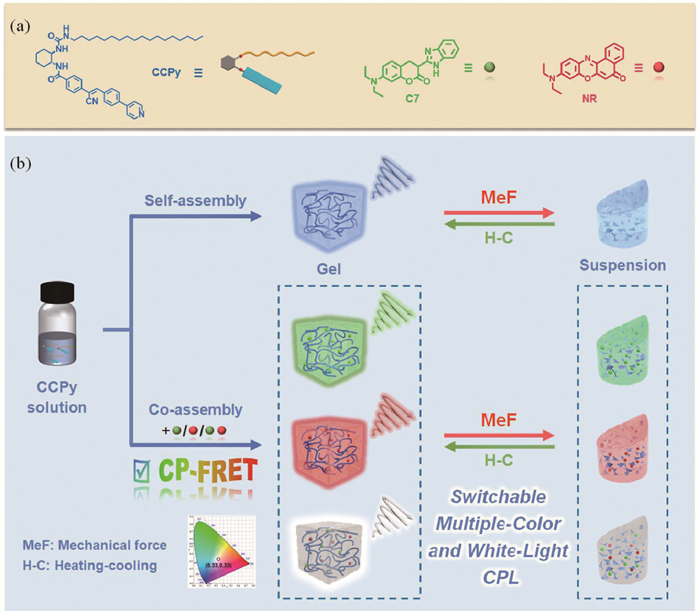
Herein, we report on a chiral supramolecular co-assembling system that integrates mechano-responsiveness with color customization, enabling on-demand regulation of multi-color [43,44] and white-light CPL. A V-shaped amphiphilic gelator CCPy derived from cyclohexanediamine was designed (Scheme 1a), based on which a mechano-responsive supramolecular gel was prepared in toluene. As illustrated in Scheme 1b, upon shaking, the gel with strong blue fluorescence (FL) and CPL rapidly collapsed into a suspension with almost quenched emission and a silent CPL signal, accompanied by a morphological change from nanofibers to wrinkled nanosheets due to notable alterations in arrangement of the molecules. This transformation was fully reversible, allowing the original gel to be restored through a heating-cooling process. Subsequently, the mechano-responsiveness of this supramolecular gel matrix was harnessed to develop tunable CPL systems featuring customized emission colors, with CCPy serving as both a chirality and energy donor. By incorporating dye molecules including Nile red (NR) and coumarin 7 (C7), co-gels exhibiting mechano-responsive green and red CPL that could be switched between ON and OFF states were constructed. On this basis, by adjusting the ratio of CCPy, C7 and NR in a ternary co-gel, the first case of a mechano-responsive white-light CPL emitter was fabricated through sequential energy transfer. In a further attempt, a remarkable showcase of information encryption was established employing the mechano-responsive multi-color and white-light emitting systems. This work held the promise of advancing construction of tunable CPL materials with customized colors, offering significant potential for applications in various fields including display and optical storage, information encryption and dynamic anti-counterfeiting.
Scheme 1
Scheme 1.
(a) Molecular structures and schematic illustrations of CCPy, C7 and NR. (b) Schematic illustration of self-/co-assembly of CCPy and the two dye molecules which leads to a mechano-responsive multi-color and white-light CPL supramolecular system.
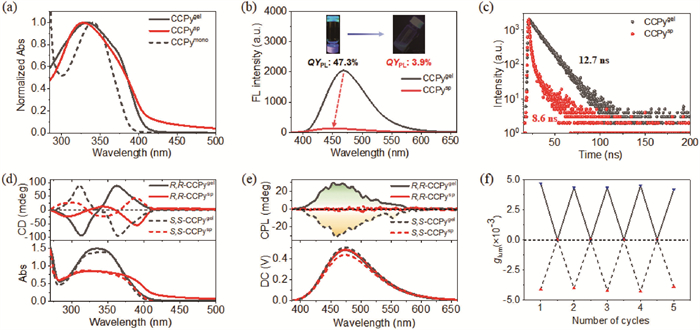
To synthesize the chiral molecule R,R-/S,S-CCPy, a long alkyl chain was firstly attached to the cyclohexanediamide skeleton via a urea bond, and then a conjugated cyanostilbene segment terminated with a pyridine group was introduced via an amide condensation reaction. Through multiple non-covalent interactions, this amphiphilic gelator self-assembled into a transparent supramolecular gel in toluene. As shown in Fig. 1a, the gel exhibited an absorption peak at 334 nm and a shoulder at 375 nm. While the molecularly dispersed solution of CCPy was barely emissive (Fig. S1 in Supporting information), the gel exhibited a bright blue emission at 466 nm with a fluorescence lifetime of 12.7 ns (Figs. 1b and c), stemming from the aggregation-induced emission (AIE) effect of the cyanostilbene chromophores [45-48]. A positive bisignate Cotton effect with a crossover at 337 nm was observed for R,R-CCPy gel by circular dichroism (CD) measurement in Fig. 1d, indicating that the molecular chirality was transferred to the supramolecular level (Fig. S2 in Supporting information) [49-51]. The excited-state supramolecular chirality of R,R-CCPy gel was further evaluated by CPL spectra, which displayed a prominent left-handed signal with a glum value of 4.69 × 10⁻³ (Fig. 1e). As shown in Figs. 1d and e, when S,S-CCPy was utilized, mirror-imaged CD and CPL spectra were obtained.
Figure 1
Figure 1.
UV–vis (a), fluorescence (b), fluorescence decay curves (c), CD (d) and CPL (e) spectra of the gel (black lines) and suspension (red lines) of CCPy in toluene ([CCPy] =14.0 mmol/L). (f) Changes in glum values of CCPy assemblies in the mechanical stimulation and heating-cooling cycles: blue and red triangles represent R,R- and S,S-CCPy assemblies, respectively. λex = 340 nm. The insets in (b) are photographs of CCPy gel and suspension in toluene under 365 nm light.
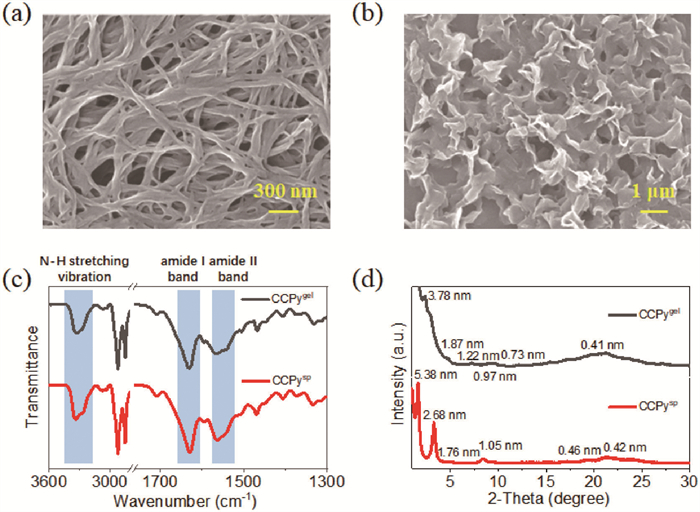
In our experiments, we observed that the toluene gel formed by CCPy was unstable under mechanical force. After shaking for 7 min and allowing it to stand for another 5 min, the highly fluorescent gel thoroughly collapsed into a turbid suspension with very weak emission, which was further identified by the rheology analysis as illustrated in Fig. S3 (Supporting information). The absorption spectrum of the suspension showed a major peak at 327 nm with a shoulder at 387 nm while the emission band was greatly weakened and shifted hypochromatically to 450 nm compared to the gel state (Figs. 1a and b). It was worth mentioning that the supramolecular chirality underwent prominent changes during the mechanical force-induced transformation as displayed in Figs. 1d and e. The CD spectrum of the R,R-CCPy suspension displayed a negative monosignate Cotton effect peaked at 387 nm and a positive bisignate Cotton effect with a crossover at 325 nm, corresponding to the absorption peaks in its ultraviolet-visible (UV–vis) spectrum. It was thus inferred that the chromophores in the suspension were packed in a counterclockwise mode, signifying an inversion of ground-state chirality in comparison to the gel. Furthermore, the original left-handed CPL signal became silent when the gel collapsed, suggesting the ON-OFF switching of the excited-state chirality within the supramolecular assemblies. The S,S-CCPy suspension showed mirrored images in both CD and CPL spectra (Figs. 1d and e). As the CCPy arrangement in the assemblies varied, the morphology changed accordingly from one-dimensional nanofibers into two-dimensional wrinkled nanosheets (Figs. 2a and b). Additionally, we measured the fluorescence lifetime of the resultant suspension, which revealed that the lifetime of the 450 nm-centered band in the suspension was 8.6 ns (Fig. 1c), much shorter than the fluorescence lifetime of the gel state. Concurrently, the quantum yield of the suspension was determined to be 3.9% in sharp contrast to 47.3% observed for the gel, confirming the quenching of fluorescence during the process. Notably, by applying a heating-cooling procedure to the suspension, the fluorescent supramolecular gel could be fully recovered, while the transformation back into the weakly emissive suspension could be induced again by exerting mechanical force. This reversible process could be repeated at least five times without obvious degradation of the glum value, as demonstrated in Fig. 1f.
Figure 2
Figure 2.
SEM images of CCPy gel (a) and suspension (b) in toluene. FT-IR spectra (c) and XRD patterns (d) of CCPy gel (black lines) and suspension (red lines) in toluene.
To shed light on the underlying mechanism behind the transition from gel to suspension induced by mechanical force, a range of techniques were employed to study both states. X-ray diffraction (XRD) measurements were carried out to unveil the packing mode of the CCPy molecules in these assemblies [52]. The XRD patterns shown in Fig. 2d revealed that in the gel state, diffraction peaks corresponding to d-spacing values of 3.78, 1.87, 1.22, 0.97, 0.73, 0.41 nm were observed, which aligned well with a ratio of 1:1/2:1/3:1/4:1/5:1/9 and unequivocally confirmed the presence of a lamellar structure. Similarly, diffraction peaks corresponding to d-spacing values of 5.38, 2.68, 1.76, 1.05, 0.46, 0.42 nm also indicated a lamellar arrangement in the suspension. Based on Corey-Pauling-Koltun (CPK) modeling, the molecular length of CCPy was approximated to be around 2.81 nm. The d-spacing values of both 3.78 and 5.38 nm fell between the length of a single CCPy molecule and twice its molecular length, suggesting that the bilayers were formed by two CCPy molecules with their arms, i.e., alkyl chains or π-conjugated segments, interdigitating with each other.
Fourier transfer infrared spectroscopy (FT-IR) technique was utilized to provide insight into the non-covalent interactions within the supramolecular assemblies [53,54]. As shown in Fig. 2c, peaks around 3250–3350 cm−1 (N-H stretching vibrations), 1628–1631 cm−1 (amide Ⅰ band) and 1540–1570 cm−1 (amide Ⅱ band) jointly confirmed the presence of hydrogen bonds formed between amide groups in both the gel and suspension states. Peaks at 2920 and 2850 cm−1 were ascribed to asymmetric and symmetric CH2 stretching vibrations, respectively, which suggested that the long alkyl chains were arranged closely in an all-trans conformation. In the gel system, the N-H stretching vibration appeared as a broad band centered at 3327 cm−1 which spilt into two distinct peaks at 3336 and 3266 cm−1 in the suspension state. In comparison, the amide Ⅰ band at 1631 cm−1 in the gel converged and shifted towards the lower wavenumber region, resulting in a peak at 1628 cm−1 in the suspension. The amide Ⅱ band appeared at 1566 cm−1 in the gel and 1563 cm−1 in the suspension, both accompanied by a shoulder peak at 1538 cm−1. These observations led to the inference that the hydrogen bonds between the amide groups became more robust after the transition from gel to suspension.
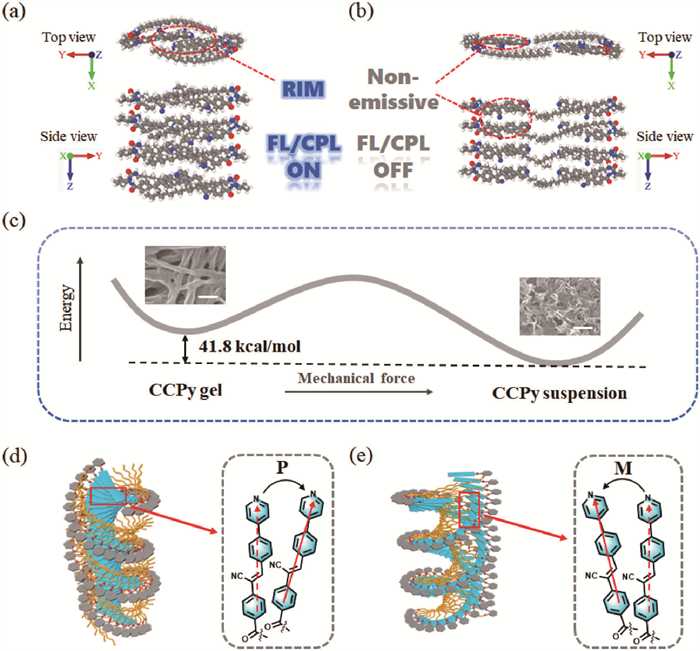
In order to gain a deeper understanding of the mechanical force-induced transformation, density functional theory (DFT) and molecular dynamics (MD) simulations were conducted on CCPy assemblies in both the gel and suspension states utilizing Gaussian 16 [55] and LAMMPS [56] programs. On the basis of the aforementioned XRD analysis, CCPy molecules were liable to form bilayers initially, which further assembled into hierarchical structures. It was disclosed by our computational simulations that both assemblies were governed by a multitude of non-covalent interactions, with the primary stabilizing interactions differing among various assemblies. As depicted in Fig. 3a, the π-conjugated chromophores of CCPy in the gel state were tightly packed, leading to strong π-π stacking interactions which served as the primary driving force behind the arrangement. In addition, multiple hydrogen bonds and van der Waals interactions played a supporting role in stabilizing this assembly. Upon application of mechanical force, the densely packed molecules within a bilayer slid apart (Fig. 3b), giving rise to a notable increase in the interlayer spacing. This transformation was accompanied by the weakening of π-π stacking interactions and the strengthening of hydrogen bonds throughout the entire assembly, as corroborated by the FT-IR measurements. It was further demonstrated that the total energy of the CCPy assembly in the suspension state was 41.8 kcal/mol lower than that in the gel state, indicating a significantly higher stability for the suspension (Fig. 3c).
Figure 3
Figure 3.
Theoretical calculations of CCPy assemblies in the gel (a) and suspension (b) states. (c) The potential energy surface of CCPy assemblies in the gel and suspension states. Scale bar: 300 nm (for the fibers) and 1 µm (for the wrinkled nanosheets). Schematic illustrations of the self-assembled structures (left) and packing modes of the π-conjugated chromophores (right) in the gel (d) and suspension (e) states.
Based on a comprehensive analysis of the experimental and simulation results, the tentative mechanism for the mechanical force-induced transformation was proposed. As a chiral building block featuring hydrogen bonding sites, a rigid π-conjugated segment and a long alkyl chain, CCPy could readily self-assemble in organic solvents through multiple non-covalent interactions including hydrogen bonds, π-π stacking and van der Waals interactions. In apolar toluene, this molecule initially formed bilayers with a d-spacing value of 3.78 nm, and further organized into nanofibers, as confirmed by XRD patterns and SEM images. Throughout the assembly, the AIE-active chromophores were tightly packed, bringing forth a strong fluorescence via a restriction of intramolecular motion (RIM) mechanism. Upon applying mechanical force, the d-spacing of the assembly increased and the packing of chromophores became relatively loose, resulting in almost fluorescence quenching and CPL silence. As the calculations revealed, the total energy of CCPy assemblies in the suspension state was notably lower than that of the gel state, confirming a higher stability of the suspension, which was in good agreement with the experimental results. Owing to the point chirality of cyclohexanediamide skeleton, the molecular chirality could be efficiently transferred to the supramolecular level upon assembling. As depicted in Fig. 3d, the π-conjugated headgroups partially overlapped and were arranged in a clockwise manner in the gel state, resulting in positive signals in both CD and CPL spectra. After the application of mechanical force, however, the chromophores were packed in a counterclockwise mode that led to a negative signal in CD spectrum (Fig. 3e).
To expand the scope of emission colors within the mechano-responsive supramolecular system, dye molecules were doped into CCPy gels. Specifically, two fluorescent dyes, NR with red emission and C7 with green emission, were chosen as the energy acceptors due to the spectral overlap between their absorption bands and the emission band of CCPy (Figs. S7 and S14 in Supporting information). A series of supramolecular co-gels was successfully prepared by incorporating varying amount of NR or C7 into CCPy. Taking co-gels formed by NR and CCPy for instance, with the fraction of NR (denoted as fNR which was calculated as nNR/nCCPy) increasing, a new emission band at 583 nm ascribed to NR gradually mounted at the expense of the CCPy emission band at 466 nm as shown in Fig. 4a and Fig. S8 (Supporting information). Combined with the fact that the fluorescence lifetime of CCPy emission at 466 nm progressively decreased from 12.7 ns to 1.5 ns as fNR increased from 0% to 20% (Fig. S9 and Table S1 in Supporting information), the trade-off between the two emission bands could be unambiguously attributed to the occurrence of Förster resonance energy transfer (FRET) with a high efficiency up to 88.2%. The efficient energy transfer, accompanied by chirality transfer between CCPy and NR, readily facilitated CP-FRET [57-60], evidenced by a left-handed CPL signal centered around 590 nm (Fig. 4b). The doping of NR up to 20% fNR did not affect the packing mode or morphology of CCPy molecules (Fig. S10 in Supporting information), and more importantly, the mechanical responsiveness of supramolecular assembly was well maintained. After shaking, the gels that emitted bright red fluorescence thoroughly collapsed into nearly non-emissive and CPL-silent suspensions, presenting a mechano-responsive red-light FL and CPL system. Likewise, co-gels comprising CCPy and C7 were also demonstrated to be a mechano-responsive green-light system, with FL and CPL switchable between ON and OFF states as demonstrated by relevant data in Figs. S13–S20 (Supporting information).
Figure 4
Figure 4.
(a) Fluorescence spectra of CCPy/NR gel (black lines) and suspension (red lines) in toluene. (b) CPL spectra of CCPy/NR gel (black lines) and suspension (red lines). (c) Fluorescence spectra of the white-light emitting CCPy/C7/NR gel (black line) and suspension (grey line). (d) CIE diagram and a photograph under excitation of 365 nm showing the neat white color of the CCPy/C7/NR gel. CPL spectra of the white-light emitting R,R-/S,S-CCPy/C7/NR gel (e) and suspension (f). λex = 340 nm. [CCPy] = 14.0 mmol/L.
Given the blue, green and red emissions from CCPy, C7 and NR, we assumed that by incorporating both C7 and NR into CCPy, a chiral white-light-emitting gel system could potentially be developed [61,62]. After screening the ratio of the three components, a standard white-light emission with a Commission International de l’Eclairage (CIE) chromaticity diagram coordinate value of (0.33, 0.33) was achieved with a ratio of [CCPy]:[C7]:[NR]=100:5:9 (Fig. 4d). By analyzing the fluorescence decay curves of CCPy and C7 emissions at 466 and 480 nm, we observed a significant decrease in the fluorescence lifetime of both CCPy and C7 after doping with the acceptors, hence revealing a sequential FRET process (Fig. S21 in Supporting information). Further investigation into the chiral emission performance of the ternary system confirmed that mirrored white-light CPL signals spanning from 410 nm to 760 nm could be obtained by using enantiomeric CCPy, as illustrated in Fig. 4e. It was worth noting that the white-light CPL system was also sensitive to mechanical force, manifested by shaking-triggered gel-to-suspension phase transformation, fluorescence quenching and CPL ON-OFF transition (Figs. 4c and f). The gel state with its original properties could then be recovered by a subsequent heating-cooling procedure. In this way, a mechano-responsive white-light CPL-emitting gel system was established based on two-step sequential CP-FRET, allowing for the reversible switching of CPL between ON and OFF states.
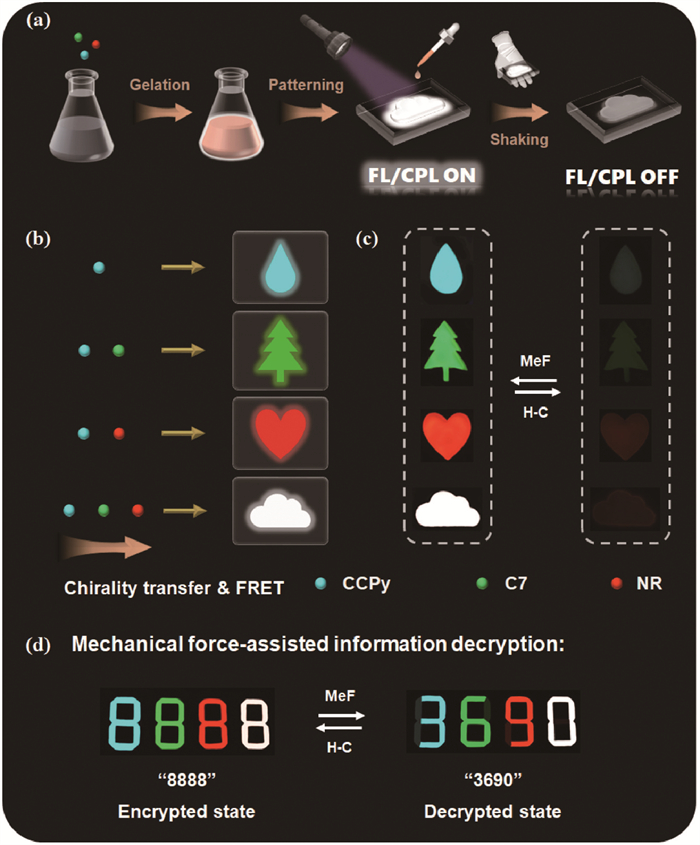
By leveraging the mechano-responsiveness of the multi-color and white-light emitting gel systems, a series of experiments showcasing encryption and restorage of information was performed. As depicted in Figs. 5a and b, CCPy gel and co-gels comprising dye molecules were prepared as tetrachromic inks emitting blue, green, red and white fluorescence, which were used to write information on Teflon substrates. Upon shaking, the bright and multicolored fluorescent patterns rapidly faded due to the mechanical force-induced quenching effect, thereby erasing the information (Fig. 5c). The highly fluorescent patterns could be fully restored after a subsequent heating-cooling process, hence retrieving the original information. Following this, we attempted to encode information of higher sophistication (Fig. 5d). Two types of tetrachromic inks comprising CCPy and optional dye molecules were used: responsive inks (R-inks) prepared in toluene and irresponsive inks (I-inks) prepared in ortho-xylene. We used I-inks to write the code “3690” on the Teflon substrate, and then complemented the rest of the figures with R-inks of the same color. In the initial state, the two types of inks were indistinguishable under 365 nm irradiation, displaying “8888”. Upon the application of mechanical force, the R-inks were quenched under UV irradiation, decrypting the information “3690” written with I-inks, which could be re-encrypted after a heating-cooling step. Therefore, the mechanical force-induced fluorescence quenching and color modulation through doping in this assembly system was strategically exploited to achieve convenient and reversible information encryption and decryption.
Figure 5
Figure 5.
The information encryption and restorage experiment performed on the (co-)assemblies prepared from CCPy, C7 and NR. Schematic illustration of (a) the sample preparation in the information encryption experiment and (b) the (co-)assembling strategies to construct patterns with bright blue, green, red and white fluorescence. (c) The transformation between varicolored fluorescent patterns and dark patterns under 365 nm irradiation upon successive exertion of mechanical stimuli and heating-cooling processing. (d) Mechanical force-assisted decryption of information with samples prepared in different solvents.
In summary, this study successfully established a mechano-responsive supramolecular gel system through the assembly of CCPy in toluene, enabling the achievement of switchable multi-color and white-light CPL. Upon shaking, the highly fluorescent gel rapidly collapsed into a suspension with almost quenched emission, accompanied by a reversal of ground-state chirality and silence of CPL. The transformation could be attributed to mechanical force-induced alterations in non-covalent interactions and packing modes among the gelators. Dye molecules serving as both chirality and energy acceptors were then incorporated into the chiral gel system, achieving green-, red- and more importantly white-light CPL-emitting mechano-responsive co-gels, which were further exploited in the application of information encryption and decryption in response to mechanical stimulus and heating-cooling cycles. Therefore, by combining the merits of chirality transfer and FRET, we successfully transmitted the mechano-responsiveness from the single-component CCPy self-assembly to multiple-component co-assemblies, along with the fluorescence and CPL color shifting from blue to green, red and ultimately standard white, hence providing a straightforward strategy for the fabrication of smart color-customizable CPL materials.
Declaration of competing interest
The authors declare that they have no known competing financial interests or personal relationships that could have appeared to influence the work reported in this paper.
CRediT authorship contribution statement
Ruirui Ren: Writing – review & editing, Writing – original draft, Investigation, Data curation. Ying Pan: Investigation, Data curation. Han-Xiao Wang: Writing – review & editing, Writing – original draft, Supervision, Conceptualization. Minghua Liu: Writing – review & editing, Writing – original draft, Supervision, Conceptualization.
Acknowledgments
We gratefully acknowledge financial support from the Strategic Priority Research Program of the Chinese Academy of Sciences (No. XDB0770101), the National Key R&D Program of China (No. 2023YFA1508900) and the National Natural Science Foundation of China (Nos. 22202211 and 52321006).
Supplementary materials
Supplementary material associated with this article can be found, in the online version, at doi:10.1016/j.cclet.2025.111060.
[1]
Y. Sang, J. Han, T. Zhao, et al., Adv. Mater. 32 (2019) 1900110.
S. Lee, K.Y. Kim, S.H. Jung, et al., Angew. Chem. Int. Ed. 58 (2019) 18878–18882. doi: 10.1002/anie.201911380
[41]
S.G. Kang, K.Y. Kim, Y. Cho, et al., Angew. Chem. Int. Ed. 61 (2022) e202207310. doi: 10.1002/anie.202207310
[42]
Y. Li, Y. Chen, J. Luo, et al., Adv. Mater. 36 (2024) 2312331. doi: 10.1002/adma.202312331
[43]
X. Wen, S. Du, L. Zhang, et al., Angew. Chem. Int. Ed. 62 (2023) e202311816. doi: 10.1002/anie.202311816
[44]
M. Pan, G. Zhang, H. Ma, et al., Sci. China Chem. 67 (2024) 2362–2372. doi: 10.1007/s11426-024-2000-3
[45]
X. Ma, B. Qiao, J. Yue, et al., Soft Matter 17 (2021) 7813–7816. doi: 10.1039/d1sm00993a
[46]
H. Shang, Z. Ding, Y. Shen, et al., Chem. Sci. 11 (2020) 2169–2174. doi: 10.1039/c9sc05643b
[47]
Y. Wang, H. Shang, B. Li, et al., CrystEngComm 19 (2017) 3801–3807. doi: 10.1039/C7CE00805H
[48]
Y. Zhang, T. Jing, Y. Quan, et al., Adv. Opt. Mater. 10 (2022) 2200915. doi: 10.1002/adom.202200915
[49]
L. Xu, M. Zhang, X. Zhu, et al., ACS Appl. Mater. Interfaces 14 (2021) 1765–1773.
[50]
Z. Riaz, S. Baddi, F. Gao, et al., Gels 10 (2024) 489. doi: 10.3390/gels10080489
[51]
L. Yang, X. Dou, C. Ding, et al., J. Phys. Chem. Lett. 12 (2021) 1155–1161. doi: 10.1021/acs.jpclett.0c03400
[52]
C. Xue, Y. Jiang, H.X. Wang, et al., Angew. Chem. Int. Ed. 61 (2022) e202205633. doi: 10.1002/anie.202205633
[53]
H. Fan, S. Du, L. Zhang, et al., Chem. Commun. 59 (2023) 1999–2002. doi: 10.1039/d2cc05691g
[54]
H.X. Wang, L. Xu, X. Zhu, et al., Nanoscale 14 (2022) 1001–1007. doi: 10.1039/d1nr07538a
[55]
J. Chai, M. Headgordon, Phys. Chem. Chem. Phys. 10 (2008) 6615–6620. doi: 10.1039/b810189b
[56]
A.P. Thompson, H.M. Aktulga, R. Berger, et al., Comput. Phys. Commun. 271 (2022) 108171. doi: 10.1016/j.cpc.2021.108171
[57]
L. Ji, Y. Sang, G. Ouyang, et al., Angew. Chem. Int. Ed. 58 (2018) 844–848.
[58]
S. Du, X. Zhu, L. Zhang, et al., ACS Appl. Mater. Interfaces 13 (2021) 15501–15508. doi: 10.1021/acsami.1c00181
[59]
L. Hu, K. Li, W. Shang, et al., Angew. Chem. Int. Ed. 59 (2020) 4953–4958. doi: 10.1002/anie.202000589
[60]
S. Ma, J. Jiang, Z. Liu, et al., Nanoscale 12 (2020) 7895–7901. doi: 10.1039/c9nr10946c
[61]
Y. Zhang, G. Tian, D. Li, et al., Laser Photonics Rev. 18 (2024) 2400223. doi: 10.1002/lpor.202400223
[62]
Y. Zhang, Y. Li, Y. Quan, et al., Angew. Chem. Int. Ed. 62 (2022) e202214424.
Scheme 1
(a) Molecular structures and schematic illustrations of CCPy, C7 and NR. (b) Schematic illustration of self-/co-assembly of CCPy and the two dye molecules which leads to a mechano-responsive multi-color and white-light CPL supramolecular system.
Figure 1
UV–vis (a), fluorescence (b), fluorescence decay curves (c), CD (d) and CPL (e) spectra of the gel (black lines) and suspension (red lines) of CCPy in toluene ([CCPy] =14.0 mmol/L). (f) Changes in glum values of CCPy assemblies in the mechanical stimulation and heating-cooling cycles: blue and red triangles represent R,R- and S,S-CCPy assemblies, respectively. λex = 340 nm. The insets in (b) are photographs of CCPy gel and suspension in toluene under 365 nm light.
Figure 2
SEM images of CCPy gel (a) and suspension (b) in toluene. FT-IR spectra (c) and XRD patterns (d) of CCPy gel (black lines) and suspension (red lines) in toluene.
Figure 3
Theoretical calculations of CCPy assemblies in the gel (a) and suspension (b) states. (c) The potential energy surface of CCPy assemblies in the gel and suspension states. Scale bar: 300 nm (for the fibers) and 1 µm (for the wrinkled nanosheets). Schematic illustrations of the self-assembled structures (left) and packing modes of the π-conjugated chromophores (right) in the gel (d) and suspension (e) states.
Figure 4
(a) Fluorescence spectra of CCPy/NR gel (black lines) and suspension (red lines) in toluene. (b) CPL spectra of CCPy/NR gel (black lines) and suspension (red lines). (c) Fluorescence spectra of the white-light emitting CCPy/C7/NR gel (black line) and suspension (grey line). (d) CIE diagram and a photograph under excitation of 365 nm showing the neat white color of the CCPy/C7/NR gel. CPL spectra of the white-light emitting R,R-/S,S-CCPy/C7/NR gel (e) and suspension (f). λex = 340 nm. [CCPy] = 14.0 mmol/L.
Figure 5
The information encryption and restorage experiment performed on the (co-)assemblies prepared from CCPy, C7 and NR. Schematic illustration of (a) the sample preparation in the information encryption experiment and (b) the (co-)assembling strategies to construct patterns with bright blue, green, red and white fluorescence. (c) The transformation between varicolored fluorescent patterns and dark patterns under 365 nm irradiation upon successive exertion of mechanical stimuli and heating-cooling processing. (d) Mechanical force-assisted decryption of information with samples prepared in different solvents.



 DownLoad:


 下载:
下载:



