Citation: Fengzhi Wang, Ke Hu, Jinquan Chen, Zhubin Hu, Haitao Sun, Tony D. James, Yufang Xu, Xuhong Qian. Meta-amino substituted naphthalimides exhibit large charge transfer and strong N-H vibrations enabling use as ratiometric fluorescent probe[J]. Chinese Chemical Letters, ;2026, 37(1): 110971. doi: 10.1016/j.cclet.2025.110971 shu

Meta-amino substituted naphthalimides exhibit large charge transfer and strong N-H vibrations enabling use as ratiometric fluorescent probe

Figures(6)

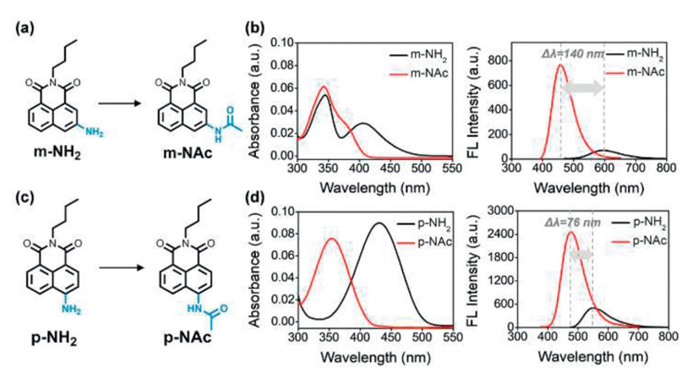
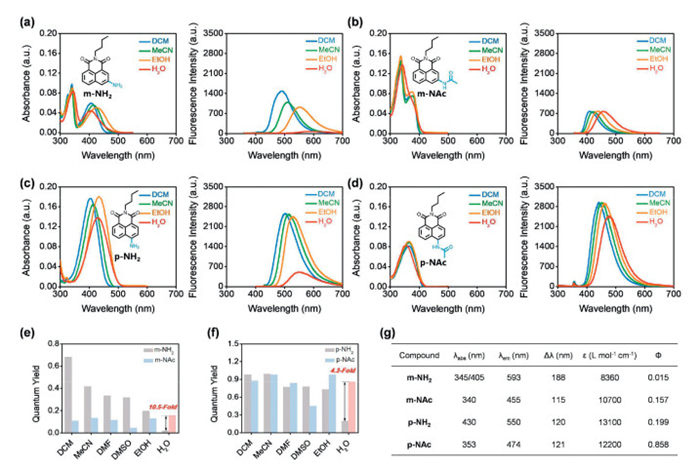
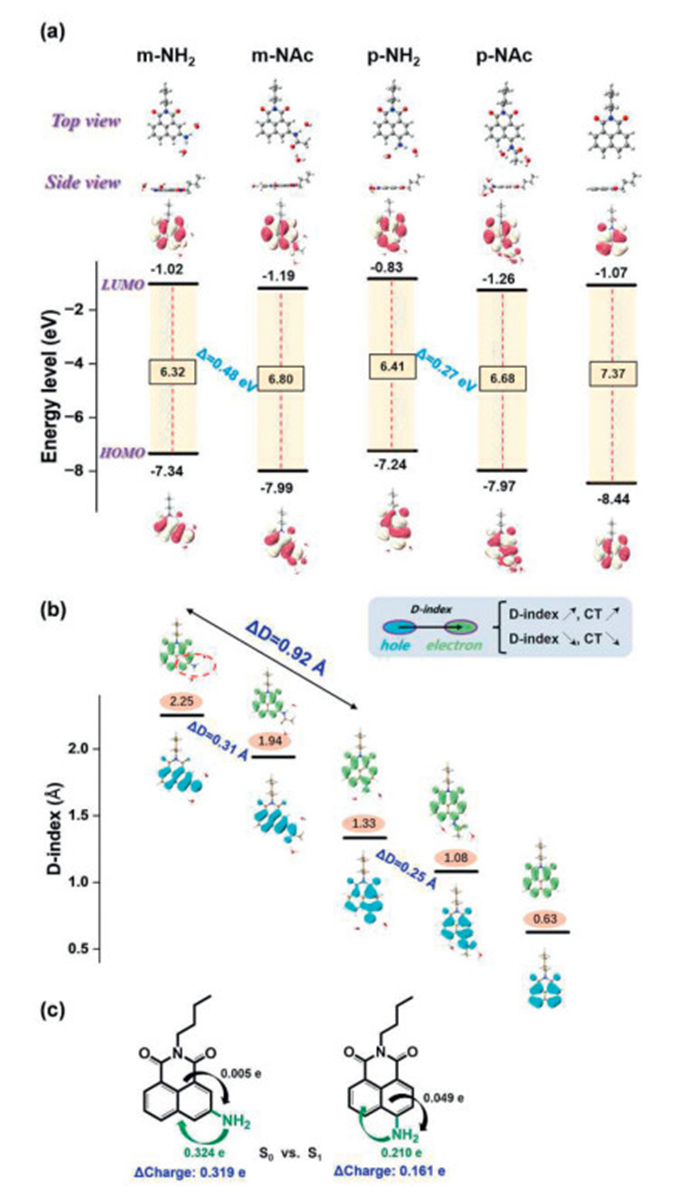
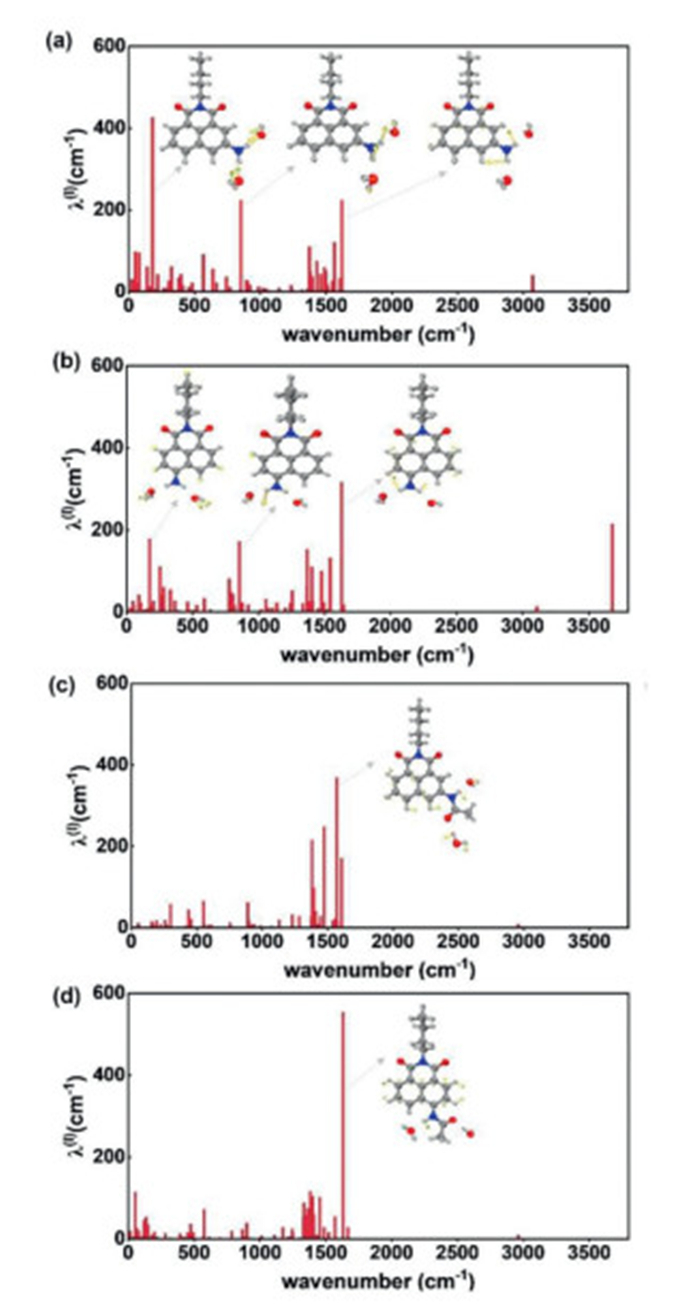
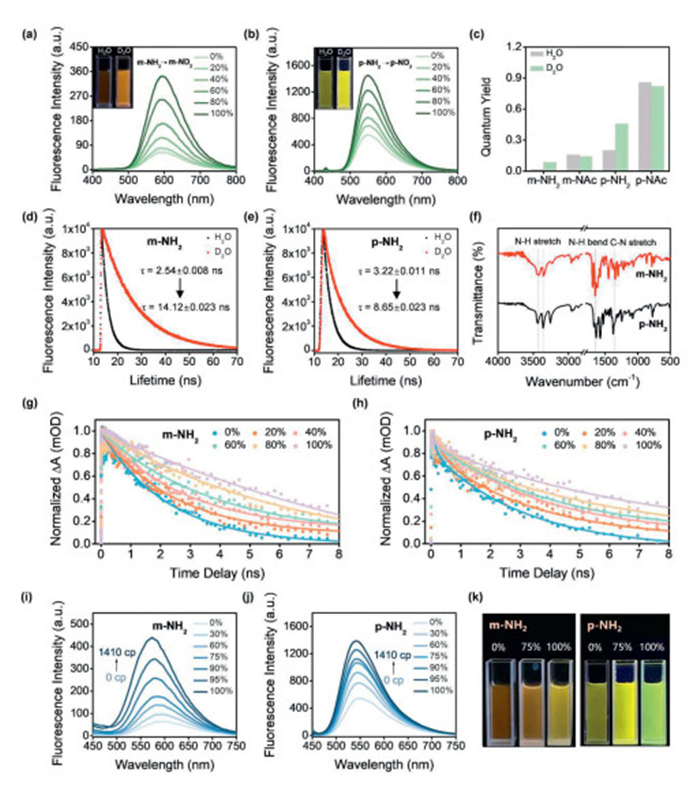
  • Fluorescent probes based on intramolecular charge transfer (ICT) have obvious advantages for accurate quantitative analysis. To obtain high-performance ratiometric probes requires distinct photophysical properties during recognition reaction process, which is closely related to their ICT characteristics. 1,8-Naphthalimide is known as a typical fluorophore with desirable ICT property when functionalized with an electron-donating moiety at the para-position of the naphthalene chromophore. Although the photophysical properties of para-substituted 1,8-naphthalimide have been well studied, its meta-substituted counterpart has not been fully evaluated since the meta-position is conventionally thought to be weakly conjugated. Herein, combined experimental and theoretical studies are performed which consistently indicate that stronger charge transfer (CT) is exhibited by the meta-amino substituted 1,8-naphthalimide (m-NH2) compared to the para-amino substituted one (p-NH2). The ratiometric response of fluorescence with significant changes in wavelength and intensity upon acetylation (m-NAc and p-NAc) can be attributed to the larger ICT and stronger -NH2 vibrations. This observation is further demonstrated by deuterium oxide experiments, viscosity experiments and quantum chemical calculations. The practical application of meta-amino-1,8-naphthalimide ICT-based probes is also confirmed. This research is expected to bring an in-depth understanding of π-conjugated systems with ICT characteristics, and facilitates the design of sensitive ICT fluorescent probes with meta-amino substitution.
  • 加载中
    1. [1]

      Y.J. Geng, Z. Wang, J.Y. Zhou, et al., Chem. Soc. Rev. 52 (2023) 3873–3926.  doi: 10.1039/d2cs00172a

    2. [2]

      D. Wu, A.C. Sedgwick, T. Gunnlaugsson, et al., Chem. Soc. Rev. 46 (2017) 7105–7123.

    3. [3]

      X.H. Qian, Z.C. Xu, Chem. Soc. Rev. 44 (2015) 4487–4493.

    4. [4]

      H. Li, W. Shi, X. Li, et al., J. Am. Chem. Soc. 141 (2019) 18301–18307.  doi: 10.1021/jacs.9b09722

    5. [5]

      J.R. Lakowicz, Principles of Fluorescence Spectroscopy, Springer, London, 2006.

    6. [6]

      A.P. de Silva, H.Q.N. Gunaratne, T. Gunnlaugsson, et al., Chem. Rev. 97 (1997) 1515–1566.

    7. [7]

      X. Tian, L.C. Murfin, L.L. Wu, et al., Chem. Sci. 12 (2021) 3406–3426.  doi: 10.1039/d0sc06928k

    8. [8]

      S.H. Park, N. Kwon, J.H. Lee, et al., Chem. Soc. Rev. 49 (2020) 143–179.  doi: 10.1039/c9cs00243j

    9. [9]

      D. Srikun, E.W. Miller, D.W. Dornaille, et al., J. Am. Chem. Soc. 130 (2008) 4596–4597.  doi: 10.1021/ja711480f

    10. [10]

      A. Pal, M. Karmakar, S.R. Bhatta, et al., Coord. Chem. Rev. 448 (2021) 214167.

    11. [11]

      M.H. Lee, J.S. Kim, J.L. Sessler, Chem. Soc. Rev. 44 (2015) 4185–4191.

    12. [12]

      J. An, P. Verwilst, H. Aziz, et al., Bioact. Mater. 13 (2022) 239–248.

    13. [13]

      X.T. Xia, F. Zeng, P.S. Zhang, et al., Sensors Actuators B: Chem. 227 (2016) 411–418.

    14. [14]

      J. Wang, H. Pan, J.Y. Li, et al., Chin. Chem. Lett. 34 (2023) 107828.

    15. [15]

      C.X. Yan, Z.Q. Guo, W.J. Chi, et al., Nat. Commun. 12 (2021) 3869.

    16. [16]

      M.R. Eftink, Biophysical and Biochemical Aspects of Fluorescence Spectroscopy, Springer, New York, 1991.

    17. [17]

      R.M. Duke, E.B. Veale, F.M. Pfeffer, et al., Chem. Soc. Rev. 39 (2010) 3936–3953.  doi: 10.1039/b910560n

    18. [18]

      L. Gopala, Y. Cha, M.H. Lee, Dyes Pigm. 201 (2022) 110195.

    19. [19]

      Z.F. Li, Q.L. Qiao, N. Xu, et al., Chin. Chem. Lett. 35 (2024) 108824.

    20. [20]

      P. Gopikrishna, N. Meher, P.K. Iyer, ACS Appl. Mater. Interfaces 10 (2017) 12081–12111.

    21. [21]

      L. Zhou, L.J. Xie, C.H. Liu, et al., Chin. Chem. Lett. 30 (2019) 1799–1808.

    22. [22]

      X.L. Xie, G.Z. Liu, X.X. Su, et al., Anal. Chem. 91 (2019) 6872–6879.  doi: 10.1021/acs.analchem.9b01175

    23. [23]

      X. Qian, Y. Xiao, Y. Xu, et al., Chem. Commun. 46 (2010) 6418–6436.  doi: 10.1039/c0cc00686f

    24. [24]

      J.H. Jia, L.L. Wu, Y. Ding, et al., Dalton Trans. 45 (2016) 9402–9406.

    25. [25]

      S.K. Dwivedi, R.C. Gupta, P. Srivastava, et al., Anal. Chem. 90 (2018) 10974–10981.  doi: 10.1021/acs.analchem.8b02570

    26. [26]

      X. Yang, Z. Yuan, W. Lu, et al., J. Am. Chem. Soc. 145 (2022) 78–88.

    27. [27]

      H. Ungati, V. Govindaraj, M. Narayanan, et al., Angew. Chem. Int. Ed. 58 (2019) 8156–8160.  doi: 10.1002/anie.201903958

    28. [28]

      B. Lozano-Torres, I. Galiana, M. Rovira, et al., J. Am. Chem. Soc. 139 (2017) 8808–8811.  doi: 10.1021/jacs.7b04985

    29. [29]

      W.C. Silvers, B. Prasai, D.H. Burk, et al., J. Am. Chem. Soc. 135 (2013) 309–314.  doi: 10.1021/ja309346f

    30. [30]

      H. Zhang, K. Wang, X.P. Xuan, et al., Chem. Commun. 52 (2016) 6308–6311.

    31. [31]

      R.M. Duke, T. Gunnlaugsson, Tetrahedron Lett. 52 (2011) 1503–1505.

    32. [32]

      L.D. Adair, N. Trinh, P.M. Vérité, et al., Chem. Eur. J. 26 (2020) 10064–10071.  doi: 10.1002/chem.202002088

    33. [33]

      Y.Y. Zhang, Y.H. Tang, X.Q. Kong, et al., Spectrochim. Acta A 247 (2021) 119150.

    34. [34]

      A.D. Johnson, K. Szacilowski, D.C. Magri, Dyes Pigm. 231 (2024) 112424.

    35. [35]

      M. Korzec, S. Kotowicz, K. Malarz, et al., Molecules 28 (2023) 6255.  doi: 10.3390/molecules28176255

    36. [36]

      S.K. Mahato, P. Barman, M. Badirujjaman, et al., Chem. Commun. 59 (2023) 4802–4805.  doi: 10.1039/d3cc00220a

    37. [37]

      J. Li, Q.L. Qiao, Y.Y. Ruan, et al., Chin. Chem. Lett. 34 (2023) 108266.

    38. [38]

      X. Liu, J.M. Cole, Z. Xu, J. Phys. Chem. C 121 (2017) 13274–13279.  doi: 10.1021/acs.jpcc.7b04176

    39. [39]

      J. Chen, C. Wang, W. Liu, et al., Angew. Chem. Int. Ed. 60 (2021) 25104–25113.  doi: 10.1002/anie.202111052

    40. [40]

      J. Chen, Q. Qiao, H. Wang, et al., Adv. Sci. 11 (2024) 2408030.

    41. [41]

      L. Cui, Y. Zhong, W.P. Zhu, et al., Chem. Commun. 46 (2010) 7121–7123.  doi: 10.1039/c0cc01000f

    42. [42]

      H. Iikura, T. Tsuneda, T. Yanai, et al., J. Chem. Phys. 115 (2001) 3540–3544.

    43. [43]

      H.T. Sun, C. Zhong, J.L. Brédas, J. Chem. Theory Comput. 11 (2015) 3851–3858.  doi: 10.1021/acs.jctc.5b00431

    44. [44]

      C.A. Guido, P. Cortona, B. Mennucci, et al., J. Chem. Theory Comput. 9 (2013) 3118–3126.  doi: 10.1021/ct400337e

    45. [45]

      Z.G. Shuai, D. Wang, Q. Peng, et al., Acc. Chem. Res. 47 (2014) 3301–3309.  doi: 10.1021/ar400306k

    46. [46]

      J. Kučera, O. Peš, T. Janovič, et al., Sens. Actuators. B: Chem. 352 (2022) 131029.

    47. [47]

      L.P. Conway, V. Rendo, M.S.P. Correia, et al., Angew. Chem. Int. Ed. 59 (2020) 14342–14346.  doi: 10.1002/anie.202005915

    48. [48]

      A. Husain, X.Y. Zhang, M.A. Doll, et al., Drug Metab. Dispos. 35 (2007) 721–727.  doi: 10.1124/dmd.106.014621

    49. [49]

      L. Liu, A. Von Vett, N.X. Zhang, et al., Chem. Res. Toxicol. 20 (2007) 1300–1308.  doi: 10.1021/tx7001614

    50. [50]

      X. Wang, L. Cui, N.N. Zhou, et al., Chem. Sci. 4 (2013) 2936–2940.  doi: 10.1039/c3sc51079d

    51. [51]

      M.K. Kuimova, S.W. Botchway, A.W. Parker, et al., Nat. Chem. 1 (2009) 69–73.  doi: 10.1038/nchem.120

  • 加载中
    1. [1]

      Yu HongYuqian JiangChenhuan YuanDecai WangYimeng SunJian Jiang . Unraveling temperature-dependent supramolecular polymorphism of naphthalimide-substituted benzene-1,3,5-tricarboxamide derivatives. Chinese Chemical Letters, 2024, 35(12): 109909-. doi: 10.1016/j.cclet.2024.109909

    2. [2]

      Haiyan Yin Abdusalam Ablez Zhuangzhuang Wang Weian Li Yanqi Wang Qianqian Hu Xiaoying Huang . Novel open-framework chalcogenide photocatalysts: Cobalt cocatalyst valence state modulating critical charge transfer pathways towards high-efficiency hydrogen evolution. Chinese Journal of Structural Chemistry, 2025, 44(4): 100560-100560. doi: 10.1016/j.cjsc.2025.100560

    3. [3]

      Chenghao GePeng WangPei YuanTai WuRongjun ZhaoRong HuangLin XieYong Hua . Tuning hot carrier transfer dynamics by perovskite surface modification. Chinese Chemical Letters, 2024, 35(10): 109352-. doi: 10.1016/j.cclet.2023.109352

    4. [4]

      Shu-Ran Xu Fang-Xing Xiao . Metal halide perovskites quantum dots: Synthesis, and modification strategies for solar CO2 conversion. Chinese Journal of Structural Chemistry, 2023, 42(12): 100173-100173. doi: 10.1016/j.cjsc.2023.100173

    5. [5]

      Zhixiao XiongShanni QiuYuyu WangHouna DuanYi XiaoYufang XuWeiping ZhuXuhong Qian . Photocalibrated NO release from the zinc ion fluorescent probe based on naphthalimide and its application in living cells. Chinese Chemical Letters, 2025, 36(4): 110002-. doi: 10.1016/j.cclet.2024.110002

    6. [6]

      Junqing YeMengyuan RenJunfeng QianXibao LiQun Chen . Advances in graphene quantum dots-based photocatalysts for enhanced charge transfer in photocatalytic reactions. Chinese Chemical Letters, 2025, 36(9): 110857-. doi: 10.1016/j.cclet.2025.110857

    7. [7]

      Huifang MaTao XuSaifei YuanShujuan LiJiayao WangYuping ZhangHao RenShulai Lei . Interlayer interactions and electron transfer effects on sodium adsorption on 2D heterostructures surfaces. Chinese Chemical Letters, 2025, 36(8): 110219-. doi: 10.1016/j.cclet.2024.110219

    8. [8]

      Yuchen WangYaoyu LiuXiongfei HuangGuanjie HeKai Yan . Fe nanoclusters anchored in biomass waste-derived porous carbon nanosheets for high-performance supercapacitor. Chinese Chemical Letters, 2024, 35(8): 109301-. doi: 10.1016/j.cclet.2023.109301

    9. [9]

      Bo YangSuqiong YanShirong BanWei Huang . New horizons in phosphorus-based emitters: From circularly polarized fluorescence to room-temperature phosphorescence. Chinese Chemical Letters, 2025, 36(11): 110837-. doi: 10.1016/j.cclet.2025.110837

    10. [10]

      Ao-Hua WangJun LiShi-Hu DuJia LiuYao ZhangMuhammad Bilal Ahmed SiddiqueJing ChenShi-Bo Cheng . Beyond superhalogen assembly: Field-driven hyperhalogen design via dual-external-field cooperativity. Chinese Chemical Letters, 2026, 37(1): 111265-. doi: 10.1016/j.cclet.2025.111265

    11. [11]

      Cheng-Cheng JiaoGuang-Xing DongKe SuYou-Xiang FengMin ZhangTong-Bu Lu . The construction of InVO4/BiVO4 heterojunction via cation-exchange for efficient and highly selective CO2 photoreduction to methanol. Chinese Chemical Letters, 2026, 37(1): 110752-. doi: 10.1016/j.cclet.2024.110752

    12. [12]

      Huizhong WuRuiheng LiangGe SongZhongzheng HuXuyang ZhangMinghua Zhou . Enhanced interfacial charge transfer on Bi metal@defective Bi2Sn2O7 quantum dots towards improved full-spectrum photocatalysis: A combined experimental and theoretical investigation. Chinese Chemical Letters, 2024, 35(6): 109131-. doi: 10.1016/j.cclet.2023.109131

    13. [13]

      Fang Niu Rong Li Qiaolan Zhang . Analysis of Gas-Solid Adsorption Behavior in Resistive Gas Sensing Process. University Chemistry, 2024, 39(8): 142-148. doi: 10.3866/PKU.DXHX202311102

    14. [14]

      Gaopeng LiuLina LiBin WangNingjie ShanJintao DongMengxia JiWenshuai ZhuPaul K. ChuJiexiang XiaHuaming Li . Construction of Bi Nanoparticles Loaded BiOCl Nanosheets Ohmic Junction for Photocatalytic CO2 Reduction. Acta Physico-Chimica Sinica, 2024, 40(7): 2306041-0. doi: 10.3866/PKU.WHXB202306041

    15. [15]

      Yushan CaiFang-Xing Xiao . Revisiting MXenes-based Photocatalysis Landscape: Progress, Challenges, and Future Perspectives. Acta Physico-Chimica Sinica, 2024, 40(8): 2306048-0. doi: 10.3866/PKU.WHXB202306048

    16. [16]

      Xiutao XuChunfeng ShaoJinfeng ZhangZhongliao WangKai Dai . Rational Design of S-Scheme CeO2/Bi2MoO6 Microsphere Heterojunction for Efficient Photocatalytic CO2 Reduction. Acta Physico-Chimica Sinica, 2024, 40(10): 2309031-0. doi: 10.3866/PKU.WHXB202309031

    17. [17]

      Jianyin HeLiuyun ChenXinling XieZuzeng QinHongbing JiTongming Su . Construction of ZnCoP/CdLa2S4 Schottky Heterojunctions for Enhancing Photocatalytic Hydrogen Evolution. Acta Physico-Chimica Sinica, 2024, 40(11): 2404030-0. doi: 10.3866/PKU.WHXB202404030

    18. [18]

      Kexin YuanYulei LiuHaoran FengYi LiuJun ChengBeiyang LuoQinglian WuXinyu ZhangYing WangXian BaoWanqian GuoJun Ma . Unlocking the potential of thin-film composite reverse osmosis membrane performance: Insights from mass transfer modeling. Chinese Chemical Letters, 2024, 35(5): 109022-. doi: 10.1016/j.cclet.2023.109022

    19. [19]

      Chunxiu YuZelin WuHongle ShiLingyun GuKexin ChenChuan-Shu HeYang LiuHeng ZhangPeng ZhouZhaokun XiongBo Lai . Insights into the electron transfer mechanisms of peroxydisulfate activation by modified metal-free acetylene black for degradation of sulfisoxazole. Chinese Chemical Letters, 2024, 35(8): 109334-. doi: 10.1016/j.cclet.2023.109334

    20. [20]

      Yihu Ke Shuai Wang Fei Jin Guangbo Liu Zhiliang Jin Noritatsu Tsubaki . Charge transfer optimization: Role of Cu-graphdiyne/NiCoMoO4 S-scheme heterojunction and Ohmic junction. Chinese Journal of Structural Chemistry, 2024, 43(12): 100458-100458. doi: 10.1016/j.cjsc.2024.100458

Metrics
  • PDF Downloads(0)
  • Abstract views(5)
  • HTML views(1)

通讯作者: 陈斌, bchen63@163.com
  • 1. 

    沈阳化工大学材料科学与工程学院 沈阳 110142

  1. 本站搜索
  2. 百度学术搜索
  3. 万方数据库搜索
  4. CNKI搜索
Address:Zhongguancun North First Street 2,100190 Beijing, PR China Tel: +86-010-82449177-888
Powered By info@rhhz.net

/

DownLoad:  Full-Size Img  PowerPoint
Return