Citation:
Xin Dai, Tong Liu, Ye Du, Jie-Yu Cao, Zhong-Juan Wang, Jie Li, Peng Zhou, Heng Zhang, Bo Lai. Synergistic effect in enhancing treatment of micro-pollutants by ferrate and carbon materials: A review[J]. Chinese Chemical Letters,
2025, 36(8): 110548.
doi:
10.1016/j.cclet.2024.110548
Synergistic effect in enhancing treatment of micro-pollutants by ferrate and carbon materials: A review
English
Synergistic effect in enhancing treatment of micro-pollutants by ferrate and carbon materials: A review
Received Date:
29 May 2024 Accepted Date:
12 October 2024 Revised Date:
08 October 2024 Available Online:
15 August 2025
Abstract:
Ferrate [Fe(Ⅵ)] has demonstrated its efficacy as a potent oxidizing agent in the treatment of wastewater, showcasing its potential for application in environmental remediation. The self-decomposition of Fe(Ⅵ) results in the formation of Fe(Ⅳ)/Fe(Ⅴ), which exhibits remarkable reactivity and selectivity towards the degradation of electron-rich micro-pollutants. Here we presented a comprehensive review on the removal of micro-pollutants in Fe(Ⅵ)/carbon materials (CMs) systems, encompassing an analysis of the oxidation mechanism and mutual activation, thereby providing guidance for the efficient elimination of recalcitrant micro-pollutants. The combnation of Fe(Ⅵ) and CMs can significantly enhanced the removal efficiency of various pollutants, with an increase ranges from 30% to 70%. The rate constants for pseudo-first order reactions were increased ranging from 3 to 14 times, while the total organic carbon (TOC) removal rate was effectively doubled. The presence of active species, including hydroxyl radicals, superoxide radical and Fe(Ⅳ)/Fe(Ⅴ) generated by Fe(Ⅵ) and CMs, can significantly enhance the oxidation efficiency of micro-pollutants which are not easily degraded solely by Fe(Ⅵ) or CMs. Furthermore, Fe(Ⅵ) can enhance the surface area and void volume of CMs, thereby reinforcing the adsorption capacity towards micro-pollutants.
Over the past few decades, the impact of chemical pollution on aquatic ecosystems has substantially increased globally [1-3]. Micro-pollutants, referring to organic chemicals present in low concentrations, encompass a wide range of substances including pharmaceuticals, personal care products, industrial chemicals, pesticides, and various other emerging new pollutants [4-7]. The prolonged exposure to these substances has deleterious effects on the well-being of humans [8,9]. Recently, various advanced processes have been effectively employed to address the issue of eliminating micro-pollutants from water, including adsorption [10], advanced oxidation processes (AOPs) [11-13], nanofiltration, membrane bioreactors etc., [14,15]. Among them, AOPs are more effective in remediating pollutants and reducing the impacts of their toxicity [16,17].
The high oxidation ability of ferrate [Fe(Ⅵ)] renders it a promising candidate for micro-pollutants treatment [18,19]. The diverse properties of Fe(Ⅵ), which facilitate simultaneous coagulation, disinfection, and oxidation of micro-pollutants, contribute to its versatility [20-22]. The application of Fe(Ⅵ) in the wastewater treatment process exhibits exceptional effectiveness as an oxidizing agent, specifically targeting emerging micro-pollutants including estrogens, bisphenol-A, and pharmaceuticals etc., frequently identified in water sources [23-26].
The utilization of Fe(Ⅵ) in the wastewater treatment process involves the postulation of transitional states, namely reactive Fe(Ⅳ)/Fe(Ⅴ), during the degradation process of Fe(Ⅵ), as well as their involvement in the oxidation of both inorganic and organic substrates [27]. The oxidative reactions of Fe(Ⅵ) involving either single-electron or double-electron transfer to Fe(Ⅳ)/Fe(Ⅴ) (Eqs. 1 and 2) [28,29]. The Fe(Ⅳ)/Fe(Ⅴ), as the predominant active species in the Fe(Ⅵ) system, exhibit enhanced oxidation capability. Previous studies have demonstrated a substantial increase in oxidation rate constants by several orders of magnitude for micro-pollutants involving Fe(Ⅳ)/Fe(Ⅴ), as compared to those involving Fe(Ⅵ) [30,31].
Due to the sluggish rate of Fe(Ⅳ)/Fe(Ⅴ) production from Fe(Ⅵ) alone, enhancing the activation of Fe(Ⅵ) is pivotal for improving the oxidation capacity in the Fe(Ⅵ) system. Consequently, numerous strategies have been proposed by researchers to activate Fe(Ⅵ), thereby promoting the generation of Fe(Ⅳ)/Fe(Ⅴ) [32]. Different approaches can be employed to enhance the generation of Fe(Ⅳ)/Fe(Ⅴ) from Fe(Ⅵ), such as acidic substances (e.g., hydrochloric acid), metal ions (e.g., Fe(Ⅲ)), carbon materials (CMs), reducing agents [32-35].
CMs, known for their extensive specific surface area, high porosity, excellent electron conductivity, and relative chemical inertness, have garnered significant attention from researchers worldwide as environmentally friendly materials [36,37]. After conducting extensive researches, it has been determined that the adsorption capacity of CMs for micro-pollutants is relatively lower [38-40]. The activation of hydrogen peroxide (H2O2) by CMs to generate hydroxyl radicals (•OH) was observed by researchers, and subsequent analysis indicated a correlation between these •OH groups and the presence of persistent free radicals (PFRs) on CMs [41]. The role of CMs in the conversion of biomass through chemical and enzymatic processes is twofold, serving as both a catalyst and a catalytic support [42-44]. The development of numerous strategies for activation has thus far been accomplished. Successful approaches encompass the metals activation, acid/alkaline activation, doping with heteroatoms, and additional methods [45-48].
Previous studies have demonstrated the promising application prospects of CMs in enhancing micro-pollutants removal through Fe(Ⅵ) catalysis [49]. In Fe(Ⅵ)/CMs systems, the presence of functional groups on the surface of carbon materials facilitates electron transfer, thereby promoting the generation of Fe(Ⅳ)/Fe(Ⅴ) species and free radicals, ultimately enhancing the oxidation efficiency towards pollutants [50]. The final product resulting from the decomposition of Fe(Ⅵ) is adsorbed onto the surface of CMs, thereby enhancing their specific surface area and void volume. Consequently, this leads to an increased number of adsorption sites and improved pollutant adsorption capabilities.
In recent years, significant advancements have been achieved in the utilization of Fe(Ⅵ) activation, with some comprehensive reviews already published [27]. However, there is a dearth of literature discussing the co-use process of CMs and Fe(Ⅵ), warranting further investigation. Additionally, there remains a dearth of comprehensive synthesis pertaining to the utilization of Fe(Ⅵ) for CMs activation, elucidation of underlying mechanisms, as well as an assessment of the merits and drawbacks associated with various types of CMs. This review primarily elucidated the effective promotion of pollutants oxidation through mutual activation between Fe(Ⅵ) and CMs. It was summarized that this system generated a greater amount of reactive oxygen species, active iron, the size of particles, the specific surface area and void volume of CMs are both enhanced. Furthermore, the rationale behind the enhanced oxidation of pollutants achieved by combining Fe(Ⅵ) with CMs was explicated.
2.
Effect of Fe(Ⅵ)/CMS on micro-pollutants oxidation
2.1
Removal efficiency of micro-pollutants in Fe(Ⅵ)/CMS systems
In this review, a range of CMs that can activate Fe(Ⅵ) were reviewed, including biochar (BC), carbon nanotube (CNT), graphite (GP), graphene oxide (GO), powdered activated carbon (PAC), hydrochar (Hy), and graphitic carbon nitride (g-C3N4). The abundance and natural regeneration of these materials make them cost-effective, as they are available in large quantities [51,52]. To demonstrate the influence of seven CMs on the oxidation process of micro-pollutants by Fe(Ⅵ), this review compiled a total of 20 diverse emerging micro-pollutants from laboratory studies (Table S1 in Supporting information). The detected contaminants encompassed pesticides, pharmaceuticals, personal care products, and a diverse array of other substances.
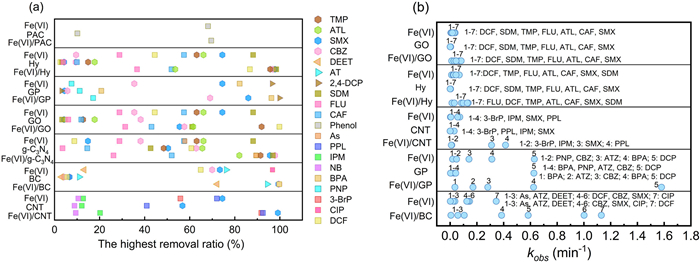
In order to accurately depict the degradation of pollutants in various systems, this review has compiled the most significant degradation rates from different studies as conclusive data for comparative analysis. As seen in Fig. 1a, when BC, GO, GP, Hy, and PAC were used alone to absorb micro-pollutants, the highest absorb efficiency of trimethoprim (TMP), sulfadimethoxine (SDM), flumequine (FLU), caffeine (CAF), atenolol (ATL), phenol, arsenic (As), bisphenol A (BPA), and p-nitrophenols (PNP) were observed to be < 10%. The CMs mentioned above displayed minimal affinity towards these micro-pollutants due to a limited availability of suitable adsorption sites [53-56]. What is more, in Hy, GO, g-C3N4, CNT, BC, GP treated micro-pollutants alone, < 20% of ciprofloxacin (CIP), sulfamethoxazole (SMX), carbamazepine (CBZ), diclofenac (DCF), N,N–diethyl-3-methyl benzoyl amide (DEET), and atrazine (AT) were eliminated [54,57]. Different from the above, the highest absorb efficiency of 3-BrP, SMX, CBZ, DCF, TMP, SDM, FLU, CAF, and ATL were observed to be approximately up to 60% when treated by CNT and g-C3N4 [41,54].
Figure 1
Figure 1.
(a) The highest efficacy of carbon materials (CMs), ferrate [Fe(Ⅵ)], and Fe(Ⅵ)/CMs systems for relevant pollutants degradation. (b) Determined reaction rate constants of relevant pollutants in CMs, Fe(Ⅵ), and Fe(Ⅵ)/CMs systems. Data were derived from Table S2 (Supporting information).
Among these carbon materials, both CNT and g-C3N4 exhibit a higher abundance of pore structures, thereby enhancing their adsorption capacity towards pollutants. However, in a comprehensive analysis when individually subjected to these 7 types of CMs, the efficacy of micro-pollutants removal was limited and necessitates further optimization. In previous studies, the combination of CMs with Fe(Ⅵ) has been employed to enhance electron transport on their surfaces, increased specific surface area and pore volume, and optimize the efficiency of pollutant removal [56,57].
The Fe(Ⅵ) functions as both an oxidizing and coagulating agent, rendering it a versatile reagent for wastewater treatment. The highest utilization of Fe(Ⅵ) alone for oxidation resulted in approximately 80% oxidation efficiencies for CIP, AT, phenol, As, PPL, iopamidol (IPM), BPA, 2,4-dichlorophenol (2,4-DCP), 3-bromophenol (3-BrP), SMX, CBZ, DCF, TMP, SDM, FLU, CAF and ATL, minimizing the production of disinfection byproducts (Fig. 1a) [41,55,58]. The oxidation efficiencies of Fe(Ⅵ) towards micro-pollutants varied depending on their chemical structures [59]. Based on previous studies, it can be observed that Fe(Ⅵ) demonstrated a high efficacy in oxidizing and removing various micro-pollutants including pollutants containing electron-rich functional groups [60].
The resistance of DEET, IPM, PNP, and ATZ against Fe(Ⅵ) oxidation were found to be significant, the highest removal efficiency remained consistently below 10% [61]. For these pollutants which contain electron-deficiency, the oxidation performance of Fe(Ⅵ) alone exhibited relatively lower efficacy, with a comparatively slower reactivity rate [62]. In order to enhance the efficacy of Fe(Ⅵ) in removing these micro-pollutants, extensive research has been conducted on the catalytic activation of Fe(Ⅵ) by CMs [63]. The aforementioned processes can facilitate the generation of a greater amount of Fe(Ⅳ)/Fe(Ⅴ) from Fe(Ⅵ), while also harnessing the H2O2 produced through the self-decomposition of Fe(Ⅵ) to generate active intermediates such as hydroxyl radical (•OH), thereby enhancing the efficacy of micro-pollutants degradation.
Thus, the incorporation of CNT, BC, g-C3N4, GO, and Hy into Fe(Ⅵ) systems have resulted in a significant enhancement of 20%−80% in the removal efficiencies for various micro-pollutants including 3-BrP, SMX, CBZ, DCF, AT, TMP, SDM, PPL, BPA, and 2, 4-DCP during water treatment (Fig. 1a). Notably, the addition of BC and Fe(Ⅵ) to water resulted in the rapid degradation of CIP and DCF, with concentrations dropping below detectable levels within a remarkably short reaction time of 5 min as confirmed by high-performance liquid chromatography (HPLC) analysis. Similarly, in Fe(Ⅵ)/BC systems, SMX and CBZ concentrations decreased below the detection limit within a reaction time of 20 min [41,55,59].
The combination of CMs with Fe(Ⅵ) systems has been previously demonstrated to enhance the efficiency of micro-pollutants removal, accelerate rates of mineralization, and mitigate environmental impact [64]. The surface active functional groups of CMs can facilitate the generation of increased amounts of Fe(Ⅳ)/Fe(Ⅴ) from Fe(Ⅵ), thereby promoting the degradation of micro-pollutants. Following the reaction, there is also an observed increase in both the surface area and void volume of CMs, leading to enhanced adsorption capacity for micro-pollutants [65].
The reaction rate constant serves as further evidence that Fe(Ⅵ)/CMs can effectively enhance the removal of micro-pollutants [66]. The observed rate constants for pseudo-first order reactions in these systems were found to be 3–14 times higher compared to those in the Fe(Ⅵ) alone system, as illustrated in Fig. 1b. The combination of CNT, GP, and BC with Fe(Ⅵ) exhibits the most pronounced enhancement in the rate of pollutant removal among these CMs. The results suggest that the carbon materials' surface may possess a higher abundance of functional groups and active sites, thereby facilitating the generation of more active species and enhancing the oxidation efficiency of pollutants [67]. The enhancement in the removal efficiency can be attributed to the generation of additional reactive species and Fe(Ⅳ)/Fe(Ⅴ), alongside Fe(Ⅵ), within these systems [59]. The findings demonstrated that the presence of CMs expedited the production rate of active species, leading to a significant enhancement in the oxidation and removal efficiency of micro-pollutants in water. Moreover, it was observed that the oxidation rate exhibited a remarkable acceleration.
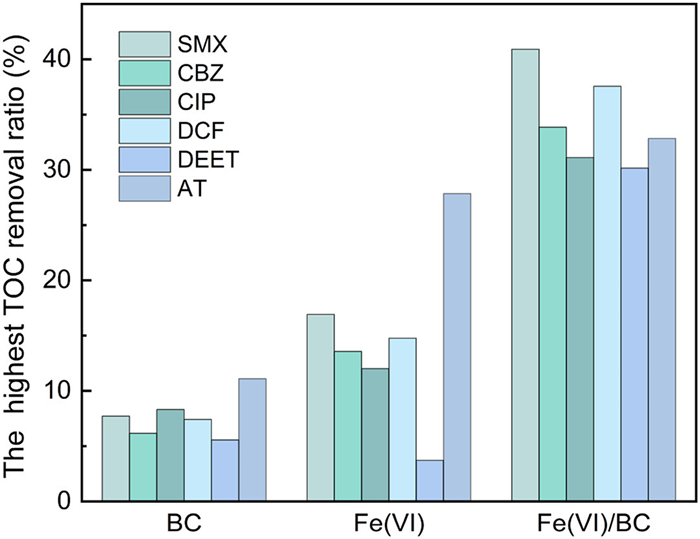
The oxidation process of micro-pollutants in aqueous environments possesses the capacity to produce deleterious compounds [68]. The majority of organics do not undergo natural decomposition and instead accumulate, thereby posing a significant environmental threat [65]. The measurement of total organic carbon (TOC) plays a pivotal role in identifying potential concerns related to water quality safety [69]. The removal of TOC can effectively enhance the microbial stability of treated water [70]. The mineralization efficiency of micro-pollutants by CMs were limited. BC exhibited an average removal efficiency of < 10% for SMX, CBZ, CIP, DCF, DEET, and AT in terms of TOC (Fig. 2). The contribution of adsorption to TOC removal was found to be negligible. Therefore, it is essential to combine CMs with other processes for effective elimination of TOC [56].
Figure 2
Figure 2.
The highest total organic carbon (TOC) removal ratios of relevant pollutants by biochar (BC), Fe(Ⅵ), and Fe(Ⅵ)/BC systems. Data were derived from Table S2.
In the Fe(Ⅵ) treatment system, coagulation frequently led to approximately 20% removal of TOC when treated SMX, CBZ, CIP, DCF. The TOC removal efficiency of DEET in the Fe(Ⅵ) system was < 10%, while the TOC removal efficiency of AT and 3-BrP in the Fe(Ⅵ) system was about 30%, which indicated that Fe(Ⅵ) was selective to the mineralization of micro-pollutants (Fig. 2 and Fig. S1 in Supporting information). The Fe(Ⅵ) oxidation process converts organics into hydroxylated forms, and subsequent adsorption by Fe(Ⅳ)/Fe(Ⅴ) can potentially enhance the removal efficiency of electron-rich micro-pollutants [71]. The application of Fe(Ⅵ) treatment, although limited in efficacy and insufficient for complete decomposition, can be enhanced by the addition of CMs in Fe(Ⅵ) systems to effectively generate more Fe(Ⅳ)/Fe(Ⅴ) species and intermediate active radicals (•OH), thereby improving micro-pollutants mineralization.
In Fe(Ⅵ)/BC system, the SMX treatment resulted in a removal of > 40% of TOC, the CBZ, CIP, DCF, DEET, and AT treatments led to a removal of over 30% of TOC (Fig. 2) [62]. Compared with the systems of Fe(Ⅵ) alone and BC alone, the TOC removal efficiency of Fe(Ⅵ)/CMs was increased about 30%−40% [56]. The mineralization rate of 3-BrP in Fe(Ⅵ)/CNT system is almost up to 60% (Fig. S1). In addition to facilitating the oxidation of micro-pollutants by Fe(Ⅵ), BC and CNT demonstrated an enhanced capacity for the removal of dissolved organics from the system. However, there is a dearth of research on the removal of TOC in systems employing Fe(Ⅵ) with other CMs. Therefore, it is imperative to prioritize investigations into TOC elimination in Fe(Ⅵ)/CMs systems for forthcoming studies.
2.2
Influence factors in Fe(Ⅵ)/CMS systems
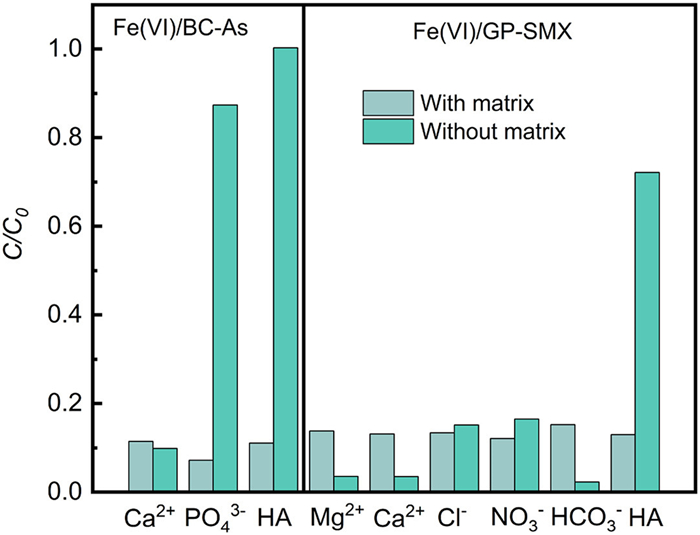
The presence of ions [72] and dissolved organic matter in the actual water sample may potentially impact the efficacy of the Fe(Ⅵ)/CMs system for micro-pollutants removal [73]. When the concentration of calcium (Ca2+) was increased from 0 mmol/L to 10 mmol/L in the Fe(Ⅵ)/BC system, there was no significant alteration observed in the removal efficiency of As (Fig. 3). Previous studies have indicated that Ca2+ exhibits a pronounced affinity towards negatively charged BC, thereby potentially augmenting the adsorption between BC and negatively charged As through neutralization of surface negative charges on the BC [74].
Figure 3
Figure 3.
The influence of matrix on the removal of pollutants in the ferrate [Fe(Ⅵ)]/biochar system and Fe(Ⅵ)/graphite system. Data were derived from Table S3 (Supporting information).
In contrast, the presence of phosphate anion (PO43−) significantly impeded As removal. The addition of 0.1 mmol/L PO43− resulted in a reduction in As removal efficiency to only 15%. This phenomenon can be attributed to the intricate interplay between PO43− and iron oxides, which may influence the formation of iron oxide particles and subsequently hinder As degradation [75]. To investigate the adaptability of the Fe(Ⅵ)/GP system, researchers examined the impact of representative ions, including chloride (Cl−), nitrate (NO3−), bicarbonate (HCO3−), as well as calcium (Ca2+) and magnesium (Mg2+), on SMX removal. Furthermore, it was observed that the introduction of Cl− and NO3− had negligible effects on SMX removal, while HCO3−, Ca2+, and Mg2+ exhibited only slight acceleration in the oxidation process (Fig. 3) [55,62]. The reactivity of the Fe(Ⅵ)/GP system was found to be minimally affected by the concentration of ions, indicating that any observed effects are independent of the ionic strength of the water matrix.
Additionally, in order to investigate the impact of natural organic matter (NOM) on the degradation process in water [76], researchers conducted an examination on the influence of humic acid (HA) on pollutants removal [77]. The findings consistently demonstrated a relatively low efficiency of approximately 16% for As removal, even when varying concentrations of HA ranging from 0 to 2 mg C/L were considered (Fig. 3). Furthermore, it was observed that the increase in HA concentration led to a decrease in the removal efficiency of As [78]. The presence of HA was found to effectively impede the degradation of As in the Fe(Ⅵ)/BC system. The presence of HA enhanced the SMX removal rate by approximately 60% in the GP/Fe(Ⅵ) system, and this constraint became more pronounced with increasing HA dosage. Here, these results can be attributed to two factors: (1) HA, as a representative organic compound in water, exhibits competitive behavior with SMX towards active species; (2) Reducing components such as quinones and phenols present in hyaluronic acid may further facilitate the conversion of Fe(Ⅳ) and Fe(Ⅴ) to Fe(Ⅱ) and Fe(Ⅲ), consequently reducing the concentration of active oxidants [79].
In natural water, a multitude of metallic and nonmetallic ions coexist with targeted pollutants, competing for active oxidants. These ions possess the ability to scavenge radicals, resulting in the generation of other species with diminished oxidation activity or lacking oxidizing properties [80]. These findings underscore the exceptional resilience of Fe(Ⅵ)/CMs systems against abundant ions and highlight their significant potential for practical applications. However, there is a paucity of literature on the effects of NOM in other Fe(Ⅵ)/CMs systems. Future studies should focus on simulating the impact of NOM present in actual wastewater on micro-pollutants removal and analyzing their influencing mechanisms.
3.
Possible mechanisms for enhancing oxidation in the Fe(Ⅵ)/CMS systems
3.1
Active iron species in Fe(Ⅵ)/CMS systems
By considering the compositions of CMs and potential reaction pathways that may occur in CMs, as well as their interaction with Fe(Ⅵ) and micro-pollutants, it is possible to comprehensively evaluate the impact of CMs on the oxidation process of micro-pollutants by Fe(Ⅵ). Studies have demonstrated that the surface of CMs exhibits a high abundance of oxygen-containing functional groups, such as carbonyl and phenolic hydroxyl groups. These functional groups can serve as electron donors, thereby influencing the catalytic performance of CMs in various reactions [81]. With the inclusion of CMs, Fe(Ⅵ) exhibits the potential for undergoing either one-electron or two-electron transfer mechanisms, leading to the generation of either Fe(Ⅴ) or Fe(Ⅳ) [82]. The relevant equations for reactions are included as follows: reactions Eqs. 3-10 [18,31,83].
The Fe(Ⅵ) exhibits the capability to generate active species, such as Fe(Ⅳ)/Fe(Ⅴ), in aqueous solutions. The reaction rate for Fe(Ⅳ)/Fe(Ⅴ) exhibits a significantly higher magnitude, approximately 4–5 orders of magnitude greater than that observed for Fe(Ⅵ). The consumption of Fe(Ⅵ) in the Fe(Ⅵ)/BC system is observed to be the highest (Fig. S2 in Supporting information), indicating that BC effectively enhances the generation of more Fe(Ⅳ)/Fe(Ⅴ) from Fe(Ⅵ). These active species demonstrate a remarkable potential for enhancing the oxidizing capacity towards micro-pollutants [84].
The utilization of sulfoxides as probe substances facilitates the discrimination between various oxidizing agents in radical oxidation and Fe(Ⅵ)-oxidation reactions by exploiting the resultant oxidation products [62]. The successful generation of Fe(Ⅳ)/Fe(Ⅴ) species in the activated Fe(Ⅵ) system has been confirmed through the conversion of methyl phenyl sulfoxide (PMSO) to methyl phenyl sulfone (PMSO2) [58,85]. The highly reactive Fe(Ⅳ)/Fe(Ⅴ) species exhibit the capability to selectively target and oxidize the electron-rich constituents of micro-pollutants [86].
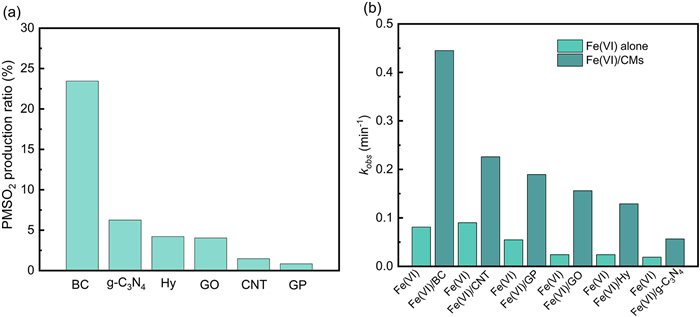
Different studies employ varying concentrations of Fe(Ⅵ) and mass-select CMs when addressing micro-pollutants treatment. To provide a comprehensive overview of the collaborative mechanism between Fe(Ⅵ) and CMs leading to the formation of Fe(Ⅳ)/Fe(Ⅴ), this review quantified the CM per unit mass required to enhance the decomposition of Fe(Ⅵ) into Fe(Ⅳ)/Fe(Ⅴ), as indicated by the rate of PMSO2 generation under this influence [87]. The generation ratio of BC per unit mass during the reaction between Fe(Ⅵ) and PMSO was approximately 23% (Fig. 4a). The reaction rate constants for PMSO with Fe(Ⅵ) and Fe(Ⅵ)/BC were determined to be 0.081 min−1 and 0.445 min−1, respectively (Fig. 4b). Importantly, compared to the Fe(Ⅵ) alone system, the oxidation of PMSO exhibited a significant enhancement by a factor of 5.5 in the presence of BC.
Figure 4
Figure 4.
(a) The production rate of methyl phenyl sulfone (PMSO2) was investigated in different ferrate [Fe(Ⅵ)]/carbon materials (CMs) systems, with each quality of CMs being examined. (b) A comparison between the determined reaction rate constants for the production of PMSO2 in the Fe(Ⅵ) system and the Fe(Ⅵ)/CMs systems. Data were derived from Table S4 (Supporting information).
Additionally, the inclusion of g-C3N4, Hy, and GO as co-additives in the Fe(Ⅵ) systems resulted in respective contributions of 6%, 4%, and 4% to the generation of PMSO2 (Fig. 4a). The Fe(Ⅵ)/CNT and Fe(Ⅵ)/GP systems accounted for < 3% of the PMSO2 generation, respectively. Additionally, the reaction rates observed for PMSO with Fe(Ⅵ)/CNT, Fe(Ⅵ)/GP, Fe(Ⅵ)/GO, Fe(Ⅵ)/Hy, and Fe(Ⅵ)/g-C3N4 were measured at 0.22 min−1, 0.18 min−1, 0.15 min−1, 0.12 min−1, and 0.05 min−1 correspondingly (Fig. 4b) [41,55,59,62]. These findings suggest that the reaction between Fe(Ⅵ) and CMs primarily generate more Fe(Ⅳ)/Fe(Ⅴ) through oxidation, thereby facilitating a higher proportion of conversion from Fe(Ⅵ) to Fe(Ⅴ)/Fe(Ⅳ) [56]. These mechanisms may contribute to the enhanced oxidative degradation of micro-pollutants observed in this system. The utilization of BC and Fe(Ⅵ) system demonstrates a superior capability in generating higher quantities of Fe(Ⅳ)/Fe(Ⅴ) compared to other CMs and Fe(Ⅵ) systems, thereby resulting in an enhanced efficiency for pollutants removal. This finding aligns with the earlier summarized experimental outcomes.
3.2
Active radicals in Fe(Ⅵ)/CMS systems
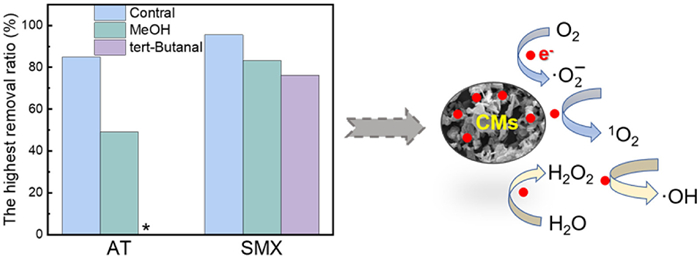
Methanol (MeOH) and tert–butanol (TBA) were used as quenchers to quench •OH (kTBA/·OH = 6 × 10⁸ L mol−1 s−1) [88-90]. The addition of MeOH and TBA to the Fe(Ⅵ)/BC pollutants degradation system resulted in a reduction of 10%−40% in the removal rate of pollutants, as depicted in Fig. 5 [56,62]. The addition of BC in Fe(Ⅵ) system facilitated the generation of these highly reactive radicals [91]. In simpler terms, the presence of CMs enhanced the oxidation efficiency by elevating the levels of intermediate Fe(Ⅵ) and promoting the generation of additional •OH. This implies that in Fe(Ⅵ)/CMs systems can effectively produce both Fe(Ⅳ)/Fe(Ⅴ) species and active radicals, thereby facilitating direct oxidation of micro-pollutants (Fig. 6) [92].
Figure 5
Figure 5.
Oxidation of AT and SMX by ferrate/biochar with methanol (MeOH) or tert–butanol. Plausible radical species in ferrate/carbon materials systems. Data were derived from Table S5 (Supporting information).
Figure 6.
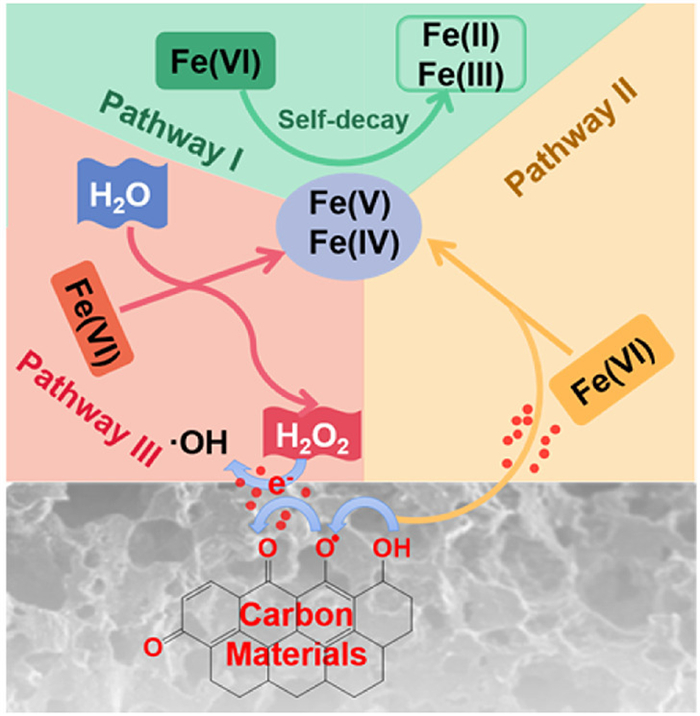
The self-decomposition of ferrate [Fe(Ⅵ)] (pathway Ⅰ) and the oxidation reactions between Fe(Ⅵ) and surface functional groups of carbon materials (pathway Ⅱ and pathway Ⅲ).
The CMs containing reducing groups, such as the hydroxyl groups in phenol, undergo oxidation leading to their conversion into carboxyl groups [93]. Electron transfer occurring on the surface of carbon materials facilitated the conversion of oxygen to •O2− into 1O2 and phenolic hydroxyl radicals, thereby facilitating the degradation of micro-pollutants (Fig. 5). To further elucidate the degradation mechanisms in diverse systems, electron spin resonance (EPR) spectra can be employed for comprehensive analysis of reactive oxygen species (ROS) [94]. The EPR spectrum of the DMPO-spiked sample exhibited distinct peaks, indicative of the generation of both •OH and •O2− (Figs. S4a and b in Supporting information). However, the utilization of this technology for detecting active species in Fe(Ⅵ)/CMs systems is limited in current studies. Therefore, it is imperative to employ more relevant technical approaches to validate the exploration process of the mechanism in future research.
The proportions of aliphatic and graphitic structures remained relatively stable on CMs throughout the process, with no significant changes observed. Additionally, a decrease in the relative intensity of phenolic hydroxyl groups on BC from 20.46% to 15.46% was noted. It was noteworthy that there was a modest increase of 2% in the relative intensity of carboxylic groups (Fig. S3 in Supporting information) [95]. The self-decomposition of Fe(Ⅵ) can generate H2O2 and the presence of PFRs on CMs can amplify the concentration of •OH in the reaction system when reacting with H2O2, thereby enhancing the oxidation capacity towards micro-pollutants in Fe(Ⅵ)/CMs systems [96].
The interaction mechanism between Fe(Ⅵ) and CMs can be categorized into three distinct pathways, as illustrated in Fig. 6. In pathway one, Fe(Ⅵ) directly oxidizes pollutants, leading to the formation of Fe(Ⅱ), which subsequently reacts with Fe(Ⅵ) to generate both Fe(Ⅲ) and Fe(Ⅴ). During the process of self-decomposition, rapid iron transformation occurs, resulting in the production of Fe(Ⅳ)/Fe(Ⅴ) species that effectively oxidize pollutants and ultimately form a floc containing Fe(Ⅱ)/Fe(Ⅲ). In pathway 2, the electron-rich aromatic moiety of the CMs can donate electrons to Fe(Ⅵ), thereby facilitating the generation of highly reactive intermediate iron species [Fe(Ⅴ) and Fe(Ⅳ)] within the system. For instance, it has been reported that BC, possessing a phenolic structure, functions as an electron shuttle within the Fe(Ⅵ)-BC system. Consequently, the Fe(Ⅵ) and BC systems exhibit the generation of phenolic hydroxyl radicals [41]. In pathway 3, Fe(Ⅵ) can also undergo a reaction with H2O to generate Fe(Ⅳ) and H2O2. Additionally, PFRs on biochar have the capability to react with H2O2, thereby elevating the •OH concentration in the reaction system and consequently enhancing the oxidative potential towards pollutants [97].
4.
Activation of CMs
4.1
Chemical properties and microscopic morphology changes in Fe(Ⅵ)/CMS systems
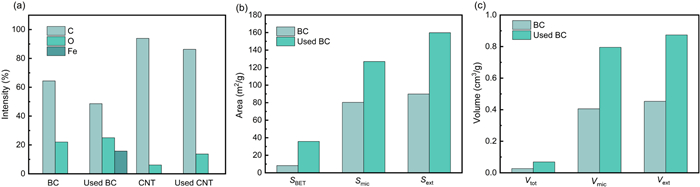
The chemical properties of CMs were investigated in preliminary studies, both before and after the reaction with Fe(Ⅵ). The unprocessed BC exhibited a predominantly spherical morphology and consisted primarily of carbon and oxygen elements [98]. After the reaction, the C element content of raw BC decreased from 82% to 78% (Fig. 7a). The proportions of O and Fe consequently increased from 0% to 0.55% and 17% to 20%, respectively. There was a significant decrease in the percentage of C−O/C−O−C and disappearance of the characteristic peak attributed to C–OH, while the relative intensity of O−C−O exhibited a substantial increase. These observations suggest active involvement of these functional groups in the reaction process, with Fe(Ⅵ) serving as an oxidizing agent for phenols and alcohols on biochar, leading to their conversion into carboxylic acids. Previous studies have revealed that BC suspension has the capability to generate persistent free radicals and reactive oxygen species (ROS), including •OH and singlet oxygen (1O2), which exhibit potential for micro-pollutants removal [84,99].
Figure 7
Figure 7.
(a) The determination of atomic concentration and chemical state in both initial carbon materials as well as exhausted carbon materials. (b) The comparison of surface area between the original biochar (BC) and the utilized BC. (c) The changes in pore volume between the initial BC and the used BC. Data were derived from Table S6 (Supporting information).
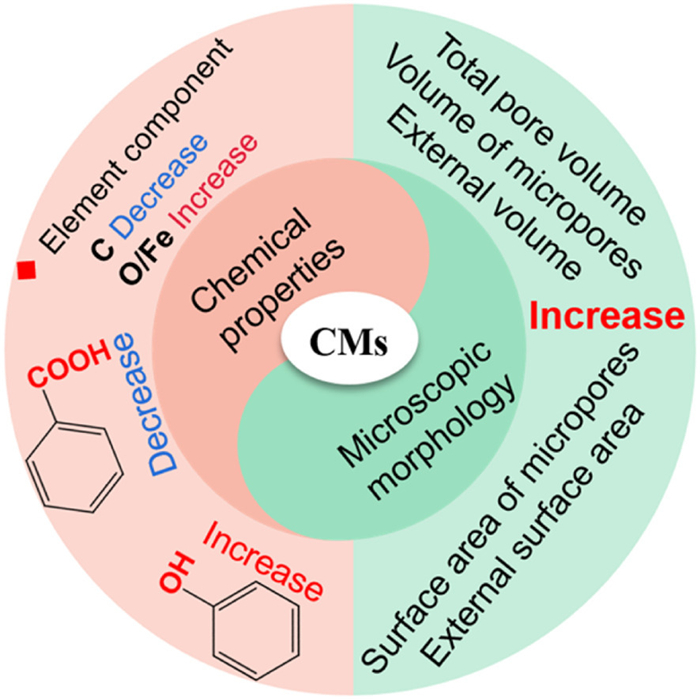
The proportion of phenolic hydroxyls on the BC decreased by 5% post-reaction, while there was a 2% increase in the relative intensity of carboxylic groups. This indicated that the electron-donating -OH reacts with Fe(Ⅵ) for conversion into the carboxylic group while promoting intermediate valence iron production The relative proportions of aliphatic and aromatic structures on the BC remained unchanged following its reaction with Fe(Ⅵ). The researchers demonstrated that the interaction between Fe(Ⅵ) and BC led to a conversion of reduction functional groups, such as phenolic hydroxyl, into oxidation functional groups, specifically carboxylic groups. What's more, the combination of Fe(Ⅵ) and CMs enhances the degree of graphitic structure in the CMs (Fig. S3). Previous studies have revealed that the graphitic structure of CMs is beneficial for improving electron conductivity [100]. Similarly, comparable effects were observed in the Fe(Ⅵ)/CNT system. The presence of electron-rich aromatic components in CMs may facilitate the generation of highly reactive Fe(Ⅳ)/Fe(Ⅴ) species in solutions.
These reactive species effectively oxidize phenolic hydroxyl groups on CMs, resulting in the formation of graphitic structures, aliphatic structures, and carboxylic groups. This process can be considered as a form of "chemical activation, " wherein Fe(Ⅵ), Fe(Ⅴ), and Fe(Ⅳ) species induce alterations in the physical structure of CMs, leading to an expanded surface area and increased pore volume. Consequently, these enhancements contribute significantly to the improved removal of TOC within these systems.
The combination of Fe(Ⅵ) with CMs induces alterations in their physical properties [101]. Upon analyzing the disparities in micro-structure between raw and spent BC, a noticeable increase in surface area (SBET) was observed, with values rising from 90 m2/g to 160 m2/g. The micro-pore surface area (Smic) experienced a significant enhancement, exhibiting an impressive improvement of fourfold as it increased from 9.1 m2/g to 35.9 m2/g. Furthermore, there was growth in the external surface area (Sext), which saw an impressive boost of 57%, increasing from 81 m2/g to 127 m2/g (Fig. 7b). The total pore volume (Vtot) of the BC increased from 0.46 cm3/g to 0.88 cm3/g following its reaction with Fe(Ⅵ). This increase was observed in both the micropore volume (Vmic), which rose from 0.033 cm3/g to 0.076 cm3/g, and the external volume (Vext), which increased from 0.41 cm3/g to 0.8 cm3/g (Fig. 7c). The surface area and pore volume of the BC were observed to increase, which could potentially enhance its capacity for adsorbing micro-pollutants [41,54,56,59,102]. The ferric oxides exhibited good dispersion on the high surface area and pore volume of BC, thereby providing abundant active sites for pollutants adsorption.
Moreover, in the presence of g-C3N4, Fe(Ⅵ) can induce additional reactions due to its higher reduction potential compared to g-C3N4 under alkaline conditions. This phenomenon occurs as Fe(Ⅵ) acts as an electron trap, facilitating electron capture and subsequent generation of Fe(Ⅴ), leading to the formation of Fe(Ⅳ) species and ultimately resulting in the synthesis of Fe(OH)3 [103]. The reactivity of Fe(Ⅴ) and Fe(Ⅳ) species towards H2O2 and •O2− surpasses that of Fe(Ⅵ), demonstrating variations across multiple orders of magnitude [83].
After exposure to Fe(Ⅵ), a decrease in the functional groups of Hy, including C/O, was observed based on the Fourier transform infrared spectroscopy (FTIR) data [59]. The high C/O ratio with high electrical conductivity, allowing long-range electron transfer at up to three times the electron transfer rate in redox reactions [104]. The presence of functional groups on the Hy surface implies an interaction with Fe(Ⅵ), thereby suggesting a potential mechanism for the removal of micro-pollutants. FTIR analysis revealed that exposure to Fe(Ⅵ) led to the depletion of functional groups on the Hy. The implication of this observation is that a chemical reaction took place between the functional groups present on the surface of Hy and Fe(Ⅴ) (Fig. 8) [105].
Figure 8
Figure 8.
The microscopic morphological changes and elemental composition variations of carbon materials before and after reaction with ferrate.
The reaction between Fe(Ⅵ) and CNT is expected to proceed rapidly, resulting in the formation of Fe(Ⅳ)/Fe(Ⅴ). It is plausible that the phenolic hydroxyl groups present on the surface of CNT undergo a chemical reaction with Fe(Ⅵ), leading to the generation of Fe(Ⅳ)/Fe(Ⅴ) [106]. The generation of Fe(Ⅳ) and Fe(Ⅵ) results in the formation of Fe(Ⅴ), indicating the presence of a primary active site on the surface-bound carbonyl functional group, as evidenced by the observed reduction in size of this group upon exposure to Fe(Ⅵ) [55]. The results unequivocally demonstrate the pivotal role played by surface functional groups in activating Fe(Ⅵ) to generate Fe(Ⅳ)/Fe(Ⅴ) [59].
In previous studies, it was observed that the ferric particles formed in the Fe(Ⅵ) treatment group exhibited a prolonged aggregation time (> 6 h), whereas the particles formed in the Fe(Ⅵ)/BC system demonstrated enhanced settling efficiency. Furthermore, it is noteworthy that the average size of both ferric (hydr)oxides and BC particles remained relatively constant throughout the reaction process. However, when Fe(Ⅵ) was combined with BC, there was a significant increase in the average particle size to 2.4 µm within 60 min, which was approximately 14.6 times larger than that observed in the Fe(Ⅵ) alone group and 2.2 times larger than that observed in the BC alone group [62]. The adsorption capacity of CMs for pollutants is significantly enhanced, as it forms complexes with ferric (hydr)oxides and becomes dispersed on the surface of CMs, resulting in an increase in the hydrodynamic size of the particles formed.
4.2
Characterization methods of CMs
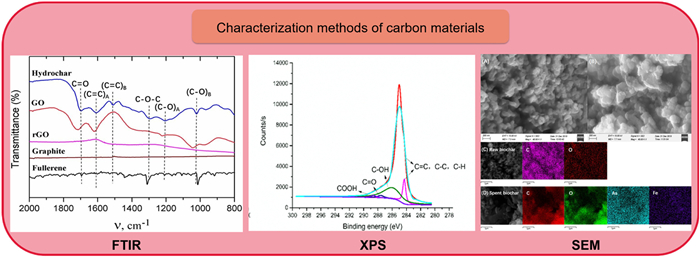
After the reaction of Fe(Ⅵ) with CMs, various approaches were employed to characterize the physical and chemical changes pre- and post-reaction of CMs, aiming to comprehensively investigate the impact of Fe(Ⅵ) on CMs activation [107,108]. The chemical properties of BC were analyzed using X-ray photoelectron spectroscopy (XPS) before and after its interaction with Fe(Ⅵ) [109]. The C 1s photoelectron spectrum of BC was examined to investigate the variation in functional groups before and after the reaction. The C 1s photoelectron spectrum of BC exhibited four distinct sub-peaks corresponding to graphitic structures, aliphatic structures, phenolic hydroxyl groups, and carboxylic groups (Fig. 9).
Figure 9
Figure 9.
Characterization methods of carbon materials including X-ray photoelectron spectroscopy (XPS), fourier transform infrared spectroscopy (FTIR), and scanning electron microscopy equipped with energy dispersive X-ray spectroscopy (SEM-EDX). Reprinted with permission [62]. Copyright 2021, Elsevier.
XPS analysis was employed to evaluate the impact of Fe(Ⅵ) oxidation on the chemical properties of BC by examining the oxygen content before and after the reaction with Fe(Ⅵ). Additionally, XPS analysis was performed for utilized g-C3N4 samples as well [110]. The results indicate that g-C3N4 effectively adsorbs the Fe(Ⅲ) oxide generated by reducing Fe(Ⅵ). XPS measurements reveal a reduction in the carbonyl functional group on GP surface after exposure to Fe(Ⅵ), suggesting its potential as the primary active site [111].
The surface functional groups of pristine and pre-oxidized CNT were analyzed using fourier transform infrared spectroscopy (FTIR) [112]. The FTIR analysis revealed a reduction in phenolic hydroxyl groups on the pre-oxidized CNT surface, accompanied by an increase in carboxyl groups [113]. The changes in surface functional groups of BC were investigated via FTIR analysis before and after undergoing a reaction. A significant increase in the intensity of the -OH stretching vibration peak was observed, indicating the presence of Fe-OOH loaded onto the BC's surface post-reaction.
Additionally, characterization utilizing FTIR spectroscopy exhibited no discernible discrepancies in the spectra of fresh and used g-C3N4 samples, thereby confirming their exceptional structural stability [110]. The Fe(Ⅵ)/g-C3N4 system was employed to investigate the photo-catalytic activity of the catalyst for micro-pollutants degradation. The FTIR results revealed a reduction in specific functional groups (such as C—O) on the CMs after exposure to Fe(Ⅵ), indicating a reaction between Fe(Ⅵ) and surface functional groups of CMs.
The microscopic morphology and elemental composition of both raw CMs and spent CMs were examined using scanning electron microscopy equipped with energy dispersive X-ray spectroscopy (SEM-EDX) analysis [114,115]. The observed trends in element variations detected through EDX analysis were found to be consistent with those identified via XPS analysis [116]. The microscopic morphology and elemental distribution on BC were investigated using SEM-EDX analysis. According to the EDX spectrum, the C/O ratio in raw BC was determined to be 4.75, which decreased to 1.97 in used BC (Fig. 7a). This observation suggests a significant increase in oxygen content after reacting with Fe(Ⅵ), enhance electron transforming, leading to increased generation of active species. Such enhancement can be attributed to the presence of oxygen-containing functional groups on CMs as well as the adsorption of Fe(Ⅵ) oxides and micro-pollutants onto its surface [117].
The Brunauer-Emmett Teller (BET) method analysis was employed to investigate the adsorption capacity of untreated CMs and CMs after utilization [118]. The surface area of the utilized BC exhibited a 2.9-fold increase compared to its initial form. The findings revealed that the utilized BC demonstrated a larger surface area and wider average pore width in comparison to its raw state, along with a higher concentration of micro-pollutants. This enhancement in surface area and pore volume provides ample active sites for reactions occurring at the surface or interface, thereby improving the adsorption performance of CMs towards micro-pollutants.
4.3
Reusability of the spent CMs
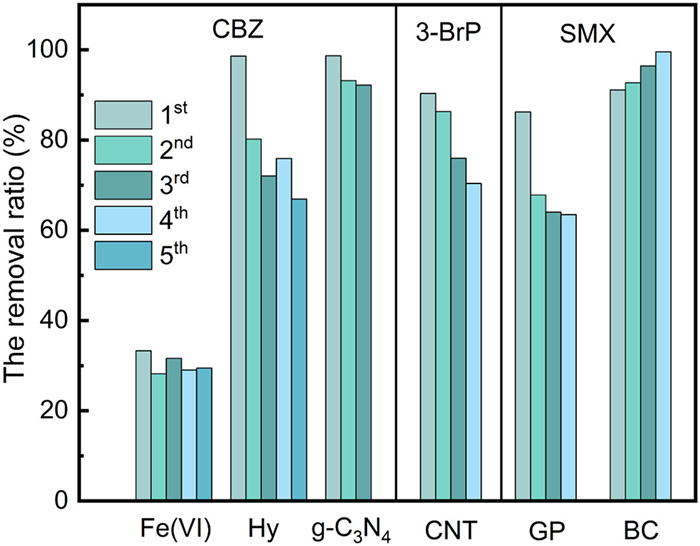
After the reaction with Fe(Ⅵ), the CMs utilized in the process were consistently collected for potential reutilization in Fe(Ⅵ) oxidation. It is noteworthy that discarded BC exhibits a more pronounced impact on expediting contaminant oxidation compared to raw BC. The incorporation of used BC into the Fe(Ⅵ)/BC system significantly enhances the rate at which micro-pollutants were removed [59]. The duration of complete oxidation decreased progressively with each successive recycling of the BC, reaching 10 min in the third cycle and only 5 min in the fourth [56].
Additionally, the g-C3N4 system exhibited remarkable efficiency and maintained a high level of stability throughout three subsequent cycles, with only a marginal decrease of 4% in micro-pollutants removal (Fig. 10) [119]. The surface of used CMs can adsorb Fe(Ⅵ) self-decomposition products, such as Fe(Ⅲ) floc. According to published researches, it has been observed that Fe(Ⅲ) oxides exhibit surface reactivity in facilitating the decomposition of Fe(Ⅵ), while potentially enhancing the decomposition of Fe(Ⅵ) and resulting in the formation of Fe(Ⅴ) [120]. The adsorption of intermediate valence ferrite compounds is commonly observed on the surface of CMs.
Figure 10
Figure 10.
The reusability effectiveness of ferrate and diverse carbon materials for the treatment of various pollutants. Data were derived from Table S6 (Supporting information).
The repeatability of GP, CNT, and Hy demonstrates a diminishing trend after undergoing four or five cycles (Fig. 10). The efficiency of micro-pollutants removal in the Fe/GP, Fe/CNT, and Fe/Hy systems consistently remained higher compared to that of the Fe(Ⅵ) process after undergoing four or five reaction cycles. This observation suggests that integrating used GP, CNT, and Hy with Fe(Ⅵ) offers a sustainable solution for remediating micro-pollutants [41,54–56,59,106]. Based on the findings, it was observed that recycled CMs possess the capability to continuously generate reactive Fe(Ⅳ)/Fe(Ⅴ) species or •OH in the presence of Fe(Ⅵ). Among these seven CMs, only BC exhibited an enhanced removal rate of pollutants upon reuse. This observation underscores the promising potential of Fe(Ⅵ)/BC system in practical engineering applications, offering a cost-effective solution.
5.
Moving forward
This review aims to provide a comprehensive summary of the potential reactivity between various CMs and Fe(Ⅵ). The generation of Fe(Ⅴ) and Fe(Ⅳ) can enhance the oxidation of micro-pollutants by Fe(Ⅵ), with both species exhibiting significantly higher reactivity compared to Fe(Ⅵ). Notably, the extent of enhanced micro-pollutants removal is dependent on the structure (or moieties) of these micro-pollutants, which must undergo significant reaction with Fe(Ⅳ)/Fe(Ⅴ) to induce such an augmented effect facilitated by CMs. These systems can also generate a higher quantity of active radicals that effectively facilitate the removal of micro-pollutants. Consequently, these generated free radicals (•OH and •O2−) can be utilized for oxidizing and decomposing organics into harmless substances that can be safely eliminated from the environment.
The reaction of CMs with Fe(Ⅵ) resulted in a significant increase in specific surface area and void volume, accompanied by a decrease in hydroxyl groups and an increase in carboxyl groups on the surface, as well as enhanced graphitization. The final product of the decomposition of Fe(Ⅵ) (Fe(Ⅲ) floc) will be adsorbed onto the surface of the CMs. The observed changes suggest that the activation of Fe(Ⅵ) leads to an increase in the number of adsorption sites on the surface of CMs, thereby enhancing the efficiency of pollutant adsorption. Among the seven CMs summarized, Fe(Ⅵ)/BC system show more obvious advantages, and the research on BC should be strengthened in the future research.
However, the current researches on the combined system of Fe(Ⅵ)/CMs still exhibits certain limitations and necessitates further improvement in the following aspects:
(1) Enhanced efforts are imperative for the development of recyclable CMs. The advancement of high specific surface area, exceptional mechanical properties, and superior thermal stability in CMs are pivotal for their diverse applications alongside Fe(Ⅵ). In comparison to conventional methods, the utilization of Fe(Ⅵ)/CMs systems can result in reduced operational and management costs. However, with repeated use of CMs, there is a significant decline in micro-pollutants removal efficiency, necessitating improvements in their reusability.
(2) The role of Fe(Ⅵ) as an activator for CMs, promoting the generation of more active sites and subsequent oxidation of organic molecules, remains uncertain. It is crucial to consider the potential influence of other factors on the activation of CMs by Fe(Ⅵ). For instance, the presence of other transition metals or inherent characteristics in CMs themselves may significantly impact the extent of activation and subsequent oxidation.
(3) The reactivity in Fe(Ⅵ)/CMs systems can also be influenced by environmental conditions, such as pH levels or the presence of other chemical species. Therefore, it is crucial to further investigate the mechanism underlying the interactions between Fe(Ⅵ) and CMs in real water for future studies.
In conclusion, Fe(Ⅵ) evidently exhibits the capability to interact with CMs and augment their reactivity. Revealing the precise mechanisms involved and elucidating the roles played by various factors remain essential areas for further investigation.
Declaration of competing interest
The authors declare that they have no known competing financial interests or personal relationships that could have appeared to influence the work reported in this paper.
CRediT authorship contribution statement
Xin Dai: Writing – review & editing, Writing – original draft, Visualization, Investigation, Formal analysis, Data curation. Tong Liu: Writing – original draft, Data curation. Ye Du: Writing – review & editing, Supervision, Conceptualization. Jie-Yu Cao: Data curation. Zhong-Juan Wang: Visualization. Jie Li: Visualization. Peng Zhou: Writing – review & editing. Heng Zhang: Writing – review & editing. Bo Lai: Writing – review & editing.
Acknowledgment
This study was supported by the National Natural Science Foundation of China (Nos. 52170044 and 52070133).
Supplementary materials
Supplementary material associated with this article can be found, in the online version, at doi:10.1016/j.cclet.2024.110548.
[1]
Y. Gao, P. Champagne, D. Blair, et al., Water Sci. Technol. 81 (2020) 853–875. doi: 10.2166/wst.2020.190
[2]
Y. Liu, F. Li, Y. Zhang, et al., Water Cycle 4 (2023) 145–153. doi: 10.1117/12.2667868
[3]
H. Li, Y. Mo, L. Wang, et al., Water Cycle 4 (2023) 79–86.
[4]
B. Song, C. Zhou, M. Qin, et al., J. Environ. Manage. 345 (2023) 118518.
[5]
H. Lei, K. Yao, B. Yang, et al., Front. Env. Sci. Eng. 17 (2022) 46. doi: 10.3390/nano13010046
[6]
M. Baratta, A.V. Nezhdanov, A.I. Mashin, et al., Sci. Total Environ. 924 (2024) 171578. doi: 10.1016/j.scitotenv.2024.171578
[7]
K. Zhang, X. Liu, Y. Wang, et al., Water Air Soil Poll. 235 (2024) 162.
R. Zheng, Z. Xu, Q. Qiu, et al., Environ. Res. 244 (2024) 117849.
[118]
Y. Luo, L. Zeng, Y. Zhao, et al., J. Water Process. Eng. 47 (2022) 102743.
[119]
B. Pan, L. Zhou, J. Qin, et al., Chemosphere 307 (2022) 135886.
[120]
J. Li, Y. Du, E. Zhao, et al., Chem. Eng. J. 461 (2023) 141832.
Figure 1
(a) The highest efficacy of carbon materials (CMs), ferrate [Fe(Ⅵ)], and Fe(Ⅵ)/CMs systems for relevant pollutants degradation. (b) Determined reaction rate constants of relevant pollutants in CMs, Fe(Ⅵ), and Fe(Ⅵ)/CMs systems. Data were derived from Table S2 (Supporting information).
Figure 2
The highest total organic carbon (TOC) removal ratios of relevant pollutants by biochar (BC), Fe(Ⅵ), and Fe(Ⅵ)/BC systems. Data were derived from Table S2.
Figure 3
The influence of matrix on the removal of pollutants in the ferrate [Fe(Ⅵ)]/biochar system and Fe(Ⅵ)/graphite system. Data were derived from Table S3 (Supporting information).
Figure 4
(a) The production rate of methyl phenyl sulfone (PMSO2) was investigated in different ferrate [Fe(Ⅵ)]/carbon materials (CMs) systems, with each quality of CMs being examined. (b) A comparison between the determined reaction rate constants for the production of PMSO2 in the Fe(Ⅵ) system and the Fe(Ⅵ)/CMs systems. Data were derived from Table S4 (Supporting information).
Figure 5
Oxidation of AT and SMX by ferrate/biochar with methanol (MeOH) or tert–butanol. Plausible radical species in ferrate/carbon materials systems. Data were derived from Table S5 (Supporting information).
Figure 6
The self-decomposition of ferrate [Fe(Ⅵ)] (pathway Ⅰ) and the oxidation reactions between Fe(Ⅵ) and surface functional groups of carbon materials (pathway Ⅱ and pathway Ⅲ).
Figure 7
(a) The determination of atomic concentration and chemical state in both initial carbon materials as well as exhausted carbon materials. (b) The comparison of surface area between the original biochar (BC) and the utilized BC. (c) The changes in pore volume between the initial BC and the used BC. Data were derived from Table S6 (Supporting information).
Figure 9
Characterization methods of carbon materials including X-ray photoelectron spectroscopy (XPS), fourier transform infrared spectroscopy (FTIR), and scanning electron microscopy equipped with energy dispersive X-ray spectroscopy (SEM-EDX). Reprinted with permission [62]. Copyright 2021, Elsevier.
Figure 10
The reusability effectiveness of ferrate and diverse carbon materials for the treatment of various pollutants. Data were derived from Table S6 (Supporting information).



 DownLoad:

 下载:
下载:



