

Scheme 1.
Classical methods toward S-aryl dithiocarbamates.


Considering the widespread presence of the dithiocarbamate skeleton in pharmaceuticals and bioactive molecules, the development of novel and convenient methods for the synthesis of these useful sulfur-containing compounds is of significant interest. Traditionally, S-aryl dithiocarbamates are constructed through the reaction of amines with thiophenols and thiophosgene [1]. Recently, transition-metal-catalyzed Ullmann-type coupling between aryl boronic acids or iodoarenes with tetraalkylthiuram disulfides or sodium dialkyldithiocarbamates has been reported [2]. The multicomponent reactions (MCRs) can minimize the pollution and reduce the cost, and can effectively improve the atomic economy and step economy of the reaction process, which has attracted extensive attention [3-5]. In recent years, the synthesis of S-aryl dithiocarbamates based on MCRs tandem reaction has been greatly developed (Scheme 1) [2]. Although many methods have been reported, the development of an alternative approach to S-aryl dithiocarbamates with high efficiency and generality is still of great research significance.
In 2019, Ritter et al. developed an efficient method for the synthesis of aryl thianthrenium salts through a site-selective C—H thianthrenation process [6]. After that, various chemical transformations using thianthrenium salts as aryl sources have been greatly developed. Because thianthrenium salts can be directly converted from arenes by C—H thianthrenation, thus these methods also indirectly realizes the aryl C—H bond functionalization.
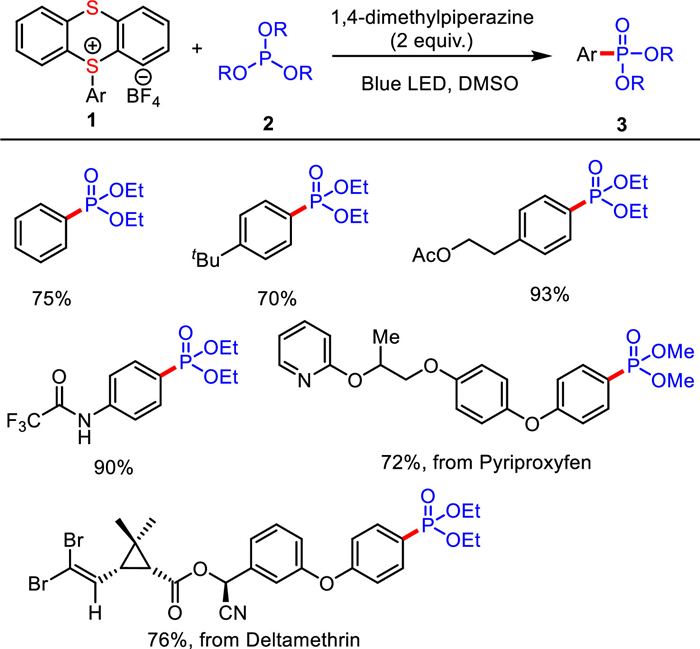
In 2023, Yang from College of Chemistry and Molecular Engineering, at Qingdao University of Science and Technology reported a simple and sustainable strategy for the synthesis of aryl phosphonates via visible-light-induced single electron transfer process of an EDA complex between thianthrenium salts and phosphites (Scheme 2) [7]. The aryl phosphonates were obtained in good to excellent yields. This developed method indirectly realizes the construction of aryl phosphonates through site-selective C—H functionalization of arenes, which has potential application value in drug development and discovery.
Very recently, Yang and co-workers demonstrated an eco-friendly and efficient method for the synthesis of S-aryl dithiocarbamates via visible-light-induced SET process of an EDA complex between thianthrenium salt functionalized arenes and dithiocarbamate anions under mild aqueous micellar conditions (Scheme 3) [8]. Various aryl thianthrenium salts which were directly synthesized from diverse arenes reacted efficiently with carbon disulfide and secondary amines, affording the target products in moderate to excellent yields. In addition, the present photochemical reaction tolerated an array of structurally and electronically diverse aryl thianthrenium salts. The method was also applied to the late-stage functionalization of pharmaceuticals or their derivatives.

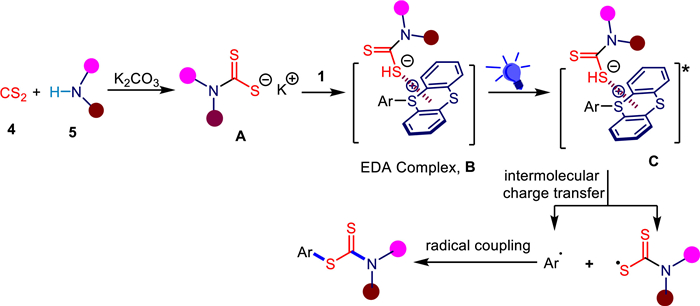
In order to better understand the mechanism of this reaction, some preliminary experiments including radical trapping experiment, EDA complex determination, and 1H NMR titration experiments by Yang and co-workers. As shown in Scheme 4, dithiocarbamate anion A is obtained through nucleophilic addition reaction between carbon disulfide 4 and amines 5 in the presence of K2CO3. Then, the electron-poor aryl thianthrenium salt 1 and the electron-rich dithiocarbamate anion A associates to generate an EDA complex B. Upon irradiation with visible-light, a SET (single electron transfer) transformation from A to 1delivers a thiyl radical E and an aryl radical D. Finally, the thiyl radical E couples with aryl radical D, affording the desired product 6.
In conclusion, Yang and co-workers have developed an efficient visible-light-induced EDA complex process for the synthesis of S-aryl dithiocarbamates under mild aqueous micellar conditions. The corresponding products were obtained in moderate to good yields with excellent functional group tolerance. This protocol affords a promising synthesis candidate for the synthesis of S-aryl dithiocarbamates.
The authors declare that they have no known competing financial interests or personal relationships that could have appeared to influence the work reported in this paper.
Rong-Nan Yi: Writing – original draft.Wei-Min He: Writing – review & editing.
W. Xu, F. Gao, Z.B. Dong, Eur. J. Org. Chem. 2018 (2018) 821–828. doi: 10.1002/ejoc.201701757
M.Y. Gao, W. Xu, S.B. Zhang, et al., Eur. J. Org. Chem. 2018 (2018) 6693–6698. doi: 10.1002/ejoc.201801271
K.L. Wang, H.T. Ji, L.J. Ou, W.M. He, Eur. J. Org. Chem. 26 (2023) e202300752.
M. He, P. Zhong, H. Liu, et al., Green Synth. Catal. 4 (2023) 41–45. doi: 10.1016/j.gresc.2022.03.002
S. Mu, H. Li, Z. Wu, et al., Chin. J. Org. Chem. 42 (2022) 4292–4299. doi: 10.6023/cjoc202211002
F. Berger, M.B. Plutschack, J. Riegger, et al., Nature 567 (2019) 223–228. doi: 10.1038/s41586-019-0982-0
H. Xu, X. Li, Y. Dong, et al., Org. Lett. 25 (2023) 3784–3789. doi: 10.1021/acs.orglett.3c01303
H. Xu, X. Li, J. Ma, et al., Chin. Chem. Lett. 34 (2023) 108403. doi: 10.1016/j.cclet.2023.108403

Scheme 3 An electron donor-acceptor photoactivation strategy for the synthesis of S-aryl dithiocarbamates using thianthrenium salts.

 扫一扫看文章


扫一扫关注我们
 DownLoad:

 下载:
下载:

