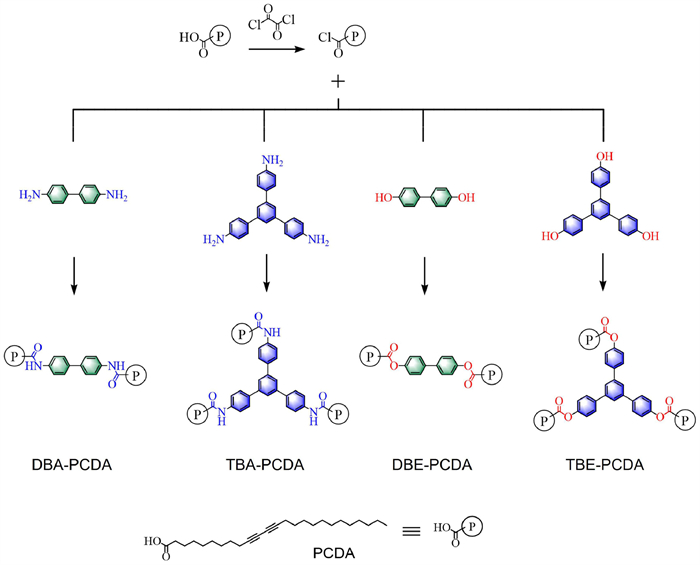
Figure 1.
Schematic of the synthesis of DBA-PCDA, TBA-PCDA, DBE-PCDA and TBE-PCDA.

Novel high-temperature thermochromic polydiacetylene material and its application as thermal indicator
Zhiqing Ge , Zuxiong Pan , Shuo Yan , Baoying Zhang , Xiangyu Shen , Mozhen Wang , Xuewu Ge


Reversible thermochromic materials have extensive and important applications in the field of intelligent temperature indication [1-6]. Generally, thermochromic materials include inorganic and organic categories. Compared with inorganic thermochromic materials, organic reversible thermochromic materials have the advantages of wide temperature range, high sensitivity and easy processing [7], but limited by the structural characteristics of organic compounds, usually have low color-changing temperatures (commonly lower than 100 ℃) and poor thermal stability at high temperature. Until now, the development of high-temperature organic reversible thermochromic materials remains a challenging issue in this field.
Polydiacetylene (PDA) is a class of conjugated organic polymers with alternating ene‑yne units on the backbone. When exposed to external stimuli such as heat [8-10], electric current [11-14], ions [15-17], biomolecules [18,19], PDA will gradually change from blue to red, therefore, it has become one of the research hotspots in the field of responsive color-changing materials in recent years. PDAs can be easily synthesized via solid polymerization of diacetylene monomers under the irradiation of 254-nm UV light for several minutes, and their properties are closely related to the chemical and aggregation structure of the monomers [20,21]. Numerous studies have shown that the introduction of aromatic and/or the hydrogen-bond-forming groups into the monomer molecule can change the intermolecular interaction and the spatial arrangement of monomers, and further affect the polymerization properties of monomers and the thermochromic temperature of the corresponding PDAs. 10,12-Pentacosadiynoic acid (PCDA) is a most commonly diacetylene monomers, and poly(PCDA) obtained by photo-initiated solid polymerization will undergo an irreversible blue-to-red color change at 65 ℃. However, Zhang et al. [22] obtained a new diacetylene monomer (Bip-DA) through the reaction between PCDA and 4′‑hydroxy-4-biphenylcarboxylic acid. The blue polymerization product poly(Bip-DA) changes to red at 90 ℃, but it can change back to blue when cooled to 20 ℃. Lee et al. [23] obtained a diacetylene monomer (Bis-PCDA-pH) containing two diacetylene units through the esterification reaction between PCDA and hydroquinone. The thermochromic temperature of the corresponding poly(Bis-PCDA-pH) could be raised to 100 ℃, the color returns to blue after cooling. Phollookin et al. [24] obtained a doubly substituted diacetylene monomer (EB-6,8–19DA) through the reaction between ethylenediamine with 8,10-nonadecadiynoic acid, and the corresponding poly(EB-6,8–19DA) also has a reversible thermochromic property with a thermochromic temperature of 90 ℃. Obviously, the chemical structure of diacetylene monomers plays a crucial role in the thermochromic properties of PDAs. However, most of the reported PDAs with reversible thermochromic properties usually have a reversible thermochromic temperature lower than 100 ℃.
Current research shows that the introduction of multiple diacetylene units or special groups that can produce stronger interaction (such as hydrogen bond, π-π interaction) into the monomer structure is conducive to increasing the thermochromic temperature. In this work, four different diacetylene monomers (DBA-PCDA, TBA-PCDA, DBE-PCDA and TBE-PCDA), each containing two or three diacetylene units, were synthesized from PCDA through the esterification and amidation reactions. The effects of functional groups in diacetylene monomers that can form hydrogen bond and π-π interactions on the thermochromic properties of the corresponding PDAs were investigated. The results show that the hydrogen bonding interactions play a decisive role in the polymerization of the monomers. The corresponding poly(DBA-PCDA) has a wide reversible thermochromic temperature range of 80-160 ℃, showing a potential application in the field of high-temperature thermal indicator above 100 ℃.
DBA-PCDA and DBE-PCDA containing two diacetylene units, TBA-PCDA and TBE-PCDA containing three diacetylene units, were synthesized by esterification and amidation reactions, using PCDA as the starting reactant (Fig. 1). The detailed synthesis processes and characterizations including 1H NMR, 13C NMR and HRMS are shown in Figs. S1-S29. The optical images depicting the corresponding diacetylenes before and after UV irradiation are presented in Fig. 2. The bridging structures of TBA-PCDA and TBE-PCDA are 1,3,5-triphenylbenzene structures, whereas those of DBA-PCDA and DBE-PCDA are biphenyl structures. The presence of the intermediate conjugated bridging unit leads to π-π interactions among all four diacetylenes. However, there are amide bonds capable of forming hydrogen-bonding interactions in DBA-PCDA and TBA-PCDA, whereas ester bonds are present in DBE-PCDA and TBE-PCDA.
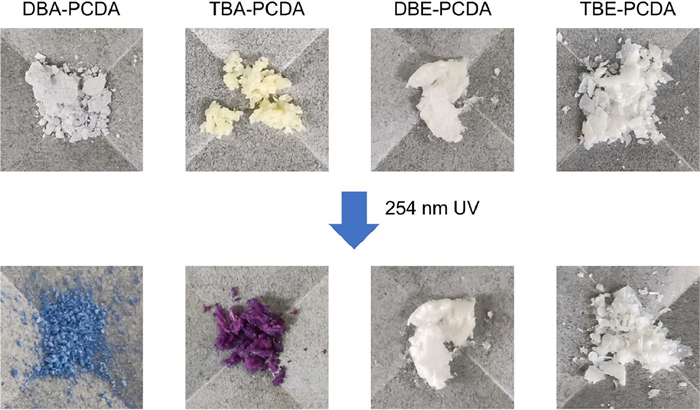
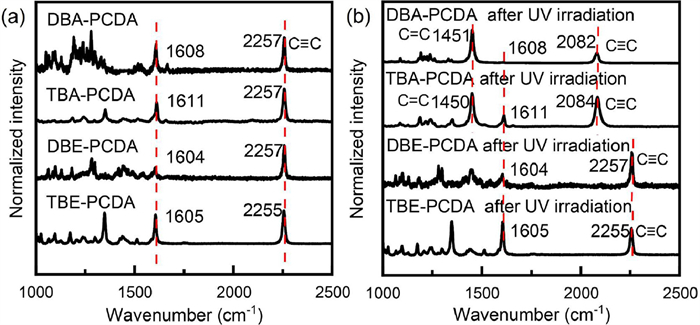
DBA-PCDA, DBE-PCDA, and TBE-PCDA are white solids at room temperature, whereas TBA-PCDA appears pale yellow. After the UV irradiation, DBA-PCDA changed to blue, TBA-PCDA changed to purple, while DBE-PCDA and TBE-PCDA have little change. The changes of the Raman spectra of the four monomers before and after the UV irradiation (Figs. 3a and b) prove the polymerization of the prepared monomers. The characterization absorption of -C≡C—C≡C- group at about 2257 cm−1 in DBA-PCDA and TBA-PCDA disappeared after UV irradiation, and correspondingly, two new peaks assigned to -C=C- and -C≡C- groups respectively at about 1451 cm−1 and 2082 cm−1 appeared, indicating the polymerization of DBA-PCDA and TBA-PCDA molecules. However, the Raman spectra of DBE-PCDA and TBE-PCDA before and after UV irradiation were the same, suggesting that topological polymerization did not occur. The results show that hydrogen-bond interactions play a more important role in the polymerization ability of diacetylene monomer than the π-π interactions.
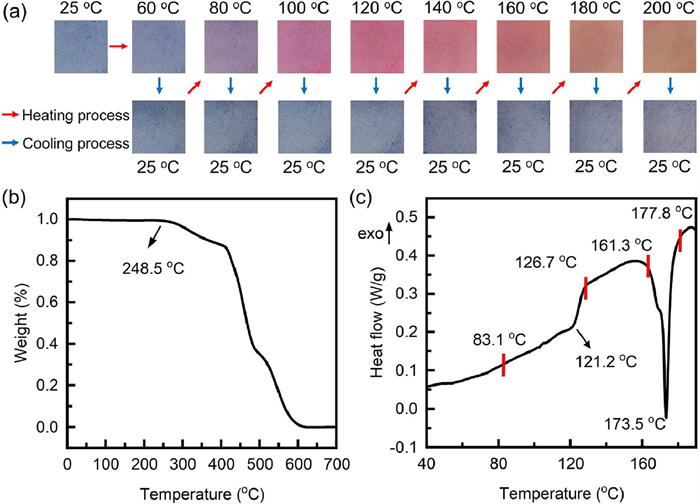
The thermochromic properties and melting behavior of poly(DBA-PCDA) and poly(TBA-PCDA) are shown in Fig. 4 and Fig. 5, respectively. Poly(DBA-PCDA) starts to change color at 80 ℃, but the color would return to blue after be cooled back to 25 ℃. It is impressive that even poly(DBA-PCDA) is heated up to 200 ℃, it can still return to blue after be cooled to room temperature, as shown in Fig. 4a. The TG curve of poly(DBA-PCDA) (Fig. 4b) also exhibits a high initial decomposition temperature of 248.5 ℃, indicating an excellent thermostability of poly(DBA-PCDA). Compared with the thermochromic behavior (Fig. 4a) and the DSC data of poly(DBA-PCDA) (Fig. 4c), it can be seen that the reversible thermochromic temperature range of poly(DBA-PCDA) is related to its melting range. The lowest color change temperature of poly(DBA-PCDA) is close to the minimum initial melting temperature. At the same time, as long as the temperature of poly(DBA-PCDA) does not exceed its maximum melting temperature, it does not melt completely, and at this time, the polymer chains have a certain activity, but they have not yet broken away from the crystal lattice. When it is cooled, the polymer chain conformation may return to the previous state due to the restriction of the crystal lattice, and the color of the sample will also change back to blue.
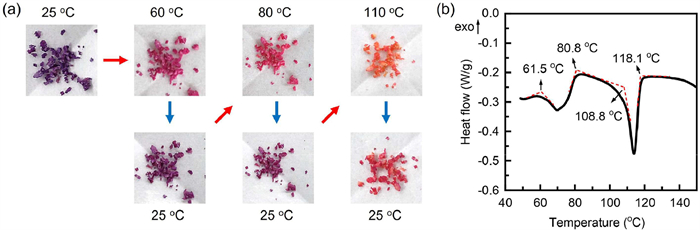
In contrast, poly(TBA-PCDA) also shows reversible thermochromic behavior in a temperature range of about 60-100 ℃ (Fig. 5a). The UV–vis spectra of poly(TBA-PCDA) at 25 ℃ and 60 ℃ in Fig. S30 (Supporting information) also prove the different light absorption, corresponding to the different color of poly(TBA-PCDA) at this two different temperature. When it is heated to 110 ℃, it will not change back to the initial purple any more. This reversible thermochromic behavior is also in accord with its melting behavior detected by DSC (Fig. 5b), which shows that the onset melting temperature of poly(TBA-PCDA) is 61.5 ℃, and the maximum melting temperature is only 118.1 ℃.
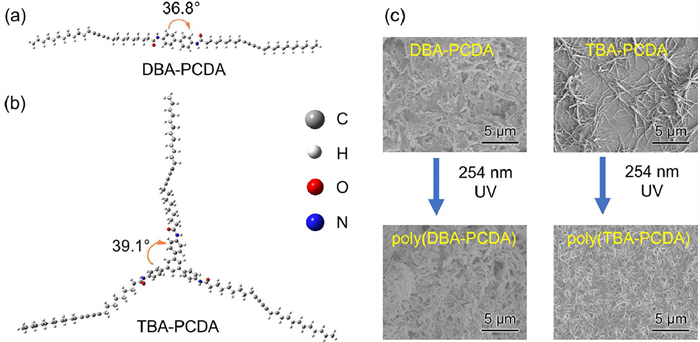
The above results indicate that reversible thermochromic behavior of PDA is determined by its melting behavior, which is closely related to the chemical structure of the monomer. It is not that the more polar functional groups and diacetylene units, the higher the thermochromic temperature. In general, the higher the regularity and symmetry of the molecular structure, the more perfect the crystallization and the higher the melting point. Figs. 6a and b show the optimized geometries for DBA-PCDA and TBA-PCDA molecules respectively calculated by density functional theory (DFT). The results revealed that the benzene ring units of the conjugated structures in both two diacetylene molecules are not perfectly coplanar. The dihedral angles in the bridging unit of DBA-PCDA and TBA-PCDA molecules are 36.8° and 39.1° respectively, indicating that the molecular arrangement of TBA-PCDA may not be as regular as that of DBA-PCDA, which will cause more spatial misalignment when molecules aggregate and crystallize (Fig. S31 in Supporting information), so the perfection degree of the crystallization of TBA-PCDA will be worse than that of DBA-PCDA, and the melting point of TBA-PCDA will be relatively low. Fig. 6c exhibits the crystalline morphologies of DBA-PCDA and TBA-PCDA before and after UV irradiation. It can be seen that DBA-PCDA is an aggregate of two-dimensional sheet-like solids, while TBA is an aggregate of one-dimensional fibrous solids with a much smaller size (Fig. 6c and Fig. S32 in Supporting information). Due to the solid polymerization mechanism, poly(DBA-PCDA) and poly(TBA-PCDA) nearly present the same morphologies with their corresponding monomers.
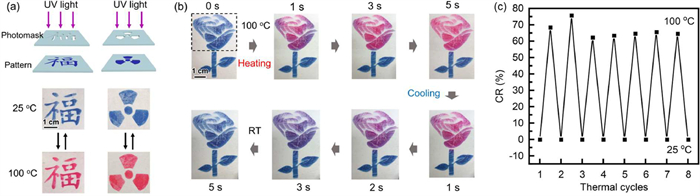
The unique characteristics of in-situ polymerization make the prepared PDA materials be highly flexible in pattern design for the application of high-temperature thermal indicator. Take the poly(DBA-PCDA) as an example (Fig. 7). Firstly, DBA-PCDA monomer was deposited on filter paper, then custom mask plate was placed on the filter paper, and finally, a poly(DBA-PCDA) thermal indicator with specific pattern can be easily obtained by shining UV light for a few minutes (Fig. 7a). When the poly(DBA-PCDA) thermal indicator was put on a hot stage of 100 ℃, an visible color change will occur within 1 second, and the whole pattern turned red after 5 s (Fig. 7b). Upon removing the heat source, the red pattern quickly turned back to blue after 5 s. In addition to the high sensitivity, the reversible thermochromic poly(DBA-PCDA) thermal indicator also has excellent thermal stability and reusability, the CR values have little change even after 7 cycles (Fig. 7c).
In summary, four novel diacetylene monomers containing multiple diacetylene units were successfully synthesized from PCDA through the amidation or esterification reactions, using 4,4′-diaminobiphenyl, 1,3,5-tris(4-aminophenyl)benzene, 4,4′-dihydroxybiphenyl, and 1,3,5-tris(4-hydroxyphenyl)benzene as bridging units. The effects of functional groups that can form hydrogen bond and π-π interactions on the solid-state polymerization properties of monomers and the thermochromic properties of the corresponding PDAs were investigated. The results show that the hydrogen-bonding interactions between monomer molecules play a more important role in the polymerization ability of diacetylene monomer than the π-π interactions. The effective combination of hydrogen-bonding and π-π interactions allows the prepared PDA to have a high melting point and a wide melting range, resulting in reversible thermochromic PDA materials with excellent sensitivity and reusability that can be used at close to 200 ℃. This work provides a theoretical and practical guidance for the development of high-performance reversible thermochromic PDA materials and high-temperature thermal indicator above 100 ℃.
The authors declare that they have no known competing financial interests or personal relationships that could have appeared to influence the work reported in this paper.
Zhiqing Ge: Writing – original draft, Methodology, Investigation, Data curation, Conceptualization. Zuxiong Pan: Investigation. Shuo Yan: Investigation. Baoying Zhang: Investigation. Xiangyu Shen: Investigation. Mozhen Wang: Writing – review & editing, Supervision, Conceptualization. Xuewu Ge: Writing – review & editing, Supervision, Conceptualization.
This work was supported by the National Natural Science Foundation of China (No. 51973205), and the Fundamental Research Funds for the Central Universities (Nos. WK9110000066, WK3450000005 and WK3450000006). The authors gratefully acknowledge Prof. Gang Zou in the Department of Polymer Science and Engineering of USTC for his sincere advice on this work. We thank the Super Computing Center of USTC for providing computational resources for this paper.
Supplementary material associated with this article can be found, in the online version, at doi:
Y.Y. Cui, Y.J. Ke, C. Liu, et al., Joule 2 (2018) 1707–1746. doi: 10.1016/j.joule.2018.06.018
P. Li, Z.H. Sun, R. Wang, et al., Front. Optoelectron. 15 (2022) 40. doi: 10.1007/s12200-022-00042-3
S. Mehta, A. Kushwaha, R.R. Kisannagar, G.D. Dipti, RSC Adv. 10 (2020) 21270–21276. doi: 10.1039/d0ra03484c
Q.Q. Jia, Q.F. Luo, H.F. Ni, et al., J. Phys. Chem. C 126 (2022) 1552–1557. doi: 10.1021/acs.jpcc.1c10347
Y.Y. He, W. Li, N. Han, J.P. Wang, X.X. Zhang, Appl. Energy 247 (2019) 615–629. doi: 10.1016/j.apenergy.2019.04.077
H.H. Liu, L. Yuan, X.F. Wu, et al., J. Mater. Chem. C 8 (2020) 9615–9624. doi: 10.1039/d0tc00921k
Y.L. Cheng, X.Q. Zhang, C.Q. Fang, J. Chen, Z. Wang, J. Mater. Sci. Technol. 34 (2018) 2225–2234. doi: 10.1016/j.jmst.2018.05.016
S. Ishioka, K. Watanabe, H. Imai, et al., Chem. Commun. 55 (2019) 11723–11726. doi: 10.1039/c9cc05303d
C. Tanioku, K. Matsukawa, A. Matsumoto, ACS Appl. Mater. Interfaces 5 (2013) 940–948. doi: 10.1021/am302603p
X. Huang, J. Ji, G. Li, G. Yang, J. Hou, ACS Appl. Polym. Mater. 8 (2022) 6047–6053. doi: 10.1021/acsapm.2c00862
H.S. Peng, X.M. Sun, F.J. Cai, et al., Nat. Nanotechnol. 4 (2009) 738–741. doi: 10.1038/nnano.2009.264
S. Park, C.W. Lee, J.M. Kim, Org. Electron. 58 (2018) 1–5. doi: 10.1016/j.orgel.2018.03.044
W. Zhang, H.B. Xu, Y. Chen, S. Cheng, L.J. Fan, ACS Appl. Mater. Interfaces 5 (2013) 4603–4606. doi: 10.1021/am401099s
G. Zou, W.L. Hu, D. Taguchi, T. Manaka, M. Iwamoto, Chem. Commun. 73 (2013) 8105–8107. doi: 10.1039/c3cc44467h
M.W. Wang, F. Wang, Y. Wang, W. Zhang, X.Q. Chen, Dyes Pigm. 120 (2015) 307–313. doi: 10.1016/j.dyepig.2015.04.035
J.T. Wen, K. Bohorquez, H. Tsutsui, Sens. Actuator. B: Chem. 232 (2016) 313–317. doi: 10.1016/j.snb.2016.03.118
S. Chen, X.P. Chen, L. Yang, et al., RSC Adv. 12 (2022) 22210–22218. doi: 10.1039/d2ra03435b
L. Jiang, X. Lei, K.J. Wang, et al., Dyes Pigm. 183 (2020) 108740. doi: 10.1016/j.dyepig.2020.108740
D.E. Wang, X.H. Gao, G.B. Li, et al., Sens. Actuator. B: Chem. 289 (2019) 85–92. doi: 10.1016/j.snb.2019.03.087
W.J. Dong, G.H. Lin, H.F. Wang, W.S. Lu, ACS Appl. Mater. Interfaces 9 (2017) 11918–11923. doi: 10.1021/acsami.7b02846
D.J. Ahn, E.H. Chae, G.S. Lee, et al., J. Am. Chem. Soc. 125 (2003) 8976–8977. doi: 10.1021/ja0299001
L. Zhang, Y.Z. Yuan, X.H. Tian, J.Y. Sun, Chin. Chem. Lett. 26 (2015) 1133–1136. doi: 10.1016/j.cclet.2015.05.027
S. Lee, J. Lee, M. Lee, et al., Adv. Funct. Mater. 24 (2014) 3699–3705. doi: 10.1002/adfm.201304147
C. Phollookin, S. Wacharasindhu, A. Ajavakom, et al., Macromolecules 43 (2010) 7540–7548. doi: 10.1021/ma101264k

Figure 2 Optical images of DBA-PCDA, TBA-PCDA, DBE-PCDA, and TBE-PCDA before and after UV irradiation.

Figure 3 Raman spectra of DBA-PCDA, TBA-PCDA, DBE-PCDA, and TBE-PCDA before (a) and after (b) 254 nm UV irradiation.

Figure 4 Digital photos at different temperature (a), TGA curve (b) and DSC curve (c) of poly(DBA-PCDA).

Figure 5 Digital photos at different temperature (a) and DSC curve (b) of poly(TBA-PCDA).

Figure 6 Optimized geometries of DBA-PCDA (a) and TBA-PCDA (b). (c) SEM images of DBA-PCDA, TBA-PCDA before and after UV irradiation.

Figure 7 (a) Schematic of the preparation of patterned poly(DBA-PCDA) thermal indicator and the optical images of the thermal indicator at 25 ℃ and 100 ℃. (b) Reversible thermochromic process of the patterned poly(DBA-PCDA). (c) The CR values of poly(DBA-PCDA) at 25 ℃ and 100 ℃ in each heating-cooling cycle.

 扫一扫看文章


扫一扫关注我们
 DownLoad:

 下载:
下载: