
Scheme 1.
1,2-Amidocyanation of 1,3-dienes and 1,3-enynes.

Copper-catalyzed photoredox 1,4-amidocyanation of 1,3-enynes with N-amidopyridin-1-ium salts and TMSCN: Facile access to α-amido allenyl nitriles
Liangfeng Yang , Liang Zeng , Yanping Zhu , Qiuan Wang , Jinheng Li


Allenes are important structural units that exist in natural products, pharmaceuticals, functional materials and organic compounds, as well as are generally recognized as valuable synthetic building blocks with remarkable chemical versatility in organic synthesis [1–8]. For these reasons, innovation in general and efficient methodologies for the construction of diverse functionalized allene backbones have attracted much attention over the past few decades [9–19]. Among them, the 1,3-enyne 1,4-difunctionalization reaction is particularly appealing as a powerful and practical tool to forge functionalized allenes through the simultaneous incorporation of two functional groups [15–66]. Traditional methods mainly concentrate on transition-metal-catalyzed 1,3-enyne 1,4-difunctionalization reactions with highly reactive organometallic reagents (such as Grignard, zinc, and lithium reagents), enabling the formation of diverse allenes via allenyl ion intermediates [15–28]. Despite significant advancement in the field, these transformations suffer from the requirement of pre-prepared functional reagents and issues of substrate accessibility and cost, functional group compatibility, and selectivity. Alternatively, radical-mediated 1,3-enyne 1,4-difunctionalization reactions [15–19] exhibit broad prospects for accessing functionalized allenes through the addition of radicals across the vinyl moiety followed by termination with various functional groups (often nucleophiles) using a transition metal oxidative catalyst [29–52] or a transition metal and photoredox synergetic catalysis [53–66], which avoid the need for pre-functionalization processes and broaden the scope of the terminating functional reagents. However, methods for the radical-mediated 1,4-difunctionalization of 1,3-enynes toward functionalized allenes are much less abundant and are confronted with the challenge of limited radical functional precursors, including perfluoroalkyl-based Togni reagents [29], cyclobutanone oxime esters [30], alkyl peroxides [53], alkyl N-hydroxyphthalimide (NHP) esters [54], a N—CF3 hydroxylamine [55], and sulfonyl reagents [56–66]. Moreover, these methods are restricted to terminal alkene-derived enynes and mainly concern on the 1,3-enyne 1,4-alkylcyanation verisons. Therefore, exploring new, general radical strategies applied to a diverse range of radical precursors, especially including synthetically significant nitrogen-centered radical variants, for creating new 1,3-enyne difunctionalization reactions toward functionalized allenes is highly desirable.
N-Amido pyridin-1-ium salts and their derivatives have been elegantly utilized as an important class of functionalities, such as bifunctional aminating reagents, nitrogen-centered nucleophilicities, latent electrophilicities and nitrogen-centered radical precursors, in organic synthesis [67–83]. In particular, N-amido pyridin-1-ium salts serve as the amino nitrogen-centered radical precursors to achieve various reactions, such as alkene difunctionalization reaction, C—H amination, and initiated C(sp3)–H pyridylation [67–83]. However, to the best of our knowledge, the 1,4-amidocyanation of 1,3-enynes initiated by amidyl radicals generated from N-amido pyridin-1-ium salts for assembling α-amido allenes has never been reported. Recently, Zhu and coworkers reported a new dual photoredox and copper catalysis for enantioselective 1,2-amidocyanation of 1,3-dienes, in which N-Boc- and NCbz-amidopyridinium salts, no N-Ts-amidopyridinium salts, were used as the amino resources and TNSCN as the CN resource (Scheme 1a) [76]. This method appears efficient with high regio- and enantioselectivities, although the enantioselective 1,2-amidocyanation of 1,3-dienes needs to perform in degassed CHCl3 with 34%–73% yields (most are lower than 60% yields) and the racemic reaction is even less efficient (the typical reaction in about 14% yield). On this basis, we envisioned that the amido radicals might be generated through homolysis of the N—N bond in various N-amido pyridin-1-ium salts, such as N-Boc-, NCbz- and N-Ts-substituted ones, which would sequentially undergo addition across the enynes to form the amido allenyl radicals and then termination by nucleophiles to achieve the enyne 1,4-difunctionalization.
Herein, we report a new copper-catalyzed photoredox 1,4-amidocyanation of 1,3-enynes with N-sulfonamidopyridin-1-ium salts and TMSCN for the synthesis of α-amido allenyl nitriles (Scheme 1b). The reaction handles the generation of the amidyl radicals via homolysis of the N—N bond of N-(sulfonamido)pyridin-1-ium salts enabled using a cooperative copper and photoredox catalysis to initiate the 1,4-amidocyanation of various 1,3-enynes, including terminal alkene-derived enynes and internal alkene-derived enynes, thus access highly valuable α-amido allenyl nitriles, which is highlighted by its broad scope in 1,3-enynes and N-sulfonamidopyridin-1-ium salts, good functional group tolerance, and high selectivity.
We began the studies by exploring the photoredox 1,4-amidocyanation reaction of non-1-en-3-yn-2-ylbenzene 1a, N-Ts-amidopyridinium salt 2a and TMSCN (Table 1). After extensive examination of the reaction parameters, a combination of [Ir(dtbbpy)(ppy)2][PF6] photocatalyst (1 mol%), 36 W blue LEDs light, Cu(CH3CN)4PF6 (2.5 mol%) and 2, 2′-bipyridine (bpy) L1 (3.5 mol%) in CH2Cl2 (DCM) at room temperature for 12 h was found to be optimal, enabling the formation of the desired α-sulfonamido allenyl nitrile 3aa in 73% yield (entry 1). The results show that [Ir(dtbbpy)(ppy)2][PF6] photocatalyst, Cu(CH3CN)4PF6 catalyst and ligand L1 are crucial for success since omitting each led to no detectable product 3aa (entries 2, 6 and 13). The reported efficient Ir(ppy)3 photocatalyst [74–76] was less efficient than [Ir(dtbbpy)(ppy)2][PF6] (entry 3). However, Ru(bpy)3Cl2, Eosin Y and 4CZIPN showed no activity (entries 4 and 5). A series of other Cu catalysts, such as CuI, CuBr, CuCl, CuOAc, and CuCl2, were found to be inferior to Cu(CH3CN)4PF6. However, Fe catalysts, such as FeCl2, Fe(acac)2 and FeCl3, show no catalytic activity (entry 12). Further screening revealed that bpy L1 was the most active ligand compared with other ligands such as dtbbpy L2, dmbbpy L3, and Phen L4 (entries 1, 14 and 15), and DCM as the solvent was the best option compared with the results in DMSO, DMF, MeCN or THF (entry 1 vs. entries 16–18). It should be noted that no reaction occurs in the dark or under white, red or purple light (entry 19). Conducting the reaction at 40 ℃ delivered identical results to those at room temperature (entry 20). Significantly, the reaction was subject to a scale up to 1 mmol of 1a, giving rise to 3aa in good yield (entry 21). Unfortunately, attempts to execute the photoredox 1,4-amidocyanation with the precedent reported efficient N-Boc- and NCbz-amidopyridinium salts 2b-c [74–76] failed (entry 22).
As shown in Scheme 2, Cu-catalyzed photoredox enyne 1,4-amidocyanation protocol was widely applicable to 1,3-enynes 1 and 1-(sulfonamido)pyridin-1-ium salts 2 under the optimized conditions. 1,3-Enynes containing an aryl ring with different electronic natures (electron-rich and deficient) and a steric hindrance at position 2 smoothly underwent the 1,4-sulfonamidocyanation, furnishing 3ba-3qa in moderate to good yields. Moreover, a wide range of substitutions, such as Me, tBu, pH, F, Cl, Br, and CF3, on the aryl ring at the para, meta, or ortho positions were well tolerated (3ba-3pa), and both electronic nature and steric hindrance had no obvious influence on the reactivity. For example, 2-aryl 1,3-enynes 1b, 1i, and 1 m bearing a Me group on the aryl ring at the para, meta, or ortho positions were converted to 3ba, 3ia, and 3ma, respectively, in 62%–68% yields. Most importantly, a halogen unit such as F, Cl, and Br remains intact, thus offering a potential for further derivatization of the resulting products (3ea-3gaa, 3ja-3la, 3na-3oa). 1,3-Enyne 1p having a 3,5-dichlorophenyl group was efficiently converted to 3pa. Naphthalen-2-yl group-substituted 1,3-enyne 1q was readily engaged in the 1,4-sulfonamidocyanation (3qa). Gratifyingly, internal 1,3-enyne 1r was a suitable substrate for constructing 3ra at a moderate yield. Various alkyl functionalities, including n‑butyl, n-hexyl, n-octyl, 4-chlorobutyl, 5-acetoxypentyl, 2-phenylethyl, and tert‑butyl groups, at the terminal alkyne of the 1,3-enynes were perfectly compatible, assembling 3sa-3ya in high yields. Notably, the structure and stereoselectivity of 3ya were unambiguously characterized using X-ray diffraction (CCDC: 2288822). Unfortunately, enynes 1z-aa possessing a phenyl group at terminal alkyne or a methyl group on 2 position of the alkene moiety were inert (3za-aaa), probably due to their steric hindrance and stability of the resulting radical intermediates.
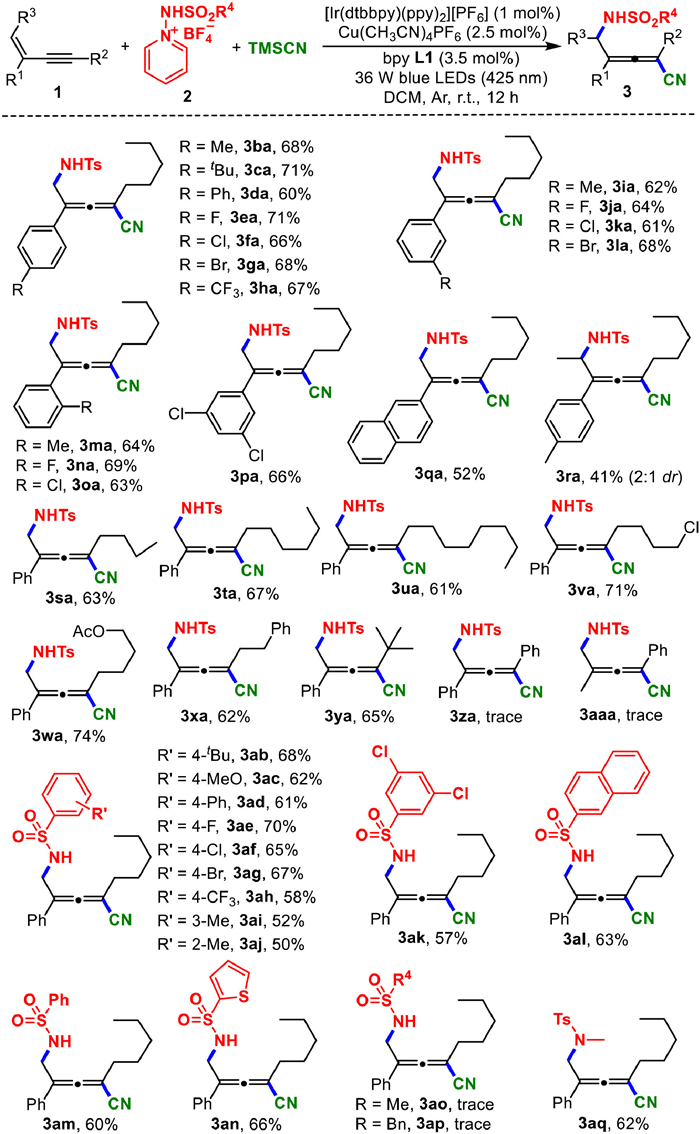
Next, the feasibility of N-(sulfonamido)pyridin-1-ium salts was examined in the presence of 1,3-enyne 1a, TMSCN, [Ir(dtbbpy)(ppy)2][PF6], Cu(CH3CN)4PF6, L1 and blue LEDs light. A broad array of functionalities, including tBu, MeO, pH, F, Cl, Br, CF3 and Me, on the aryl group of the arylsulfonamido moiety were compatible with the optimized conditions, affording 3ab–aj in 50%–70% yields. In addition, the steric hindrance affects the reaction: While N-(arylsulfonamido)pyridin-1-ium salt containing a p-Me group 2a delivered a 73% yield of 3aa (entry 1, Table 1), the ones possessing an m-Me 2i or an o-Me group 2j diminished yields of 3ai and 3aj to 50% and 52%, respectively. Dichloro-substituted 1-(arylsulfonamido)pyridin-1-ium salt 2k accommodated to the reaction (3ak). For 1,3-enynes bearing a phenyl, naphthalen-2-yl, or thiophene group, the reaction occurred smoothly and delivered 3al-an in satisfactory yields. However, N-(alkylsulfonamido)pyridin-1-ium salts 2o-p is not amenable to the 1,4-sulfonamidocyanation reaction (3ao-ap), probably attributing to the instability of the alkylamido radicals [67–83]. Interestingly, secondary N-Me-N-Ts-amido-pyridinium salt 2q was competent to deliver 3aq in 62% yield.
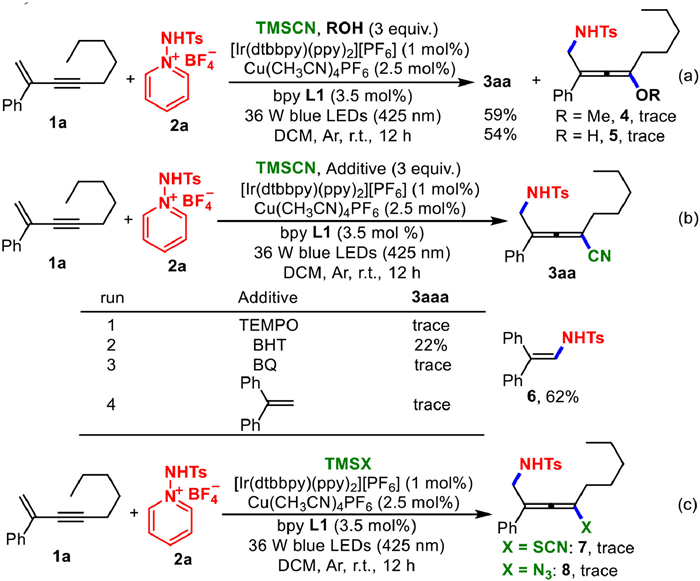
In the presence of a nucleophile like MeOH or H2O, 1,3-enyne 1a still run the 1,4-sulfonamidocyanation reaction, not 1,4-amidooxylation reaction (5 and 6), albeit with decreasing yields of 3aa (Scheme 3a). Control experiments demonstrated that the enyne 1,4-sulfonamidocyanation reaction was inhibited by a radical scavenger, including TEMPO, BHT, BQ and 1,1-diphenylalkene (Scheme 3b). Moreover, the reaction with 1,1-diphenyalkene afforded N-(2,2-diphenylvinyl)−4-methyl-benzenesulfonamide 4 in 62% along with a trace of 3aa. The results indicate that this current reaction involves a radical process. However, TMSSCN and TMSN3 had no reactivity for the photoredox 1,4-amidocyanation of 1,3-enyne 1a with 2a (Scheme 3c).
The Stern–Volmer fluorescence quenching experiments of a mixture of [Ir(dtbbpy)(ppy)2][PF6] and 1-(sulfonamido)-pyridin-1-ium salt 2a were carried out (Figs. S1 and S2 in Supporting information). The fluorescence of [Ir(dtbbpy)(ppy)2][PF6] was gradually quenched by increasing concentrations of 2a, suggesting that the photocatalysis is initially affected by the 1-(sulfonamido)pyridin-1-ium salt to generate the amidyl radicals. Notably, the light on-off experiments show that visible light is crucial for success (Fig. S3 in Supporting information).
Based on the current results and preceding literature studies [15–19,29–83], a plausible mechanism for this copper-catalyzed photoredox enyne 1,4-sulfonamidocyanation protocol was proposed (Scheme 4). Single electron transfer (SET) between the excited state IrⅢ* and 1-(sulfonamido)pyridin-1-ium salt 2 to form the IrⅣ species and the 1-(sulfonamido)pyridine radical A, followed by cleavage of the N–N bond with the aid of the [CuxLn] species to generate the amidyl radical intermediate B [67–83]. Addition of the intermediate B across the C=C bond of 1,3-enyne 1 affords the radical intermediates C and D. Meanwhile, the reaction of the active CuⅠLn species, which is generated through coordination of the [Cux] species and bpy L1, with TMSCN affords the CuⅠLnCN intermediate E, which sequentially undergoes photooxidation with the IrⅣ species and TMSCN to deliver the CuⅡLn(CN)2 intermediate F and regeneration of the active IrⅢ species [29–83]. The addition of the intermediate F to the intermediate D gives rise to the generation of the allenyl-CuⅢLnCN intermediate G [29–66,76]. Reductive elimination of the intermediate G delivers the desired product 3 and the CuⅠLnCN intermediate E. The other role of the Cu catalyst and ligand may weakly coordinate with the resulting radicals to stabilize/activate them.

In summary, we have developed the first radical-mediated 1,4-amidocyanation of 1,3-enynes with N-amidopyridin-1-ium salts and TMSCN for producing α-amido allenyl nitriles using a cooperative copper and photoredox catalysis. This method enables the formation of two new bonds, one C(sp3)-N bond and one C(sp2)-C(sp) bond, in a single reaction, and represents a mild, general route to the synthesis of α-sulfonamido allenyl nitriles featuring broad substrate scope, good functional group compatibility and excellent selectivity.
The authors declare that they have no known competing financial interests or personal relationships that could have appeared to influence the work reported in this paper.
The authors would like to thank the National Natural Science Foundation of China (No. 22271245) for the financial support. Y.-P. Z. also thank the Yantai "Double Hundred Plan" and the Talent Induction Program for Youth Innovation Teams in Colleges and Universities of Shan-dong Province.
Supplementary material associated with this article can be found, in the online version, at doi:
L.L. Wei, H. Xiong, R.P. Hsung, Acc. Chem. Res. 36 (2003) 773–782. doi: 10.1021/ar030029i
A. Hoffmann-Röder, N. Krause, Angew. Chem. Int. Ed. 43 (2004) 1196–1216. doi: 10.1002/anie.200300628
S. Ma, Chem. Rev. 105 (2005) 2829–2872. doi: 10.1021/cr020024j
S. Ma, Acc. Chem. Res. 42 (2009) 1679–1688. doi: 10.1021/ar900153r
P. Rivera-Fuentes, F. Diederich, Angew. Chem. Int. Ed. 51 (2012) 2818–2828. doi: 10.1002/anie.201108001
S. Yu, S. Ma, Angew. Chem. Int. Ed. 51 (2012) 3074–3112. doi: 10.1002/anie.201101460
G. Qiu, J. Zhang, K. Zhou, et al., Tetrahedron 74 (2018) 7290–7301. doi: 10.1016/j.tet.2018.10.061
L. Liu, R.M. Ward, J.M. Schomaker, Chem. Rev. 119 (2019) 12422–12490. doi: 10.1021/acs.chemrev.9b00312
S. Ma, Eur. J. Org. Chem. (2004) 1175–1183.
S. Yu, S. Ma, Chem. Commun. 47 (2011) 5384–5418. doi: 10.1039/C0CC05640E
R.K. Neff, D.E. Frantz, ACS Catal. 4 (2014) 519–528. doi: 10.1021/cs401007m
J. Ye, S. Ma, Org. Chem. Front. 1 (2014) 1210–1224. doi: 10.1039/C4QO00208C
S. Du, A.X. Zhou, R. Yang, et al., Org. Chem. Front. 8 (2021) 6760–6782. doi: 10.1039/D1QO01151K
W. Xiao, J. Wu, Org. Chem. Front. 9 (2022) 5053–5073. doi: 10.1039/D2QO00994C
Q. Dherbassy, S. Manna, F.J.T. Talbot, et al., Chem. Sci. 11 (2020) 11380–11393. doi: 10.1039/D0SC04012F
L. Fu, S. Greßies, P. Chen, et al., Chin. J. Chem. 38 (2020) 91–100. doi: 10.1002/cjoc.201900277
Y. Li, H. Bao, Chem. Sci. 13 (2022) 8491–8506. doi: 10.1039/D2SC02573F
Y. Yu, J. Zhang, Eur. J. Org. Chem. 2022 (2022) e202201017. doi: 10.1002/ejoc.202201017
X. Liu, C. Jiao, S. Cui, et al., ChemCatChem 15 (2023) e202300601. doi: 10.1002/cctc.202300601
H. Todo, J. Terao, H. Watanabe, et al., Chem. Commun. (2008) 1332–1334.
J. Terao, F. Bando, N. Kambe, Chem. Commun. (2009) 7336–7338.
W. Zhang, H. Xu, H. Xu, et al., J. Am. Chem. Soc. 131 (2009) 3832–3833. doi: 10.1021/ja8099008
W. Zhang, S. Zheng, N. Liu, et al., J. Am. Chem. Soc. 132 (2010) 3664–3665. doi: 10.1021/ja100173w
Y. Tomida, A. Nagaki, J.I. Yoshida, J. Am. Chem. Soc. 133 (2011) 3744–3747. doi: 10.1021/ja110898s
Y. Mori, G. Onodera, M. Kimura, Chem. Lett. 43 (2014) 97–99. doi: 10.1246/cl.130865
A. Nishimura, E. Tamai, M. Ohashi, et al., Chem. Eur. J. 20 (2014) 6613–6617. doi: 10.1002/chem.201402218
H.Y. Wang, W. Zhang, C.M. Schienebeck, et al., Org. Chem. Front. 1 (2014) 386–390. doi: 10.1039/C3QO00088E
Y. Mori, T. Kawabata, G. Onodera, et al., Synthesis 48 (2016) 2385–2395. doi: 10.1055/s-0035-1560448
F. Wang, D. Wang, Y. Liang, et al., Angew. Chem. Int. Ed. 57 (2018) 7140–7145. doi: 10.1002/anie.201803668
Y. Song, C. Fu, S. Ma, et al., ACS Catal. 11 (2021) 10007–10013. doi: 10.1021/acscatal.1c02140
K.-F. Zhang, K.-J. Bian, C. Li, et al., Angew. Chem. Int. Ed. 58 (2019) 5069–5074. doi: 10.1002/anie.201813184
C. Ye, Y. Li, X. Zhu, et al., Chem. Sci. 10 (2019) 3632–3636. doi: 10.1039/C8SC05689G
X. Zhu, W. Deng, M.F. Chiou, et al., J. Am. Chem. Soc. 141 (2019) 548–559. doi: 10.1021/jacs.8b11499
Y. Song, S. Song, X. Duan, et al., Chem. Commun. 55 (2019) 11774–11777. doi: 10.1039/C9CC05853B
Q. Zhang, M.T. Muhammad, M.F. Chiou, et al., Org Lett. 22 (2020) 5261–5265. doi: 10.1021/acs.orglett.0c01953
J. Huang, Y. Jia, X. Li, et al., Org. Lett. 23 (2021) 2314–2319. doi: 10.1021/acs.orglett.1c00449
X.Y. Dong, T.Y. Zhan, S.P. Jiang, et al., Angew. Chem. Int. Ed. 60 (2021) 2160–2164. doi: 10.1002/anie.202013022
F.S. He, P. Bao, F. Yu, et al., Org. Lett. 23 (2021) 7472–7476. doi: 10.1021/acs.orglett.1c02665
L. Chen, C. Lin, S. Zhang, et al., ACS Catal. 11 (2021) 13363–13373. doi: 10.1021/acscatal.1c03861
Y. Cai, J. Chen, Y. Huang, Org. Lett. 23 (2021) 9251–9255. doi: 10.1021/acs.orglett.1c03601
X. Li, X. Ren, H. Wu, et al., Chin. Chem. Lett. 32 (2021) 9–12. doi: 10.1016/j.cclet.2020.11.045
L. Chen, J. Wang, C. Lin, et al., Org. Lett. 24 (2022) 7047–7051. doi: 10.1021/acs.orglett.2c03007
Y. Lv, W. Han, W. Pu, et al., Org. Chem. Front. 9 (2022) 3775–3780. doi: 10.1039/D2QO00486K
M. Li, G.Q. Sun, Y.Y. Liu, et al., J. Org. Chem. 88 (2023) 1403–1410. doi: 10.1021/acs.joc.2c02271
Q. Li, Z.L. Wang, Y.H. Xu, Chin. Chem. Lett. 34 (2023) 108150. doi: 10.1016/j.cclet.2023.108150
Z. Cheng, T. Yang, C. Li, Y, et al., J. Am. Chem. Soc. 145 (2023) 25995–26002. doi: 10.1021/jacs.3c11368
Q. Wang, Y. Chen, K. Peng, et al., Org. Lett. 25 (2023) 8889–8894. doi: 10.1021/acs.orglett.3c03677
X. Li, N. Li, L. Yang, et al., ACS Catal. 13 (2023) 12755–12765. doi: 10.1021/acscatal.3c03497
D. Zhang, J. Fan, Y. Shi, et al., Chem. Sci. 14 (2023) 9191–9196. doi: 10.1039/D3SC01501G
S. Li, W. Yang, J. Shi, et al., ACS Catal. 13 (2023) 2142–2148. doi: 10.1021/acscatal.2c04978
H.J. Miao, J.H. Zhang, S. Liu, et al., Org. Lett. 25 (2023) 5563–5568. doi: 10.1021/acs.orglett.3c01809
W. Jian, M.F. Chiou, Y. Li, et al., Chin. Chem. Lett. 35 (2024) 108980. doi: 10.1016/j.cclet.2023.108980
Y. Zeng, M.F. Chiou, X. Zhu, et al., J. Am. Chem. Soc. 142 (2020) 18014–18021. doi: 10.1021/jacs.0c06177
Y. Chen, K. Zhu, Q. Huang, et al., Chem. Sci. 12 (2021) 13564–13571. doi: 10.1039/D1SC04320J
S. Liu, Y. Huang, F.L. Qing, et al., Eur. J. Org. Chem. 26 (2023) e202201061. doi: 10.1002/ejoc.202201061
T. Xu, S. Wu, Q.N. Zhang, et al., Org. Lett. 23 (2021) 8455–8459. doi: 10.1021/acs.orglett.1c03179
C. Li, D.D. Hu, R.X. Jin, et al., Org. Chem. Front. 9 (2022) 788–794. doi: 10.1039/D1QO01653A
D.D. Hu, Q. Gao, J.C. Dai, et al., Sci. China Chem. 65 (2022) 753–761.
Y. Chen, J. Wang, Y. Lu, Chem. Sci. 12 (2021) 11316–11321. doi: 10.1039/D1SC02896K
Q. Sun, X.P. Zhang, X. Duan, et al., Chin. J. Chem. 40 (2022) 1537–1545. doi: 10.1002/cjoc.202200056
F.H. Zhang, X. Guo, X. Zeng, et al., Nat. Commun. 13 (2022) 5036. doi: 10.1038/s41467-022-32614-4
L. Wang, R. Ma, J. Sun, et al., Chem. Sci. 13 (2022) 3169–3175. doi: 10.1039/D1SC06100C
W. Liu, C. Liu, M. Wang, et al., ACS Catal. 12 (2022) 10207–10221. doi: 10.1021/acscatal.2c01521
C. Cheng, G.F. Lv, S. Wu, et al., Org. Lett. 25 (2023) 4236–4240. doi: 10.1021/acs.orglett.3c01103
J.J. Zhang, L. Lou, R. Lv, et al., Chin. Chem. Lett. 34 (2023) 109342.
Y. Zhang, W. Zhou, M. Gao, et al., Chin. Chem. Lett. 34 (2023) 108836.
F.S. He, S. Ye, J. Wu, ACS Catal. 9 (2019) 8943–8960.
P. Roychowdhury, S. Samanta, H. Tan, et al., Org. Chem. Front. 10 (2023) 2563–2580. doi: 10.1039/D3QO00190C
K. Miyazawa, T. Koike, M. Akita, Chem. Eur. J. 21 (2015) 11677–11680. doi: 10.1002/chem.201501590
J.N. Mo, W.L. Yu, J.Q. Chen, et al., Org. Lett. 20 (2018) 4471–4474. doi: 10.1021/acs.orglett.8b01760
W.L. Yu, J.Q. Chen, Y.L. Wei, et al., Chem. Commun. 54 (2018) 1948–1951. doi: 10.1039/C7CC09151F
Y. Moon, B. Park, I. Kim, et al., Nat. Commun. 10 (2019) 4117. doi: 10.1038/s41467-019-12216-3
Y. Moon, W. Lee, S. Hong, J. Am. Chem. Soc. 142 (2020) 12420–12429. doi: 10.1021/jacs.0c05025
W. Guo, Q. Wang, J. Zhu, Angew. Chem. Int. Ed. 60 (2021) 4085–4089. doi: 10.1002/anie.202014518
D. Forster, W. Guo, Q. Wang, et al., ACS Catal. 11 (2021) 10871–10877. doi: 10.1021/acscatal.1c03545
D. Forster, W. Guo, Q. Wang, et al., ACS Catal. 13 (2023) 7523–7528. doi: 10.1021/acscatal.3c01782
T.W. Greulich, C.G. Daniliuc, A. Studer, Org. Lett. 17 (2015) 254–257. doi: 10.1021/ol503338b
S. Shin, S. Lee, W. Choi, et al., Angew. Chem. Int. Ed. 60 (2021) 7873–7879. doi: 10.1002/anie.202016156
A. Maity, P. Roychowdhury, R.G. Herrera, et al., Org. Lett. 24 (2022) 2762–2766. doi: 10.1021/acs.orglett.2c00869
C. Pan, Z. Yang, X. Wu, et al., Org. Lett. 25 (2023) 494–499. doi: 10.1021/acs.orglett.2c04190
Y. Liu, A. Feng, R. Zhu, et al., Chem. Sci. 14 (2023) 4580–4588. doi: 10.1039/D3SC00002H
T.T. Li, Y. Cheng, W.J. Xiao, et al., Chem. Cat. Chem. 15 (2023) e202301068.
G.Q. Li, F.R. Meng, W.J. Xiao, et al., Org. Chem. Front. 10 (2023) 2773–2781. doi: 10.1039/D3QO00513E

Scheme 2 Scope of the enynes (1) and 1-(sulfonamido)pyridin-1-ium salts (2). Reaction conditions: 1 (0.2 mmol), 2 (0.3 mmol), TMSCN 3a (0.4 mmol), [Ir(dtbbpy)(ppy)2][PF6] (1 mol%), Cu(CH3CN)4PF6 (2.5 mol%), bpy L1 (3.5 mol%), 36 W blue LED, DCM (2 mL), argon, room temperature and 12 h.

 扫一扫看文章


扫一扫关注我们
 DownLoad:



 下载:
下载:

