Citation:
Xianghe Kong, Xiaoli Liao, Zhenkun Huang, Lei Mei, Hongqing Wang, Kongqiu Hu, Weiqun Shi. Designed assembly of heterometallic cluster organic frameworks based on Th6 cluster[J]. Chinese Chemical Letters,
2024, 35(11): 109642.
doi:
10.1016/j.cclet.2024.109642
Designed assembly of heterometallic cluster organic frameworks based on Th6 cluster
English
Designed assembly of heterometallic cluster organic frameworks based on Th6 cluster
Received Date:
18 December 2023 Accepted Date:
04 February 2024 Revised Date:
26 January 2024 Available Online:
15 November 2024
Abstract:
Four novel compounds based on hexanuclear thorium cluster were synthesized and characterized. Compound 1 [Th6(HPyC)8(HCOO)4] is formed by replacing formate ligands of preassembled thorium cluster [Th6O4(OH)4(H2O)6(HCOO)12] with eight H2PyC (4-pyrazolecarboxylic acid) under solvothermal conditions. Each of the HPyC− ligands is coordinated with one Cu2+ to form the (4,8)-connected -net structure of compound 2 [(CuCl2)2Th6(HPyC)8(HCOO)4]. In compound 3 [(CuCl2)2Th6(HPyC)10(HCOO)4], ten of the formate ligands of preassembled Th6 cluster are replaced by HPyC− ligands. Compared with compound 2, the two extra HPyC− ligands in the equatorial plane of the Th6 cluster in compound 3 are not further connected to copper ions. Therefore, the topology structure of compound 3 is same with that of compound 2. Compound 4 [(Cu3Cl2)(CuCl2)Th6(PyC)3(HPyC)4(HCOO)5] contains three kinds of metal nodes, Th6 cluster, Cu3 cluster and mononuclear Cu2+, and exhibits a novel (5,7)-connected net structure, which was first discovered in actinide MOFs. Furthermore, considering the satisfactory stability of compound 4 and its unsaturated metal nodes and Lewis acid sites, the catalysis of cycloaddition of CO2 was further studied. We found that this thorium-copper heterometallic cluster organic framework can be used as a potential actinide functional material for catalyzing the efficient CO2 conversion to value-added products.
Thorium Molten Salt Reactor Nuclear Energy System (TMSR), as the fourth-generation reactor technology, has become the current international advanced nuclear energy research and development hotspot due to its outstanding safety and sustainable development [1–3]. The reserves of thorium in the Earth's crust is much higher than uranium, and thorium-based fuels have a higher energy output per unit weight and less waste generation compared to uranium [4–7]. Exploring novel thorium-based compounds is of great significance as it can provide valuable coordination chemistry information of thorium, which contributes to a comprehensive understanding of the chemical and physical properties of thorium under different conditions [8–10]. Th4+ cation has a larger ionic radius and coordination number than other tetravalent cations like Zr4+ and Hf4+, making it easier to form metal nodes with richer coordination geometry [11–13]. In addition, Th4+ cations trend to hydrolysis in aqueous solution, resulting in cluster structures bridged by OH−/O2− groups [14–17]. With the in-depth understanding of thorium and the development of actinide metal functional materials, more and more thorium clusters and derived materials are synthesized and used in adsorption separation [18–20], catalysis [21,22], photo-sensing [23,24], radiation detection [25,26] and other fields.
In contrast to simple molecular thorium complexes or discrete thorium clusters, the assembly of thorium clusters with polycarboxylic acid ligands can produce thorium cluster organic frameworks (ThCOFs), which have excellent chemical and radiation stability and can serve as a unique platform for multifunctional applications [27]. For example, Volkringer et al. firstly synthesized a ThCOF Th6O4(OH)4(H2O)6(bdc)6·6DMF·12H2O with terephthalic acid by controlling the hydrolysis of Th4+ cations, which adopts the UiO-66 topology and exhibits a very high porosity [28]. Compared with Zr4+ and Hf4+ cations tending to adopt the eight-coordinate square antiprismatic geometry and forming M6(μ3-O)4(μ3-OH)4 SBUs [29–31], Th4+ cations in the Th6 clusters adopt a structure of nine-coordinate capped square antiprism geometry. The higher coordination number of Th4+ cations also opens up more possibilities for creating new and unique topologies. Recently, Lin et al. constructed a series of ThCOF materials (Th-SINAP) for iodine adsorption [32], ion recognition [33] and radiation detection [34] by the assembly of Th6 clusters and polycarboxylic acid ligands, indicating the great potential application of thorium-based materials in the nuclear industry.
Heterometallic multi-component MOFs constructed based on clusters are gaining increasing attention due to their richer structural diversity and multifunctionality compared to the single-component MOFs [35–37]. A reasonable method for the synthesis of heterometallic MOFs is employing polyfunctional hybrid ligands or mixed ligands with varied coordination capabilities instead of polycarboxylic acid ligands, which is also suitable for the constructing of heterometallic ThCOFs. For example, Luo et al. used a multifunctional imidazole acid derivative ligand to combine 5f and 3d metal to obtain a [Th8Co8] nanocage MOF with double screening ability, which can be used for clear separations of both H2/D2 isotopes and butane/or hexane isomers [38]. Hu and coauthors reported a viologen-based radical-containing heteroaromatic MOF with an unprecedented (6, 18)-connected she-d topology. This multicomponent MOF exhibits excellent visible/NIR light-driven CO2 photoreduction activity [39].
Controlling polymorphic formation with identical precursors remains a challenging task in the construction of heterometallic ThCOFs due to the generation of different clusters during Th4+ hydrolysis [32,40]. Thus, it is urgent to develop a synthetic strategy to precisely control thorium clusters as a secondary building unit to assemble and construct new ThCOFs. In this work, a preassembled thorium cluster [Th6O4(OH)4(H2O)6(HCOO)12] (abbreviated as Th6) and a multifunction ligand 4-pyrazolecarboxylic acid (H2PyC) are used to construct heterometallic ThCOFs. Through the regulation of experimental conditions, the H2PyC ligand was exchanged with formate ligand on the Th6 cluster to form the intermediate clusters [Th6O4(OH)4(H2O)6(HPyC)x(HCOO)12-x], which are further assembled with copper ions to form two kinds of thorium-copper heterometallic ThCOFs with different topologies. The reversibility of ligand exchange and the introduction of heterometallic copper ions enrich the structural diversity of thorium-based MOFs. More importantly, a thorium-copper heterometallic ThCOF has polymetallic active sites and Lewis acidity, making it a promising catalyst for CO2 conversion.
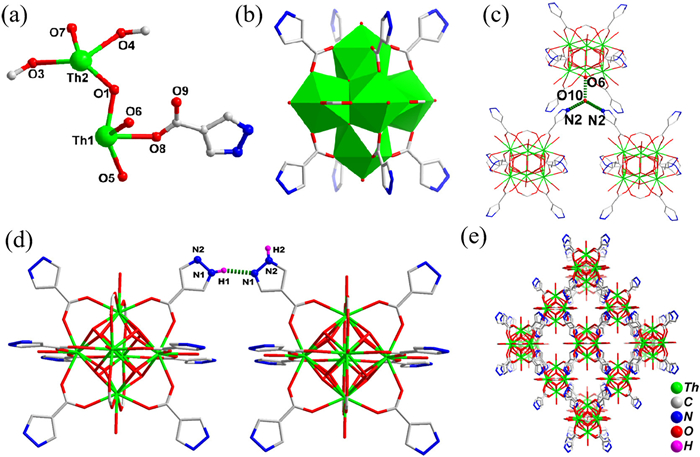
Th6(µ3-O)4(µ3-OH)4(H2O)6(HPyC)8(HCOO)4·4H2O (1). Single-crystal X-ray structural determination shows that compound 1 crystallizes in a cubic space group Immm (Table S1 in Supporting information). As shown in Fig. 1a, the asymmetric unit contains two Th4+ cations with position occupancies of 0.5 (Th2) and 0.25 (Th1), respectively. Then two Th1 atoms and four Th2 atoms are bridged together by four µ3-O and four µ3-OH to form a typical [Th6(µ3-O)4(µ3-OH)4]12+ cluster, which is further coordinated by eight HPyC− ligands, four HCOO− ligands and six H2O to form the final structure of compound 1, as depicted in Fig. 1b. The Th6 cluster is linked to two neighbouring units via multiple hydrogen bonds to form a 1D supramolecular chain (Fig. 1d). Adjacent 1D supramolecular chains are connected to one another by a series of lattice H2O molecules via multiple hydrogen bonds (Fig. 1c), resulting in a 3D porous structure (Fig. 1e).
Figure 1
Figure 1.
(a) Asymmetric unit of compound 1. (b) The structure of Th6(µ3-O)4(µ3-OH)4(H2O)6(HPyC)8(HCOO)4 cluster. (c, d) Hydrogen bond interactions forces between adjacent Th6 clusters. (e) 3D porous structure of compound 1 formed by hydrogen bonding. Color scheme: Th, green; Cu, cyan; C, gray; O, red; N, blue; H, pink. Most H atoms were omitted for clarity.
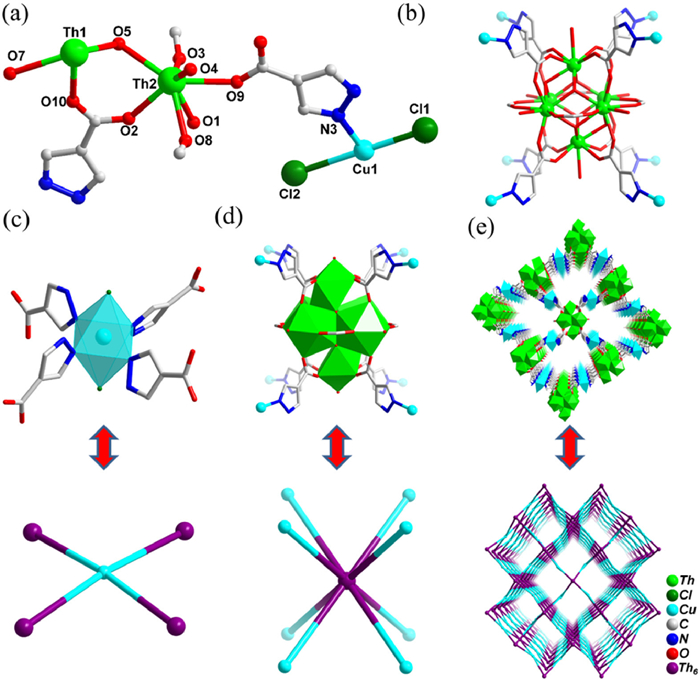
(CuCl2)2Th6(µ3-O)4(µ3-OH)4(HPyC)8(HCOO)4(H2O)6 (2). Compound 2 crystallizes in an orthorhombic space group Pbam (Table S1). The asymmetric unit of compound 2 consists of 1/4 Th6(µ3-O)4(µ3-OH)4(H2O)6 cluster, 1/2 CuCl2 unit, two crystallographically independent HPyC− ligands and two HCOO− ligands with position occupancy of 0.5, as shown in Fig. 2a. Each Th6 cluster is surrounded by four HCOO− ligands and eight HPyC− ligands, and further connected with eight Cu atoms (Fig. 2b). As shown in Fig. 2c, the Cu atom has an elongated octahedral configuration with two Cl atoms occupying the axial positions. Four HPyC− ligands provide four nitrogen atoms to occupy the equatorial plane of the Cu atom and further connect it with four Th6 clusters (Fig. 2c). The two kinds of metal/cluster nodes are connected together by a series of ligands to form a 3D framework containing 1D open channels along the c axis (Fig. 2e). Structure simplification and calculation show that the topological type of compound 2 is a (4,8)-connected scu net with Schläfli symbol of (416·612)(44·62)2 [41].
Figure 2
Figure 2.
(a) Asymmetric unit of compound 2. (b) The Th6(HPyC)8 cluster connected with eight Cu atoms. (c) The Copper ion connected to four pyrazoles and viewed as a 4-connected node. (d) Th6 cluster connected to eight copper ions and viewed as an 8-connected node. (e) 3D framework of compound 2 is classified as a (4,8)-connected scu net. Color scheme: Th, green; Cu, cyan; Cl, dark green; C, gray; O, red; N, blue; Th6, purple. H atoms were omitted for clarity.
(CuCl2)2Th6(µ3-O)4(µ3-OH)4(HPyC)10(HCOO)2(H2O)6 (3). As with compound 2, compound 3 also crystallizes in the orthorhombic space group Pbam due to their similar asymmetric units and coordinate environments (Table S1 and Fig. S2a in Supporting information). In compound 3, the Cu atom also adopts an elongated octahedral configuration defined by two Cl atoms at the axial positions and four N atoms of four HPyC− ligands in the equatorial plane (Figs. S2c and S3a in Supporting information). Although the Th6 cluster of compound 3 is coordinated by ten HPyC− ligands, only eight of which are further connected with Cu atoms and the other two ligands are free (Figs. S2b and S3c in Supporting information). Thus, the 3D framework of compound 3 is also classified as a (4,8)-connected scu net containing 1D open channels along the c axis (Figs. S2d and S3e). Due to the presence of HPyC− ligands that are not coordinated to Cu atoms in the 1D open channels, the solvent-accessible volume decreases from 58.6% of compound 2 to 53.7% of compound 3 calculated by PLATON routine [42].
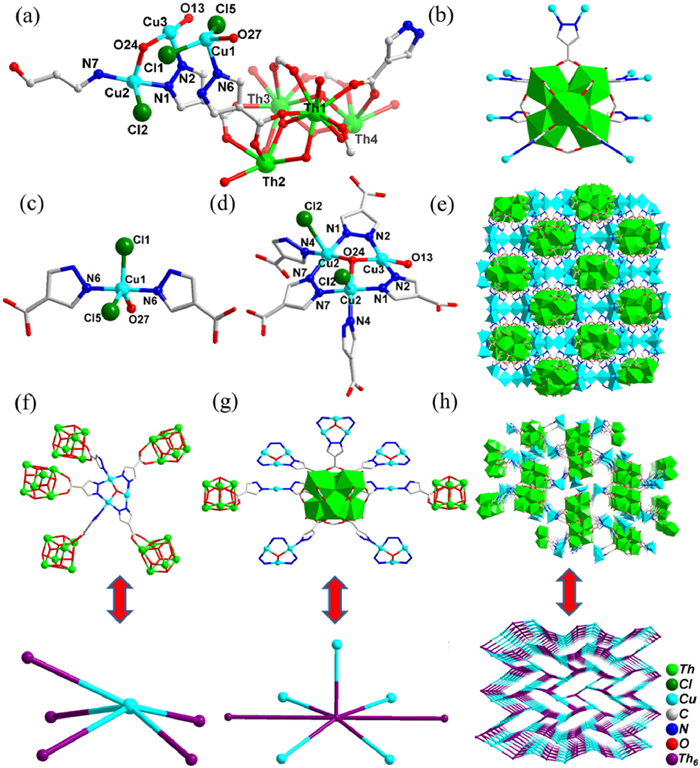
[Cu3(µ3-OH)(H2O)Cl2][Cu(H2O)Cl2]Th6(µ3-O)4(µ3-OH)4(PyC)3(HPyC)4(HCOO)5(H2O)6 (4). Compound 4 crystallizes in an orthorhombic space group Pnma (Table S1). The asymmetric unit of compound 4 contains four Th and three Cu atoms which are crystallographically independent, 3.5 PyC2−/HPyC− ligands, 2.5 HCOO− ligands, three Cl− anion and several coordinated O2−/OH−/H2O groups, as shown in Fig. 3a, Figs. S4a and b (Supporting information). In this unit, Th2 and Th4 are located at the special position of the symmetry axis with position occupancy of 0.5, whereas the occupancy of Th1 and Th3 is 1.0. Through an axisymmetric operation the whole Th6(µ3-O)4(µ3-OH)4 cluster core of compound 4 is obtained, where seven edges are coordinated by the carboxylates from PyC2−/HPyC− ligands, while the remaining five ones are coordinated by the carboxylates from HCOO− ligands (Figs. 3b and g). As shown in Fig. 3c, the Cu1 atom has a distorted triangular bipyramid configuration defined by two Cl atoms and one H2O in the equatorial plane and two N atoms from two HPyC− ligands at the axial positions, respectively. Two Cu2 atoms and one Cu3 atom are bridged together by one µ3-OH and three N2 groups from three PyC2− ligands to form a trinuclear cluster Cu3(µ3-OH)N6, in which Cu atoms adopt the square pyramidal or quadrilateral configurations, respectively (Figs. 3c and d). Therefore, the structure of compound 4 involves three kinds of metal nodes, hexanuclear cluster Th6(µ3-O)4(µ3-OH)4(COO)12(H2O)6, trinuclear cluster Cu3(µ3-OH)N6 and mononuclear CuCl2N2(H2O), which are bridged together through a series of PyC2−/HPyC− ligands to construct a 3D framework, as shown in Fig. 3e. Topologically, Each Cu3 cluster is connected with five Th6 clusters and can be viewed as a 5-connected node (Fig. 3f). Each Th6 cluster is connected with two Th6 clusters and five Cu3 clusters via two Cu(HPyC)2 units and five PyC2−/HPyC− ligands, respectively, and can be viewed as a 7-connected node (Fig. 3g). Structure simplification shows that the framework of compound 4 is classified as a (5,7)-connected net with Schläfli symbol of (32·44·54)(34·46·56·65) calculated using the TOPOS program (Fig. 3h) [41]. Although tens of thousands of MOFs have been synthesized, there have been very few (5,7)-connected MOFs reported. To the best of our knowledge, this compound represents the first example of an An-MOF with (5,7)-connected net.
Figure 3
Figure 3.
(a) Asymmetric unit of compound 4. (b) Th6(HPyC)7 cluster connected with ten Cu atoms. (c) The structure of trinuclear cluster Cu3(µ3-OH)(HPyC)5. (d) The coordination modes of Cu1 ion. (e) 3D framework of compound 4. (f) Cu3 cluster connected with five Th6 clusters and viewed as a 5-connected node. (g) Th6 cluster connected to five Cu3 clusters and two Th6 clusters and viewed as a 7-connected node. (h) The topology of compound 4 is classified as a (5,7)-connected net. Color scheme: Th, green; Cu, cyan; Cl, dark green; C, gray; O, red; N, blue; Th6, purple. H atoms were omitted for clarity.
Compound 1 was formed by substitution of eight HPyC− ligands for the HCOO− ligands on the preassembled Th6O4(OH)4(H2O)6(HCOO)12 under solvothermal conditions, indicating that ligands on the Th6 cluster are exchangeable. Meanwhile, the pyrazole N atom on HPyC− ligands has the coordination ability, and can further coordinate with heterometal atom to construct heterometallic ThCOFs. The introduced copper ions are used as the second metal node to connect four adjacent Th6 cluster units via pyrazole nitrogen to form a scu-type cubic net topology, in which eight of the HCOO− ligands of preassembled Th6 cluster are also replaced by HPyC− ligands. However, the ligands HPyC− and formate on the Th6 cluster are in a competitive coordination relationship, so eutectic compounds 2 and 3 with the same coordination and topologies were obtained, but with a different number of substituted HPyC− ligands on the Th6 cluster, indicating the diversity of ligand substitution patterns. Further adjustment of the acidity of the reaction system by the addition of HCOOH affects the hydrolysis of copper ions to form a trinuclear copper cluster unit, which acts as a multi-coordination metal node to connect five Th6 clusters to form compound 4 with a more complex (5,7)-connected net, in which seven of the HCOO− ligands of preassembled Th6O4(OH)4(H2O)6(HCOO)12 are replaced by HPyC−/PyC2− ligands. The formation of new copper clusters causes significant structural changes and enhanced structural stability. However, the pre-assembled Th6 cluster units are not affected by the system environment, and although the regulation reaction conditions may affect the number of exchanged ligands, the Th6O4(OH)4 core structure remains stable. Therefore, it is feasible to construct cluster-based MOFs via ligand exchange strategy based on preassembled Th6 cluster. In addition, the reversibility of ligand exchange also endows cluster-based MOFs with structural diversity.
The phase purity of compounds 1–4 can be confirmed through PXRD (Fig. S6 in Supporting information). The PXRD spectra of compounds 1 and 4 are consistent with the simulated results, indicating the high phase purity. Moreover, compound 4 exhibits excellent stability in water over a wide pH range. For compounds 2 and 3, because they are eutectic compounds with similar coordination patterns and topologies, it is difficult to confirm their purity. Therefore, subsequent physicochemical characterization was carried out with compound 2 as the representative, and the discussion of the physicochemical properties of the relevant compounds is in Supporting information.
On the one hand, compound 4 exhibits excellent stability, on the other hand, Th6 clusters and unsaturated trinucleated copper can provide Lewis acid and active sites for catalytic reactions [22]. Therefore, this porous heterometallic ThCOF is expected to be used for catalytic cycloaddition of epoxides. Initially, epichlorohydrin (1 mmol) was selected as the model substrate, and under a typical reaction condition, 9.3 mg (0.003 mmol, 0.3%) catalyst, 16.2 mg (0.05 mmol, 5 mol%) co-catalyst (tetrabutylammonium bromide (TBAB)), 1 mL acetonitrile, 0.1 MPa CO2, and 70 ℃ reacted for 12 h. The corresponding cyclic carbonate yield can exceed 99% (entry 1, Table S3 and Figs. S11-S15 in Supporting information). Subsequently, further exploration was conducted on the influence of reaction conditions on catalytic efficiency. The catalytic efficiency was found to hardly change when the reaction time or cocatalyst dosage was reduced by half. Even if the catalyst, cocatalyst and reaction time are reduced at the same time, the reaction efficiency can still reach about 77%. In particular, the catalytic efficiency can reach 99% with 0.3 mol% catalyst and 5 mol% TBAB for 6 h, which can be used as a typical reaction condition for further experiments.
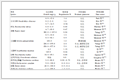
To further explore the catalytic performance of compound 4, more cycloaddition reactions were carried out under typical conditions to explore the substrate scope. As shown in Table 1 (Figs. S16-S23 in Supporting information), for alkyl epoxy substrates with smaller molecular sizes, such as 1,2-oxanephthenane and 1,2-epoxybutene, the catalytic efficiency can exceed 99%. While for epoxides containing benzene rings, such as epoxy styrene and glycerol phenyl ether, the catalytic efficiency is only about 10% and 40%, respectively. We further studied the influence of reaction time on its catalytic efficiency. With the extension of reaction time (24 h), the catalytic efficiency increased significantly (43% and 70%, respectively). The reason for the huge difference in catalytic efficiency should be due to the steric hindrance effect of the substituents. The 1D channel structure of compound 4 can be divided into two irregular small pores by the chloride ions coordinated on the Cu3 cluster, where the maximum size is about 6 Å (Fig. S5 in Supporting information). We further calculated the size of different epoxy substrate molecules and found that alkyl epoxides can easily enter the pores, while epoxy compounds with benzene rings are difficult to enter and diffuse [43]. In addition, after three consecutive catalytic cycles, no significant decrease was found in the catalytic activity of compound 4 (Fig. S24 in Supporting information), and the PXRD spectrum analysis of compound 4 before and after the reaction showed excellent stability of the catalyst (Fig. S7 in Supporting information).
Table 1
Table 1.
Synthesis of various cyclic carbonates from CO2 and epoxides.a
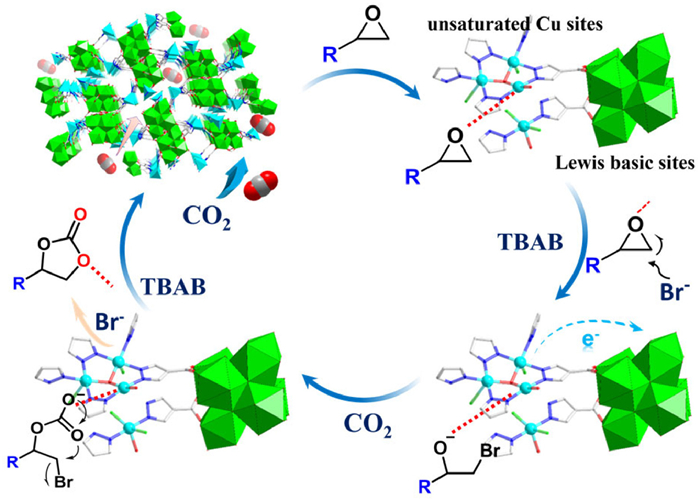
Combined with the structural characteristics of catalysts and literature reports, the possible mechanism of cycloaddition reaction is proposed [44,45], as shown in Fig. 4. Epoxides and CO2 molecules are first attracted and enriched into the pore structure by hydrogen bonding and weak interactions. The oxygen atoms on the epoxide are then activated by forming coordination bonds with the unsaturated metal site copper ions, thereby weakening the C—O bonds in epoxides. Then, the nucleophilic Br− anion of the cocatalyst TBAB attacks the carbon atoms with small steric hindrance on the epoxy ring, thereby opening the epoxy ring to form intermediate oxygen anions. Simultaneously, Th6 clusters can provide Lewis acidic and defect sites for catalytic reactions and facilitate the transfer of electrons [27,46–48]. Polarized CO2 rapidly combines with oxygen anions to form five-membered cyclic carbonate anions. Finally, Br− is removed from the alky-carbonate anions, and the cocatalyst TBAB is released to complete the cyclization process. From this catalytic process, the heterometallic unsaturated metal site copper cation and the Lewis basic site Th6 cluster synergistically drive the catalytic reaction.
Figure 4
Figure 4.
Proposed catalytic mechanism for cycloaddition of epoxides and CO2 to cyclic carbonate by compound 4.
In summary, we have obtained three novel thorium cluster-based MOFs via the ligand exchange strategy. When copper ions are introduced to coordinate with the pyrazole-nitrogen end of the N/O bifunctional hybrid ligand H2PyC, two kinds of thorium-copper heterometallic cluster organic frameworks with different topologies were obtained. Compounds 2 and 3 have similar coordination structures and the same scu-type topological framework. The only difference is that in compound 3, there are two additional HPyC− ligands on the equatorial plane of the Th6 cluster, which do not further coordinate with copper ions. By adjusting the acidity of the system, the hydrolysis behavior of copper ion is further controlled. In compound 4, trinuclear copper appears and serves as the metal node, forming a novel (5,7)-connected framework structure, which is first time reported in actinide-based MOFs. This new heterometallic ThCOF exhibits excellent stability and can be used as an effective catalyst for the cycloaddition of carbon dioxide with epoxides to form the corresponding cyclic carbonates. The ligand exchange strategy based on preassembled Th6 cluster provides the possibility to controllable construct novel cluster-based MOFs materials. This work provides a valuable reference for the development and utilization of actinide heterometallic functional materials.
Declaration of competing interest
The authors declare that they have no known competing financial interests or personal relationships that could have appeared to influence the work reported in this paper.
Acknowledgments
We acknowledge the support of the National Natural Science Foundation of China (Nos. 22076187, 22122609), the Hunan Province Natural Science Foundation of China (No. 2023JJ40530), and the Scientific Research Fund of Hunan Provincial Education Department (No. 22C0202). We thank The National Science Fund for Distinguished Young Scholars (No. 21925603).
Supplementary materials
Supplementary material associated with this article can be found, in the online version, at doi:10.1016/j.cclet.2024.109642.
Figure 1
(a) Asymmetric unit of compound 1. (b) The structure of Th6(µ3-O)4(µ3-OH)4(H2O)6(HPyC)8(HCOO)4 cluster. (c, d) Hydrogen bond interactions forces between adjacent Th6 clusters. (e) 3D porous structure of compound 1 formed by hydrogen bonding. Color scheme: Th, green; Cu, cyan; C, gray; O, red; N, blue; H, pink. Most H atoms were omitted for clarity.
Figure 2
(a) Asymmetric unit of compound 2. (b) The Th6(HPyC)8 cluster connected with eight Cu atoms. (c) The Copper ion connected to four pyrazoles and viewed as a 4-connected node. (d) Th6 cluster connected to eight copper ions and viewed as an 8-connected node. (e) 3D framework of compound 2 is classified as a (4,8)-connected scu net. Color scheme: Th, green; Cu, cyan; Cl, dark green; C, gray; O, red; N, blue; Th6, purple. H atoms were omitted for clarity.
Figure 3
(a) Asymmetric unit of compound 4. (b) Th6(HPyC)7 cluster connected with ten Cu atoms. (c) The structure of trinuclear cluster Cu3(µ3-OH)(HPyC)5. (d) The coordination modes of Cu1 ion. (e) 3D framework of compound 4. (f) Cu3 cluster connected with five Th6 clusters and viewed as a 5-connected node. (g) Th6 cluster connected to five Cu3 clusters and two Th6 clusters and viewed as a 7-connected node. (h) The topology of compound 4 is classified as a (5,7)-connected net. Color scheme: Th, green; Cu, cyan; Cl, dark green; C, gray; O, red; N, blue; Th6, purple. H atoms were omitted for clarity.



 DownLoad:


 下载:
下载: