College of Chemistry, Chemical Engineering and Materials Science, Collaborative Innovation Center of Functionalized Probes for Chemical Imaging in Universities of Shandong, Key Laboratory of Molecular and Nano Probes, Ministry of Education, Shandong Normal University, Ji'nan 250014, China
yubindong@sdnu.edu.cn (Y.-B. Dong). 1 These authors contributed equally to this work.
Received Date:
29 October 2021 Accepted Date:
24 January 2022 Revised Date:
21 January 2022 Available Online:
15 October 2022
Abstract:
A metal-free porphyrin covalent organic framework was employed as the heterogeneous photocatalyst for the synthesis of tetrahydroquinolines under aerobic conditions. With visible light irradiation of a catalytic amount of H2P-Bph-COF at room temperature, various substituted N, N-dimethylanilines and N-aryl maleimides were transformed to tetrahydroquinoline derivatives in moderate to good yields. This was the first example of the synthesis of tetrahydroquinolines via the photocatalytic aerobic annulation reaction employing the metal-free COF as the heterogeneous photocatalyst.
Tetrahydroquinolines and their derivatives are important scaffolds which are widely found in natural products and synthetic drugs [1-4]. Various methods have been developed for the synthesis of tetrahydroquinoline skeletons thus far [5, 6]. Among them, the oxidative annulation of N, N-dimethylaniline with maleimide holds special interest, which provides a convenient and efficient protocol to access tetrahydroquinolines [7-12]. As is shown, this reported oxidative annulation strategy usually involves the metal catalysts together with molecular oxygen or organic oxidants. Despite the remarkable success, this approach, however, generally requires harsh reaction conditions in most cases. Photocatalysis is considered as an eco-friendly and powerful synthetic technique, which can promote functional-group transformations with the photon as a green source of energy and a traceless reagent [13-21]. It provides a competitive alternative to tetrahydroquinolines synthesis [22-33], in which a variety of photoactive molecular metal complexes and organic dyes, including Ru(bpy)3Cl2, Ir(ppy)2(dtbbpy)PF6, [Cu(dap)2]Cl and Eosin Y, have been employed as the photocatalysts. However, these photocatalysts are usually homogeneous, which would lead to the difficult catalyst separation and recovery. Therefore, the design and synthesis of recyclable and efficient heterogeneous photocatalysts for the photocatalytic aerobic annulation reactions are of great importance.
Covalent organic frameworks (COFs), as an emerging class of organic crystalline porous materials with highly ordered and extended structures, have recently received increasing attention [34]. Due to their tuneability, high chemical stability, and excellent optical properties, COFs are found to be efficient heterogeneous photocatalysts for a series of organic transformations [35-48]. However, the COF-based photocatalytic aerobic annulation to tetrahydroquinolines has been rarely reported. Very recently, a Pt-metallated COF was reported to serve as the photocatalyst for oxidative annulation, in which the loaded Pt enhanced the photocatalytic activity of COF [49]. To meet the requirements of resource-saving and low-cost aerobic annulation, we envisioned that the metal-free porphyrin [50-52] COF with unique photophysical and photochemical properties could be the efficient photocatalyst for such transformation.
Herein, we report, for the first time, a metal-free porphyrin COF (H2P-Bph-COF)-based protocol for the synthesis of tetrahydroquinolines via photocatalytic aerobic annulation. In the presence of H2P-Bph-COF, various tetrahydroquinolines were obtained by the combination of N, N-dimethylanilines with maleimides under visible-light irradiation at room temperature. Furthermore, the obtained H2P-Bph-COF heterogeneous photocatalyst was robust, and could be reused at least five times without loss in its catalytic activity. To the best of our knowledge, the photocatalytic aerobic annulation reaction employing the metal-free COF as the heterogeneous photocatalyst has not been reported thus far.
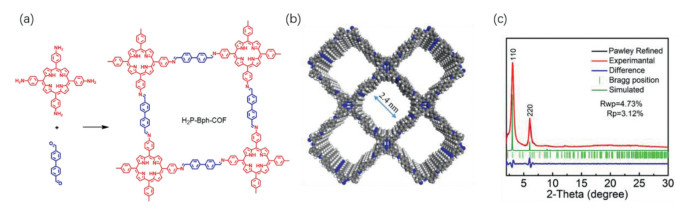
As shown in Fig. 1a, the porphyrin COF of H2P-Bph-COF was synthesized by the acid-catalyzed Schiff-base condensation between 5, 10, 15, 20-tetra(p-amino-phenyl)porphyrin (H2TAPP) and 4, 4′-biphenyldialdehyde under solvothermal conditions (HOAc, o-dichlorobenzene/n-BuOH, 120 ℃, 3 days). H2P-Bph-COF was obtained as the purple crystalline solids [53, 54]. The formation of H2P-Bph-COF was confirmed by Fourier transform infrared (FT-IR). The peaks of 1695 cm−1 for C=O and 3338 cm−1 for N-H were strongly attenuated, while a new characteristic C=N stretching vibration band at 1626 cm−1 was observed in the FT-IR spectrum of H2P-Bph-COF, implying the formation of the imine bond (Fig. S1 in Supporting information). Powder X-ray diffraction (PXRD) analysis indicated the good crystallinity of the obtained H2P-Bph-COF. As shown in Fig. 1c, the PXRD diagram of H2P-Bph-COF exhibited two intense peaks at 3.09° and 6.04°, which were attributed to (110) and (220) planes, respectively. The simulation of its PXRD pattern with Materials Studio (version 2018) suggested that H2P-Bph-COF possessed the 2D network with eclipsed AA-type stacking mode. The Pawley refinement indicated a negligible difference between the simulated and experimental PXRD patterns. H2P-Bph-COF was assigned to the space group P4 with optimized parameters of a = b = 41.49 Å, c = 3.67 Å, α = β = γ = 90°, residuals Rwp = 4.73% and Rp = 3.12%.
Figure 1
Figure 1.
(a) Schematic representation of the synthesis of H2P-Bph-COF (HOAc, o-dichlorobenzene/n-BuOH, 120 ℃, 3 days). (b) Top view of the eclipsed structure proposed for H2P-Bph-COF (gray, C; blue, N; and white, H). (c) Indexed experimental (red), Pawley-refined (black), and simulated (green) PXRD patterns of H2P-Bph-COF. The difference plot is presented in blue.
The porosity of H2P-Bph-COF was investigated by N2 adsorption-desorption measurements at 77 K (Fig. S2 in Supporting information). The Brunauer-Emmett-Teller (BET) surface area of H2P-Bph-COF was determined as 413 m2/g, and the total pore volume was calculated to be 0.32 cm3/g. The pore size distribution was mainly centered at ca. 2.0 nm based on nonlocal density functional theory (NLDFT) (Fig. S3 in Supporting information). The morphology of H2P-Bph-COF was examined by scanning electron microscopy (SEM), which showed that the obtained H2P-Bph-COF features micrometer-scale lamellar morphology (Fig. S4 in Supporting information). Thermogravimetric analysis (TGA) indicated that H2P-Bph-COF remains stable up to ca. 240 ℃, suggesting its good thermal stability (Fig. S5 in Supporting information).
We initially choose N, N-dimethylaniline (1a) and N-phenylmaleimide (2a) as the model substrates to carry out the photocatalytic oxidative annulation reaction. When the mixture, containing the substrates and a catalytic amount of H2P-Bph-COF (8 mol%) as the photocatalyst in DMF, was irradiated by blue LEDs (λ = 450 nm) under an oxygen atmosphere for 12 h, the desired annulated product of 3a was obtained in 50% yield (Table 1, entry 1). Screening of the solvents showed that CHCl3 was the best to give the product in 71% yield, while only a trace amount of annulated product was detected in MeOH or THF under the given conditions (Table 1, entries 2–6). On the other hand, the less catalyst loading (6 mol%) resulted in a lower 66% yield (Table 1, entry 7), while the more catalyst loading of 10 mol% did not lead to higher yield (Table 1, entry 8). In addition, the longer reaction time of 14 h and 16 h caused a slightly higher 76% yield for 3a (Table 1, entries 9 and 10). Further assessment revealed that the oxygen atmosphere is necessary (Table 1, entry 11). Control experiments indicated that both H2P-Bph-COF and visible-light were essential for this aerobic annulation reaction (Table 1, entries 12 and 13). As such, the optimized conditions for synthesis of tetrahydroquinoline are as follows: 0.2 mmol 1a, 0.1 mmol 2a, and 8 mol% H2P-Bph-COF in 3 mL CHCl3, irradiated by blue LEDs under an oxygen atmosphere for 14 h at room temperature.
Table 1
Table 1.
Optimization of the H2P-Bph-COF catalyzed photocatalytic aerobic annulation reaction conditions.a
The leaching test demonstrated that H2P-Bph-COF was a typical heterogeneous catalyst (Fig. S6 in Supporting information), and the yield of the annulation product 3a was still up to 73% after five catalytic runs (Fig. S7 in Supporting information). The measured PXRD pattern of H2P-Bph-COF was intact after five catalytic runs, implying that its excellent stability and recyclability of H2P-Bph-COF in photocatalysis (Fig. S8 in Supporting information).
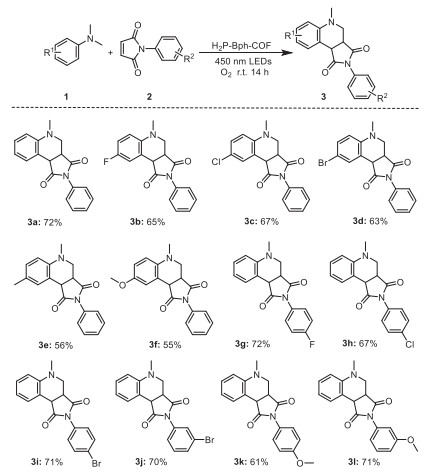
With the optimal reaction condition in hand, we explored the generality of this aerobic reaction. As shown in Scheme 1, a variety of N, N-dimethylanilines with electron-donating or electron-withdrawing groups could smoothly react with N-phenylmaleimide (2a) under the optimized reaction conditions, affording the desired annulated products in moderate-to-good yields (3b-3f). Furthermore, the scope of N-phenylmaleimide was also examined. When the N, N-dimethylaniline (1a) reacted with electronically diverse N-aryl maleimides bearing halogens (3g-3j) and alkoxy (3k-3l) groups at the meta-, and para- positions of aryl ring, the corresponding tetrahydroquinolines were generated in moderate-to-good yields. We have also investigated the scope of N-alkyl maleimides. N-Benzyl maleimide could react with N, N-dimethylaniline to afford the desired product in 32% yield (3m). Only a trace amount of annulated product (3n) was detected for the reaction of N-methyl maleimide with N, N-dimethylaniline (Scheme S3 in Supporting information).
Scheme 1
Scheme 1.
Scope of the H2P-Bph-COF catalyzed photocatalytic aerobic annulation reaction. Reaction conditions: 1 (0.2 mmol), 2 (0.1 mmol), 8 mol% H2P-Bph-COF, 3 mL CHCl3, blue LEDs (λ = 450 nm), 14 h, room temperature, in oxygen. Isolated yields are shown.
To understand the reaction process of the system, cyclic voltammetry of H2P-Bph-COF was performed. As is shown in Fig. S9 (Supporting information), an onset potential at −0.80 V vs. Fc/Fc+, attributable to the redox potential of EH was observed. In addition, the UV–vis diffuse reflectance spectrum of H2P-Bph-COF displayed a broad absorption up to ca. 660 nm, and the optical band gap (Eg) was calculated to be 1.75 eV according to the Tauc plots (Fig. S10 in Supporting information). Thus, the reduction potential of EH was determined to be 0.95 V vs. Fc/Fc+ [55-58]. On the other hand, the oxidation potential of 1a (E1a•/1a) was known as 0.34 V vs. Fc/Fc+[59, 60]. These results proved the thermodynamic feasibility of the photoinduced electron transfer from 1a to H2P-Bph-COF*.
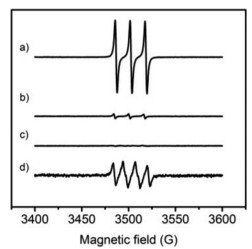
In order to determine the function of molecular oxygen, we performed the electron-spin resonance (ESR) measurement to study the reactive oxygen species (ROS) generated in the system. Thereinto, 2, 2, 6, 6-tetramethylpiperidine (TEMP) was employed as a probe to trap 1O2, and 5, 5-dimethyl-1-pyrroline-N-oxide (DMPO) was used to capture O2• −. As shown in Fig. 2, the characteristic signal of 1O2 was observed when the system containing H2P-Bph-COF and TEMP was irradiated by blue LEDs, and the 1O2 signal was strongly attenuated after the addition of 1a. In contrast, no signal was detected in the system containing DMPO and H2P-Bph-COF irradiated by blue LEDs. However, the characteristic signal of O2• − captured by DMPO was clearly observed after the addition of 1a, indicating the formation of O2• −, a crucial species for the oxidative annulation reaction, via a photoinduced electron transfer process.
Figure 2
Figure 2.
ESR measurements of (a) CHCl3 solution of H2P-Bph-COF and TEMP irradiated by blue LEDs; (b) CHCl3 solution of H2P-Bph-COF, 1a and TEMP irradiated by blue LEDs; (c) CHCl3 solution of H2P-Bph-COF and DMPO irradiated by blue LEDs; (d) CHCl3 solution of H2P-Bph-COF, 1a and DMPO irradiated by blue LEDs.
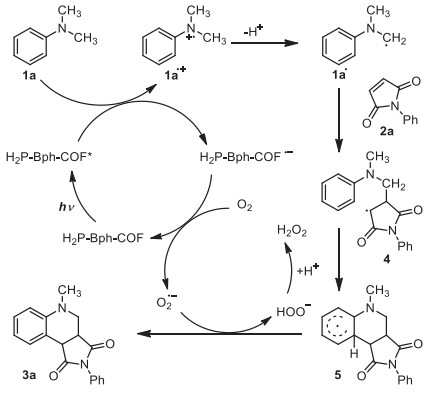
Based on above results and previous reports [22-33], we proposed the reaction mechanism for this transformation. As shown in Scheme 2, upon irradiation by visible-light, the H2P-Bph-COF was activated to its excited state H2P-Bph-COF*. The electron transfer from 1a to H2P-Bph-COF* led to the formation of 1a and H2P-Bph-COF• −. The generated H2P-Bph-COF• − further reacted with O2 to produce O2• −, accompanying the regeneration of H2P-Bph-COF. Meanwhile, the generated 1a further lose one proton to afford α-aminoalkyl radical 1a, which followed to react with 2a to produce radical 4. Subsequently, the generated 4 underwent cyclization to form intermediate 5. Finally, the oxidation and deprotonation of intermediate 5 assisted by O2• − afforded the desired product 3a, with the formation of H2O2.
In summary, we report a metal-free porphyrin COF and its application in photocatalytic oxidative annulation reaction of N, N-dimethylanilines with maleimides. Upon visible-light irradiation, the metal-free H2P-Bph-COF can be a highly efficient heterogeneous and reusable photocatalyst to promote the formation of various substituted tetrahydroquinolines in moderate to good yields under mild conditions. We believe that the photoactive COF-based synthetic protocol herein not only provides a green and facile way to access tetrahydroquinolines synthesis, but also significantly expands the application scope of COF-based catalysts.
Declaration of competing interest
The authors declare that they have no known competing financial interests or personal relationships that could have appeared to influence the work reported in this paper.
Acknowledgments
We are grateful for the financial support from the National Natural Science Foundation of China (Nos. 22101158, 22171169, 21971153 and 21772116), the Natural Science Foundation of Shandong Province (No. ZR2021MB088), the Taishan Scholars Climbing Program of Shandong Province, the Taishan Scholar Project of Shandong Province, and the Major Basic Research Projects of Shandong Natural Science Foundation (No. ZR2020ZD32).
Supplementary materials
Supplementary material associated with this article can be found, in the online version, at doi:10.1016/j.cclet.2022.01.065.
[1]
A. Cappelli, C. Nannicini, S. Valenti, et al., ChemMedChem 5 (2010) 739–748. doi: 10.1002/cmdc.200900523
[2]
K. Grychowska, G. Satała, T. Kos, et al., ACS Chem. Neurosci. 7 (2016) 972–983. doi: 10.1021/acschemneuro.6b00090
S. Lin, C.S. Diercks, Y.B. Zhang, et al., Science 349 (2015) 1208–1213. doi: 10.1126/science.aac8343
[55]
N.J. Turro, V. Ramamurthy, J.C. Scaiano, Modern Molecular Photochemistry of Organic Molecules, University Science Books, Sausalito, CA, 2010, p. 252. doi: 10.1111/j.1751-1097.2012.01178.x
[56]
W. Huang, Z.J. Wang, B.C. Ma, et al., J. Mater. Chem. A 4 (2016) 7555–7559. doi: 10.1039/C6TA01828A
Figure 1
(a) Schematic representation of the synthesis of H2P-Bph-COF (HOAc, o-dichlorobenzene/n-BuOH, 120 ℃, 3 days). (b) Top view of the eclipsed structure proposed for H2P-Bph-COF (gray, C; blue, N; and white, H). (c) Indexed experimental (red), Pawley-refined (black), and simulated (green) PXRD patterns of H2P-Bph-COF. The difference plot is presented in blue.
Figure 2
ESR measurements of (a) CHCl3 solution of H2P-Bph-COF and TEMP irradiated by blue LEDs; (b) CHCl3 solution of H2P-Bph-COF, 1a and TEMP irradiated by blue LEDs; (c) CHCl3 solution of H2P-Bph-COF and DMPO irradiated by blue LEDs; (d) CHCl3 solution of H2P-Bph-COF, 1a and DMPO irradiated by blue LEDs.



 DownLoad:



 下载:
下载: