Citation:
Hu Jun, Zhu Pengcheng, Li Yanmei, Chen Yongxiang. Synthesis of Ras proteins and their application in biofunctional studies[J]. Chinese Chemical Letters,
2018, 29(7): 1043-1050.
doi:
10.1016/j.cclet.2018.05.035
Synthesis of Ras proteins and their application in biofunctional studies
Key Laboratory of Bioorganic Phosphorus Chemistry and Chemical Biology(Ministry of Education), Department of Chemistry, Tsinghua University, Beijing 100084, China
Received Date:
23 April 2018 Accepted Date:
18 May 2018 Revised Date:
17 May 2018 Available Online:
22 July 2018
Abstract:
Approximately 30% of human cancers are associated with RAS mutation. Ras proteins on the plasma membrane regulate a plenty of important cellular processes. The post-translational modifications (PTMs) of Ras proteins like lipidation and methylation are crucial for their correct cellular localization and biological function. Hence, obtaining Ras proteins with different kinds of modifications is the necessary prerequisite to investigate their biological properties at molecular level. In this review, we mainly summarize the developed strategies including chemical total synthesis, biosynthesis and semi-synthesis for producing Ras proteins with modifications and their application in biological studies.
Ras proteins function as molecular switches in some important
cellular signaling pathways through cycling between active GTPbound state and inactive GDP-bound state, which regulate plenty
of cell processes, including cell survival, proliferation, differentiation, apoptosis and cytoskeletal dynamics [1]. The genetic
mutations of RAS genes that persistently activate downstream
signaling pathways, can cause cancers. About 30% of human
cancers are associated with RAS mutations [2]. In order to trigger
the downstream signaling, Ras proteins must bind to the inner face
of plasma membrane, which requires the lipid and methyl
modifications at the C-terminal tail of proteins. These protein
post-translational modifications (PTMs) play a key role in
regulating membrane association and cellular process of Ras
proteins, like trafficking process and protein-protein interactions
[3]. However, lacking appropriate protein tools with PTMs had
been a big hindrance to the biofunctional studies of Ras proteins. In
recent years, the chemical biology approaches, like protein
chemical synthesis and semi-synthesis, have experienced huge
advances and brought great chances to obtain Ras proteins with
multi-modifications. These synthesized Ras proteins largely
facilitate the related functional research. Thus, this mini-review
mainly summarizes recent strategies for the synthesis of Ras
proteins and their applications in biofunctional studies.
2.
Ras proteins
Ras proteins are guanine nucleotide-bound proteins
(G proteins), which are encoded by RAS genes. RAS subfamily
contains three genes (NRAS, HRAS and KRAS), which can translate
into four protein isoforms: N-Ras, H-Ras, K-Ras4A and K-Ras4B [4].
All of Ras proteins are composed of two parts: one is the G domain
(the first 165 amino acids), which is highly conserved; the other is
the hypervariable region (HVR), which contains approximately 20
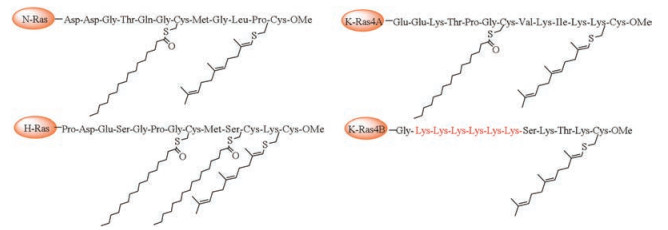
amino acids (Fig. 1). Ras proteins are under a dynamic equilibrium
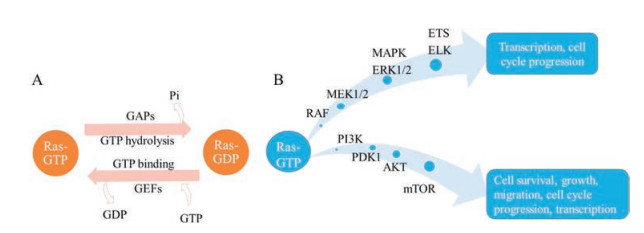
between 'on' and 'off' conformations which are conferred by GTP
and GDP exchanging. Normally, the active GTP-bound state can be
switched to the inactive GDP-bound state by GTPase activating
proteins (GAPs, accelerating GTP hydrolysis and GDP binding). The
exchange of GDP-Ras for GTP-Ras is regulated by guanine
nucleotide exchange factors (GEFs, stimulating the release of
GDP) [1].
Figure 1
Figure 1.
The hypervariable region (HVR) of four Ras proteins. N-Ras and K-Ras4A contains palmitoyl and farnesyl groups. H-Ras contains two palmitoyl and farnesyl groups. KRas4B contains farnesyl group and polybasic lysine. Reproduced with permission [5]. Copyright 2014, Elsevier Ltd
Ras proteins play a significant role in cellular signaling
pathways and regulate a serial of biological events, including cell
survival, cell adhesion, apoptosis and cellular metabolism. When
Ras proteins bind to GTP, they trigger the downstream signals.
There are two main Ras signaling pathways, MAPK (RAF/MEK/ERK)
pathway and PI3K/PDK/AKT pathway [5]. The MAPK pathway
requires the dimerization of Ras. Dimerized Ras activates RAF, which promotes the phosphorylation of MEK1/2, and further
activates the ERK1/2, resulting in the growth of cell. Ras can also
effectively activate PI3K/PDK/AKT pathway. Receptor tyrosine
kinase (RTK) and Ras binding to PI3K give rise to the phosphorylation of PI3K, which recruit the AKT with the help of PDK1, leading
to the activation of mTOR. (Fig. 2B) [6].
Figure 2
Figure 2.
The cycle and signaling pathways of Ras proteins. (A). GTP-Ras is the active form, and the GTP can be hydrolyzed with the help of GAPs, resulting in the inactive GDPbound Ras; GDP-Ras is the inactive form, and the GDP can be released with the help of GEFs, resulting in the active GTP-bound Ras. (B). Two main Ras-involved signaling
pathways in cellular process. One is MAPK pathway, another one is PI3K pathway. Reproduced with permission [5]. Copyright 2014, Elsevier Ltd.
In order to activate the downstream signaling, Ras proteins
must localize to the plasma membrane, and the PTMs of Ras
proteins are indispensable for their enrichment on the plasma
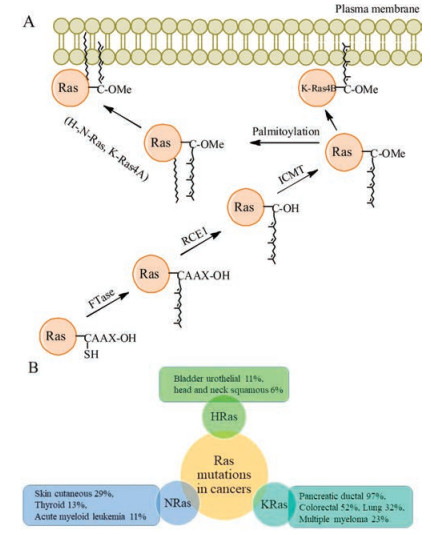
membrane. The nascent Ras proteins contain a CAAX motif at its
C-terminus, which is further modified by a series of enzymes, including prenyltransferases (farnesyltransferase or geranylgeranyltransferase type Ⅰ, adding farnesyl or polyisoprene group to the
CAAX Cys), RAS-converting enzyme 1 (RCE1, removing the AAX
motif), isoprenyl cysteine transferase (Icmt, adding the methyl
ester to the carboxyl group of farnesylcysteine) [7]. These
modifications largely enhance the binding affinity of Ras proteins
to the inner face of plasma membrane for triggering the
downstream signals (Fig. 3A).
Figure 3
Figure 3.
The process of Ras proteins' PTMs and the frequency of Ras mutations in
various human cancers. (A) Ras proteins undergo three enzymes-catalyzed
reactions at least to get the lipid and methyl modifications for targeting the
plasma membrane [4]. (B) The mutation frequencies of Ras proteins differ in
disparate cancers [9]
The activated RAS genes due to mutation were identified in
human cancer for the first time in 1982 [8, 9]. Subsequent research
found that RAS genes are among the most frequently mutated genes
in human cancer. 97% of pancreatic ductal adenocarcinoma and 52%
of colorectal adenocarcinoma are related to KRAS mutations, 29% of
skin cutaneous melanoma and 13% of thyroid carcinoma are
associated with NRAS mutations, and 11% of Bladder urothelial
carcinoma are relevant to HRAS mutations [6, 9] (Fig. 3B). Thus, Ras
proteins are important anticancer drug targets, and scientists have
dug into them for many years. However, decades of research have
not yet produce a Ras-targeting drug for clinical use. In the early
days, the research focused on interfering GTP binding to the Ras
proteins [10]. But Ras proteins turned out to have a high affinity for
GTP so that the GDP-like drugs were not effective [11-13]. Later, the
research moved on to destroy the function of Ras proteins by
inhibiting farnesyltransferase to disturb the binding affinity of Ras
proteins and plasma membrane [9, 14-16]. It looked like a winning
solution, but unfortunately it failed in clinical trials. Besides, there
are no suitable pockets for small molecules to bind with Ras
proteins' surfaces. Ras proteins are so called "undruggable" [17].
Thus, uncovering the mechanisms of regulating Ras proteins'
activity is important for developing anti-Ras therapeutics.
Over the past decades, scientists have spared no efforts on figuring
out the whole structure of Ras proteins, as well as the role of modified
Rasproteins in cellularprocesses.Due to the flexibilityand complexity
of the C-terminal structure in Ras proteins, these questions have been
difficult to be fully addressed. Thus, the scientists made efforts to
prepare the full-length Ras proteins with multi-modifications for
exploring the function of Ras protein, the mechanism of Ras signaling, and anti-Ras drug design. In this review, we summarize current
strategies for obtaining Ras proteins with multi-modifications, and
their applications for in vitro and in vivo biofunctional studies.
3.
Strategies for obtaining Ras proteins
Till now, there are various approaches to obtain Ras proteins, such as purifying from E. coli cells [18, 19] or particular mammalian
tissues [20], chemical total synthesis, and semi-synthesis. In this
chapter, we mainly introduce the methods of obtaining Ras
proteins with modifications.
3.1
Total synthesis of Ras proteins
With the advancing of protein synthesis technology, it becomes
not so difficult to synthesize desired proteins. Remarkably, Kent
and Muir devised simple techniques of native chemical ligation
(NCL) and expressed protein ligation (EPL), which indicated that
the field of protein synthesis entered a new era [21-23]. After that, more and more innovative protein ligation techniques have been
developed, such as serine/threonine ligation [24-28], peptide
hydrzides-mediated NCL [29-31]. Meanwhile, many proteins with
different PTMs have been obtained through protein chemical
synthesis or semi-synthesis, such as phosphorylated proteins, glycosylated proteins, ubiquitinated proteins and lipidated proteins [32-40].
In 2017, Danishefsky's group prepared two truncated K-Ras
(G12 V) proteins variant (1–166) containing all-L or all-D type
amino acids without PTMs via chemical total synthesis [41].
Although it is easy to obtain the all-L K-Ras through recombinant
protein expression in E. coli, the all-D variant can only be produced
via chemical synthesis. This protein material enables the mirrorimage display screening to identify all-D peptide inhibitors of
oncogenic K-Ras, which facilitates developing anti-Ras therapies.
However, the comparative low yield of chemical total synthesis
limits the preparative scale of Ras proteins.
3.2
Biosynthesis of Ras proteins with modifications
Due to the importance of the C-terminal PTMs of Ras proteins, Ras proteins with lipidation were acquired through the incubation
of nascent protein with farnesyl transferase to study the MAP
kinase activation system [42, 43]. However, it cannot fully
represent the lipidated Ras proteins in vivo, which undergo several
further enzyme-catalyzed modifications. In 2015, Stephen's group
obtained full-length K-Ras4B proteins with farnesylation and
methylation using the insect cell expression system [44], which is a
big breakthrough for the preparation of K-Ras4B proteins.
3.3
Semi-synthesis of Ras protein with modifications
Though recombinant protein expression is a useful method to
obtain Ras proteins, there still exist lots of limits. For example, the
common prokaryote systems like E. coli lack machines to undergo
protein posttranslational modifications; the eukaryote systems
often suffer from low protein expression level and heterogeneous
PTMs. Chemical total synthesis provides much more freedom to
introduce all kinds of modifications into proteins, but it is often
expensive and time-consuming. By combining the advantages of
both protein expression and chemical synthesis, protein semisynthesis has become a powerful strategy to prepare proteins with
homogeneous multi-PTMs in a considerable amount [45, 46]. Ras
proteins contain important lipid and methyl modifications in the
C-terminal. Thus, according to the protein semi-synthesis strategy, the N-terminal parts of Ras proteins without PTMs can be easily
obtained via recombinant protein expression while the C-terminal
peptides with PTMs can be produced through chemical synthesis.
In the end, both two parts are ligated to generate full-length Ras
proteins with multi-PTMs. Moreover, additional tags like fluorophores and isotope elements for biophysical assays can also be
site-specifically incorporated into synthesized proteins.
3.3.1
The strategies of lipopeptides synthesis
The HVR regions of Ras proteins often contain more than one
PTM including lipids and methyl ester C-terminus. In particular, farnesyl group is acid-labile, which is not compatible with
common peptide cleavage and deprotection conditions using
strong acids. A variety of methods to synthesize lipopeptide and
ligation strategies to incorporate the peptides into Ras proteins
have been developed [47]. With the technique of peptide synthesis
developed continuously, the strategies of lipopeptides synthesis
have shifted from liquid phase synthesis to solid phase synthesis, from Boc protecting group strategies to Fmoc protecting group
strategies, from lipidated amino acids building block synthesis to
lipidation of peptides site specifically. The yield and simplicity
increased significantly and continuously.
Waldmann's group synthesized S-palmitoylated and S-farnesylated C-terminal peptide of the human N-Ras protein by using
dipeptides building blocks, of which acetate protecting group can
be deprotected in a mild condition by lipase from Mucor miehei
[48] (Scheme 1). The cysteine with farnesyl and methyl
modifications were synthesized in classical chemical methods as
a starting point and then attached with next dipeptide building
blocks in a liquid phase. The combination of classical chemical
synthesis methods and enzymatic technique can help to obtain
various Ras lipopeptides.
Scheme 1
Scheme 1.
The dipeptides building blocks synthesis in a mild condition with lipase
from Mucor miehei
With the linker strategies developed, the pre-lipopetides can be
anchored on different kinds of resins, and be further elongated
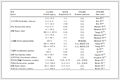
following solid phase peptide synthesis (SPPS) strategies (Table 1)
[49]. Thus, the modification sites were first protected with
different groups, which were respectively deprotected and further
transformed into different PTMs site-specifically. In 2001, Poulter's group [50] first used Kaiser benzophenone oxime linker to
synthesize a CAAX region peptide of Ras protein with a farnesyl
group at the N-terminal cysteine using Boc-based SPPS strategy.
Additional biotin tag was attached on the N-terminus of the
tetrapeptide and then it was released under a mild base condition.
Table 1
Table 1.
Different linkers for solid-phase peptides synthesis of lipopeptides [49]
Waldmann's group improved the linker strategies so that
lipopeptides were easily synthesized using other two kinds of
linkers. With an aryl hydrazide linker [51], the resin loading
process and elongation of peptide were carried on following Fmocbased SPPS strategy. Hydrazide linker was cleaved under
nucleophilic aerobic conditions, and the obtained peptide could
be either an ester or an amide. H-Ras and N-Ras peptides with two
or three lipids modification and methylation were firstly synthesized by this strategy. Another one is Ellman alkyl sulfonamide
linker [52, 53]. This linker is stable to be treated with either acid or
base condition. The target peptides were released under a mild
condition by selective N-alkylation and attack of different
nucleophiles, obtaining a product of an ester or an amide. HRas, N-Ras and K-Ras4B peptides with one or two lipid modification and methylation reached a yield of over 60%.
In 2012, Distefano's group synthesized peptides with cysteine
methyl esters C-terminus through Trt-Cl resins, which can befurther
farnesylated in liquid phase after their releasing from resins [54].
They developed a new strategy for synthesizing peptides containing
a C-terminal cysteine methyl ester. According to this strategy, an
Fmoc-Cys-OMe building block was first attached onto 2-Cl Trt-Cl or
Trt-Cl resins via its side-chain thiol group, and the peptide sequence
was further elongated following standard Fmoc-based SPPS
procedures. In the end, the free thiol group of the peptide Cterminal cysteine methyl ester was modified by farnesyl group with
trans, trans farnesyl bromide after the cleavage of peptides from
resins.Otherlipopeptideswithmulti-PTMs, for example C-terminal
of LC3-II protein and Rheb protein, can be obtained using the same
linker strategies [55-57]. In 2017, our group firstly semi-synthesized the full-length K-Ras4B protein modified with phosphate, farnesyl and methyl groups [58]. The farnesyl moiety cannot
accommodate with strong acids, which is applied in the cleavage of
phosphoryl ester. Thus, we employed the similar strategy with
Distefano's one to add the farnesyl group into the peptide in liquid
phase afterits releasingfrom resinsbyTFA. Finally, theK-Ras4BHVR
region peptide containing these three modifications was successfully synthesized in a high yield. With a cysteine attached in the
N-terminal of the peptide, it was easily coupled with expressed
K-Ras4B protein thioester by means of NCL reaction.
3.3.2
The strategies of protein conjugation
After the synthesis of lipopeptides, the way to attach the
peptides to expressed truncated protein is another key factor
affecting the yield of protein synthesis.
Kent and his coworkers developed NCL reaction in 1994 [21], leading to a high yield of peptide conjugation products
(Scheme 2A). The NCL reaction involves two reactants. One is
peptide C-terminal thioester and the other is peptide with a
cysteine residue at its N-terminus. The thiol group of N-terminal
cysteine of one peptide attacks the C-terminal thioester group of
another peptide to form a new peptide thioester. Then, the amino group of cysteine attacks the new peptide thioester to undergo an
S, N-acyl shift and finally a native amide bond forms between two
peptide reactants.
Scheme 2
Scheme 2.
Two major methods for protein native ligation [21, 22, 47]. (A) Native chemical ligation. (B) Expressed protein ligation
Protein thioester can be generated through the split of protein
intein strategy and be further used to link with another peptide or
protein fragment containing an N-terminal cysteine via NCL [22]
(Scheme 2B). This strategy is called expressed protein ligation
(EPL). With these powerful techniques, it is possible to obtain Ras
protein with multi-PTMs easily. Take a process of Ras protein
synthesis as an example, the expressed truncated protein fused to
intein can be pulled down according to the designed affinity tag
binding to the beads. The purified protein fusion undergoes an S, N-acyl shift and a transthioesterification reaction with MESNa (2-
mercaptoethanesulfonate), resulting a newly formed protein
thioester. Through an NCL reaction the lipopeptides can be coupled
with the protein thioester easily. In 2006, Waldmann's group firstly
used an intein mediated EPL reaction for attaching the lipopeptides
to expressed protein thioesters and obtained functional H-Ras and
K-Ras4B proteins [59]. In 2010, this group also synthesized
functional Rheb protein according to the EPL strategy [57].
Besides powerful NCL and EPL, there are other methods to
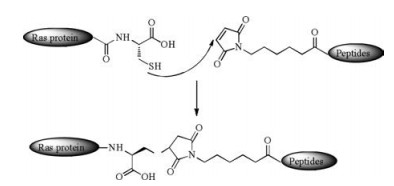
conjugate lipopeptides with the expressed proteins. The MIC
ligation reaction (Scheme 3) is an efficient method in protein
engineering, which proceeds under a neutral pH condition
between a maleimido group within a peptide and a cysteine
residue at the C-terminus of truncated protein. The thiol group of
cysteine attacks the maleimido group and forms a stable addition
product, so that the peptides with multi-PTMs can be incorporated
into truncated Ras proteins mildly. In 2000, Waldmann's group
synthesized functional H-Ras lipoproteins with fluorescent tags for
in vivo studies using MIC ligation [60]. In 2003, they improved the
methods and succeeded in synthesizing functional H-Ras and NRas lipoproteins on solid support [61].
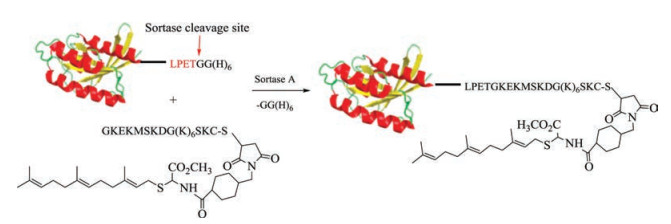
Pollok's group reported sortase-mediated ligation as a useful
tool for protein engineering in 2004 (Fig. 4) [62]. Sortase A, a kind
of transpeptidase, can recognize the specific peptide sequence
(Leu-Pro-Glu-Thr-Gly) of substrate and cleave this motif after the
Thr residue to form a protein thioester. Then, the Gly residue at
the N-terminus of lipopeptide can attack the protein thioester
leading to the formation of a native amide bond. In 2012, Dementiev's group used a sortase ligation for obtaining functional K-Ras4B protein with farnesyl and methyl modifications, which
was further applied to study K-Ras4B protein's properties and
dimer formation [63].
Figure 4
Figure 4.
Sortase-mediated ligation in K-Ras4B protein synthesis. Reproduced with permission [63]. Copyright 2012, Elsevier Inc
As we can see, the ligation reactions play a key role in the semisynthesis of Ras protein due to their high yield and simplicity, although they may introduce an insertion of additional cysteine
residue or other linkers into Ras protein.
3.4
Summary and prospects of Ras protein synthesis
All these strategies introduced above to obtain Ras proteins
with PTMs have their own advantages and disadvantages.
Chemical total synthesis is an effective way to obtain Ras proteins
with all kinds of PTMs, but it is often expensive and timeconsuming. In addition, this strategy sometimes meets the
difficulty of refolding synthesized protein correctly. The biosynthesis approach is potential to generate a great amount of Ras
proteins with PTMs in an economic way. However, the produced
proteins in eukaryote system usually contain incomplete and
heterogeneous PTMs. The semi-synthesis strategy combines the
advantages of both chemical synthesis and recombinant protein
expression. In particular, the important PTMs of Ras proteins
including farnesylation, methylation and phosphorylation mainly
localize in their C-terminal region. Thus, the semi-synthesis
strategy appears to be the most useful one to generate Ras
proteins with multi-PTMs in milligram scale for further application
in biofunctional studies.
4.
Biophysical researches with synthesized Ras proteins
Ras proteins bind to the inner face of plasma membrane with
the help of lipidated HVR peptides, and initiate the downstream
signaling pathway. Besides, lipidation is also responsible for the
subcellular localization of Ras proteins and their interaction with
the chaperon protein for transportation [64]. Ras proteins have
been studied since 1980 s, while most biochemical studies and
structural research of these proteins have been done using
truncated proteins without the C-terminal HVR or full-length
proteins produced in bacteria without PTMs. For the purpose of
figuring out the structure and function of Ras proteins with PTMs in
vitro and in vivo, it is essential to obtain the multi-modified
proteins in a high yield and quality [44]. With the development of
efficient synthetic strategies for generating Ras proteins with
multi-modifications, more and more biofunctional research
employing these material have been carried out and addressed
a serial of important issues that could not be answered in previous
time. In this part, we mainly focus on the biophysical studies using
synthesized Ras proteins.
4.1
Ras proteins in the membrane
The association with plasma membrane is necessary for Ras
proteins to transduce the downstream signal. But the molecular
mechanism of Ras proteins-plasma membrane interaction had
been not understood in depth before the multi-modified Ras
proteins, especially the one with prenylation, were obtained.
Scientists have done a lot of cellular research by the means of
overexpressing Ras proteins, knocking out the genes of relative
enzymes and other in vivo technique. Nevertheless, there still
existed a lot of questions about the interaction between Ras
proteins and plasma membrane that could not be well addressed
through the in vivo studies. For example, how Ras proteins interact
with plasma membrane at molecular level, how Ras proteins
change their conformation in plasma membrane, and in which
subdomain of plasma membrane Ras proteins localize. However, the biofunctional research using synthetic Ras proteins with lipid
modification provided a lot of information for answering these
questions [65].
The research on lipidated Ras proteins was promoted by the
development of protein semi-synthesis strategies. In 1990 s, Gelb's
group obtained H-Ras protein with farnesyl modification incorporated by use of farnesyltransferase, and the following research
showed that farnesylation is critical for the Ras signaling [42, 43].
Kuhlmann and his co-workers obtained the H-Ras protein
containing lipidated HVR by use of semi-synthesis strategy for
the first time, which was further proved to be a valuable tool for
biophysical researches [66].
However, it is difficult to carry out the experiments between
lipidated proteins and the plasma membrane since the phospholipid in the membrane is similar to the lipidated chains of
proteins, which makes the lipid chains and membrane component undistinguishable. To tackle this problem, a lot of new
method and technology had been proposed, like fluorescence
probes, 2H-labelling of the lipid chains [67-71]. Gorfe's group
made use of the triply lipidated peptides of H-Ras to study the
behavior of Ras proteins in different membrane domain. The data
showed that lipidated chains play an important role in H-Rasmembrane association as well as forming protein nanoclustering
in different membrane nanodomains [72]. Both Winter's and
Huster's groups took the advantage of semi-synthetic lipidated
proteins for a serial biophysical research including investigating
the chain length of proteins adapted to the membrane and
studying the distribution of proteins in multiphasic artificial
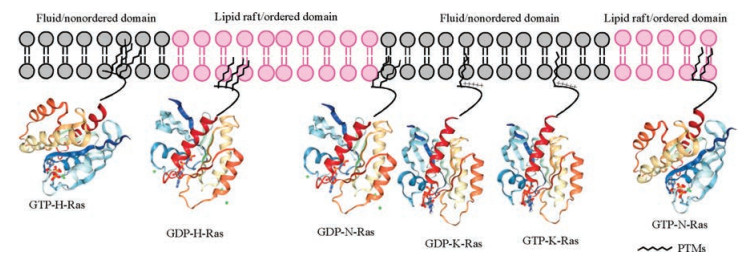
membrane, [73-75]. Their research came to conclusions that HRas and N-Ras were enriched in liquid order domains of
membrane, whereas K-Ras4B stayed in liquid disorder domains
of membrane (Fig. 5).
Figure 5
Figure 5.
The specific affinity of different Ras isoforms with different microdomains of plasma membrane. Reproduced with permission [76]. Copyright 2015, American
Association for Cancer Research
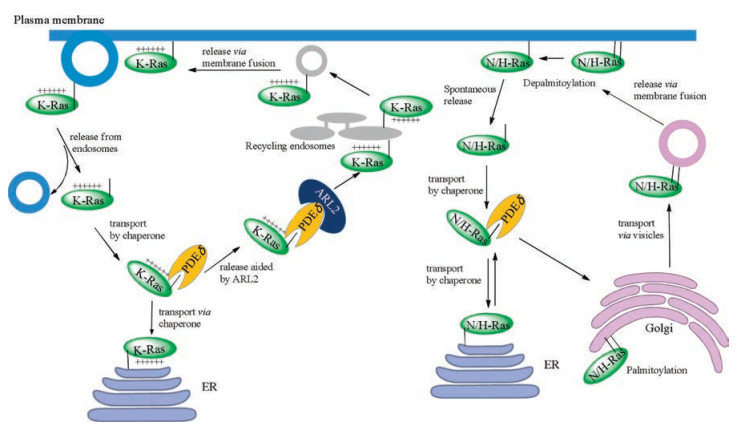
In order to target plasma membrane, N-Ras and H-Ras were
transported by vesicle from Golgi through secretory pathway, after
they were palmitoylated in the Golgi (Fig. 6) [77]. As for K-Ras4B, it
does not contain additional cysteine in its HVR for palmitoylation.
Thus, it was transported via an uncharacterized pathway [78].
Some of shuttle proteins were proposed in this trafficking pathway
[79, 80], and the most promising one is GDI-like solubilizing factor
PDEδ. After Waldmann's group obtained modified Rheb and KRas4B proteins via semi-synthesis [57], Wittinghofer's group
further reported the complex structure of PDEδ and farnesylated
Rheb, which provided a great explanation to the mechanism of
these two proteins' interaction [81]. Meanwhile, Bastiaens's group
did a serial of experiments in vivo, demonstrating that PDEδ could
sequester farnesylated K-Ras4B in accord with Wittinghofer's data
in vitro and regulate the cellular localization of K-Ras4B proteins
[82]. Recently, Simanshu's group obtained the multi-modified KRas4B proteins using Stephen's insect system [44], and got the
complex structure of multi-modified K-Ras4B and PDEδ [83]. They
verified those farnesyl and methyl group are essential for the
interaction of K-Ras4B with PDEδ.
Figure 6
Figure 6.
The transport system of different Ras isoforms. Reproduced with permission [5]. Copyright 2014, Elsevier Ltd
Due to the fluidity of plasma membrane, the depth of
isoprenylation inserting into the plasma membrane is alterable, and Ras proteins can release from the plasma membrane, thus
regulating cellular signaling [71, 76, 82]. K-Ras4B protein dissociated from the plasma membrane enters into the cytoplasm and
interacts with PDEδ. The Arf-like GTPase Arl2 can bind to the
allosteric site of PDEδ, leading to the conformational change of
PDEδ and release of K-Ras4B from PDEδ [81]. After that, K-Ras4B is
in the surrounding area of nucleus where recycling endosome (RE)
is rich. K-Ras4B prefers to bind to the RE membrane, because of the
negatively charged surface of RE membrane [84].
When H-Ras contains two palmitoyl groups, it displays a high
binding affinity to plasma membrane and cannot spontaneously
dissociate from it. In the state of depalmitoylation, H-Ras is soluble
in the cytoplasm and can interact with PDEδ. N-Ras contains one
palmitoyl group and the process of depalmitoylation will decrease
its association with the membrane too. Then, N-Ras is delivered to
the Golgi by PDEδ (Fig. 6) [85].
In addition, some other factors including protein phosphorylation and Ca2+/calmodulin (CaM) can also affect the association
of K-Ras4B with plasma membrane. The cellular K-Ras4B can be
phosphorylated at the site of Ser181 [58, 86, 87]. Our group has
semi-synthesized K-Ras4B proteins possessing phosphate, farnesyl and methyl moieties, and further employed them to explore
the effects of phosphorylation on interaction between K-Ras4B
and membrane by means of biophysical techniques like fluorescence polarization, frequency-domain fluorescence anisotropy, and infrared reflection-absorption spectroscopy. Our
studies demonstrate that phosphorylation of K-Ras4B at Ser181
decreases its binding affinity with membrane, in a membrane
fluidity-dependent manner. Meanwhile, this phosphorylation at
Ser181 does not weaken K-Ras4B's binding with its transport
protein PDEδ in cytoplasm. Besides, phosphorylated K-Ras4B
maintains the localization in the liquid-disorder domain of
membrane [58]. It has been found that the poly-lysine domain
of K-Ras4B can interact with Ca2+/CaM, and the farnesyl group can
bind to the pocket of Ca2+/CaM [88, 89]. Winter's group has done
some biophysical research using semi-synthesized K-Ras4B
proteins combined different techniques, like Surface plasmon
resonance, atomic force microscope, etc. The results proved that
Ca2+/CaM can sequester membrane-bound K-Ras4B and the
interaction between two proteins is independent of Ras guanine
nucleotide state [89].
5.
Summary
Ras proteins play a key role in some important cellular signaling
pathways that regulate many essential cell events. Mutational
activation of Ras proteins is among the most powerful drivers of
cancer. The nascent Ras proteins undergo a serial of posttranslational modification reactions to possess lipids and methyl
moieties, which are required for their association with plasma
membrane to trigger the downstream signaling. So, it is very
necessary to obtain Ras proteins with all kind of PTMs for
investigating their biofunction. The research history of Ras proteins
has seen the great advantages of protein synthesis. As we
summarized in this review, chemical total synthesis, biosynthesis
and semi-synthesis strategies have been developed for obtaining
Ras proteins with PTMs. The three strategies have their own
advantages and disadvantages. Generally, Ras protein semisynthesis is more popular since it combines the flexibility of
chemical synthesis and the efficiency of protein expression.
Meanwhile, the synthesized multi-modified Ras proteins provide
a great chance to investigate their biological function deeply at
molecular level, including the behaviors of Ras proteins in the
membrane (like their mobility, orientation and association with
the plasma membrane), as well as protein-protein interactions
between Ras and their transport proteins.
Acknowledgment
We are grateful to the National Natural Science Foundation of
China (Nos. 21672125, 91753122).
[1]
Y. Pylayeva-Gupta, E. Grabocka, D. Bar-Sagi, Nat. Rev. Cancer 11(2011) 761-774. doi: 10.1038/nrc3106
H. Jang, A. Banerjee, T. Chavan, V. Gaponenko, R. Nussinov, J. Biol. Chem. 292(2017) 12544-12559. doi: 10.1074/jbc.M117.785063
[89]
B. Sperlich, S. Kapoor, H. Waldmann, R. Winter, K. Weise, Biophys. J.111(2016) 113-122. doi: 10.1016/j.bpj.2016.05.042
Figure 1
The hypervariable region (HVR) of four Ras proteins. N-Ras and K-Ras4A contains palmitoyl and farnesyl groups. H-Ras contains two palmitoyl and farnesyl groups. KRas4B contains farnesyl group and polybasic lysine. Reproduced with permission [5]. Copyright 2014, Elsevier Ltd
Figure 2
The cycle and signaling pathways of Ras proteins. (A). GTP-Ras is the active form, and the GTP can be hydrolyzed with the help of GAPs, resulting in the inactive GDPbound Ras; GDP-Ras is the inactive form, and the GDP can be released with the help of GEFs, resulting in the active GTP-bound Ras. (B). Two main Ras-involved signaling
pathways in cellular process. One is MAPK pathway, another one is PI3K pathway. Reproduced with permission [5]. Copyright 2014, Elsevier Ltd.
Figure 3
The process of Ras proteins' PTMs and the frequency of Ras mutations in
various human cancers. (A) Ras proteins undergo three enzymes-catalyzed
reactions at least to get the lipid and methyl modifications for targeting the
plasma membrane [4]. (B) The mutation frequencies of Ras proteins differ in
disparate cancers [9]
Figure 5
The specific affinity of different Ras isoforms with different microdomains of plasma membrane. Reproduced with permission [76]. Copyright 2015, American
Association for Cancer Research



 DownLoad:




 下载:
下载:



