Login In
Crystallization-induced phosphorescence of pure organic luminogens
- Corresponding author: Chun-Rui Wang, luminogens.wzhyuan@sjtu.edu.cn Yong-Ming Zhang, ymzsjtu@gmail.com
Figures(10)
Citation:
Chun-Rui Wang, Yong-Yang Gong, Wang-Zhang Yuan, Yong-Ming Zhang. Crystallization-induced phosphorescence of pure organic luminogens[J]. Chinese Chemical Letters,
;2016, 27(8): 1184-1192.
doi:
10.1016/j.cclet.2016.05.026

Figures(10)


(a) S.K. Lower, M.A. El-Sayed, The triplet state and molecular electronic processes in organic molecules, Chem. Rev. 66(1966) 199-241; (b) C.J. Fischer, A. Gafni, D.G. Steel, J.A. Schauerte, The triplet-state lifetime of indole in aqueous and viscous environments: significance to the interpretation of room temperature phosphorescence in proteins, J. Am. Chem. Soc. 124(2002) 10359-10366.
(a) Y.G. Ma, H.Y. Zhang, J.C. Shen, C.M. Che, Electroluminescence from triplet metal-ligand charge-transfer excited state of transition metal complexes, Synth. Met. 94(1998) 245-248; (b) M.A. Baldo, D.F. O'brien, Y. You, et al., Highly efficient phosphorescent emission from organic electroluminescent devices, Nature 395(1998) 151-154.
D. Lee, J. Jung, D. Bilby. A novel optical ozone sensor based on purely organic phosphor[J]. ACS Appl. Mater. Interfaces, 2015,7:2993-2997. doi: 10.1021/am5087165
(a) Q.L.M. de Chermont, C. Chanéac, J. Seguin, et al., Nanoprobes with nearinfrared persistent luminescence for in vivo imaging, Proc. Natl. Acad. Sci. U. S. A. 104(2007) 9266-9271; (b) Q. Zhao, C.H. Huang, F.Y. Li, Phosphorescent heavy-metal complexes for bioimaging, Chem. Soc. Rev. 40(2011) 2508-2524.
G.Q. Zhang, G.M. Palmer, M.W. Dewhirst, C.L. Fraser. A dual-emissivematerials design concept enables tumour hypoxia imaging[J]. Nat. Mater., 2009,8:747-751. doi: 10.1038/nmat2509
Y.H. Deng, D.X. Zhao, X. Chen. Long lifetime pure organic phosphorescence based on water soluble carbon dots[J]. Chem. Commun., 2013,49:5751-5753. doi: 10.1039/c3cc42600a
(a) P.X. Liang, D. Wang, Z.C. Miao, et al., Spectral and self-assembly properties of a series of asymmetrical pyrene derivatives, Chin. Chem. Lett. 25(2014) 237-242; (b) P.Z. Chen, H.R. Zheng, L.Y. Niu, et al., A BODIPY analogue from the tautomerization of sodium 3-oxide BODIPY, Chin. Chem. Lett. 26(2015) 631-635; (c) C.C. Wang, S.Y. Yan, Y.Q. Chen, et al., Triphenylamine pyridine acetonitrile fluorogens with green emission for pH sensing and application in cells, Chin. Chem. Lett. 26(2015) 323-328.
(a) R. Shrivastava, J. Kaur, Studies on long lasting optical properties of Eu2+ and Dy3+ doped di-barium magnesium silicate phosphors, Chin. Chem. Lett. 26(2015) 1187-1190; (b) B. Wang, H. Lin, J. Xu, et al., Design, preparation, and characterization of a novel red long-persistent perovskite phosphor: Ca3Ti2O7: Pr3+, Inorg. Chem. 54(2015) 11299-11306; (c) V.W.W. Yam, V.K.M. Au, S.Y.L. Leung, Light-emitting self-assembled materials based on d8 and d10 transition metal complexes, Chem. Rev. 115(2015) 7589-7728.
S. Reineke, M.A. Baldo. Room temperature triplet state spectroscopy of organic semiconductors[J]. Sci. Rep., 2014,43797.
(a) E.B. Asafu-Adjaye, S.Y. Su, Mixture analysis using solid substrate room temperature luminescence, Anal. Chem. 58(1986) 539-543; (b) S. Scypinski, L.J.C. Love, Room-temperature phosphorescence of polynuclear aromatic hydrocarbons in cyclodextrins, Anal. Chem. 56(1984) 322-327; (c) D. Levy, D. Avnir, Room temperature phosphorescence and delayed fluorescence of organic molecules trapped in silica sol-gel glasses, J. Photochem. Photobiol. A 57(1991) 41-63; (d) G.Q. Zhang, J.B. Chen, S.J. Payne, et al., Multi-emissive difluoroboron dibenzoylmethane polylactide exhibiting intense fluorescence and oxygen-sensitive room-temperature phosphorescence, J. Am. Chem. Soc. 129(2007) 8942-8943.
W.Z. Yuan, X.Y. Shen, H. Zhao. Crystallization-induced phosphorescence of pure organic luminogens at room temperature[J]. J. Phys. Chem. C, 2010,114:6090-6099. doi: 10.1021/jp909388y
(a) J.D. Luo, Z.L. Xie, J.W.Y. Lam, et al., Aggregation-induced emission of 1-methyl-1, 2, 3, 4, 5-pentaphenylsilole, Chem. Commun. (2001) 1740-1741; (b) W.Z. Yuan, P. Lu, S.M. Chen, et al., Changing the behavior of chromophores from aggregation-caused quenching to aggregation-induced emission: development of highly efficient light emitters in the solid state, Adv. Mater. 22(2010) 2159-2163; (c) J. Mei, N.L.C. Leung, R.T.K. Kwok, J.W.Y. Lam, B.Z. Tang, Aggregation-induced emission: together we shine, united we soar, Chem. Rev. 115(2015) 11718-11940.
O. Bolton, K. Lee, H.J. Kim, K.Y. Lin, J. Kim. Activating efficient phosphorescence from purely organic materials by crystal design[J]. Nat. Chem., 2011,3:205-210.
(a) M.A. El-Sayed, Spin-orbit coupling and the radiationless processes in nitrogen heterocyclics, J. Phys. Chem. 38(1963) 2834-2838; (b) M.A. El-Sayed, Triplet state. Its radiative and nonradiative properties, Acc. Chem. Res. 1(1968) 8-16.
H.F. Shi, Z.F. An, P.Z. Li. Enhancing organic phosphorescence by manipulating heavy atom interaction[J]. Cryst. Growth Des., 2016,16:808-813. doi: 10.1021/acs.cgd.5b01400
G.P. Yong, Y.M. Zhang, W.L. She, Y.Z. Li. Stacking-induced white-light and bluelight phosphorescence from purely organic radical materials[J]. J. Mater. Chem., 2011,21:18520-18522. doi: 10.1039/c1jm14690d
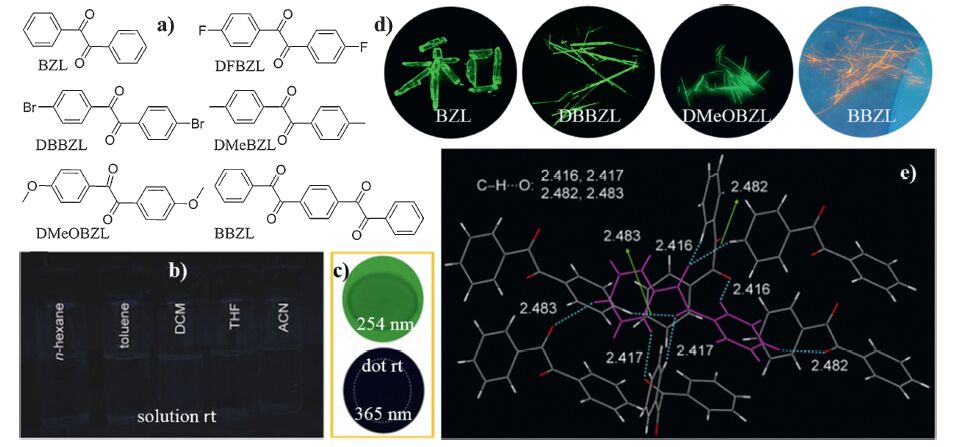
Y.Y. Gong, Y.Q. Tan, H. Li. Crystallization-induced phosphorescence of benzils at room temperature[J]. Sci. China Chem., 2013,56:1183-1186. doi: 10.1007/s11426-013-4930-9
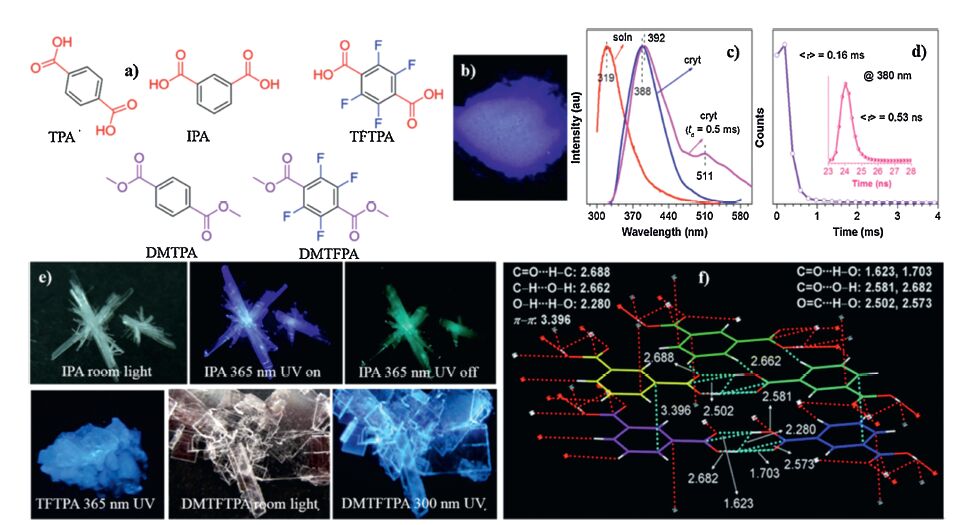
Y.Y., L.F., Q.Peng, etal.. Crystallization-induced dualemission from metaland heavy atom-free aromatic acids and esters[J]. Chem. Sci., 2015,6:4438-4444. doi: 10.1039/C5SC00253B
(a) S. Hirata, K. Totani, J.X. Zhang, et al., Efficient persistent room temperature phosphorescence in organic amorphous materials under ambient conditions, Adv. Funct. Mater. 23(2013) 3386-3397; (b) Z.F. An, C. Zheng, Y. Tao, et al., Stabilizing triplet excited states for ultralong organic phosphorescence, Nat. Mater. 14(2015) 685-690; (c) C.Y. Li, X. Tang, L.Q. Zhang, et al., Reversible luminescence switching of an organic solid: controllable on-off persistent room temperature phosphorescence and stimulated multiple fluorescence conversion, Adv. Opt. Mater. 3(2015) 1184-1190; (d) Z.Y. Yang, Z. Mao, X.P. Zhang, et al., Intermolecular electronic coupling of organic units for efficient persistent room-temperature phosphorescence, Angew. Chem. Int. Ed. 55(2016) 2181-2185.
(a) P.C. Xue, J.B. Sun, P. Chen, et al., Luminescence switching of a persistent roomtemperature phosphorescent pure organic molecule in response to external stimuli, Chem. Commun. 51(2015) 10381-10384; (b) X.P. Zhang, T.Q. Xie, M.X. Cui, et al., General design strategy for aromatic ketone-based single-component dual-emissive materials, ACS Appl. Mater. Interfaces 6(2014) 2279-2284.
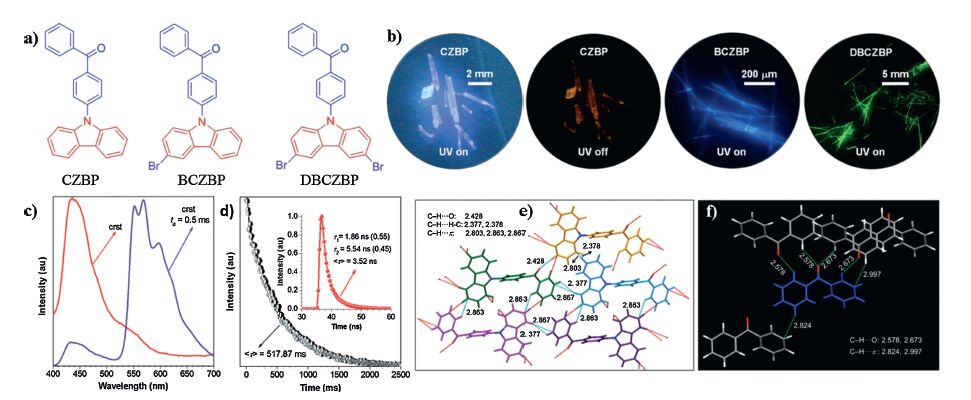
Y.Y. Gong, G. Chen, Q. Peng. Achieving persistent room temperature phosphorescence and remarkable mechanochromism from pure organic luminogens[J]. Adv. Mater., 2015,27:6195-6201. doi: 10.1002/adma.201502442
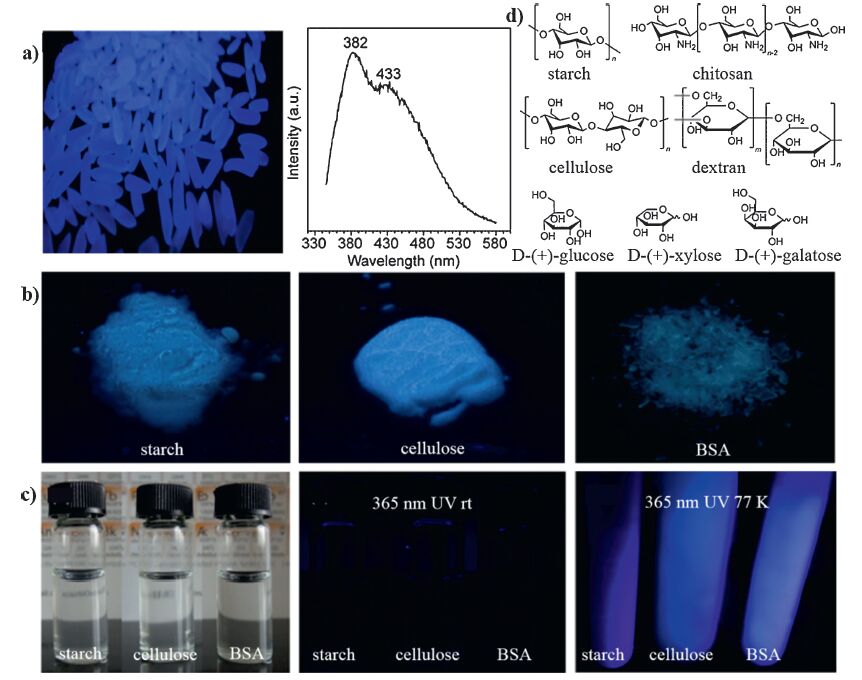
Y.Y. Gong, Y.Q. Tan, J. Mei. Room temperature phosphorescence from natural products: crystallization matters[J]. Sci. China Chem., 2013,56:1178-1182. doi: 10.1007/s11426-013-4923-8
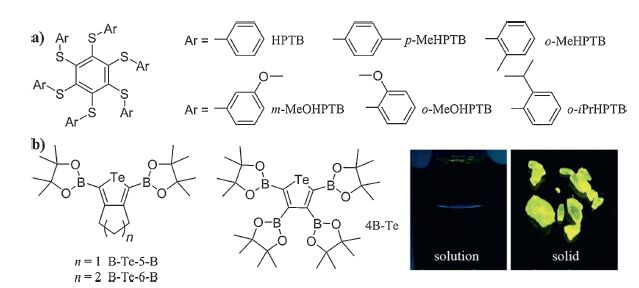
A. Fermi, G. Bergamini, R. Peresutti. Molecular asterisks with a persulfurated benzene core are among the strongest organic phosphorescent emitters in the solid state[J]. Dyes Pigments, 2014,110:113-122. doi: 10.1016/j.dyepig.2014.04.036
G. He, W. Torres Delgado, D.J. Schatz. Coaxing solid-state phosphorescence from tellurophenes[J]. Angew. Chem. Int. Ed., 2014,53:4587-4591. doi: 10.1002/anie.201307373
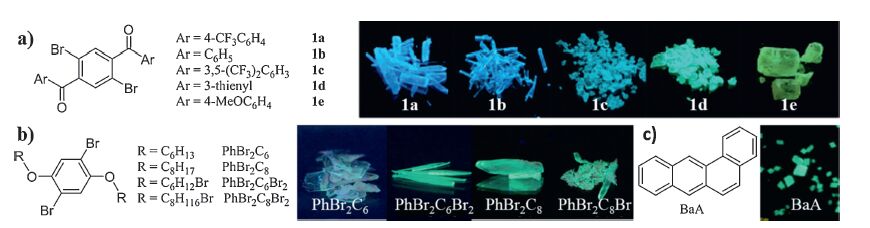
M. Shimizu, A. Kimura, H. Sakaguchi. Room-temperature phosphorescence of crystalline 1, 4-bis (aroyl)-2, 5-dibromobenzenes[J]. Eur. J. Org. Chem., 2016,2016:467-473. doi: 10.1002/ejoc.201501382
S. Maity, P. Mazumdar, M. Shyamal, G.P. Sahoo, A. Misra. Crystal induced phosphorescence from benz(a)anthracene microcrystals at room temperature[J]. Spectrochim. Acta Part A, 2016,157:61-68. doi: 10.1016/j.saa.2015.12.002
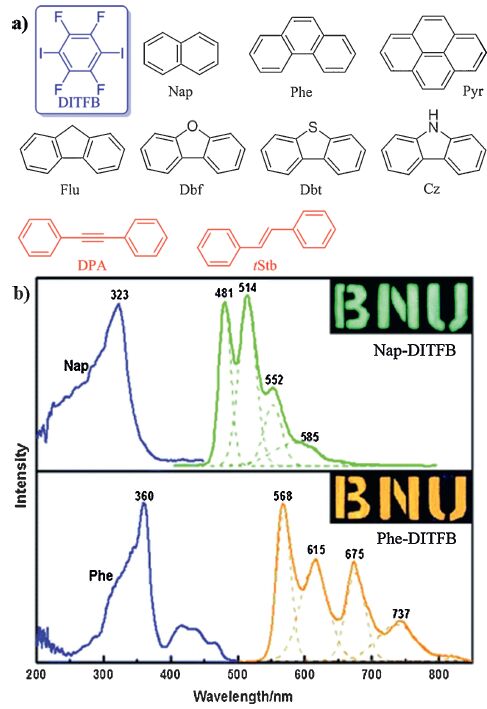
(a) H.Y. Gao, X.R. Zhao, H. Wang, X. Pang, W.J. Jin, Phosphorescent cocrystals assembled by 1,4-diiodotetrafluorobenzene and fluorene and its heterocyclic analogues based on C-I…π halogen bonding, Cryst. Growth Des. 12(2012) 4377-4387; (b) Q.J. Shen, H.Q. Wei, W.S. Zou, H.L. Sun, W.J. Jin, Cocrystals assembled by pyrene and 1,2-or 1, 4-diiodotetrafluorobenzenes and their phosphorescent behaviors modulated by local molecular environment, CrystEngComm 14(2012) 1010-1015; (c) H.Y. Gao, Q.J. Shen, X.R. Zhao, et al., Phosphorescent co-crystal assembled by 1,4-diiodotetrafluorobenzene with carbazole based on C-I…π halogen bonding, J. Mater. Chem. 22(2012) 5336-5343; (d) Q.J. Shen, X. Pang, X.R. Zhao, et al., Phosphorescent cocrystals constructed by 1,4-diiodotetrafluorobenzene and polyaromatic hydrocarbons based on C-I…π halogen bonding and other assisting weak interactions, CrystEngComm 14(2012) 5027-5034.
S. d'Agostino, F. Grepioni, D. Braga, B. Ventura. Tipping the balance with the aid of stoichiometry: room temperature phosphorescence versus fluorescence in organic cocrystals[J]. Cryst. Growth Des., 2015,15:2039-2045. doi: 10.1021/acs.cgd.5b00226
kr and knr are the rate constants for radiative (phosphorescence) and nonradiative deactivations from the T1 state, respectively, and kq is the rate constant based on quenching of the triplet excitons by interaction with the surroundings such as oxygen and humidity.
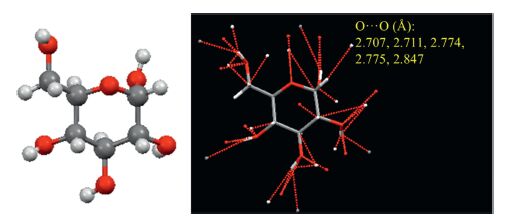
G.M. Brown, H.A. Levy. α-D-Glucose: precise determination of crystal and molecular structure by neutron-diffraction analysis[J]. Science, 1965,147:1038-1039.
Ya-Ting Gao , Yi-Lin Zhu , Xiao-Yuan Wang , Li-Ya Liang , Meng-Li Liu , Shuai Chang , Han-Bin Xu , Da-Wei Li , Bin-Bin Chen . Pure organic electrophosphorochromism system. Chinese Chemical Letters, 2025, 36(11): 110855-. doi: 10.1016/j.cclet.2025.110855
Jiayin Zhou , Depeng Liu , Longqiang Li , Min Qi , Guangqiang Yin , Tao Chen . Responsive organic room-temperature phosphorescence materials for spatial-time-resolved anti-counterfeiting. Chinese Chemical Letters, 2024, 35(11): 109929-. doi: 10.1016/j.cclet.2024.109929
Dian-Xue Ma , Yu-Wu Zhong . Achieving highly-efficient room-temperature phosphorescence with a nylon matrix. Chinese Journal of Structural Chemistry, 2024, 43(9): 100391-100391. doi: 10.1016/j.cjsc.2024.100391
Zeyin Chen , Jiaju Shi , Yusheng Zhou , Peng Zhang , Guodong Liang . Polymer microparticles with ultralong room-temperature phosphorescence for visual and quantitative detection of oxygen through phosphorescence image and lifetime analysis. Chinese Chemical Letters, 2025, 36(5): 110629-. doi: 10.1016/j.cclet.2024.110629
Kun Zhang , Ni Dan , Dan-Dan Ren , Ruo-Yu Zhang , Xiaoyan Lu , Ya-Pan Wu , Li-Lei Zhang , Hong-Ru Fu , Dong-Sheng Li . A small D-A molecule with highly heat-resisting room temperature phosphorescence for white emission and anti-counterfeiting. Chinese Journal of Structural Chemistry, 2024, 43(3): 100244-100244. doi: 10.1016/j.cjsc.2024.100244
Jianmei Guo , Yupeng Zhao , Lei Ma , Yongtao Wang . Ultra-long room temperature phosphorescence, intrinsic mechanisms and application based on host-guest doping systems. Chinese Journal of Structural Chemistry, 2024, 43(9): 100335-100335. doi: 10.1016/j.cjsc.2024.100335
Hong Yao , Feixiang Yang , Jianpeng Hu , Wenyu Cao , Shuning Qin , Tai-Bao Wei , Bingbing Shi , Qi Lin . Ultralong room temperature phosphorescence and broad color-tunability persistent luminescence via new strategy. Chinese Chemical Letters, 2025, 36(6): 110375-. doi: 10.1016/j.cclet.2024.110375
Bo Yang , Suqiong Yan , Shirong Ban , Wei Huang . New horizons in phosphorus-based emitters: From circularly polarized fluorescence to room-temperature phosphorescence. Chinese Chemical Letters, 2025, 36(11): 110837-. doi: 10.1016/j.cclet.2025.110837
Takuya Tanaka , Rikuto Noda , Yuki Sawatari , Riki Iwai , Ben Zhong Tang , Gen-ichi Konishi . Viscosity responsiveness of excited-state dynamics in aggregated-induced emission luminogens. Chinese Chemical Letters, 2025, 36(12): 111495-. doi: 10.1016/j.cclet.2025.111495
Chunyuan Kang , Xiaoyu Li , Fan Yang , Bai Yang . Ionic-bond crosslinked carbonized polymer dots for tunable and enhanced room temperature phosphorescence. Acta Physico-Chimica Sinica, 2026, 42(1): 100156-0. doi: 10.1016/j.actphy.2025.100156
Fengyao Cui , Qiaona Zhang , Tangxin Xiao , Zhouyu Wang , Leyong Wang . Reversible phosphorescence in pseudopolyrotaxane elastomer. Chinese Chemical Letters, 2024, 35(10): 110061-. doi: 10.1016/j.cclet.2024.110061
Xinhui Fan , Yonghao Fan , Yuli Dang , Puhui Xie , Xin Li , Zhanqi Cao , Song Jiang , Lijie Liu , Xin Zheng , Lixia Xie , Caoyuan Niu , Guoxing Liu , Yong Chen . Logically ordered control of organic room-temperature long-lived supramolecular luminophors. Chinese Chemical Letters, 2025, 36(8): 110648-. doi: 10.1016/j.cclet.2024.110648
Yu-Yao Li , Xiao-Hui Li , Zhi-Xuan An , Yang Chu , Xiu-Li Wang . Room-temperature olefin epoxidation reaction by two 2D cobalt metal-organic complexes under O2 atmosphere: Coordination and structural regulation. Chinese Chemical Letters, 2025, 36(4): 109716-. doi: 10.1016/j.cclet.2024.109716
Ying Zhao , Yao He , Jian-Xin Yang , Wen-Jie Liu , Dan Tian , Francisco Aznarez , Le-Le Gong , Li-Long Dang , Lu-Fang Ma . Controllable self-assembly and photothermal conversion of metalla[2]catenanes induced by synergistic effect of free radicals and stacking interactions. Chinese Chemical Letters, 2025, 36(12): 111460-. doi: 10.1016/j.cclet.2025.111460
Siwei Wang , Wei-Lei Zhou , Yong Chen . Cucurbituril and cyclodextrin co-confinement-based multilevel assembly for single-molecule phosphorescence resonance energy transfer behavior. Chinese Chemical Letters, 2024, 35(12): 110261-. doi: 10.1016/j.cclet.2024.110261
Linnan Jiang , Zhenkai Qian , Yong Chen , Xiaoyong Yu , Yugui Qiu , Wen-Wen Xu , Yonghui Sun , Xiufang Xu , Lihua Wang , Yu Liu . Double response reversible phosphorescence based on cyclodextrin supramolecular flexible elastic achieved multicolor delayed fluorescence. Chinese Chemical Letters, 2025, 36(8): 110676-. doi: 10.1016/j.cclet.2024.110676
Wen-Xuan Song , Yao-Yu Cai , Ying-Jie Liu , Shuang-Quan Zang . Cation-driven assembly of gold(Ⅰ) tweezers towards lighted circularly polarized phosphorescence. Chinese Chemical Letters, 2025, 36(9): 110326-. doi: 10.1016/j.cclet.2024.110326
Qingyu Niu , Yulu Zhang , Zerong Ge , Jiabao Liu , Zhiqiang Li , Yong Chen , Yu Liu . Competitive binding based on cucurbit[8]uril for florescence/phosphorescence ratiometric detection of 3-nitrotyrosine. Chinese Chemical Letters, 2025, 36(11): 110935-. doi: 10.1016/j.cclet.2025.110935
Pu Zhang , Xiang Mao , Xuehua Dong , Ling Huang , Liling Cao , Daojiang Gao , Guohong Zou . Two UV organic-inorganic hybrid antimony-based materials with superior optical performance derived from cation-anion synergetic interactions. Chinese Chemical Letters, 2024, 35(9): 109235-. doi: 10.1016/j.cclet.2023.109235
Saisai Yuan , Yiming Chen , Xijuan Wang , Degui Zhao , Tengyang Gao , Caiyun Wei , Chuanxiang Chen , Yang Yang , Wenjing Hong . Decouple the intermolecular interaction by encapsulating an insulating sheath. Chinese Chemical Letters, 2025, 36(6): 110816-. doi: 10.1016/j.cclet.2025.110816
 DownLoad: