Insight into nitrogen-doped biochar prepared from Chinese medicine compound residue for peracetic acid activation in sulfamethoxazole degradation: Electron transfer mechanism
Citation:
Wenrui Jia, Chenghuan Qiao, Dongfang Zhao, Juanshan Du, Yaohua Wu, Yongqi Liang, Qinglian Wu, Xiaochi Feng, Huazhe Wang, Wanqian Guo. Insight into nitrogen-doped biochar prepared from Chinese medicine compound residue for peracetic acid activation in sulfamethoxazole degradation: Electron transfer mechanism[J]. Chinese Chemical Letters,
2025, 36(11): 110886.
doi:
10.1016/j.cclet.2025.110886
Insight into nitrogen-doped biochar prepared from Chinese medicine compound residue for peracetic acid activation in sulfamethoxazole degradation: Electron transfer mechanism
English
Insight into nitrogen-doped biochar prepared from Chinese medicine compound residue for peracetic acid activation in sulfamethoxazole degradation: Electron transfer mechanism
State Key Laboratory of Urban Water Resource and Environment, Harbin Institute of Technology, Harbin 150090, China
b.
Department of Energy Engineering, Korea Institute of Energy Technology (KENTECH), Naju 58330, South Korea
c.
State Key Laboratory of Urban Water Resource and Environment, School of Civil and Environmental Engineering, Harbin Institute of Technology (Shenzhen), Shenzhen 518055, China
Received Date:
11 September 2024 Accepted Date:
19 January 2025 Revised Date:
19 December 2024 Available Online:
15 November 2025
Abstract:
The advanced oxidation system based on peracetic acid (PAA) has been proved to be a green and safe oxidation decontamination technology. Among them, the key challenge and complexity in current research lies in the directional induction of PAA and its utilization for selective removal of refractory pollutants. This study prepared nitrogen-doped biochar (NBC) using compound pharmaceutical residues commonly found in traditional Chinese medicine as a precursor. A system based on NBC-activated PAA was constructed for sulfamethoxazole (SMX) degradation. The introduction of nitrogen significantly enhanced the degree of graphitization in NBC. The degradation system achieved 87.89% SMX degradation efficiency within 60 min. Furthermore, the formation of the intricate NBC-PAA* complex detected by in-situ Raman was of paramount importance as it facilitates enhanced electron transfer processes within the complex, thereby promoting PAA decomposition through electron loss. The formation of a new complex between SMX and NBC-PAA* facilitated the completion of electron transfer process within the complex. In summary, this study explored a novel approach for treating and disposing of solid waste from Chinese medicine residue by successfully inducing non-free radical degradation pathway using PAA system. It offers fresh insights and ideas in the fields of water treatment and solid waste management.
With society advancing rapidly, there has been a significant improvement in medical treatment standards. Concurrently, the production and use of pharmaceuticals have increased. In recent years, antibiotics have become widely used for treating both human and animal ailments. However, excessive antibiotic usage has led to their dispersion and accumulation in the natural environment. The presence of tetracycline, sulfonamides, and quinolone antibiotic residues has been identified in sewage treatment plants, exhibiting concentrations ranging from 285.5 ng/L to 1.35 mg/L. While in urban rivers, the concentrations of tetracycline and oxytetracycline reached up to 8.54 × 10² ng/L and 2.08 × 10³ µg/kg, respectively [1]. The proliferation of antibiotics in the environment presents a grave crisis and ecological hazard to plants, animals, and the natural ecosystem [2,3]. Conversely, the introduction of antibiotics into organisms via water pollution in the environment leads to their subsequent accumulation in the human body, thereby posing threat to human health [4]. The use of antibiotics presents significant threat to health security due to its ability to promote the resistance of environmental microorganisms [5]. Therefore, the reduction of antibiotics in the environment has become an urgent problem to be solved.
The removal of residual antibiotic contaminants in the environment can be achieved through physical, chemical, and biological methods [6-8]. The chemical treatment technology based on advanced oxidation (AOPs) has emerged as a promising approach for addressing such pollutants due to its inherent advantages in terms of rapid and efficient degradation, cost-effectiveness, environmental friendliness, and safety [6,9,10]. The AOPs system employing persulfate as a potent oxidizing agent ensures the efficient degradation capability of emerging pollutants. Unfortunately, the cost of putting persulfate into service and the risk of by-products (such as SO42-) pose significant challenges for its application in real-world pollution scenarios [11]. However, the emergence and application of PAA have introduced a novel solution. The PAA structure, composed solely of carbon, hydrogen, and oxygen atoms, represents an efficient, cost-effective, and readily obtainable green oxidizer. Consequently, it possesses distinctive advantages in the realms of advanced oxidation processes and sterilization technologies [12]. Among them, the utilization of diverse catalytic technologies for activating PAA to degrade pollutants has garnered significant attention. Specifically, the process of cleaving the PAA bond and generating hydroxyl radicals (•OH) and organic free radicals (CH3C(O)OO•) through energy or potent activation catalysts represents the principal active species within PAA-based AOPs systems. For example, the medium pressure UV activated PAA to produce •OH and CH3C(O)OO• significantly degraded norfloxacin, and the Fe(Ⅱ)-Fe(Ⅲ) system could also activate PAA to produce highly active free radicals [13,14]. However, the degradation system dominated by free radicals exhibits limited selectivity towards pollutants and is susceptible to interference from external environmental factors such as pH. In contrast, the oxidation system based on PAA offers a stable and targeted non-free radical pathway, effectively circumventing the aforementioned issues [15,16]. In recent years, carbon-based materials that have been modified through doping exhibit characteristics such as active sites, specialized functional group structures, and a high degree of graphitization, which confer distinct advantages in activating oxidants and facilitating non-free radical selective oxidation mechanisms [11,17,18]. Wang et al. prepared N-doped straw biochar (NBC), which not only increased the degree of graphitization and specific surface area, but also explored the electron transfer mechanism between pollutants and oxidants [19]. Liu et al. investigated the catalytic performance of Co(Ⅱ) doped carbon nitride in PAA system, which dissociated the adsorbed PAA through unique double electron transfer mechanism and converted the coordinated Co(Ⅱ) into high-priced metal Co(IV), completing the degradation of sulfamethoxazole (SMX) as active species [20,21]. Zhang et al. prepared biochar (BC)-supported Co nanoparticle catalyst and found that R-O•, 1O2, and high-priced metals contributed to the degradation of pollutants [22]. Consequently, carbon-based materials are pivotal in facilitating non-radical oxidation mechanisms. Among them, the development and application of BC represent a critical pathway for resource utilization [23]. In particular, unlike other carbon-based materials, the structural properties of BC exhibit significant variations in response to changes in precursor and pyrolysis conditions, thereby exerting a crucial influence on its catalytic performance [24]. Therefore, the selection and preparation of appropriate BC-based materials to achieve selective oxidative degradation of emerging pollutants in PAA degradation systems is currently a challenging research area and key to making breakthroughs.
Traditional Chinese medicine (TCM), as an integral component of the traditional Chinese medical program, has garnered significant attention and utilization owing to its efficacious treatment modalities for refractory ailments with minimal adverse effects. In recent years, the frequent occurrence of diseases such as environmental pollution and virus-induced pneumonia has highlighted the unique advantages of TCM in treating these challenging conditions. However, during the process of decocting the final products, a significant amount of Chinese medicine residue remains, which is nutrient-deficient and has high moisture content, posing challenges for its reuse and treatment [25]. Currently, the treatment of Chinese medicine residue primarily relies on biological fermentation. However, the extended fermentation period and low value associated with Chinese medicine residue hinder its widespread adoption and application [26]. The utilization of BC derived from Chinese medicine residue and its application in the field of AOPs enables the comprehensive valorization of Chinese medicine residue while concurrently addressing pollution control, thus representing an effective approach for waste treatment and enhancing the value of Chinese medicine residue [27]. However, currently, the preparation and application of BC from Chinese medicinal residue primarily focus on single medicinal residues as precursors, which deviates somewhat from the actual utilization of Chinese medicine and its residues. Moreover, a singular pharmaceutical residue fails to meet the requirements for classifying and disposing agricultural waste. The true environmental demand in waste management lies in the comprehensive utilization of mixed pharmaceutical residues based on prescription classification.
This study involved the preparation of NBC using Chinese medicine compound residue as precursor. Additionally, SMX has been detected in medical wastewater and sewage treatment plants, so SMX was selected as the target pollutant and oxidation system based on NBC-activated PAA to degrade SMX was constructed. Furthermore, the degradation mechanism of the PAA activation system induced by NBC was investigated. Currently, research on the involvement of Chinese pharmaceutical residue biochar in AOPs systems primarily focuses on investigating adsorption efficiency and the mechanism of free radical generation [28]. The non-radical pathway of electron transfer driven by NBC derived from Chinese pharmaceutical residue was comprehensively investigated through electrochemical analyses in this study. Ultimately, the application potential and toxicity level of BC obtained from Chinese medicine compound residue as precursor were determined, confirming its feasibility for practical applications. Therefore, this paper explores a novel approach for the treatment and disposal of solid waste containing pharmaceutical residues in mixed prescriptions. Additionally, it elucidates the electron transfer mechanism of biocharcoal activated PAA based on N-doped pharmaceutical residues. This innovative concept presents an opportunity to address both water pollution treatment and comprehensive utilization of waste biomass.
PAA is prepared for immediate application, with a stock solution concentration of 150 g/L (2 mmol/L), while all chemical reagents are prepared using ultra-pure water. All chemicals and solvents were of analytical grade and were used without further purification. Except in special circumstances, all experiments were performed in distilled (DI) water system. Chemicals and materials adopted in the experimental research are listed in Text S1 (Supporting information).
The Chinese medicine residue of the “Huaidampness and toxification prescription” commonly employed in TCM for pneumonia treatment, was selected as the precursor system to prepare BC derived from Chinese medicine residue. The main components of the mixed prescriptions include: 6 g of ephedra, 9 g of Fried bitter almond, 15 g (fried) first plaster stone, 10 g each of liquorice and patchouli, 3 g of magnolia officinalis, 10 g each of amomum and pinellia rhizoma atractylodis 15 g of poria cocos, 5 g of raw rhubarb (after), and finally, 10 g each of astragalus root, semen lepidii, and red paeony root. The mixed prescription was subjected to boiling at 100 ℃ for 2 h, followed by rinsing of the resulting Chinese medicinal residue with deionized (DI) water and air drying for two days. Subsequently, the residue was dried in vacuum oven at 80 ℃ until constant weight was achieved. Then, the Chinese medicine residue was pulverized and stored using 0.2 mm screen. The NBC was synthesized through urea pyrolysis. The mass ratios of Chinese medicine residue to urea were 1:0, 2:1, 1:1, 1:2, 1:3, and 1:4, respectively. The mixture was placed in a tube furnace under N2 atmosphere with a heating rate of 5 ℃/min and pyrolyzed at 700 ℃ for 2 h to obtain BC, NBC2-1, NBC1-1, NBC1-2, NBC1-3, and NBC1-4. Subsequently, the obtained BC underwent cleaning, drying and grinding before further utilization. Detailed information regarding methods for testing analysis can be found in Text S2 (Supporting information).
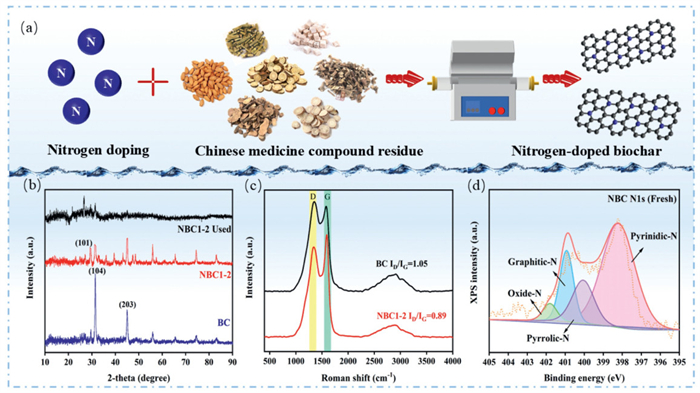
The material characterization of NBC was conducted to ensure the successful synthesis of biochar and the effective incorporation of N. The synthesis process of NBC was shown in Fig. 1a. The X-ray powder diffractometer (XRD) results (Fig. 1b) demonstrated that the characteristic peak intensity of NBC surpasses that of conventional BC, while simultaneously preserving the peak intensity of specific crystal faces (101), (104), and (203) in BC [29,30]. Raman analysis (Fig. 1c) further revealed that, in comparison to conventional BC [31], the ID/IG value of NBC was merely 0.89, thereby unequivocally indicating heightened degree of graphitization and enhanced suitability for catalytic involvement in the electron transfer process within the system [32]. Additionally, the successful introduction of N was confirmed through XPS characterization (Fig. 1d), wherein distinct peaks corresponding to pyridine N, piromono N, and graphite N were observed at 398.2, 400.5, and 401 cm-1, respectively [33]. In conclusion, the successful synthesis of N-doped BC from Chinese pharmaceutical residues has been confirmed. The high degree of graphitization and introduction of N doping were expected to facilitate rapid electron transfer processes in PAA systems.
Figure 1
Figure 1.
(a) Nitrogen-doped biochar synthesis path based on Chinese medicine compound residue. (b) XRD pattern analysis of conventional BC, fresh NBC1-2 and used NBC1-2. (c) Raman spectral analysis of conventional BC and NBC1-2. (d) XPS spectra of N 1s in NBC1-2.
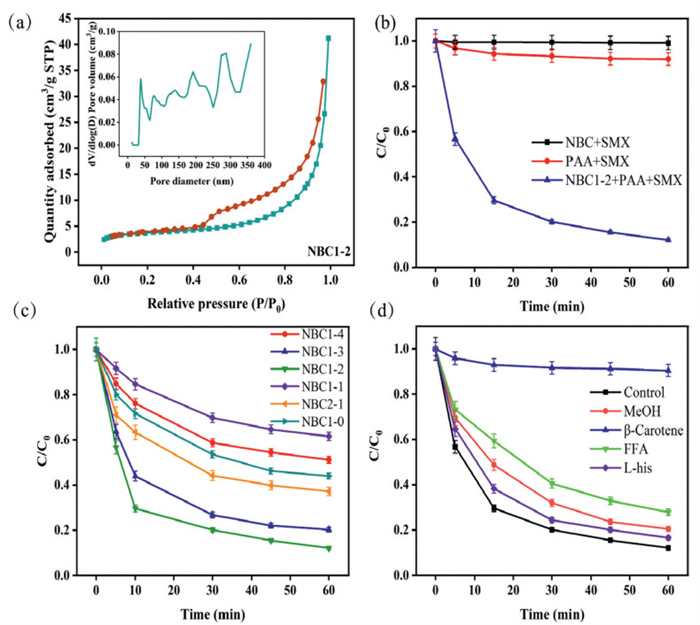
The N2 adsorption-desorption isotherm and pore size distribution curves of NBC were examined to confirm that the majority of SMX in system underwent degradation rather than being adsorbed (Fig. 2a). The adsorption curve of NBC exhibited isothermal characteristics consistent with type Ⅳ, indicating the presence of diverse pore sizes including micropores and mesoporous structures within the material, which aligns with conventional BC (Fig. S2 in Supporting information) [34]. Therefore, the adsorption capacity of NBC with varying doping ratios for SMX was investigated (Fig. S3 in Supporting information). The adsorption capacity of NBC towards pollutants remained limited irrespective of the doping ratio. Only at N doping ratio of 4:1, a mere 13.5% of SMX was adsorbed. This observation suggested that the pore structure of NBC expands with increasing doping ratio; however, the removal efficiency for SMX through adsorption is negligible. The degradation efficiency was explored by constructing AOPs system based on NBC/PAA. Under the condition that neither NBC nor PAA can independently degrade SMX, the collaborative degradation system of NBC and PAA achieved remarkable 87.89% removal of SMX within 60 min (Fig. 2b). This finding directly confirms the exceptional oxidation capabilities of the NBC/PAA-based system. Meanwhile, the catalytic activation properties of NBC with varying doping ratios were assessed (Fig. 2c). In the absence of N doping, the original BC achieved a degradation efficiency of 56% for SMX. With the increase in doping ratio, there have been significant qualitative changes observed in the ability to degrade pollutants, particularly for NBC1-2 and NBC1-3, nearly achieving complete removal of SMX. This implied that N doping, as a crucial factor influencing electron transfer and oxidation–reduction reaction (REDOX) reactions, can optimize the structure of BC and regulate its electronic properties, thereby enhancing degradation efficiency. However, it was undeniable that the excessive increase in N doping may not necessarily yield beneficial outcomes for the degradation system and environmental pollution. Therefore, NBC1-2 represented the optimal dosage of doping for this study. The quenching experiment of the degradation system was subsequently conducted to elucidate the predominant active species involved. Methanol (MeOH), β-carotene, furfuryl alcohol (FFA), and L-histidine (L-His) were employed as quenching agents for hydroxyl radicals (•OH), free electrons, superoxide anion radicals (O2•-), and singlet oxygen (1O2) [35-38]. According to the results presented in Fig. 2d, β-carotene exhibited robust inhibitory effect, suppressing SMX degradation by 78.33% compared to the control group. These findings suggest that the rapid electron transfer within the system was attenuated upon addition of β-carotene, leading to tentatively conclude that the dominant mechanism underlying the degradation process involves an electron transfer triggered by NBC supplementation. Simultaneously, FFA exhibited limited inhibitory effect, whereas MeOH and L-His demonstrate negligible interference with the normal reaction process, thereby corroborating the hypothesis of minimal presence of free radicals within the system.
Figure 2
Figure 2.
(a) Adsorption isotherm curve of NBC1-2. (b) Experiment on performance of degradation system. (c) Experimental study on degradation properties of materials with different N doping ratios. (d) The quenching experiment results. Conditions: [PAA] = 3 mmol/L, NBC1–2 = 0.1 g/L, [SMX] = 10 µmol/L, and T = 23 ± 2 ℃.
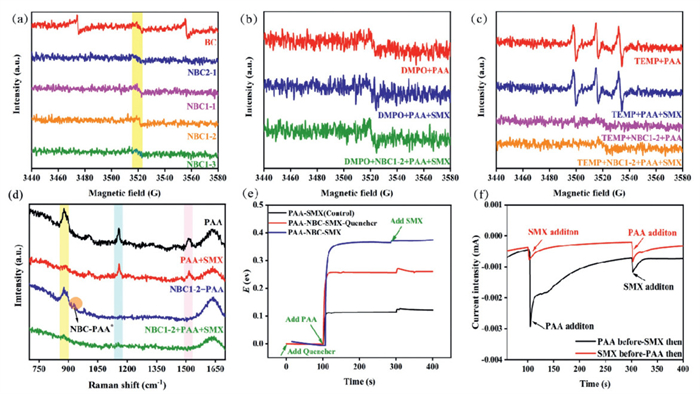
The induction of electron transfer mechanism is intricately linked to the structural properties of materials. In this regard, the significance of persistent free radicals (PFRs) inherent in BC cannot be disregarded. In the EPR analysis of the material (Fig. 3a), negligible disparity was observed in the characteristic peak intensity of PFRs localized around 3520 cm-1 between BC and N-doped samples, implying that the incorporation of N did not significantly impact the formation and structure of PFRs [39,40]. However, when combined with material characterization, it became evident that N doping enhances the degree of graphitization in BC, which is crucial for facilitating electron transfer. Simultaneously, the PFRs provided by NBC can serve as the reaction site for PAA activation [41]. Furthermore, the dominant active species of the degradation system were further identified using electron spin resonance (ESR). Upon addition of 5,5-dimethyl-1-pyrroline N-oxide (DMPO) probe to detect free radicals (Fig. 3b), no distinct characteristic peak curve was observed, indicating the absence of typical active species in the system [42]. Moreover, it was intriguing to observe distinct 2,2,6,6-tetramethylpiperidinyl-1-oxide (TEMPO) triple peak signals in the systems of 2,2,6,6-tetramethylpiperidine (TEMP) + PAA and TEMP + PAA + SMX (Fig. 3c) when TEMP serves as a trapping agent for 1O2 [43]. However, upon the introduction of NBC, the characteristic peak associated with TEMP disappears, indicating that PAA, which was responsible for inducing this characteristic peak in the system, got consumed leading to a failure in 1O2 generation. Consequently, it can be inferred that NBC facilitates rapid consumption of PAA and generation of new complexes. The above hypothesis was further validated by in situ Raman spectroscopy analysis. The results presented in Fig. 3d revealed the detection of tensile vibration corresponding to O-O at 884 cm-1 solely in the PAA system [44,45]. However, upon the addition of SMX, a decrease in peak intensity was observed, suggesting O-O bond cleavage. These findings are highly consistent with the capture results of TEMP. However, upon the addition of NBC, the characteristic peaks associated with PAA and PAA + SMX were no longer observed, while a novel characteristic peak emerged at 911 cm-1, corresponding to the NBC-PAA* complex formation. Subsequently, with the introduction of SMX, the distinctive peak of NBC-PAA* was also eliminated, suggesting that SMX addition disrupted the original complex and facilitated the generation of new products to achieve efficient degradation of SMX [46]. To validate this conjecture, open circuit potential (OCPT) analysis was employed to investigate potential variations in system (Fig. 3e) [47]. Upon the addition of PAA at 100 s, an immediate increase in potential was observed on the NBC-coated electrode, confirming that the formation of NBC-PAA* complex led to a sharp rise in potential [48]. Furthermore, after introducing SMX at 300 s, the system's potential further increased, providing evidence for the formation of a novel complex [SMX-NBC-PAA*] with higher reaction potential. However, the potential increase of OCPT was suppressed in the system where the quencher was pre-added, indicating that the quencher inhibited a portion of the electron transfer process [37]. The XPS test results before and after the reaction further elucidated the occurrence of an electron transfer process (Fig. S4 in Supporting information). The π-π* characteristic peak near 291.8 eV in the C 1s orbital vanished post-reaction, providing confirmation that specific functional groups within NBC are actively involved in the electron transfer process [49]. Finally, I-t curve further confirms the intricate process of electron transfer that occurs internally (Fig. 3f). Regardless of the order in which PAA and SMX are added, a significant decrease in current was observed, indicating that the addition of PAA induces the formation of NBC-PAA* complex and internal electron transfer. Similarly, the addition of SMX results in its adsorption to the corresponding active site on NBC, leading to the formation of a novel complex and subsequent electron transfer.
Figure 3
Figure 3.
(a) EPR captures experimental results of NBC. (b) Experimental results of DMPO signal acquisition. (c) Experimental results of TEMP signal acquisition. (d) In situ Raman spectrogram. (e) OCPT test results of degradation system. (f) I-t curve test results of degradation system. Conditions: [PAA] = 3 mmol/L, NBC1-2 = 0.1 g/L, [SMX] = 10 µmol/L, and T = 23 ± 2 ℃.
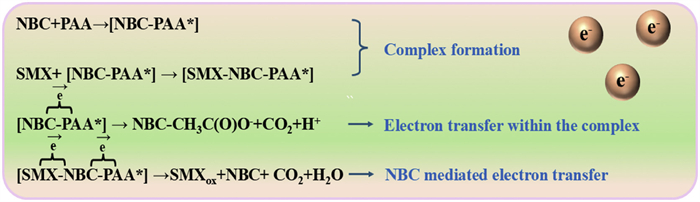
In summary, N doping enhanced the conductivity of BC, while additionally providing more defect sites for the adsorption reaction of pollutants and oxidants [19,50]. As the reaction proceeds, PAA and SMX come into complete contact with NBC, facilitating strong electron transfer to form NBC-PAA*. Due to the high degree of graphitization exhibited by NBC and the presence of strong π-π* interactions, a significant electron transfer took place within the complex, leading to the decomposition of PAA. Consequently, the introduction of SMX resulted in the formation of a more thermodynamically favorable SMX-NBC-PAA* complex. Facilitated by NBC, efficient electron transfer ensued, leading to the decomposition of SMX and subsequent disintegration of the NBC-PAA* complex, thereby accomplishing the degradation process (Fig. 4).
Figure 4
Figure 4.
Schematic diagram of the electron transfer process mediated by NBCs. Conditions: [PAA] = 3 mmol/L, NBC1–2 = 0.1 g/L, [SMX] = 10 µmol/L, and T = 23 ± 2 ℃.
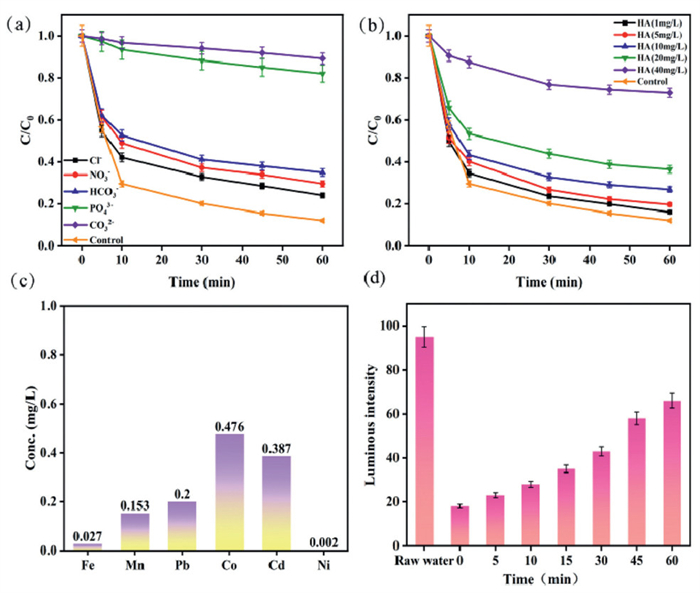
The process of electron transfer was susceptible to external environmental factors, thus necessitating an investigation into the interference effects of inorganic anions and natural organic matter present in natural water (Figs. 5a and b) [44]. Among the various inorganic anions examined, PO43- and CO32- exhibited the most pronounced inhibitory effect, resulting in only 18.01% and 10.79% degradation of SMX, respectively. As a chelating agent, PO43- adsorb onto the catalyst surface and occupy the active sites, thereby diminishing the degradation efficiency of SMX [51]. CO32- consumed PAA through electron transfer to generate CO3•- [52]. However, overall, the interference from more electronegative inorganic ions was stronger in system, which further underscored the predominant role of electron transfer. The degradation system exhibited significant inhibition when the concentration of humic acid (HA), a representative component of natural organic matter, reached 40 mg/L. This inhibition can be attributed to the competitive adsorption and spatial/electrostatic effects of HA on the surface of NBC, which hindered electron transfer by reducing the formation of NBC-PAA* [53]. Fortunately, at lower concentrations, HA had minimal interference with the system, indicating stable electron transfer performance. Finally, an assessment was conducted to evaluate the toxicity levels associated with both materials and systems.
Figure 5
Figure 5.
Application potential analysis of degradation system: (a) Inorganic anion interference test, (b) natural organic matter interference test, (c) TCLP leaching toxicity test of NBC. (d) Changes of luminous intensity of Vibrio fischeri in degradation system. Conditions: [PAA] = 3 mmol/L, NBC1–2 = 0.1 g/L, [SMX] = 10 µmol/L, and T = 23 ± 2 ℃.
The leaching risk of heavy metals in BC derived from the preparation of Chinese medicine residue using a mixed prescription was assessed. The levels of 6 heavy metals, including Fe, Mn, and Pb, were quantified in the materials using Toxicity Characteristic Leaching Procedure (TCLP) as identification method (Fig. 5c) [54]. The leaching level of Co2+ was measured at 0.476 mg/L, which may be attributed to the specific precursor employed in this study. Throughout the cultivation, harvesting, and processing stages, Chinese medicine formulated with multiple ingredients is susceptible to heavy metal contamination resulting from soil absorption and utensil residue. Fortunately, following TCLP testing, NBC derived from traditional Chinese medicinal compounds exhibits minimal residual concentration of representative heavy metals, thereby posing no significant disturbance or pollution risk to the environment [55].
Additionally, the luminous intensity of Vibrio fischeri was employed as a criterion for identifying the toxicity level of the degradation system [56]. The luminescence intensity of Vibrio fischeri was assessed at specific time intervals (0, 5, 10, 15, 30, 45 and 60 min) to investigate its variation (Fig. 5d) [57]. The toxicity level of Vibrio Fischeri is inversely proportional to its luminous intensity, as observed in the ultra-pure water system used as a control group. In this system, the luminous intensity of Vibrio Fischeri was measured at 98. However, upon the addition of antibiotics and PAA, there was a significant decrease in luminous intensity within just 5 min, with readings dropping to only 18. However, upon formation of the NBC-PAA* complex, the electron transfer process proceeded smoothly, leading to efficient consumption and degradation of pollutants. Consequently, the toxicity level of the degradation system declined while the luminous intensity increased. Ultimately, at 60 min post-reaction termination, luminescent bacteria exhibited a restored luminescence intensity of 60 with a relative light suppression rate of 30.53% (Fig. S5 in Supporting information). The luminescence intensity, although still suppressed, provided evidence of a reduction in toxicity from the initial high level to lower toxic state. The degradation system is susceptible to interference from strong electronegative ions, thereby impeding the smooth progression of electron transfer processes. Additionally, excessively high concentrations of HA can also hinder the occurrence of this process. However, it was noteworthy that the biochar derived from the mixed prescription drug residues exhibits a low concentration of heavy metals. Moreover, as the reactive complex forms and depletes, the toxicity level of the degradation system gradually diminishes, thereby demonstrating its significant potential for application.
In conclusion, the NBC was synthesized using Chinese medicine compound residue as precursor for BC. By incorporating N doping, the graphitization degree and conductivity of NBC were significantly enhanced. Through the establishment of AOPs system wherein N-doped drug residue biochar effectively activated PAA for the degradation of SMX. Furthermore, N doping significantly enhanced the degree of graphitization in NBC and facilitated the formation of the intricate NBC-PAA* complex. Moreover, upon the introduction of SMX, novel NBC-PAA-SMX complex was formed due to its robust electron transfer capability with the aforementioned complex. Finally, the oxidation system of this unique electron transfer mechanism has been demonstrated to possess robust anti-interference properties and a low toxicity level, thereby exhibiting exceptional potential for practical applications. This study successfully utilized commonly available mixed Chinese medicine residue waste, establishing a novel approach for waste treatment through waste utilization. The degradation system enhances the non-free radical pathway predominantly governed by the electron transfer mechanism, offering novel insights and ideas for the field of Fenton-like water treatment.
Declaration of competing interest
The authors declare that they have no known competing financial interests or personal relationships that could have appeared to influence the work reported in this paper.
CRediT authorship contribution statement
Wenrui Jia: Writing – review & editing, Writing – original draft, Methodology, Investigation, Formal analysis, Data curation, Conceptualization. Chenghuan Qiao: Writing – review & editing, Writing – original draft, Methodology, Formal analysis, Data curation. Dongfang Zhao: Writing – original draft, Validation, Supervision, Data curation. Juanshan Du: Supervision, Software, Resources, Funding acquisition. Yaohua Wu: Writing – original draft, Visualization, Validation, Software. Yongqi Liang: Writing – original draft, Formal analysis, Data curation, Conceptualization. Qinglian Wu: Software, Resources, Funding acquisition. Xiaochi Feng: Software, Resources, Project administration. Huazhe Wang: Writing – original draft, Visualization, Validation, Supervision, Project administration, Methodology, Investigation. Wanqian Guo: Visualization, Validation, Project administration, Funding acquisition.
Acknowledgments
This work was supported by the National Natural Science Foundation of China (No. 52200049), the China Postdoctoral Science Foundation (No. 2022TQ0089), the Heilongjiang Province Postdoctoral Science Foundation (No. LBH-Z22181), the State Key Laboratory of Urban Water Resource and Environment (Harbin Institute of Technology) (No. 2024TS28) and the Fundamental Research Funds for the Central Universities.
Supplementary materials
Supplementary material associated with this article can be found, in the online version, at doi:10.1016/j.cclet.2025.110886.
[1]
C. Li, J. Lu, J. Liu, et al., Environ. Sci. Pollut. Res. 23 (2016) 15111–15121. doi: 10.1007/s11356-016-6688-z
Figure 1
(a) Nitrogen-doped biochar synthesis path based on Chinese medicine compound residue. (b) XRD pattern analysis of conventional BC, fresh NBC1-2 and used NBC1-2. (c) Raman spectral analysis of conventional BC and NBC1-2. (d) XPS spectra of N 1s in NBC1-2.
Figure 2
(a) Adsorption isotherm curve of NBC1-2. (b) Experiment on performance of degradation system. (c) Experimental study on degradation properties of materials with different N doping ratios. (d) The quenching experiment results. Conditions: [PAA] = 3 mmol/L, NBC1–2 = 0.1 g/L, [SMX] = 10 µmol/L, and T = 23 ± 2 ℃.
Figure 4
Schematic diagram of the electron transfer process mediated by NBCs. Conditions: [PAA] = 3 mmol/L, NBC1–2 = 0.1 g/L, [SMX] = 10 µmol/L, and T = 23 ± 2 ℃.



 DownLoad:

 下载:
下载: