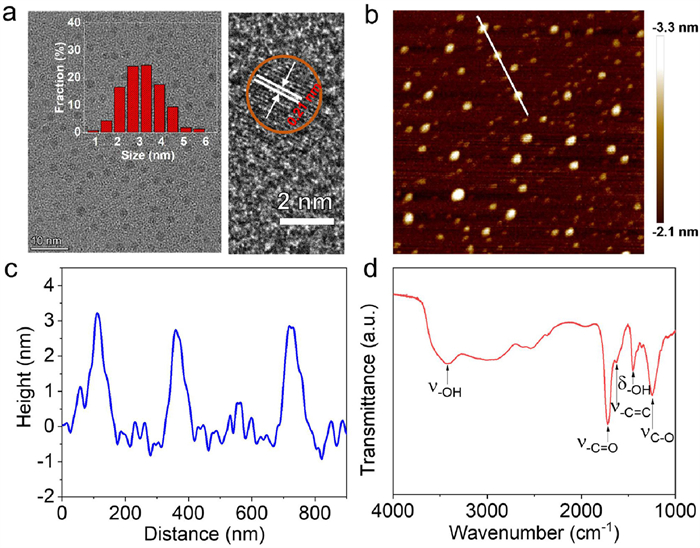
Figure 1.
Characterization of CD. (a) TEM and high resolution TEM (HRTEM). (b) AFM. (c) The height profile of the white line in b. (d) FTIR spectrum.

Visible light boosted Fenton-like reaction of carbon dot-Fe(Ⅲ) complex: Kinetics and mechanism insights
Ting Zhang , Baojing Huang , Hong Huang , Ailing Yan , Shiqiang Lu , Xufang Qian


Organic pollutant degradation is one of the critical topics in wastewater treatment and natural environmental remediation. Among various techniques, the advanced oxidation processes (AOPs) can remove pollutants through active reagents to oxidize organic compounds [1-3]. As a typical AOPs, Fenton and Fenton–like reactions that can generate hydroxyl radicals (•OH) address growing concerns about severe environmental pollution. Three main reactions are involved (Eqs. 1-3).
|
|
(1) |
|
|
(2) |
|
|
(3) |
As shown in Eq. 2, the rate-limiting step is the reduction of Fe3+ species both in homogenous and heterogenous Fenton systems, leading to the low decomposition efficiency of hydrogen peroxide (H2O2) and a sluggish Fe3+/Fe2+ cycle. This process is highly sensitive to solution pH (2.8–3.2) and the precipitation of substantial quantities of ferric sludge significantly constrains its practical applications. One potential solution to these issues involves the addition of chelating ligands, which can modulate the solubility of iron ions and can lead to the formation of strong photoactive complexes, particularly in the presence of carboxylate group or polycarboxylates, as photosensitizers. Photocatalysis has emerged as a transformative technology in addressing environmental challenges and advancing sustainable energy solutions. The ability of photocatalytic materials to harness solar energy to drive chemical reactions has garnered significant attention in recent years, especially in the context of environmental remediation and energy production. Recent advancements in photocatalysis have primarily focused on the development of novel materials and enhanced methodologies. For instance, the incorporation of metal-organic frameworks (MOFs) and covalent organic frameworks (COFs) as photocatalysts has shown remarkable promise due to their tunable structures and high surface areas, which facilitate efficient light absorption and charge separation [4-6]. Additionally, two-dimensional materials, such as graphene and transition metal dichalcogenides, have been explored for their unique electronic properties and ability to enhance photocatalytic activity [7,8]. In order to produce an efficient photocatalytic system, two main components must be combined and operated together: a catalyst or a mediator able to absorb the energy of solar light and a sacrificial electron donor. The photosensitizer absorbs light, generating electron-hole pairs, which facilitate charge transfer to the catalyst, thereby promoting the reduction of metal ions (Mn+). Subsequently, the sacrificial electron donor replenishes the photosensitizer with electrons, initiating the second catalytic cycle. For optimal performance, the photocatalytic system must employ a stable light absorber that functions across a broad spectral range, demonstrates prolonged charge separation, and is easily prepared from low-cost, photostable materials.
Photoactive materials were commonly employed in advanced oxidation, while they were limited by expensive, toxic, fragile properties and slow electron transfer kinetics [9,10]. Carbon dot (CD) has attracted considerable attention as a novel class of nanoscale carbon materials, owing to their unique optical and electronic properties. As an eco-friendly and metal-free alternative, CD holds significant promise as a sustainable photocatalyst. Moreover, CD appears to exhibit distinctive donor/acceptor properties [11-17], exceptional electron transfer characteristics, and photostability and can be synthesized through cost-effective methods using various techniques. These attributes make CD highly promising candidates as light-absorbing materials. The visible light absorption capability of CD depends on their size, surface functionalization, and intrinsic properties. Additionally, the surface functional groups of CD can be tailored to enhance their catalytic performance or to facilitate the attachment of other catalysts or reactive species.
As the size of CD is reduced to dimensions comparable to the exciton Bohr radius of graphene, the zigzag boundary significantly alters the electron distribution [18]. CD shows unique phenomena not only in single-electron transistors, as explained by the theory of chaotic neutrino billiards, but also in photochemistry, carbocatalysis, and electronics [19]. For instance, the carbocatalysis of graphene oxide (GO) is well-established in the oxidative dehydrogenation of ethylbenzene to produce styrene. The zigzag edge sites of GO, featuring unpaired electrons, serve as the active catalytic centers, facilitating enhanced kinetics in trapping and activating molecular oxygen through a sequence of electron transport and reduction to superoxide radicals [20]. However, the unequivocal identification of the origin of the catalytic effect remains a challenge, as CD contains functional groups (-COOH, C—OH, C═O, C—O) and/or boundary defects. The photochemical properties of CD excited by external light energy have been widely reported due to the presence of a flexible bandgap. The unique chemiluminescence phenomenon was also found due to the radiative recombination of oxidant-injected holes (Ce4+) and electrons in CD [21]. The use of photostable CD as photosensitizers in Fenton-like catalysis presents a promising strategy for harnessing visible light energy to drive efficient and environmentally friendly oxidation reactions. While solar energy conversion has made significant strides in recent years, its application in environmental processes remains underutilized. Addressing these limitations is critical to maximizing the potential of solar energy and enhancing its role in sustainable development. Ongoing research and development are imperative to further improve solar energy technologies and explore innovative solutions.
Herein, we found that the remarkably enhanced Fenton-like reaction performance was boosted by visible light irradiation for CD-COOFeⅢ complex. The energy band gap of CD was determined to be 2.91 eV by fitting the Tauc curve. An apparent kinetic model was established, demonstrating that the addition of CD-COOFeⅢ was more conducive to the visible light boosted Fenton-like oxidation of phenol. A maximum quantum yield (QY) of solar-to-Fe(Ⅱ) achieved 87.7%, which is the highest among photocatalyst materials related to visible light pollutant removal [22-25]. The concentration of ferrous ions in the system kept a high value which indicates the fast transformation of Fe(Ⅲ) to Fe(Ⅱ) in visible light boosted Fenton-like system of CD-COOFeⅢ. Furthermore, results from free radical quenching experiments and electron paramagnetic resonance (EPR) analyses indicated that the enhanced photo-induced electron transfer process effectively improved the Fenton-like activity of the CD-COOFeⅢ/H2O2.
CD colloidal solution were prepared by an electrochemical exfoliation method [26]. As shown in Fig. S1 (Supporting information), the CD colloidals were well-dispersed in an aqueous, homogeneous, and transparent solution without turbidity or precipitation. The transmission electron microscope (TEM) image and statistical result of the particle size distribution show that the synthesized CD colloid was uniformly dispersed without agglomeration, and the average particle size is ~3.0 nm (Fig. 1a). The atomic force microscopy (AFM) image and height profiles show that a uniform CD colloid was formed through the synthesis processes, consistent with TEM results (Figs. 1b and c). The height profile displays a thickness of ~3.0 nm, indicating the few-layer structure of the CD (Fig. 1c). The FTIR spectrum of CD powder displays a broad peak located at 3445 cm−1, suggesting the existence of hydroxyl groups on the surfaces of CD. The peaks located at about 1720, 1621, 1445, and 1248 cm−1 are attributed to νCnullO, νCnullC, δ-OH, and νCnullO, respectively (Fig. 1d). The results indicated that the CD composite possessed a unique structure. The sp2-hybridized C═C in the aromatic ring of graphite is partially oxidized, and oxygen-containing functional groups (C—O and C═O) were formed in CD during the electrochemical anodic oxidation. Upon the introduction of Fe(Ⅲ), the peak attributed to νCnullO also shifted from 1720 cm−1 to 1701 cm−1, alongside the appearance of a new peak at 1386 cm−1, which is ascribed to the symmetrical stretching vibration of -COO− (Fig. S2 in Supporting information). These observations support the formation of a carboxylate-FeⅢ (-COOFeⅢ) complex.
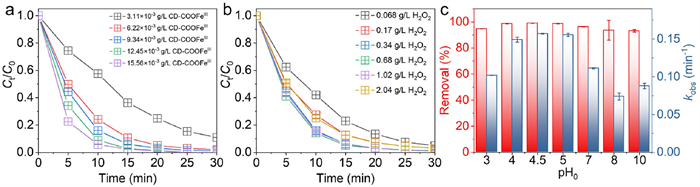
The visible light boosted Fenton-like performance of CD-COOFeⅢ/H2O2 (vis) was evaluated by the degradation of phenol under visible light irradiation. This was conducted using a 300 W xenon lamp light source with the 420 nm cut-off filter, the light intensity is 10 mW/cm2, and the temperature is 20 ℃. To optimize the experimental conditions, the effects of CD-COOFeⅢ dosages, H2O2 dosages, and pH0 on phenol removal have been explored (Fig. 2). First, we explored the impact of CD-COOFeⅢ dosages on the degradation of phenol. As seen from Fig. 2a, when CD-COOFeⅢ dosage is over 6.22 × 10⁻³ g/L, phenol was completely removed in 30 min. Then, we investigated the effects of H2O2 on the degradation of phenol and found that the optimal amount of H2O2 was 0.34 g/L (Fig. 2b). Excessive H2O2 acts as •OH scavengers, detrimental to the Fenton-like reaction [27-29]. The phenol removal of CD-COOFeⅢ/H2O2 (vis) gradually increases as pH0 increases to 4, then keeps fluctuating at pH0 = 4–5, and then decreases as pH0 increases from 5 to 10. The kobs value remains stable (~0.15 min−1) in the pH0 range of 4–5 which is induced by the buffering capacity of CD (pKa = 4.5) [30]. Ultimately, in our case, the optimal reaction conditions were as follows: [CD-COOFeⅢ] = 9.34 × 10⁻³ g/L, [H2O2] = 0.34 g/L, [Phenol] = 10 mg/L, pH0 = 4.5.
In order to study the reaction kinetics of pollutant degradation, the experimental results were fitted and calculated. The reaction equation involving the Fenton-like reaction can be expressed as Eq. 4 or its logarithmic form Eq. 5, where a and b represent the number of grades of the reaction and K represents the total reaction rate constant [29,31,32].
|
|
(4) |
|
|
(5) |
By adjusting the concentration of each reactant and the catalyst, the total rate constant K could be easily calculated. Thus, the apparent kinetic equation of phenol degradation catalyzed by CD-COOFeⅢ in collaboration with the Fenton reaction was obtained. Detailed calculated data were shown in Tables S1 and S2 (Supporting information).
For fitting degradation curves, we chose the function model of ExpDecl: y = y0 + A1e-x/t. As shown in Table S1, the equation of derivative –lg(dc/dt) can be calculated. As shown in Fig. 3a, Eq. 6 of the fitted line can be obtained by drawing –lg(dc/dt) and lg[CD-COOFeⅢ]0, and the reaction order a = 0.31356 and Eq. 7 can be obtained.
|
|
(6) |
|
|
(7) |
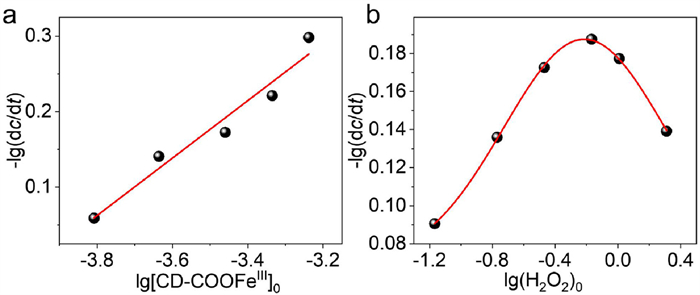
Similarly, the H2O2-related curves were fitted using the Gauss model with the details shown in Table S2. With reference to the above calculation process, –lg(dc/dt) and lg[H2O2]0 is illustrated in Fig. 3b. We use nonlinear fitting and adopt the Gauss model:
|
|
(8) |
|
|
(9) |
By combining the above Eqs. 8 and 9, the rate constant K can be obtained from Eq. 10. According to the optimized degradation conditions, K = 31.49198, and the total reaction order is a + b = 0.498.
|
|
(10) |
where a = 0.31356, b = 0.11768, [CD-COOFeⅢ]0 = 9.336 × 10⁻³ g/L, and [H2O2]0 = 0.34 g/L.
In addition, the reaction rate equation can be expressed as Eq. 11. Careful kinetic measurements revealed that the reaction order of [CD-COOFeⅢ] is between zero- and first-order kinetics, which indicates that increased [CD-COOFeⅢ] is beneficial for the degradation of phenol.
|
|
(11) |
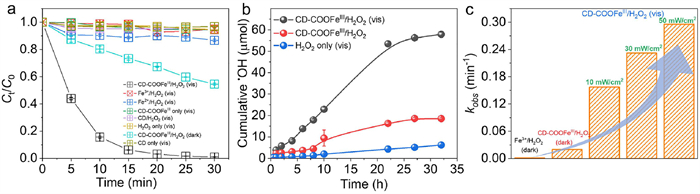
The mechanism of the phenol degradation of CD-COOFeⅢ/H2O2 was investigated by a series of control experiments. From Fig. 4a, it can be observed that it is inefficient for the following systems: Fe3+/H2O2 (vis), Fe2+/H2O2 (vis), CD-COOFeⅢ only (vis), CD only (vis), and H2O2 only (vis) (Fig. 4a). Controlled activity test was also performed under dark conditions to determine the effect of visible light. CD-COOFeⅢ/H2O2 presents ~45% of phenol removal under dark because of less decomposition of H2O2 for strong oxidizing radicals (Figs. 4a and b). With the increased intensity of visible light irradiation, the reaction rate increased obviously confirming that visible light irradiation enhanced the kinetics of the phenol oxidation process (Fig. 4c).
Additionally, free-radical capturing experiments were performed for CD-COOFeⅢ/H2O2. Here, sodium bicarbonate, tert‑butyl alcohol, and AgNO3 were used to capture h+, •OH, and e−, respectively. As shown in Fig. S3 (Supporting information), the addition of sodium bicarbonate to the CD-COOFeⅢ/H2O2 (vis) system promotes the kinetic process of phenol pollutant removal. Conversely, when tert‑butanol and AgNO3 were added separately to the CD-COOFeⅢ/H2O2 (vis) system, the removal of phenol pollutant is significantly inhibited. Additionally, to further confirm the generation of •OH during the reaction, we employed 5,5-dimethyl-1-pyrroline-N-oxide (DMPO) as a spin trap for electron paramagnetic resonance spectroscopy. As depicted in Fig. S4 (Supporting information), a distinct •OH signal was detected in the CD-COOFeⅢ/H2O2 (vis) system. Upon introducing phenol model pollutants into the system, the detection signal of hydroxyl radicals weakened, indicating that a portion of •OH was consumed during pollutant degradation, consistent with the results obtained from the quenching experiments. Therefore, we conclude that •OH is the primary reactive oxygen species in the CD-COOFeⅢ/H2O2 photocatalytic system, and the photocatalytic process involving electron transfer contributes to the enhancement of CD-COOFeⅢ/H2O2 photocatalytic performance.
To demonstrate the electron transfer capabilities and reducing power of carbon dot, we first collected the photocurrent generated by TiO2/FTO, CD/FTO and CD/TiO2/FTO electrode under visible-light irradiation. Higher currents were obtained during visible-light illumination with CD than without CD (Fig. S5 in Supporting information), in which the photoinduced electrons transfer from excited CD to TiO2, demonstrating that CD acts as a photosensitizer. Then, the photocurrent generated as a function of different organics concentrations on the surface of CD/FTO electrode under visible-light irradiation were also tested. Substantially higher currents were obtained during visible-light illumination with organics than pure CD/FTO (Fig. 5a). Moreover, the gradual increase in the photocurrent intensity with the organic's concentration might come from electron transfer from adsorbed organics to the conduction band of CD. UV–vis spectrum of carbon dot presented a broad absorption in UV region with a wide tail in the near-visible region (Fig. S6 in Supporting information). It is evident that there are two distinct absorption peaks located at 234 nm and 356 nm, assigning to the π → π* charge transfer transition within the carbon core (aromatic benzene rings with sp2 hybridized carbon structures, C═C) and the n → π* charge transfer transition occurring in the C═O functional groups present on the carbon core, respectively. Notably, the absorption peak observed at 301 nm results from either π → π* and n → π* charge transfer transitions or intermolecular charge transfer processes involving structures with π → π* characteristics within the CD, specifically occurring in the interlayer regions [33]. Additionally, the absorption intensity at this wavelength increases proportionally with the incorporation of various organic molecular pollutants (Fig. S7 in Supporting information). The higher the concentration of pollutants, the greater the increase in absorption intensity (Fig. S8 in Supporting information). This phenomenon can be attributed to the charge transfer transitions between carbon dots and organics, leading to a blue shift in the position of the absorption peak.
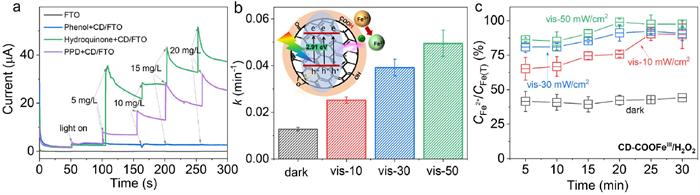
We investigated the kinetics of the reduction of iron ions under various light conditions. As depicted in Fig. 5b, under dark conditions, the CD also exhibits the ability to reduce iron ions, and the visible light illumination further accelerates the reduction process of iron ions significantly. Similarly, in the CD-COOFeⅢ/H2O2 Fenton-like system, the concentration of Fe(Ⅱ) remains in dynamic equilibrium during the initial stages of the reaction and slightly increases in the later stages. Moreover, with an increase of the illumination intensity, the Fe(Ⅱ) content in the CD-COOFeⅢ/H2O2 system also increases (Fig. 5c). These results indicate that the photogenerated electron of CD expedited the reduction of iron ions in the Fenton-like reaction, consequently achieving a highly efficient oxidation process.
Based on the above results, a possible mechanism of carbon dot as a photosensitizer for visible light boosted Fenton-like reaction on CD-COOFeⅢ was proposed (Fig. 6). Upon visible light exposure, CD absorbs energy, exciting electrons through π → π* and n → π* charge transfer transitions. These excited electrons are transferred to Fe(Ⅲ), reducing it to Fe(Ⅱ) and initiating the Fe(Ⅲ)/Fe(Ⅱ) cycle. During the irradiation process, CD* can also accept electrons from electron-donating pollutants, forming an electron-rich CD•−. This electron can be utilized in the reduction of iron ions, with the electrons transferred from CD to reduce Fe(Ⅲ) calculated at 1.1 mmol/g (Fig. S9 in Supporting information). A maximum QY of solar-to-Fe2+ was achieved at 87.7% under the light intensity of 5 mW/cm2, which is one of the highest active materials (Fig. S10 and Table S3 in Supporting information). Furthermore, the oxidation performance keeps stable for at least ten times recycle use in the visible region beyond λ > 420 nm for CD-COOFeⅢ/H2O2 system (Fig. S11 in Supporting information).
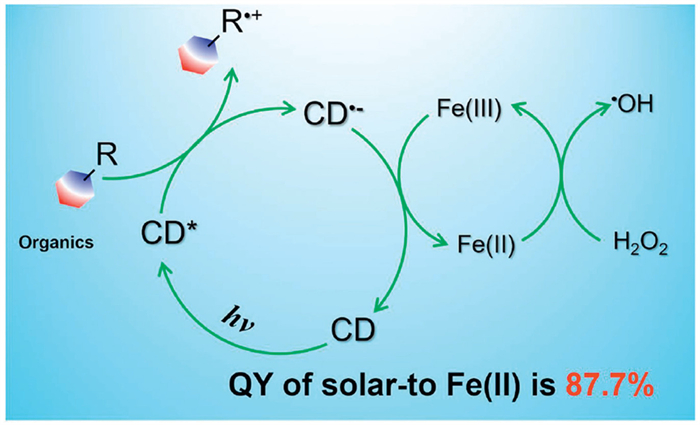
In summary, this study demonstrates the visible light boosted Fenton-like performance of CD-COOFeⅢ. An apparent kinetic model was developed to assess the performance of CD-COOFeⅢ in phenol oxidation under visible light. The results show that Fe(Ⅲ) reduction is significantly enhanced via an efficient electron transfer process, with CD effectively reducing Fe(Ⅲ) to Fe(Ⅱ) and achieving a solar-to-Fe(Ⅱ) QY of 87.7%. This discovery not only elucidates the role of nanosized carbon particles like CD in sunlit aqueous ecosystems, but also suggests a viable strategy for promoting sunlight-driven organic degradation in surface environments in the presence of nanosized artificial and/or natural carbon materials.
The authors declare that they have no competing financial interests or personal relationships that could have appeared to influence the work reported in this paper.
Ting Zhang: Writing – original draft, Methodology, Investigation, Formal analysis, Data curation, Conceptualization. Baojing Huang: Writing – review & editing, Methodology, Investigation, Formal analysis, Data curation. Hong Huang: Investigation, Formal analysis. Ailing Yan: Writing – review & editing, Supervision. Shiqiang Lu: Supervision. Xufang Qian: Writing – review & editing, Visualization, Supervision, Resources, Project administration, Funding acquisition, Conceptualization.
The authors acknowledge the support of Natural Science Foundation of China (No. 22276123), the Shanghai Engineering Research Center of Water Environment Simulation and Ecological Restoration (No. WESER-202201), and the Postdoctoral Fellowship Program of CPSF (No. GZB20240456). The authors thank the Instrumental Analysis Center (School of Environmental Science and Engineering and Shanghai Jiao Tong University) for assistance with material characterization tests.
Supplementary material associated with this article can be found, in the online version, at doi:
M.J.F. Calvete, G. Piccirillo, C.S. Vinagreiro, M.M. Pereira, Coord. Chem. Rev. 395 (2019) 63–85. doi: 10.1016/j.ccr.2019.05.004
S. Garcia-Segura, E. Brillas, J. Photoch. Photobio. C 31 (2017) 1–35. doi: 10.1016/j.jphotochemrev.2017.01.005
J. Deng, Y. Zeng, E. Almatrafi, et al., Coord. Chem. Rev. 505 (2024) 215693–215715. doi: 10.1016/j.ccr.2024.215693
L. Qin, C. Ma, J. Zhang, T. Zhou, Adv. Funct. Mater. 34 (2024) 2401562–2401602. doi: 10.1002/adfm.202401562
Q. Zhang, S. Gao, Y. Guo, et al., Nat. Commun. 14 (2023) 1147–1157. doi: 10.1038/s41467-023-36779-4
X. Li, Q. Dong, Q. Tian, et al., Mater. Today Chem. 26 (2022) 101037–101057. doi: 10.1016/j.mtchem.2022.101037
Z.L. Shaw, S. Kuriakose, S. Cheeseman, et al., Nat. Commun. 12 (2021) 3879–7606. doi: 10.1038/s41467-021-24185-7
B. Zhao, D. Shen, Z. Zhang, et al., Adv. Funct. Mater. 31 (2021) 2105132–2105167. doi: 10.1002/adfm.202105132
S. Deshmukh, A. Deore, S. Mondal, ACS Appl. Nano Mater. 4 (2021) 7587–7606. doi: 10.1021/acsanm.1c01880
J.E. Ulloa Rojas, V.L. de Oliveira, D.R. de Araujo, et al., ACS Biomater. Sci. Eng. 8 (2022) 128–139. doi: 10.1021/acsbiomaterials.1c00913
L. Dordevic, F. Arcudi, M. Cacioppo, M. Prato, Nat. Nanotechnol. 17 (2022) 112–130. doi: 10.1038/s41565-021-01051-7
Z.A. Qureshi, H. Dabash, D. Ponnamma, M.K.G. Abbas, Heliyon 10 (2024) e31634-31657.
H. Wang, L. Ai, Z. Song, et al., Chem. Eur. J. 29 (2023) e202302383. doi: 10.1002/chem.202302383
G.A.M. Hutton, B. Reuillard, B.C.M. Martindale, et al., J. Am. Chem. Soc. 138 (2016) 16722–16730. doi: 10.1021/jacs.6b10146
H. Yang, Y. Liu, Z. Guo, et al., Nat. Commun. 10 (2019) 1789–1799. doi: 10.1038/s41467-019-09830-6
F. Zhao, X. Li, M. Zuo, et al., J. Environ. Chem. Eng. 11 (2023) 109487–109511. doi: 10.1016/j.jece.2023.109487
K.A.S. Fernando, S. Sahu, Y. Liu, et al., ACS Appl. Mater. Interfaces 7 (2015) 8363–8376. doi: 10.1021/acsami.5b00448
J. Peng, W. Gao, B.K. Gupta, et al., Nano Lett. 12 (2012) 844–849. doi: 10.1021/nl2038979
L.A. Ponomarenko, F. Schedin, M.I. Katsnelson, et al., Science 320 (2008) 356–358. doi: 10.1126/science.1154663
C. Su, M. Acik, K. Takai, et al., Nat. Commun. 3 (2012) 2315–2323.
Z. Lin, W. Xue, H. Chen, J.-M. Lin, Chem. Commun. 48 (2012) 1051–1053. doi: 10.1039/C1CC15290D
S. Ghosh, K. Chakraborty, T. Pal, S. Ghosh, Sci. Rep. 13 (2023) 19028–19040. doi: 10.1038/s41598-023-46120-0
Y. Li, P. Li, J. Wang, et al., Appl. Catal. B 225 (2018) 519–529. doi: 10.1016/j.apcatb.2017.12.017
R. Gogoi, S.K. Jena, A. Singh, et al., J. Environ. Chem. Eng. 12 (2024) 112006–112019. doi: 10.1016/j.jece.2024.112006
O.A. Yildirim, H. Arslan, S. Sonmezoglu, Appl. Surf. Sci. 390 (2016) 111–121. doi: 10.17131/milelnihal.88630
H. Ming, Z. Ma, Y. Liu, et al., Dalton Trans. 41 (2012) 9526–9531. doi: 10.1039/c2dt30985h
M.M. Bello, A.A.A. Raman, A. Asghar, Process Saf. Environ. Protect. 126 (2019) 119–140. doi: 10.1016/j.psep.2019.03.028
C. Zhang, N. Ding, Y. Pan, L. Fu, Y. Zhang, Chin. Chem. Lett. 35 (2024) 109579–109590. doi: 10.1016/j.cclet.2024.109579
C. Dong, J. Ji, B. Shen, M. Xing, J. Zhang, Environ. Sci. Technol. 52 (2018) 11297–11308. doi: 10.1021/acs.est.8b02403
T. Zhang, Y. Wen, Z. Pan, et al., Environ. Sci. Technol. 56 (2022) 2617–2625. doi: 10.1021/acs.est.1c06276
M. Xing, W. Xu, C. Dong, et al., Chem 4 (2018) 1359–1372. doi: 10.1016/j.chempr.2018.03.002
S. Xiao, C. Zhou, X. Ye, et al., ACS Appl. Mater. Interfaces 12 (2020) 32604–32614. doi: 10.1021/acsami.0c06373
M. Sudolska, M. Dubecky, S. Sarkar, et al., J. Phys. Chem. C 119 (2015) 13369–13373. doi: 10.1021/acs.jpcc.5b04080

Figure 1 Characterization of CD. (a) TEM and high resolution TEM (HRTEM). (b) AFM. (c) The height profile of the white line in b. (d) FTIR spectrum.

Figure 2 Plots of phenol removal versus time by variable dosages of (a) CD-COOFeⅢ and (b) H2O2 in CD-COOFeⅢ/H2O2 (vis). (c) Effect of different initial pH0 on phenol removal. Reaction conditions: [CD-COOFeⅢ] = 3.11 × 10⁻³–15.56 × 10⁻³ g/L, [H2O2] = 0.068–2.04 g/L, [Phenol] = 10 mg/L, pH0 = 3–10, visible light irradiation using a 300 W xenon lamp light source with the 420 nm cut-off filter with light intensity of 10 mW/cm2 at 20 ℃. Error bars denote one standard deviation from the mean.

Figure 3 Kinetics of phenol degradation. Apparent kinetic calculated fitting line between (a) −lg(dc/dt) and lg[CD-COOFeⅢ]0 and (b) −lg(dc/dt) and lg[H2O2]0.

Figure 4 Degradation performance. (a) Degradation of phenol in various systems. (b) Quantitative determination of •OH vs. time of various systems. (c) Reaction rate of various systems.

Figure 5 Photochemical test. (a) Photocurrent time profiles were obtained with CD/FTO, organics/CD/FTO, and FTO photoanodes. (b) The k value of ferric ions reduction by the CD colloidal solution in the dark or light and N2 atmosphere. (c) CFe(Ⅱ)/CFe(T) concentration percentage variation in CD-COOFeⅢ/H2O2 in the dark, or light.

 扫一扫看文章


扫一扫关注我们
 DownLoad:
 下载:
下载:
