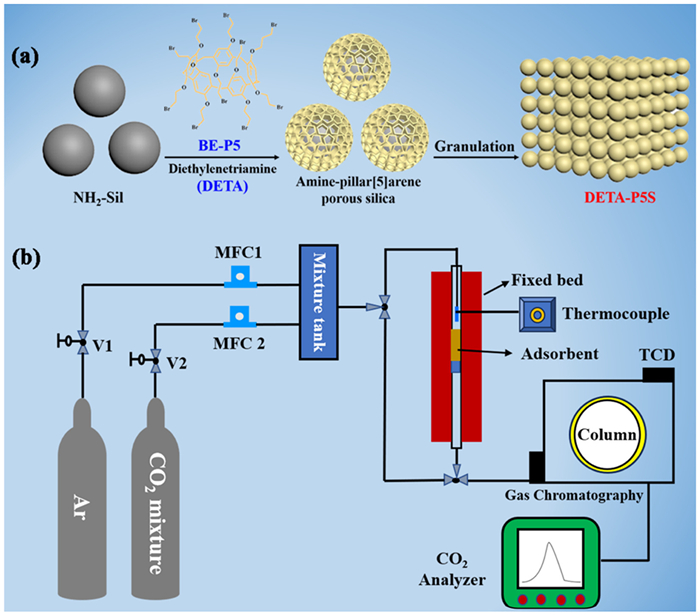
Figure 1.
(a) Synthesis of DETA-P5S. (b) Schematic diagram of fixed-bed (FD-2000) reactor for CO2 capture.

Synthesis of amine-pillar[5]arene porous adsorbent for adsorption of CO2 and selectivity over N2 and CH4
Hui Li , Yanxing Qi , Jia Chen , Juanjuan Wang , Min Yang , Hongdeng Qiu


Excessive emissions of carbon dioxide (CO2), stemming from the combustion of fossil fuels, are deemed major contributors to the greenhouse effect [1–3]. To the best of our understanding, CO2 also serves as a valuable resource the production of fine chemicals, beverage additives, and other fields [4,5]. Recent studies have confirmed that CO2 capture and storage (CCS) would be a potential method for carbon reduction [6]. A myriad of capture adsorption techniques and materials have been studied to CO2 capture [7–9]. Thereinto, solid adsorbent was believed to be the most potential one with considerations to their simple preparation, good repeatability and stability [10]. However, these adsorbents have shortcomings of poor selectivity or low adsorption capacity. Therefore, there is a pressing need to develop novel solid adsorbents that enhance CO2 capture efficiency.
To investigate the practical separation efficacy of adsorbents, there is a significant emphasis on enhancing the CO2 capacity with selectivity for CO2 over N2 and CH4. Additionally, factors such as stability and regenerability are crucial in adsorbent development [11,12]. Recently, solid amine adsorbents obtained by grafting or impregnating porous silica with organic amines, have garnered attention due to their superior physical and chemical properties, which are notably characterized by high selectivity, easy regeneration and potential prospects of CO2 capture [13–16]. This has the potential to significantly enhance the adsorption process compared to raw porous materials. The adsorption capacity of CO2 and selectivity of porous solid amine adsorbents may be contingent upon factors such as specific surface area, pore volume, porosity, and the interaction between gas molecules and active sites within the main skeleton groups. Notably, pore volume and active sites are crucial for the adsorption capacity, particularly in the context of selective adsorption [17,18]. However, how to optimize the design scheme for high adsorption capacity along with its selectivity is still a great challenge [19]. In the separation of CO2 from N2 and CH4, the similarity in molecular sizes and intermolecular interactions plays a significant role [20]. All previously reported studies have clearly indicated that the strategic introduction of low-density molecules and organic amines into porous adsorbents may serve as a feasible method for synthesizing materials with high CO2 adsorption capacity. Additionally, these materials can selectively separate CO2/N2 and CO2/CH4 gases [21–23].
Herein, in view of previous studies on pillar[5]arenes [24–27], we reported a novel amine-pillar[5]arene based solid amine adsorbent, named DETA-P5S, which constructed from bromo-pillar[5]arene (BE-P5), diethylenetriamine (DETA) and porous silica as shown in Fig. 1a and Fig. S1 (Supporting information). Subsequently, the adsorption process of CO2 and selectivity separation for CO2 over N2 and CH4 on DETA-P5S were performed on a fixed-bed (Fig. 1b). The physicochemical properties of adsorbents were systematically studied by FT-IR, scanning electron microscopy (SEM), thermogravimetric analysis (TGA), BET, XPS, MIP, etc. The effects of gas flow rate, amount, adsorption temperature, and adsorption mechanism on CO2 adsorption process were also investigated.
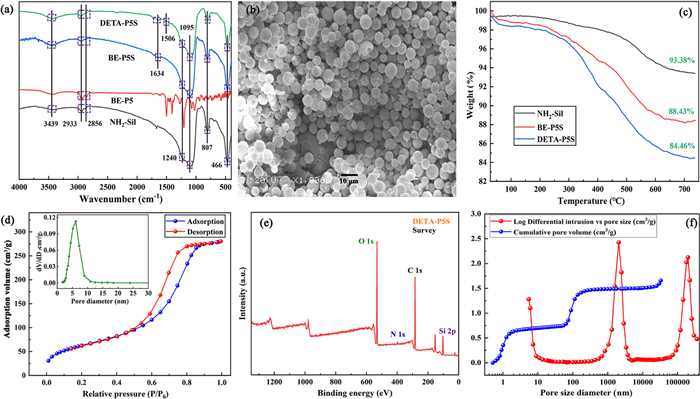
In FT-IR spectra, a broad band at 3550~3300 cm−1 was referred to the stretching vibration of N−H and Si−OH. The peaks at 2933 and 2856 cm−1 were assigned to symmetric and asymmetric stretching vibration corresponding to C−H bonds, respectively. The peak at 1634 cm−1 was identified as the stretching vibration of C=C on benzene ring, which indicated the successful introduction of BE-P5. Additionally, peaks at 1506 and 1240 cm−1 were attributed to the N−H deformation vibration of aliphatic secondary amines and C—N stretching vibration, respectively, which confirmed the successful modification of DETA. The peaks at 1095, 807 and 466 cm−1 were characteristic vibrational peaks of Si−O−Si bonds. These data confirmed the successful preparation of DETA-P5S (Fig. 2a). SEM exhibited agglomerating morphology of silica particles with rough surface and apparent silica pore (Fig. 2b). Transmission electron microscopy (TEM) investigation revealed that there was significant pore structure of silica particle stacking in DETA-P5S (Fig. S4 in Supporting information). TGA curves of NH2-Sil, BE-P5S, and DETA-P5S under N2 flow were examined and presented in Fig. 2c. The findings indicated that pristine NH2-Sil has high thermal stability in a protective atmosphere, the weight loss was only 6.62% even after being heated to 750 ℃. The DETA-P5S also exhibited excellent thermal stability until the temperature reached 260 ℃, a more rapid decrease stage for the quality of BE-P5S and DETA-P5S was appeared in the temperature range of 260–750 ℃. This could be attributed to the decomposition, combustion and volatilization of BE-P5 or DETA within the adsorbents. Ultimately, the loss rate of BE-P5S and DETA-P5S were 11.69% and 15.54%, which indicated that the bonding amount of BE-P5 and DETA were reached 5.07% and 3.85%, respectively. The N2 adsorption-desorption isotherms and BJH pore size distribution curves of DETA-P5S was shown in Fig. 2d, it can be found that DETA-P5S has a typical Ⅳ type of N2 desorption curves with a large surface area of 231.65 m²/g, which indicated DETA-P5S has mesoporous pore structure. In addition, X-ray photoelectron spectroscopy (XPS) confirmed the presence of C, N, O, and Si elements (Fig. 2e). Elemental analysis (EA) also showed that the content of DETA-P5S for N, C, H reached 2.68%, 13.28% and 1.63% (Table S1 in Supporting information), confirmed the successful grafting of DETA on BE-P5S. Moreover, energy-dispersive X-ray spectroscopy (EDS) analysis in SEM shows that O, C, and N elements were uniformly distributed over DETA-P5S (Fig. S5 in Supporting information). Mercury intrusion porosimetry revealed that the total pore volume of DETA-P5S was 1.66 cm3/g, with a pore size was 77.17 nm. The porosity reached 67.73%, which provided favorable conditions for the adsorption of CO2 (Fig. 2f). While large pores formed may be the pores between porous silica in aggregate granulation, and the mesoporous pores originate from the porous silica.
The evaluation of CO2 adsorption process was conducted using a fixed-bed (FD-2000) reactor, equipped with a 6 mm diameter quartz reaction tube. The saturation adsorption capacity of CO2 was determined by utilizing the breakthrough curve according to Zhao et al. [28]. The adsorbent was first treated for 50 min at 120 ℃ with a flow rate of 20 mL/min Ar to remove pre-adsorbed residual solvents, then adjusted to corresponding adsorption conditions and carried out CO2 adsorption process. An adsorption cycle was considered complete when the outlet CO2 concentration matched the inlet concentration. Subsequently, Ar was purged again to desorption at 120 ℃ for 50 min, then proceed to the next CO2 adsorption at corresponding requirements. Throughout the experiment, the CO2 concentration of the reactor outlet was measured using gas chromatography, coupled with a TCD detector.
In order to investigate the optimal adsorption capacity of DETA-P5S for CO2, the breakthrough curves were measured at different factors like flow rates, amount of adsorbent, adsorption temperatures, and different adsorbents. The effect of flow rate on the breakthrough curve of DETA-P5S was operated as Fig. 3a. It was found that the CO2 saturation adsorption capacity for CO2 reached 7.4 mmol/g when 0.2 g of DETA-P5S at a flow rate of 10 mL/min. However, both the breakthrough time and saturation adsorption capacity for CO2 declined as the gas flow rate increased. It may be that working at a faster gas flow rate reduced the retention time of CO2 gas in the fixed bed, thus resulted in a decrease of adsorption, eventually leaded to earlier breakthrough times, these characteristics are consistent with the reports [29].
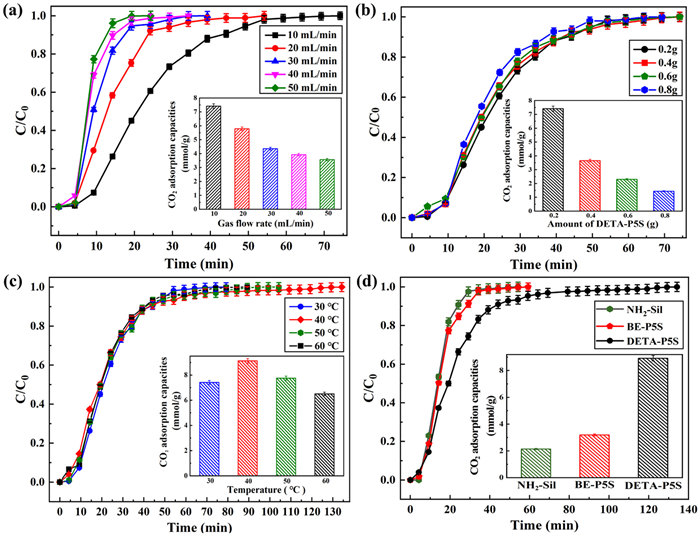
Subsequently, the effect of DETA-P5S amount for CO2 adsorption capacity was investigated with flow rate of 10 mL/min at 30 ℃ (Fig. 3b), and the breakthrough time was shortened and the CO2 saturated adsorption capacity decreased with the increase of DETA-P5S increased from 0.2 g to 0.8 g. Based on the basis of adsorption mechanism, the adsorption capacity of acid gas may depend on the amine proportion in DETA-P5S. It could be concluded that a certain amount of DETA-P5S could enhance CO2 adsorption capacity for dominant adsorption mode. However, when too much adsorbent was packed, the column height of the adsorbent increased, and the diffusion resistance of CO2 through the adsorbent pores was increased accordingly, which reduced the contact time between CO2 and the active amine of the internal adsorbent. As a result, the saturation adsorption capacity was reduced. Therefore, the saturation adsorption capacity of CO2 is related to the amount of DETA-P5S in specific reaction tubes.
Temperature significantly influences the CO2 adsorption capacity, Fig. 3c represented the effect of adsorption temperature on CO2 adsorption capacity from 30 ℃ to 60 ℃ on 0.2 g DETA-P5S at a 10 mL/min flow rate. the results revealed that the CO2 saturation adsorption capacity of DETA-P5S reached 9.1 mmol/g when the temperature at 40 ℃, however, further temperature increases lead to a decrease in adsorption capacity, these results indicated that the adsorption of CO2 to EDTA-P5S may be a kinetics-controlled process. When increased the temperature, the diffusion resistance of CO2 decreases, the structure of alkyl chain in DETA-P5S stretched and exposed more active site, which leads to a significant increase in CO2 capture capacity. However, with the further increased of temperature, the desorption of CO2 from the adsorption site in the pore may become more priority, resulting in the reduction of CO2 adsorption capacity. Therefore, DETA-P5S at 40 ℃ was an important factor as a candidate material for CO2 adsorption.
Furthermore, with multiple modification in synthesis process, the CO2 adsorption capacity may be different. To examine the impact of DETA derivatives on adsorption capacity, we investigated the CO2 adsorption capacity of control adsorbents NH2-Sil and BE-P5S (Fig. 3d). The saturated adsorption capacity of CO2 on DETA-P5S was found to be the highest when compared to the other two adsorbents. The results indicated that the introduction of DETA on pillar[5]arene bonded porous silica greatly enhanced the adsorption capacity of CO2. Considering the great change of CO2 adsorption capacity after the introduction of DETA and BE-P5, this method can provide a new strategy for the development of CO2 solid amine adsorbent.
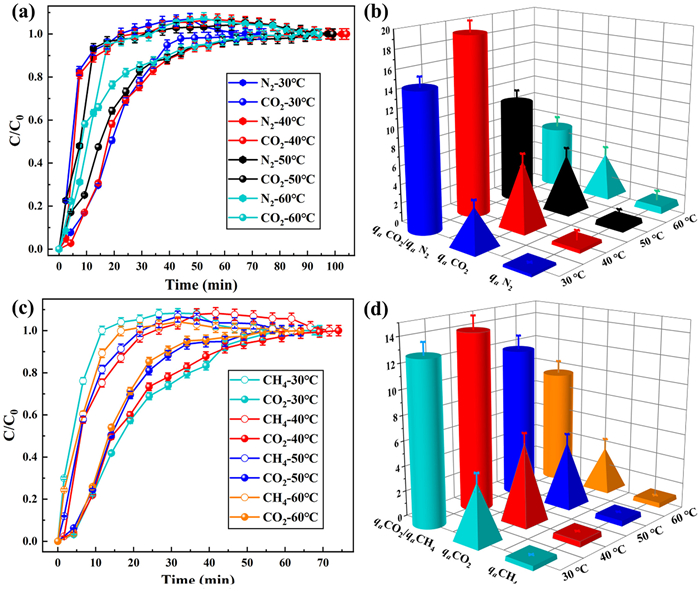
To further assess the practical separation performance of DETA-P5S, the effect of temperature on dynamic adsorption performance selectivities of DETA-P5S for CO2/N2 and CO2/CH4 were evaluated through breakthrough tests, respectively. The two ternary gas mixtures CO2/N2/Ar and CO2/CH4/Ar with a composition of 5/5/90 were used at a flow rate of 10 mL/min at 30~60 ℃. The adsorption time of CO2 in whole adsorption process was longer than that of N2 and CH4, indicated that the adsorption capacity of CO2 was strong, and the breakthrough time was longer than that of N2 and CH4. The breakthrough curve clearly shown that DETA-P5S has good separation potential for CO2 over N2 and CH4. The dynamic saturation adsorption capacities of DETA-P5S were 7.11 (0.37) and 6.18 (0.44) mmol/g for CO2/N2 (Figs. 4a and b) and CO2/CH4 (Figs. 4c and d), respectively, both the gas mixtures showed high separation selectivity. These results have demonstrated that DETA-P5S is a promising absorbent for the adsorption of CO2 in preference to CH4 and N2.
As an excellent adsorbent, in addition to high absorption capacity and selective separation, there are advantages of stability at cyclic adsorption. During operation, the adsorption temperature of 40 ℃ and desorption temperature of 110 ℃ were performed for DETA-P5S in CO2 cyclic adsorption capacity (Fig. 5a), the study concluded that the adsorption capacity of CO2 diminished from 8.4 mmol/g to 7.6 mmol/g following 15 cycles of adsorption and desorption, yet it still retained an exceptionally high CO2 adsorption capacity. The findings suggested that DETA-P5S could be effectively utilized in cyclic CO2 adsorption operations.
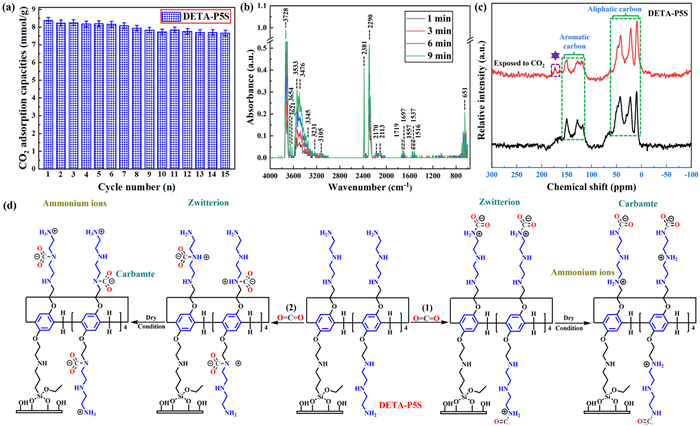
In situ infrared spectroscopy was employed to study the adsorption mechanism of CO2 on DETA-P5S. As shown in Fig. 5b and Fig. S6 (Supporting information), the intensity of stretching vibration at 3728~3533 cm−1 was confirmed to be due to the binding effect between CO2 and –OH on silicas. The peak at 3345 cm−1 was the asymmetric stretching vibration peak of NH2, and the peak at 3231 cm−1 was the symmetric stretching vibration peak of NH2 and NH. Peak at 3105 cm−1 was the stretching vibration of N—H. The intensity of stretching vibration at 2381 cm−1 and 2290 cm−1 were thought to be stretching vibration of CO2, the peak at 2170 cm−1 was the vibration peak of NH2+–COO−. Peaks at 1711 cm−1 was vibration adsorption peaks of C=O bond in –NCOOH. Peak at 1697 cm−1 is the deformation vibration peak of NH3+. Peaks at 1557~1553 cm−1 were the stretching vibration peak of COO−. Peak at 1516 cm−1 was the stretching vibration peak of C—N, and peaks at 651 cm−1 was assigned for CO2 deformation vibration. The adsorption peaks of NH3+ and NH2+ gradually intensified mainly because CO2 reacted with NH2 and NH. This was consistent with dynamic CO2 adsorption mechanism of solid amine adsorbent [30–32]. Consequently, the CO2 adsorption of adsorbent follows anionic and cationic mechanisms on DETA-P5S, finally forming ammonium ions and carbamate.
Solid-state 13C MAS NMR spectrum was further conducted to investigate the adsorption mechanism for whether there was a formation of carbamate (Fig. 5c), the distinct resonance at 168 ppm indicated the formation of carbamate after adsorbed CO2 by DETA-P5S. Therefore, DETA-P5S has the ability to selectively adsorption of CO2, as well as the amide and hydroxyl group in its framework have a synergistic effect, they play an important role in the interaction with CO2 in both chemisorption and physisorption (Fig. 5d). Lastly, the pseudo-first-order model, pseudo-second-order model and Avrami kinetic model were fitted to the adsorption process, the results suggested that the Avrami model can accurately predict the adsorption kinetics of DETA-P5S, the correlation coefficient of R2 was above 0.9977 and the adsorption process has both physical and chemical adsorption, but physical adsorption plays a dominant role in the adsorption process (Fig. S7 and Table S2 in Supporting information) [7].
In conclusion, a novel amine-pillar[5]arene functionalized CO2 porous adsorbents (DETA-P5S) with high CO2 adsorption capacity was prepared for selective separation CO2 over N2 and CH4. The DETA-P5S preferentially adsorbs CO2 over N2 and CH4 for its primary and secondary amine with a weakly nucleophilic property, which were able to interact with CO2. The effects of gas flow rate, amount of adsorbent, and adsorption temperature on CO2 adsorption capacities were systematic studied. The DETA-P5S has the optimal capture amount of 9.1 mmol/g with 5 vol% CO2 flow rates at 40 ℃, which indicated that the introduction of DETA provided amino active sites, while the cavity of pillar[5]arene provided capture pores, thereby promoting CO2 adsorption. Moreover, the dynamic saturation adsorption capacities of DETA-P5S were 7.11 (0.37) and 6.18 (0.44) mmol/g for CO2/N2 and CO2/CH4, respectively, both the gas mixtures showed high separation selectivity. Simultaneously, the DETA-P5S also maintained an outstanding CO2 adsorption capacity even after ten regeneration cycles. In-situ FTIR and solid-state 13C MAS NMR spectrum confirmed that the CO2 adsorption process on DETA-P5S was consistent with zwitterionic mechanism. This study demonstrates that amine-pillar[5]arene solid porous adsorbent with organic amine modification and could provide a facile protocol for the challenging CO2 capture.
The authors declare that they have no known competing financial interests or personal relationships that could have appeared to influence the work reported in this paper.
The authors are thankful for financial supports from National Natural Science Foundation of China (No. 22204169), Gansu Natural Science Foundation (Nos. 23JRRA619, 21JR7RA076) and Scientific and Technological Program of Chengguan District, Lanzhou (No. 2023JSCX0037).
Supplementary material associated with this article can be found, in the online version, at doi:
L. Zhang, S.H. Lin, Y.P. Liu, et al., Inorg. Chem. 62 (2023) 8058–8063. doi: 10.1021/acs.inorgchem.3c01055
M.M. Abdelnaby, N.A.A. Qasem, B.A. Al-Maythalony, et al., ACS Sustain. Chem. Eng. 7 (2019) 13941–13948. doi: 10.1021/acssuschemeng.9b02334
M. Breunig, M. Dorner, J. Senker, J. Mater. Chem. A 9 (2021) 12797–12806. doi: 10.1039/D0TA12426E
L. Li, N. Zhao, W. Wei, et al., Fuel 108 (2013) 112–130. doi: 10.1016/j.fuel.2011.08.022
S. Ravi, J. Kim, Y. Choi, ACS Sustain. Chem. Eng. 11 (2023) 1190–1199. doi: 10.1021/acssuschemeng.2c06621
J.J. Dai, D.Y. Xie, Y. Liu, et al., Ind. Eng. Chem. Res. 59 (2020) 7866–7874. doi: 10.1021/acs.iecr.0c00447
G.J. Zhang, P.Y. Zhao, L.X. Hao, et al., Sep. Purif. Technol. 209 (2019) 516–527. doi: 10.1016/j.seppur.2018.07.074
M.M. Zhang, L. Chen, Z.Y. Yuan, et al., Ind. Eng. Chem. Res. 62 (2023) 8902–8910. doi: 10.1021/acs.iecr.3c01083
E. Jeon, S.Y. Moon, J.S. Bae, et al., Angew. Chem. Int. Ed. 55 (2016) 1318–1323. doi: 10.1002/anie.201508367
G.J. Zhang, P.Y. Zhao, L.X. Hao, et al., J. CO2 Util. 24 (2018) 22–33. doi: 10.1016/j.jcou.2017.12.006
A.M. Varghese, G.N. Karanikolos, Int. J. Greenh. Gas Control. 96 (2020) 103005. doi: 10.1016/j.ijggc.2020.103005
L.J. Wei, W. Wei, N. Xue, et al., ACS Appl. Mater. Interfaces 13 (2021) 5814–5822. doi: 10.1021/acsami.0c19907
K.S.K. Reddy, A.M. Varghese, A.E. Ogungbenro, et al., ACS Appl. Eng. Mater. 1 (2023) 720–733. doi: 10.1021/acsaenm.2c00136
Y. Le, D. Guo, B. Cheng, et al., J. Colloid Interface Sci. 408 (2013) 173–180. doi: 10.1016/j.jcis.2013.07.014
G.J. Zhang, P.Y. Zhao, Y. Xu, J. Ind. Eng. Chem. 54 (2017) 59–68. doi: 10.1016/j.jiec.2017.05.018
G.J. Zhang, P.Y. Zhao, Y. Xu, et al., ACS Appl. Mater. Interfaces 10 (2018) 34340–34354. doi: 10.1021/acsami.8b13069
J. Lu, J. Zhang, J. Mater. Chem. A 2 (2014) 13831–13834. doi: 10.1039/C4TA03015J
B. Zhang, G.Y. Li, J. Yan, et al., J. Phys. Chem. C 119 (2015) 13080–13087. doi: 10.1021/acs.jpcc.5b02806
S. Bali, J. Leisen, G.S. Foo, et al., ChemSusChem 7 (2014) 3145–3156. doi: 10.1002/cssc.201402373
D.V. Quang, A. Dindi, M.R.M. Abu-Zahra, ACS Sustain. Chem. Eng. 5 (2017) 3170–3178. doi: 10.1021/acssuschemeng.6b02961
J. Peng, Z. Liu, Y. Wu, et al., ACS Appl. Mater. Interfaces 14 (2022) 21089–21097. doi: 10.1021/acsami.2c04779
K.K. Wang, H.L. Huang, D.H. Liu, et al., Environ. Sci. Technol. 50 (2016) 4869–4876. doi: 10.1021/acs.est.6b00425
M. Babaei, S. Salehi, M. Anbia, et al., J. Chem. Eng. Data 63 (2018) 1657–1662. doi: 10.1021/acs.jced.8b00014
H. Li, Y.R. Zhu, B.B. Shi, et al., Chin. J. Chem. 33 (2015) 373–378. doi: 10.1002/cjoc.201400882
H. Li, K.J. Quan, X. Yang, et al., Trends Anal. Chem. 131 (2020) 116026. doi: 10.1016/j.trac.2020.116026
H. Li, X.P. Wang, C.X. Shi, et al., Chin. Chem. Lett. 34 (2023) 107606. doi: 10.1016/j.cclet.2022.06.029
C.X. Shi, H. Li, X.F. Shi, et al., Chin. Chem. Lett. 33 (2022) 3613–3622. doi: 10.1016/j.cclet.2021.12.010
P.Y. Zhao, G.J. Zhang, Y. Xua, J. CO2 Util. 34 (2019) 543–557. doi: 10.1016/j.jcou.2019.08.001
R. Sabouni, H. Kazemian, S. Rohani, Environ. Sci. Technol. 47 (2013) 9372–9380. doi: 10.1021/es401276r
Y. Zhai, S.S.C. Chuang, Energy Technol. 53 (2017) 510–519.
P.Y. Zhao, G.J. Zhang, Y. Xu, et al., Energy Fuels 33 (2019) 3357–3369. doi: 10.1021/acs.energyfuels.8b04278
G.S. Foo, J.J. Lee, C.H. Chen, et al., ChemSusChem 10 (2017) 266–276. doi: 10.1002/cssc.201600809

Figure 1 (a) Synthesis of DETA-P5S. (b) Schematic diagram of fixed-bed (FD-2000) reactor for CO2 capture.

Figure 2 Characterization of adsorbents: (a) FT-IR spectra of NH2-Sil, BE-P5, BE-P5S, and DETA-P5S, (b) SEM of DETA-P5S, (c) TG of NH2-Sil, BE-P5S, and DETA-P5S, (d) N2 adsorption/desorption isotherms of DETA-P5S, (e) XPS of DETA-P5S, (f) MIA of DETA-P5S.

Figure 3 (a) Effect of gas flow rate for CO2 adsorption capacity of DETA-P5S. (b) Effect of DETA-P5S amount for CO2 adsorption capacity. (c) Effect of adsorption temperature for CO2 adsorption capacity. (d) CO2 adsorption capacity of different adsorbents.

Figure 4 (a) Effect of temperature on selectivity of CO2/N2 for DETA-P5S. (b) Saturated adsorption capacity and selectivity of CO2/N2. (c) Effect of temperature on selectivity of CO2/CH4 for DETA-P5S. (d) Saturated adsorption capacity and selectivity factor of CO2/CH4.

 扫一扫看文章


扫一扫关注我们
 DownLoad:
 下载:
下载:

 下载:
下载: