
Scheme 1.
Copper-catalysed aerobic oxidation of primary alcohols

Copper-Catalyzed Aerobic Oxidation Reaction of Benzyl Alcohol in Water under Base-Free Condition
Xiaojiang Yang , Jincheng Mao , Heng Zhang , Yang Zhang , Jinhua Mao


It is well known that carbonyls are a class of essential functional groups as well as important structural units that were found in numerous biologically active compounds, the direct oxidation through alcohols has been extensively explored[1~3] and the typical of transition metals such as trioxide[4~8] or manganese[9~11] have been generally utilized as catalysts, however, the catalyst system suffers from some drawbacks, for instance, the high cost and potential environmental toxicity of transition metals. Subsequently, the use of inexpensive, abundant and non-toxic metal[12] as catalyst has been widely explored. In 1984, Semmelhack and co-workers[13~17] reported a copper and TEMPO as co-catalyst system catalyzed oxidation of primary alcohols. In 2002, Knochel[18, 19] and Gree[20] reported a copper and TEMPO catalyzed oxidation of alcohol by using contain fluorine double phase and ionic liquid under oxygen condition (Scheme 1). However, this protocol utilizes molecular oxygen as oxidant and contains fluorine phase and ionic liquid, which can greatly limit its practical applications.[21, 22] In recent years, Stahl et al.[23~26] devised a new protocol which utilized nitrogen ligand of Cu and TEMPO system (Scheme 1). Although significant improvements such as higher efficiency and milder reaction conditions have been achieved by introducing the method, limitations still exist, for instance, the use of an unfavorable organic solvent, a nitrogen ligand and stoichiometric amount of base has greatly limited its practical applications. Herein, we wish to report our recent results in the facile, base-free catalytic oxidation of benzyl alcohols by common low-cost copper catalyst and TEMPO, where water was used as a green solvent (Scheme 1). This represents a novel example of catalytic oxidation of benzyl alcohols to corresponding aromatic aldehydes.
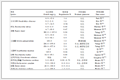
Initially, we used 4-methoxybenzyl alcohol (1a) as the starting materials for metal-catalyzed oxidation, and a systematic condition optimization was undertaken. The results are summarized in Table 1. To our delight, the desired 4-methoxybenzaldehyde (2a) was obtained in 85% yield when oxine-copper (10 mol%) was chosen as a catalyst and the reaction was conducted in water in the presence of sodium carbonate (Na2CO3) and TEMPO at 60 ℃ for 24 h under air (Entry 1, Table 1). Further screening by altering temperature was carried out and affording 2a in 87% yield under the same conditions (Entry 2). To our delight, the desired product 2a was obtained in 94% yield when the reaction was conducted under the same conditions in the absence of base (Entry 3). In contrast, other CuⅠ and CuⅡ salts were found to be less active catalysts for the reaction (Entries 4~8). In order to further improve the efficiency for the conversion of 4-methoxybenzyl alcohol, we then tested the reaction with an changed amount of oxinecopper, but the results were found to be worse (Entries 9, 10). Finally, decreasing the amount of TEMPO resulted in a decreased yield of 2a (69%, Entry 11).
 下载:
导出CSV
下载:
导出CSV
 |
|||||
| Entry | Catalyst | Cocatalyst | Solvent | Temp./℃ | Yield/% |
| 1b | Bis(8-quinolinolato) copper(Ⅱ) | TEMPO | H2O | 60 | 85 |
| 2b | Bis(8-quinolinolato) copper(Ⅱ) | TEMPO | H2O | 25 | 87 |
| 3 | Bis(8-quinolinolato) copper(Ⅱ) | TEMPO | H2O | 25 | 94 |
| 4 | Copper(Ⅱ) triflate | TEMPO | H2O | 25 | 92 |
| 5 | Cupric acetylacetonate | TEMPO | H2O | 25 | 86 |
| 6 | CuBr2 | TEMPO | H2O | 25 | 90 |
| 7 | CuI | TEMPO | H2O | 25 | 79 |
| 8 | CuSO4 | TEMPO | H2O | 25 | 93 |
| 9c | Bis(8-quinolinolato) copper(Ⅱ) | TEMPO | H2O | 25 | 69 |
| 10d | Bis(8-quinolinolato) copper(Ⅱ) | TEMPO | H2O | 25 | 87 |
| 11e | Bis(8-quinolinolato) copper(Ⅱ) | TEMPO | H2O | 25 | 69 |
| a 4-Methoxybenzyl alcohol (0.3 mmol), cat. (10 mol%), TEMPO (0.5 equiv.), H2O (2 mL), 24 h. b Na2CO3 (50 mol%). c Cat. (5 mol%). d Cat. (20 mol%). e TEMPO (0.25 equiv.). f All yields are for isolated products. | |||||
Having established the optimized reaction conditions for the synthesis of 2a, we then focused on the extension of the substrate scopes for the reactions and the results are summarized in Table 2. It was revealed that benzyl alcohol containing either electron-donating or electron-withdrawing groups on their aromatic rings could be smoothly transformed into the desired products. Gratifyingly, methyl and methoxy substituent at different positions (orth-, meta- or para-) of the benzene ring did not affect the efficiency and the corresponding aldehydes (2b~2d) were all obtained in good to excellent yields (Entries 2~4, Table 2). Using 4-mehylbenzyl alcohol as the substrate, the desired product 2e could be acquired in 85% yield (Entry 5). Specifically, halo substituents (Br and Cl) on the para-position of benzyl alcohol did not affect the efficiency and the corresponding products (2f~2g) were obtained in high yields (Entries 6, 7). To our surprise, even though the strong electron-withdrawing nitro-group was used, the expected product 2h was isolated in 93% yield (Entry 8). The reactions involving (3-phenoxyphenyl) methanol also afforded the desired product 2i in 90% yield (Entry 9).
下载:
导出CSV
 |
|||
| Entry | Alcohol | Aldehyde | Yield/% |
| 1 |  |
 |
94 |
| 2 |  |
 |
93 |
| 3 |  |
 |
89 |
| 4 |  |
 |
91 |
| 5 |  |
 |
85 |
| 6 |  |
 |
92 |
| 7 |  |
 |
90 |
| 8 |  |
 |
93 |
| 9 |  |
 |
90 |
| a Catalytic conditions: benzyl alcohol (0.3 mmol), bis(8-quinolinolato) copper(Ⅱ) (10 mol%), TEMPO (0.5 equiv.), H2O (2 mL), 25 ℃, 24 h. | |||
As for the possible mechanism, based on the pioneer works, [27, 28] we proposed the possible catalytic cycle as shown in Scheme 2. Firstly, the CuⅡ-hydroxide species A could be generated by direct oxidation of LnCuⅠ by O2, which comes from air. In the presence of TEMPO, the LnCuⅡ-OH could be obtained. Adding the benzyl alcohol, the intermediate B could be acquired via removing water. Finally, B could react with the TEMPO radical with release of TEMPOH and cuprous species to afford the desired aldehydes.[29]
In summary, we have successfully developed a novel, effective and direct oxidation of benzyl alcohol catalyzed by bis(8-quinolinolato) copper(Ⅱ) in the presence of TEMPO as an oxidant in water without using any base at 25 ℃ for 24 h under air. The present copper catalysis system is suitable for the oxidation reactions between a wide range of benzyl alcohol, benzyl alcohol containing either electron-donating or electron-withdrawing groups on their aromatic rings could be smoothly transformed into the desired products. The use of inexpensive, abundant and non-toxic copper as catalyst and water as a green solvent, as well as the base-free conditions make this method much attractive and promising for industrial applications. Further studies of relevant reaction mechanisms and the exploration of further applications of this methodology are underway in our laboratory.
1H NMR (400 MHz) spectral and 13C NMR (100 MHz) data were recorded on a Varian 400 M spectrometers using CDCl3 as solvent. 1H NMR spectra was recorded with tetramethylsilane as internal reference; 13C NMR spectra was recorded with CDCl3 (δ 77.00) as internal reference. MS were performed by the State-authorized Analytical Center in Southwest Petroleum University. All manipulations were carried out under air atmosphere. Benzyl alcohols were purchased from Acros Organics and used without further purification. TEMPO and copper catalysts were purchased from Adamas corporation. Column chromatography was generally performed on silica gel (300~400 mesh) and reactions were monitored by thin layer chromatography (TLC) using UV light to visualize the course of the reactions.
To a Schlenk tube equipped with a magnetic stir bar, benzyl alcohol (0.5 mmol), bis(8-quinolinolato) copper(Ⅱ) (0.05 mmol), TEMPO (0.25 mmol) and water (2 mL) were added under air condition. The resulting reaction mixture was kept stirring at 25 ℃ for 24 h. At the end of the reaction, the reaction mixture was poured into a saturated aqueous NaCl solution (20 mL) and extracted with ethyl acetate (15 mL×3). The organic phases were combined, and the volatile components were evaporated under reduced pressure. The crude product was purified by column chromatography on silica gel using ethyl acetate and petroleum ether mixtures to afford the desired product in high purity.
4-Methoxybenzaldehyde:[30, 31] m.p. 182 ℃; boiling point 275 ℃. Solubility: soluble in methanol, ethanol, ether, insoluble in hot water. 1H NMR (600 MHz, CDCl3) δ: 9.85 (s, 1H), 7.81 (d, J=8.8 Hz, 2H), 6.97 (d, J=8.6 Hz, 2H), 3.85 (s, 3H); 13C NMR (151 MHz, CDCl3) δ: 190.8, 164.6, 131.9, 129.9, 114.3, 55.6.
4-Methylbenzaldehyde:[30] Colorless liquid with soft floral and almond aromas; m.p. -6 ℃; b.p. 106 ℃. Solubility: miscible with ethanol, ether and acetone, slightly soluble in water. 1H NMR (600 MHz, CDCl3) δ: 9.91 (s, 1H), 7.72 (d, J=8.0 Hz, 2H), 7.27 (d, J=7.7 Hz, 2H), 2.37 (s, 3H); 13C NMR (151 MHz, CDCl3) δ: 191.8, 145.5, 134.2, 129.8, 129.7, 21.8.
4-Chlorobenzaldehyde:[30, 31] Colorless flake crystals; m.p. 46 ℃; b.p. 213~214 ℃. Solubility: soluble in benzene, toluene and other solvents, insoluble in water. 1H NMR (600 MHz, Chloroform-d) δ: 9.98 (s, 1H), 7.82 (d, J=8.4 Hz, 2H), 7.51 (d, J=8.4 Hz, 2H); 13C NMR (151 MHz, CDCl3) δ: 190.9, 140.9, 134.7, 130.9, 129.4.
4-Bromobenzaldehyde:[31] Colorless or yellowish leaf crystal with pungent smell; m.p. 67 ℃; b.p. 67~68 ℃. Solubility: soluble in ethanol and benzene, insoluble in water.1H NMR (400 MHz, CDCl3) δ: 10.00 (s, 1H), 7.80~7.75 (m, 2H), 7.74~7.69 (m, 2H); 13C NMR (151 MHz, CDCl3) δ: 191.0, 135.1, 132.4, 131.0, 129.7.
Supporting Information Copies of 1H NMR and 13C NMR spectra for representative products. The Supporting Information is available free of charge via the Internet at http://sioc-journal.cn.
刘文香, 吴宇强, 李灵芝, 李霞, 有机化学, 2016, 36, 1501. http://sioc-journal.cn/Jwk_yjhx/CN/abstract/abstract345483.shtmlLiu, W. X.; Wu, Y. Q.; Li, L. Z.; Li, X. Chin. J. Org. Chem. 2016, 36, 1501(in Chinese). http://sioc-journal.cn/Jwk_yjhx/CN/abstract/abstract345483.shtml
罗飞华, 龙洋, 李正凯, 周向葛, 化学学报, 2016, 74, 805. doi: 10.3866/PKU.WHXB201603111Luo, F. H.; Long, Y.; Li, Z. K.; Zhou, X. G. Acta Chim. Sinica 2016, 74, 805(in Chinese). doi: 10.3866/PKU.WHXB201603111
陈燚, 胡奥晗, 杨凌毅, 李早英, 严琨, 有机化学, 2017, 37, 1939. http://sioc-journal.cn/Jwk_yjhx/CN/abstract/abstract346075.shtmlChen, Y.; Hu, A. H.; Yang, L. Y.; Li, Z. Y.; Yan, K. Chin. J. Org. Chem. 2017, 37, 1939(in Chinese). http://sioc-journal.cn/Jwk_yjhx/CN/abstract/abstract346075.shtml
Bowden, K.; Heilbron, I. M.; Jones, E. R. H.; Weedon, B. C. L. J. Chem. Soc. 1946, 39. doi: 10.1039/jr9460000039
Corey, E. J.; Suggs, J. W. Tetrahedron Lett. 1975, 16, 2647. doi: 10.1016/S0040-4039(00)75204-X
Piancatelli, G.; Scettri, A.; Auria, M. Synthesis 1982, 245. doi: 10.1002/chin.198238380/abstract
De, A. J. Sci. Ind. Res. 1982, 41, 484.
Luzzio, F. A.; Guziec, F. S. Org. Prep. Proced. Int. 1988, 20, 533. doi: 10.1080/00304948809356301
Ladbury, J. W.; Cullis, C. F. Chem. Rev. 1958, 58, 403. doi: 10.1021/cr50020a005
Fatiadi, A. J. Synthesis 1976, 65.
Taylor, R. J. K.; Reid, M.; Foot, J.; Raw, S. A. Acc. Chem. Res. 2005, 38, 851. doi: 10.1021/ar050113t
Semmelhack, M. F.; Schmid, C. R.; Cortes, D. A.; Chou, C. S. J. Am. Chem. Soc. 1984, 106, 3374. doi: 10.1021/ja00323a064
Gamez, P.; Arends, I. W. C. E.; Sheldon, R. A.; Reedijk, J. Adv. Synth. Catal. 2004, 346, 805. doi: 10.1002/(ISSN)1615-4169
Jiang, N.; Ragauskas, A. J. J. Org. Chem. 2006, 71, 7087. doi: 10.1021/jo060837y
Figiel, P. J.; Sibaouih, A.; Ahmad, J. U.; Nieger, M.; Leskela, M.; Repo, T. Adv. Synth. Catal. 2009, 351, 2625. doi: 10.1002/adsc.200900478
Konning, D.; Hiller, W.; Christmann, M. Org. Lett. 2012, 14, 5258. doi: 10.1021/ol302420k
Hoover, J. M.; Steves, J. E.; Stahl, S. S. Nat. Protoc. 2012, 7, 1161. doi: 10.1038/nprot.2012.057
Ragagnin, G.; Betzemeier, B.; Quici, S.; Knochel, P. Tetrahedron 2002, 58, 3985. doi: 10.1016/S0040-4020(02)00250-8
Betzemeier, B. Cavazzini, M.; Quici, S.; Knochel, P. Tetrahedron Lett. 2000, 41, 4343. doi: 10.1016/S0040-4039(00)00620-1
Ansari, I. A.; Gree, R. Org. Lett. 2002, 4, 1507. doi: 10.1021/ol025721c
Liu, K. J.; Fu, Y. L.; Xie, L. Y.; Wu, C.; He, W. B.; Peng, S.; Wang, Z.; Bao, W. H.; Cao, Z.; Xu, X. H.; He, W. M. ACS Sustainable Chem. Eng. 2018, 6, 4916. doi: 10.1021/acssuschemeng.7b04400
Jiang, X. G.; Zhai, Y. Z.; Chen, J. Y.; Han, Y. L.; Yang, Z.; Ma, S. M. Chin. J. Chem. 2018, 36, 15. doi: 10.1002/cjoc.201700576
Steves, J. E.; Stahl, S. S. J. Am. Chem. Soc. 2013, 135, 15742. doi: 10.1021/ja409241h
Gamez, P.; Reedijk, J.; Sheldon, R. A. Chem. Commun. 2003, 2414. http://www.ncbi.nlm.nih.gov/pubmed/14587708
Hoover, J. M.; Stahl, S. S. J. Am. Chem. Soc. 2011, 133, 16901. doi: 10.1021/ja206230h
Kumpulainen, E. T. T.; Koskinen, A. M. P. Chem.-Eur. J. 2009, 15, 10901. doi: 10.1002/chem.200901245
Steves, J. E.; Stahl, S. S. J. Org. Chem. 2015, 80, 11184. doi: 10.1021/acs.joc.5b01950
Hill, N. J.; Hoover, J. M.; Stahl, S. S. J. Chem. Educ. 2013, 90, 102. doi: 10.1021/ed300368q
Hoover, J. M.; Ryland, B. L.; Stahl, S. S. ACS Catal. 2013, 3, 2599. doi: 10.1021/cs400689a
Corre, Y.; Rysak, V.; Capet, F.; Djukic, J. P.; Agbossou-Niedercorn, F.; Michon, C. Chemistry 2016, 22, 14036. doi: 10.1002/chem.201602867
Zhan, L. W.; Han, L.; Xing, P.; Jiang, B. Chemistry 2016, 47, 5990. http://www.ncbi.nlm.nih.gov/pubmed/26633757
Table 1. Optimization of reaction conditionsa
|
|
|||||
| Entry | Catalyst | Cocatalyst | Solvent | Temp./℃ | Yield/% |
| 1b | Bis(8-quinolinolato) copper(Ⅱ) | TEMPO | H2O | 60 | 85 |
| 2b | Bis(8-quinolinolato) copper(Ⅱ) | TEMPO | H2O | 25 | 87 |
| 3 | Bis(8-quinolinolato) copper(Ⅱ) | TEMPO | H2O | 25 | 94 |
| 4 | Copper(Ⅱ) triflate | TEMPO | H2O | 25 | 92 |
| 5 | Cupric acetylacetonate | TEMPO | H2O | 25 | 86 |
| 6 | CuBr2 | TEMPO | H2O | 25 | 90 |
| 7 | CuI | TEMPO | H2O | 25 | 79 |
| 8 | CuSO4 | TEMPO | H2O | 25 | 93 |
| 9c | Bis(8-quinolinolato) copper(Ⅱ) | TEMPO | H2O | 25 | 69 |
| 10d | Bis(8-quinolinolato) copper(Ⅱ) | TEMPO | H2O | 25 | 87 |
| 11e | Bis(8-quinolinolato) copper(Ⅱ) | TEMPO | H2O | 25 | 69 |
| a 4-Methoxybenzyl alcohol (0.3 mmol), cat. (10 mol%), TEMPO (0.5 equiv.), H2O (2 mL), 24 h. b Na2CO3 (50 mol%). c Cat. (5 mol%). d Cat. (20 mol%). e TEMPO (0.25 equiv.). f All yields are for isolated products. | |||||
 下载: 导出CSV
Table 2. Scope of bis(8-quinolinolato)copper(Ⅱ)/TEMPO-catalyzed aerobic oxidation of benzyl alcohols to aromatic aldehydesa
|
|
|||
| Entry | Alcohol | Aldehyde | Yield/% |
| 1 | |
|
94 |
| 2 | |
|
93 |
| 3 | |
|
89 |
| 4 | |
|
91 |
| 5 | |
|
85 |
| 6 | |
|
92 |
| 7 | |
|
90 |
| 8 | |
|
93 |
| 9 | |
|
90 |
| a Catalytic conditions: benzyl alcohol (0.3 mmol), bis(8-quinolinolato) copper(Ⅱ) (10 mol%), TEMPO (0.5 equiv.), H2O (2 mL), 25 ℃, 24 h. | |||
下载: 导出CSV

 扫一扫看文章


扫一扫关注我们


