Login In

Mechanistic Insight into the Photo-splitting of Water to Dihydrogen Catalyzed by Si-Substituted Keggin-type Polyoxometalate
- Corresponding author: Ci Chenggang, chenggci@sgmtu.edu.cn
Figures(5)
Citation:
Ci Chenggang, Dong Long, Zang Jiechao, Luo Guoxiang. Mechanistic Insight into the Photo-splitting of Water to Dihydrogen Catalyzed by Si-Substituted Keggin-type Polyoxometalate[J]. Chemistry,
;2020, 83(9): 837-843.

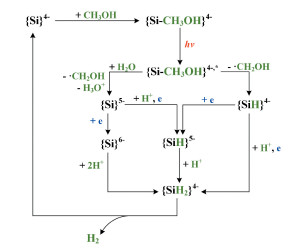
Figures(5)


Tachibana Y, Vayssieres L, Durrant J. Nat. Photon., 2012, 6: 511~518.
Dalle K E, Warnan J, Leung J J, et al. Chem. Rev., 2019, 119(4): 2752~2875.
Hou Y, Pang H, Zhang L, et al. J. Power Sources, 2020, 446: 227319.
Ding Y S, Wang H Y, Ding Y. Dalton Transac., 2020, 49: 3457~3462.
Paille G, Boulmier A, Bensaid A, et al. Chem. Commun., 2019, 55: 4166~4169.
Zhang Z Y, Lin Q P, Zheng S T, et al. Chem. Commun., 2011, 47: 3918~3920.
Akid R, Darwent J R. J. Chem. Soc., Dalton Transac., 1985, 395~399.
Keïta B, Nadjo L. J. Electroanal. Chem., 1985, 191: 441~448.
Dang L Q, You W S, Zhang X, et al. Chin. Chem. Lett., 2006, 17(7): 973~976.
Nie Y H, Chen W L, Liu Z J, et al. Inorg. Chem. Commun., 2015, 61: 184~186.
Huang B S, Hart J N. Phys. Chem. Chem. Phys., 2020, 22: 1727~1737.
Kataoka Y, Yano N, Handa M, et al. Dalton Transac., 2019, 48: 7302~7312.
Kayanuma M, Stoll T, Daniel C, et al. Phys. Chem. Chem. Phys., 2015, 17: 10497~10509.
Ravelli D, Dondi D, Fagnoni M, et al. J. Comput. Chem., 2011, 32: 2983~2987.
Ravelli D, Dondi D, Fagnoni M, et al. Phys. Chem. Chem. Phys., 2013, 15: 2890~2986.
Frisch M J, Trucks G W, Schlegel H B, et al. Gaussian 16; Gaussian, Inc., Wallingford, CT, 2016.
Stephens P J, Devlin F J, Chabalowski C F, et al. J. Phys. Chem., 1994, 98: 11623~11627.
Francl M M, Pietro W J, Hehre W J, et al. J. Chem. Phys., 1982, 77: 3654~3661.
Hehre W J, Ditchfield R, Pople J A. J. Chem. Phys., 1972, 56: 2257.
Hariharan P C, Pople J A. Theor. Chim. Acta, 1973, 28: 213~222.
Casida M E, Jamorski C, Casida K C, et al. J. Chem. Phys., 1998, 108: 4439~4449.
Stratmann R E, Scuseria G E, Frisch M J. J. Chem. Phys., 1998, 109: 8218~8224.
Zhao Y, Truhlar D G. J. Chem. Theory Comput., 2008, 4: 1849~1868.
Yanai T, Tew D P, Handy N C. Chem. Phys. Lett., 2004, 393: 51~57.
O'Boyle N M, Tenderholt A L, Langner K M. J. Comput. Chem., 2008, 29: 839~845.
Cancès E, Mennucci B, Tomasi J. J. Chem. Phys., 1997, 107: 3032~3041.
Niu J Y, You X Z, Duan C Y, et al. Inorg. Chem., 1996, 35: 4211~4217.
Yang Wang , Shuangliang Liu , Jianbo Zhao . Exploring the mechanism of Diels-Alder reaction: a computational chemistry experiment for undergraduate students. University Chemistry, 2026, 41(7): 257-265. doi: 10.12461/PKU.DXHX202504061
Hao Wu , Fengqi Li , Xinwei Shi , Haifeng Bian , Qing Zhou , Shunshun Jia , Yujie Ma , Jian Gu , Jingzi Zhang , Shuijian He , Xiangkang Meng . Machine-learning guides discovery of multi-principal element alloys as electrocatalyst for hydrogen evolution reaction. Acta Physico-Chimica Sinica, 2026, 42(8): 100227-0. doi: 10.1016/j.actphy.2025.100227
Mengyang LI , Hao XU , Zhonghao NIU , Chunhua GONG , Weihui ZHONG , Jingli XIE . Highly effective catalytic synthesis of β-amino alcohols by using viologen-polyoxometalate hybrid materials. Chinese Journal of Inorganic Chemistry, 2025, 41(7): 1294-1300. doi: 10.11862/CJIC.20250080
Anqi LI , Wenjing YANG , Xueming LI , Yanfong REN . Performance and mechanism of a foam Ti/FeCo-Fe2O3-CoFe2O4/SnO2-Sb anode for synergistic activation of peroxymonosulfate toward degradation of organic pollutants. Chinese Journal of Inorganic Chemistry, 2026, 42(5): 944-958. doi: 10.11862/CJIC.20250323
Jie ZHAO , Sen LIU , Qikang YIN , Xiaoqing LU , Zhaojie WANG . Theoretical calculation of selective adsorption and separation of CO2 by alkali metal modified naphthalene/naphthalenediyne. Chinese Journal of Inorganic Chemistry, 2024, 40(3): 515-522. doi: 10.11862/CJIC.20230385
Wei Sun , Yongjing Wang , Kun Xiang , Saishuai Bai , Haitao Wang , Jing Zou , Arramel , Jizhou Jiang . CoP Decorated on Ti3C2Tx MXene Nanocomposites as Robust Electrocatalyst for Hydrogen Evolution Reaction. Acta Physico-Chimica Sinica, 2024, 40(8): 2308015-0. doi: 10.3866/PKU.WHXB202308015
Hao XU , Ruopeng LI , Peixia YANG , Anmin LIU , Jie BAI . Regulation mechanism of halogen axial coordination atoms on the oxygen reduction activity of Fe-N4 site: A density functional theory study. Chinese Journal of Inorganic Chemistry, 2025, 41(4): 695-701. doi: 10.11862/CJIC.20240302
Peng YUE , Liyao SHI , Jinglei CUI , Huirong ZHANG , Yanxia GUO . Effects of Ce and Mn promoters on the selective oxidation of ammonia over V2O5/TiO2 catalyst. Chinese Journal of Inorganic Chemistry, 2025, 41(2): 293-307. doi: 10.11862/CJIC.20240210
Weina Wang , Lixia Feng , Fengyi Liu , Wenliang Wang . Computational Chemistry Experiments in Facilitating the Study of Organic Reaction Mechanism: A Case Study of Electrophilic Addition of HCl to Asymmetric Alkenes. University Chemistry, 2025, 40(3): 206-214. doi: 10.12461/PKU.DXHX202407022
Haoyun SHENG , Jiejie LI , Ziqi TIAN . Progress in the design of oxygen evolution catalysts for water electrolysis driven by simulation and data. Chinese Journal of Inorganic Chemistry, 2026, 42(9): 1845-1870. doi: 10.11862/CJIC.20260059
Hongfei Yin , Mengling Hong , Jinyang Zhang , Wentao Wang , Wei Chen , Guozhi Wu . Oxygen vacancy-mediated 2D/2D Bi2MoO6/Bi2O2S S-scheme heterojunctions for efficient CO2 photoreduction. Acta Physico-Chimica Sinica, 2026, 42(9): 100332-0. doi: 10.1016/j.actphy.2026.100332
Shuangshuang Mao , Juhua Luo , Bingjie Han , Jiahuan Shi , Yujia Gu . Covalent organic framework-derived Fe3C/NC/TiO2 heterostructures for high-performance electromagnetic wave absorption. Acta Physico-Chimica Sinica, 2026, 42(7): 100290-. doi: 10.1016/j.actphy.2026.100290
Jiajie Li , Xiaocong Ma , Jufang Zheng , Qiang Wan , Xiaoshun Zhou , Yahao Wang . Recent Advances in In-Situ Raman Spectroscopy for Investigating Electrocatalytic Organic Reaction Mechanisms. University Chemistry, 2025, 40(4): 261-276. doi: 10.12461/PKU.DXHX202406117
Ronghao Zhao , Yifan Liang , Mengyao Shi , Rongxiu Zhu , Dongju Zhang . Investigation into the Mechanism and Migratory Aptitude of Typical Pinacol Rearrangement Reactions: A Research-Oriented Computational Chemistry Experiment. University Chemistry, 2024, 39(4): 305-313. doi: 10.3866/PKU.DXHX202309101
Wentao Lin , Wenfeng Wang , Yaofeng Yuan , Chunfa Xu . Concerted Nucleophilic Aromatic Substitution Reactions. University Chemistry, 2024, 39(6): 226-230. doi: 10.3866/PKU.DXHX202310095
Zhi Chai , Huashan Huang , Xukai Shi , Yujing Lan , Zhentao Yuan , Hong Yan . Wittig反应的立体选择性. University Chemistry, 2025, 40(8): 192-201. doi: 10.12461/PKU.DXHX202410046
Chonghang Sun , Xingfang Zheng , Lin Li , Xiaolei Jiang , Fangdong Hu . 类比法在有机化学机理教学中的应用——以羰基化合物及羧酸衍生物为例. University Chemistry, 2026, 41(9): 382-391. doi: 10.12461/PKU.DXHX202508095
Bolin Sun , Jie Chen , Ling Zhou . 乙烯型卤代烃的亲核取代反应. University Chemistry, 2025, 40(8): 152-157. doi: 10.12461/PKU.DXHX202410032
Kaifu Zhang , Shan Gao , Bin Yang . Application of Theoretical Calculation with Fun Practice in Raman Spectroscopy Experimental Teaching. University Chemistry, 2025, 40(3): 62-67. doi: 10.12461/PKU.DXHX202404045
Hongting Yan , Aili Feng , Rongxiu Zhu , Lei Liu , Dongju Zhang . Reexamination of the Iodine-Catalyzed Chlorination Reaction of Chlorobenzene Using Computational Chemistry Methods. University Chemistry, 2025, 40(3): 16-22. doi: 10.12461/PKU.DXHX202403010
 DownLoad: