Login In
Distribution and enrichment characteristics of arsenic in feed-coal and by-products of coal-fired power plants
- Corresponding author: ZHANG Kai, kzhang@ncepu.edu.cn
Figures(5)
Citation:
LIU Xuan, SU Yin-jiao, ZHAO Yuan-cai, TENG Yang, ZHANG Kai, ZHANG Yong-hong. Distribution and enrichment characteristics of arsenic in feed-coal and by-products of coal-fired power plants[J]. Journal of Fuel Chemistry and Technology,
;2020, 48(12): 1513-1519.

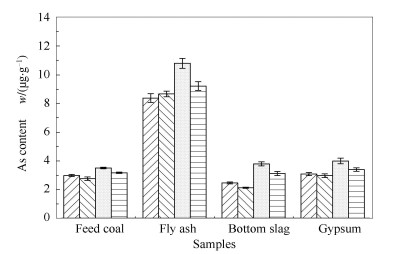
Figures(5)


FINKELMAN R B. Trace elements in coal: Environmental and health significance[J]. Biol Trace Elem Res, 1999,67:2-9.
NRIAGU J O, PACYNA J M. Quantitative assessment of worldwide contamination of air, water and soils by trace metals[J]. Nature, 1988,333(6169):134-139.
LIEVE H. Sampling technologies and air pollution control devices for gaseous and particulate arsenic: A review[J]. Environ Pollut, 2005,137(2):305-315.
WEI Shao-qing, TENG Yang, LI Xiao-hang, SU Yin-jiao, YANG Wei, ZHANG Kai. Comparison of mercury emission from around 300 MW coal-fired power generation units between pulverized boiler and circulating fluidized-bed boiler[J]. J Fuel Chem Technol, 2017,45(8):1009-1016.
SENIOR C L, BOOL L E, MORENCY J R. Laboratory study of trace element vaporization from combustion of pulverized coal[J]. Fuel Process Technol, 2000,63:109-124.
ZHAO Y C, ZHANG J Y, HUANG W C, WANG Z H, LI Y, SONG D Y, ZHAO F H, ZHENG C G. Arsenic emission during combustion of high arsenic coals from Southwestern Guizhou, China[J]. Energy Convers Manage, 2008,49:615-624.
ZOU Chan, WANG Chun-bo, XING Jia-ying. Reaction mechanism of arsenic and nitrous oxide s during coal combustion[J]. J Fuel Chem Technol, 2019,47(2):139-144.
AKIRA O, TSUNENORI N, YUKA S, AKIRA I, HIROKAZU T. Analysis of arsenic and some other elements in coal fly ash by X-ray photoelectron spectroscopy[J]. J Hazard Mater, 2005,119(1/3):213-217.
LOPEZ-ANTON M A, DIAZ-SOMOANO M, SPEARS D A, MARTINEZ-TARAZONA M R. Arsenic and selenium capture by fly ashes at low temperature[J]. Environ Sci Technol, 2006,40:3947-3951.
ZHENG C H, WANG L, ZHANG Y X, ZHANG J, ZHAO H T, ZHOU J S, GAO X, CEN K F. Partitioning of hazardous trace elements among air pollution control devices in ultra-low-emission coal-fired power plants[J]. Energy Fuels, 2017,31(6):6334-6344.
ZHAO Y, ZHONG W Q, SUN H. Removal of arsenic from flue gas using NaClO/NaClO2 complex absorbent[J]. Chem Eng Res Des, 2019,144:505-511.
TIAN H Z, WANG Y, XUE Z G, QU Y P, CHAI F H, HAO J M. Atmospheric emissions estimation of Hg, As, and Se from coal-fired power plants in China, 2007[J]. Sci Total Environ, 2011,409(16):3078-3081.
DUAN L B, CUI J, JIANG Y, ZHAO C S, EDWARD J A. Partitioning behavior of Arsenic in circulating fluidized bed boilers co-firing petroleum coke and coal[J]. Fuel Process Technol, 2017,166:107-114.
GENG W H, FURUZONO T, NAKAJIMA T, TAKANASHI H, OHKI A. Determination of total arsenic in coal and wood using oxygen flask combustion method followed by hydride generation atomic absorption spectrometry[J]. J Hazard Mater, 2010,176:356-360.
ZHANG N, SUN G L, MA H R. Determination of ultra-trace selenium in mineral samples by hydride generation atomic fluorescence spectrometry with pressurized-PTFE-vessel acid digestion[J]. Miner Eng, 2007,20(15):1397-1400.
WANG J, NAKAZATO T, SAKANISHI K, YAMADA O, TAO H, SAITO I. Microwave digestion with HNO3/H2O2 mixture at high temperatures for determination of trace elements in coal by ICP-OES and ICP-MS[J]. Anal Chim Acta, 2004,514(1):115-124.
AKIRA I, TSUNENORI N, HIROKAZU T, AKIRA O, YOSHIO F, TORU Y. Effect of pretreatment conditions on the determination of major and trace elements in coal fly ash using ICP-AES[J]. Fuel, 2006,85(2):257-263.
HATANPAA E, KAJANDER K, LAITINEN T, PIEPPONEN S, REVITZER H. A study of trace element behavior in two modern coal-fired power plants I. Development and optimization of trace element analysis using reference materials[J]. Fuel Process Technol, 1997,51(3):205-217.
ZHU Zhen-wu, ZHUO Yu-qun. Effect of acid systems for determination of trace elements in coal combustion byproducts using microwave digestion method[J]. J Tsinghua Univ (Sci & Technol), 2016,56(10):1072-1078.
GÓMEZ-ARIZA J L, SÁNCHEZ-RODAS D, GIRÁLDEZ I, MORALES E. A comparison between ICP-MS and AFS detection for arsenic speciation in environmental samples[J]. Talanta, 2000,51(2):257-268.
LIU Jing, ZHNEG Chu-guang, JIA Xiao-hong, XU Jie-ying. Determination of 14 elements in coal ash by microwave digestion and inductively coupled plasma atomic emission spectrometry[J]. Anal Chem, 2003,31(11):1360-1363.
WANG Xue-tao, JIN Bao-sheng, ZHONG Zhao-ping, QU Cheng-rui. Influence of atmospheres on behavior of heavy metals during melting process of fly ashes from municipal solid waste incinerator[J]. Proc CSEE, 2006,26(7):47-52.
ZHAO Feng-hua, REN De-yi, PENG Su-ping, WANG Yun-quan, ZHANG Jun-ying, DING Zhen-hua, CONG Zhi-yuan. The modes of occurrence of arsenic in coal[J]. Adv Earth Sci, 2003,18(2):214-220.
LIU Hui-min, WANG Chun-bo, ZHANG Yue, SUN Zhe, SHAO Huan. Effect of temperature and occurrence form of arsenic on its migration and volatilization during coal combustion[J]. J Chem Ind Eng, 2015,66(11):4643-4651.
CHEN C, LI Q, TAO D J, ZHAI J P, TAO C L. Physical and chemical prosperities difference between pulverized coal boiler fly ash and circulating fluidized bed combustion ash[J]. Asian J Chem, 2012,24(10):4538-4540.
LI Yang, CHEN Wei, ZHAO Yong-chun, LI Hai-long, ZHANG Jun-ying, LI Jie, HU Hao-quan. Removal of elemental mercury from flue gas by Fe/Al-SiO2 complex[J]. J Fuel Chem Technol, 2019,47(12):1409-1416.
ZHU Yong-qing. Silicate Melt Structure[M]. Beijing: Geological Publishing House, 1990.
ZHAO Feng-hua, REN De-yi, XU De-wei, YIN Jin-shuang, LI Ya-nan, WANG Xiu-qin. Research on the phase of arsenic in coal-burning residue[J]. J China Univ Min Technol, 1999,28(4):366-367.
MEIJ R, VERDENBREGT L H J, WINKEL H T. The fate and behavior of mercury in coal-fired power plants[J]. J Air Waste Manage, 2002,52(8):912-917.
BHATTACHARYYA S, DONAHOE J, DAN P. Experimental study of chemical treatment of coal fly ash to reduce the mobility of priority trace elements[J]. Fuel, 2009,88(7):1173-1184.
RODELLA N, BOSIOA , ZACCO A, BORGESE L, PASQUALI M, DALIPI R, DEPERO L E, PATEL V, BINGHAM P A, BONTEMPI E. Arsenic stabilization in coal fly ash through the employment of waste materials[J]. J Environ Chem Eng, 2014,2(3):1352-1357.
YUDOVICH Y E, KETRIS M P. Arsenic in coal: A review[J]. Int J Coal Geol, 2005,61:141-196.
Jinmei Zhou , Huamin Li , Yiru Wang , Wenwei Zhang , Xiuqiong Zeng , Juanjuan Song , Yongxian Fan , Dongcheng Liu , Yanping Ren , Faqiong Zhao , Mei Shi , Min Hu , Wan Li , Xiuyun Wang , Weihong Li , Xiaohang Qiu , Yong Fan , Jianrong Zhang , Shuyong Zhang . Suggestions on Operational Standards for Heating and Heating Instruments (Part IV): Microwave Heating and the Use of Microwave Ovens, Microwave Reactor and Microwave Digester. University Chemistry, 2026, 41(3): 172-181. doi: 10.12461/PKU.DXHX202507043
Han Ren , Xingrui He , Xiangfeng Zeng , Zeyi Long , Guifeng Wang , Qixin Zhang , Xiaochuan Zou . From Ancient Alchemical Furnaces to Contemporary Technological Wonders. University Chemistry, 2026, 41(2): 328-334. doi: 10.12461/PKU.DXHX202503111
Wan Li , Mei Shi , Yanping Ren , Faqiong Zhao , Min Hu , Xiuyun Wang , Juanjuan Song , Yongxian Fan , Dongcheng Liu , Xiuqiong Zeng , Wenwei Zhang , Weihong Li , Xiaohang Qiu , Yong Fan , Jianrong Zhang , Shuyong Zhang . Suggestions on Heating and Heating Instruments (Part V): Solid-State Synthesis and High-Temperature Heating Using Muffle and Tube Furnaces. University Chemistry, 2026, 41(3): 182-190. doi: 10.12461/PKU.DXHX202507046
Wenwei Zhang , Chanzi Ruan , Yiru Wang , Xiuqiong Zeng , Juanjuan Song , Yongxian Fan , Dongcheng Liu , Yanping Ren , Faqiong Zhao , Mei Shi , Min Hu , Wan Li , Xiuyun Wang , Weihong Li , Xiaohang Qiu , Yong Fan , Jianrong Zhang , Shuyong Zhang . Suggestions on Heating and Heating Instruments (Part II): Direct Heating and the Use of Electric Furnace, Hot Plates, Ceramic Hot Plates, Electromagnetic Heating Stirrers and Heating Mantles. University Chemistry, 2026, 41(3): 154-162. doi: 10.12461/PKU.DXHX202507035
Jiahe Peng , Dongxiao Wen , Jizhou Jiang . Sustainable production of aviation fuel cycloalkanes from plastic waste under ambient-pressure conditions. Acta Physico-Chimica Sinica, 2026, 42(9): 100341-0. doi: 10.1016/j.actphy.2026.100341
Shuai Zhang , Haifeng Li , Shijie Zhang , Shun Wang , Suxuan Du , Zhiwei Zhao , Xiaomiao Zhao , Xiaowei Liang . Microwave assisted construction of Ta2CTx MXene/CuInS2 heterostructures toward enhanced dielectric loss and broadband electromagnetic wave absorption. Acta Physico-Chimica Sinica, 2026, 42(8): 100305-0. doi: 10.1016/j.actphy.2026.100305
Shanying Chen , Kangning Huo , Ke Qi , Jingyi Li , Shuxin Li , Yunchao Li . A Novel Colloid Electrophoresis Experiment with the Characteristics of Resource Recycling and Inquiry-Driven Experimental Design. University Chemistry, 2024, 39(5): 274-286. doi: 10.3866/PKU.DXHX202311067
Zimo Shen , Tongwei Zhang , Zhiyi Zhu , Zonghao Gong , Qing Feng , Jinyi Yang , Zhen Li , Min Liu , Wei Qi . From Alkaloid to Anticancer Agent: The Transformative Journey of Camptothecin. University Chemistry, 2025, 40(10): 161-165. doi: 10.12461/PKU.DXHX202411027
Xudong Lv , Tao Shao , Junyan Liu , Meng Ye , Shengwei Liu . Paired Electrochemical CO2 Reduction and HCHO Oxidation for the Cost-Effective Production of Value-Added Chemicals. Acta Physico-Chimica Sinica, 2024, 40(5): 2305028-0. doi: 10.3866/PKU.WHXB202305028
Yuena Yu , Fang Fang . Microwave-Assisted Synthesis of Safinamide Methanesulfonate. University Chemistry, 2024, 39(11): 210-216. doi: 10.3866/PKU.DXHX202401076
Yuchen Zhou , Huanmin Liu , Hongxing Li , Xinyu Song , Yonghua Tang , Peng Zhou . Designing thermodynamically stable noble metal single-atom photocatalysts for highly efficient non-oxidative conversion of ethanol into high-purity hydrogen and value-added acetaldehyde. Acta Physico-Chimica Sinica, 2025, 41(6): 100067-0. doi: 10.1016/j.actphy.2025.100067
Jie WU , Zhihong LUO , Xiaoli CHEN , Fangfang XIONG , Li CHEN , Biao ZHANG , Bin SHI , Quansheng OUYANG , Jiaojing SHAO . Critical roles of AlPO4 coating in enhancing cycling stability and rate capability of high voltage LiNi0.5Mn1.5O4 cathode materials. Chinese Journal of Inorganic Chemistry, 2025, 41(5): 948-958. doi: 10.11862/CJIC.20240400
Jiamin Li , Wenyue Zhong , Kin Shing Chan . “烯”君入瓮又入学——据元素周期表与酸碱理论谈烯烃教学. University Chemistry, 2025, 40(6): 177-182. doi: 10.12461/PKU.DXHX202408040
Yanan Liu , Xiaogang Su , Di Lan , Jiangyong Liu , Weihai Ma , Yaqing Liu . Bimetallic MOF-derived CoZn-C/MWCNTs composite for lightweight and wideband microwave absorption. Acta Physico-Chimica Sinica, 2026, 42(6): 100276-0. doi: 10.1016/j.actphy.2026.100276
Renwei Feng , Congmin Fan , Di Lan , Lanxiang Liu , Qinchuan He , Yiqun Wang . Anchoring strategy-induced conductive loss in Ni-MOF@expanded graphite composites to achieve broadband microwave absorption. Acta Physico-Chimica Sinica, 2026, 42(8): 100301-0. doi: 10.1016/j.actphy.2026.100301
Xiangli Wang , Yuanfu Deng . Teaching Design of Elemental Chemistry from the Perspective of “Curriculum Ideology and Politics”: Taking Arsenic as an Example. University Chemistry, 2024, 39(2): 270-279. doi: 10.3866/PKU.DXHX202308092
Min LI , Xianfeng MENG . Preparation and microwave absorption properties of ZIF-67 derived Co@C/MoS2 nanocomposites. Chinese Journal of Inorganic Chemistry, 2024, 40(10): 1932-1942. doi: 10.11862/CJIC.20240065
Haotong Ma , Mingyu Heng , Yang Xu , Wei Bi , Yingchun Miao , Shuning Xiao . Synergistic carbon doping and Cu loading on boron nitride via microwave synthesis for enhanced atmospheric CO2 photoreduction. Acta Physico-Chimica Sinica, 2025, 41(11): 100132-0. doi: 10.1016/j.actphy.2025.100132
Bo Liang , Yuyijian Zhao , Siyu Wang , Shihan Huang , Fangke Zhou , Chuankun Zhang , Yue Wang , Xiaoming Guo . Synergistic molecular assembly and impedance matching in polyimide-derived porous carbon nanosheets for advanced microwave absorption. Acta Physico-Chimica Sinica, 2026, 42(6): 100285-0. doi: 10.1016/j.actphy.2026.100285
Qiang Wang , Jifan Yang , Xiaolei Su , Yi Liu . La2O3 decorated Ti3C2Tx MXene: temperature regulation and frequency selective surface synergy for enhanced X-Band microwave absorption. Acta Physico-Chimica Sinica, 2026, 42(8): 100308-0. doi: 10.1016/j.actphy.2026.100308
 DownLoad: