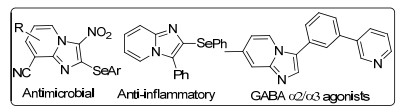
Figure 1.
Examples of imidazo[1, 2-a]pyridine-based drug

Eco-friendly C-3 Selenation of Imidazo[1, 2-a]pyridines in Ionic Liquid
Xin Wang , Shiqiang Mu , Ting Sun , Kai Sun


The structural modification of imidazo[1, 2-a]pyridine, an important "privileged scaffold", is synthetically attractive because this structural motif occurs in many bioactive pharmaceuticals and natural products.[1] Several commercially available drugs (zolpidiem, anti-inflammatory, saripidem, miroprofen) have this moiety in their core structure.[2] The facile synthesis of imidazo[1, 2-a]pyridine derivatives containing various substituents has aroused much recent attention. The C-3 position of these derivatives is electron-rich, and at present, many metal-catalyzed C-3 functionalization reactions including arylation, [3] alkenylation, [4] trifluoromethylation, [5] carbonylation, [6] metal-free fluorination, [7] and sulfenylation[8] have been realized. These transformations have reasonably high efficiency and versatility, and three general C-3 functionalization mechanisms have also currently been proposed: (ⅰ) a carbometalation process followed by coupling reactions; [9] (ⅱ) direct electrophilic attack on the C-3 position; [10] (ⅲ) a radical pathway.[11] However, The factors involve elaborated pre-cursors, expensive metal catalysts, ligands, non-green solvents, and poor substrate scope, warranting the development of improved methods for synthesizing these important skeletons. Developing sustainable methods for the regiospecific C-3 functionalization of imidazo[1, 2-a]pyridines is therefore of many interest.
During the last few decades, organoselenium compounds have received much interest, due to their broad applications in synthetic chemistry and medicinal biology.[12] The facile decoration of selenide groups on other functional groups, and their roles in further synthetic manipulation, have also encouraged interest in selenation reactions. We are interested in environmentally benign C—Se bond formation reactions, [13] and recently realized the oxygen-promoted amidoselenation and amidotelluration of alkenes.[14] The incorporation of a selenide group into heterocycles has received increasing attentions. A survey of the literatures revealed that much efforts towards the synthetic methods for the C-3 selenation of imidazo[1, 2-a]pyridines have been made recent years.[15] Very recently, an efficient oxidative dual C—H selenation radical reaction of imidazoheterocycles with ethers or alkanes using selenium powder was also developed.[15e] Molecular iodine is a green and abundant oxidant, and many advances have been achieved with iodine-promoted C—H functionalization. Herein, we report the direct C-3 selenation of imidazo[1, 2-a]pyridines, using molecular iodine as the oxidant. A broad range of imidazo[1, 2-a]pyridines can be C-3 functionalized with various selenium sources in relative eco-friendly ionic liquid under neat conditions.[16]
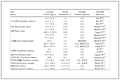
We began our brief investigation by focusing on the reaction between 2-phenylimidazo[1, 2-a]pyridine (1a) and 1, 2-diphenyldiselane (2a) at 60 ℃ in various solvents (Table 1). When the reaction was conducted in EtOAc for 4 h, 41% of desired 3a was isolated (Entry 1). Other polar solvents, such as EtOH and H2O performed poorly and delivered the desired 3a in low yields (Entries 2, 3). DMSO, 1-butyl-3-methylimidazolium hexafluorophosphate (ionic liquid Ⅰ) and 1-butyl-3-methylimidazolium tetrafluorobo- rate (ionic liquid Ⅱ) were also tested and we were pleased to find that 67% yield of 3a could be obtained in ionic liquid Ⅰ after 4 h, which may because the good solubility of iodine source and selenium reagent in ionic liquid (Entries 4~6). When 20 mol% molecular iodine was added instead of KI, 51% of 3a was isolated (Entry 7). A high yield of 84% of 3a was obtained when 1.1 equiv. of molecular iodine was added as iodine source in the absence of TBHP (Entry 8). Further screenings revealed that the reaction temperature had significant effect on the yield of 3a. Increasing the reaction temperature to 90 ℃ or decreasing to 30 ℃ led to low yields of 3a (Entries 9 and 10). The optimal conditions for the coupling were therefore determined to be as follows: 1a (0.2 mmol), 2a (0.2 mmol), I2 (0.22 mmol), mixed in ionic liquid Ⅰ(1.0 mL) at 60 ℃ for 4 h (Table 1, Entry 8).
 下载:
导出CSV
下载:
导出CSV
 | ||||
| Entry | Iodine source | Oxidant | Solvent | Yieldb/% of 3a/4 |
| 1 | KI | TBHP | EtOAc | 41/0c |
| 2 | KI | TBHP | EtOH | 23/0c |
| 3 | KI | TBHP | H2O | 0/0 c |
| 4 | KI | TBHP | DMSO | 55/0c |
| 5 | KI | TBHP | Ionic liquid Ⅰ | 67/0d |
| 6 | KI | TBHP | Ionic liquid Ⅱ | 43/0e |
| 7 | I2 | TBHP | Ionic liquid Ⅰ | 51/Tracef |
| 8 | I2 | No | Ionic liquid Ⅰ | 84/Traceg |
| 9 | I2 | No | Ionic liquid Ⅰ | 33/23h |
| 10 | I2 | No | Ionic liquid Ⅰ | 56/Tracei |
| a Reactions were carried out with 1a (38.8 mg, 0.2 mmol), 2a (62.8 mg, 0.2 mmol), iodine source (20 mol%) and oxidant (2 equiv.) in solvent (2 mL) at 60 ℃ for 4 h in a Schlenk tube. b Yield of the isolated product. c TBHP (t-butylhydroperoxide, 70% in water). d Ionic liquid Ⅰ (1-butyl-3-methylimi- dazolium hexafluorophosphate). e Ionic liquid Ⅱ (1-butyl-3-methylimidazolium tetrafluoroborate). f Molecular iodine (10.2 mg, 20 mol%) was added. g Molecular iodine (55.8 mg, 0.22 mmol) was added. h Reaction performed at 90 ℃ and molecular iodine (55.8 mg, 0.22 mmol) was added. i Reaction performed at 30 ℃ and molecular iodine (55.8 mg, 0.22 mmol) was added. | ||||
The transformation was then applied to C-2 heteroaryl substituted imidazopyridine 1k, and afforded 3k in satisfactory yield. The effect of substituents at the pyridine ring of imidazo[1, 2-a]pyridines was investigated. Substituents such as 5-Me, 6-Me, 7-Me, and 5-F on the pyridine ring of imidazo[1, 2-a]pyridines resulted in smooth reaction under optimized conditions, yielding the corresponding products 3l~3o in moderate to good yields (84%~91%).
Organoselenides decorated in functional reactions have important biological and medicinal properties. Therefore, the versatility of the reaction toward different substituents was explored (Table 3). Diphenyl diselenides bearing electron-withdrawing (R=F, Br) and electron-donating (R=OMe) groups proceeded smoothly, and afforded the desired C-3 selenation products 3p~3r in good yields (86%~90%). 1, 2-Di(thiophen-2-yl)diselane was also compatible with the catalytic system, affording 3s in high yield. Furthermore, dimethyldiselenide was tested with 1a and delivered 3t in good yield.
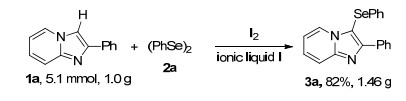
To demonstrate the scalability of the method, we conducted the gram-scale C-3 selenation of 2-phenylimi- dazo[1, 2-a]-pyridine 1a under optimized conditions, which gave the desired product 3a in 82% yield (Scheme 1).
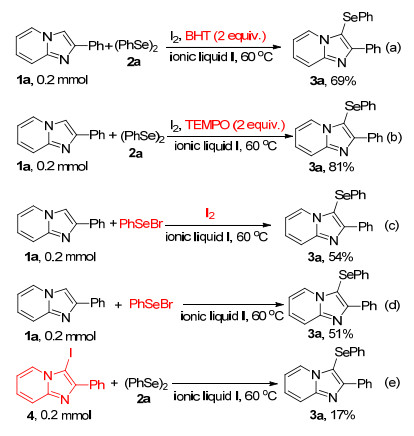
To understand the mechanism of this reaction, some control experiments were carried out. The reaction was not suppressed in the presence of the radical scavengers 2, 6-di- tert-butyl-4-methylphenol (BHT) and 2, 2, 6, 6-tetramethyl-piperidine-1-oxyl (TEMPO) (Schemes 2a, 2b). It suggested that the reaction did not support a radical mechanism, and probably proceeded via an anionic pathway. PhSeBr tends to react via a phenylselenium cationic intermediate. When PhSeBr was added instead of diphenyl diselenide 2a, selenation occurred smoothly and yielded the C-3 selenation 3a in 54% yield (Schemes 2c and 2d). During the selenation progress, C-3 iodination product 4 could also be isolated. Therefore, furthermore the substitution reaction with 4 and 2a was tested, while just a low yield of 3a was detected during this reaction. The result suggested that 4 may be involved, but not the real active intermediate in the reaction (Scheme 2e).
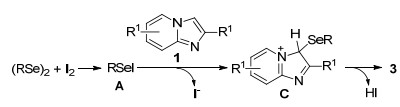
Based on the above results and literature reports, [9] an electrophilic C-3 selenation mechanism for this reaction was proposed, as shown in Scheme 3. Initially, an electrophilic species A (PhSeI) is most likely generated when diphenyl diselenide (2a) reacted with molecular iodine. Next, the reactive intermediate A reacts at the C-3 position with imidazo[1, 2-a]pyridines to form species C. This species can undergo proton elimination to afford the final product 3. However, the other direct C-3 electrophilic iodination and subsequent substitution mechanism through intermidate 4 cannot be completely ruled out in the reaction.
In summary, an relative eco-friendly and efficient iodine-promoted method for the C3 selenation of imidazo[1, 2-a]pyridines have been established. The protocol is applicable to a lot of imidazo[1, 2-a]pyridines using various selenium sources. This method features green reaction conditions, broad substrate scope, and is applicable to a wide variety of functional groups. It can also be readily scaled up, so is practical for the industrial syntheses of nitrogen- and selenium-containing molecules. Primary mechanistic studies are consistent with a C-3 electrophilic functionalization pathway.
All reagents were purchased from commercial sources and used without further purification. 1H NMR and 13C NMR spectra were recorded on a Bruker Ascend™ 400 spectrometer in deuterated solvents containing TMS as an internal reference standard. High-resolution mass spectrometry (HRMS) analyses were conducted on a Waters LCT Premier/XE. Melting points were measured on a melting point apparatus equipped with a thermometer and were uncorrected. All the reactions were monitored by thin-layer chromatography (TLC) using GF254 silica gel-coated TLC plates. Purification by flash column chromatography was performed over SiO2 (silica gel 200~300 mesh).
2-Phenylimidazo[1, 2-a]pyridine (1a) (38.8 mg, 0.2 mmol), 1, 2-diphenyldiselane (2a) (62.8 mg, 0.2 mmol) and molecular iodine (55.8 mg, 0.22 mmol) were mixed in ionic liquid Ⅰ (1.0 mL). The mixture was stirred at 60 ℃ for 4 h in a Schlenk tube. The reaction was monitored by thin-layer chromatography (TLC) before being quenched with water (10 mL) and extracted with dichloromethane (3 mL×5). The extracted organics were dried over anhydrous sodium sulfate, and the solvent was removed under reduced pressure. The residue was purified by flash silica gel column chromatography using ethyl acetate/petroleum ether (V: V=1:5) as an eluent to give compound 3a as a white solid (58.8 mg, 84%).
2-Phenyl-3-(phenylselanyl)imidazo[1, 2-a]pyridine (3a): White solid, m.p. 76~77 ℃; 1H NMR (400 MHz, CDCl3)δ: 6.86 (t, J=6.8 Hz, 1H), 7.11~7.18 (m, 5H), 7.31 (t, J=7.6 Hz, 1H), 7.38~7.47 (m, 3H), 7.72 (d, J=8.8 Hz, 1H), 8.19 (d, J=7.6 Hz, 2H), 8.36 (d, J=6.4 Hz, 1H); 13C NMR (100 MHz, CDCl3) δ: 102.9, 113.0, 117.5, 125.6, 126.4, 126.6, 128.3, 128.4, 128.7, 129.6, 130.8, 133.7, 147.7, 151.7. HRMS (ESI-TOF) calcd for C19H15N2Se [M+H]+ 351.0402, found 351.0405.
2-(3-Chlorophenyl)-3-(phenylselanyl)imidazo[1, 2-a]-pyridine (3b): White solid, m.p. 69~70 ℃; 1H NMR (400 MHz, CDCl3) δ: 6.86 (t, J=6.8 Hz, 1H), 6.89~7.37 (m, 8H), 7.71 (d, J=8.8 Hz, 1H), 8.09 (t, J=6.0 Hz, 1H), 8.22 (s, 1H), 8.37 (d, J=6.8 Hz, 1H); 13C NMR (100 MHz, CDCl3) δ: 103.4, 113.1, 117.6, 125.6, 126.6, 126.8, 128.4, 128.7, 129.4, 129.7, 130.5, 134.3, 135.6, 147.7, 150.1. HRMS (ESI-TOF) calcd for C19H14ClN2Se [M+H]+ 385.0012, found 385.0017.
2-(4-Fluorophenyl)-3-(phenylselanyl)imidazo[1, 2-a]-pyridine (3c): White solid, m.p. 135~136 ℃; 1H NMR (400 MHz, CDCl3) δ: 6.88 (t, J=6.8 Hz, 1H), 6.89~7.35 (m, 8H), 7.70 (d, J=9.2 Hz, 1H), 8.14 (d, J=5.6 Hz, 2H), 8.16 (d, J=5.6 Hz, 1H); 13C NMR (100 MHz, CDCl3) δ: 113.0, 115.1, 115.3, 117.5, 125.6, 126.5, 126.7, 129.2, 129.7, 129.9, 130.4, 130.5, 130.7, 147.7, 150.9, 161.8, 163.3. HRMS (ESI-TOF) calcd for C19H14FN2Se[M+H]+ 369.0302, found 369.0306.
2-(4-Chlorophenyl)-3-(phenylselanyl)imidazo[1, 2-a]py-ridine (3d): White solid, m.p. 100~101 ℃; 1H NMR (400 MHz, CDCl3) δ: 6.87 (d, J=6.8 Hz, 1H), 6.90~7.20 (m, 7H), 7.32 (dd, J=1.2, 8.8 Hz, 1H), 7.36 (t, J=3.6 Hz, 1H), 7.71 (d, J=8.8 Hz, 1H), 8.07 (d, J=6.0 Hz, 1H); 13C NMR (100 MHz, CDCl3) δ: 103.4, 113.2, 117.6, 125.6, 126.7, 126.8, 128.4, 128.7, 129.5, 129.7, 130.5, 134.2, 135.6, 147.7, 150.1. HRMS (ESI-TOF) calcd for C19H14ClN2Se, [M+H]+ 385.0012, found 385.0016.
2-(4-Bromophenyl)-3-(phenylselanyl)imidazo[1, 2-a]py-ridine (3e): White solid, m.p. 133~134 ℃; 1H NMR (400 MHz, CDCl3) δ: 6.84 (d, J=6.0 Hz, 1H), 6.85~7.19 (m, 6H), 7.30 (dd, J=2.0, 7.6 Hz, 2H), 7.33 (dd, J=1.2, 6.8 Hz, 1H), 7.69 (d, J=9.2 Hz, 2H), 8.06 (d, J=8.8 Hz, 1H); 13C NMR (100 MHz, CDCl3) δ: 103.0, 113.1, 117.5, 122.8, 125.6, 126.6, 126.8, 128.2, 129.7, 130.2, 130.6, 131.4, 132.7, 147.7, 150.5. HRMS (ESI-TOF) calcd for C19H14BrN2Se [M+H]+ 428.9507, found 428.9503.
3-(Phenylselanyl)-2-(4-(trifluoromethyl)phenyl)imida-zo[1, 2-a]pyridine (3f): White solid, m.p. 93~94 ℃; 1H NMR (400 MHz, CDCl3) δ: 6.89 (d, J=6.8 Hz, 1H), 6.92~7.38 (m, 5H), 7.69 (d, J=8.0 Hz, 1H), 7.35 (d, J=9.2 Hz, 3H), 8.31 (d, J=8.0 Hz, 1H), 8.39 (d, J=6.8 Hz, 1H); 13C NMR (100 MHz, CDCl3) δ: 103.7, 113.3, 117.7, 122.8, 125.1, 122.2, 122.5, 122.6, 126.8, 126.9, 128.3, 128.8, 129.5, 129.7, 130.0, 130.3, 130.4, 130.6, 137.3, 147.8, 150.1. HRMS (ESI-TOF) calcd for C20H14N2F3Se, [M+H]+ 419.0274, found 419.0269.
3-(Phenylselanyl)-2-(2, 3, 4-trichlorophenyl)imidazo[1, 2-a]pyridine (3g): White solid, m.p. 123~124 ℃; 1H NMR (400 MHz, CDCl3) δ: 7.22~7.34 (m, 9H), 8.05 (d, J=1.6 Hz, 1H), 8.33 (d, J=2.0 Hz, 1H); 13C NMR (100 MHz, CDCl3) δ: 109.0, 114.1, 126.6, 127.1, 129.2, 129.5, 129.7, 130.4, 130.6, 132.6, 155.4, 158.9. HRMS (ESI-TOF) calcd for C19H12N2Cl3Se [M+H]+ 452.9233, found 452.9231.
3-(Phenylselanyl)-2-(m-tolyl)imidazo[1, 2-a]pyridine(3h): White solid, m.p. 88~89 ℃; 1H NMR (400 MHz, CDCl3) δ: 2.42 (s, 3H), 6.86 (s, 1H), 7.11~7.33 (m, 8H), 7.71 (d, J=9.2 Hz, 1H), 7.97 (t, J=8.0 Hz, 2H), 8.35 (d, J=7.2 Hz, 1H); 13C NMR (100 MHz, CDCl3) δ: 21.4, 102.9, 112.8, 117.5, 125.5, 125.8, 126.3, 126.6, 128.1, 128.3, 129.4, 129.6, 130.9, 133.6, 137.9, 147.7, 151.9. HRMS (ESI-TOF) calcd for C20H17N2Se [M+H]+ 365.0554, found 365.0559.
2-(4-Methoxyphenyl)-3-(phenylselanyl)imidazo[1, 2-a]-pyridine (3i): Colourless liquid; 1H NMR (400 MHz, CDCl3) δ: 3.85 (s, 3H), 6.85 (t, J=6.8 Hz, 1H), 6.97 (d, J=8.8 Hz, 2H), 7.10~7.29 (m, 6H), 7.31 (d, J=7.6 Hz, 1H), 7.73 (d, J=9.2 Hz, 2H), 8.13 (d, J=8.8 Hz, 1H); 13C NMR (100 MHz, CDCl3) δ: 55.2, 102.0, 112.8, 113.7, 117.2, 125.5, 126.2, 126.3, 126.6, 128.1, 129.6, 130.0, 131.0, 147.6, 151.6, 159.9. HRMS (ESI-TOF) calcd for C20H17N2OSe [M+H]+ 381.0504, found 381.0507.
2-(3, 4-Dimethylphenyl)-3-(phenylselanyl)imidazo[1, 2-a]pyridine (3j): White solid, m.p. 97~98 ℃; 1H NMR (400 MHz, CDCl3) δ: 2.30~2.31 (m, 6H), 6.84 (d, J=6.8 Hz, 1H), 7.12~7.28 (m, 7H), 7.70 (d, J=8.0 Hz, 1H), 7.89~7.95 (m, 2H), 8.33 (d, J=6.4 Hz, 1H); 13C NMR (100 MHz, CDCl3) δ: 19.5, 19.7, 102.5, 112.7, 117.4, 125.5, 126.1, 126.2, 126.5, 128.3, 129.5, 126.6, 126.9, 131.0, 131.2, 136.5, 137.0, 147.6, 152.0. HRMS (ESI-TOF) calcd for C21H19N2Se [M+H]+ 379.0713, found 379.0708.
2-(5-Chlorothiophen-2-yl)-3-(phenylselanyl)imidazo-[1, 2-a]pyridine (3k): White solid, m.p. 105~106 ℃; 1H NMR (400 MHz, CDCl3) δ: 6.86~6.92 (m, 2H), 7.15~7.30 (m, 6H), 7.64 (d, J=9.2 Hz, 1H), 7.78 (d, J=4.0 Hz, 1H), 8.32 (d, J=6.8 Hz, 1H); 13C NMR (100 MHz, CDCl3) δ: 102.1, 113.1, 117.2, 125.3, 125.8, 126.6, 126.8, 127.0, 128.7, 129.7, 130.1, 131.4, 135.3, 147.6. HRMS (ESI-TOF) calcd for C17H12ClN2SSe [M+H]+ 390.9576, found 390.9571.
6-Methyl-2-phenyl-3-(phenylselanyl)imidazo[1, 2-a]py-ridine (3l): White solid, m.p. 145~146 ℃; 1H NMR (400 MHz, CDCl3) δ: 2.28 (m, 3H), 7.11~7.15 (m, 6H), 7.36~7.45 (m, 3H), 7.61 (d, J=9.2 Hz, 1H), 8.17 (d, J=7.6 Hz, 3H); 13C NMR (100 MHz, CDCl3) δ: 18.3, 102.3, 116.9, 122.7, 123.3, 126.5, 128.0, 128.2, 128.3, 128.6, 129.5, 129.6, 131.3, 133.9, 146.8, 151.6. HRMS (ESI-TOF) calcd for C20H17N2Se [M+H]+ 365.0554, found 365.0558.
7-Methyl-2-phenyl-3-(phenylselanyl)imidazo[1, 2-a]py-ridine (3m): White solid, m.p. 51~52 ℃; 1H NMR (400 MHz, CDCl3) δ: 2.41 (m, 3H), 6.63 (d, J=7.2 Hz, 1H), 7.09~7.16 (m, 5H), 7.36~7.48 (m, 4H), 8.18 (t, J=6.8 Hz, 1H); 13C NMR (100 MHz, CDCl3) δ: 21.3, 101.9, 115.5, 116.0, 124.7, 126.5, 128.1, 128.2, 128.3, 128.6, 129.6, 131.2, 133.9, 137.5, 148.1, 151.6. HRMS (ESI-TOF) calcd for C20H17N2Se, [M+H]+ 365.0554, found 365.0557.
6-Fluoro-2-phenyl-3-(phenylselanyl)imidazo[1, 2-a]py-ridine (3n): White solid, m.p. 100~101 ℃; 1H NMR (400 MHz, CDCl3) δ: 7.11~7.22 (m, 6H), 7.39~7.71 (m, 3H), 7.15 (d, J=6.8 Hz, 1H), 8.29 (d, J=2.4 Hz, 2H), 8.31 (d, J=2.4 Hz, 1H); 13C NMR (100 MHz, CDCl3) δ: 104.4, 112.3, 112.7, 117.9, 118.0, 126.9, 128.3, 128.4, 128.6, 129.7, 130.3, 133.5, 145.2, 152.5, 152.9, 154.8. HRMS (ESI-TOF) calcd for C19H14FN2Se, [M+H]+ 369.0302, found 369.0308.
8-Methyl-2-phenyl-3-(phenylselanyl)imidazo[1, 2-a]py- ridine (3o): White solid, m.p. 131~132 ℃; 1H NMR (400 MHz; CDCl3) δ: 2.75 (m, 3H), 6.74 (s, 1H), 7.08~7.18 (m, 6H), 7.39~7.49 (m, 3H), 8.20~8.23 (m, 3H); 13C NMR (100 MHz; CDCl3) δ: 16.9, 103.1, 112.9, 123.4, 125.1, 126.5, 127.5, 128.3, 128.9, 129.6, 131.2, 134.1, 148.0, 151.4. HRMS (ESI-TOF) calcd for C20H17N2Se [M+H]+ 365.0554, found 365.0560.
3-((2-Bromophenyl)selanyl)-2-phenylimidazo[1, 2-a]pyridine (3p): White solid, m.p. 138~139 ℃; 1H NMR (400 MHz, CDCl3) δ: 6.92 (d, J=0.8 Hz, 1H), 6.94 (d, J=6.8 Hz, 1H), 7.25~7.51 (m, 6H), 7.62 (d, J=9.2 Hz, 1H), 8.07 (d, J=8.4 Hz, 3H), 8.23 (d, J=6.8 Hz, 1H); 13C NMR (100 MHz, CDCl3) δ: 103.0, 113.1, 117.5, 122.8, 125.6, 126.6, 126.8, 128.2, 129.7, 130.2, 130.6, 131.4, 132.7, 147.7, 150.5. HRMS (ESI-TOF) calcd for C19H14BrN2Se [M+H]+ 428.9507, found 428.9501.
3-((4-Fluorophenyl)selanyl)-2-phenylimidazo[1, 2-a]py-ridine (3q): White solid, m.p. 98~99 ℃; 1H NMR (400 MHz, CDCl3) δ: 6.89 (d, J=8.4 Hz, 3H), 7.08 (d, J=5.2 Hz, 2H), 7.29~7.46 (m, 4H), 7.71 (d, J=9.2 Hz, 1H), 8.16 (d, J=7.2 Hz, 2H), 8.34 (d, J=6.4 Hz, 1H); 13C NMR (100 MHz, CDCl3) δ: 103.1, 113.0, 116.7, 116.9, 117.6, 125.1, 125.4, 126.5, 128.3, 128.5, 128.7, 130.3, 130.4, 133.6, 147.6, 151.6, 160.8, 163.3. HRMS (ESI-TOF) calcd for C19H14FN2Se [M+H]+ 369.0302, found 369.0308.
3-((4-Methoxyphenyl)selanyl)-2-phenylimidazo[1, 2-a]pyridine (3r): Colourless liquid; 1H NMR (400 MHz, CDCl3) δ: 3.85 (m, 3H), 6.84~7.30 (m, 8H), 7.69 (d, J=8.8 Hz, 1H), 8.12 (d, J=8.8 Hz, 2H), 8.34 (d, J=6.8 Hz, 1H); 13C NMR (100 MHz, CDCl3) δ: 55.2, 102.0, 112.8, 113.7, 117.2, 125.5, 126.3, 126.6, 128.1, 129.6, 129.9, 131.0, 147.6, 151.6, 159.9. HRMS (ESI-TOF) calcd for C20H17N2OSe [M+H]+ 381.0504, found 381.0509.
2-Phenyl-3-(thiophen-2-ylselanyl)imidazo[1, 2-a]pyri-dine (3s): White solid, m.p. 67~68 ℃; 1H NMR (400 MHz, CDCl3) δ: 6.93 (d, J=6.8 Hz, 1H), 7.25~7.51 (m, 6H), 7.62 (d, J=9.2 Hz, 1H), 8.08 (d, J=8.0 Hz, 1H), 8.23 (d, J=6.4 Hz, 1H); 13C NMR (100 MHz, CDCl3) δ: 105.0, 112.9, 117.5, 124.3, 125.4, 126.3, 127.9, 128.4, 129.0, 129.7, 132.7, 133.8, 147.2, 150.7. HRMS (ESI-TOF) calcd for C17H13N2SSe [M+H]+ 356.9964, found 356.9967.
2-Phenyl-3-(thiophen-2-ylselanyl)imidazo[1, 2-a]pyri-dine (3t): White solid, m.p. 133~134 ℃; 1H NMR (400 MHz, CDCl3) δ: 2.14 (s, 3H), 6.94 (t, J=6.4, 1H), 7.29~7.40 (m, 2H), 7.49 (d, J=7.6, 2H), 7.51 (d, J=7.6, 1H), 8.22 (d, J=7.2, 2H), 8.53 (d, J=7.2, 1H); 13C NMR (100 MHz, CDCl3) δ: 8.65, 105.0, 112.8, 117.4, 125.5, 126.0, 128.2, 128.6, 133.8, 146.9, 150.7. HRMS (ESI-TOF) calcd for C14H13N2Se [M+H]+ 289.0244, found 289.0240.
Supporting Information 1H NMR and 13C NMR spectra for compounds 3a~3t. The Supporting Information is available free of charge via the Internet at http://sioc-journal.cn/.
(a) Enguehard-Gueiffier, C.; Gueiffier, A. Mini-Rev. Med. Chem. 2007, 7, 888;
(b) Baviskar, A. T.; Amrutkar, S. M.; Trivedi, N.; Chaudhary, V.; Nayak, A.; Guchhait, S. K.; Banerjee, U. C.; Bharatam, P. V.; Kundu, C. N. ACS Med. Chem. Lett. 2015, 6, 481.
(a) Meng, T.; Wang, W.; Zhang, Z.; Ma, L.; Zhang, Y.; Miao, Z.; Shen, J. Bioorg. Med. Chem. 2014, 22, 848.
(b) Gallud, A.; Vaillantm, O.; Maillard, L. T.; Arama, D. P.; Dubois, J.; Maynadier, M.; Lisowski, V.; Garcia, M.; Martinez, J.; Masurier, N. Eur. J. Med. Chem. 2014, 75, 382.
(c) Zhao, Y.-X.; Ding, Y.-Y.; Lü, Y.-T.; Kang, C.-M. Chin. J. Org. Chem. 2019, 39, 1304(in Chinese).
(赵鑫雨, 丁洋洋, 吕英涛, 康从民, 有机化学, 2019, 39, 1304.)
For selected papers, see: (a) Toure, B. B.; Lane, B. S.; Sames, D. Org. Lett. 2006, 8, 1979.
(b) Fu, H.; Chen, L.; Doucet, H. J. Org. Chem. 2012, 77, 4473.
(c) Choy, P. Y.; Luk, K. C.; Wu, Y.; So, C. M.; Wang, L.; Kwong, F. Y. J. Org. Chem. 2015, 80, 1457.
For selected papers, see: (a) Koubachi, J.; Kazzouli, S. E.; Berteina-Raboin, S.; Mouaddib, A.; Guillaumeta, G. Synthesis 2008, 2537.
(b) Zhan, H.; Zhao, L.; Li, N.; Chen, L.; Liu, J.; Liao, J.; Cao, H. RSC Adv. 2014, 4, 32013.
(c) Ghosh, M.; Naskar, A.; Mitra, S.; Hajra, A. Eur. J. Org. Chem. 2015, 2015, 715.
Monir, K.; Bagdi, A. K.; Ghosh, M.; Hajra, A. J. Org. Chem. 2015, 80, 1332. doi: 10.1021/jo502928e
(a) Lei, S.; Chen, G.; Mai, Y.; Chen, L.; Cai, H.; Tan, J.; Cao, H. Adv. Synth. Catal. 2016, 358, 67.
(b) Gao, Y.; Lu, W.; Liu, P.; Sun, P. J. Org. Chem. 2016, 81, 2482.
Liu, P.; Gao, Y.; Gu, W.; Shen, Z.; Sun, P. J. Org. Chem. 2015, 80, 11559. doi: 10.1021/acs.joc.5b01961
For selected papers, see: (a) Ravi, C.; Mohan, D. C.; Adimurthy, S. Org. Lett. 2014, 16, 2978.
(b) Gao, Z.; Zhu, X.; Zhang, R. RSC. Adv. 2014, 4, 19891.
(c) Bagdi, A. K.; Mitra, S.; Ghosh, M.; Hajra, A. Org. Biomol. Chem. 2015, 13, 3314.
(d) Rafique, J.; Saba, Sumbal.; Rosário, A. R.; Braga, A. L. Chem. Eur. J. 2016, 22, 11854.
(e) Rafique, J.; Saba, S.; Franco, M. S.; Bettanin, L.; Schneider, A. R.; Silva, L. T.; Braga, A. L. Chem. Eur. J. 2018, 16, 880.
(f) Xie, L.-Y.; Peng, S.; Fan, T.-G.; Liu, Y.-F.; Sun, M.; Jiang, L.-L.; Wang, X.-X.; Cao, Z.; He, W.-M. Sci. China Chem. 2019, 62, 460.
For selected papers, see: (a) Toure, B. B.; Lane, B. S.; Sames, D. Org. Lett. 2006, 8, 1979.
(b) Cao, H.; Zhan, H.; Lin, Y.; Lin, X.; Du, Z.; Jiang, H. Org. Lett. 2012, 14, 1688.
(c) Fu, H.; Chen, L.; Doucet, H. J. Org. Chem. 2012, 77, 4473.
For selected papers, see: (a) Li, Z.; Hong, J.; Zhou, X. Tetrahedron 2011, 67, 3690.
(b) Ravi, C; Mohan, D. C.; Adimurthy, S. Org. Lett. 2014, 16, 2978.
(c) Liu, S.; Xi, H.; Zhang, J.; Wu, X.; Gao, Q.; Wu, A. Org. Biomol. Chem. 2015, 13, 8807.
(d) Huang, X.; Wang, S.; Li, B.; Wang, X.; Ge, Z.; Li, R. RSC Adv. 2015, 5, 22654.
For selected papers, see: (a) Cao, H.; Lei, S.; Li, N.; Chen, L.; Liu, J.; Cai, H.; Qiu, S.; Tan, J. Chem. Commun. 2015, 51, 1823.
(b) Monir, K.; Bagdi, A. K.; Ghosh, M.; Hajra, A. J. Org. Chem. 2015, 80, 1332.
(c) Mitra, S.; Ghosh, M.; Mishra, S.; Hajra, A. J. Org. Chem. 2015, 80, 8275.
(d) Yang, D.; Yan, K.; Wei, W.; Li, G.; Lu, S.; Zhao, C.; Tian, L.; Wang, H. J. Org. Chem. 2015, 80, 11073.
(e) Sun, K.; Li, S.-J.; Chen, X.-L.; Liu, Y.; Huang, X.-Q.; Wei, D.-H.; Qu, L.-B.; Zhao, Y.-F.; Yu, B. Chem. Commun. 2019, 55, 2861.
For selected works, see: (a) Mugesh, G.; du Mont, W. W.; Sies, H. Chem. Rev. 2001, 101, 2125.
(b) Mugesh, G.; Singh, H. B. Acc. Chem. Res. 2002, 35, 226.
(c) Nogueira, C. W.; Zeni, G.; Rocha, J. B. T. Chem. Rev. 2004, 104, 6255.
(d) Rhoden, C. R. B.; Zeni, G. Org. Biomol. Chem. 2011, 9, 1301.
(e) Liu, M.-X.; Li, Y.-M.; Yu, L.; Xu, Q.; Jiang, X.-F. Sci. China Chem. 2018, 61, 294.
(f) Lu, L.-H.; Zhou, S.-J.; He, W.-B.; Xia, W.; Chen, P.; Yu, X.; Xu, X.; He, W.-M. Org. Biomol. Chem. 2018, 16, 9064.
(g) Wu, C.; Xiao, H.-J.; Wang, S.-W.; Tang, M.-S.; Tang, Z.-L.; Xia, W.; Li, W.-F.; Cao, Z.; He, W.-M. ACS Sustainable Chem. Eng. 2019, 7, 2169.
(h) Feng, C.-L.; Zhu, J.; Tang, Q.-J.; Zhou, A.-H. Chin. J. Org. Chem. 2019, 39, 1187(in Chinese).
(冯春来, 朱杰, 唐秋洁, 周爱华, 有机化学, 2019, 39, 1187.)
(a) Sun, K.; Wang, X.; Lv, Y.; Li, G.; Jiao, H.; Dai, C.; Li, Y.; Zhang, C.; Liu, L. Chem. Commun. 2016, 52, 8471.
(b) Sun, K.; Wang, X.; Fu, F.; Zhang, C.; Chen, Y.; Liu, L. Green Chem. 2017, 19, 1490.
(c) Sun, K.; Lv, Y.; Shi, Z.; Fu, F.; Zhang, C.; Zhang, Z. Sci. China Chem. 2017, 60, 730.
(d) Sun, K.; Shi, Z.; Liu, Z.; Luan, B.; Zhu, J.; Xue, Y. Org. Lett. 2018, 20, 6687.
(e) Sun, K.; Wang, S.-N.; Feng, R.-R.; Zhang, Y.-X.; Wang, X.; Zhang, Z.-G.; Zhang, B. Org. Lett. 2019, 21, 2052.
Sun, K.; Wang, X.; Zhang, C.; Zhang, S.; Chen, Y.; Jiao, H.; Du, W. Chem. Asian J. 2017, 12, 713. doi: 10.1002/asia.201700017
For selected recent works, see: (a) Rafique, J.; Saba, S.; Rosário, A. R.; Braga, A. L. Chem.-Eur. J. 2016, 22, 11854.
(b) Sun, P.-F.; Jiang, M.; Wei, W.; Min, Y.-Y.; Zhang, W.; Li, W.-H. Yang, D.-S.; Wang, H. J. Org. Chem. 2017, 82, 2906.
(c) Guo, T.; Wei, X.-N.; Wang, H.-Y.; Zhu, Y.-L.; Zhao, Y.-H.; Ma, Y.-C. Org. Biomol. Chem. 2017, 15, 9455.
(d) Guo, T.; Dong, Z.; Zhang, P.-K.; Xing, W.-Q.; Li, L.-P. Tetrahedron Lett. 2018, 59, 2554.
(e) Zhu, J.; Zhu, W.-H.; Xie, P.; Pittman, C. U.; Zhou, A.-H. Tetrahedron 2018, 74, 6569.
(f) Rafique, J.; Saba, S.; Franco, M. S.; Bettanin, L.; Schneider, A. R.; Silva, L. T.; Braga, A. L. Chem.-Eur. J. 2018, 24, 4173.
(g) Guo, T.; Wei, X.-N.; Liu, Y.; Zhang, P.-K.; Zhao, Y.-H. Org. Chem. Front. 2019, 6, 1414.
For selected example with ionic liquid as the solvent, see: (a) Xie, L.-Y.; Peng, S.; Lu, L.-H.; Hu, J.; Bao, W.-H.; Zeng, F.; Tang, Z.; Xu, X.; He, W.-M. ACS Sustainable Chem. Eng. 2018, 6, 7989.
(b) Wu, C.; Lu, L.-H.; Peng, A.-Z.; Jia, G.-K.; Peng, C.; Cao, Z.; Tang, Z.; He, W.-M.; Xu, X. Green Chem. 2018, 20, 3683.
(c) Yang, G.-P.; Wu, X.; Yu, B.; Hu, C. ACS Sustainable Chem. Eng. 2019, 7, 3727.
Table 1. Survey of the reaction conditionsa
| ||||
| Entry | Iodine source | Oxidant | Solvent | Yieldb/% of 3a/4 |
| 1 | KI | TBHP | EtOAc | 41/0c |
| 2 | KI | TBHP | EtOH | 23/0c |
| 3 | KI | TBHP | H2O | 0/0 c |
| 4 | KI | TBHP | DMSO | 55/0c |
| 5 | KI | TBHP | Ionic liquid Ⅰ | 67/0d |
| 6 | KI | TBHP | Ionic liquid Ⅱ | 43/0e |
| 7 | I2 | TBHP | Ionic liquid Ⅰ | 51/Tracef |
| 8 | I2 | No | Ionic liquid Ⅰ | 84/Traceg |
| 9 | I2 | No | Ionic liquid Ⅰ | 33/23h |
| 10 | I2 | No | Ionic liquid Ⅰ | 56/Tracei |
| a Reactions were carried out with 1a (38.8 mg, 0.2 mmol), 2a (62.8 mg, 0.2 mmol), iodine source (20 mol%) and oxidant (2 equiv.) in solvent (2 mL) at 60 ℃ for 4 h in a Schlenk tube. b Yield of the isolated product. c TBHP (t-butylhydroperoxide, 70% in water). d Ionic liquid Ⅰ (1-butyl-3-methylimi- dazolium hexafluorophosphate). e Ionic liquid Ⅱ (1-butyl-3-methylimidazolium tetrafluoroborate). f Molecular iodine (10.2 mg, 20 mol%) was added. g Molecular iodine (55.8 mg, 0.22 mmol) was added. h Reaction performed at 90 ℃ and molecular iodine (55.8 mg, 0.22 mmol) was added. i Reaction performed at 30 ℃ and molecular iodine (55.8 mg, 0.22 mmol) was added. | ||||
 下载: 导出CSV

 扫一扫看文章


扫一扫关注我们