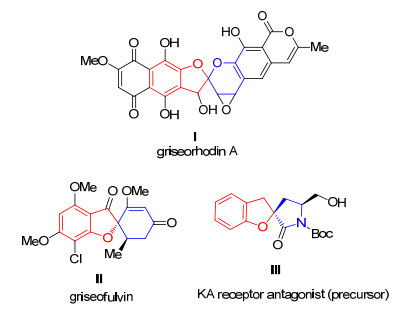
Figure 1.
Representative examples of bioactive spirocyclic benzofuran derivatives


The 2, 3-dihydrobenzofuran ring is the core structure of a number of bioactive natural and artificial molecules, and its effective synthesis has therefore attracted much interest from chemists.[1] As a special subset of 2, 3-dihydrobenzo- furans, the spirocyclic benzofuran skeletons have also been found in many biologically interesting compounds (Figure 1).[2] For instance, the telomerase inhibitor griseorhodin A (Ⅰ), probably the most heavily oxidized bacterial polyketide, features a unique spirobenzofuran moiety which is crucial for its activity.[2a, 2b] Griseofulvin (Ⅱ), first isolated from filamentous fungi, contains a spirobenzofuranone core, and has been used to treat ringworm infections of the skin and nails in both humans and animals for deca- des.[2c~2g] The spiro[benzofuran-2, 3'-pyrrolidine] derivative (Ⅲ) was used as a key precursor in the synthesis of a KA receptor antagonist.[2h~2j] Since a spirocycle contains two perpendicular rings commonly connected through one quaternary carbon, this structural feature imposes more challenges in its synthesis.[3] Thus, synthesis of the spirobenzofuran skeleton has become an attractive research topic. In the reported effective syntheses, the spirobenzofurans were generally constructed through multistep synthetic routes.[2] The catalytic cascade synthetic protocols are relatively rare.[2f, 4] Accordingly, new and efficient synthetic strategies for spirocyclic benzofurans remain highly desirable.
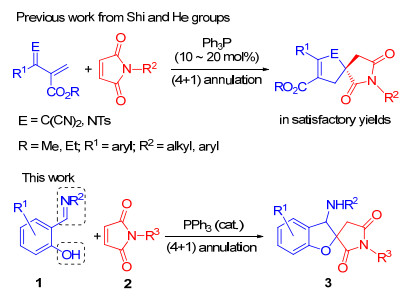
During the past two decades, the phosphine catalytic annulation strategy has made great progress and has provided a powerful toolbox for constructing diverse cycles.[5] Among the annulation reactions, the allylic phosphorus ylide-initiated annulations are proven to be prevailing.[5e, 5g] As the key reactive intermediates, allylic P-ylides are in situ generated from popular substrates such as electron-deficient allenes and Morita-Baylis-Hillman (MBH) derivatives with phosphines. The allylic P-ylide-mediated annulations generally proceed through a tandem sequence of Michael addition/intramolecular SN2'-like substitution. By this mode, the ring-closure step can effectively circumvent the steric hindrance arising from the bulky phosphonium moiety.[6] On the other hand, the non-allylic P-ylide-initiated annulations were seldom reported through a similar mode of Michael addition/intramolecular SN2-like substitution.[7] Recently our group and Shi's group independently developed novel phosphine-catalyzed [4+1] annulation reactions of electron-deficient 4π-conjugated systems such as 1, 3-dienes or 1, 3-azadienes with maleimides, providing a convenient and highly efficient method to construct important azaspiro[4.4]nonane skeletons (Scheme 1).[7] By our results, the annulation reaction is initiated with the in situ formed non-allylic P-ylide from maleimide and PPh3, and proceeds through a sequence of the Michael addition/intramolecular SN2-like substitution. Accordingly this reaction also represents the first example of phosphine-catalyzed [4+1] annulation reaction via non-allylic phosphorus ylides (Scheme 1).[7b] Encouraged by the feasibility of this annulation reaction in the construction of spirocycles, recently we further extended this [4+1] annulation strategy to dual functional salicyl imines 1 and successfully developed a new and convenient method to synthesize spiro[benzofuran-2, 3'-pyrrolidine]-2', 5'- diones (Scheme 1). Herein we report the relevant results.
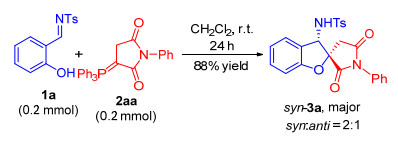
We initiated the investigation with the stoichiometric reaction of salicyl N-tosylimine 1a and phosphorus ylide 2aa[8] in CH2Cl2 at room temperature. To our delight, an expected [4+1] annulation product 3a was obtained in 88% combined yield after column chromatographic isolation (Scheme 2). This result revealed that a [4+1] annulation reaction between salicyl N-tosylimine 1a and phosphorus ylide 2aa could be readily achieved.
Considering that phosphorus ylide 2aa can be in situ generated from the corresponding N-phenyl maleimide and PPh3 in the presence of benzoic acid, [7b] we then investigated a phosphine catalytic version of the [4+1] annulation by using salicyl N-tosylimine 1a and N-phenyl maleimide 2a as the model substrates (Table 1). In the presence of PPh3 (20 mol%, relative to 2a) and benzoic acid (20 mol%), a mixture of 1a (0.2 mmol) and 2a (0.24 mmol) in CH2Cl2 (2.0 mL) was stirred at room temperature for 48 h, and the expected spirocyclic benzofuran 3a was obtained but in only 23% isolated yield with dr 2.5:1 (Entry 1). Considering the fact that salicyl N-tosylimine 1a bearing an acidic phenolic hydroxyl may act as a proton shuttle instead of benzoic acid, this reaction was repeated in the absence of benzoic acid and the product 3a was obtained in 34% yield with 2.9:1 dr (Entry 2). Without catalyst PPh3, the annulation reaction could not occur at all (Entry 3). With the catalyst PPh3 (20 mol%) employed, the substrate ratio of 1a/2a was surveyed. Gratifyingly, the total yields of 3a were significantly increased as the ratio of 1a/2a was adjusted from 1:1.2 to 3:1 (Entries 2 and 4~7). With the ratio of 1a/2a 2:1 selected, several triarylphosphines were screened (Entries 8~12). The results unveiled that 4-fluoro, 4-chloro, 4-methyl, and 4-methoxy substituted triarylphosphines were all effective for the reaction (Entries 8~11); but (4-CF3C6H4)3P was ineffective (Entry 12). With PPh3 (20 mol%) employed as the catalyst, a couple of common solvents including chloroform, toluene, acetonitrile and methanol were then examined (Entries 13~16). It was found that the model reaction readily gave the product 3a in moderate yields in nonpolar or polar aprotic solvents (Entries 13~15). Protic solvent methanol was detrimental to the reaction and none of 3a was obtained (Entry 16). Finally, the loading of the catalyst PPh3 was also surveyed. As the loading of PPh3 was increased to 100 mol%, the total yield of 3a was improved to 99% (Entries 17~19). Thus, the optimal conditions were established as listed in Entry 19, Table 1. With regard to the ratio of syn-3a versus anti-3a, in all cases, the product 3a was isolated with dr varying from 1.7:1 to 6.7:1 (Table 1, Entries 1~19).

 下载:
导出CSV
下载:
导出CSV
 | ||||||
| Entry | Catalyst (mol%) | Ratio of 1a/2a | Solvent | Time/h | Yieldb/% of 3a | drc |
| 1d | PPh3 (20) | 1/1.2 | CH2Cl2 | 48 | 23 | 2.5:1 |
| 2 | PPh3 (20) | 1/1.2 | CH2Cl2 | 48 | 34 | 2.9:1 |
| 3 | None | 1/1.2 | CH2Cl2 | 48 | 0 | — |
| 4 | PPh3 (20) | 1.2/1 | CH2Cl2 | 24 | 63 | 2.2:1 |
| 5 | PPh3 (20) | 1.5/1 | CH2Cl2 | 24 | 56 | 2.3:1 |
| 6 | PPh3 (20) | 2/1 | CH2Cl2 | 24 | 74 | 1.7:1 |
| 7 | PPh3 (20) | 3/1 | CH2Cl2 | 24 | 78 | 2.8:1 |
| 8 | (4-FC6H4)3P (20) | 2/1 | CH2Cl2 | 48 | 61 | 2.4:1 |
| 9 | (4-ClC6H4)3P (20) | 2/1 | CH2Cl2 | 48 | 41 | 3.6:1 |
| 10 | (4-MeC6H4)3P (20) | 2/1 | CH2Cl2 | 24 | 70 | 2.7:1 |
| 11 | (4-MeOC6H4)3P (20) | 2/1 | CH2Cl2 | 24 | 49 | 3:1 |
| 12 | (4-CF3C6H4)3P (20) | 2/1 | CH2Cl2 | 48 | Trace | — |
| 13 | PPh3 (20) | 2/1 | CHCl3 | 36 | 50 | 3:1 |
| 14 | PPh3 (20) | 2/1 | Toluene | 36 | 59 | 3.4:1 |
| 15 | PPh3 (20) | 2/1 | CH3CN | 24 | 66 | 6.7:1 |
| 16 | PPh3 (20) | 2/1 | CH3OH | 24 | 0 | — |
| 17 | PPh3 (50) | 2/1 | CH2Cl2 | 24 | 84 | 3:1 |
| 18 | PPh3 (70) | 2/1 | CH2Cl2 | 24 | 86 | 2.9:1 |
| 19 | PPh3 (100) | 2/1 | CH2Cl2 | 24 | 99 | 2.4:1 |
| aTypical conditions: a mixture of 1a, 2a and phosphine in solvent (2.0 mL) was stirred at room temprature for a specified time. bIsolated yields. c Determined by 1H NMR assay of the crude product. d Benzoic acid was added. | ||||||
With the optimized conditions in hand, the substrate scope of this [4+1] annulation reaction was then explored, and the results are summarized in Table 2. With salicyl N-tosylimine 1a used as a representative partner, a series of N-substituted maleimides 2 were firstly surveyed (Entries 1~9). Except N-(tert-butoxycarbonyl) maleimide 2i, N-aryl, N-benzyl and N-butyl maleimides 2 were all effective substrates in the [4+1] annulations with 1a, readily affording the corresponding products 3 in modest to excellent yields. With N-phenyl maleimide 2a chosen as one reactant, a series of different salicyl N-tosylimines 1 were further examined (Entries 10~18). Both electron-donating and electron-withdrawing substituents R1 on the benzene ring of salicyl N-tosylimines were well tolerated, yielding the corresponding products in modest to excellent yields (Entries 10~16). Salicyl N-benzenesulfonylimine 1i also uneventfully delivered the normal product 3p in 99% yield (Table 2, Entry 17). Furthermore, the bulky substrate (2-hydroxynaphthalen-1-yl) N-tosylimine 1j was also effective in the reaction with maleimide 2a, readily giving the corresponding tricyclic product 3q in good yield (Entry 18). In all cases, the annulation products 3 were obtained as a pair of separable diastereomeric isomers syn-3 and anti-3 in the variable ratio of 1.6:1~5.0:1 (Table 2). In most of cases, products 3 were isolated as pure diastereomers. Thus, the results indicate that the phosphine-cata- lyzed [4+1] annulation reaction between salicyl imines 1 and maleimides 2 has a flexible substrate scope and accordingly provides a convenient and efficient method to construct spiro[benzofuran-2, 3'-pyrrolidine]-2', 5'-diones.
下载:
导出CSV
 | |||||||
| Entry | R1 | R2 (1) | R3 (2) | Time/h | 3a | Yieldb/% of 3 | drc |
| 1 | H | Ts (1a) | Ph (2a) | 24 | 3a | 99 | 2.4:1 |
| 2 | H | Ts (1a) | 4-MeOC6H4 (2b) | 24 | 3b | 96 | 3.9:1 |
| 3 | H | Ts (1a) | 4-MeC6H4 (2c) | 24 | 3c | 44 | 2.2:1 |
| 4 | H | Ts (1a) | 4-ClC6H4 (2d) | 24 | 3d | 81 | 2.0:1 |
| 5 | H | Ts (1a) | 4-FC6H4 (2e) | 24 | 3e | 71 | 2.3:1 |
| 6 | H | Ts (1a) | 4-NO2C6H4 (2f) | 12 | 3f | 80 | 3.4:1 |
| 7 | H | Ts (1a) | Bn (2g) | 12 | 3g | 77 | 3.2:1 |
| 8 | H | Ts (1a) | n-Bu (2h) | 24 | 3h | 65 | 3.4:1 |
| 9 | H | Ts (1a) | Boc (2i) | 96 | Trace | — | |
| 10 | 3, 5-Cl2 | Ts (1b) | Ph (2a) | 24 | 3i | 92 | 2.1:1 |
| 11 | 3, 5-Br2 | Ts (1c) | Ph (2a) | 24 | 3j | 66 | 3.2:1 |
| 12 | 5-Me | Ts (1d) | Ph (2a) | 24 | 3k | 86 | 2.7:1 |
| 13 | 5-MeO | Ts (1e) | Ph (2a) | 24 | 3l | 91 | 2.4:1 |
| 14 | 5-NO2 | Ts (1f) | Ph (2a) | 96 | 3m | 73 | 1.6:1 |
| 15 | 4-MeO | Ts (1g) | Ph (2a) | 24 | 3n | 64 | 2.7:1 |
| 16 | 3-MeO | Ts (1h) | Ph (2a) | 96 | 3o | 92 | 5.0:1 |
| 17 | H | Bs (1i) | Ph (2a) | 24 | 3p | 99 | 3.6:1 |
| 18 | 5, 6-Benzo | Ts (1j) | Ph (2a) | 96 | 3q | 74 | 3.7:1 |
| aTypical conditions: under N2 atmosphere, a mixture of salicyl imines 1 (1.0 mmol), maleimide 2 (0.5 mmol) and PPh3 (0.5 mmol) in CH2Cl2 (4.0 mL) was stirred at room temperature for a specified time. b Isolated yields based on 2. c Determined by 1H NMR assay of the crude product. | |||||||
The structures of products 3 were well identified by 1H and 13C NMR and HRMS. Representative compounds syn-3a (CCDC 1906851) and anti-3a (CCDC 1906852) were further confirmed by X-ray crystallographic analyses.
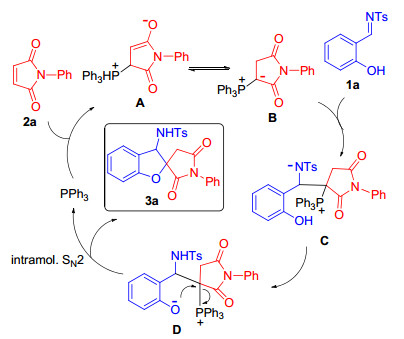
According to the stoichiometric reaction showed in Scheme 2 and our previous work, [7b, 9] a plausible mechanism is exemplified in Scheme 3 to rationalize the formation of 3. A phosphorus ylide B is in situ generated via the nucleophilic attack of phosphine at maleimide 2a followed by proton transfer. The ylide B then undergoes a nucleophilic addition to salicyl imine like 1a to generate intermediate C, which subsequently transforms into intermediate D by proton transfer. Finally, cyclization occurs by an intramolecular SN2-like substitution to furnish spirocyclic benzofuran like 3a and regenerate the phosphine catalyst (Scheme 3). In light of our previous report, [7b] the in situ formation of P-ylide B is aided with a protic acid additive such as benzoic acid (20 mol%). In this reaction, the substrate salicyl imines like 1a bearing a phenolic hydroxyl presumably also acts as a protic acid additive and assists formation of P-ylide B with the proton transfer process (Scheme 3). Since the substrate salicyl imine 1a is in excess as the protic additive, the excessive salicyl imine 1a may inhibit the [4+1] annulation reaction by protonating the reactive P-ylide B. This inhibition may be compensated with the increased loading of the catalyst PPh3. That is why a relatively higher (up to 100 mol%) catalyst loading is required to attain a good yield (Table 1, Entry 19).
In conclusion, we have successfully developed a novel phosphine-catalyzed [4+1] annulation reaction between dual functional salicyl imines and maleimides. This work definitely expands the substrate scope of the non-allylic P-ylide-initiated [4+1] annulation strategy. Also, this reaction provides a simple and efficient method for constructing spirobenzofurans from readily available materials and under mild conditions. Mechanistically, this reaction proceeds through a cascade sequence of nucleophilic addition/intramolecular SN2-like substitution involving reactive P-ylide intermediates. Accordingly, it represents a new mode of the non-allylic P-ylide-mediated [4+1] annulation reaction. Further expanding its scope and developing its asymmetric version are currently under investigation in our laboratory.
Unless otherwise noted, all reactions were carried out in a nitrogen atmosphere under anhydrous conditions. All the solvents were purified according to the standard procedures. 1H NMR and 13C NMR spectra were recorded on a Bruker AV 400 in CDCl3 with tetramethylsilane (TMS) as the internal standard. Melting points were measured on a RY-I apparatus and uncorrected. High resolution ESI mass spectra were acquired with a Varian 7.0 T FTMS instrument. X-ray crystal diffraction data were collected on a Nonius Kappa CCD diffractometer with Mo Kα radiation (λ=0.7107 Å) at room temperature. Column chromatography was performed on silica gel (200~300 mesh) using a mixture of petroleum ether/ethyl acetate as eluent. Substrates 1 were prepared according to literature methods.[10] Maleimides 2 were prepared through the reported method from maleic anhydride and the corresponding amines.[11]
Under a N2 atmosphere, a mixture of 1 (1 mmol), 2 (0.5 mmol), and PPh3 (0.5 mmol) in CH2Cl2 (4.0 mL) was stirred at room temperature for the specified hours (monitored by TLC). After the reaction was completed, the mixture was concentrated on a rotary evaporator under reduced pressure and the residue was subjected to purification by column chromatography on silica gel (gradient elution with a mixture of petroleum ether/ethyl acetate from 5:1 to 3:1) to afford the [4+1] annulation products 3.
N-(2', 5'-Dioxo-1'-phenyl-3H-spiro[benzofuran-2, 3'-pyr-rolidin]-3-yl)-4-methylbenzenesulfonamide (3a): 99% yield, 2.4:1 dr. For syn-3a, white solid, m.p. 198~200 ℃; 1H NMR (CDCl3, 400 MHz) δ: 7.80 (d, J=8.3 Hz, 2H), 7.54~7.32 (m, 7H), 7.23 (t, J=7.9 Hz, 1H), 6.93~6.79 (m, 2H), 6.72 (d, J=7.5 Hz, 1H), 5.53 (d, J=7.2 Hz, 1H), 5.30 (d, J=7.2 Hz, 1H), 3.79 (d, J=18.6 Hz, 1H), 2.96 (d, J=18.6 Hz, 1H), 2.44 (s, 3H); 13C NMR (CDCl3, 100 MHz) δ: 174. 6, 172.4, 157.5, 144.7, 135.8, 131.5, 131.2, 130.3, 129.3, 129.0, 127.3, 126.7, 124.2, 123.1, 122.4, 110.7, 88.6, 59.3, 37.0, 21.6. For anti-3a, white solid, m.p. 191~194 ℃; 1H NMR (400 MHz, DMSO-d6) δ: 9.01 (d, J=5.7 Hz, 1H), 7.89 (d, J=8.2 Hz, 2H), 7.57~7.38 (m, 7H), 7.22 (t, J=7.8 Hz, 1H), 6.89 (d, J=8.0 Hz, 1H), 6.84 (t, J=7.4 Hz, 1H), 6.40 (d, J=7.5 Hz, 1H), 5.52 (d, J=5.7 Hz, 1H), 3.51 (s, 2H), 2.43 (s, 3H); 13C NMR (100 MHz, DMSO-d6) δ: 173.6, 172.4, 158.9, 143.7, 138.3, 132.5, 130.7, 130.3, 129.5, 129.2, 127.7, 127.2, 125.2, 124.4, 121.9, 110.1, 89.8, 64.4, 41.4, 21.5; HRMS-ESI calcd for C24H21N2O5S [M+H]+ 449.1166, found 449.1167.
N-(1'-(4-Methoxyphenyl)-2', 5'-dioxo-3H-spiro[benzofu-ran-2, 3'-pyrrolidin]-3-yl)-4-methylbenzenesulfonamide (3b): 96% yield, 3.9:1 dr. For syn-3b, white solid, m.p. 206~208 ℃; 1H NMR (400 MHz, DMSO-d6) δ: 9.14 (d, J=8.1 Hz, 1H), 7.83 (d, J=8.2 Hz, 2H), 7.49 (d, J=8.1 Hz, 2H), 7.31~7.25 (m, 3H), 7.10 (d, J=9.0 Hz, 2H), 6.96~6.89 (m, 2H), 6.67 (d, J=7.5 Hz, 1H), 5.17 (d, J=8.1 Hz, 1H), 3.82 (s, 3H), 3.50 (d, J=18.2 Hz, 1H), 3.21 (d, J=18.2 Hz, 1H), 2.42 (s, 3H); 13C NMR (100 MHz, DMSO-d6) δ: 175.0, 172.1, 159.3, 157.3, 143.6, 137.4, 130.6, 130.1, 128.2, 126.6, 124.8, 124.2, 123.5, 122.0, 114.3, 110.0, 87.8, 59.7, 55.4, 36.4, 21.0; HRMS-ESI calcd for C25H23N2O6S [M+H]+ 479.1272, found 479.1284.
N-(2', 5'-Dioxo-1'-(p-tolyl)-3H-spiro[benzofuran-2, 3'-pyr-rolidin]-3-yl)-4-methylbenzenesulfonamide (3c): 44% yield, 2.2:1 dr. For syn-3c, white solid, m.p. 200~202 ℃; 1H NMR (400 MHz, DMSO-d6) δ: 9.15 (s, 1H), 7.83 (d, J=8.2 Hz, 2H), 7.48 (d, J=8.1 Hz, 2H), 7.35 (d, J=8.2 Hz, 2H), 7.30~7.22 (m, 3H), 6.97~6.88 (m, 2H), 6.67 (d, J=7.5 Hz, 1H), 5.17 (s, 1H), 3.51 (d, J=18.2 Hz, 1H), 3.23 (d, J=18.2 Hz, 1H), 2.41 (s, 3H), 2.37 (s, 3H); 13C NMR (100 MHz, DMSO-d6) δ: 175.4, 172.4, 157.8, 144.1, 138.9, 137.9, 131.1, 130.6, 130.0, 129.6, 127.3, 127.1, 125.4, 124.0, 122.5, 110.5, 88.3, 60.2, 36.9, 21.5, 21.3. For anti-3c, white solid, m.p. 188~190 ℃; 1H NMR (400 MHz, DMSO-d6) δ: 9.02 (d, J=6.9 Hz, 1H), 7.90 (d, J=8.2 Hz, 2H), 7.48 (d, J=8.1 Hz, 2H), 7.34 (d, J=8.3 Hz, 2H), 7.29 (d, J=8.4 Hz, 2H), 7.22 (t, J=7.8 Hz, 1H), 6.90 (d, J=8.0 Hz, 1H), 6.84 (t, J=7.5 Hz, 1H), 6.40 (d, J=7.5 Hz, 1H), 5.51 (d, J=6.9 Hz, 1H), 3.50 (s, 2H), 2.43 (s, 3H), 2.37 (s, 3H); 13C NMR (100 MHz, DMSO-d6) δ: 173.7, 172.5, 158.9, 143.7, 138.8, 138.3, 130.7, 130.3, 129.9, 129.9, 127.5, 127.2, 125.1, 124.4, 121.9, 110.1, 89.8, 64.3, 41.3, 21.5, 21.2; HRMS-ESI calcd for C25H23N2O5S [M+H]+ 463.1322, found 463.1334.
N-(1'-(4-Chlorophenyl)-2', 5'-dioxo-3H-spiro[benzofuran-2, 3'-pyrrolidin]-3-yl)-4-methylbenzenesulfonamide (3d): 81% yield, 2.0:1 dr. For syn-3d, white solid, m.p. 192~193 ℃; 1H NMR (400 MHz, DMSO-d6) δ: 9.16 (d, J=8.1 Hz, 1H), 7.82 (d, J=8.2 Hz, 2H), 7.64 (d, J=8.7 Hz, 2H), 7.47 (d, J=8.1 Hz, 2H), 7.41 (d, J=8.7 Hz, 2H), 7.27 (t, J=7.7 Hz, 1H), 6.96~6.88 (m, 2H), 6.65 (d, J=7.5 Hz, 1H), 5.19 (d, J=8.1 Hz, 1H), 3.52 (d, J=18.1 Hz, 1H), 3.24 (d, J=18.1 Hz, 1H), 2.40 (s, 3H); 13C NMR (100 MHz, DMSO-d6) δ: 174.6, 171.6, 157.3, 143.6, 137.4, 133.4, 130.6, 130.5, 130.1, 129.2, 128.8, 126.6, 124.8, 123.5, 122.0, 110.1, 87.9, 59.9, 36.5, 21.0. For anti-3d, white solid, m.p. 182~184 ℃; 1H NMR (CDCl3, 400 MHz) δ: 7.81 (d, J=8.3 Hz, 2H), 7.45~7.40 (m, 2H), 7.33 (dt, J=3.9, 2.2 Hz, 4H), 7.22 (t, J=7.7 Hz, 1H), 6.85 (t, J=7.6 Hz, 2H), 6.71~6.66 (m, 1H), 5.68 (d, J=9.5 Hz, 1H), 5.26 (d, J=9.5 Hz, 1H), 3.33 (s, 2H), 2.45 (s, 3H); 13C NMR (100 MHz, DMSO-d6) δ: 172.5, 171.7, 158.4, 144.5, 136.6, 134.8, 131.1, 130.1, 129.6, 129.5, 128.0, 127.2, 124.2, 123.5, 122.4, 110.5, 88.1, 64.0, 41.4, 21.6; HRMS-ESI calcd for C24H23ClN3O5S [M+NH4]+ 500.1041, found 500.1048.
N-(1'-(4-Fluorophenyl)-2', 5'-dioxo-3H-spiro[benzofuran-2, 3'-pyrrolidin]-3-yl)-4-methylbenzenesulfonamide (3e): 71% yield, 2.3:1 dr. For syn-3e, white solid, m.p. 216~218 ℃; 1H NMR (400 MHz, DMSO-d6) δ: 9.16 (d, J=8.1 Hz, 1H), 7.83 (d, J=8.2 Hz, 2H), 7.48 (d, J=8.1 Hz, 2H), 7.45~7.37 (m, 4H), 7.27 (t, J=7.7 Hz, 1H), 6.97~6.87 (m, 2H), 6.66 (d, J=7.5 Hz, 1H), 5.19 (d, J=8.1 Hz, 1H), 3.52 (d, J=18.1 Hz, 1H), 3.24 (d, J=18.1 Hz, 1H), 2.41 (s, 3H); 13C NMR (100 MHz, DMSO-d6) δ: 175.3, 172.3, 162.2 (d, JCF=245.7 Hz), 157.8, 144.1, 137.9, 131.1, 130.6, 129.8 (d, JCF=9.0 Hz), 128.4 (d, JCF=2.9 Hz), 127.1, 125.3, 124.0, 122.5, 116.6 (d, JCF=23.0 Hz), 110.6, 88.3, 60.4, 37.0, 21.5. For anti-3e, white solid, m.p. 174~176 ℃; 1H NMR (400 MHz, DMSO-d6) δ: 9.02 (d, J=7.0 Hz, 1H), 7.89 (d, J=8.2 Hz, 2H), 7.52~7.39 (m, 6H), 7.23 (t, J=7.8 Hz, 1H), 6.90 (d, J=8.1 Hz, 1H), 6.85 (t, J=7.5 Hz, 1H), 6.42 (d, J=7.5 Hz, 1H), 5.52 (d, J=7.0 Hz, 1H), 3.51 (s, 2H), 2.43 (s, 3H); 13C NMR (100 MHz, DMSO-d6) δ: 173.5, 172.3, 162.2 (d, J=245.5 Hz), 158.9, 143.7, 138.3, 130.8, 130.3, 129.9 (d, J=8.9 Hz), 128.7 (d, J=2.8 Hz), 127.2, 125.2, 124.3, 121.9, 116.5 (d, J=23.0 Hz), 110.1, 89.9, 64.4, 41.3, 21.5; HRMS-ESI calcd for C24H23FN3O5S [M+NH4]+ 484.1337, found 484.1343.
4-Methyl-N-(1'-(4-nitrophenyl)-2', 5'-dioxo-3H-spiro[ben-zofuran-2, 3'-pyrrolidin]-3-yl)benzenesulfonamide (3f): 80% yield, 3.4:1 dr. For syn-3f, white solid, m.p. 193~195 ℃; 1H NMR (400 MHz, DMSO-d6) δ: 9.18 (d, J=8.1 Hz, 1H), 8.44 (d, J=8.9 Hz, 2H), 7.83 (d, J=8.1 Hz, 2H), 7.71 (d, J=8.9 Hz, 2H), 7.47 (d, J=8.0 Hz, 2H), 7.28 (t, J=7.7 Hz, 1H), 6.93 (dd, J=13.8, 7.6 Hz, 2H), 6.66 (d, J=7.4 Hz, 1H), 5.23 (d, J=8.1 Hz, 1H), 3.55 (d, J=18.1 Hz, 1H), 3.30 (d, J=18.1 Hz, 1H), 2.41 (s, 3H); 13C NMR (100 MHz, DMSO-d6) δ: 174.8, 171.7, 157.8, 147.5, 144.1, 137.9, 137.6, 131.1, 130.5, 128.5, 127.1, 125.4, 124.9, 123.9, 122. 6, 110.6, 88.4, 60.4, 37.1, 21.5; HRMS-ESI calcd for C24H23N4O7S [M+NH4]+ 511.1282, found 511.1286.
N-(1'-Benzyl-2', 5'-dioxo-3H-spiro[benzofuran-2, 3'-pyr-rolidin]-3-yl)-4-methylbenzenesulfonamide (3g): 77% yield, 3.2:1 dr. For syn-3g, white solid, m.p. 157~159 ℃; 1H NMR (CDCl3, 400 MHz) δ: 7.67 (d, J=8.2 Hz, 2H), 7.42~7.29 (m, 7H), 7.20 (t, J=7.8 Hz, 1H), 6.84 (t, J=7.5 Hz, 1H), 6.78 (d, J=8.1 Hz, 1H), 6.64 (d, J=7.5 Hz, 1H), 5.24 (d, J=7.6 Hz, 1H), 5.07 (d, J=7.6 Hz, 1H), 4.74 (d, J=14.3 Hz, 1H), 4.67 (d, J=14.3 Hz, 1H), 3.59 (d, J=18.6 Hz, 1H), 2.83 (d, J=18.6 Hz, 1H), 2.45 (s, 3H); 13C NMR (CDCl3, 100 MHz) δ: 175.0, 172.7, 157.7, 144.6, 136.0, 135.1, 131.2, 130.2, 128.7(2C), 128.0, 127.2, 124.4, 123.5, 122.4, 110.5, 88.3, 77.4, 77.2, 77.0, 76.7, 58.8, 42.7, 36.8, 21.6. For anti-3g, white solid, m.p. 187~189 ℃; 1H NMR (400 MHz, DMSO-d6) δ: 8.93 (d, J=6.8 Hz, 1H), 7.87 (d, J=8.2 Hz, 2H), 7.47 (d, J=8.1 Hz, 2H), 7.33 (q, J=3.3 Hz, 4H), 7.31~7.26 (m, 1H), 7.19 (t, J=7.8 Hz, 1H), 6.87~6.78 (m, 2H), 6.36 (d, J=7.5 Hz, 1H), 5.46 (d, J=6.8 Hz, 1H), 4.70 (d, J=15.3 Hz, 1H), 4.60 (d, J=15.3 Hz, 1H), 3.41 (s, 2H), 2.43 (s, 3H); 13C NMR (100 MHz, DMSO-d6) δ: 174.0, 173.5, 158.7, 143.7, 138.1, 135.9, 130.6, 130.2, 129.0, 127.8, 127.7, 127.4, 125.0, 124.8, 121.8, 110.1, 89.6, 63.5, 42.2, 40.8, 21.5; HRMS-ESI calcd for C25H23N2O5S [M+H]+ 463.1322, found 463.1323.
N-(1'-Butyl-2', 5'-dioxo-3H-spiro[benzofuran-2, 3'-pyrro-lidin]-3-yl)-4-methylbenzenesulfonamide (3h): 65% yield, 3.4:1 dr. For syn-3h, white solid, m.p. 127~129 ℃; 1H NMR (CDCl3, 400 MHz) δ: 7.78 (d, J=8.2 Hz, 2H), 7.38 (d, J=8.1 Hz, 2H), 7.20 (t, J=7.8 Hz, 1H), 6.85 (t, J=7.5 Hz, 1H), 6.79 (d, J=8.1 Hz, 1H), 6.67 (d, J=7.5 Hz, 1H), 5.34 (d, J=7.6 Hz, 1H), 5.17 (d, J=7.6 Hz, 1H), 3.56 (q, J=8.6 Hz, 2H), 3.55 (d, J=18.5 Hz, 1H), 2.79 (d, J=18.5 Hz, 1H), 2.47 (s, 3H), 1.66~1.57 (m, 2H), 1.41~1.31 (m, 2H), 0.95 (t, J=7.3 Hz, 3H); 13C NMR (CDCl3, 100 MHz) δ: 175.3, 173.3, 157.6, 144.6, 136.2, 131.1, 130.2, 127.3, 124.3, 123.6, 122.3, 110.6, 88.4, 58.8, 39.1, 36.8, 29.5, 21.6, 20.0, 13.6. For anti-3h, white solid, m.p. 161~163 ℃; 1H NMR (CDCl3, 400 MHz) δ: 7.83 (d, J=8.3 Hz, 2H), 7.38 (d, J=8.0 Hz, 2H), 7.25 (t, J=7.7 Hz, 1H), 6.92~6.88 (m, 1H), 6.83 (d, J=8.1 Hz, 1H), 6.73 (d, J=7.5 Hz, 1H), 5.54 (d, J=10.0 Hz, 1H), 5.29 (d, J=10.0 Hz, 1H), 3.55~3.49 (m, 2H), 3.17 (d, J=18.4 Hz, 1H), 3.09 (d, J=18.4 Hz, 1H), 2.49 (s, 3H), 1.66~1.58 (m, 2H), 1.37 (dq, J=14.7, 7.3 Hz, 2H), 0.96 (t, J=7.3 Hz, 3H); 13C NMR (CDCl3, 101 MHz) δ: 173.6, 173.0, 158.3, 144.4, 137.1, 130.8, 130.1, 127.1, 124.2, 124.1, 122.3, 110.4, 87.6, 63.1, 40.9, 39.0, 29.5, 21.6, 20.0, 13.6; HRMS-ESI calcd for C22H28N3O5S [M+NH4]+ 446.1744, found 446.1747.
N-(5, 7-Dichloro-2', 5'-dioxo-1'-phenyl-3H-spiro[benzo-furan-2, 3'-pyrrolidin]-3-yl)-4-methylbenzenesulfonamide (3i): 92% yield, 2.1:1 dr. For syn-3i, white solid, m.p. 209~211 ℃; 1H NMR (400 MHz, DMSO-d6) δ: 9.13 (d, J=8.5 Hz, 1H), 7.84 (d, J=8.1 Hz, 2H), 7.59~7.53 (m, 3H), 7.52~7.47 (m, 3H), 7.38 (d, J=7.7 Hz, 2H), 6.28 (s, 1H), 5.36 (d, J=8.5 Hz, 1H), 3.52 (d, J=18.1 Hz, 1H), 3.41 (d, J=18.1 Hz, 1H), 2.43 (s, 3H); 13C NMR (100 MHz, DMSO-d6) δ: 173.6, 171.3, 152.6, 143.9, 137.6, 131.5, 130.1, 129.9, 129.0, 128.8, 127.8, 127.0, 126.7, 125.9, 123.6, 115.2, 89.3, 59.7, 36.1, 21.0. For anti-3i, white solid, m.p. 199~201 ℃; 1H NMR (400 MHz, DMSO-d6) δ: 9.13 (d, J=7.4 Hz, 1H), 7.89 (d, J=8.2 Hz, 2H), 7.58~7.46 (m, 6H), 7.44~7.35 (m, 2H), 6.05 (dd, J=1.9, 1.1 Hz, 1H), 5.71 (d, J=7.4 Hz, 1H), 3.65 (d, J=17.7 Hz, 1H), 3.50 (d, J=17.7 Hz, 1H), 2.45 (s, 3H); 13C NMR (100 MHz, DMSO-d6) δ: 172.7, 171.8, 153.9, 144.1, 138.0, 132.3, 130.4, 130.0, 129.5, 129.3, 128.4, 127.7, 127.2, 125.9, 123.7, 115.2, 91.1, 64.2, 40.8, 21.5; HRMS- ESI calcd for C24H22Cl2N3O5S [M+NH4]+ 534.0652, found 534.0656.
N-(5, 7-Dibromo-2', 5'-dioxo-1'-phenyl-3H-spiro[benzo-furan-2, 3'-pyrrolidin]-3-yl)-4-methylbenzenesulfonamide(3j): 66% yield, 3.2:1 dr. For syn-3j, white solid, m.p. 221~224 ℃; 1H NMR (400 MHz, DMSO-d6) δ: 9.10 (d, J=8.4 Hz, 1H), 7.82 (d, J=7.7 Hz, 2H), 7.74 (s, 1H), 7.55 (t, J=7.0 Hz, 2H), 7.48 (d, J=7.8 Hz, 3H), 7.37 (d, J=7.4 Hz, 2H), 6.31 (d, J=8.3 Hz, 1H), 5.37 (d, J=8.3 Hz, 1H), 3.50 (d, J=18.0 Hz, 1H), 3.36 (d, J=18.0 Hz, 1H), 2.43 (s, 3H); 13C NMR (100 MHz, DMSO-d6) δ: 174.1, 171.7, 155.0, 144.4, 138.1, 135.4, 132.0, 130.6, 129.5, 129.4, 128.3, 127.5, 127.4, 127.2, 113.8, 103.9, 89.5, 60.3, 36.6, 21.6; HRMS-ESI calcd for C24H22Br2N3O5S [M+NH4]+621.9641, found 621.9647.
4-Methyl-N-(5-methyl-2', 5'-dioxo-1'-phenyl-3H-spiro-[benzofuran-2, 3'-pyrrolidin]-3-yl)benzenesulfonamide(3k): Isolated as a diastereomeric mixture, 86% yield, dr 2.7:1; white solid. For the major syn-3k, 1H NMR (400 MHz, DMSO-d6) δ: 9.05 (d, J=8.2 Hz, 1H), 7.81 (d, J=8.1 Hz, 2H), 7.58~7.46 (m, 5H), 7.35 (d, J=7.6 Hz, 2H), 7.05 (d, J=8.2 Hz, 1H), 6.80 (d, J=8.2 Hz, 1H), 6.26 (s, 1H), 5.14 (d, J=8.1 Hz, 1H), 3.50 (d, J=18.1 Hz, 1H), 3.20 (d, J=18.1 Hz, 1H), 2.42 (s, 3H), 2.11 (s, 3H); 13C NMR (100 MHz, DMSO-d6) δ: 174.8, 171.9, 155.3, 143.6, 137.6, 131.7, 130.8, 130.5, 130.1, 129.1, 128.8, 127.0, 126.7, 125.1, 123.6, 109.6, 87.9, 59.7, 36.5, 21.0, 20.2. For the minor anti-3k, 1H NMR (400 MHz, DMSO-d6) δ: 8.89 (d, J=7.2 Hz, 1H), 7.89 (d, J=8.1 Hz, 2H), 7.58~7.46 (m, 5H), 7.39 (d, J=7.5 Hz, 2H), 7.01 (d, J=8.4 Hz, 1H), 6.77 (d, J=8.2 Hz, 1H), 6.05 (s, 1H), 5.45 (d, J=7.1 Hz, 1H), 3.48 (s, 1H), 3.34 (s, 1H), 2.44 (s, 3H), 2.08 (s, 3H); 13C NMR (100 MHz, DMSO-d6) δ: 174.5, 173.0, 156.5, 143.2, 137.9, 132.0, 130.8, 130.5, 129.8, 129.0, 128.7, 127.2, 126.8, 125.0, 123.9, 109.2, 89.3, 63.9, 40.9, 21.0, 20.3; HRMS-ESI calcd for C25H23N2O5S [M+H]+ 463.1322, found 463.1331.
N-(5-Methoxy-2', 5'-dioxo-1'-phenyl-3H-spiro[benzofu-ran-2, 3'-pyrrolidin]-3-yl)-4-methylbenzenesulfonamide(3l): Isolated as a diastereomeric mixture, 91% yield, dr 2.4:1; white solid. For the major syn-3l, 1H NMR (400 MHz, DMSO-d6) δ: 9.09 (d, J=8.3 Hz, 1H), 7.84 (d, J=8.3 Hz, 2H), 7.58~7.46 (m, 5H), 7.42~7.34 (m, 2H), 6.80 (tt, J=8.8, 5.6 Hz, 2H), 5.95 (d, J=2.3 Hz, 1H), 5.16 (d, J=8.2 Hz, 1H), 3.53 (s, 3H), 3.50 (d, J=18.0 Hz, 1H).3.21 (d, J=18.0 Hz, 1H), 2.41 (s, 3H); 13C NMR (100 MHz, DMSO-d6) δ: 175.2, 172.3, 155.0, 151.7, 144.2, 138.3, 132.2, 130.6, 129.6, 129.3, 127.5, 127.2, 124.8, 116.7, 111.0, 110.0, 88.6, 60.5, 56.0, 37.0, 21.5. For the minor anti-3l, 1H NMR (400 MHz, DMSO-d6) δ: 8.91 (d, J=7.4 Hz, 1H), 7.91 (d, J=8.2 Hz, 2H), 7.58~7.46 (m, 5H), 7.42~7.34 (m, 2H), 6.80 (tt, J=8.8, 5.6 Hz, 2H), 5.73 (d, J=2.3 Hz, 1H), 5.48 (d, J=7.4 Hz, 1H), 3.50 (s, 5H), 2.41 (s, 3H); 13C NMR (100 MHz, DMSO-d6) δ: 173.6, 172.3, 154.5, 152.8, 143.8, 138.1, 132.5, 130.3, 129.5, 129.2, 127.7, 127.3, 125.2, 116.0, 110.4, 110.3, 89.9, 64.6, 55.9, 41.3, 21.5; HRMS-ESI calcd for C25H23N2O6S [M+H]+ 479.1272, found 479.1279.
4-Methyl-N-(5-nitro-2', 5'-dioxo-1'-phenyl-3H-spiro[ben-zofuran-2, 3'-pyrrolidin]-3-yl)benzenesulfonamide (3m): 73% yield, 1.6:1 dr. For anti-3m, white solid, m.p. 175~177 ℃; 1H NMR (CDCl3, 400 MHz) δ: 8.18 (dd, J=8.9, 2.1 Hz, 1H), 7.87 (d, J=8.0 Hz, 2H), 7.51 (t, J=7.7 Hz, 2H), 7.44 (dd, J=10.8, 7.6 Hz, 3H), 7.36 (d, J=8.0 Hz, 2H), 7.33 (s, 1H), 6.92 (d, J=8.9 Hz, 1H), 5.58 (d, J=10.3 Hz, 1H), 5.40 (d, J=10.3 Hz, 1H), 3.43 (s, 2H), 2.51 (s, 3H); 13C NMR (CDCl3, 100 MHz) δ: 171.8, 171.2, 163.0, 145.5, 143.3, 136.3, 130.8, 130.5, 129.4, 129.4, 127.9, 127.1, 126.6, 125.8, 120.9, 110.8, 89.9, 62.3, 40.5, 21.7; HRMS-ESI calcd for C24H23N4O7S [M+NH4]+ 511.1282, found 511.1289.
N-(6-Methoxy-2', 5'-dioxo-1'-phenyl-3H-spiro[benzofu-ran-2, 3'-pyrrolidin]-3-yl)-4-methylbenzenesulfonamide(3n): 64% yield, dr 2.7:1. For syn-3n, white solid; m.p. 210~211 ℃; 1H NMR (CDCl3, 400 MHz) δ: 7.81 (d, J=7.9 Hz, 2H), 7.44 (d, J=7.9 Hz, 2H), 7.38~7.30 (m, 4H), 7.26 (s, 1H), 6.55 (d, J=8.3 Hz, 1H), 6.50~6.26 (m, 2H), 5.22 (d, J=7.2 Hz, 1H), 5.07 (d, J=7.2 Hz, 1H), 3.82 (d, J=18.6 Hz, 1H), 3.75 (s, 3H), 2.99 (d, J=18.6 Hz, 1H), 2.46 (s, 3H); 13C NMR (CDCl3, 100 MHz) δ: 174.3, 172.2, 162.7, 159.1, 144.7, 136.1, 131.5, 130.3, 129.3, 129.0, 127.3, 126.6, 124.4, 115.0, 109.0, 96.6, 89.3, 59.0, 55.6, 37.0, 21.6. For anti-3n, white solid; m.p. 182~184 ℃; 1H NMR (CDCl3, 400 MHz) δ: 7.83 (d, J=8.3 Hz, 2H), 7.52~7.46 (m, 2H), 7.45~7.33 (m, 5H), 6.60 (d, J=8.2 Hz, 1H), 6.42 (dt, J=6.4, 2.1 Hz, 2H), 5.47 (d, J=9.8 Hz, 1H), 5.23 (d, J=9.9 Hz, 1H), 3.75 (s, 3H), 3.34 (d, J=18.3 Hz, 1H), 3.28 (d, J=18.3 Hz, 1H), 2.46 (s, 3H); 13C NMR (CDCl3, 100 MHz) δ: 172.7, 171.9, 162.5, 159.9, 144. 5, 137.0, 131.2, 130.1, 129.2, 129.0, 127.2, 126.7, 124.6, 115.4, 108.7, 96.6, 88.7, 63.6, 55.6, 41.5, 21.6; HRMS-ESI calcd for C25H26N3O6S [M+NH4]+ 496.1537, found 496.1538.
N-(7-Methoxy-2', 5'-dioxo-1'-phenyl-3H-spiro[benzofu-ran-2, 3'-pyrrolidin]-3-yl)-4-methylbenzenesulfonamide(3o): 92% yield, dr 5:1. For syn-3o, white solid; m.p. 168~170 ℃; 1H NMR (CDCl3, 400 MHz) δ: 7.80 (d, J=8.2 Hz, 2H), 7.50 (t, J=7.4 Hz, 2H), 7.44 (d, J=7.3 Hz, 1H), 7.40~7.31 (m, 4H), 6.88~6.80 (m, 2H), 6.33 (d, J=7.0 Hz, 1H), 5.46 (d, J=7.2 Hz, 1H), 5.33 (d, J=7.2 Hz, 1H), 3.86 (s, 3H), 3.81 (d, J=18.7 Hz, 1H), 3.03 (d, J=18.7 Hz, 1H), 2.44 (s, 3H); 13C NMR (CDCl3, 101 MHz) δ: 174.2, 172.3, 146.0, 144.7, 135.8, 131.5, 130.3, 129.2, 129.0, 127.3, 126.7, 124.3, 123.4, 115.6, 113.5, 89.0, 59.8, 56.1, 37.0, 21.6. For anti-3o, white solid; m.p. 200~202 ℃; 1H NMR (CDCl3, 400 MHz) δ: 7.84 (d, J=8.1 Hz, 2H), 7.53~7.32 (m, 7H), 6.90~6.79 (m, 2H), 6.37 (d, J=6.9 Hz, 1H), 5.55 (d, J=9.9 Hz, 1H), 5.34 (d, J=9.9 Hz, 1H), 3.87 (s, 3H), 3.44 (d, J=18.5 Hz, 1H), 3.31 (d, J=18.5 Hz, 1H), 2.45 (s, 3H); 13C NMR (CDCl3, 101 MHz) δ: 172.4, 171.9, 146.8, 144.5, 136.8, 131.2, 130.2, 129.2, 129.0, 127.2, 126.7, 124.9, 123.3, 115.8, 113.5, 88.4, 64.1, 56.1, 41.4, 21.6; HRMS-ESI calcd for C25H26N3O6S [M+NH4]+ 496.1537, found 496.1545.
4-Bromo-N-(2', 5'-dioxo-1'-phenyl-3H-spiro[benzofuran-2, 3'-pyrrolidin]-3-yl)benzenesulfonamide (3p): Isolated as a diastereomeric mixture, 99% yield, dr 3.6:1; white solid. For the major syn-3p, 1H NMR (400 MHz, DMSO- d6) δ: 9.22 (d, J=7.8 Hz, 1H), 7.99~7.90 (m, 2H), 7.77~7.72 (m, 1H), 7.69 (d, J=7.7 Hz, 2H), 7.59~7.53 (m, 2H), 7.50~7.46 (m, 1H), 7.40~7.35 (m, 2H), 7.27 (t, J=7.7 Hz, 1H), 6.99~6.84 (m, 2H), 6.58 (d, J=7.6 Hz, 1H), 5.22 (d, J=7.6 Hz, 1H), 3.52 (d, J=18.1 Hz, 1H), 3.26 (d, J=18.1 Hz, 1H); 13C NMR (100 MHz, DMSO-d6) δ: 175.3, 172.3, 157.9, 140.9, 133.7, 132.2, 131.1, 130.2, 129.6, 129.3, 127.5, 127.0, 125.3, 124.0, 122.5, 110.6, 88.4, 60.3, 37.0. For the minor anti-3p, 1H NMR (400 MHz, DMSO-d6) δ: 9.10 (d, J=7.1 Hz, 1H), 8.06~7.99 (m, 2H), 7.77~7.72 (m, 1H), 7.66 (d, J=1.2 Hz, 2H), 7.59~7.53 (m, 2H), 7.50~7.46 (m, 1H), 7.44~7.40 (m, 2H), 7.21 (d, J=8.6 Hz, 1H), 6.99~6.84 (m, 1H), 6.82 (t, J=7.4 Hz, 1H), 6.33 (d, J=7.5 Hz, 1H), 5.56 (d, J=7.1 Hz, 1H), 3.53 (s, 2H); 13C NMR (100 MHz, DMSO-d6) δ: 173. 6, 172.4, 158.9, 141.1, 133.4, 132.5, 130.8, 129.9, 129.5, 129.2, 127.7, 127.2, 125.1, 124.3, 121.9, 110.2, 89.8, 64.3, 41.3; HRMS-ESI calcd for C23H22N3O5S [M+NH4]+ 452.1274, found 452.1282.
N-(2', 5'-Dioxo-1'-phenyl-1H-spiro[naphtho[2, 1-b]furan-2, 3'-pyrrolidin]-1-yl)-4-methylbenzenesulfonamide (3q): 74% yield, 3.7:1 dr. For syn-3q, white solid, m.p. 196~198 ℃; 1H NMR (CDCl3, 400 MHz) δ: 7.83 (d, J=8.2 Hz, 2H), 7.73 (t, J=8.2 Hz, 2H), 7.56~7.30 (m, 7H), 7.25 (t, J=7.3 Hz, 1H), 7.13~7.02 (m, 2H), 6.55 (d, J=8.3 Hz, 1H), 5.64 (d, J=7.4 Hz, 1H), 5.12 (d, J=7.4 Hz, 1H), 3.87 (d, J=18.7 Hz, 1H), 3.08 (d, J=18.7 Hz, 1H), 2.50 (s, 3H); 13C NMR (CDCl3, 100 MHz) δ: 174.3, 172.1, 156.6, 144.8, 136.2, 132.8, 131.5, 130.3, 130.0, 129.5, 129.2, 129.2, 128.9, 127.6, 127.4, 126.6, 123.9, 120.9, 113.5, 112.0, 89.4, 59.5, 37.4, 21.7; HRMS-ESI calcd for C28H26N3O5S [M+NH4]+ 516.1587, found 516.1591.
Supporting Information Copies of 1H NMR and 13C NMR spectra for 3, X-ray crystallographic data, and ORTEP drawings for syn-3a and anti-3a. This material is available free of charge via the Internet at http://sioc-journal.cn/.
(a) Hemelaere, R.; Carreaux. F.; Carboni, B. Eur. J. Org. Chem. 2015, 11, 2470.
(b) Wu, B.; Chen, M.-W.; Ye, Z.-S.; Yu, C.-B.; Zhou, Y.-G. Adv. Synth. Catal. 2014, 356, 383.
(c) Luo, L.; Liu, C.; Hou, Z.; Wang, Y.; Dai, L. RSC Adv. 2014, 4, 29527.
(d) Liu, Y.; Lu, A.; Hu, K.; Wang, Y.; Song, H.; Zhou, Z.; Tang, C. Eur. J. Org. Chem. 2013, 22, 4836.
(e) Coy B, E. D.; Jovanovic, L.; Sefkow, M. Org. Lett. 2010, 12, 1976.
(f) Xie, P.; Huang, Y.; Chen, R. Org. Lett. 2010, 12, 3768.
(g) Leticia, J.-G.; Sergio, G.-M.; Miriam, A.-C.; Manuel, M.-D.; Ignacio, R.-G. Chem. Eur. J. 2007, 13, 557.
(h) Barton, D. H. R.; Nakanishi, K.; MethCohn, O.; Kelly, J. W. Comprehensive Natural Products Chemistry, Pergamon Press, Oxford, UK, 1999.
(i) Qin, Z.; Liu, W.; Wang, D.; He, Z. J. Org. Chem. 2016, 81, 4690.
(j) Cheng, Y.; Fang, Z.; Li, W.; Li, P. Org. Chem. Front. 2018, 5, 2728.
(a) Li, A.; Piel, J. Chem. Biol. 2002, 9, 1017.
(b) Tsang, K. Y.; Brimble, M. A. Tetrahedron 2007, 63, 6015.
(c) Pirrung, M. C.; Brown, W. L.; Rage, S.; Laughton, P. J. Am. Chem. Soc. 1991, 113, 8561.
(d) Usegilo, M.; Castellano, P. M.; Operto, M. A.; Torres, R.; Kaufman, T. S. Bioorg. Med. Chem. Lett. 2006, 16, 5097.
(e) Padmanaban, M.; Biju, A. T.; Glorius, F. Org. Lett. 2011, 13, 5624.
(f) Dong, N.; Li, X.; Wang, F.; Cheng, J.-P. Org. Lett. 2013, 15, 4896.
(g) Petersen, A. B.; Ronnest, M. H.; Larsen, T. O.; Clausen, M. H. Chem. Rev. 2014, 114, 12088.
(h) Effland, R. C.; Gardner, B. A.; Strupczewski, J. J. Heterocycl. Chem. 1981, 18, 811.
(i) Kyei, A. S.; Tchabanenko, K.; Baldwin, J. E.; Adlington, R. M. Tetrahedron Lett. 2004, 45, 8931.
(j) Cohen, J. L.; Limon, A.; Miledi, R.; Chamberlin, A. R. Bioorg. Med. Chem. Lett. 2006, 16, 2189.
(a) Han, B.; Huang, W.; Ren, W.; He, G.; Wang, J.; Peng, C. Adv. Synth. Catal. 2015, 357, 561.
(b) Wen, J.; Wei, W.; Xue, S.; Yang, D.; Lou, Y.; Gao, C.; Wang, H. J. Org. Chem. 2015, 80, 4966.
(c) Yang, C.; Li, J.; Zhou, R.; Chen, X.; Gao, Y.; He, Z. Org. Biomol. Chem. 2015, 13, 4869.
(d) Liang, L.; Li, E.; Xie, P.; Huang, Y. Chem. Asian J. 2014, 9, 1270.
(e) Huang, X.-F.; Zhang, Y.-F.; Qi, Z.-H.; Li, N.-K.; Geng, Z.-C.; Li, K.; Wang, X.-W. Org. Biomol. Chem. 2014, 12, 4372.
(f) Sannigrahi, M. Tetrahedron. 1999, 55, 9007.
(g) Heathcock, C. H.; Graham, S. L.; Pirrung, M. C.; Plavac, F.; White, C. T. In The Total Synthesis of Natural Products, Vol. 5, Ed.: Simon, J., John Wiley and Sons, New York, 1983, p. 264.
Karthikeyan, K.; Perumal, P. T. Synlett 2009, 2366.
For selected reviews on phosphine-catalyzed annulations, see: (a) Lu, X.; Zhang, C.; Xu, Z. Acc. Chem. Res. 2001, 34, 535.
(b) Ye, L.-W.; Zhou, J.; Tang, Y. Chem. Soc. Rev. 2008, 37, 1140.
(c) Marinetti, A.; Voituriez, A. Synlett 2010, 174.
(d) Zhao, Q.-Y.; Lian, Z.; Wei, Y.; Shi, M. Chem. Commun. 2012, 48, 1724.
(e) Zhou, R.; Liu, R.; Li, R.; He, Z. Chin. J. Org. Chem. 2014, 34, 2385(in Chinese). (周荣, 刘蓉芳, 李瑞丰, 贺峥杰, 有机化学, 2014, 34, 2385.) (f) Xie, P.; Huang, Y. Org. Biomol. Chem. 2015, 13, 8578.
(g) Zhou, R.; He, Z. Eur. J. Org. Chem. 2016, 1937.
(h) Wang, T.; Han, X.; Zhong, F.; Yao, W.; Lu, Y. Acc. Chem. Soc. 2016, 49, 1369.
Zhou, R.; Duan, C.; Yang, C.; He, Z. Chem. Asian J. 2014, 9, 1183. doi: 10.1002/asia.201301633
(a) Zhang, X.-N.; Chen, G.-Q.; Tang, X.-Y.; Wei, Y.; Shi, M. Angew. Chem. Int. Ed. 2014, 53, 10768.
(b) Yang, M.; Wang, T.; Cao, S.; He, Z. Chem. Commun. 2014, 50, 13506.
The P-ylide 2aa can be readily prepared from Ph3P and maleimide 2a in the presence of an acid, see: Hedaya. E.; Theodoropulos, S. Tetrahedron 1968, 24, 2241.
Zhou, R.; Wang, J.; Yu, J.; He, Z. J. Org. Chem. 2013, 78, 10596. doi: 10.1021/jo401363u
Wynne, J. H.; Price, S. E.; Rorer, J. R.; Stalick, W. M. Synth. Commun. 2009, 33, 341.
Sortino, M.; Garibotto, F.; Filho, V. C.; Gupta, M.; Enriz, R.; Zacchino, S, Bioorg. Med. Chem., 2011, 19, 2823. doi: 10.1016/j.bmc.2011.03.038
Table 1. Survey of conditions for the phosphine-catalyzed [4+1] annulation reaction of 1a and 2aa
| ||||||
| Entry | Catalyst (mol%) | Ratio of 1a/2a | Solvent | Time/h | Yieldb/% of 3a | drc |
| 1d | PPh3 (20) | 1/1.2 | CH2Cl2 | 48 | 23 | 2.5:1 |
| 2 | PPh3 (20) | 1/1.2 | CH2Cl2 | 48 | 34 | 2.9:1 |
| 3 | None | 1/1.2 | CH2Cl2 | 48 | 0 | — |
| 4 | PPh3 (20) | 1.2/1 | CH2Cl2 | 24 | 63 | 2.2:1 |
| 5 | PPh3 (20) | 1.5/1 | CH2Cl2 | 24 | 56 | 2.3:1 |
| 6 | PPh3 (20) | 2/1 | CH2Cl2 | 24 | 74 | 1.7:1 |
| 7 | PPh3 (20) | 3/1 | CH2Cl2 | 24 | 78 | 2.8:1 |
| 8 | (4-FC6H4)3P (20) | 2/1 | CH2Cl2 | 48 | 61 | 2.4:1 |
| 9 | (4-ClC6H4)3P (20) | 2/1 | CH2Cl2 | 48 | 41 | 3.6:1 |
| 10 | (4-MeC6H4)3P (20) | 2/1 | CH2Cl2 | 24 | 70 | 2.7:1 |
| 11 | (4-MeOC6H4)3P (20) | 2/1 | CH2Cl2 | 24 | 49 | 3:1 |
| 12 | (4-CF3C6H4)3P (20) | 2/1 | CH2Cl2 | 48 | Trace | — |
| 13 | PPh3 (20) | 2/1 | CHCl3 | 36 | 50 | 3:1 |
| 14 | PPh3 (20) | 2/1 | Toluene | 36 | 59 | 3.4:1 |
| 15 | PPh3 (20) | 2/1 | CH3CN | 24 | 66 | 6.7:1 |
| 16 | PPh3 (20) | 2/1 | CH3OH | 24 | 0 | — |
| 17 | PPh3 (50) | 2/1 | CH2Cl2 | 24 | 84 | 3:1 |
| 18 | PPh3 (70) | 2/1 | CH2Cl2 | 24 | 86 | 2.9:1 |
| 19 | PPh3 (100) | 2/1 | CH2Cl2 | 24 | 99 | 2.4:1 |
| aTypical conditions: a mixture of 1a, 2a and phosphine in solvent (2.0 mL) was stirred at room temprature for a specified time. bIsolated yields. c Determined by 1H NMR assay of the crude product. d Benzoic acid was added. | ||||||
 下载: 导出CSV
Table 2. Synthesis of spiro[benzofuran-2, 3'-pyrrolidine]-2', 5'-diones 3a
| |||||||
| Entry | R1 | R2 (1) | R3 (2) | Time/h | 3a | Yieldb/% of 3 | drc |
| 1 | H | Ts (1a) | Ph (2a) | 24 | 3a | 99 | 2.4:1 |
| 2 | H | Ts (1a) | 4-MeOC6H4 (2b) | 24 | 3b | 96 | 3.9:1 |
| 3 | H | Ts (1a) | 4-MeC6H4 (2c) | 24 | 3c | 44 | 2.2:1 |
| 4 | H | Ts (1a) | 4-ClC6H4 (2d) | 24 | 3d | 81 | 2.0:1 |
| 5 | H | Ts (1a) | 4-FC6H4 (2e) | 24 | 3e | 71 | 2.3:1 |
| 6 | H | Ts (1a) | 4-NO2C6H4 (2f) | 12 | 3f | 80 | 3.4:1 |
| 7 | H | Ts (1a) | Bn (2g) | 12 | 3g | 77 | 3.2:1 |
| 8 | H | Ts (1a) | n-Bu (2h) | 24 | 3h | 65 | 3.4:1 |
| 9 | H | Ts (1a) | Boc (2i) | 96 | Trace | — | |
| 10 | 3, 5-Cl2 | Ts (1b) | Ph (2a) | 24 | 3i | 92 | 2.1:1 |
| 11 | 3, 5-Br2 | Ts (1c) | Ph (2a) | 24 | 3j | 66 | 3.2:1 |
| 12 | 5-Me | Ts (1d) | Ph (2a) | 24 | 3k | 86 | 2.7:1 |
| 13 | 5-MeO | Ts (1e) | Ph (2a) | 24 | 3l | 91 | 2.4:1 |
| 14 | 5-NO2 | Ts (1f) | Ph (2a) | 96 | 3m | 73 | 1.6:1 |
| 15 | 4-MeO | Ts (1g) | Ph (2a) | 24 | 3n | 64 | 2.7:1 |
| 16 | 3-MeO | Ts (1h) | Ph (2a) | 96 | 3o | 92 | 5.0:1 |
| 17 | H | Bs (1i) | Ph (2a) | 24 | 3p | 99 | 3.6:1 |
| 18 | 5, 6-Benzo | Ts (1j) | Ph (2a) | 96 | 3q | 74 | 3.7:1 |
| aTypical conditions: under N2 atmosphere, a mixture of salicyl imines 1 (1.0 mmol), maleimide 2 (0.5 mmol) and PPh3 (0.5 mmol) in CH2Cl2 (4.0 mL) was stirred at room temperature for a specified time. b Isolated yields based on 2. c Determined by 1H NMR assay of the crude product. | |||||||
下载: 导出CSV

 扫一扫看文章


扫一扫关注我们