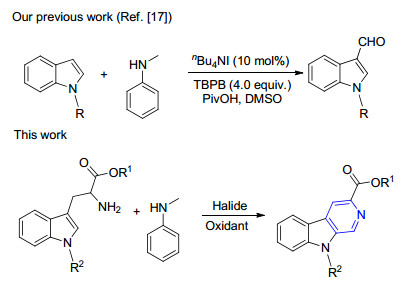
Scheme 1.
N-methylaniline acts as carbon source


Aromatic β-carbolines represent one of the most important classes of heterocycles that display important biological activity.[1] They are involved in the treatment of malaria,[2] cancer,[3] acquired immune deficiency syndrome (AIDS),[4] and other diseases.[5] In addition, some β-carboline derivatives displayed interesting optical properties and acted as photosensitizers in material science.[6] Generally, syntheses of aromatic β-carbolines involve utilization of traditional methods such as Pictet-Spengler reaction[7] and Bischler-Napieralski cyclization,[8] a protic or Lewis acid is needed to obtain the imine intermediate and the reactions take place under harsh conditions. Moreover, a subsequent oxidation step is required to form the desired aromatic β-carbolines.[9] More recently, intense efforts are directed towards to synthesize β-carbolines skeleton by use of transition-metal catalyzed oxidative cycloaromatization reactions, including Pd,[10] Cu,[11] Ru,[12] Rh,[13] Au,[14] and bimetallic Cu/Rh.[15] Although these reported protocols were successfully applied to syntheses of β-carboline derivatives, most of the reactions occurred in the presence of expensive metal catalysts, and in certain cases the starting materials were not easily accessible. In view of the importance of the β-carbolines, particularly in medicinal chemistry, the metal-free and mild methods for the preparation of these compounds are desirable. Recently, an eminent contribution independent of metal- and acid-catalyzed reaction has emerged.[16] In 2012, we[17] have reported an efficient nBu4NI-catalyzed C(3)-formylation of indoles using N-methylaniline as the carbonyl source (Scheme 1). As a part of major project aimed at developing halide-catalyzed cross-dehydrogenative coupling (CDC) reactions[18] we herein design a new synthetic strategy for the construction of β-carboline skeleton through the reaction of tryptophan ester with N-methylaniline (Scheme 1). We envisioned that this metal free protocol is complementary to the existing methods.
To validate our hypothesis in Scheme 1, an initial experiment was performed under our previous formylation conditions using the readily available tryptophan methyl ester hydrochloride (1a) and N-methylaniline (2) as the model substrates. Unfortunately, the reactants failed to undergo cyclization to the corresponding β-carboline under our reported conditions[17a] (Table 1, Entry 1). Attempts to perform the cyclization using other iodine mediators such as I2 or KI led to the formation of substantial amounts of side products and only trace of desired 3a was detected (Entries 2 and 3). The reaction was then conducted with the combination of nBu4NBr/tert-butyl peroxybenzoate (TBPB) in 1, 4-dioxane in the absence of PivOH. The result indicated that the desired product 3a was obtained in 37% yield (Entry 4). When tert-butyl hydroperoxide (TBHP) was used instead of TBPB, a higher yield of 3a was observed (Entry 5). In contrast, the use of H2O2 led to no conversion (Entry 6). It was found that additives Ph3P, isatoic anhydride (IA) and perylenetetracarboxylic dianhydride (PTCDA) promoted the cycloaromatization efficiently to afford β-carboline 3a in 52%, 63% and 61% yields, respectively (Entries 7~9). The satisfactory yields were observed using the combination of Ph3Ph/IA or Ph3Ph/PTCDA (Entries 10 and 11).
 下载:
导出CSV
下载:
导出CSV
 | ||||||
| Entry | Halide | Oxidant | Additive | Solvent | Yield/% | |
| 1 | nBu4NI | TBPB | PivOH | DMSO | Trace | |
| 2 | I2 | TBPB | PivOH | DMSO | Trace | |
| 3 | KI | TBPB | PivOH | DMSO | Trace | |
| 4 | nBu4NBr | TBPB | — | 1, 4-Dioxane | 37 | |
| 5 | nBu4NBr | TBHP | — | 1, 4-Dioxane | 42 | |
| 6 | nBu4NBr | H2O2 | — | 1, 4-Dioxane | 0 | |
| 7 | nBu4NBr | TBHP | Ph3P | 1, 4-Dioxane | 52 | |
| 8 | nBu4NBr | TBHP | IA | 1, 4-Dioxane | 63 | |
| 9 | nBu4NBr | TBHP | PTCDA | 1, 4-Dioxane | 61 | |
| 10b | nBu4NBr | TBHP | Ph3P/IA | 1, 4-Dioxane | 85 | |
| 11b | nBu4NBr | TBHP | Ph3P/PTCDA | 1, 4-Dioxane | 79 | |
| a Reaction conditions: 1a (0.25 mmol), 2 (0.50 mmol), halide (1.0 equiv.), oxidant (3.5 equiv.), additive (1.0 equiv.), solvent (2.0 mL) under air; isolated yields. b Ph3P (1.0 equiv.), IA (isatoic anhydride, 1.0 equiv.), PTCDA (perylenetetracarboxylic dianhydride, 1.0 equiv.), TBPB (tert-butyl peroxybenzoate), TBHP (tert-butyl hydroperoxide). | ||||||
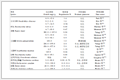
With the optimal conditions in hand (Table 1, Entry 10), the scope of this transformation was next examined and various tryptophans were subjected to the optimized conditions. As illustrated in Table 2, both ethyl and benzyl esters of tryptophan were tolerated (3b and 3c). The substrates with halide groups afforded the corresponding products 3d~3f in 33%~41% yields. The cyclization underwent smoothly with N-methyl, N-benzyl and allyl substrates to yield the desired products 3h~3j in 67%, 45% and 65% yields, respectively. However, when N, N-dimethylamine as carbon source was subjected to the present conditions, the desired product was not obtained, and a side product 4, 4′-methylenebis (N, N-dimethylaniline) through the homocoupling of N, N-dimethylamine was observed. The similar result has been reported by us in a previous work.[17a] Unfortunately, tryptophans with 6-hydroxy, 6-cyano, N-acetyl or N-benzoyl groups failed to give the corresponding products under the present conditions.
下载:
导出CSV
 | ||
 |
 |
 |
| a Reaction conditions: 1 (0.25 mmol), 2 (0.50 mmol), under air; isolated yields. | ||
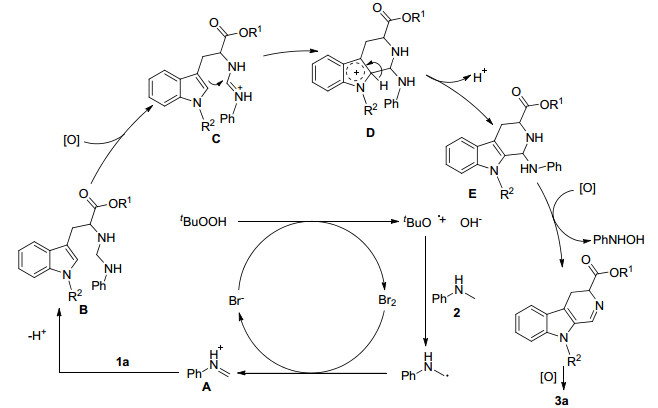
To explore the reaction mechanism, the radical inhibition experiments were carried out. We found that the present reaction was completely suppressed by use of 2, 2, 6, 6-tetramethyl-1-piperidinyloxy (TEMPO) or butylated hydroxytoluene (BHT). Based on our previous report[17a] and this result, a plausible reaction pathway is shown in Scheme 2. First, the reaction of Br- with TBHP produces tBuO· via a SET pathway. Then tBuO· abstract H atom from methyl group of N-methylaniline 2 that further yields imine ion A by oxidation. Second, the addition reaction of A with 1a takes place to yield intermediate B, followed by the oxidation producing intermediate C. Third, intermediate C undergoes an intramolecular cyclization to provide D that further gives intermediate E by deprotonation. Finally, Cope elimination of E and the followed oxidation afford the final product 3a. At this stage, the precise role of additives is unknown. We speculate that the cationic bromonium complex Ph3PBr+ may be formed in the transformation.[19] It acts as a Lewis acid to promote cyclization just as Lewis acid catalyzed Pictet-Spengler reaction.[7] As for the additives IA and PTCDA, they might promote the deamination of E, like dehydrating agents in Bischler-Napieralski cyclization.[8]
In summary, an efficient method for the synthesis of aromatic β-carbolines from readily available starting materials under mild conditions was developed. This protocol is the useful complementary to the known methods for the synthesis of aromatic β-carbolines.
1H NMR and 13C NMR spectra were recorded on a Bruker AVANCE AV400 (400 MHz for 1H NMR and 101 MHz for 13C NMR). All NMR chemical shifts were referenced to residual solvent peaks or to Si(CH3)4 as an internal standard. NMR spectra recorded in CDCl3 were referenced to residual CHCl3 at δ 7.26 for 1H NMR or 77.0 for 13C NMR. NMR spectra recorded in DMSO-d6 were referenced to residual DMSO at δ 2.49 and 3.33 for 1H NMR or 39.6 for 13C NMR. HRMS were measured using a Q-TOF LC-MS and a ESI-FTICR technique. Reactions were monitored by thin-layer chromatography (TLC) on 0.25 mm silica gel glass plates coated with 60 F254. Column chromatography was performed on silica gel (200~300 mesh) using a mixture of dichloromethane and ethyl acetate as eluant. Commercially available reagents 1a~1c were used as received without further purification. Raw materials 1d~1j were prepared by the known methods[20] and analytical data matched literature values.[21]
Methyl 2-amino-3-(1H-indol-3-yl)propanoate hydrochloride (1a, 0.25 mmol, 63.7 mg, 1.0 equiv.) was added to a mixture of TBAB (0.25 mmol, 81.4 mg, 1.0 equiv.), PPh3 (0.25 mmol, 65.5 mg, 1.0 equiv.), isatoic anhydride (0.25 mmol, 42 mg, 1.0 equiv.) and N-methylaniline (0.5 mmol, 55 μL, 2.0 equiv.) under air, and then tert-butyl hydroperoxide (0.875 mmol, 120 μL, 3.5 equiv.) and 1, 4-dioxane (2 mL) were added. After the mixture was stirred at 70 ℃ for 20 h, the residue was mixed with silica gel and concentrated. The resulting mixture was purified by silica gel column chromatography on silica gel with dichloro-methane/ethyl acetate (V:V=3:1) as eluent to give the desired product 3a.
Methyl 9H-pyrido[3, 4-b]indole-3-carboxylate (3a):[22] White solid (48.1 mg, 85%). m.p. 242~244 ℃; 1H NMR (400 MHz, DMSO-d6) δ: 12.10 (s, 1H), 8.99 (s, 1H), 8.94 (s, 1H), 8.42 (d, J=7.7 Hz, 1H), 7.68 (d, J=8.1 Hz, 1H), 7.61 (t, J=7.4 Hz, 1H), 7.32 (t, J=7.2 Hz, 1H), 3.92 (s, 3H); 13C NMR (101 MHz, DMSO) δ: 166.5, 141.4, 137.9, 136.9, 134.2, 129.2, 127.9, 122.7, 121.3, 120.7, 118.1, 112.9, 52.4; HRMS (ESI) calcd for C13H11N2O2 [M+H]+ 227.0815, found 227.0811.
Ethyl 9H-pyrido[3, 4-b]indole-3-carboxylate (3b):[23] White solid (49.9 mg, 83%). m.p. 225~227 ℃; 1H NMR (400 MHz, DMSO-d6) δ: 12.07 (s, 1H), 8.98 (s, 1H), 8.93 (s, 1H), 8.42 (d, J=8.0 Hz, 1H), 7.68 (d, J=8.4 Hz, 1H), 7.61 (t, J=7.8 Hz, 1H), 7.33 (t, J=7.6 Hz, 1H), 4.38 (tt, J=7.1, 4.5 Hz, 2H), 1.38 (td, J=7.2, 2.3 Hz, 3H); 13C NMR (101 MHz, DMSO-d6) δ: 166.0, 141.4, 137.9, 137.2, 134.1, 129.1, 127.9, 122.7, 121.3, 120.7, 118.0, 112.8, 61.0, 14.8. HRMS (ESI) calcd for C14H13N2O2 [M+H]+ 241.0972, found 241.0968.
Benzyl 9H-pyrido[3, 4-b]indole-3-carboxylate (3c): White solid (44.6 mg, 59%). m.p. 233~234 ℃; 1H NMR (400 MHz, DMSO-d6) δ: 12.11 (s, 1H), 8.98 (d, J=4.5 Hz, 2H), 8.43 (d, J=7.8 Hz, 1H), 7.71~7.66 (m, 1H), 7.63 (d, J=7.0 Hz, 1H), 7.54 (d, J=7.2 Hz, 2H), 7.43 (d, J=7.5 Hz, 2H), 7.41~7.37 (m, 1H), 7.32 (d, J=7.6 Hz, 1H), 5.43 (s, 2H); HRMS (ESI) calcd for C19H15N2O2 [M+H]+ 303.1128, found 303.1132.
Methyl 6-chloro-9H-pyrido[3, 4-b]indole-3-carboxylate (3d):[24] White solid (26.7 mg, 41%). m.p. 275~277 ℃; 1H NMR (400 MHz, DMSO-d6) δ: 12.20 (s, 1H), 8.99 (s, 1H), 8.94 (s, 1H), 8.43 (d, J=8.4 Hz, 1H), 7.73 (s, 1H), 7.33 (d, J=8.4 Hz, 1H), 3.95~3.89 (m, 3H); 13C NMR (101 MHz, DMSO) δ: 165.8, 141.4, 137.6, 136.8, 133.9, 132.9, 126.9, 123.7, 120.5, 119.7, 117.6, 112.0, 51.9; HRMS (ESI) calcd for C13H10ClN2O2 [M+H]+ 261.0425, found 261.0429.
Methyl 7-chloro-9H-pyrido[3, 4-b]indole-3-carboxylate (3e): White solid (26.1 mg, 40%). m.p. 288~289 ℃; 1H NMR (400 MHz, DMSO-d6) δ: 12.18 (s, 1H), 8.99 (s, 1H), 8.94 (s, 1H), 8.44 (d, J=8.4 Hz, 1H), 7.73 (s, 1H), 7.34 (d, J=8.4 Hz, 1H), 3.92 (s, 3H); 13C NMR (101 MHz, DMSO) δ: 166.4, 142.0, 138.2, 137.5, 134.5, 133.5, 127.5, 124.3, 121.0, 120.3, 118.2, 112.6, 52.5; HRMS (ESI) calcd for C13H10ClN2O2 [M+H]+ 261.0425, found 261.0426.
Methyl 6-bromo-9H-pyrido[3, 4-b]indole-3-carboxylate (3f):[25] White solid (25.2 mg, 33%). m.p. 278~280 ℃; 1H NMR (400 MHz, DMSO-d6) δ: 12.25 (s, 1H), 9.00 (s, 2H), 8.71 (d, J=2.0 Hz, 1H), 7.73 (dd, J=8.6, 2.0 Hz, 1H), 7.65 (d, J=8.8 Hz, 1H), 3.92 (s, 3H); 13C NMR (101 MHz, DMSO) δ: 166.4, 140.1, 138.1, 137.2, 134.6, 131.7, 127.0, 125.4, 123.2, 118.7, 114.9, 112.8, 52.5; HRMS (ESI) calcd for C13H10BrN2O2 [M+H]+ 304.9920, 306.9905, 305.9959, 307.9939, found 304.9918, 306.9902, 305.9953, 307.9937.
Methyl 6-methyl-9H-pyrido[3, 4-b]indole-3-carboxylate (3g): White solid (37.2 mg, 62%). m.p. 283~284 ℃; 1H NMR (400 MHz, DMSO-d6) δ: 11.97 (s, 1H), 8.94 (s, 1H), 8.88 (s, 1H), 8.19 (s, 1H), 7.57 (d, J=8.2 Hz, 1H), 7.44 (d, J=8.4 Hz, 1H), 2.50 (s, 3H); 13C NMR (101 MHz, DMSO) δ: 166.5, 139.7, 138.1, 136.7, 134.1, 130.6, 129.6, 127.6, 122.2, 121.5, 118.0, 112.6, 52.4, 21.5; HRMS (ESI) calcd for C14H13N2O2 [M+H]+ 241.0972, found 241.0975.
Methyl 9-methyl-9H-pyrido[3, 4-b]indole-3-carboxylate (3h):[26] White solid (40.2 mg, 67%). m.p. 215~216 ℃; 1H NMR (400 MHz, DMSO-d6) δ: 9.12 (s, 1H), 8.93 (s, 1H), 8.44 (d, J=7.9 Hz, 1H), 7.77 (d, J=8.3 Hz, 1H), 7.69 (t, J=7.7 Hz, 1H), 7.37 (t, J=7.5 Hz, 1H), 4.05 (s, 3H), 3.93 (s, 3H); 13C NMR (101 MHz, DMSO) δ: 166.4, 142.3, 138.3, 137.0, 132.9, 129.3, 127.5, 122.8, 121.0, 120.9, 117.8, 111.0, 52.5, 30.1; HRMS (ESI) calcd for C14H13N2O2 [M+H]+ 241.0972, found 241.0975.
Methyl 9-benzyl-9H-pyrido[3, 4-b]indole-3-carboxylate (3i):[26] White solid (32.4 mg, 41%). m.p. 187~188 ℃; 1H NMR (400 MHz, DMSO-d6) δ: 9.20 (s, 1H), 8.98 (s, 1H), 8.48 (d, J=7.9 Hz, 1H), 7.82 (d, J=8.4 Hz, 1H), 7.66 (t, J=7.7 Hz, 1H), 7.37 (t, J=7.5 Hz, 1H), 7.27 (dt, J=23.3, 7.5 Hz, 5H), 5.87 (s, 2H), 3.92 (s, 3H); 13C NMR (101 MHz, DMSO) δ: 166.4, 141.8, 138.0, 137.5, 133.2, 129.5, 129.2, 128.1, 128.0, 127.3, 123.0, 121.3, 121.2, 118.0, 111.4, 52.5, 46.6; HRMS (ESI) calcd for C20H17N2O2 [M+H]+ 317.1285, found 317.1290.
Methyl 9-allyl-9H-pyrido[3, 4-b]indole-3-carboxylate (3j): White solid (43.3 mg, 65%). m.p. 209~211 ℃; 1H NMR (400 MHz, DMSO-d6) δ: 9.11 (s, 1H), 8.97 (s, 1H), 8.47 (d, J=7.9 Hz, 1H), 7.77 (d, J=8.3 Hz, 1H), 7.67 (t, J=7.7 Hz, 1H), 7.37 (t, J=7.5 Hz, 1H), 6.06 (ddt, J=15.8, 10.2, 5.1 Hz, 1H), 5.25 (d, J=5.1 Hz, 2H), 5.16 (d, J=10.3 Hz, 1H), 5.01 (d, J=17.1 Hz, 1H), 3.93 (s, 3H); HRMS (ESI) calcd for C16H15N2O2 [M+H]+ 267.1128, found 267.1133.
SupportingInformation 1H NMR,13C NMR and HRMS spectra of compounds 3a~3j. The Supporting Information is available free of charge via the Internet at http://sioc-journal.cn.
(a) Cao, R. H.; Peng, W. L.; Wang, Z. H.; Xu, A. L. Curr. Med. Chem. 2007, 14, 479.
(b) Lancianesi, S.; Palmieri, A.; Petrini, M. Chem. Rev. 2014, 114, 7108.
(c) Nagle, A. S.; Khare, S.; Kumar, A. B.; Supek, F.; Buchynskyy, A.; Mathison, C. J. N.; Chennamaneni, N. K.; Pendem, N.; Buckner, F. S.; Gelb, M. H.; Molteni, V. Chem. Rev. 2014, 114, 11305.
(d) Gema, D.; Javier, P. C. Eur. J. Org. Chem. 2011, 2011, 7243.
(e) Zhang, G.-J.; Hu, F.; Jiang, H.; Dai, L.-M.; Liao, H.-B.; Li, N.; Wang, H.-S.; Pan, Y.-M.; Liang, D. Phytochemistry 2018, 145, 68.
(f) Venkataramana, R. P. O.; Hridhay, M.; Nikhil, K.; Khan, S.; Jha, P. N.; Shah, K.; Kumar, D. Bioorg. Med. Chem. Lett. 2018, 28, 1278.
(g) Devi, N.; Kumar, S.; Pandey, S. K.; Singh, V. Asian J. Org. Chem. 2018, 7, 6.
(a) Shilabin, A. G.; Kasanah, N.; Tekwani, B. L.; Hamann, M. T. J. Nat. Prod. 2008, 71, 1218.
(b) Winkler, J. D.; Londregan, A. T.; Hamann, M. T. Org. Lett. 2006, 8, 2591.
(a) Boursereau, Y.; Coldham, I. Bioorg. Med. Chem. Lett. 2004, 14, 5841.
(b) Guan, H.; Chen, H.; Peng, W.; Ma, Y.; Cao, R.; Liu, X.; Xu, A. Eur. J. Med. Chem. 2006, 41, 1167.
(c) Rashid, M. A.; Gustafson, K. R.; Boyd, M. R. J. Nat. Prod. 2001, 64, 1454.
(d) Prinsep, M. R.; Blunt, J. W.; Munro, M. H. G. J. Nat. Prod. 1991, 54, 1068.
(e) Yang, J.-M.; Zhu, Y.-H.; Chen, S.; Lu, X.; Wu, Y.-M.; Ma, F.-E.; Li, L.-P.; Yang, Y.; Shi, Z.-H.; Huang, K.-Y.; Hong, X.; Jiang, P.; Peng, Y. MedChemComm 2018, 9, 100.
(f) Dighe, S. U.; Khan, S.; Soni, I.; Jain, P.; Shukla, S.; Yadav, R.; Sen, P.; Meeran, S. M.; Batra, S. J. Med. Chem. 2015, 58, 3485.
(g) Kamal, A.; Srinivasulu, V.; Nayak, V. L.; Sathish, M.; Shankaraiah, N.; Bagul, C.; Reddy, N. V. S.; Rangaraj, N.; Nagesh, N. ChemMedChem 2014, 9, 2084.
(a) Tang, J.; Wang, Y.; Wang, R.; Dong, Z.; Yang, L.; Zheng, Y.; Liu, J. Chem. Biodiversity 2008, 5, 447.
(b) Wang, Y.-H.; Tang, J.-G.; Wang, R.-R.; Yang, L.-M.; Dong, Z.-J.; Du, L.; Shen, X.; Liu, J.-K.; Zheng, Y.-T. Biochem. Biophys. Res. Commun. 2007, 355, 1091.
(c) Yu, X.; Lin, W.; Li, J.; Yang, M. Bioorg. Med. Chem. Lett. 2004, 14, 3127.
(a) Hagen, T. J.; Skolnick, P.; Cook, J. M. J. Med. Chem. 1987, 30, 750.
(b) Müller, W. E.; Fehske, K. J.; Borbe, H. O.; Wollert, U.; Nanz, C.; Rommelspacher, H. Pharmacol., Biochem. Behav. 1981, 14, 693.
(a) Im, Y.; Lee, J. Y. Chem. Commun. 2013, 49, 5948.
(b) Paul, B. K.; Ghosh, N.; Mukherjee, S. RSC Adv. 2016, 6, 9984.
(c) Swami, S.; Behera, D.; Agarwala, A.; Verma, V. P.; Shrivastava, R. New J. Chem. 2018, Ahead of Print.
(a) Whaley, W. M.; Govindachari, T. R. In Organic Reactions, John Wiley & Sons, Inc., 2004.
(b) Cox, E. D.; Cook, J. M. Chem. Rev. 1995, 95, 1797.
(c) Rao, R. N.; Maiti, B.; Chanda, K. ACS Comb. Sci. 2017, 19, 199.
(d) Gobe, V.; Gandon, V.; Guinchard, X. Adv. Synth. Catal. 2018, 360, 1280.
(e) Glenn, C. C.; Jan, B. Eur. J. Org. Chem. 2004, 2004, 1286.
Bischler, A.; Napieralski, B. Ber. Dtsch. Chem. Ges. 1893, 26, 1903. doi: 10.1002/cber.189302602143
(a) Singh, D.; Sharma, P.; Kumar, R.; Pandey, S. K.; Malakar, C. C.; Singh, V. Asian J. Org. Chem. 2018, 7, 383.
(b) Singh, D.; Hazra, C. K.; Malakar, C. C.; Pandey, S. K.; Kaith, B. S.; Singh, V. ChemistrySelect 2018, 3, 4859.
(c) Kovvuri, J.; Nagaraju, B.; Nayak, V. L.; Akunuri, R.; Rao, M. P. N.; Ajitha, A.; Nagesh, N.; Kamal, A. Eur. J. Med. Chem. 2018, 143, 1563.
(d) Singh, D.; Kumar, V.; Devi, N.; Malakar, C. C.; Shankar, R.; Singh, V. Adv. Synth. Catal. 2017, 359, 1213.
(e) Manasa, K. L.; Tangella, Y.; Ramu, G.; Babu, B. N. ChemistrySelect 2017, 2, 9162.
(f) Galvis, C. E. P.; Kouznetsov, V. V. Synthesis 2017, 49, 4535.
(g) Hati, S.; Sen, S. Tetrahedron Lett. 2016, 57, 1040.
(h) Meesala, R.; Arshad, A. S. M.; Mordi, M. N.; Mansor, S. M. Tetrahedron 2016, 72, 8537.
(i) Kamal, A.; Tangella, Y.; Manasa, K. L.; Sathish, M.; Srinivasulu, V.; Chetna, J.; Alarifi, A. Org. Biomol. Chem. 2015, 13, 8652.
(j) Kamal, A.; Sathish, M.; Prasanthi, A. V. G.; Chetna, J.; Tangella, Y.; Srinivasulu, V.; Shankaraiah, N.; Alarifi, A. RSC Adv. 2015, 5, 90121.
(k) Kamal, A.; Narasimha Rao, M. P.; Swapna, P.; Srinivasulu, V.; Bagul, C.; Shaik, A. B.; Mullagiri, K.; Kovvuri, J.; Reddy, V. S.; Vidyasagar, K.; Nagesh, N. Org. Biomol. Chem. 2014, 12, 2370.
(a) Ding, S.; Shi, Z.; Jiao, N. Org. Lett. 2010, 12, 1540.
(b) Tang, S.; Wang, J.; Xiong, Z.; Xie, Z.; Li, D.; Huang, J.; Zhu, Q. Org. Lett. 2017, 19, 5577.
(c) Mulcahy, S. P.; Varelas, J. G. Tetrahedron Lett. 2013, 54, 6599.
(d) Dhara, S.; Singha, R.; Ahmed, A.; Mandal, H.; Ghosh, M.; Nuree, Y.; Ray, J. K. RSC Adv. 2014, 4, 45163.
(e) Yan, Q.; Gin, E.; Banwell, M. G.; Willis, A. C.; Carr, P. D. J. Org. Chem. 2017, 82, 4328.
(f) Dhiman, S.; Mishra, U. K.; Ramasastry, S. S. V. Angew. Chem., Int. Ed. 2016, 55, 7737.
(g) Pan, X.; Bannister, T. D. Org. Lett. 2014, 16, 6124.
(h) Wang, T.-T.; Zhang, D.; Liao, W.-W. Chem. Commun. 2018, 54, 2048.
Dalvi, B. A.; Lokhande, P. D. Tetrahedron Lett. 2018, 59, 2145. doi: 10.1016/j.tetlet.2018.01.061
Nissen, F.; Richard, V.; Alayrac, C.; Witulski, B. Chem. Commun. 2011, 47, 6656. doi: 10.1039/c1cc11298h
(a) Varelas, J. G.; Khanal, S.; O'Donnell, M. A.; Mulcahy, S. P. Org. Lett. 2015, 17, 5512.
(b) Webb, N. J.; Marsden, S. P.; Raw, S. A. Org. Lett. 2014, 16, 4718.
(a) Verniest, G.; England, D.; De Kimpe, N.; Padwa, A. Tetrahedron 2010, 66, 1496.
(b) Subba Reddy, B. V.; Rajashekhar Reddy, M.; Yarlagadda, S.; Ravikumar Reddy, C.; Ravi Kumar, G.; Yadav, J. S.; Sridhar, B. J. Org. Chem. 2015, 80, 8807.
Too, P. C.; Chua, S. H.; Wong, S. H.; Chiba, S. J. Org. Chem. 2011, 76, 6159. doi: 10.1021/jo200897q
Zhu, Y.; Liu, M.; Cai, Q.; Jia, F.; Wu, A. Chem.-Eur. J. 2013, 19, 10132. doi: 10.1002/chem.201301734
(a) Li, L. T.; Huang, J.; Li, H. Y.; Wen, L. J.; Wang, P.; Wang, B. Chem. Commun. 2012, 48, 5187.
(b) Li, L. T.; Li, H. Y.; Xing, L. J.; Wen, L. J.; Wang, P.; Wang, B. Org. Biomol. Chem. 2012, 10, 9519.
Wang, B.; Wong, H. N. C. Bull. Chem. Soc. Jpn. 2018, 91, 710. doi: 10.1246/bcsj.20170393
Guo, F.; Wang, L.; Mao, S.; Zhang, C.; Yu, J.; Han, J. Tetrahedron 2012, 68, 8367. doi: 10.1016/j.tet.2012.06.107
(a) Benson, S. C.; Lee, L.; Yang, L.; Snyder, J. K. Tetrahedron 2000, 56, 1165.
(b) Chiotellis, A.; Muller, A.; Mu, L.; Keller, C.; Schibli, R.; Krä mer, S. D.; Ametamey, S. M. Mol. Pharmaceutics 2014, 11, 3839.
(a) Garcia, J. M.; Curzon, S. S.; Watts, K. R.; Konopelski, J. P. Org. Lett. 2012, 14, 2054.
(b) Dua, R. K.; Phillips, R. S. Tetrahedron Lett. 1992, 33, 29.
(c) Tang, J.-G.; Wang, Y.-H.; Wang, R.-R.; Dong, Z.-J.; Yang, L.-M.; Zheng, Y.-T.; Liu, J.-K. Chem. Biodiversity 2008, 5, 447.
(d) De Croos, P. Z.; Sangdee, P.; Stockwell, B. L.; Kar, L.; Thompson, E. B.; Johnson, M. E.; Currie, B. L. J. Med. Chem. 1990, 33, 3138.
Xu, W.; Zhao, M.; Wang, Y.; Zhu, H.; Wang, Y.; Zhao, S.; Wu, J.; Peng, S. MedChemComm 2016, 7, 1730. doi: 10.1039/C6MD00215C
Sun, R.; Liu, R.; Zhou, C.; Ren, Z.; Guo, L.; Ma, Q.; Fan, W.; Qiu, L.; Yu, H.; Shao, G.; Cao, R. MedChemComm 2015, 6, 2170. doi: 10.1039/C5MD00312A
Ikeda, R.; Kimura, T.; Tsutsumi, T.; Tamura, S.; Sakai, N.; Konakahara, T. Bioorg. Med. Chem. Lett. 2012, 22, 3506. doi: 10.1016/j.bmcl.2012.03.077
Primas, N.; El-Kashef, H.; Lancelot, J.-C.; Lesnard, A.; Dodd, R. H.; Raulta, S. ARKIVOC 2010, 2010, 14.
Cao, R.; Chen, Q.; Hou, X.; Chen, H.; Guan, H.; Ma, Y.; Peng, W.; Xu, A. Bioorg. Med. Chem. 2004, 12, 4613. doi: 10.1016/j.bmc.2004.06.038
Table 1. Optimization of the reaction conditionsa
| ||||||
| Entry | Halide | Oxidant | Additive | Solvent | Yield/% | |
| 1 | nBu4NI | TBPB | PivOH | DMSO | Trace | |
| 2 | I2 | TBPB | PivOH | DMSO | Trace | |
| 3 | KI | TBPB | PivOH | DMSO | Trace | |
| 4 | nBu4NBr | TBPB | — | 1, 4-Dioxane | 37 | |
| 5 | nBu4NBr | TBHP | — | 1, 4-Dioxane | 42 | |
| 6 | nBu4NBr | H2O2 | — | 1, 4-Dioxane | 0 | |
| 7 | nBu4NBr | TBHP | Ph3P | 1, 4-Dioxane | 52 | |
| 8 | nBu4NBr | TBHP | IA | 1, 4-Dioxane | 63 | |
| 9 | nBu4NBr | TBHP | PTCDA | 1, 4-Dioxane | 61 | |
| 10b | nBu4NBr | TBHP | Ph3P/IA | 1, 4-Dioxane | 85 | |
| 11b | nBu4NBr | TBHP | Ph3P/PTCDA | 1, 4-Dioxane | 79 | |
| a Reaction conditions: 1a (0.25 mmol), 2 (0.50 mmol), halide (1.0 equiv.), oxidant (3.5 equiv.), additive (1.0 equiv.), solvent (2.0 mL) under air; isolated yields. b Ph3P (1.0 equiv.), IA (isatoic anhydride, 1.0 equiv.), PTCDA (perylenetetracarboxylic dianhydride, 1.0 equiv.), TBPB (tert-butyl peroxybenzoate), TBHP (tert-butyl hydroperoxide). | ||||||
 下载: 导出CSV
Table 2. Scope of the substratesa
| ||
|
|
|
| a Reaction conditions: 1 (0.25 mmol), 2 (0.50 mmol), under air; isolated yields. | ||
下载: 导出CSV

 扫一扫看文章


扫一扫关注我们