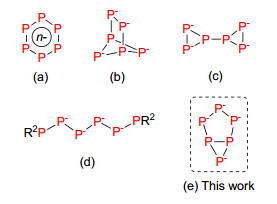
Scheme 1.
Representative examples of P6 ligands

Isolation and Characterization of a Trinuclear Rare-Earth Metal Complex Containing a Bicyclo[3.1.0]-P64- Ligand
Shanshan Du , Zhengqi Chai , Jingyuan Hu , Wen-Xiong Zhang , Zhenfeng Xi


Metal mediated functionalization of white phosphorus to phosphorus-based chemicals has been a hot area in recent years.[1~5] One major interest in this field is searching for different types of polyphosphorus ligands, which is of fundamental theoretical significance despite that sometimes the yield is low. Among various polyphosphorus ligands, the search of different types of P6 ligands derived from P4 has been exploring. Since Scherer et al reported the first triple-decker sandwich molybdenum complex bearing a cyclo-P6 ligand,[6] the P6 ligands of structural diversity have received continuous attention in both experimental characterization and theoretical calculations.[7, 8] In 1980s, Scherer et al. characterized a series of transition metal cyclo-P6 complexes in which the cyclo-P6 ligands could be viewed as cyclo-P66-, cyclo-P64-, cyclo-P62- and cyclo-P6, respectively (Scheme 1a).[9~11] Then, a binuclear thulium complex bearing a bicyclic P66- ligand via thulium-mediated P4 reductive functionalization was obtained (Scheme 1b).[12] Later, a binuclear niobium complex bearing cP3-cP3; ligand was documented (Scheme 1c).[13] Besides P6 ligands derived from P4, a 3d/4f complex having cP3-cP3 ligand[14] (Scheme 1c) and these complexes bearing linear P66- or P64- ligands[15, 16] (Scheme 1d) could also be obtained by other methods. Although four types of P6 ligands have been reported, the new type of bicyclo[3.1.0]-P64- ligand is unexplored (Scheme 1e).
Rare-earth metals mediated functionalization of P4 is rare due to the mismatch of the soft-hard properties between phosphorus and rare-earth metals.[17] Recently, we have reported the reaction of Ph, TMS-substituted lutetacyclopentadienes with P4 which affords the corresponding lutetium cyclo-P3 complexes and phospholyl lithium.[18, 19] Then, to investigate the substituent effect of lutetacyclopentadienes, the reaction of Me, TMS-substituted lutetacyclopentadienes with P4 was carried out. In this reaction, a trinuclear rare-earth metal complex [{(η5-C5Me5)LuCl}3(THF)P6][Li(THF)4] was isolated which contains the bicyclo[3.1.0]-P6 ligand mentioned above. It also represents the first P6 complex directly derived from P4 involved rare-earth metals.
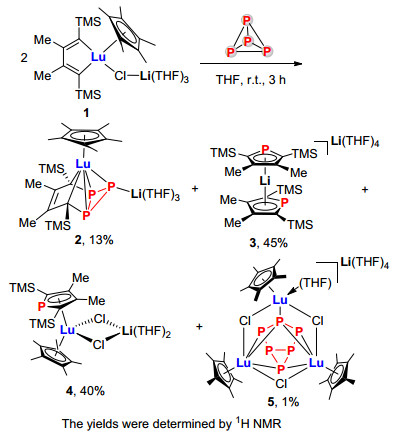
Reaction of two equivalents of Me, TMS-substituted lutetacyclopentadiene (1) with P4 was carried out in THF at room temperature (Scheme 2). After 3 h, the expected cyclo-P3 lutetium complex (2) and the aggregated phospholyl lithium (3) were obtained.[19b, 9c] Besides, the sandwich lutetium complex (4) was isolated as a new complex. Interestingly, an unexpected trinuclear rare-earth metal complex [{(η5-C5Me5)LuCl}3(THF)P6][Li(THF)4] (5) having a bicyclo[3.1.0]-P64- ligand was also observed in this reaction.
The structure of 4 was determined by X-ray diffraction analysis which reveals that 4 crystallizes in the P21/c space group. There are two independent molecules of 4 in a unit cell which have the similar structural features so that Figure 1 shows one of them. The lutetium is supported by a Cp* ligand, a phospholyl ligand and two chlorine atoms. The lithium bridges the two chlorine atoms and also coordinates to two THF molecules. Both the bond lengths and the bond angles are located in the normal range compared to the known examples.[20] In this reaction, 4 was formed directly from P4 while the previous methods always need an additional step to prepare the phospholyl lithium, sodium or potassium first.[21]
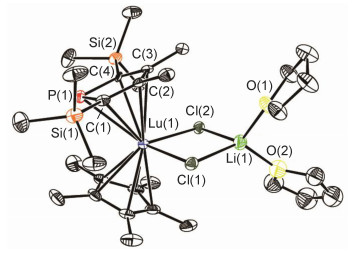
Ellipsoids are set at 30% probability level. Hydrogen atoms are omitted for clarity. Selected bond lengths [Å] and angles [°]: Lu(1)—P(1) 2.8651 (18), Lu(1)—C(1) 2.704(6), Lu(1)—C(2) 2.734(6), Lu(1)—C(3) 2.728(6), Lu(1)—C(4) 2.695(6), P(1)—C(1) 1.771(7), P(1)—C(4) 1.742(6), C(1)—C(2) 1.418(9), C(2)—C(3) 1.412(9), C(3)—C(4) 1.423(9); C(1)—P(1)—C(4) 91.5(3), P(1)—C(1)—C(2) 111.0(5), C(1)—C(2)—C(3) 112.5(6), C(2)—C(3)—C(4) 113.2(6), P(1)—C(4)—C(3) 111.3(5).
The structure of 5 was determined by X-ray diffraction analysis (Figure 2). The analysis reveals that 5 crystallizes in the P-1 space group. 5 is a separated ion pair consisting of a negative charged [P6Lu3] moiety and a lithium counter cation. The [P6Lu3] moiety has a pseudo mirror plane along the P(1)—P(4)—Lu(3) plane. Each lutetium is supported by a Cp* ligand and every two lutetiums have a bridging chlorine atom. Lu(1) and Lu(2) coordinate to the P6 ligand in a η3 mode while Lu(3) coordinates in a η1 mode. All of the Lu—P bond lengths are in the normal range of those found in the known lutetium phosphine or phosphide compounds (2.785~2.977 and 2.782~2.947 Å, respectively).[22] The lutetium-phosphide bond lengths [Lu(1)—P(3), 2.729(3) Å; Lu(2)—P(5), 2.721(3) Å] are significantly shorter than the lutetium-phosphine bond lengths [Lu(1)—P(1), 2.828(3) Å; Lu(1)—P(4), 2.883(4) Å; Lu(2)—P(1), 2.822(3) Å; Lu(2)—P(4), 2.879(3) Å]. The bicyclo[3.1.0]-P6 ligand takes a boat-like conformation composing of an envelope shaped five-membered ring and a three-membered ring. The P(2)—P(3)—P(5)—P(6) plane has an acute dihedral angle with the P(1)— P(2)—P(6) plane as 106.488°, while it has an obtuse dihedral angle with the P(3)—P(4)—P(5) plane as 132.771°. All the P—P bond lengths are in the typical range of P—P single bond length.[1] The P—P bonds of the three-membered ring [P(1)—P(2), 2.236(5) Å; P(1)—P(6), 2.236(5) Å] are slightly longer than those of the five-membered ring [P(2)—P(3), 2.188(4) Å; P(3)—P(4), 2.182(4) Å; P(4)—P(5), 2.179(4) Å; P(5)—P(6), 2.179(4) Å], since the three-membered ring has a larger ring strain. In addition, upon Lu(1) and Lu(2) capping the puckered bicyclo-[3.1.0]-P6 moiety, a [P6Lu2] cage is formed which could be viewed as an analogue of the known Zintl-P7 cage[23] by replacement of one edge P atom by two Lu atoms.
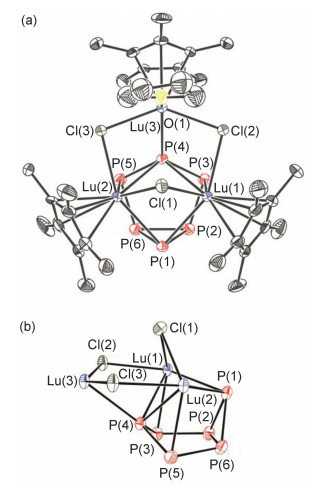
Ellipsoids are set at 30% probability level. Hydrogen atoms, lithium counter cation and its coordinating THF molecules are omitted for clarity. Cp* ligands and THF are also omitted in the structure of the [P6Lu3Cl3] core. Selected bond lengths [Å] and angles [°]: Lu(1)—P(1) 2.828(3), Lu(1)—P(3) 2.729(3), Lu(1)—P(4) 2.883(4), Lu(2)—P(1) 2.822(3), Lu(2)—P(4), 2.753(4), Lu(2)—P(5) 2.721(3), Lu(3)—P(4) 2.753(4), P(1)—P(2) 2.236(5), P(1)—P(6) 2.236(5), P(2)—P(3) 2.188(4), P(2)—P(6) 2.205(5), P(3)—P(4) 2.182(4), P(4)—P(5) 2.179(4), P(5)—P(6) 2.179(4); P(2)—P(1)—P(6) 59.10(15), P(1)—P(2)—P(3) 112.44(17), P(1)—P(2)—P(6) 60.46(15), P(3)—P(2)—P(6) 107.58(17), P(2)—P(3)—P(4) 97.79(16), P(3)—P(4)—P(5) 107.82(18), P(4)—P(5)—P(6) 97.96(17), P(1)—P(6)—P(2) 60.45(15), P(1)—P(6)—P(5) 112.80(18), P(2)—P(6)—P(5) 107.59(18)
To the best of our knowledge, it is the first time that the bicyclo[3.1.0]-P6 ligand is incorporated into metal complexes, despite the fact that two neutral polyphosphane compounds with this P6 motif linked with four tBu or Cp* substituents have been reported.[24, 25] Complex 5 is also the first example that rare-earth metal fragments activate P4 affording a P6 ligand.
The 31P{1H} NMR spectrum of 5 shows four sets of peaks corresponding to the four types of phosphorus atoms. The P(1) atom shows a triplet of triplet locating at δ -188.18 with 1JPP and 2JPP values at about 198 and 48 Hz, respectively. The P(2)/P(6) atoms show a triplet of doublet locating at δ 9.63 with 1JPP and 1JPP values at about 208 and 90 Hz, respectively. The P(3)/P(5) atoms show a multiplet locating between δ -76.43 and -74.46. The P(4) atom shows a pseudo triplet locating at δ -31.91 with 1JPP value at about 372 Hz.
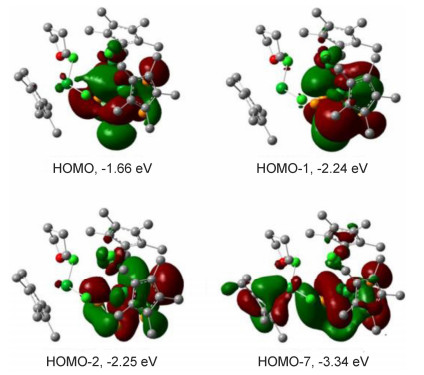
To better understand the bonding between the three lutetium metals and the bicyclo[3.1.0]-P6 ligand as well as the charge distribution of the negative charged P6 ligand, density functional theory (DFT) calculations were performed to check canonical molecular orbitals (CMOs, Figure 3). HOMO shows that the lone electron pair of P(4) has an interaction with the d orbitals of both Lu(1) and Lu(2) simultaneously, which could be viewed as a P(4) centered three-center two-electron bond. Analogously, HOMO-2 show another three-center two-electron bond among P(1), Lu(1) and Lu(2) centered at P(1). HOMO-1 shows the interaction between P(3)/P(5) and Lu(1)/Lu(2), while HOMO-7 shows the interaction between P(4) and Lu(3). According to the NBO analysis, all of the P—P bonds are formed by overlap of their corresponding p orbitals, and all of the Lu—P bonds are formed by overlap of the p orbitals of the phosphorus atoms and the d orbitals of the lutetium metals.
In summary, we have isolated a trinuclear rare-earth metal complex 5 containing a bicyclo[3.1.0]-P6 ligand, which is an unreported type and represents the first example that rare-earth metal fragments activate P4 affording a P6 ligand. The bonding situations of this novel complex 5 were discussed based on X-ray diffraction analysis and DFT calculations.
All operations were performed under an atmosphere of dry nitrogen in a Vigor (SG 1200/750TS-F) glovebox. Anhydrous THF, hexane and toluene were purified using an Mbraun SPS-800 Solvent Purification System and dried over fresh Na chips in the glovebox. THF-d8 was purchased from Cambridge Isotope Laboratory (CIL), degassed, and vacuum transferred to 4 Å molecular sieves. Organometallic samples for NMR spectroscopic measurements were prepared in the glovebox using J. Young valve NMR tubes (Wilmad 528-JY). NMR spectra were recorded on a Bruker Avance 400 MHz and a Bruker Avance 500 MHz spectrometers. 1H NMR chemical shifts were reported with reference to solvent resonances of THF-d8 at δ 3.58. 31P{1H} NMR chemical shifts were reported with respect to 85% H3PO4 (aq.) (δ 0.0) standard. 1 was prepared according to the literature procedure.[26] Other reagents were commercially available and used without further purification. Caution! P4 is light-sensitive and highly flammable upon exposure to air. It should be handled with care.[3c]
P4 (123.9 mg, 1.0 mmol) was added to a THF solution (20 mL) of 1 (1298.4 mg, 2.0 mmol) in one portion. The reaction mixture was stirred at room temperature for 3 h and 1 was consumed completely monitored by 1H NMR. After removal of the solvent under reduced pressure, the reddish yellow solid was extracted by 6 mL of hexane. The extract was concentrated to 4 mL at room temperature by volatilization and then stored at -25 ℃ for three days affording 3 as colorless crystals along with few yellowish red crystals referred to 5. After crystallization, the remaining supernatant liquid of the extract mainly contains 2 monitored by 31P{1H} NMR. The residue was dissolved in 5 mL of THF. Then hexane (about 20 mL) was added till the first precipitation appears and the solution was stored at -25 ℃ affording the crystals of 4 along with that of 3.
The in situ 1H NMR and 31P NMR showed no signal of 5 due to its low yield. 5 crystalized as several red crystals from the large proportion of yellowish colorless crystals 3. By isolating the red crystals one by one under microscope, about 3 mg of 5 was obtained although impurities still remain concomitant. The 31P NMR experiment was conducted at room temperature for about 1 h (scan number 1600). The 31P{1H} COSY NMR experiment was conducted at room temperature for about 1 d.
The NMR yields of 2~4 (13%, 45% and 40%, respectively) could be determined by 1H NMR with hexamethylbenzene as internal standard. 5 couldn't be detected by the in situ 1H NMR or 31P NMR because the yield of 5 is very low as about 1% (ca. 3 mg 5 was isolated).
(η5-C5Me5)Lu{Me2(SiMe3)2Li(THF)3C4P3}] (2): 1H NMR (400 MHz, THF-d8) δ: 0.34 (s, 18H, SiMe3), 1.76~1.79 (m, 12H, β-CH2, THF), 1.93 (s, 15H, C5Me5), 2.22 (s, 6H, Me), 3.60~3.63 (m, 12H, α-CH2, THF); 31P NMR (162 MHz, THF-d8) δ: -85.15 (t, 1P,1JPP=211.9 Hz, PLi), -199.46 (t, 2P,1JPP=211.9 Hz, PC).
{η5-C4PMe2(SiMe3)2}(η5-C5Me5)Lu{Cl2Li(THF)2} (4): 1H NMR (400 MHz, THF-d8) δ: 0.25 (s, 18H, SiMe3), 1.76~1.79 (m, 8H, β-CH2, THF), 1.99 (s, 15H, C5Me5), 2.19 (s, 6H, Me), 3.60~3.63 (m, 8H, α-CH2, THF); 31P NMR (162 MHz, THF-d8) δ: 159.49 (s).
[{(η5-C5Me5)LuCl}3(THF)P6][Li(THF)4] (5): 1H NMR (500 MHz, THF-d8) δ: 1.76~1.79 (m, 16H, β-CH2, THF), 1.90 (s, 45H, C5Me5), 3.61~3.63 (m, 16H, α-CH2, THF); 31P NMR (202 MHz, THF-d8) δ: 9.63 (td,1JPP=ca. 208 Hz,1JPP=ca. 90 Hz, 2P, LuPPPPLi), -31.91 (t,1JPP=ca. 372 Hz, 1P, LuPPPPLi), -74.46~76.43 (m, 2P, LuPPPPLi), -188.18 (tt,1JPP=ca. 198 Hz,2JPP=ca. 48 Hz, 1P, LuPPPPLi).
Single crystals of 4 and 5 suitable for X-ray analysis were grown as shown in experimental section. The crystals were wrapped in mineral oil and then were frozen at 180 or 100 K. Data collections were performed at 180 or 100 K on a SuperNova diffractometer using graphite-monoch-romated Mo Kα radiation (λ=0.71073 Å). Using Olex2,[27] the structure were solved with the ShelXS or Superflip structure solution program using Charge Flipping[28] and refined with the ShelXL refinement package using Least Squares minimization. Refinement was performed on F2 anisotropically for all of the non-hydrogen atoms by the full-matrix least-squares method. The hydrogen atoms were placed at the calculated positions and were included in the structure calculation without further refinement of their parameters. Crystallographic data (excluding structure factors) have been deposited with the Cambridge Crystallographic Data Centre with supplementary publication numbers: CCDC 1869142 (4), 1869143 (5). These data can be obtained free of charge from the Cambridge Crystallographic Data Centre via www.ccdc.cam.ac.uk/data_request/cif.
SupportingInformation X-ray data of 4 and 5, Computational details of 5, and NMR spectra of new products. The Supporting Information is available free of charge via the Internet at http://sioc-journal.cn/.
(a) Cossairt, B. M.; Piro, N. A.; Cummins, C. C. Chem. Rev. 2010, 110, 4164.
(b) Caporali, M.; Gonsalvi, L.; Rossin, A.; Peruzzini, M. Chem. Rev. 2010, 110, 4178.
(c) Scheer, M.; Balázs, G.; Seitz, A. Chem. Rev. 2010, 110, 4236.
(d) Khan, S.; Sen, S. S.; Roesky, H. W. Chem. Commun. 2012, 48, 2169.
(a) Martin, C. D.; Weinstein, C. M.; Moore, C. E.; Rheingold, A. L.; Bertrand, G. Chem. Commun. 2013, 49, 4486.
(b) Borger, J. E.; Ehlers, A. W.; Lutz, M.; Slootweg, J. C.; Lammertsma, K. Angew. Chem., Int. Ed. 2014, 53, 12836.
(c) Arrowsmith, M.; Hill, M. S.; Johnson, A. L.; Kociok-Köhn, G.; Mahon, M. F. Angew. Chem., Int. Ed. 2015, 54, 7882.
(a) Piro, N. A.; Figueroa, J. S.; McKellar, J. T.; Cummins, C. C. Science 2006, 313, 1276.
(b) Camp, C.; Maron, L.; Bergman, R. G.; Arnold, J. J. Am. Chem. Soc. 2014, 136, 17652.
(c) Pinter, B.; Smith, K. T.; Kamitani, M.; Zolnhofer, E. M.; Tran, B. L.; Fortier, S.; Pink, M.; Wu, G.; Manor, B. C.; Meyer, K.; Baik, M.-H.; Mindiola, D. J. J. Am. Chem. Soc. 2015, 137, 15247.
(a) Zarzycki, B.; Bickelhaupt, F. M.; Radius, U. Dalton Trans. 2013, 42, 7468.
(b) Yao, S.; Lindenmaier, N.; Xiong, Y.; Inoue, S.; Szilvási, T.; Adelhardt, M.; Sutter, J.; Meyer, K.; Driess, M. Angew. Chem., Int. Ed. 2015, 54, 1250.
(c) Spitzer, F.; Graß l, C.; Balázs, G.; Zolnhofer, E. M.; Meyer, K.; Scheer, M. Angew. Chem., Int. Ed. 2016, 55, 4340.
(d) Pelties, S.; Maier, T.; Herrmann, D.; de Bruin, B.; Rebreyend, C.; Gärtner, S.; Shenderovich, I. G.; Wolf, R. Chem. Eur. J. 2017, 23, 6094.
Mathey, F. Angew. Chem., Int. Ed. 2003, 42, 1578. doi: 10.1002/anie.200200557
Scherer, O. J.; Sitzmann, H.; Wolmershäuser, G. Angew. Chem., Int. Ed. Engl. 1985, 24, 351. doi: 10.1002/anie.198503511
Fleischmann, M.; Heindl, C.; Seidl, M.; Balázs, G.; Virovets, A. V.; Peresypkina, E. V.; Tsunoda, M.; Gabbaï, F. P.; Scheer, M. Angew. Chem., Int. Ed. 2012, 51, 9918. doi: 10.1002/anie.201204686
(a) Warren, D. S.; Gimarc, B. M. J. Am. Chem. Soc. 1992, 114, 5378.
(b) Hiberty, P. C.; Volatron, F. Heteroat. Chem. 2007, 18, 129.
Scherer, O. J.; Swarowsky, H.; Wolmershäuser, G.; Kaim, W.; Kohlmann, S. Angew. Chem., Int. Ed. Engl. 1987, 26, 1153. doi: 10.1002/anie.198711531
Scherer, O. J.; Schwalb, J.; Swarowsky, H.; Wolmershäuser, G.; Kaim, W.; Gross, R. Chem. Ber. 1988, 121, 443. doi: 10.1002/cber.19881210309
Scherer, O. J.; Vondung, J.; Wolmershäuser, G. Angew. Chem., Int. Ed. Engl. 1989, 28, 1355. doi: 10.1002/anie.198913551
Scherer, O. J.; Werner, B.; Heckmann, G.; Wolmershäuser, G. Angew. Chem., Int. Ed. Engl. 1991, 30, 553. doi: 10.1002/anie.199105531
Hulley, E. B.; Wolczanski, P. T.; Lobkovsky, E. B. Chem. Commun. 2009, 6412.
Arleth, N.; Gamer, M. T.; Köppe, R.; Pushkarevsky, N. A.; Konchenko, S. A.; Fleischmann, M.; Bodensteiner, M.; Scheer, M.; Roesky, P. W. Chem. Sci. 2015, 6, 7179. doi: 10.1039/C5SC02252E
Vaira, M. D.; Stoppioni, P. Polyhedron 1994, 13, 3045. doi: 10.1016/S0277-5387(00)83669-4
Wiśniewska, A.; Łapczuk-Krygier, A.; Baranowska, K.; Chojnacki, J.; Matern, E.; Pikies, J.; Grubba, R. Polyhedron 2013, 55, 45. doi: 10.1016/j.poly.2013.02.046
(a) Konchenko, S. N.; Pushkarevsky, N. A.; Gamer, M. T.; Köppe, R.; Schnöckel, H.; Roesky, P. W. J. Am. Chem. Soc. 2009, 131, 5740.
(b) Huang, W.; Diaconescu, P. L. Chem. Commun. 2012, 48, 2216.
(c) Huang, W.; Diaconescu, P. L. Eur. J. Inorg. Chem. 2013, 4090.
(d) Selikhov, A. N.; Mahrova, T. V.; Cherkasov, A. V.; Fukin, G. K.; Kirillov, E.; Lamsfus, C. A.; Maron, L.; Trifonov, A. A. Organometallics 2016, 35, 2401.
(e) Schoo, C.; Bestgen, S.; Köppe, R.; Konchenko, S. N.; Roesky, P. W. Chem. Commun. 2018, 54, 4770.
Ma, W.; Yu, C.; Chen, T.; Xu, L.; Zhang, W.-X.; Xi, Z. Chem. Soc. Rev. 2017, 46, 1160. doi: 10.1039/C6CS00525J
(a) Xu, L.; Chi, Y.; Du, S.; Zhang, W.-X.; Xi, Z. Angew. Chem., Int. Ed. 2016, 55, 9187.
(b) Du, S.; Yin, J.; Chi, Y.; Xu, L.; Zhang, W.-X. Angew. Chem., Int. Ed. 2017, 56, 15886.
(c) Du, S.; Zhang, W.-X.; Xi, Z. Organometallics 2018, 37, 2018.
(d) Du, S.; Hu, J.; Chai, Z.; Zhang, W.-X.; Xi, Z. Chin. J. Chem. 2019, 37, 71.
(a) Nief, F.; Mathey, F. J. Chem. Soc., Chem. Commun. 1989, 800.
(b) Fontaine, F.-G.; Tupper, K. A.; Tilley, T. D. J. Organomet. Chem. 2006, 691, 4595.
(a) Jaroschik, F.; Shima, T.; Li, X.; Mori, K.; Ricard, L.; Le Goff, X.-F.; Nief, F.; Hou, Z. Organometallics 2007, 26, 5654.
(b) Xu, Y.; Wang, Z.; Gan, Z.; Xi, Q.; Duan, Z.; Mathey, F. Org. Lett. 2015, 17, 1732.
(a) Zhang, L.; Suzuki, T.; Luo, Y.; Nishiura, M.; Hou, Z. Angew. Chem., Int. Ed. 2007, 46, 1909.
(b) Masuda, J. D.; Jantunen, K. C.; Ozerov, O. V.; Noonan, K. J. T.; Gates, D. P.; Scott, B. L.; Kiplinger, J. L. J. Am. Chem. Soc. 2008, 130, 2408.
(a) Turbervill, R. S. P.; Goicoechea, J. M. Chem. Rev. 2014, 114, 10807; (b) Hennersdorf, F.; Frötschel, J.; Weigand, J. J. J. Am. Chem. Soc. 2017, 139, 14592.
Baudler, M.; Aktalay, Y.; Tebbe, K. F.; Heinlein, T. Angew. Chem., Int. Ed. Engl. 1981, 20, 967. doi: 10.1007/978-3-322-85352-3_1
Jutzi, P.; Kroos, R.; Möller, A.; Bögger, H.; Penk, M. Chem. Ber. 1991, 124, 75. doi: 10.1002/cber.19911240112
(a) Xu, L.; Wang, Y.-C.; Wei, J.; Wang, Y.; Wang, Z.; Zhang, W.-X.; Xi, Z. Chem. Eur. J. 2015, 21, 6686.
(b) Xu, L.; Wei, J.; Zhang, W.-X.; Xi, Z. Chem. Eur. J. 2015, 21, 15860.
(c) Xu, L.; Wang, Y.; Wang, Y.-C.; Wang, Z.; Zhang, W.-X.; Xi, Z. Organometallics 2016, 35, 5.
Dolomanov, O. V.; Bourhis, L. J.; Gildea, R. J.; Howard, J. A. K.; Puschmann, H. J. Appl. Cryst. 2009, 42, 339. doi: 10.1107/S0021889808042726
Palatinus, L.; Chapuis, G. J. Appl. Cryst. 2007, 40, 786. doi: 10.1107/S0021889807029238

Figure 1 ORTEP drawing of 4
Ellipsoids are set at 30% probability level. Hydrogen atoms are omitted for clarity. Selected bond lengths [Å] and angles [°]: Lu(1)—P(1) 2.8651 (18), Lu(1)—C(1) 2.704(6), Lu(1)—C(2) 2.734(6), Lu(1)—C(3) 2.728(6), Lu(1)—C(4) 2.695(6), P(1)—C(1) 1.771(7), P(1)—C(4) 1.742(6), C(1)—C(2) 1.418(9), C(2)—C(3) 1.412(9), C(3)—C(4) 1.423(9); C(1)—P(1)—C(4) 91.5(3), P(1)—C(1)—C(2) 111.0(5), C(1)—C(2)—C(3) 112.5(6), C(2)—C(3)—C(4) 113.2(6), P(1)—C(4)—C(3) 111.3(5).

Figure 2 ORTEP drawing of 5 (a) and its [P6Lu3Cl3] core (b)
Ellipsoids are set at 30% probability level. Hydrogen atoms, lithium counter cation and its coordinating THF molecules are omitted for clarity. Cp* ligands and THF are also omitted in the structure of the [P6Lu3Cl3] core. Selected bond lengths [Å] and angles [°]: Lu(1)—P(1) 2.828(3), Lu(1)—P(3) 2.729(3), Lu(1)—P(4) 2.883(4), Lu(2)—P(1) 2.822(3), Lu(2)—P(4), 2.753(4), Lu(2)—P(5) 2.721(3), Lu(3)—P(4) 2.753(4), P(1)—P(2) 2.236(5), P(1)—P(6) 2.236(5), P(2)—P(3) 2.188(4), P(2)—P(6) 2.205(5), P(3)—P(4) 2.182(4), P(4)—P(5) 2.179(4), P(5)—P(6) 2.179(4); P(2)—P(1)—P(6) 59.10(15), P(1)—P(2)—P(3) 112.44(17), P(1)—P(2)—P(6) 60.46(15), P(3)—P(2)—P(6) 107.58(17), P(2)—P(3)—P(4) 97.79(16), P(3)—P(4)—P(5) 107.82(18), P(4)—P(5)—P(6) 97.96(17), P(1)—P(6)—P(2) 60.45(15), P(1)—P(6)—P(5) 112.80(18), P(2)—P(6)—P(5) 107.59(18)

 扫一扫看文章


扫一扫关注我们
 下载:
下载:

 下载:
下载:

