Scheme 1.
Synthesis of 3


Natural gastrodine (4-(hydroxymethyl)phenyl-β-D-glu- copyranoside), one major active ingredient of Chinese herbal medicine, has been clinical as antalgic and hypnotic for a long time in China and no obvious side effects have been reported.[1, 2] 4-Formylphenyl-(2, 3, 4, 6-tetra-O-acetyl)- D-lucopyranoside as gastrodine intermediate, has exhibited a variety of biological effects, such as gantioxidative activity, [3] antiobesity, [4] antiinflammation, [5] anticonvulsant activity, [6] memory improvement[7] and acetylcholinesterase inhibitors.[8] However, such gastrodine intermediates exist many limitations, for example, long onset time, low bioavailability and poor lipophilicity, which prompted us to search for new derivatives of gastrodine intermediate through structure modifications.[9~11]
The Knoevenagel reaction of aromatic aldehydes and 1, 3-dioxane-4, 6-dione is a simple and effective strategy for C—C bond formation. 5-Arylmethylene-1, 3-diox- ane-4, 6- dione and its bis-adducts have been attracted great interest because versatile substrates were used in various types of reactions.[12] They often act as acceptors in the 1, 4-addition of organometallic reagents[13] and as dienophiles in Diels- lder and tandem Knoevenagel-Michael additions.[14, 15] They were commonly synthesized employing a variety of catalysts such as piperidine, [16] Et3N, [17] anhydrous ZnCl2, [18] and [bmim]BF4.[19] However, many of these methodologies have not been entirely satisfactory, involving harsh reaction conditions, low yields, high catalyst loading, environmentally unfavorable solvents or tedious work-up to obtain the products. Hence, the development of a simple, green and efficient procedure is highly desirable.
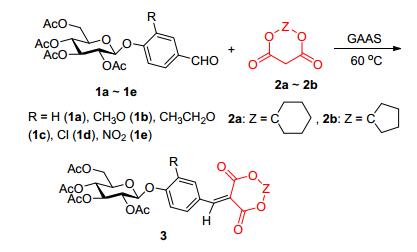
The research of a clean, safe and efficient synthetic methodology is one of the major focus areas of green chemistry. Organic reactions such as Friedel-Crafts alkylations, Michael addition, ring-opening reactions, [20] multicomponent reactions (MCR)[21, 22] and tandem Knoevena- gel-Michael addition[23] have been recently examined in percence of gluconic acid aqueous solution. In this paper, the synthesis of novel gastrodine intermediate derivatives via Knovenagel condensation of 4-formylphenyl-(2, 3, 4, 6- tetra-O-acetyl)-β-D-glucopyranoside and 1, 3-dioxane-4, 6- dione in ethanol using gluconic acid aqueous solution (GAAS) as an effective biocatalyst was described (Scheme 1).
As depicted in Table 1, the investigations were initiated with 4-formylphenyl-(2, 3, 4, 6-tetra-O-acetyl)-β-D-glucop- yranoside (1a) and 2, 2-pentylidene-1, 3-dioxane-4, 6-dione (2a) as the model system to find the optimal conditions. The neat experiment without any catalyst gave the desired product 3a only in 18% yield (Table 1, Entry 1). Our next attempts were focused on the evaluation of the efficiency of various solvents under catalyst-free conditions. Only a trace amount of product was detected in hexane or water (Table 1, Entries 2, 3). A significant improvement was obtained in ethyl acetate, CH3OH and acetonitrile, and the yield reached 76% with EtOH as the solvent (Table 1, Entries 4~7). Next, different catalysts were examined in the reaction, such as CH3COOH, tartaric acid aqueous solution (TAAS), piperidine and GAAS, and the results showed that GAAS was superior (Table 1, Entries 8~11). When the amount of GAAS was decreased to 1 mL, the product yield was only 83%. While, with larger amount of GAAS was added, no further improvement of the product yields was observed (Table 1, Entries 12, 13). The optimum reaction time and reaction temperature were also investigated, respectively (Table 1, Entries 14, 15). Among the various reaction conditions, the condition in Table 1 Entry 11 was the most promising conditions.

 下载:
导出CSV
下载:
导出CSV
| Entry | Solvent (mL) | Catalyst (mol%) | Time/h | Temperature/℃ | Yieldb/% |
| 1 | — | — | 10 | 60 | 18 |
| 2 | Hexane (10) | — | 10 | 60 | Trace |
| 3 | H2O (10) | — | 10 | 60 | Trace |
| 4 | EtOAc (10) | — | 10 | 60 | 34 |
| 5 | CH3CN (10) | — | 8 | 60 | 63 |
| 6 | CH3OH (10) | — | 8 | 60 | 71 |
| 7 | CH3CH2OH (10) | — | 8 | 60 | 76 |
| 8 | CH3CH2OH (10) | AcOH (aq. 50%) (2) | 6 | 60 | 70 |
| 9c | CH3CH2OH (10) | TAAS (aq. 10%) (2) | 6 | 60 | 78 |
| 10 | CH3CH2OH (10) | Piperidine (2) | 6 | 60 | 81 |
| 11 | CH3CH2OH (10) | GAAS (aq. 50%) (2) | 6 | 60 | 92 |
| 12 | CH3CH2OH (10) | GAAS (aq. 50%) (1) | 8 | 60 | 83 |
| 13 | CH3CH2OH (10) | GAAS (aq. 50%) (2) | 6 | 60 | 92 |
| 14 | CH3CH2OH (10) | GAAS (aq. 50%) (2) | 6 | 50 | 81 |
| 15 | CH3CH2OH (10) | GAAS (aq. 50%) (2) | 6 | 70 | 86 |
| 16 | CH3CH2OH (10) | GAAS (aq. 50%) (2) | 5 | 60 | 88 |
| 17 | CH3CH2OH (10) | GAAS (aq. 50%) (2) | 8 | 60 | 90 |
| a Reaction conditions: 4-formylphenyl-(2, 3, 4, 6-tetra-O-acetyl)-β-D-glucopyranoside (1 mmol) and 2, 2-pentylidene-1, 3-dioxane-4, 6-dione (1.2 mmol) were mixed in solvent (10 mL). b Isolated yields. c TAAS was tartaric acid aqueous solution (aq. 10%). | |||||
With the optimized conditions established, we extended the process to different 1, 3-dioxane-4, 6-dione compounds and various 4-formylphenyl-(2, 3, 4, 6-tetra-O-acetyl)-β-D- glucopyranoside derivatives. The results were summarized in Table 2. It was found that a series of aromatic aldehydes containing sugar moiety with electron donating or electron withdrawing substituent groups 1a~2e were smoothly transformed to the corresponding target compounds 3a~3j in good to excellent yields.
下载:
导出CSV
| Entry | R | Z | Time/h | Product | Yieldb/% |
| 1 | H |  |
6 | 3a | 92 |
| 2 | 2-CH3O |  |
8 | 3b | 83 |
| 3 | 2-CH3CH2O |  |
8 | 3c | 81 |
| 4 | 2-Cl |  |
6 | 3d | 80 |
| 5 | 2-NO2 |  |
4 | 3e | 78 |
| 6 | H |  |
6 | 3f | 90 |
| 7 | 2-CH3O |  |
4 | 3g | 85 |
| 8 | 2-CH3CH2O |  |
5 | 3h | 83 |
| 9 | 2-Cl |  |
7 | 3i | 81 |
| 10 | 2-NO2 |  |
4 | 3j | 80 |
| a Reaction conditions: 4-formylphenyl-(2, 3, 4, 6-tetra-O-acetyl)-β-D-glucopy- ranoside derivtives (1 mmol) and 1, 3-dioxane-4, 6-dione (1.2 mmol) were mixed in GAAS (2 mL) and EtOH (10 mL) at 60 ℃. b Isolated yields. | |||||
In order to investigate the recyclability and reusability of GAAS, the reaction mixture was filtered after completion of the reaction. The filtrate consisting GAAS and EtOH was recovered and then subjected to the next run in the model reaction. Interestingly, GAAS without lossing any appreciable catalytic activity in the fifth reused reactions, providing the corresponding product in almost unchanged yield (Table 3).
下载:
导出CSV
| Time | 1st run | 2nd run | 3rd run | 4th run | 5th run |
| Yield/% | 92 | 92 | 90 | 89 | 86 |
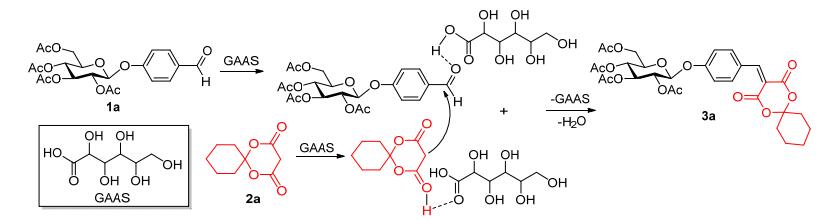
A plausible mechanism for the Knoevenagel reaction synthesis of 5-(4-(2, 3, 4, 6-tetra-O-acetyl-β-D-glucopyran- osyl))phenylmethylene-2, 2-pentylidene-1, 3-dioxane-4, 6- dione (3a) is depicted in Scheme 2. GAAS as a biocatalyst promoted the enolization of 2a by forming hydrogen bonds with CO2H and 2a, thus it increases the nucleophilic char- acter of the methylene carbon of 2a. Meanwhile, it also increases the electrophilic character of the carbonyl of 1a by forming hydrogen bonds with the carbonyl oxygen of 1a. After the condensation reaction, the product 3a is obtained.
In summary, GAAS was proved to be an effective biocatalyst for the synthesis of novel gastrodine intermediate analogues under mild conditions. Different 1, 3-dioxane- 4, 6-dione compounds and various aromatic aldehydes containing sugar moietes could be converted to the corresponding products with good to excellent yields (78%~92%). The operation and work-up procedures were very simple and no column chrommatography purification was needed. In addition, GAAS could be recycled and reused many times without lossing its effciency.
All of the reagents purchased were of analytical reagent grade and used without further purification. Melting points were detected with a XT-4 digital micro melting point apparatus (Tianjin Tianpu Instrument Factory) without correction; 1H NMR and 13C NMR spectra were recorded on a Bruker AV-400 instrument with CDCl3 as solvent.
To a 50 mL tube equiped with a stirring bar were added 4-formylphenyl-(2, 3, 4, 6-tetra-O-acetyl)-β-D-glucopyrano-side[8, 24] (1 mmol), 1, 3-dioxane-4, 6-dione (1.2 mmol), GAAS (aqu. 50%) (2.0 mL) and EtOH (10 mL). The vessel was then sealed with a screw cap under 60 ℃ for the desired time. Upon completion of the reaction, as confirmed by thin-layer chromatography [V(petroleum ether): V(EtOAc)=4:1], the reaction mixture was cooled and filtered. The filtrate consisting GAAS and EtOH was recovered and then subjected to the next run in the model reaction. The crude solid residue was washed with water and purified by recrytallization from absolute EtOH to give the pure products.
5-(4-(2, 3, 4, 6-Tetra-O-acetyl-β-D-glucopyranosyl))phen- yl-methylene-2, 2-pentylidene-1, 3-dioxane-4, 6-dione (3a): Light yellow solid, m.p. 157~159 ℃; 1H NMR (400 MHz, CDCl3) δ: 1.49~1.53 (m, 2H), 1.71~1.77 (m, 4H), 2.00~2.04 (m, 4H), 2.05 (s, 3H), 2.06 (s, 6H), 2.08 (s, 3H), 3.92 (ddd, J=7.6, 5.2, 2.4 Hz, 1H, H5), 4.18 (dd, J=12.4, 2.4 Hz, 1H, H6a), 4.30 (dd, J=12.4, 5.6 Hz, 1H, H6b), 5.18~5.23 (m, 2H), 5.31~5.33 (m, 2H), 7.05 (d, J=8.8 Hz, 2H), 8.15 (d, J=8.8 Hz, 2H), 8.34 (s, 1H); 13C NMR (100 MHz, CDCl3) δ: 20.58, 20.67, 22.19, 22.21, 24.15, 36.48, 36.52, 61.85, 68.11, 70.97, 72.37, 72.55, 97.95, 105.21, 113.38, 116.49, 116.79, 126.86, 131.80, 136.69, 156.66, 160.09, 160.71, 163.56, 169.21, 169.36, 170.16, 170.48. IR (KBr) νmax: 2968, 2949, 2941, 1752, 1724, 1611, 1592, 1508, 1439, 1229, 1176, 1080 cm-1; HRMS calcd for C30H34NaO14 [M+Na]+ 641.1846; found 641.1823.
5-(4-(2, 3, 4, 6-Tetra-O-acetyl-β-D-glucopyranosyl)-3-meo-xyl)phenylmethylene-2, 2-pentylidene-1, 3-dioxane-4, 6-di-one (3b): Light yellow solid, m.p. 141~143 ℃; 1H NMR (400 MHz, CDCl3) δ: 1.49~1.53 (m, 2H), 1.71~1.77 (m, 4H), 2.00~2.03 (m, 4H), 2.05 (s, 3H), 2.06 (s, 3H), 2.07 (s, 3H), 2.08 (s, 3H), 3.86 (ddd, J=7.6, 5.2, 2.4 Hz, 1H, H5), 3.89 (s, 3H), 4.18 (dd, J=12.4, 2.4 Hz, 1H, H6a), 4.28 (dd, J=12.4, 5.2 Hz, 1H, H6b), 5.13~5.20 (m, 2H), 5.31~5.33 (m, 2H), 7.13 (d, J=8.4 Hz, 1H), 7.55 (dd, J=8.4, 2.0 Hz, 1H), 8.18 (d, J=2.0 Hz, 1H), 8.32 (s, 1H); 13C NMR (100 MHz, CDCl3) δ: 20.61, 20.69, 22.17, 22.22, 24.14, 36.44, 36.50, 56.14, 61.86, 68.21, 70.97, 72.32, 72.38, 99.48, 105.24, 113.29, 117.04, 117.45, 127.85, 130.29, 149.96, 150.78, 157.11, 160.25, 163.69, 169.27, 169.41, 170.24, 170.56; IR (KBr) νmax: 2970, 2947, 2944, 1751, 1726, 1595, 1567, 1510, 1434, 1370, 1296, 1239, 1222, 1175, 1083, 1062, 1035 cm-1; HRMS calcd for C31H36NaO15 [M+Na]+ 671.1952; found 671.1940.
5-(4-(2, 3, 4, 6-Tetra-O-acetyl-β-D-glucopyranosyl)-3-etho-xyl)phenylmethylene-2, 2-pentylidene-1, 3-dioxane-4, 6-dio-ne (3c): Light yellow solid, m.p. 153~156 ℃; 1H NMR (400 MHz, CDCl3) δ: 1.44 (t, J=7.2 Hz, 3H), 1.49~1.53 (m, 2H), 1.71~1.77 (m, 4H), 2.00~2.03 (m, 4H), 2.04 (s, 3H), 2.05 (s, 3H), 2.06 (s, 3H), 2.08 (s, 3H), 3.87 (ddd, J=7.6, 5.2, 2.4 Hz, 1H, H5), 4.11 (q, J=7.2 Hz, 2H), 4.19 (dd, J=12.4, 2.0 Hz, 1H, H6a), 4.28 (dd, J=12.4, 5.2 Hz, 1H, H6b), 5.15~5.20 (m, 2H), 5.28~5.38 (m, 2H), 7.12 (d, J=8.4 Hz, 1H), 7.53 (dd, J=8.4, 2.0 Hz, 1H), 8.16 (d, J=2.0 Hz, 1H), 8.31(s, 1H); 13C NMR (100 MHz, CDCl3) δ: 14.64, 20.58, 20.61, 20.64, 20.67, 22.17, 22.22, 24.15, 36.44, 36.50, 61.88, 64.76, 68.27, 70.95, 72.28, 72.44, 99.31, 105.19, 113.14, 117.37, 118.26, 127.74, 130.29, 149.19, 151.01, 157.20, 160.26, 163.69, 169.08, 169.37, 170.20, 170.50; IR (KBr) νmax: 2971, 2947, 2944, 1750, 1724, 1566, 1510, 1429, 1370, 1284, 1253, 1237, 1160, 1067, 1053, 1035 cm-1; HRMS calcd for C32H38NaO15 [M+Na]+ 685.2108; found 685.2119.
5-(4-(2, 3, 4, 6-Tetra-O-acetyl-β-D-glucopyranosyl)-3-chlo- ro)phenylmethylene-2, 2-pentylidene-1, 3-dioxane-4, 6-dio- ne (3d): light yellow solid, m.p. 126~128 ℃; 1H NMR (400 MHz, CDCl3) δ: 1.49~1.54 (m, 2H), 1.72~1.77 (m, 4H), 2.00~2.04 (m, 4H), 2.05 (s, 3H), 2.06 (s, 3H), 2.09 (s, 3H), 2.10(s, 3H), 3.93 (ddd, J=7.6, 5.2, 2.4 Hz, 1H, H5), 4.22 (dd, J=12.4, 2.0 Hz, 1H, H6a), 4.30 (dd, J=12.4, 5.2 Hz, 1H, H6b), 5.14~5.23 (m, 2H), 5.30~5.42 (m, 2H), 7.20 (d, J=2.4 Hz, 1H), 8.01 (d, J=2.4, 1H), 8.23 (s, 1H), 8.26 (s, 1H); 13C NMR (100 MHz, CDCl3) δ: 20.58, 20.59, 20.62, 20.68, 22.18, 24.10, 36.56, 36.59, 61.79, 68.08, 70.56, 72.26, 72.52, 99.26, 105.49, 114.93, 116.57, 124.51, 127.79, 134.39, 135.85, 155.07, 156.24, 159.76, 163.09, 169.10, 169.33, 170.16, 170.46; IR (KBr) νmax: 2966, 2948, 2943, 1753, 1727, 1617, 1585, 1497, 1420, 1369, 1236, 1200, 1186, 1066, 1037 cm-1; HRMS calcd for C30H33Cl- NaO14 [M+Na]+ 675.1457; found 675.1441.
5-(4-(2, 3, 4, 6-Tetra-O-acetyl-β-D-glucopyranosyl)-3-nitro)-phenylmethylene-2, 2-pentylidene-1, 3-dioxane-4, 6-dione (3e): Light yellow solid, m.p. 186~188 ℃; 1H NMR (400 MHz, CDCl3) δ: 1.49~1.55 (m, 2H), 1.72~1.78 (m, 4H), 2.00~2.04 (m, 4H), 2.05 (s, 3H), 2.07(s, 3H), 2.10 (s, 3H), 2.12 (s, 3H), 3.96 (ddd, J=7.6, 5.2, 2.8 Hz, 1H, H5), 4.23 (dd, J=12.4, 2.4 Hz, 1H, H6a), 4.29 (dd, J=12.4, 5.2 Hz, 1H, H6b), 5.18~5.29 (m, 2H), 5.32~5.37 (m, 2H), 7.39 (d, J=8.8 Hz, 1H), 8.27 (d, J=8.8 Hz, 1H), 8.31 (s, 1H), 8.61 (s, 1H); 13C NMR (100 MHz, CDCl3) δ: 20.50, 20.58, 20.68, 22.17, 24.03, 36.66, 36.70, 61.72, 67.91, 70.30, 72.09, 72.68, 99.41, 105.84, 116.54, 118.25, 127.06, 130.43, 138.85, 140.67, 152.31, 153.58, 159.49, 162.54, 169.12, 169.27, 170.14, 170.41; IR (KBr) νmax: 2967, 2948, 2940, 1754, 1732, 1618, 1578, 1537, 1427, 1369, 1294, 1244, 1220, 1211, 1190, 1087, 1070, 1039 cm-1; HRMS calcd for C30H33NNaO16 [M+Na]+ 686.1697; found 686.1672.
5-(4-(2, 3, 4, 6-Tetra-O-acetyl-β-D-glucopyranosyl))phenyl-methylene-2, 2-butylidene-1, 3-dioxane-4, 6-dione (3f): Light yellow solid, m.p. 208~210 ℃; 1H NMR (400 MHz, CDCl3) δ: 1.87~1.92 (m, 4H), 2.05 (s, 3H), 2.06 (s, 6H), 2.08 (s, 3H), 2.19~2.23 (m, 4H), 3.93 (ddd, J=7.6, 5.2, 2.4 Hz, 1H, H5), 4.18 (dd, J=12.4, 2.4 Hz, 1H, H6a), 4.30 (dd, J=12.4, 5.6 Hz, 1H, H6b), 5.16~5.24 (m, 2H), 5.31~5.33 (m, 2H), 7.06 (d, J=8.8 Hz, 2H), 8.14 (d, J=8.8 Hz, 2H), 8.32 (s, 1H); 13C NMR (100 MHz, CDCl3) δ: 20.59, 20.69, 23.25, 23.29, 38.47, 38.51, 61.83, 68.08, 70.95, 72.36, 72.54, 97.90, 113.59, 113.64, 116.53, 126.74, 131.82, 136.67, 136.68, 156.82, 160.80, 160.87, 164.21, 169.22, 169.37, 170.17, 170.50; IR (KBr) νmax: 2966, 2955, 2944, 1754, 1727, 1613, 1595, 1511, 1437, 1223, 1183, 1082 cm-1; HRMScalcd for C29H32NaO14 [M+Na]+ 627.1690; found 627.1674.
5-(4-(2, 3, 4, 6-Tetra-O-acetyl-β-D-glucopyranosyl)-3-meo-xyl)phenylmethylene-2, 2-butylidene-1, 3-dioxane-4, 6-dione (3g): light yellow solid, m.p. 156~158 ℃; 1H NMR (400 MHz, CDCl3) δ: 1.87~1.92 (m, 4H), 2.05 (s, 3H), 2.06 (s, 3H), 2.07 (s, 3H), 2.08 (s, 3H), 2.18~2.25 (m, 4H), 3.86 (ddd, J=7.6, 5.2, 2.4 Hz, 1H, H5), 3.89 (s, 3H), 4.19 (dd, J=12.4, 2.4 Hz, 1H, H6a), 4.28 (dd, J=12.4, 5.2 Hz, 1H, H6b), 5.13~5.20 (m, 2H), 5.29~5.33 (m, 2H), 7.14 (d, J=8.4 Hz, 1H), 7.54 (dd, J=8.4, 2.0 Hz, 1H), 8.14 (d, J=2.0 Hz, 1H), 8.30 (s, 1H); 13C NMR (100 MHz, CDCl3) δ: 20.60, 20.69, 23.23, 23.32, 38.44, 38.52, 56.12, 56.16, 61.88, 68.20, 70.96, 72.37, 99.65, 113.55, 113.65, 116.93, 117.46, 127.75, 130.28, 150.01, 150.90, 151.10, 157.19, 160.98, 164.31, 169.23, 169.38, 170.21, 170.51; IR (KBr) νmax: 2970, 2947, 2941, 1751, 1723, 1605, 1585, 1506, 1429, 1374, 1246, 1225, 1163, 1069 cm-1; HRMS calcd for C30H34NaO15 [M+Na]+ 657.1795; found 657.1769.
5-(4-(2, 3, 4, 6-Tetra-O-acetyl-β-D-glucopyranosyl)-3-etho-xyl)Phenylmethylene-2, 2-butylidene-1, 3-dioxane-4, 6-dione (3h): light yellow solid, m.p. 141~143 ℃; 1H NMR (400 MHz, CDCl3) δ: 1.45 (t, J=6.8 Hz, 3H), 1.87~1.90 (m, 4H), 2.05 (s, 3H), 2.06 (s, 3H), 2.07 (s, 3H), 2.08 (s, 3H), 2.19~2.24 (m, 4H), 3.88 (ddd, J=7.6, 5.2, 2.4 Hz, 1H, H5), 4.11 (q, J=6.8 Hz, 2H), 4.26~4.30 (m, 2H), 5.15~5.21 (m, 2H), 5.28~5.38 (m, 2H), 7.13 (d, J=8.4 Hz, 1H), 7.53 (dd, J=8.4, 2.0 Hz, 1H), 8.12 (s, 1H), 8.29 (s, 1H); 13C NMR (100 MHz, CDCl3) δ: 14.64, 20.60, 20.62, 20.65, 20.69, 23.23, 23.33, 38.45, 38.53, 61.90, 64.79, 68.25, 70.94, 72.29, 72.42, 99.29, 113.39, 113.63, 117.37, 118.14, 127.62, 130.30, 149.23, 151.12, 157.32, 161.01, 163.34, 169.08, 169.37, 170.20, 170.51; IR (KBr) νmax: 2969, 2947, 2942, 1752, 1724, 1607, 1586, 1507, 1438, 1371, 1245, 1224, 1165, 1080 cm-1; HRMS calcd for C31H36NaO15 [M+Na]+ 671.1952; found 671.1969.
5-(4-(2, 3, 4, 6-Tetra-O-acetyl-β-D-glucopyranosyl)-3-chlo- ro)phenylmethylene-2, 2-butylidene-1, 3-dioxane-4, 6-dione (3i): White solid, m.p. 188~190 ℃; 1H NMR (400 MHz, CDCl3) δ: 1.88~1.91 (m, 4H), 2.05 (s, 3H), 2.07 (s, 3H), 2.09 (s, 3H), 2.10 (s, 3H), 2.18~2.24 (m, 4H), 3.93 (ddd, J=7.6, 5.2, 2.4 Hz, 1H, H5), 4.20~4.32 (m, 2H), 5.14~5.23 (m, 2H), 5.30~5.42 (m, 2H), 7.20 (d, J=2.4 Hz, 1H), 8.00 (d, J=4.4 Hz, 1H), 8.21 (s, 1H), 8.24 (s, 1H); 13C NMR (100 MHz, CDCl3) δ: 20.60, 20.62, 20.69, 23.26, 23.29, 38.54, 38.58, 61.79, 68.07, 70.54, 72.25, 72.53, 99.24, 113.87, 115.20, 116.61, 124.58, 127.67, 134.38, 135.81, 155.19, 156.34, 160.51, 163.73, 169.10, 169.33, 170.16, 170.48; IR (KBr) νmax: 2966, 2948, 2944, 1757, 1730, 1616, 1591, 1497, 1430, 1375, 1239, 1221, 1192, 1082 cm-1; HRMS calcd for C29H31ClNaO14 [M+Na]+ 661.1300; found 661.1312.
5-(4-(2, 3, 4, 6-Tetra-O-acetyl-β-D-glucopyranosyl)-3-ni-tro)-phenylmethylene-2, 2-butylidene-1, 3-dioxane-4, 6-dio-ne (3j): White solid, m.p. 185~187 ℃; 1H NMR (400 MHz, CDCl3) δ: 1.88~1.94 (m, 4H), 2.06 (s, 3H), 2.07 (s, 3H), 2.10 (s, 3H), 2.12 (s, 3H), 2.19~2.24 (m, 4H), 3.96 (ddd, J=7.6, 5.2, 2.8 Hz, 1H, H5), 4.24 (dd, J=12.4, 2.4 Hz, 1H, H6a), 4.29 (dd, J=12.4, 5.2 Hz, 1H, H6b), 5.19~5.29 (m, 2H), 5.32~5.37 (m, 2H), 7.39 (d, J=8.8 Hz, 1H), 8.26 (s, 1H), 8.29 (s, 1H), 8.60(s, 1H); 13C NMR (100 MHz, CDCl3) δ: 20.49, 20.56, 20.67, 23.25, 23.27, 38.61, 38.63, 61.69, 67.91, 70.29, 72.08, 72.68, 99.40, 114.16, 116.83, 118.30, 126.93, 130.41, 138.79, 140.71, 152.40, 153.68, 160.20, 163.16, 169.11, 169.27, 170.14, 170.41; IR (KBr) νmax: 3083, 2969, 2948, 2940, 1752, 1735, 1726, 1620, 1584, 1558, 1537, 1499, 1429, 1368, 1345, 1249, 1231, 1220, 1173, 1087 cm-1; HRMS calcd for C29H31N- NaO16 [M+Na]+ 672.1541; found 672.1555.
Supporting Information NMR spectra of 3a~3j is available free of charge via the Internet at http://sioc-journal.cn/.
Wang, M. W.; Hao, X.; Chen, K. Philos. Trans. R. Soc., B 2007, 362, 1093. doi: 10.1098/rstb.2007.2036
Zhou, J. Acta Chim. Sin. 1980, 38, 7.
Liu, J.; Mori, A. Neuropharmacology 1992, 31, 1287. doi: 10.1016/0028-3908(92)90058-W
Park, S.; Kim, D. S.; Kang, S. Appl. Environ. Microbiol. 1994, 60, 3903.
Ahn, E. K.; Jeon, H. J.; Lim, E. J.; Jung, H. J. J. Ethnopharmacol. 2007, 110, 476. doi: 10.1016/j.jep.2006.10.006
沙静姝, 毛洪奎, 药学通报, 1987, 22, 27.Sha, J. Z.; Mao, H. K. Chin. Pharm. Bull. 1987, 22, 27(in Chinese).
Wu, C. R.; Hsieh, M. T.; Huang, S. C.; Chang, W. H.; Chen, C. F. Planta Med. 1996, 62, 317. doi: 10.1055/s-2006-957892
Wen, H.; Lin, C. L.; Ling, Q.; Ge, H.; Ma, L.; Cao, R. H.; Wan, Y. Q.; Peng, W. L.; Wang, Z. H.; Song, H. C. Eur. J. Med. Chem. 2008, 43, 166. doi: 10.1016/j.ejmech.2007.03.018
祝钱莉, 唐强, 李颖, 尹述凡, 有机化学, 2006, 26, 1264. doi: 10.3321/j.issn:0253-2786.2006.09.014Zhu, Q. L.; Tang, Q.; Li, Y.; Yin, S. F. Chin. J. Org. Chem. 2006, 26, 1264(in Chinese). doi: 10.3321/j.issn:0253-2786.2006.09.014
胡翠, 杨鸿均, 李颖, 尹述凡, 有机化学, 2009, 29, 89.Hu, C.; Yang, H. J.; Yin, S. F. Chin. J. Org. Chem. 2009, 29, 89(in Chinese).
Zheng, L.; Yin, X. J.; Yang, C. L.; Li, Y.; Yin, S. F. Chem. J. Nat. Compd. 2011, 47, 170. doi: 10.1007/s10600-011-9873-9
Chen, B. C. Heterocyles 1991, 32, 529. doi: 10.3987/REV-90-422
(a) Bian, Y. J.; Qin, Y; Xiao, L. W.; Li, J. T. Chin. J. Org. Chem. 2006, 26, 1165(in Chinese).
(边延江, 秦英, 肖立伟, 李记太, 有机化学, 2006, 26, 1165.)
(b) Huang, W. Y.; Qian, Z. H. Acta Chim. Sinica 1987, 45, 1175(in Chinese).
(黄维垣, 钱昭辉, 化学学报, 1987, 45, 1175.)
Fillion, E.; Dumas, A. M.; Hogg, S. A. J. Org. Chem. 2006, 71, 9899. doi: 10.1021/jo0618876
林春花, 袁建军, 刘德永, 张后富, 许招会, 有机化学, 2017, 37, 1560.Lin, C. H.; Yuan, J. J.; Liu, D. Y.; Zhang, H. F.; Xu, Z. H. Chin. J. Org. Chem. 2017, 37, 1560(in Chinese).
Tahmassebi, W. D.; Wilson, L. J. A.; Kieser, J. M. Synth. Commun. 2009, 39, 2605. doi: 10.1080/00397910802663345
Pesyan, N. N.; Gharib, A.; Behroozi, M.; Shokr, A. Arabian J. Chem. 2013, 5, 1.
Rao, P. S.; Venkataratnam, R. V. Indian J. Chem. B. 1993, 32B, 484.
Tahmassebi, D.; Wilson, L. J. A.; Kieser, J. M. Synth. Commun. 2009, 40, 260.
Zhou, Z. H.; Yang, J.; Li, M. H.; Gu, Y. L. Green Chem. 2011, 13, 2204. doi: 10.1039/c1gc15411g
Li, B. H.; Li, P. H.; Fang, X. N.; Li, C. X.; Sun, J. L.; Mo, L. P. Tetrahedron 2013, 69, 1057. doi: 10.1016/j.tet.2012.11.076
严楠, 夏剑辉, 熊云奎, 熊斌, 林春花, 廖维林, 有机化学, 2014, 34, 2487.Yan, N.; Xia, J. H.; Xiong, Y. K.; Xiong, B.; Lin, C. H.; Liao, W. L. Chin. J. Org. Chem. 2014, 34, 2487(in Chinese).
Xu, Z. H.; Zhou, P.; Tu, Y. H.; Liu, D. Y.; Liao, W. L.; Liao, C. W. Heterocycles 2017, 94, 1115. doi: 10.3987/COM-17-13673
Lars, K.; Joachim, T. J. Carbohydr. Chem. 2003, 22, 9. doi: 10.1081/CAR-120019010
Table 1. Optimization of reaction conditionsa
| Entry | Solvent (mL) | Catalyst (mol%) | Time/h | Temperature/℃ | Yieldb/% |
| 1 | — | — | 10 | 60 | 18 |
| 2 | Hexane (10) | — | 10 | 60 | Trace |
| 3 | H2O (10) | — | 10 | 60 | Trace |
| 4 | EtOAc (10) | — | 10 | 60 | 34 |
| 5 | CH3CN (10) | — | 8 | 60 | 63 |
| 6 | CH3OH (10) | — | 8 | 60 | 71 |
| 7 | CH3CH2OH (10) | — | 8 | 60 | 76 |
| 8 | CH3CH2OH (10) | AcOH (aq. 50%) (2) | 6 | 60 | 70 |
| 9c | CH3CH2OH (10) | TAAS (aq. 10%) (2) | 6 | 60 | 78 |
| 10 | CH3CH2OH (10) | Piperidine (2) | 6 | 60 | 81 |
| 11 | CH3CH2OH (10) | GAAS (aq. 50%) (2) | 6 | 60 | 92 |
| 12 | CH3CH2OH (10) | GAAS (aq. 50%) (1) | 8 | 60 | 83 |
| 13 | CH3CH2OH (10) | GAAS (aq. 50%) (2) | 6 | 60 | 92 |
| 14 | CH3CH2OH (10) | GAAS (aq. 50%) (2) | 6 | 50 | 81 |
| 15 | CH3CH2OH (10) | GAAS (aq. 50%) (2) | 6 | 70 | 86 |
| 16 | CH3CH2OH (10) | GAAS (aq. 50%) (2) | 5 | 60 | 88 |
| 17 | CH3CH2OH (10) | GAAS (aq. 50%) (2) | 8 | 60 | 90 |
| a Reaction conditions: 4-formylphenyl-(2, 3, 4, 6-tetra-O-acetyl)-β-D-glucopyranoside (1 mmol) and 2, 2-pentylidene-1, 3-dioxane-4, 6-dione (1.2 mmol) were mixed in solvent (10 mL). b Isolated yields. c TAAS was tartaric acid aqueous solution (aq. 10%). | |||||
 下载: 导出CSV
Table 2. Synthesis of compounds 3a~3ja
| Entry | R | Z | Time/h | Product | Yieldb/% |
| 1 | H | |
6 | 3a | 92 |
| 2 | 2-CH3O | |
8 | 3b | 83 |
| 3 | 2-CH3CH2O | |
8 | 3c | 81 |
| 4 | 2-Cl | |
6 | 3d | 80 |
| 5 | 2-NO2 | |
4 | 3e | 78 |
| 6 | H | |
6 | 3f | 90 |
| 7 | 2-CH3O | |
4 | 3g | 85 |
| 8 | 2-CH3CH2O | |
5 | 3h | 83 |
| 9 | 2-Cl | |
7 | 3i | 81 |
| 10 | 2-NO2 | |
4 | 3j | 80 |
| a Reaction conditions: 4-formylphenyl-(2, 3, 4, 6-tetra-O-acetyl)-β-D-glucopy- ranoside derivtives (1 mmol) and 1, 3-dioxane-4, 6-dione (1.2 mmol) were mixed in GAAS (2 mL) and EtOH (10 mL) at 60 ℃. b Isolated yields. | |||||
下载: 导出CSV
Table 3. Recycling experiments
| Time | 1st run | 2nd run | 3rd run | 4th run | 5th run |
| Yield/% | 92 | 92 | 90 | 89 | 86 |
下载: 导出CSV

 扫一扫看文章


扫一扫关注我们