Login In
Temperature Dependent Near Infrared Spectroscopy for Understanding the Hydrogen Bonding of Amines
- Corresponding author: Shao Xueguang, xshao@nankai.edu.cn
Figures(6)
Citation:
Zhu Xuewei, Cui Xiaoyu, Cai Wensheng, Shao Xueguang. Temperature Dependent Near Infrared Spectroscopy for Understanding the Hydrogen Bonding of Amines[J]. Acta Chimica Sinica,
;2018, 76(4): 298-302.
doi:
10.6023/A18010003

Figures(6)


Wang, Y.; Murayama, K.; Myojo, Y.; Tsenkova, R.; Hayashi, N.; Ozaki, Y. J. Phys. Chem. B 1998, 102, 6655.
doi: 10.1021/jp9816115
Wu, Y. Q.; Czarnik-Matusewicz, B.; Murayama, K.; Ozaki, Y. J. Phys. Chem. B 2000, 104, 5840.
doi: 10.1021/jp000537z
Yuan, B.; Murayama, K.; Wu, Y. Q.; Tsenkova, R.; Dou, X. M.; Era, S.; Ozaki, Y. Appl. Spectrosc. 2003, 57, 1223.
doi: 10.1366/000370203769699072
Xu, Y.; Wu, P. Y. Acta Chim. Sinica 2008, 66, 1903(in Chinese).
doi: 10.3321/j.issn:0567-7351.2008.16.010
Shao, X. G.; Kang, J.; Cai, W. S. Talanta 2010, 82, 1017.
doi: 10.1016/j.talanta.2010.06.009
Kang, J.; Cai, W. S.; Shao, X. G. Talanta 2011, 85, 420.
doi: 10.1016/j.talanta.2011.03.089
Shan, R. F.; Zhao, Y.; Fan, M. L.; Liu, X. W.; Cai, W. S.; Shao, X. G. Talanta 2015, 131, 170.
doi: 10.1016/j.talanta.2014.07.081
Cui, X. Y.; Cai, W. S.; Shao, X. G. RSC Adv. 2016, 6, 105729.
doi: 10.1039/C6RA18912A
Cui, X. Y.; Liu, X. W.; Yu, X. M.; Cai, W. S.; Shao, X. G. Anal. Chim. Acta 2017, 957, 47.
doi: 10.1016/j.aca.2017.01.004
Liu, X. W.; Cui, X. Y.; Yu, X. M.; Cai, W. S.; Shao, X. G. Chin. Chem. Lett. 2017, 28, 1447.
doi: 10.1016/j.cclet.2017.03.021
Qi, L. H.; Cai, W. S.; Shao, X. G. Acta Chim. Sinica 2016, 74, 172. (in Chinese).
Wei, Y. R.; Yang, X. D.; Ma, Y. R.; Wang, S. F.; Yuan, Q. Chin. J. Chem. 2016, 34, 558.
doi: 10.1002/cjoc.v34.6
Czarnecki, M. A.; Morisawa, Y.; Futami, Y.; Ozaki, Y. Chem. Rev. 2015, 115, 9707.
doi: 10.1021/cr500013u
Segtnan, V. H.; Šašić, Š.; Isaksson, T.; Ozaki, Y. Anal. Chem. 2001, 73, 3153.
doi: 10.1021/ac010102n
Czarnik-Matusewicz, B.; Pilorz, S. Vib. Spectrosc. 2006, 40, 235.
doi: 10.1016/j.vibspec.2005.10.002
Czarnecki, M. A. J. Phys. Chem. A 2000, 104, 6356.
doi: 10.1021/jp000407q
Pauling, L.; Corry, R. B.; Branson, H. R. Proc. Natl. Acad. Sci. U. S. A. 1951, 37, 205.
doi: 10.1073/pnas.37.4.205
Watson, J. D.; Crick, F. H. Nature 1953, 171, 737.
doi: 10.1038/171737a0
Conley, R. T. Infrared Spectroscopy, Allyn and Bacon, Boston, MA, 1996, Chapter 7.
Sinsheimer, J. E.; Keuhnelian, A. M. Anal. Chem. 1974, 46, 89.
doi: 10.1021/ac60337a011
Kang, J.; Cai, W. S.; Shao, X. G. Talanta 2011, 85, 420.
doi: 10.1016/j.talanta.2011.03.089
Shao, X. G.; Leung, A. K. M.; Chau, F. T. Acc. Chem. Res. 2003, 36, 276.
doi: 10.1021/ar990163w
Shan, R. F.; Cai, W. S.; Shao, X. G. Chemon. Intell. Lab. Syst. 2014, 131, 31.
doi: 10.1016/j.chemolab.2013.12.002
Ni, Y. N.; Wang, Y.; Kokot, S. Talanta 2009, 78, 432.
doi: 10.1016/j.talanta.2008.11.035
Peng, D.; Xu, K. X.; Li, C. X. Spectrosc. Spect. Anal. 2008, 28, 825(in Chinese).
doi: 10.3964/j.issn.1000-0593.2008.04.026
Ma, C. X.; Shao, X. G. J. Chem. Inf. Comput. Sci. 2004, 44, 907.
doi: 10.1021/ci034211+
Shao, X. G.; Wang, F.; Chen, D.; Su, Q. D. Anal. Bioanal. Chem. 2004, 378, 1382.
doi: 10.1007/s00216-003-2397-9
Shao, X. G.; Ma, C. X. Chemom. Intell. Lab. Syst. 2003, 69, 157.
doi: 10.1016/j.chemolab.2003.08.001
Stordrange, L.; Christy, A. A.; Kvalheim, O. M.; Shen, H. L.; Liang, Y. Z. J. Phys Chem. A 2002, 106, 8543.
doi: 10.1021/jp013670f
Comon, P. Signal Process. 1994, 36, 287.
doi: 10.1016/0165-1684(94)90029-9
Chen, J.; Wang, X. Z. J. Chem. Inf. Comput. Sci. 2001, 41, 992.
doi: 10.1021/ci0004053
Shao, X. G.; Wang, W.; Hou, Z. Y.; Cai, W. S. Talanta 2006, 69, 676.
doi: 10.1016/j.talanta.2005.10.039
Fang, L. M.; Lin, M. Acta Chim. Sinica 2008, 66, 1791(in Chinese).
Pasadakis, N.; Kardamakis, A. A. Anal. Chim. Acta 2006, 578, 250.
doi: 10.1016/j.aca.2006.06.072
Bi, X.; Li, T. H.; Wu, L. Chem. J. Chin. Univ. 2004, 25, 1023(in Chinese).
doi: 10.3321/j.issn:0251-0790.2004.06.006
Shao, X. G.; Wang, G. Q.; Wang, S. F.; Su, Q. D. Anal. Chem. 2014, 76, 5143.
Wang, G.; Cai, W. S.; Shao, X. G. Chemom. Intell. Lab. Syst. 2006, 82, 137.
doi: 10.1016/j.chemolab.2005.05.009
Zhang, M. J.; Tong, P. J.; Wang, W. M.; Geng, J. P.; Du, Y. P. Chemom. Intell. Lab. Syst. 2011, 105, 207.
doi: 10.1016/j.chemolab.2011.01.007
Xue Wu , Yupeng Liu , Bingzhe Wang , Lingyun Li , Zhenjian Li , Qingcheng Wang , Quansheng Cheng , Guichuan Xing , Songnan Qu . Rationally assembling different surface functionalized carbon dots for enhanced near-infrared tumor photothermal therapy. Acta Physico-Chimica Sinica, 2025, 41(9): 100109-0. doi: 10.1016/j.actphy.2025.100109
Huiying Xu , Minghui Liang , Zhi Zhou , Hui Gao , Wei Yi . Application of Quantum Chemistry Computation and Visual Analysis in Teaching of Weak Interactions. University Chemistry, 2025, 40(3): 199-205. doi: 10.12461/PKU.DXHX202407011
Zidong Zhou , Xiang Fang , Zhaoxia Wang . 糖族出征,谁与争锋. University Chemistry, 2026, 41(8): 296-301. doi: 10.12461/PKU.DXHX202508028
Yang Wang , Yunpeng Fu , Xiaoji Liu , Guotao Zhang , Guobin Li , Wanqiang Liu , Jinglun Wang . Structural Analysis of Nitrile Solutions Based on Infrared Spectroscopy Probes. University Chemistry, 2025, 40(4): 367-374. doi: 10.12461/PKU.DXHX202406113
Lihua Jin , Lei Tian , Chaozhan Wang , Jiawei Liu , Quan Bai , Yan Li . Teaching Exploration and Practice of the Instrumental Analysis Experiment “Distinguishing Green Plastic Bags by Attenuated Total Reflectance Fourier Transform Infrared Spectroscopy”. University Chemistry, 2026, 41(2): 360-365. doi: 10.12461/PKU.DXHX202502089
Yinglian LI , Chengcheng ZHANG , Xinyu ZHANG , Xinyi WANG . Spin crossover in [Co(pytpy)2]2+ complexes modified by organosulfonate anions. Chinese Journal of Inorganic Chemistry, 2024, 40(6): 1162-1172. doi: 10.11862/CJIC.20240087
Yanfen PENG , Xinyue WANG , Tianbao LIU , Xiaoshuo WU , Yujing WEI . Syntheses and luminescence of four Cd(Ⅱ)/Zn(Ⅱ) complexes constructed by 1,3‐bis(4H‐1,2,4‐triazole)benzene. Chinese Journal of Inorganic Chemistry, 2025, 41(7): 1416-1426. doi: 10.11862/CJIC.20250018
Yuanyuan Lian , Qingzhe Dong , Dashuang Wang , Lin Wang , Shuangshuang Liu , Yan Jiang , Nannan Wu . NIR-triggered photothermal antibacterial melamine foam decorated by MXene/AgNWs with integrated electromagnetic interference shielding for potential bacterial infection. Acta Physico-Chimica Sinica, 2026, 42(11): 100352-0. doi: 10.1016/j.actphy.2026.100352
Zhengxuan Chang , Haoyang Jiang , Weiguang Zhao . Development of an AI-powered infrared spectroscopy recognition and teaching assistance system for halogenated n-butane preparation experiment. University Chemistry, 2026, 41(7): 430-440. doi: 10.12461/PKU.DXHX202505070
Dong Xiang , Kunzhen Li , Kanghua Miao , Ran Long , Yujie Xiong , Xiongwu Kang . Amine-Functionalized Copper Catalysts: Hydrogen Bonding Mediated Electrochemical CO2 Reduction to C2 Products and Superior Rechargeable Zn-CO2 Battery Performance. Acta Physico-Chimica Sinica, 2024, 40(8): 2308027-0. doi: 10.3866/PKU.WHXB202308027
Yuan Zhuang , Wenhui Li , Jie Li . Curriculum Reform of “Chemical Composition Analysis of Materials” under Background of First-Class Discipline Construction. University Chemistry, 2025, 40(5): 283-290. doi: 10.12461/PKU.DXHX202407070
YanYuan Jia , Rong Rong , Jie Liu , Jing Guo , GuoYu Jiang , Shuo Guo . Unity is Strength, and Independence Shines: A Science Popularization Experiment on AIE and ACQ Effects. University Chemistry, 2024, 39(9): 349-358. doi: 10.12461/PKU.DXHX202402035
Gang Ma , Siyu Jin , Bo Zheng , Lingyan Gao . Bound Water: Intelligent Regulation from Biological Hydrogen-Bond Networks to Artificial Materials. University Chemistry, 2026, 41(4): 275-279. doi: 10.12461/PKU.DXHX202504088
Yuanyuan Ping , Wangqing Kong . 光催化碳氢键官能团化合成1-苯基-1,2-乙二醇. University Chemistry, 2025, 40(6): 238-247. doi: 10.12461/PKU.DXHX202408092
Yaling Chen . Basic Theory and Competitive Exam Analysis of Dynamic Isotope Effect. University Chemistry, 2024, 39(8): 403-410. doi: 10.3866/PKU.DXHX202311093
Xingyuan Lu , Yutao Yao , Junjing Gu , Peifeng Su . Energy Decomposition Analysis and Its Application in the Many-Body Effect of Water Clusters. University Chemistry, 2025, 40(3): 100-107. doi: 10.12461/PKU.DXHX202405074
Junyang FENG , Xiaoli HAN , Yongjie SONG , Gang LI . Proton conduction and fluorescence properties of an ionic hydrogen-bonded organic framework constructed from dibromophthalic acid. Chinese Journal of Inorganic Chemistry, 2026, 42(4): 693-702. doi: 10.11862/CJIC.20250350
Ke Liu , Qi Gao , Haifeng Li , Lipeng Diao , Xuegang Chen , Daohao Li , Guanglei Wu . Hydrogen-bonding intermolecular interaction between graphene oxide and polytetrafluoroethylene enhanced creep resistance. Acta Physico-Chimica Sinica, 2026, 42(8): 100315-0. doi: 10.1016/j.actphy.2026.100315
Ying Zhu , Dongliang Tian , Ting Wang , Mingjie Liu . Integrating fundamentals, frontiers, and applications in basic chemistry education: a case study on hydrogen bond structures for cultivating top science and engineering talent. University Chemistry, 2026, 41(6): 35-39. doi: 10.12461/PKU.DXHX202509074
Jiahui CHEN , Tingting ZHENG , Xiuyun ZHANG , Wei LÜ . Research progress of near-infrared absorption inorganic nanomaterials in photothermal and photodynamic therapy of tumors. Chinese Journal of Inorganic Chemistry, 2024, 40(12): 2396-2414. doi: 10.11862/CJIC.20240106
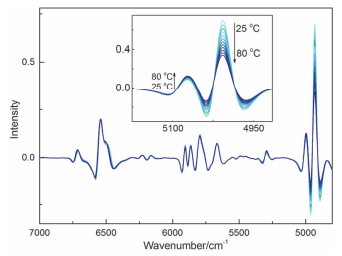
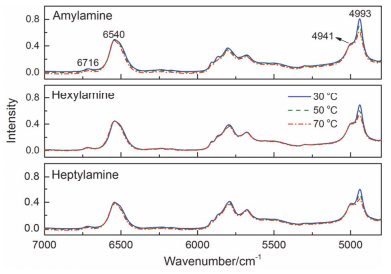
The inset highlights the spectral variations in the region of 5100~4840 cm-1
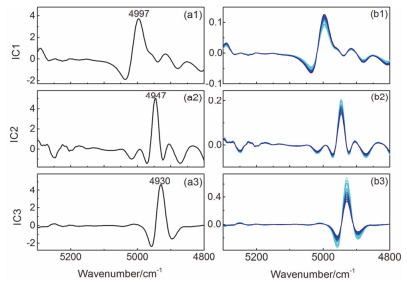
(a) independent components; (b) reconstructed spectra
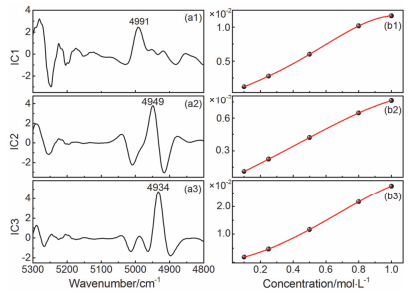
(a) independent components; (b) relationship of the peak intensity and concentration for the reconstructed spectra
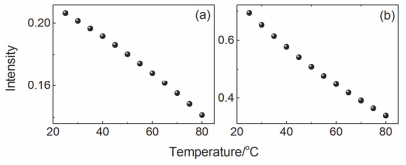
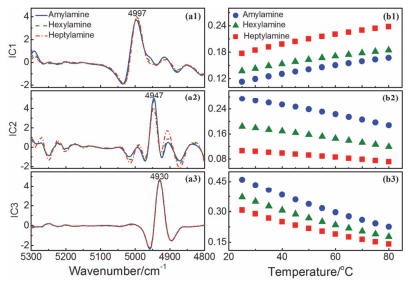
(a) independent components; (b) relationship of the peak intensity and temperature for the reconstructed spectra
 DownLoad: