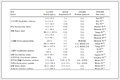
Table 1.
Crystallographic Data for Complexes 1~3

Syntheses, Crystal Structures and Different Magnetic Behaviors of Three Cyanide-bridged FeII-MII (M = Fe, Co and Mn) Complexes
Ying-Ying HUANG , Qing-Dou XU , Sheng-Min HU , Xin-Tao WU , Tian-Lu SHENG


In the past decades, cyanide-bridged compounds have attracted the attention of many researchers because of their interesting magnetic coupling between paramagnetic metal centers[1, 2] and metal-to-metal charge transfer properties[3-5]. So far, a large number of cyanide-bridged compounds with novel structures and fascinating magnetic properties such as single-chain magnets (SCM)[6-10], single-molecule magnets (SMM)[11-16] and spin crossover (SCO)[17-22] have been reported. Among them, SCO complexes can switch between low spin (LS) and high spin (HS) states under the stimulation of external conditions such as light[17], pressure[23] and temperature[21] which are usually accompanied by the change of material physical properties like magnetic, optics and dielectric properties. Therefore, spin crossover complex is one of the most attractive advanced switchable materials with the potential to be used as molecular switches, data storage and data displays[24, 25]. Although this area has been studied for a long time, most of them focused on the effect of ligand field on metal ion spin state. There are few studies on the spin-crossover behavior of different metal ions in the same ligand filed.
In view of many SCO behaviors which are more common on octahedral transition metal complexes of d4-d7 electronic configuration coordinated by six nitrogen-based ligands[26, 27], we decide to use 2, 6-bis-((2-pyridyl)methoxymethane)pyridine (PY5OMe2) ligand and cyanide-bridge as N-donor ligands to synthesize octahedral coordination compounds and investigate their spin transition behaviors. Herein, we report three dinuclear cyanide-bridged compounds which have been synthesized and characterized by IR spectroscopy, single-crystal X-ray diffraction analysis and magnetic properties analysis. For better comparison, three adjacent transition metal ions Mn(II), Fe(II) and Co(II) are used as the central metal ions to coordinate with 2, 6-bis-((2-pyridyl)methoxymethane)pyridine (PY5OMe2) ligand to form the [MII(PY5OMe2)]2+ (M = Fe, Co and Mn) fragment and further combine with mononuclear complex [FeII(PY5OMe2)CN]+ through cyanide-bridge. The obtained three dinuclear complexes [FeII(PY5OMe2)CNMII(PY5OMe2)](OTf)3 (M = Fe 1, Co 2 and Mn 3) possess similar structures but obviously different magnetic behaviors.
Unless otherwise description, the experiments are under argon atmosphere and operated with the standard Schlenk techniques. Except that tetrahydrofuran is an ultra-dry solvent (water ≤ 30 ppm), other chemical solvents are purchased at reagent grade without further purification. [MII(PY5OMe2)](OTf)2 (M = Fe, Co and Mn) were synthesized through the published papers[28, 29]. Infrared (IR) spectra in the range of 4000~400 cm-1 were performed on a VERTEX 70 spectrophotometer with KBr pellet. The elemental analyses (C, H and N) were recorded on a Vario MICRO elemental analyzer. Variable-temperature magnetic susceptibility and field dependence of the magnetization measurements were conducted on a Quantum Design Magnetic Property Measurement System MPMS-XL magnetometer. Pascal's constants were used to correct the diamagnetism of complexes 1~3[30]. And the thermal analyses were performed on a STA449C comprehensive thermal analyzer from 300 to 850 K at a heating rate of 20 K·min-1 under nitrogen flow.
Since complexes 1~3 were prepared in a similar way, only the preparation of complex 1 is described in detail here.
KCN (1.95 g, 30 mmol) and [FeII(PY5OMe2)](OTf)2 (2.49 g, 3 mmol) were added in methanol (30 mL). The mixture was refluxed at 80 ℃ for about 0.5 hours. Then the solvent was removed in a vacuum and the remaining solids were extracted with CH2Cl2. The dark red product was obtained by removing CH2Cl2 solvent under reduced pressure and recrystallized in methanol. Yield: 1.71 g, 81%. Anal. Calcd. (%) for C31H25F3FeN6O5S∙CH3OH: C, 52.04; H, 3.96; N, 11.38. Found (%): C, 52.02; H, 3.98; N, 11.33.
[FeII(PY5OMe2)CN](OTf) (0.0706 g, 1 mmol) and [FeII(PY5OMe2)](OTf)2 (0.0829 g, 1 mmol) were added in methanol (15 mL). The reaction mixture was refluxed with stirring at 80 ℃ for about 6 hours, after which the mixture solution was concentrated under reduced pressure, and then the product is precipitated by the addition of diethyl ether. The obtained product was redissolved in acetonitrile (8 mL), obtaining brown red crystals by slow diffusion of diethyl ether into the acetonitrile solution. Yield: 0.115 g, 75%. Anal. Calcd. (%) for C62H50F9Fe2N11O13S3∙2H2O: C, 47.37; H, 3.46; N, 9.80. Found (%): C, 47.27; H, 3.41; N, 9.78.
The synthesis procedure was the same as complex 1 with [FeII(PY5OMe2)CN](OTf) (0.0706 g, 1 mmol) and CoII(PY5OMe2)[OTf]2 (0.0832 g, 1 mmol) in 15 mL methanol. The orange red crystals were obtained. Yield: 0.121 g, 78%. Anal. Calcd. (%) for C62H50CoF9FeN11O13S3∙2H2O: C, 47.28; H, 3.46; N, 9.78. Found (%): C, 47.37; H, 3.38; N, 9.87.
The synthesis procedure was the same as complex 1: [FeII(PY5OMe2)CN](OTf) (0.0706 g, 1 mmol) and MnII(PY5OMe2)[OTf]2 (0.0828 g, 1 mmol) in 15 mL methanol. The dark red crystals were obtained. Yield: 0.109 g, 71%. Anal. Calcd. (%) for C62H50F9FeMnN11O13S3: C, 48.51; H, 3.28; N, 10.04. Found (%): C, 48.58; H, 3.77; N, 9.47.
The crystallographic data of complex 2 were collected using an ω-scan model technique on a Saturn724+ CCD diffractometer with graphite-monochromatic MoKα (λ = 0.71073 Å). Complexes 1 and 3 were on a MetalJet D2+ diffractometer with graphite-monochromatic GaKα (λ = 1.3405 Å). These structures were solved by direct methods using Fourier difference techniques with the SHELXL-2018/3 program package[31] and refined by full-matrix least-squares method on F2 with anisotropic thermal parameters for the non-hydrogen atoms. All the hydrogen atoms were calculated and generated in the ideal positions.
Complexes 1~3 were synthesized by solution method and their crystals were obtained by slow diffusion of diethyl ether into the acetonitrile solution. Single-crystal X-ray diffraction analyses show that in the cation of compounds 1~3 the two cation fragments [Fe(PY5OMe2)]2+ and [M(PY5OMe2)]2+ (M = Fe, Co or Mn) with similar coordination structures are linked via a single cyanide bridge. Compounds 1, 2 and 3 crystallize in the monoclinic space group P21/c, P21/c and triclinic space group P
 DownLoad:
CSV
DownLoad:
CSV
| 1 | 2 | 3 | |
| Chemical formula | C62H50F9Fe2N11O13S3∙2H2O∙3CH3CN | C62H50CoF9FeN11O13S3∙2H2O∙3CH3CN | C62H50F9FeMnN11O13S3 |
| Formula weight | 1695.20 | 1698.28 | 1535.10 |
| T (K) | 100(2) | 100(2) | 200(2) |
| Color and habit | Red prism | Red prism | Red prism |
| Crystal size (mm) | 0.31 × 0.21 × 0.18 | 0.51 × 0.28 × 0.19 | 0.35 × 0.15 × 0.12 |
| Crystal system | Monoclinic | Monoclinic | Triclinic |
| Space group | P21/c | P21/c | P |
| a (Å) | 12.41240(10) | 12.3934(3) | 12.9145(4) |
| b (Å) | 35.1871(3) | 35.4776(6) | 12.9482(3) |
| c (Å) | 16.25860(10) | 16.3918(3) | 20.6481(4) |
| α (°) | 90 | 90 | 89.6328(16) |
| β (°) | 97.0630(10) | 96.895(2) | 84.5167(19) |
| γ (°) | 90 | 90 | 84.809(2) |
| V (Å3) | 7047.16(9) | 7155.2(3) | 3422.85(14) |
| Z | 4 | 4 | 2 |
| ρcalc (g/cm3) | 1.598 | 1.577 | 1.489 |
| μ (mm-1) | 3.329 (GaKα) | 0.623 (MoKα) | 3.045 (GaKα) |
| F(000) | 3480.0 | 3484.0 | 1564.0 |
| θ (°) | 4.37~104.09 | 3.40~52.74 | 5.96~104.09 |
| GOF | 1.066 | 1.067 | 1.051 |
| Rint | 0.0655 | 0.0581 | 0.1014 |
| R, wR (I > 2σ(I)) | 0.0565, 0.1423 | 0.0487, 0.1260 | 0.0777, 0.1887 |
| R, wR (all data) | 0.0596, 0.1444 | 0.0561, 0.1313 | 0.0893, 0.1963 |
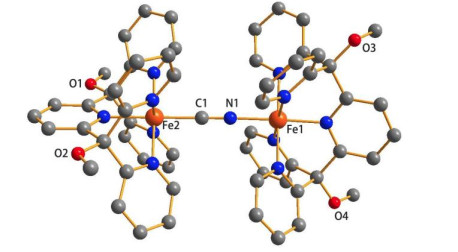
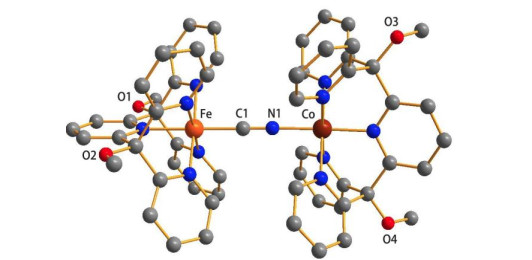

As shown in Table 2, the bond angles of C≡N–M (M = Fe and Co) and Fe–C≡N in 1 and 2 are nearly linear in ranges of 176.6(2)~177.1(3)° and 177.8(2)~178.0(3)°. The average Fe–N distances of [Fe(PY5OMe2)CN]+ are 1.985(3) Å in 1 and 2.021(2) Å in 2, which are in good agreement of the bond lengths for LS Fe(II) complexes[32], suggesting the cyanide-carbon coordinated Fe(II) is of low-spin. And the average M–N (M = Fe, Co) distances of cyanide-nitrogen coordinated metal ions are 1.997(3) Å in 1 and 2.080(2) Å in 2. These are typical bond lengths for a LS Fe(II) complex and a HS Co(II) complex[34-37], which are consistent with the following magnetic data. We have tried to figure out the changes in bond lengths of 1 at high temperature, at which, however, the crystal was prone to collapse, thus precluding us from obtaining its crystallographic data at 400 K.
DownLoad:
CSV
| Compound 1 | Compound 2 | Compound 3(a) | Compound 3(b) | |||||||
| Fe(1)–N(1) | 1.925(3) | Co–N(1) | 1.994(2) | Mn(1)–N(1) | 2.132(6) | Mn(2)–N(7) | 2.113(5) | |||
| Fe(1)–N(2) | 2.040(3) | Co–N(2) | 2.124(2) | Mn(1)–N(2) | 2.182(6) | Mn(2)–N(8) | 2.174(7) | |||
| Fe(1)–N(3) | 1.962(3) | Co–N(3) | 2.040(2) | Mn(1)–N(3) | 2.119(6) | Mn(2)–N(9) | 2.127(7) | |||
| Fe(1)–N(4) | 2.005(3) | Co–N(4) | 2.088(2) | Mn(1)–N(4) | 2.466(4) | Mn(2)–N(10) | 2.423(4) | |||
| Fe(1)–N(5) | 1.990(3) | Co–N(5) | 2.074(2) | Mn(1)–N(5) | 2.094(6) | Mn(2)–N(11) | 2.142(7) | |||
| Fe(1)–N(6) | 2.062(3) | Co–N(6) | 2.158(2) | Mn(1)–N(6) | 2.171(6) | Mn(2)–N(12) | 2.129(7) | |||
| Fe(1)–N(7) | 1.998(3) | Fe–N(7) | 2.018(2) | Fe(1)–N(2) | 2.053(6) | Fe(2)–N(8) | 2.112(7) | |||
| Fe(2)–N(8) | 1.996(3) | Fe–N(8) | 2.013(2) | Fe(1)–N(3) | 2.091(6) | Fe(2)–N(9) | 2.097(7) | |||
| Fe(2)–N(9) | 2.032(3) | Fe–N(9) | 2.055(2) | Fe(1)–N(4) | 2.000(4) | Fe(2)–N(10) | 2.005(5) | |||
| Fe(2)–N(10) | 1.991(3) | Fe–N(10) | 2.008(2) | Fe(1)–N(5) | 2.120(6) | Fe(2)–N(11) | 2.093(7) | |||
| Fe(2)–N(11) | 1.997(3) | Fe–N(11) | 2.013(2) | Fe(1)–N(6) | 2.108(6) | Fe(2)–N(12) | 2.106(7) | |||
| Fe(2)–C(1) | 1.910(3) | Fe–C(1) | 1.904(3) | Fe(1)–C(1) | 1.948(6) | Fe(2)–C(31) | 1.957(5) | |||
| N(1)≡C(1) | 1.164(5) | N(1)≡C(1) | 1.145(3) | N(1)≡C(1) | 1.153(8) | N(7)≡C(31) | 1.150(10) | |||
| C(1)≡N(1)–Fe(1) | 177.1(3) | C(1)≡N(1)–Co | 176.6(2) | C(1)≡N(1)–Mn(1) | 179.1(15) | C(31)≡N(7)–Mn(2) | 178.4(9) | |||
| N(1)–Fe(1)–N(2) | 89.63(11) | N(1)–Co–N(2) | 90.89(8) | N(1)–Mn(1)–N(2) | 102.3(5) | N(8)–Mn(2)–N(9) | 80.9(2) | |||
| N(1)–Fe(1)–N(3) | 177.76(2) | N(1)–Co–N(3) | 177.97(8) | N(1)–Mn(1)–N(4) | 174.6(6) | N(9)–Mn(2)–N(11) | 157.8(2) | |||
| N(1)≡C(1)–Fe(2) | 178.0(3) | N(1)≡C(1)–Fe | 177.8(2) | N(1)≡C(1)–Fe(1) | 178.3(11) | N(7)≡C(31)–Fe(2) | 178.5(10) | |||
| C(1)–Fe(2)–N(7) | 92.31(11) | C(1)–Fe–N(7) | 92.68(9) | C(1)–Fe(1)–N(2) | 89.5(4) | C(31)–Fe(2)–N(8) | 89.3(5) | |||
| C(1)–Fe(2)–N(9) | 178.86(3) | C(1)–Fe–N(9) | 178.98(9) | C(1)–Fe(1)–N(4) | 77.6(4) | C(31)–Fe(2)–N(10) | 179.1(6) | |||
IR spectra of complexes 1~3 are listed in Table 3, and the data of the parent mononuclear compound [FeII(PY5OMe2)CN](OTf) are also listed for the purpose of comparison. Compared with [FeII(PY5OMe2)CN](OTf) (νCN = 2087 cm-1), the CN stretching bands in compounds 1 (νCN = 2095 cm-1) and 2 (νCN = 2099 cm-1) show a clear shift to higher frequencies and a evident shift to lower frequency for compound 3 (νCN = 2077 cm-1). This result can be explained by a combination of two factors: back-bonding from the C-bonded metal into the CN bond and kinematic coupling upon cyanide-bridge formation[38-40]. The former effect is expected to be enhanced by the withdrawal of charge from the cyanide to the second metal and shifts ν(CN) to a lower frequency, while the latter effect is a mechanical constraint on the CN motion and shifts ν(CN) to a higher frequency. For compounds 1 and 2, the raise of νCN can be attributed to the stronger effect of the kinematic coupling than the back-bonding effect. For compound 3, however, it can be considered that the back-bonding effect is outweighed, suggesting that Mn2+ is electron-poorer than Fe2+ and Co2+.
DownLoad:
CSV
| Complexes | νCN (cm-1) |
| [FeII(PY5OMe2)CN](OTf) | 2087 |
| 1 | 2095 |
| 2 | 2099 |
| 3 | 2077 |
The temperature dependence of magnetic susceptibilities for complexes 1, 2 and 3 was collected in an applied field of 1000 Oe under the temperature range of 2~400 K (Fig. 2). Complexes 2 and 3 were recorded in a cooling mode from 400 to 2 K, and complex 1 was recorded in both cooling and heating modes from 400 to 2 to 400 K. The TGA results of complexes 1~3 show that compounds 1 and 2 have lost all solvents at 400 K and these three compounds remain thermally stable in the temperature range of 300~400 K (Fig. S3). The thermal variation of the product of the molar magnetic susceptibility times the temperature (χMT) for the Fe(II) complex 1 shows the presence of SCO, as shown in Fig. 2. The value of χMT at 400 K is 2.38 cm3·K·mol−1 slightly below the expected value (3.0 cm3·K·mol−1) of one HS Fe(II) ion (S = 2, g = 2.0), which means the existence of a small amount of LS Fe(II). On further cooling, there is an obvious decrease in the χMT values from 2.38 to 0 cm3·K·mol−1 from 400 to 300 K, indicating the completion of spin transition from HS to the LS state. In heating processes, the transition occurs from 400 to 336 K, resulting in a hysteresis loop of 36 K. For the Co(II) complex 2, the χMT value is 2.87 cm3·K·mol−1 at 400 K which is consistent with an octahedral HS Co(II) center with S = 3/2, then the χMT product shows a smooth decline and reached 1.74 cm3·K·mol−1 at 2 K. This magnetic behavior is typical in Co(II) octahedral complex and attributed to the magnetic anisotropy caused by spin-orbit coupling[33-36]. The χMT product for the Mn(II) complex 3 basically maintains at around 4.65 cm3·K·mol−1 in the temperature range of 2~400 K, which is in agreement with the theoretical spin-only values (4.375 cm3·K·mol−1) for a HS Mn(II) ion (S = 5/2, g = 2.0).
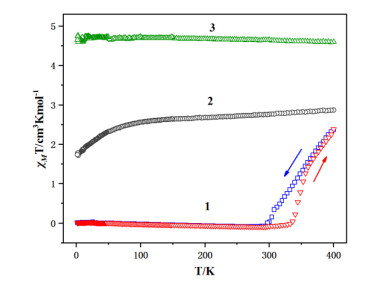
Apparently, these three adjacent transition metal ions show different magnetic behaviors, although they are in the same ligand field. The Co(II) ion for 2 and Mn(II) ion for 3 are both in a high-spin state through 2~400 K, but the cyanide-nitrogen coordinated Fe(II) ion for complex 1 possesses a SCO behavior over 300 K. Such differences are related to the d-orbital splitting of these metal ions, indicating that Fe(II) gives a lager orbital splitting in this ligand field[41].
In summary, three dinuclear cyanide-bridged complexes have been designed and synthesized by using the same building unit [FeII(PY5OMe2)CN]+ and mononuclear units [MII(PY5OMe2)]2+ (M = Fe, Co and Mn) with different metal ions. Single-crystal X-ray diffraction analyses show that the structures of these three dinuclear complexes are very similar. The measured ν(CN) results for compounds 1~3 suggest that Mn2+ is electron-poorer than Fe2+ and Co2+. And, the temperature dependence of magnetic susceptibilities suggest that these three compounds have different magnetic behavior, namely compound 1 exhibits a SCO behavior and a hysteresis of 36 K, while 2 and 3 are paramagnetic with the high-spin cyanide-nitrogen bound Co(II) and Mn(II).
Shatruk, M.; Avendano, C.; Dunbar, K. R. Cyanide-bridged complexes of transition metals: a molecular magnetism perspective. Prog. Inorg. Chem. 2009, 56, 155‒334.
Wang, J. H.; Li, Z. Y.; Yamashita, M.; Bu, X. H. Recent progress on cyano-bridged transition-metal-based single-molecule magnets and single-chain magnets. Coord. Chem. Rev. 2021, 428, 213617‒213637. doi: 10.1016/j.ccr.2020.213617
Wang, J. H.; Vignesh, K. R.; Zhao, J.; Li, Z. Y.; Dunbar, K. R. Charge transfer and slow magnetic relaxation in a series of cyano-bridged Fe4IIIM2II (M = FeII, CoII, NiII) molecules. Inorg. Chem. Front. 2019, 6, 493‒497.
Su, S. D.; Zhu, X. Q.; Wen, Y. H.; Zhang, L. T.; Yang, Y. Y.; Lin, C. S.; Wu, X. T.; Sheng, T. L. A diruthenium-based mixed spin complex Ru25+ (S = 1/2)-CN-Ru25+ (S = 3/2). Angew. Chem. Int. Ed. 2019, 131, 15344‒15348.
Yang, Y. Y.; Zhu, X. Q.; Hu, S. M.; Su, S. D.; Zhang, L. T.; Wen, Y. H.; Wu, X. T.; Sheng, T. L. Different degrees of electron delocalization in mixed valence Ru-Ru-Ru compounds by cyanido-/isocyanido-bridge isomerism. Angew. Chem. Int. Ed. 2018, 57, 14046‒14050. doi: 10.1002/anie.201806157
Lescouezec, R.; Vaissermann, J.; Ruiz-Perez, C.; Lloret, F.; Carrasco, R.; Julve, M.; Verdaguer, M.; Dromzee, Y.; Gatteschi, D.; Wernsdorfer, W. Cyanide-bridged iron(III)-cobalt(II) double zigzag ferromagnetic chains: two new molecular magnetic nanowires. Angew. Chem. Int. Ed. 2003, 42, 1483‒1486. doi: 10.1002/anie.200250243
Wang, S.; Zuo, J. L.; Gao, S.; Song, Y.; Zhou, H. C.; Zhang, Y. Z.; You, X. Z. The observation of superparamagnetic behavior in molecular nanowires. J. Am. Chem. Soc. 2004, 126, 8900‒8901. doi: 10.1021/ja0483995
Toma, L. M.; Lescouezec, R.; Pasan, J.; Ruiz-Perez, C.; Vaissermann, J.; Cano, J.; Carrasco, R.; Wernsdorfer, W.; Lloret, F.; Julve, M. [Fe(bpym)(CN)4]-: a new building block for designing single-chain magnets. J. Am. Chem. Soc. 2006, 128, 4842‒4853. doi: 10.1021/ja058030v
Hoshino, N.; Iijima, F.; Newton, G. N.; Yoshida, N.; Shiga, T.; Nojiri, H.; Nakao, A.; Kumai, R.; Murakami, Y.; Oshio, H. Three-way switching in a cyanide-bridged [CoFe] chain. Nat. Chem. 2012, 4, 921‒926. doi: 10.1038/nchem.1455
Pichon, C.; Suaud, N.; Duhayon, C.; Guihery, N.; Sutter, J. P. Cyano-bridged Fe(II)-Cr(III) single-chain magnet based on pentagonal bipyramid units: on the added value of aligned axial anisotropy. J. Am. Chem. Soc. 2018, 140, 7698‒7704. doi: 10.1021/jacs.8b03891
Sokol, J. J.; Hee, A. G.; Long, J. R. A cyano-bridged single-molecule magnet: slow magnetic relaxation in a trigonal prismatic MnMo6(CN)18 cluster. J. Am. Chem. Soc. 2002, 124, 7656‒7657. doi: 10.1021/ja0263846
Choi, H. J.; Sokol, J. J.; Long, J. R. Raising the spin-reversal barrier in cyano-bridged single-molecule magnets: linear Mn(III)2M(III)(CN)6 (M = Cr, Fe) species incorporating [(5-brsalen)Mn]+ units. Inorg. Chem. 2004, 43, 1606‒1608. doi: 10.1021/ic035327q
Zhang, Y. Z.; Mallik, U. P.; Clerac, R.; Rath, N. P.; Holmes, S. M. Irreversible solvent-driven conversion in cyanometalate {Fe2Ni}n (n = 2, 3) single-molecule magnets. Chem. Commun. 2011, 47, 7194‒7196. doi: 10.1039/c1cc10679a
Cho, K. J.; Ryu, D. W.; Kwak, H. Y.; Lee, J. W.; Lee, W. R.; Lim, K. S.; Koh, E. K.; Kwon, Y. W.; Hong, C. S. Designed cyanide- and phenoxide-bridged Fe(III)Mn(III) single-molecule magnet constructed by highly blocked paramagnetic precursors. Chem. Commun. 2012, 48, 7404‒7406. doi: 10.1039/c2cc32503a
Saber, M. R.; Dunbar, K. R. Trigonal bipyramidal 5d-4f molecules with SMM behavior. Chem. Commun. 2014, 50, 2177‒2179. doi: 10.1039/C3CC49124B
Xin, Y.; Wang, J.; Zychowicz, M.; Zakrzewski, J. J.; Nakabayashi, K.; Sieklucka, B.; Chorazy, S.; Ohkoshi, S. I. Dehydration-hydration switching of single-molecule magnet behavior and visible photoluminescence in a cyanido-bridged Dy(III)Co(III) framework. J. Am. Chem. Soc. 2019, 141, 18211‒18220. doi: 10.1021/jacs.9b09103
Papanikolaou, D.; Margadonna, S.; Kosaka, W.; Ohkoshi, S.; Brunelli, M.; Prassides, K. X-ray illumination induced Fe(II) spin crossover in the Prussian blue analogue cesium iron hexacyanochromate. J. Am. Chem. Soc. 2006, 128, 8358‒8363. doi: 10.1021/ja061650r
Kosaka, W.; Nomura, K.; Hashimoto, K.; Ohkoshi, S. Observation of an Fe(II) spin-crossover in a cesium iron hexacyanochromate. J. Am. Chem. Soc. 2005, 127, 8590‒8591. doi: 10.1021/ja050118l
Jeon, I. R.; Calancea, S.; Panja, A.; Piñero Cruz, D. M.; Koumousi, E. S.; Dechambenoit, P.; Coulon, C.; Wattiaux, A.; Rosa, P.; Mathonière, C.; Clérac, R. Spin crossover or intra-molecular electron transfer in a cyanido-bridged Fe/Co dinuclear dumbbell: a matter of state. Chem. Sci. 2013, 4, 2463‒2470. doi: 10.1039/c3sc22069a
Li, Z. Y.; Dai, J. W.; Damjanović, M.; Shiga, T.; Wang, J. H.; Zhao, J.; Oshio, H.; Yamashita, M.; Bu, X. H. Structure switching and modulation of magnetic properties in diarylethene-bridged metallosupramolecular compounds via controlled coordination-driven self-assembly. Angew. Chem. Int. Ed. 2019, 58, 4339‒4344. doi: 10.1002/anie.201900789
Herchel, R.; Boca, R.; Gembicky, M.; Kozisek, J.; Renz, F. Spin crossover in a tetranuclear Cr(III)-Fe(III)3 complex. Inorg. Chem. 2004, 43, 4103‒4105. doi: 10.1021/ic035374i
Kawabata, S.; Chorazy, S.; Zakrzewski, J. J.; Imoto, K.; Fujimoto, T.; Nakabayashi, K.; Stanek, J.; Sieklucka, B.; Ohkoshi, S. I. In situ ligand transformation for two-step spin crossover in Fe(II)[M(IV)(CN)8]4- (M = Mo, Nb) cyanido-bridged frameworks. Inorg. Chem. 2019, 58, 6052‒6063. doi: 10.1021/acs.inorgchem.9b00361
Papanikolaou, D.; Kosaka, W.; Margadonna, S.; Kagi, H.; Ohkoshi, S. I.; Prassides, K. Piezomagnetic behavior of the spin crossover Prussian blue analogue CsFe[Cr(CN)6]. J. Phys. Chem. C. 2007, 111, 8086‒8091. doi: 10.1021/jp068885+
Kuppusamy, S. K.; Mario, R. Emerging trends in spin crossover (SCO) based functional materials and devices. Coord. Chem. Rev. 2017, 346, 176‒205. doi: 10.1016/j.ccr.2017.03.024
Holovchenko, A.; Dugay, J.; Gimenez-Marques, M.; Torres-Cavanillas, R.; Coronado, E.; van der Zant, H. S. J. Near room-temperature memory devices based on hybrid spin-crossover SiO2 nanoparticles coupled to single-layer graphene nanoelectrodes. Adv. Mater. 2016, 28, 7228‒7233. doi: 10.1002/adma.201600890
Cowan, M. G.; Olguin, J.; Narayanaswamy, S.; Tallon, J. L.; Brooker, S. Reversible switching of a cobalt complex by thermal, pressure, and electrochemical stimuli: abrupt, complete, hysteretic spin crossover. J. Am. Chem. Soc. 2012, 134, 2892‒2894. doi: 10.1021/ja208429u
Thies, S.; Sell, H.; Schuett, C.; Bornholdt, C.; Naether, C.; Tuczek, F.; Herges, R. Light-induced spin change by photodissociable external ligands: a new principle for magnetic switching of molecules. J. Am. Chem. Soc. 2011, 133, 16243‒16250. doi: 10.1021/ja206812f
Goldsmith, C. R.; Cole, A. P.; Stack, T. D. C–H activation by a mononuclear manganese(III) hydroxide complex: synthesis and characterization of a manganese-lipoxygenase mimic? J. Am. Chem. Soc. 2005, 127, 9904‒9912. doi: 10.1021/ja039283w
Rudd, D. J.; Goldsmith, C. R.; Cole, A. P.; Stack, T. D.; Hodgson, K. O.; Hedman, B. X-ray absorption spectroscopic investigation of the spin-transition character in a series of single-site perturbed iron(II) complexes. Inorg. Chem. 2005, 44, 1221‒1229. doi: 10.1021/ic048765l
Bain, G. A.; Berry, J. F. Diamagnetic corrections and Pascal's constants. J. Chem. Edu. 2008, 85, 532‒536. doi: 10.1021/ed085p532
Sheldrick, G. M. Crystal structure refinement with SHELXL. Acta. Crystallogr. C. Struct. Chem. 2015, 71, 3‒8. doi: 10.1107/S2053229614024218
Phan, H.; Hrudka, J. J.; Igimbayeva, D.; Lawson Daku, L. M.; Shatruk, M. A simple approach for predicting the spin state of homoleptic Fe(II) tris-diimine complexes. J. Am. Chem. Soc. 2017, 139, 6437‒6447. doi: 10.1021/jacs.7b02098
Banci, L.; Bencini, A.; Benelli, C.; Gatteschi, D.; Zanchini, C. Spectral-structural correlations in high-spin cobalt(II) complexes. Struct. Bond. 1982, 52, 37‒86.
Benmansour, S.; Setifi, F.; Gómez-García, C. J.; Triki, S.; Coronado, E.; Salaün, J. Y. A novel polynitrile ligand with different coordination modes: synthesis, structure and magnetic properties of the series [M(tcnoprOH)2(H2O)2] (M = Mn, Co and Cu) (tcnoprOH- = [(NC)2CC(OCH2CH2CH2OH)C(CN)2]-). J. Mol. Struct. 2008, 890, 255‒262. doi: 10.1016/j.molstruc.2008.04.044
Herrera, J. M.; Bleuzen, A.; Dromzee, Y.; Julve, M.; Lloret, F.; Verdaguer, M. Crystal structures and magnetic properties of two octacyanotungstate(IV) and (V)-cobalt(II) three-dimensional bimetallic frameworks. Inorg. Chem. 2003, 42, 7052‒7059. doi: 10.1021/ic034188+
Lloret, F.; Julve, M.; Cano, J.; Ruiz-García, R.; Pardo, E. Magnetic properties of six-coordinated high-spin cobalt(II) complexes: theoretical background and its application. Inorganica. Chimica. Acta 2008, 361, 3432‒3445. doi: 10.1016/j.ica.2008.03.114
Berlinguette, C. P.; Dragulescu-Andrasi, A.; Sieber, A.; Gudel, H. U.; Achim, C.; Dunbar, K. R. A charge-transfer-induced spin transition in the discrete cyanide-bridged complex [Co(tmphen)2]3[Fe(CN)6]2]. J. Am. Chem. Soc. 2005, 127, 6766‒6779. doi: 10.1021/ja043162u
Alvarez, S.; Lpez, C.; Bermejo, M. J. C–N stretching force constants in cyano complexes: general trends for polycyano, mixed-ligand and cyano-bridged complexes transition. Met. Chem. 1984, 9, 123‒126. doi: 10.1007/BF00935925
Bignozzi, C. A.; Argazzi, R.; Schoonover, J. R.; Gordon, K. C.; Dyer, R. B.; Scandola, F. Electronic coupling in cyano-bridged ruthenium polypyridine complexes and role of electronic effects on cyanide stretching frequencies. Inorg. Chem. 1992, 31, 5260‒5267. doi: 10.1021/ic00051a018
Dows, D. A.; Haim, A.; Wilmarth, W. K. Infra-red spectroscopic detection of bridging cyanide groups. J. Inorg. Nucl. Chem. 1961, 21, 33‒37. doi: 10.1016/0022-1902(61)80408-9
Halcrow, M. The effect of ligand design on metal ion spin state-lessons from spin crossover complexes. Crystals 2016, 6, 58‒78. doi: 10.3390/cryst6050058

Figure 1a Structure of complex 1 (All the H atoms, CF3SO3- anions and solvent molecules have been removed)

Figure 1b Structure of complex 2 (All the H atoms, CF3SO3- anions and solvent molecules have been removed)

Figure 1c Structure of complex 3 (The positional disordered atoms, all the H atoms, F3SO3- anions and solvent molecules have been removed for clarity)

Figure 2 Thermal variation of the χMT product for complexes 1 (The dashed red and blue lines represent the heating and cooling modes, respectively), 2 (gray) and 3 (green)
Table 1. Crystallographic Data for Complexes 1~3
| 1 | 2 | 3 | |
| Chemical formula | C62H50F9Fe2N11O13S3∙2H2O∙3CH3CN | C62H50CoF9FeN11O13S3∙2H2O∙3CH3CN | C62H50F9FeMnN11O13S3 |
| Formula weight | 1695.20 | 1698.28 | 1535.10 |
| T (K) | 100(2) | 100(2) | 200(2) |
| Color and habit | Red prism | Red prism | Red prism |
| Crystal size (mm) | 0.31 × 0.21 × 0.18 | 0.51 × 0.28 × 0.19 | 0.35 × 0.15 × 0.12 |
| Crystal system | Monoclinic | Monoclinic | Triclinic |
| Space group | P21/c | P21/c | P |
| a (Å) | 12.41240(10) | 12.3934(3) | 12.9145(4) |
| b (Å) | 35.1871(3) | 35.4776(6) | 12.9482(3) |
| c (Å) | 16.25860(10) | 16.3918(3) | 20.6481(4) |
| α (°) | 90 | 90 | 89.6328(16) |
| β (°) | 97.0630(10) | 96.895(2) | 84.5167(19) |
| γ (°) | 90 | 90 | 84.809(2) |
| V (Å3) | 7047.16(9) | 7155.2(3) | 3422.85(14) |
| Z | 4 | 4 | 2 |
| ρcalc (g/cm3) | 1.598 | 1.577 | 1.489 |
| μ (mm-1) | 3.329 (GaKα) | 0.623 (MoKα) | 3.045 (GaKα) |
| F(000) | 3480.0 | 3484.0 | 1564.0 |
| θ (°) | 4.37~104.09 | 3.40~52.74 | 5.96~104.09 |
| GOF | 1.066 | 1.067 | 1.051 |
| Rint | 0.0655 | 0.0581 | 0.1014 |
| R, wR (I > 2σ(I)) | 0.0565, 0.1423 | 0.0487, 0.1260 | 0.0777, 0.1887 |
| R, wR (all data) | 0.0596, 0.1444 | 0.0561, 0.1313 | 0.0893, 0.1963 |
 下载: 导出CSV
Table 2. Selected Bond Lengths (Å) and Bond Angles (°) for Complexes 1~3
| Compound 1 | Compound 2 | Compound 3(a) | Compound 3(b) | |||||||
| Fe(1)–N(1) | 1.925(3) | Co–N(1) | 1.994(2) | Mn(1)–N(1) | 2.132(6) | Mn(2)–N(7) | 2.113(5) | |||
| Fe(1)–N(2) | 2.040(3) | Co–N(2) | 2.124(2) | Mn(1)–N(2) | 2.182(6) | Mn(2)–N(8) | 2.174(7) | |||
| Fe(1)–N(3) | 1.962(3) | Co–N(3) | 2.040(2) | Mn(1)–N(3) | 2.119(6) | Mn(2)–N(9) | 2.127(7) | |||
| Fe(1)–N(4) | 2.005(3) | Co–N(4) | 2.088(2) | Mn(1)–N(4) | 2.466(4) | Mn(2)–N(10) | 2.423(4) | |||
| Fe(1)–N(5) | 1.990(3) | Co–N(5) | 2.074(2) | Mn(1)–N(5) | 2.094(6) | Mn(2)–N(11) | 2.142(7) | |||
| Fe(1)–N(6) | 2.062(3) | Co–N(6) | 2.158(2) | Mn(1)–N(6) | 2.171(6) | Mn(2)–N(12) | 2.129(7) | |||
| Fe(1)–N(7) | 1.998(3) | Fe–N(7) | 2.018(2) | Fe(1)–N(2) | 2.053(6) | Fe(2)–N(8) | 2.112(7) | |||
| Fe(2)–N(8) | 1.996(3) | Fe–N(8) | 2.013(2) | Fe(1)–N(3) | 2.091(6) | Fe(2)–N(9) | 2.097(7) | |||
| Fe(2)–N(9) | 2.032(3) | Fe–N(9) | 2.055(2) | Fe(1)–N(4) | 2.000(4) | Fe(2)–N(10) | 2.005(5) | |||
| Fe(2)–N(10) | 1.991(3) | Fe–N(10) | 2.008(2) | Fe(1)–N(5) | 2.120(6) | Fe(2)–N(11) | 2.093(7) | |||
| Fe(2)–N(11) | 1.997(3) | Fe–N(11) | 2.013(2) | Fe(1)–N(6) | 2.108(6) | Fe(2)–N(12) | 2.106(7) | |||
| Fe(2)–C(1) | 1.910(3) | Fe–C(1) | 1.904(3) | Fe(1)–C(1) | 1.948(6) | Fe(2)–C(31) | 1.957(5) | |||
| N(1)≡C(1) | 1.164(5) | N(1)≡C(1) | 1.145(3) | N(1)≡C(1) | 1.153(8) | N(7)≡C(31) | 1.150(10) | |||
| C(1)≡N(1)–Fe(1) | 177.1(3) | C(1)≡N(1)–Co | 176.6(2) | C(1)≡N(1)–Mn(1) | 179.1(15) | C(31)≡N(7)–Mn(2) | 178.4(9) | |||
| N(1)–Fe(1)–N(2) | 89.63(11) | N(1)–Co–N(2) | 90.89(8) | N(1)–Mn(1)–N(2) | 102.3(5) | N(8)–Mn(2)–N(9) | 80.9(2) | |||
| N(1)–Fe(1)–N(3) | 177.76(2) | N(1)–Co–N(3) | 177.97(8) | N(1)–Mn(1)–N(4) | 174.6(6) | N(9)–Mn(2)–N(11) | 157.8(2) | |||
| N(1)≡C(1)–Fe(2) | 178.0(3) | N(1)≡C(1)–Fe | 177.8(2) | N(1)≡C(1)–Fe(1) | 178.3(11) | N(7)≡C(31)–Fe(2) | 178.5(10) | |||
| C(1)–Fe(2)–N(7) | 92.31(11) | C(1)–Fe–N(7) | 92.68(9) | C(1)–Fe(1)–N(2) | 89.5(4) | C(31)–Fe(2)–N(8) | 89.3(5) | |||
| C(1)–Fe(2)–N(9) | 178.86(3) | C(1)–Fe–N(9) | 178.98(9) | C(1)–Fe(1)–N(4) | 77.6(4) | C(31)–Fe(2)–N(10) | 179.1(6) | |||
下载: 导出CSV
Table 3. CN Stretching Frequencies of Complexes 1~3 and Their Parent Mononuclear Compound
| Complexes | νCN (cm-1) |
| [FeII(PY5OMe2)CN](OTf) | 2087 |
| 1 | 2095 |
| 2 | 2099 |
| 3 | 2077 |
下载: 导出CSV

 扫一扫看文章


扫一扫关注我们