Key Laboratory of Green and Precise Synthetic Chemistry and Applications, Ministry of Education, Anhui Province Key Laboratory of Pollutant Sensitive Materials and Environmental Remediation, School of Physics and Electronic Information, Huaibei Normal University, Huaibei 235000, China
Received Date:
04 May 2022 Accepted Date:
29 May 2022 Available Online:
20 June 2022
Abstract:
Utilizing solar energy to achieve artificial photosynthesis of chemical fuel is prevalent in tackling excessive CO2 emission and fossil fuel depletion. Grievous charge recombination and weak redox capability aggravate the CO2 photoreduction performance. Engineering tailored morphology and constructing matched heterostructure are two significant schemes to ameliorate the CO2 photoconversion efficiency of g-C3N4-based composite. Herein, a novel S-scheme ultrathin porous g-C3N4 (UPCN)/Ag2MoO4 (AMO) composite was designed by in-situ growing tetragonal α-AMO nanoparticles (NPs) (5-30 nm) on UPCN nanosheets (NSs). The S-scheme charge transfer route endows UPCN/AMO with fast charge separation and strong redox capability, demonstrated by X-ray photoelectron spectroscopy (XPS), photoelectrochemical tests, steady-state and time-resolved photoluminescence (PL) spectra, and DFT calculations. The UPCN/AMO composite exhibits elevated CO2 photoreduction performance with CO and CH4 yield rates of 6.98 and 0.38 μmol g-1 h-1, which are 3.5 and 2.9 folds higher than that of pristine UPCN, respectively. Finally, the CO2 photoreduction intermediates are analyzed, and the CO2 photoreduction mechanism is discussed. This work provides a reference for various g-C3N4-based composites applied in artificial photosynthesis.
Photocatalytic CO2 reduction to carbonaceous fuel is a rewarding project for CO2 accumulation and fossil resource depletion.[1-3] Nevertheless, the grievous charge recombination and weak redox capability still slack CO2 photoreduction research pace.[4-7] For one thing, CO2 photoconversion to hydrocarbon fuels involves an uphill reaction that needs high activation energy.[8-10] For another, CO2 photoreduction needs the synergistic effect of the photogenerated holes and electrons.[11-13] It requires that the electrons on the conduction band (CB) possess sufficient reductive capability to activate the CO2 molecules, and the holes on the valance band (VB) possess enough oxidative power to produce protons by oxidizing water.[14-17] In this way, a pristine semiconductor whose energy is appropriate for carbon dioxide reduction has a wide bandgap, which is detrimental for the utilization of visible light.[18-25] S-scheme heterojunction photocatalysts can simultaneously accomplish fast charge separation and strong redox ability, potentially appealing for improved CO2 photoreduction performance.[1]
Recently, g-C3N4 (CN) has served as a CO2 photoreduction candidate due to an appropriate bandgap of about 2.7 eV and negative CB potential.[26-28] The CO2 photoreduction activity of pristine CN remains undisireble due to the fast charge recombination and weak oxidative capability.[29, 30] Therefore, developing a novel S-scheme CN-based composite remains imperative to ameliorate charge separation and redox ability for improved CO2 photoreduction performance.[14, 31, 32] Some CN-based composites, such as g-C3N4/ZnO, [17] TiO2/C3N4/Ti3C2 Mxene, [33] g-C3N4/Zn0.2Cd0.8S, [34] g-C3N4/Sn2S3-DETA, [35] Cu2V2O7/g-C3N4, [36] Au@Void@g-C3N4/SnS, [37] and LaPO4/g-C3N4, [38] were fabricated for ameliorating CO2 photoreduction performance. To further understand the CO2 photoreduction mechanism and improve the CO2 photoreduction performance, more novel oxidative photocatalysts are worthwhile to be developed. Ag2MoO4 (AMO) exhibits outstanding photodegradation and antibacterial performance owing to a positive VB level.[39, 40] Meanwhile, the band structure of AMO theoretically matches well with that of CN.[41] Thereby, it is feasible to design an S-scheme CN/AMO composite to raise the CO2 photoreduction efficiency.
Inspired by this, the ultrathin porous g-C3N4 (UPCN)/AMO was fabricated by annealing and in-situ growing routes. The S-scheme UPCN/AMO heterojunction was discovered by X-ray photoelectron spectroscopy (XPS) and work function calculation. Benefited from S-scheme heterojunction, the internal electric field (IEF) provides a driven force for photoexcited electrons to migrate from AMO CB to UPCN VB. Consequently, the charge with weak redox capability will recombine driven by IEF, and the charge with elevated redox capability will be reserved and involved in the CO2 photoreduction reaction. Meanwhile, with S-scheme heterojunction and ultrathin sheet-like structure, the oxidation reaction will occur on AMO nanoparticles (NPs), and the reduction reaction will proceed on UPCN nanosheets (NSs), which achieves spatial charge separation. The advanced charge separation efficiency was also verified by photoelectrochemical tests, steady-state and time-resolved photoluminescence (SSPL and TRPL) spectra. As expected, the UPCN/AMO composite elevated CO2 photoreduction performance compared with UPCN. Subsequently, the CO2 photoreduction intermediates were unveiled by in-situ diffuse reflectance infrared Fourier transform spectroscopy (DRIFTS), which is a vital reference for the CO2 photoreduction process. Eventually, the CO2 photoreduction mechanism of the UPCN/AMO composite was proposed.
RESULTS AND DISCUSSION
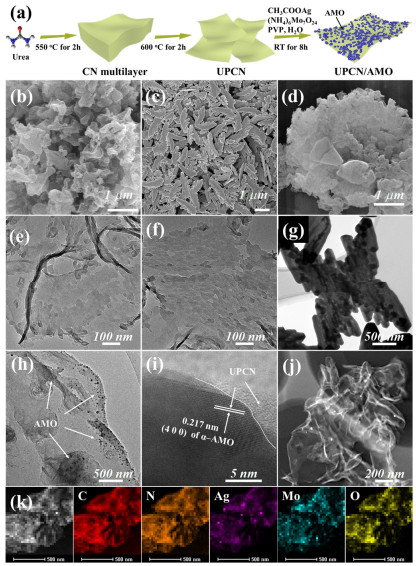
The preparation processes of the UPCN/AMO composite are vividly illustrated in Figure 1a. Firstly, multilayered CN was fabricated by controllably calcining pure urea at 550 ℃ in a muffle furnace. These multilayered CN will dissociate into UPCN during the secondary calcination route at 600 ℃. This UPCN surface is negatively charged, [42] which is conducive to the adsorption of Ag+ ions.[43-47] The adsorbed Ag+ ions will serve as the nucleation site of AMO so that AMO NPs can intimately grow on UPCN NSs to form UPCN/AMO composite. The UPCN NSs are curly and porous with a thickness of 1.05 nm (Figure 1b, e, f and Figure S1). Instead, the pristine AMO NSs are butterfly-like with a thickness of about dozens of nanometers (Figure 1c, g). The UPCN/AMO composite morphology is not significantly distinct from pristine AMO NSs (Figure 1d). Because when AMO in situ grows on UPCN NSs, it will not grow into nanosheets but into small nanoparticles with a diameter of several to dozens of nanometers (Figure 1h). Moreover, a clear lattice fringe with an interplanar spacing of 0.217 nm can readily correspond to the (400) plane of α-AMO. In addition, an apparent interface between α-AMO and amorphous UPCN marked with a white curve can be observed (Figure 1i). Meanwhile, the bright white spots on curved UPCN NSs can originate from AMO NPs, which further verifies the formation of UPCN/AMO heterojunction (Figure 1j). Five elements of C, N, Ag, Mo, and O are displayed on the scan region of HAADF-STEM (Figure 1k). The elements distribution region matched well with the UPCN/AMO sample, further demonstrating that AMO NPs successfully anchor on the UPCN surface.
Figure 1
Figure 1.
(a) Diagram illustration for the formation process of UPCN/AMO composite; FESEM images of (b) UPCN NSs, (c) AMO NSs and (d) UPCN/AMO composite; TEM images of (e, f) UPCN NSs, (g) AMO NSs and (h) UPCN/AMO composite; (i) HRTEM image, (j, k) HAADF image and corresponding elements mappings of UPCN/AMO composite.
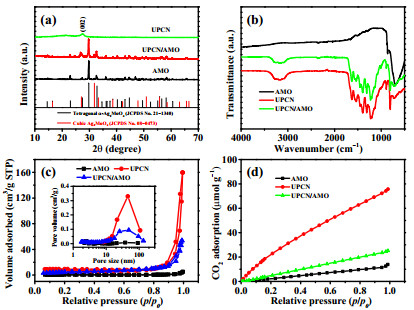
The phase of AMO, UPCN, and UPCN/AMO composite was detected by XRD (Figure 2a). The diffraction peaks of pristine AMO can be assigned to tetragonal α-AMO and cubic AMO (JCPDS No. 21-1340 and 08-0473), of which α-AMO is the main phase.[39, 48] A weak diffraction peak of UPCN at 2θ = 27.4° caused by interplanar stacking can correspond with the (002) crystal plane of UPCN.[49, 50] The broad diffraction peak also indicates the multilayered UPCN was dissociated into UPCN NSs. The diffraction peaks of UPCN/AMO are similar to that of pristine AMO, but the ratio of cubic AMO slightly increases. The diameter of cubic AMO is smaller than that of tetragonal α-AMO, which also illustrates that when AMO grows on UPCN, its size will decrease to form NPs rather than be butterfly-like NSs.[48, 51] Regretfully, the diffraction peak of UPCN NSs fails to be observed on the diffraction peaks of the UPCN/AMO composite. Therefore, the FT-IR spectra were employed to evidence the existence of UPCN NSs (Figure 2b). For UPCN NSs, the absorption peak at 808 cm-1 originates from the breathing mode of s-triazine rings.[52] The absorption peaks between 1130 and 1720 cm-1 correspond to C-N stretching vibration and heptazine-based structure.[53] The absorption peaks in the 2920-3460 cm-1 range derive from amidogen and hydroxyl groups.[54] For AMO, the absorption peak at 681 cm-1 results from the stretching vibration of the Mo-O octahedron.[55] The absorption peaks of UPCN/AMO composite exhibit strong signals of UPCN, evidencing the existence of UPCN. In addition, the UPCN of UPCN/AMO composite can also be detected by electron paramagnetic resonance (EPR) spectroscopy (Figure S2). No apparent EPR signal for AMO can be observed, indicating few defects. Instead, a strong EPR signal with a g value of 2.005 for pristine UPCN can be ascribed to aromatic circulation in tri-s-triazine structures of UPCN. The UPCN/AMO composite exhibits a stronger EPR adsorption peak, denoting that AMO can trigger the charge delocalization of UPCN, thus benefiting charge separation.[56] The nitrogen adsorption-desorption isotherms and hysteresis loop of UPCN, AMO, and UPCN/AMO can be classified into type IV and H3, uncovering mesoporous capillary condensation and slit-type pores from curved NSs (Figure 2c).[57-59] The UPCN exhibits a higher specific surface area, larger volume, and stronger CO2 adsorption due to ultrathin porous sheet-like structure than pristine AMO (Figure 2c, d and Table S1). In contrast, the UPCN/AMO shows a lower specific surface area, pore volume, and weak CO2 adsorption ability than pristine UPCN, demonstrating the successful load of AMO NPs on UPCN NSs.
Figure 2
Figure 2.
(a) XRD patterns, (b) FT-IR spectra, (c) N2 adsorption-desorption isotherms and corresponding pore-size distribution (inset), and (d) CO2 adsorption isotherms of AMO, UPCN and UPCN/AMO composite.
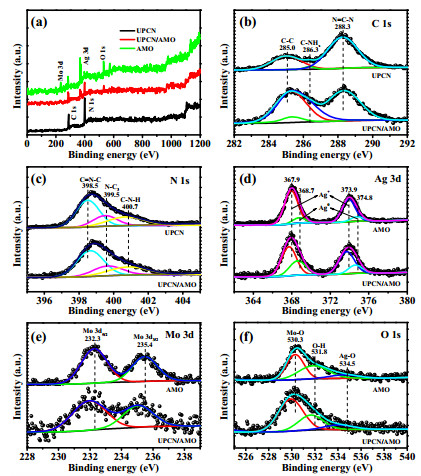
The elemental ingredients and chemical states were investigated by XPS. The C 1s and N 1s orbitals match well with pristine UPCN, and the Ag 3d, Mo 3d, and O 1s orbitals are linked to pristine AMO (Figure 3a). The absorption peaks of UPCN/AMO composite can be readily indexed to pristine UPCN and AMO, and no other impurity can be observed, indicating the successful preparation of UPCN/AMO composite. The three characteristic peaks of C1s orbital at 285.0, 286.3, and 288.3 eV can be indexed to C-C, C-NHx, and N=C-N groups (Figure 3b).[60] While the three characteristic peaks of N1s orbital at 398.5, 399.5, and 400.7 eV can be assigned to C=N-C, N-C3, and C-NH groups (Figure 3c).[28] These typical chemical ingredients are derived from the unique tri-s-triazine structures. Two absorption peaks of Ag 3d orbitals at 367.9 and 373.9 eV come from the Ag+ ions, while two other absorption peaks at 368.7 and 374.8 eV result from the Ag0 NPs, indicating a few Ag+ ions can generate during the process of CO2 photoreduction (Figure 3d).[39] Two absorption peaks of Mo 3d orbitals at 232.3 and 235.4 eV originate from Mo 3d5/2 and 3d3/2 orbitals (Figure 3e), respectively. Moreover, three adsorption peaks of O 1s orbital at 530.3, 531.8, and 534.5 eV can be indexed to Mo-O, O-H, and Ag-O groups (Figure 3f).[51] Further, the C 1s and N 1s orbitals of UPCN/AMO shift to higher binding energy than that of pristine UPCN, while the Ag 3d, Mo 3d, and O 1s orbitals of UPCN/AMO shift to lower binding energy compared with that of AMO. The results demonstrate that when AMO contacts UPCN, the UPCN loses electrons, while AMO obtains electrons from UPCN.[61]
Figure 3
Figure 3.
(a) Survey spectra; High-resolution XPS spectra of (b) C 1s, (c) N 1s, (d) Ag 3d, (e) Mo 3d and (f) O 1s orbitals of various samples.
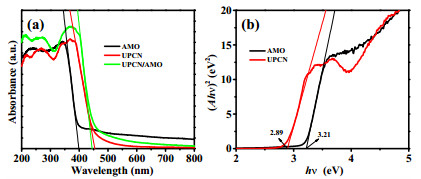
The light absorption ability and bandgap of samples were uncovered by UV-Vis DRS (Figure 4a). The absorption edge of AMO, UPCN, and UPCN/AMO is 392, 453, and 443 nm, respectively, illustrating that UPCN is the main component of UPCN/AMO and AMO exerts a trivial effect on the visible light-harvesting of UPCN. Further, the bandgap of AMO and UPCN calculated by Tauc relation (eq. 1) is 3.21 and 2.89 eV, respectively (Figure 4b).[62]
Figure 4
Figure 4.
(a) UV-Vis DRS and (b) Tauc curves of various samples.
Here A, hν, α, and Eg are the constant, photon energy, absorption coefficient, and bandgap of photocatalysts. Besides, both UPCN and AMO are direct semiconductors (n = 1).
$ E_{VB} = X - E^{e} + 0.5E_{g} $
(2)
$ E_{CB} = E_{VB} - E_{g} $
(3)
The electronegativities X of UPCN and AMO are 4.64 and 5.92 eV. The value of constant Ee is 4.5 eV. According to Eq. 1-3, ECB and EVB of UPCN are -1.30 and 1.59 Ev, and those of AMO are -0.18 and 3.03 eV.
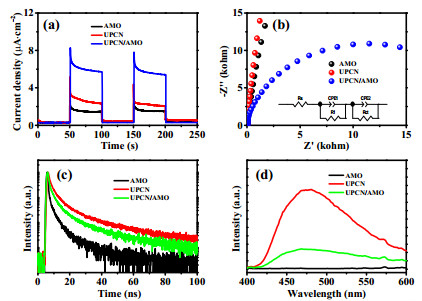
The charge generation, migration, recombination, and lifetime were detected by transient photocurrent, Nyquist plots, and SSPL and TRPL spectra (Figure 5). The photocurrent derives from photogenerated charge migration. Compared with pristine AMO and UPCN, the UPCN/AMO composite shows higher transient photocurrent density, revealing that more photogenerated charges are generated under illumination (Figure 5a).[63] The inset in Figure 5b is the equivalent circuit drawing of Nyquist plots. Rs represents the electrical resistance of the Na2SO4 solution. CPE1 and CPE2 denote the constant phase element between the electrolyte solution and electrode. R1 signifies the resistance between the conductive glass and photocatalysts. Rct means the charge transfer resistance of samples, expressed by the arc radius of Nyquist plots in the low-frequency region.[64] The UPCN/AMO composite exhibits a smaller arc radius than pristine AMO and UPCN, reflecting a lower charge resistance under light irradiation (Figure 5b). The energy of photocatalysts after charge recombination will be released by fluorescence. Therefore, the SSPL intensity can reveal the recombination degree of the photoexcited charge.[65, 66] The UPCN exhibits a vigorous SSPL peak at 475 nm, indicating the intense charge recombination (Figure 5c). Instead, the SSPL intensity of AMO is weak between 400 and 600 nm. The UPCN/AMO composite presents the lowest SSPL intensity, illustrating the charge recombination is well restrained by constructing the UPCN/AMO heterojunction. Further, the TRPL decay curves are employed to explore the photoexcited charge lifetime (Figure 5d). The fitting detail for AMO, UPCN, and UPCN/AMO composite is summarized in Table 1. For pristine AMO, the relative intensity A1 (4983) of shorter lifetime τ1 (0.83 ns) far outweighs the relative intensity A2 (327) of longer lifetime τ2 (6.21 ns). The same is true for pristine UPCN, illustrating interior photoexcited charge recombination outweighs photocatalyst surface.[62] In contrast, the relative intensity A1 of UPCN/AMO composite is lower than that of pristine AMO and UPCN, indicating that the interior charge recombination is significantly mitigated. A new lifetime τ3 (0.61 ns) for UPCN/AMO composite with higher relative intensity A3 (7687) derives from the interfacial photogenerated charge transfer, thus demonstrating that the interfacial charge transfer contributes to lower interior charge recombination. Therefore, the introduction of AMO boosts the charge separation of UPCN, accounting for a lower average lifetime of UPCN/AMO composite (5.86 ns) than that of pristine UPCN (8.57 ns).
Figure 5
Figure 5.
(a) Transient photocurrent, (b) Nyquist plots, (c) SSPL spectra, (d) TRPL decay curves of AMO, UPCN, and UPCN/AMO.
Table 1.
The TRPL Decay Plots Can Be Fitted by the Multi-exponential Eq. 4. $I(t) = I_{0} + A_{1}\exp(-t/τ_{1}) + A_{2}\exp(-t/τ_{2}) + A_{3}\exp(-t/τ_{3}) \quad\quad\quad (4)$$τ = (A_{1}τ_{1}^{2} + A_{2}τ_{2}^{2} + A_{3}τ_{3}^{2})/(A_{1}τ_{1} + A_{2}τ_{2} + A_{3}τ_{3}) \quad\quad\quad (5)$ where I0 represent the baseline value; Ai and τi (i = 1, 2, 3) are the relative intensity and lifetime indexed to the interior, surficial, and interfacial charge recombination. The average lifetime (τ) is calculated by Eq. 5. The fitting detail is summarized below.
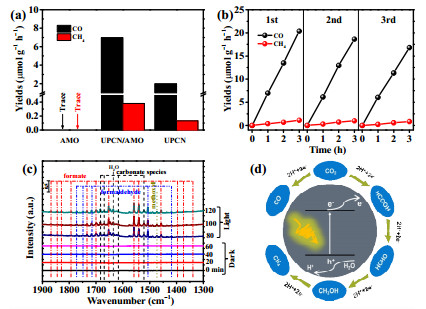
The photocatalytic activity of UPCN and UPCN/AMO composite was evaluated by CO2 photoreduction tests conducted under the full spectrum. Due to a weak reduction capability, the pristine AMO has no CO2 photoreduction activity (Figure 6a).[51] As a comparison, pristine UPCN exhibits high CO2 photoreduction performance, of which the yield rates of CO and CH4 are 1.98 and 0.13 μmol g-1 h-1. The preferential CO2 photoconversion to CO for UPCN is consistent with previous reports. The UPCN/AMO composite exhibits high CO2 photoreduction performance with CO and CH4 yield rates of 6.98 and 0.38 μmol g-1 h-1, which are 3.5 and 2.9 folds higher than that of pristine UPCN, respectively. According to Figure 5, the enhanced CO2 photoreduction performance is derived from effective charge separation. The photostability of the UPCN/AMO composite was investigated by three successive CO2 photoreduction tests (Figure 6b). After three runs, the CO and CH4 yield rates can remain at 83% and 74%, demonstrating satisfied CO2 photoreduction durability. Meanwhile, the comparison to similar work has been summarized (Table S2). The CO2 photoreduction intermediates were monitored by in situ DRIFTS (Figure 6c). No available signals can be detected without CO2 flow and irradiation. Subsequently, when the CO2 gas with water vapor flows through the sample chamber for 60 min, no apparent adsorption peaks can be observed. Under illumination with CO2 and water vapor flows, the carbonate species (1552, 1619, 1671, and 1683 cm-1) and H2O (1636 cm-1) adsorbed on the UPCN/AMO composite surface can be observed.[67] The result uncovers that light excitation can alter the electron density of the UPCN/AMO surface and boost CO2 and H2O molecule adsorption. The adsorbed carbonate species and H2O molecule are the vital precursors of CO2 photoreduction. Meanwhile, the CO2 photoreduction products, such as formaldehyde (1419, 1507, 1717, 1749 and 1773 cm-1), formate (1340, 1375, 1396, 1459, 1542, 1559, 1652, 1701, 1734, 1794, 1830, 1846 and 1868 cm-1) and methoxyl (1471 cm-1), can also be clearly observed. The carbonate species and CO2 photoreduction products change slightly after illumination for 20 min, indicating fast CO2 adsorption and photoreduction process.[4, 68] In addition, the results also discover that the CO and CH4 derive from the CO2 photoreduction instead of possible impurities. The CO2 photoconversion to CH4 and CO is involved in the synergy of two electrons and two protons (Figure 6d). The reduction of CO2 to CO takes only one step, while the reduction of CO2 to CH4 takes four steps. The adsorbed CO2 molecule is first catalyzed to HCOOH, then to HCHO, subsequently to CH3OH, and eventually to CH4. The complex reduction process can also be a significant factor that the CO yield rate is far higher than the CH4 one.[67]
Figure 6
Figure 6.
(a) CO2 photoreduction performance of various samples; (b) Three successive CO2 photoreduction tests and (c) In situ DRIFTS of UPCN/AMO composite; (d) Illustration of CO2 photoreduction process.
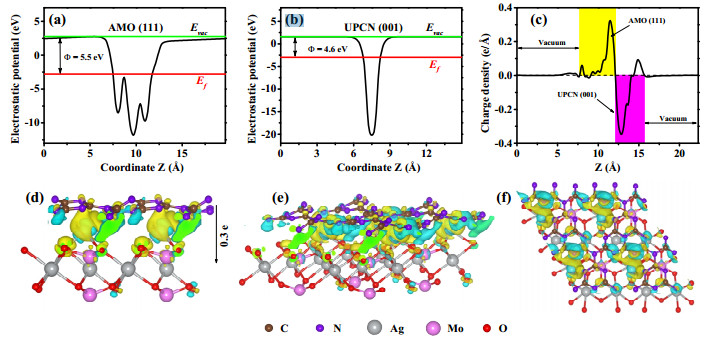
To classify the charge separation and transfer mechanism of UPCN/AMO heterojunction, the work function of AMO (111) and UPCN (001) surface and EDD of UPCN (001)/AMO (111) interface were calculated (Figure 7). The work function of AMO (111) and UPCN (001) surface is respectively 5.5 and 4.6 eV (Figure 7a, b). When the vacuum level (EVac) is defined as zero, the bigger the work function, the more negative the Fermi level (Ef). Therefore, the UPCN Ef is more negative than AMO, indicating when AMO contacts with UPCN, the electron will transfer from UPCN to AMO. The planar-averaged EDD Δρ(z) of UPCN (001)/AMO (111) interface exhibits the electron density of AMO (111) surface is positive (Figure 7c). In contrast, UPCN (001) surface is opposing, which further confirms that electron transfers from UPCN (001) to the AMO (111) surface. To visualize this, the side view (Figure 7d, e) and top view (Figure 7f) of EDD of the UPCN (001)/AMO (111) interface were displayed. The AMO (111) surface is full of yellow, indicating electron accumulation. In contrast, UPCN (001) surface is filled with cyan, denoting the electron depletion, consistent with the work function analysis and planar-averaged EDD Δρ(z). Furthermore, the electron transfer from UPCN (001) to AMO (111) surface quantified by Bader charge is 0.3 e (Figure 7d).
Figure 7
Figure 7.
Work function of (a) AMO (111) and (b) UPCN (001) surface; (c) Planar-averaged electron density difference (EDD) Δρ(z) of UPCN (001)/AMO (111) interface; (d, e) Side view and (f) top view of EDD of UPCN (001)/AMO (111) interface with an isosurface of 1.15 × 10⁻³ e/Å3.
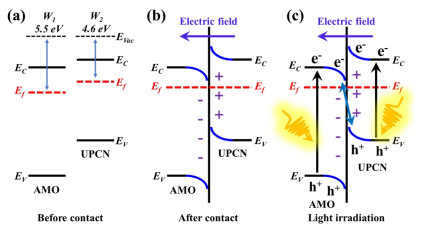
The CO2 photoreduction mechanism of the S-scheme UPCN/AMO composite was sketchily outlined in Figure 8. First, both UPCN and AMO are n-type semiconductors, and the UPCN CB and Ef are more negative than AMO (Figure 4, 7, 8a).[41] Therefore, after AMO contacts with UPCN, the UPCN surface will be positively charged due to electron loss, while the AMO surface will be negatively charged owing to electron accumulation (Figure 8b). An IEF directed from UPCN to AMO surface will form. When UPCN/AMO heterojunction is exposed under illumination, the hole will be excited from VB to CB for AMO and UPCN (Figure 8c). The IEF will drive the photoexcited electrons of AMO CB to recombine with the photoexcited holes on UPCN CB. Accordingly, elevated oxidative holes on AMO VB and intensified reductive electrons on UPCN CB will be reserved. Therefore, S-scheme UPCN/AMO heterojunction achieves charge separation, heightens redox capability, and elevates CO2 photoreduction performance.
Figure 8
Figure 8.
The band structure of UPCN and AMO (a) before and (b) after contact; (c) Charge transfer of UPCN/AMO heterojunction under illumination.
In summary, S-scheme UPCN/AMO composite is dedicatedly fabricated, responsible for raised CO2 photoreduction performance. First, the UPCN NSs benefit the load of AMO NPs, which serves as a key for the formation of UPCN/AMO composite. In addition, AMO NPs promote the charge separation of UPCN and reserve the strong redox capability of UPCN/AMO composite by forming S-scheme heterojunction with UPCN. Moreover, the UPCN NSs also provide massive adsorption sites for CO2 photoreduction. Therefore, the elevated CO2 photoreduction performance originnates from the ultrathin porous sheet-like structure and S-scheme heterojunction. The design strategy for S-scheme UPCN/AMO can be a reference for the artificial photosynthesis of other UPCN-based composites.
EXPERIMENTAL
Preparation of UPCN NSs. 12 g urea was transferred a 50 mL crucible and maintained at 550 ℃ for 2 h in the air. After cooling, the multilayered CN remained. Then the natural CN multilayer was heated to 600 ℃ for 2 h in the air to generate UPCN NSs.[69]
Preparation of UPCN/AMO Composite and Butterfly-like AMO NSs. Typically, CH3COOAg (167 mg) and polyvinyl pyrrolidone (833 mg) were successively put in 50 mL deionized water. Then 375 mg UPCN NSs was added and stirred for a while to ensure these UPCN NSs were sufficiently dispersed. Then, (NH4)6Mo7O24·4H2O (28.5 mM, 2.5 mL) was poured carefully to load the AMO on UPCN NSs. Ultimately, the UPCN/AMO was collected by washing and drying. The butterfly-like AMO NSs were synthesized in the same route without introducing the UPCN NSs.
Characterization. Morphology with elemental distribution was observed on JSM 7500F field emission scanning electron microscope (FESEM), Titan G2 60-300 transmission electron microscopy (TEM), Bruker MultiMode 8 atomic force microscope (AFM), and aberration-corrected high-angle annular dark-field scanning transmission electron microscopy (HAADF-STEM) with energy dispersive X-ray spectrometer (EDS). X-ray diffraction (XRD) patterns and N2 adsorption-desorption (CO2 adsorption) spectra were recorded on Shimadzu XRD-6100 X-ray diffractometer and a Micromeritics ASAP 3020 nitrogen adsorption instrument. XPS was recorded on the Thermo ESCALAB 250Xi apparatus. Electron paramagnetic resonance (EPR) spectroscopy and UV-Vis diffuse reflectance spectra (DRS) were respectively collected on Bruker EXM nano EPR spectrometer and Shimadzu UV-2600 UV-Vis spectrophotometer. Fourier transform infrared (FT-IR) and in-situ DRIFTS were obtained from the Nicolet iS50 spectrometer. Photoelectrochemical tests and SSPL (TRPL) spectra were collected on the CHI660C electrochemical workstation and FLS1000 fluorescence spectrophotometer, respectively.
CO2Photoreduction Test and Computational Details. It is provided in supporting information.
ACKNOWLEDGEMENTS:
This work was supported by the National Natural Science Foundation of China (51572103 and 51973078), the Distinguished Young Scholar of Anhui Province (1808085J14), the Major Projects of Education Department of Anhui Province (KJ2020ZD005), and the Key Foundation of Educational Commission of Anhui Province (KJ2019A0595).
The authors declare no competing interests.
COMPETING INTERESTS
Supplementary information is available for this paper at http://manu30.magtech.com.cn/jghx/EN/10.14102/j.cnki.0254-5861.2022-0108 For submission:https://mc03.manuscriptcentral.com/cjsc ADDITIONAL INFORMATION
Wageh, S.; Al-Hartomy, O. A.; Alotaibi, M. F.; Liu, L. Ionized cocatalyst to promote CO2 photoreduction activity over core-triple-shell ZnO hollow spheres. Rare Metals2022, 41, 1077-1079. doi: 10.1007/s12598-021-01902-1
[4]
Wang, L.; Cheng, B.; Zhang, L.; Yu, J. In situ irradiated XPS investigation on S-scheme TiO2@ZnIn2S4 photocatalyst for efficient photocatalytic CO2 reduction. Small2021, 17, 2103447. doi: 10.1002/smll.202103447
[5]
Ke, X.; Zhang, J.; Dai, K.; Fan, K.; Liang, C. Integrated S-scheme heterojunction of amine-functionalized 1D CdSe nanorods anchoring on ultrathin 2D SnNb2O6 nanosheets for robust solar-driven CO2 conversion. Solar RRL2021, 5, 2000805. doi: 10.1002/solr.202000805
[6]
Liu, S.; Chen, W.; Li, Y.; Ding, K.; Zhang, Y.; Lin, W. Mechanism on carbon vacancies in polymeric carbon nitride for CO2 rhotoreduction. Chin. J. Struct. Chem.2020, 39, 2068-2076. http://doc.paperpass.com/journal/20200248jghx.html
Zhang, J.; Fu, J.; Dai, K. Graphitic carbon nitride/antimonene van der Waals heterostructure with enhanced photocatalytic CO2 reduction activity. J. Mater. Sci. Technol.2022, 116, 192-198. doi: 10.1016/j.jmst.2021.10.045
[9]
Zhang, M.; Yi, J.; Huang, Y.; Cao, R. Covalent triazine frameworks-derived N, P dual-doped porous carbons for highly efficient electrochemical reduction of CO2. Chin. J. Struct. Chem.2021, 40, 1213-1222. http://doc.paperpass.com/journal/20210159jghx.html
[10]
Sayed, M.; Xu, F.; Kuang, P.; Low, J.; Wang, S.; Zhang, L.; Yu, J. Sustained CO2-photoreduction activity and high selectivity over Mn, C-codoped ZnO core-triple shell hollow spheres. Nat. Commun.2021, 12, 4936. doi: 10.1038/s41467-021-25007-6
[11]
Wang, Z.; Fan, J.; Cheng, B.; Yu, J.; Xu, J. Nickel-based cocatalysts for photocatalysis: hydrogen evolution, overall water splitting and CO2 reduction. Mater. Today Phys.2020, 15, 100279. doi: 10.1016/j.mtphys.2020.100279
[12]
Zhao, X.; Zhuo, D.; Chen, Q.; Guo, G. Enhancing electrochemical reduction of CO2 to formate by regulating the support morphology. Chin. J. Struct. Chem.2021, 40, 376-382. http://doc.paperpass.com/journal/20210096jghx.html
[13]
Li, M.; Li, J.; Wu, M.; Wang, X. First-principles study on the properties of CaO (100) surface adsorbing carbon dioxide. Chin. J. Struct. Chem.2021, 40, 973-984. http://d.wanfangdata.com.cn/periodical/jghx202108001
Sayed, M.; Zhu, B.; Kuang, P.; Liu, X.; Cheng, B.; Al Ghamdi, A.; Wageh, S.; Zhang, L.; Yu, J. EPR investigation on electron transfer of 2D/3D g-C3N4/ZnO S-scheme heterojunction for enhanced CO2 photoreduction. Adv. Sustain. Syst.2022, 6, 2100264. doi: 10.1002/adsu.202100264
[18]
Xu, C.; Lv, P. Photo-assisted deposited titanium dioxide film and the enhancement of its photocatalytic water splitting activity. Chin. J. Struct. Chem.2021, 40, 1223-1230. http://qikan.cqvip.com/Qikan/Article/Detail?id=7105828633
[19]
Li, M.; Guan, R.; Li, J.; Zhao, Z.; Zhang, J.; Dong, C.; Qi, Y.; Zhai, H. Performance and mechanism research of Au-HSTiO2 on photocatalytic hydrogen production. Chin. J. Struct. Chem.2020, 39, 1437-1443. http://www.cqvip.com/QK/95925X/202008/7102810052.html
Zhang, J.; Liao, H.; Sun, S. Construction of 1D/1D WO3 nanorod/TiO2 nanobelt hybrid heterostructure for photocatalytic application. Chin. J. Struct. Chem.2020, 39, 1019-1028. http://d.wanfangdata.com.cn/periodical/jghx202006004
Guo, H.; Ding, J.; Wan, S.; Wang, Y.; Zhong, Q. Highly efficient CH3OH production over Zn0.2Cd0.8S decorated g-C3N4 heterostructures for the photoreduction of CO2. Appl. Surf. Sci.2020, 528, 146943. doi: 10.1016/j.apsusc.2020.146943
[35]
Huo, Y.; Zhang, J.; Dai, K.; Li, Q.; Lv, J.; Zhu, G.; Liang, C. All-solid-state artificial Z-scheme porous g-C3N4/Sn2S3-DETA heterostructure photocatalyst with enhanced performance in photocatalytic CO2 reduction. Appl. Catal. B: Environ.2019, 241, 528-538. doi: 10.1016/j.apcatb.2018.09.073
[36]
Thanh Truc, N. T.; Hanh, N. T.; Nguyen, M. V.; Le Chi, N. T. P.; Van Noi, N.; Tran, D. T.; Ha, M. N.; Trung, D. Q.; Pham, T. -D. Novel direct Z-scheme Cu2V2O7/g-C3N4 for visible light photocatalytic conversion of CO2 into valuable fuels. Appl. Surf. Sci.2018, 457, 968-974. doi: 10.1016/j.apsusc.2018.07.034
[37]
Liang, M.; Borjigin, T.; Zhang, Y.; Liu, H.; Liu, B.; Guo, H. Z-Scheme Au@Void@g-C3N4/SnS yolk-shell heterostructures for superior photocatalytic CO2 reduction under visible light. ACS Appl. Mater. Interfaces2018, 10, 34123-34131. doi: 10.1021/acsami.8b09455
[38]
Li, M.; Zhang, L.; Fan, X.; Wu, M.; Wang, M.; Cheng, R.; Zhang, L.; Yao, H.; Shi, J. Core-shell LaPO4/g-C3N4 nanowires for highly active and selective CO2 reduction. Appl. Catal. B: Environ.2017, 201, 629-635. doi: 10.1016/j.apcatb.2016.09.004
[39]
Wang, Z.; Zhang, J.; Lv, J.; Dai, K.; Liang, C. Plasmonic Ag2MoO4/AgBr/Ag composite: excellent photocatalytic performance and possible photocatalytic mechanism. Appl. Surf. Sci.2017, 396, 791-798. doi: 10.1016/j.apsusc.2016.11.031
Huo, Y.; Wang, Z.; Zhang, J.; Liang, C.; Dai, K. Ag SPR-promoted 2D porous g-C3N4/Ag2MoO4 composites for enhanced photocatalytic performance towards methylene blue degradation. Appl. Surf. Sci.2018, 459, 271-280. doi: 10.1016/j.apsusc.2018.08.005
[42]
Yu, W.; Xu, D.; Peng, T. Enhanced photocatalytic activity of g-C3N4 for selective CO2 reduction to CH3OH via facile coupling of ZnO: a direct Z-scheme mechanism. J. Mater. Chem. A2015, 3, 19936-19947. doi: 10.1039/C5TA05503B
[43]
Cai, H.; Li, N.; Li, Y.; An, D. Solvothermal synthesis and characterization of two Cd(Ⅱ) coordination polymers with isomeric multi-carboxylate ligands. Chin. J. Struct. Chem.2021, 40, 637-645. http://qikan.cqvip.com/Qikan/Article/Detail?id=7104893026
[44]
Yan, L.; Meng, X.; Xu, Y.; Liu, W. Synthesis, crystal structure, theoretical calculation, and photophysical property of a new Cd(Ⅱ) complex based on N-heterocyclic ligand and isophthalic acid. Chin. J. Struct. Chem.2021, 40, 329-333. http://qikan.cqvip.com/Qikan/Article/Detail?id=7104464990
Chang, X.; Yang, X.; Zhai, Z.; Chen, J.; Li, F. Synthesis, structure and highly enhanced phosphorescence of a cadmium(Ⅱ) coordination polymer assembled with 1, 4-naphthalenedicarboxylic acid and 2-propylimidazole. Chin. J. Struct. Chem.2021, 40, 187-192.
[47]
Bi, M.; Wen, Y.; Zhang, H.; Zhang, J. Syntheses, crystal structures and properties of two new Zn based boron imidazolate frameworks. Chin. J. Struct. Chem.2021, 40, 865-870. http://doc.paperpass.com/journal/20210103jghx.html
Wu, X.; Liu, M.; Guo, H.; Ying, S.; Chen, Z. Polyoxovanadate-based MOFs microsphere constructed from 3-D discrete nano-sheets as supercapacitor. Chin. J. Struct. Chem.2021, 40, 994-998. http://d.wanfangdata.com.cn/periodical/jghx202108003
[50]
Huang, Y.; Mei, F.; Zhang, J.; Dai, K.; Dawson, G. Construction of 1D/2D W18O49/porous g-C3N4 S-scheme heterojunction with enhanced photocatalytic H2 evolution. Acta Phys. Chim. Sin.2022, 38, 2108028.
[51]
Wang, Z.; Huo, Y.; Zhang, J.; Lu, C.; Dai, K.; Liang, C.; Zhu, G. Facile preparation of two-dimensional Bi2MoO6@Ag2MoO4 core-shell composite with enhanced visible light photocatalytic activity. J. Alloys Compd.2017, 729, 100-108. http://www.onacademic.com/detail/journal_1000040074836810_2686.html
[52]
Sun, J.; Liu, H.; Liu, T. Synthesis, crystal structure and characterization of a new hydrogen-bonded organic framework. Chin. J. Struct. Chem.2021, 40, 1082-1087. http://doc.paperpass.com/journal/20210136jghx.html
[53]
Li, X.; Zhang, J.; Dai, K.; Fan, K.; Liang, C. Cd3(C3N3S3)2 polymer/Sn Schottky heterojunction for broadband-solar highly selective photocatalytic CO2 reduction. Solar RRL2021, 5, 2100788. doi: 10.1002/solr.202100788
[54]
Huo, Y.; Zhang, J.; Wang, Z.; Dai, K.; Pan, C.; Liang, C. Efficient interfacial charge transfer of 2D/2D porous carbon nitride/bismuth oxychloride step-scheme heterojunction for boosted solar-driven CO2 reduction. J. Colloid Interface Sci.2021, 585, 684-693. http://www.sciencedirect.com/science/article/pii/S0167577X20314294
[55]
Li, Z.; Wu, Z.; He, R.; Wan, L.; Zhang, S. In2O3-x(OH)y/Bi2MoO6 S-scheme heterojunction for enhanced photocatalytic performance. J. Mater. Sci. Technol.2020, 56, 151-161.
[56]
Xia, P.; Cao, S.; Zhu, B.; Liu, M.; Shi, M.; Yu, J.; Zhang, Y. Designing a 0D/2D S-scheme heterojunction over polymeric carbon nitride for visible-light photocatalytic inactivation of bacteria. Angew. Chem. Int. Ed.2020, 59, 5218-5225. http://pubmed.ncbi.nlm.nih.gov/31944512/
Huang, Y.; Mao, J.; Qian, Q.; Xue, H.; Liu, Y. Study on the different photocatalytic performances for tetracycline hydrochloride degradation of p-block metal composite oxides Sr1.36Sb2O6 and Sr2Sb2O7. Chin. J. Struct. Chem.2021, 40, 394-402.
Xu, F.; Meng, K.; Cao, S.; Jiang, C.; Chen, T.; Xu, J.; Yu, J. Step-by-step mechanism insights into the TiO2/Ce2S3 S-scheme photocatalyst for enhanced aniline production with water as a proton source. ACS Catal.2021, 12, 164-172. http://www.nstl.gov.cn/paper_detail.html?id=898625dc2803e78a666e60a3ceafa72d
[62]
Wang, Z.; Cheng, B.; Zhang, L.; Yu, J.; Li, Y.; Wageh, S.; Al-Ghamdi, A. A. S-Scheme 2D/2D Bi2MoO6/BiOI van der Waals heterojunction for CO2 photoreduction. Chin. J. Catal.2022, 43, 1657-1666.
[63]
Yang, H.; Zhang, J. F.; Dai, K. Organic amine surface modified one-dimensional CdSe0.8S0.2-diethylenetriamine/two-dimensional SnNb2O6 S-scheme heterojunction with promoted visible-light-driven photocatalytic CO2 reduction. Chin. J. Catal.2022, 43, 255-264. http://www.sciencedirect.com/science/article/pii/S1872206720637846
[64]
Hu, T.; Dai, K.; Zhang, J.; Chen, S. Noble-metal-free Ni2P modified step-scheme SnNb2O6/CdS-diethylenetriamine for photocatalytic hydrogen production under broadband light irradiation. Appl. Catal. B: Environ.2020, 269, 118844.
[65]
Wu, H.; Xu, Y.; Miao, T.; Fu, X.; Shi, H.; Qian, L. Probing photocatalytic hydrogen evolution of cobalt complexes: experimental and theoretical methods. Chin. J. Struct. Chem.2021, 40, 1696-1709. http://qikan.cqvip.com/Qikan/Article/Detail?id=7106340968
[66]
Liang, Y.; Xu, X.; Ni, J.; Li, J.; Wang, F. Synthesis, structure and fluorescence property of new Cd-MOFs based on a tetraphenylethylene (TPE) ligand. Chin. J. Struct. Chem.2021, 40, 193-198. http://www.cqvip.com/QK/95925X/20195/7002172911.html
[67]
Wang, Z.; Cheng, B.; Zhang, L.; Yu, J.; Tan, H. BiOBr/NiO S-scheme heterojunction photocatalyst for CO2 photoreduction. Solar RRL2022, 6, 2100587. doi: 10.1002/solr.202100587
[68]
Deng, H.; Fei, X.; Yang, Y.; Fan, J.; Yu, J.; Cheng, B.; Zhang, L. S-scheme heterojunction based on p-type ZnMn2O4 and n-type ZnO with improved photocatalytic CO2 reduction activity. Chem. Eng. J.2021, 409, 127377.
[69]
Lei, G.; Cao, Y.; Zhao, W.; Dai, Z.; Shen, L.; Xiao, Y.; Jiang, L. Exfoliation of graphitic carbon nitride for enhanced oxidative desulfurization: a facile and general strategy. ACS Sustain. Chem. Eng.2019, 7, 4941-4950.
Figure 1
(a) Diagram illustration for the formation process of UPCN/AMO composite; FESEM images of (b) UPCN NSs, (c) AMO NSs and (d) UPCN/AMO composite; TEM images of (e, f) UPCN NSs, (g) AMO NSs and (h) UPCN/AMO composite; (i) HRTEM image, (j, k) HAADF image and corresponding elements mappings of UPCN/AMO composite.
Figure 2
(a) XRD patterns, (b) FT-IR spectra, (c) N2 adsorption-desorption isotherms and corresponding pore-size distribution (inset), and (d) CO2 adsorption isotherms of AMO, UPCN and UPCN/AMO composite.
Figure 6
(a) CO2 photoreduction performance of various samples; (b) Three successive CO2 photoreduction tests and (c) In situ DRIFTS of UPCN/AMO composite; (d) Illustration of CO2 photoreduction process.
Figure 7
Work function of (a) AMO (111) and (b) UPCN (001) surface; (c) Planar-averaged electron density difference (EDD) Δρ(z) of UPCN (001)/AMO (111) interface; (d, e) Side view and (f) top view of EDD of UPCN (001)/AMO (111) interface with an isosurface of 1.15 × 10⁻³ e/Å3.
Table 1.
The TRPL Decay Plots Can Be Fitted by the Multi-exponential Eq. 4. $I(t) = I_{0} + A_{1}\exp(-t/τ_{1}) + A_{2}\exp(-t/τ_{2}) + A_{3}\exp(-t/τ_{3}) \quad\quad\quad (4)$$τ = (A_{1}τ_{1}^{2} + A_{2}τ_{2}^{2} + A_{3}τ_{3}^{2})/(A_{1}τ_{1} + A_{2}τ_{2} + A_{3}τ_{3}) \quad\quad\quad (5)$ where I0 represent the baseline value; Ai and τi (i = 1, 2, 3) are the relative intensity and lifetime indexed to the interior, surficial, and interfacial charge recombination. The average lifetime (τ) is calculated by Eq. 5. The fitting detail is summarized below.



 DownLoad:


 下载:
下载:



