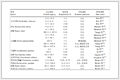
Table 1.
Crystal Data and Structure Refinement for the Compounds

Syntheses, Crystal Structures and Properties of Two Coordination Polymers Based on Bisbenzimidazole
Qiang-Qiang JIA , Min WAN , Liang TONG , Zheng XING , Guo-Xi WANG , Li-Zhuang CHEN


In the history of heterocyclic chemistry[1-6], benzimidazole and its derivative are widely used in many fields due to its unique properties[7], such as drug synthesis[8], coordination chemistry[9-10], bioinorganic chemistry fields, etc. Benzimidazole derivatives could be designed and synthesized as special ligands, and used as monodentate/bidentate ligand due to their unique structures to construct structural diversity metal organic frameworks(MOFs)[11-15]. Recently, bisbenzimidazole compounds have been perused and attracted widespread attention[16]. A large number of bisbenzimidazole ligands have been synthesized including rigid[17] and semi-rigid[18] structures which break through single coordination mothed of benzimidazole. Therefore, the structures of the synthesized compounds are even more diverse and interesting, and their properties are more preferable[19].
In this work, two novel compounds were synthesized via volatilization method with bis(1H-benzo[d]imidazol-2-yl)methane (Bim), and their structures were determined by single-crystal X-ray diffraction. According to the structure rigidity of compounds, their fluorescence properties were directly confirmed by photoluminescence spectroscopy measurements. Furthermore, their chemical structure thermal stability and dielectric properties were investigated, indicating their potential as multifunctional materials under a wide temperature range.
All reagents from commercial sources were used without purification. Thermo-gravimetric analysis (TGA) was showed in the environment of nitrogen at a heating rate of 10 K·min–1 in the range of 20~800 ℃. IR test was recorded by infrared spectrometer (KBr tablet) with wave number 400~4000 cm–1. Powder X-ray diffraction test conditions: tube voltage 40 kV, tube current 10 mA, CuKα radiation, wavelength 1.5406 Å, test angle range 5~50°, step 0.02° and scanning speed 6 °/min. The sample was ground into powder in an agate mortar and pressed into a tablet press, and a 7mm × 2mm × 0.4mm (length, width, and height) sample was cut and tested using a conductive silver paste fixed on a six-claw electrode. The test frequency range was 500 Hz~1 MHz. Fluorescence properties of compounds were also studied at room temperature.
Crystals of compounds with moderate size and complete appearance were selected for single-crystal X-ray diffraction analysis. Data collections were performed with a multi-scan mode at 296(2) K in the ranges of 2.4° < θ < 24.9° (1) and 2.3° < θ < 26.4° (2) on a Bruker SMART APEX-II CCD diffractometer equipped with MoKα radiation (λ = 0.71073 Å). The data sets were corrected by empirical absorption correction using SADABS. The final refinement gave R(1) = 0.0498 and R(2) = 0.0517, wR(1) = 0.0902 and wR(2) = 0.0556, respectively. The crystal structures were solved by direct methods and refined by full-matrix least-squares method on F2 by means of SHELXL software package. All non-hydrogen atoms were refined anisotropically and all hydrogen atoms were located and refined geometrically. Furthermore, calculations of distances and angles between some atoms were performed by DIAMOND or SHELXL. Crystalgraphy data of compound 1 and 2 are listed in Table 1.
 DownLoad:
CSV
DownLoad:
CSV
| Compounds | 1 | 2 |
| Empirical formula | C15H10CuIN4O | C15H10CdCl2N4O |
| Formula weight | 452.71 | 445.57 |
| Temperature (K) | 296 | 296 |
| Crystal system | Monoclinic | Triclinic |
| Space group | P21/c | P |
| a (Å) | 9.2614(2) | 9.2545(12) |
| b (Å) | 17.7440(3) | 10.0645(13) |
| c (Å) | 9.6480(2) | 10.0645(13) |
| α (°) | 90 | 93.91 |
| β (°) | 113.886(1) | 113.604(2) |
| γ (°) | 90 | 113.604(2) |
| V (Å3) | 1449.70(5) | 757.42(17) |
| Z | 4 | 2 |
| F(000) | 872 | 436 |
| ρcalcd./g·cm–3 | 2.074 | 1.954 |
| μ(mm-1) | 3.64 | 1.80 |
| θ range (º) | 2.4 to 24.9 | 2.3 to 21.6 |
| Collected reflections | 3193 | 5758 |
| Unique reflections | 2443 | 1943 |
| R, wR (I > 2σ(I)) | 0.0283 to 0.0681 | 0.0328 to 0.0504 |
| R, wR (all data) | 0.0498 to 0.0902 | 0.0517 to 0.0556 |
The synthesis of bis(1H-benzo[d]imidazol-2-yl)methane is based on experimental methods reported by previous literature[20] with a slight modification that malonic acid was replaced by malononitrile (Scheme 1). Malononitrile (3 mmol, 3.380 g), o-phenylenediamine (6.6 mmol, 7.1280 g) and hydrochloric acid (4 mol/L, 30 mL) were added to a flask, followed by evacuating and ventilating nitrogen for three times to form an oxygen-free environment. The mixture was heated to 120 ℃ and kept for 12 h. When the temperature dropped to ca. 70 ℃, the reaction mixture was poured into ice water (200 mL). After adjusting pH to 10 with NaOH solution, a large amount of white solid was precipitated. Then it was filtered by suction operation, and the filter cake was washed with water for several times. The cake was dried overnight at 60 ℃ in an oven. Recrystallization from ethanol gave a white crystalline powder bis(1H-benzo[d]imidazol-2-yl)methane (6.72 g, yield 79%). ESI-MS(m/z): [M-H]- 247.6; [M+H]+248.3. FT-IR (KBr, cm-1): 3434(m), 2767(w), 2627(s), 2549(w), 1614(w), 1463(s, -CH2-), 1402(s), 1318(s), 1284(m), 1256(m), 1150(w), 1105(w), 982(w), 915(s), 853(s), 736(s), 641(m), 596(w), 506(w).

Synthesis of [Bim(C=O)CuI]2 A mixture of bis(1H-benzo[d]imidazol-2-yl)methane (281 mg, 10 mmol), CuI (313 mg, 20 mmol), methanol (10 mL) and water (10mL) was added to a 50 mL beaker. The mixture was stirred for 10 minutes, and then the insoluble matter was filtered off to give a transparent solution. This resulting solution was placed in shady and dark place to evaporate slowly. Few days later, a slight yellow crystal was obtained with a yield of 48% (based on Cu). Anal. Calcd. for [C15H10ICuN4O] (%): C, 44.33; H, 2.46; N, 13.80. Found (%): C, 42.67; H, 4.85; N, 14.06. FT-IR (KBr, cm-1): 3443(m), 2745(m), 2633(s), 2555(w), 1952(m), 1745(w, C=O), 1611(s, C=N), 1477(s, C=N), 1382(m), 1293(m), 1215(s), 1019(s), 852(s), 740(s), 617(m), 427(m).
Synthesis of [Bim(C=O)CdCl2]2 The CuI was replaced by CdCl2 with other conditions unchanged. Few days later, a slight yellow crystal was obtained with a yield of 53% (based on Cd). Anal. Calcd. for C15H10CdCl2N4O (%): C, 39.73; H, 2.21; N, 14.13. Found (%): C, 40.50; H, 3.45; N, 14.06. FT-IR (KBr, cm-1): 3501(m), 2725(m), 2643(s), 2547(w), 1952(m), 1746(w, C=O), 1604(s, C=N), 1480(s, C=N), 1379(m), 1300(m), 1215(s), 1021(s), 857(s), 739(s), 615(m), 425(m).
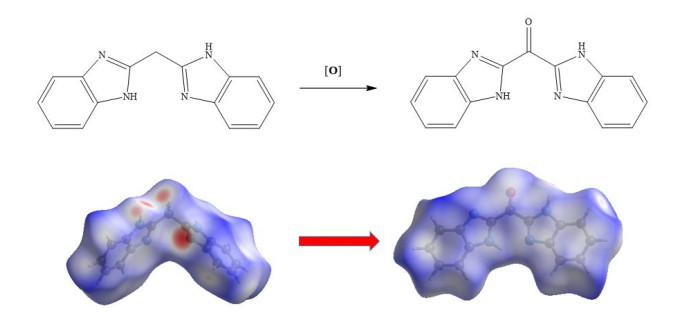
According to literature[21-24], under aerobic conditions, the methylene group is easily oxidized to a carbonyl group. In this way, the central carbon atom is changed from the original sp3 to the sp2 hybridization, which increases its out-side-ring conjugation, thus making the compound more stable (Scheme 2).
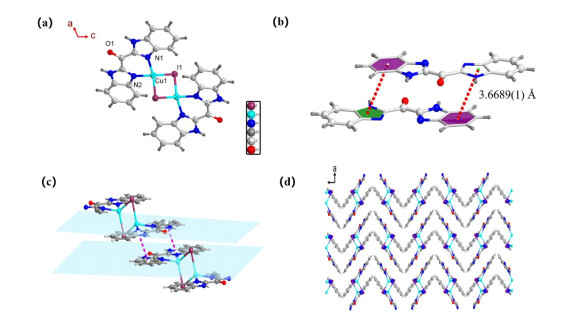
Structure of compound 1 A transparent single crystal with regular shape and moderate size was selected for single-crystal X-ray diffraction analysis. The results show (Fig. 1) that the structure adopts monoclinic P21/c space group. The crystal is a binuclear metal-organic structure. Each copper atom is connected by two bromine and two nitrogen atoms. The iodine atom that bridges with two copper atoms leads to a high symmetry structure. The distances between copper and iodine atoms are 2.7029(19) and 2.5765(17) Å, and those of copper and nitrogen atoms are 2.071(9) and 2.063(10) Å, all within normal ranges[21, 22]. It can be seen from the packing diagram that the structure presents a zigzag shape through chemical force accumulation (π-π accumulation, van der Waals force). Besides, the distance between two centroids is 3.6689(1) Å and the dihedral angle is 0.00°. Interestingly, methylene in the benzimidazole ligand is oxidized to carbonyl group, in which the C-atom converts to sp2 from the original sp3, increasing the extra-cyclic conjugation effect of the ligands. Parts of the major bond lengths and bond angles are listed in Table 2.
 DownLoad:
CSV
DownLoad:
CSV
| Bond | Dist. | Angle | (°) | |
| Cu(1)–I(1) | 2.5748(6) | Cu(1i)–I(1)–Cu(1) | 68.584(19) | |
| Cu(1)–N(1) | 2.058(3) | I(1i)–Cu(1)–I(1) | 111.416(19) | |
| Cu(1)–N(2) | 2.054(3) | N(2)–Cu(1)–I(1) | 107.68(9) | |
| C(8)–O(1) | 1.219(5) | N(1)–Cu(1)–I(1) | 110.55(9) | |
| Symmetry code: i : –x, y+1/2, –z+1/2 | ||||
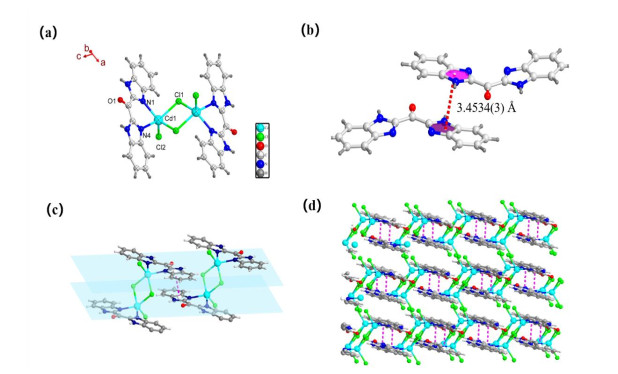
Structure of compound 2 Compound 2 (Fig. 2) is similar to 1 except that the Cd atom adopts a five-coordination mode to balance the charge. The distances between cadmium and chlorine atoms are 2.6238(15) to 2.4031(12) Å, and the lengths of cadmium and nitrogen atoms are 2.300(4) to 2.302(4) Å. In π-π stacking, the centroids distance is 3.3730(3) Å and the dihedral angle is 0.000(2)°. Major bond lengths and bond angles are listed in Table 3.
 DownLoad:
CSV
DownLoad:
CSV
| Bond | Dist. | Angle | (°) | |
| Cd(1)–Cl(1) | 2.6238(15) | Cl(1)–Cd(1)–Cl(1i) | 79.32(4) | |
| Cd(1)–Cl(2) | 2.4031(12) | Cl(1)–Cd(1)–Cl(2) | 108.58(5) | |
| Cd(1)–N(1) | 2.300(4) | N(4)–Cd(1)–Cl(1) | 146.62(10) | |
| Cd(8)–N(4) | 2.302(4) | N(1)–Cd(1)–Cl(1) | 90.05(11) | |
| Symmetry code : i: –x, –y, –z | ||||
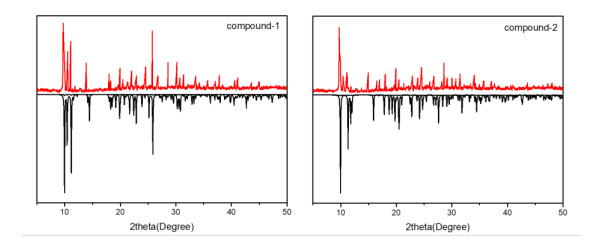
According to powder X-ray diffraction analysis (Fig. 3), the PXRD of two newly prepared compounds is completely consistent with their calculated peak positions. Therefore, it can be preliminarily determined that two compounds are pure products.
The fluorescence and luminescence properties of the compounds are interesting. According to the principle of fluorescence emission the possible reasons are electronic transitions (including π-π* and n-π* transitions) or structural rigidity, non-covalent bonding, large conjugated systems and diamagnetic metals[25]. When energy provided (ultraviolet light, heat, pressure, etc.), it could show strong fluorescence emission and even aggregation-induce emission (AIE). Recently, cuprous iodide clusters have been used to induce complex luminescence and better results are obtained. The solid-state fluorescent spectrum of compounds 1 and 2 at room temperature reveals maximal emission peaks at 440 and 475 nm (Fig. 4a), suggesting both compounds are potential blue purple luminescent materials.
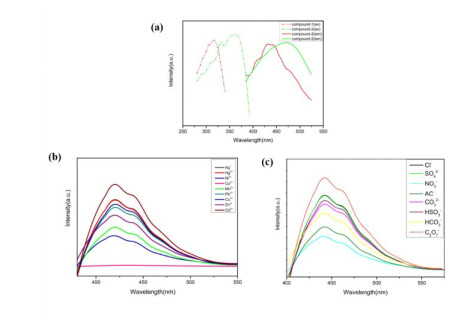
Through aggregation concentration quenching (ACQ) experiment, the fluorescence of compound 1 is greatly weakened or even disappears with the existence of Co2+ (Fig. 4b, 4c). The possible reason is the paramagnetic effect of such ions, which causes the excited electrons to be captured by the metal. To a certain extent, electronic transition is restricted and makes fluorescence quenched.
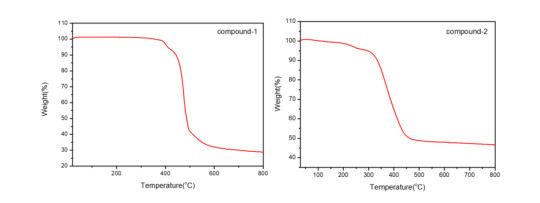
In order to further study the thermal stability of the compounds, thermogravimetric analysis was performed. In the thermogravimetric curve (Fig. 5), compound 1 began to lose weight at ca 400 ℃, and completely collapsed until 500 ℃. Compared to 1, 2 was completely decomposed until 450 ℃. It can be known that both compounds 1 and 2 have better stability.
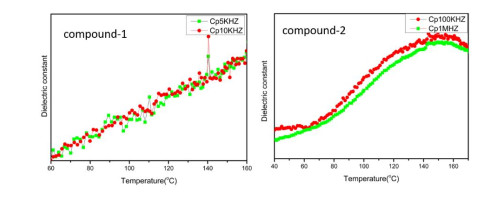
Dielectric test (Fig. 6) showed that compounds 1 and 2 are both positive dielectric materials as the dielectric constant gradually increases with increasing the temperature at different frequencies.
Two novel coordination polymers [Bim(C=O)CuI]2 (1) and [Bim(C=O)CdBr2]2 (2) were synthesized via volatilization method by using bis(1H-benzo[d]imidazol-2-yl)methane (Bim) as the flexible ligand. Interestingly, methylene (CH2) in Bim was oxidized to carbonyl (C=O) in air. The fluorescence emission spectra of 1 and 2 reaches maximum around 440 and 475 nm, which indicate the potential application in LED field. Especially for compound 1, its fluorescence is quenched when cobalt ion exists in solution. Both two compounds are positive dielectric materials within a wide temperature range for their remarkable thermal stability.
Rouffet, M.; de Oliveira, C. A. F.; Udi, Y.; Agrawal, A.; Sagi, I.; McCammon, J. A.; Cohen, S. M. From sensors to silencers: quinoline- and benzimidazole-sulfonamides as inhibitors for zinc proteases. J. Am. Chem. Soc. 2010, 132, 8232–8233. doi: 10.1021/ja101088j
Chen, L. Z.; Liao, W. Q.; Ai, Y.; Li, J. Y.; Deng, S. Y.; Hou, Y. L.; Tang, Y. Y. Precise molecular design toward organic-inorganic zinc chloride ABX3 ferroelectrics. J. Am. Chem. Soc. 2020, 142, 6236–6243. doi: 10.1021/jacs.0c00315
Liu, H. Y.; Zhang, H. Y.; Chen, X. G.; Xiong, R. G. Molecular design principles for ferroelectrics: ferroelectrochemistry. J. Am. Chem. Soc. 2020, 142, 15205–15218. doi: 10.1021/jacs.0c07055
Li, J. Y.; Xu, Q. L.; Ye, S. Y.; Tong, L.; Chen, X.; Chen, L. Z. A multiaxial molecular ferroelectric with record high TC designed by intermolecular interaction modulation. Chem. Commun. 2021, 57, 943–946. doi: 10.1039/D0CC07377F
Su, Y. J.; Cui, Y. L.; Wang, Y.; Lin, R. B.; Zhang, W. X.; Zhang, J. P.; Chen, X. M. Copper(Ⅰ) 2-isopropylimidazolate: supramolecular isomerism, isomerization, and luminescent properties. Cryst. Growth. Des. 2015, 15, 1735–1739. doi: 10.1021/cg501737j
Chen, Z. X.; Jiang, Y. W.; Zhang, L.; Guo, Y. L.; Ma, D. W. Oxalic diamides and tert-butoxide: two types of ligands enabling practical access to alkyl aryl ethers via Cu-catalyzed coupling reaction. J. Am. Chem. Soc. 2019, 141, 3541–3549. doi: 10.1021/jacs.8b12142
Zhang, X. L.; Jin, M. F.; Feng, Y. Q. Syntheses, crystal structures and luminescent properties of two new Zn(Ⅱ) coordination polymers based on rigid biphenyldicarboxylate. Inorg. Chem. Comm. 2011, 14, 952–955. doi: 10.1016/j.inoche.2011.03.040
Chen, C. H.; Shi, J.; Tang, C. W. Recent developments in molecular organic electroluminescent materials. Macromol. Res. 1998, 125, 1–48.
Xu, G. C.; Qin, H.; Okamura, T. K.; Bai, Z. S.; Ding, J.; Huang, Y. Q.; Liu, G. X. Cadmium(Ⅱ) coordination polymers with flexible tetradentate ligand 1, 2, 4, 5-tetrakis(imidazol-1-ylmethyl)benzene: anion effect and reversible anion exchange property. CrystEngComm. 2008, 11, 205–374.
Liu, X. C.; Guo, X. L.; Niu, Y. Y.; Wang, Q. L.; Cui, Q. Synthesis and structure of a CdI2 coordination polymer with 1, 4-bis(benzimidazole-1-yl-methylene)benzene (bbmb). J. Chem. Crystallogr. 2009, 39, 147–150. doi: 10.1007/s10870-008-9445-4
Dong, B. X.; Xu, Q. Structural investigation of flexible 1, 4-bis(1, 2, 4-triazol-1-ylmethyl)benzene ligand in keggin-based polyoxometalate frameworks. Cryst. Growth. Des. 2009, 9, 2776–2782. doi: 10.1021/cg9000076
Hou, G. F.; Bi, L. H.; Li, B.; Wu, L. X. Reaction controlled assemblies of polyoxotungstates (-molybdates) and coordination polymers. Inorg. Chem. 2010, 49, 6474–6483. doi: 10.1021/ic1001495
Xu, C. Y.; Li, L. K.; Wang, Y. P.; Guo, Q. Q.; Hou, H. W. Three-dimensional Cd(Ⅱ) coordination polymers based on semirigid bis(methylbenzimidazole) and aromatic polycarboxylates: syntheses, popological structures and photoluminescent properties. Cryst. Growth Des. 2011, 11, 4667–4675. doi: 10.1021/cg200961a
Meng, X. R.; Song, Y. L.; Hou, H. W. Hydrothermal syntheses, crystal structures, and characteristics of a series of Cd−btx coordination polymers (btx = 1, 4-bis(triazol-1-ylmethyl)benzene). Inorg. Chem. 2004, 43, 3528−3536. doi: 10.1021/ic0354670
Hou, H. W.; Ma, K.; Zhao, Y. G.; Han, X.; Meng, X. R. Interestingly pH-responsible behavior in benzothiadiazole-derived coordination polymer constructed via a situ click synthesis. Cryst. Growth. Des. 2018, 18, 12, 7419–7425.
Zhao, Y. L.; Wu, C.; Qiu, P. L.; Li, X. P.; Wang, Q.; Chen, J. S. New benzimidazole-based bipolar sosts: highly efficient phosphorescent and thermally activated delayed fluorescent OLEDs employing the same device structure. ACS Appl. Mater. Interfaces 2016, 8, 4, 2635–2643.
Avishek, D.; SaibalBera, K. B. Cocrystals and salts of pyridine-3, 5-bis(1-methyl-benzimidazole-2-yl) with pyromellitic acid: aromatic guest inclusion and separation via benzimidazole-carboxylic acid heterosynthon. Cryst. Growth. Des. 2015, 15, 1, 318–325.
Sachio, H.; Satoshi, I.; Aoyagi, S. Hydrogen-bonded architectures and field-induced polarization switching in bridged bis(benzimidazole) crystals. Cryst. Growth. Des. 2019, 19, 1, 328–335.
Yao, H. C.; Li, M. M.; Yang, G. S.; Li, Z. J.; Zhu, Y. Ketonization of methylene of bis(benzimidazol-2-yl)methane by molecular oxygen under the catalysis of cobalt(Ⅱ) ion. Inorg. Chim. Acta 2007, 360, 3959–3964. doi: 10.1016/j.ica.2007.04.042
Sobkowiak, A.; Sawyer, D. T. Cobalt(Ⅱ)-induced activation of dioxygen for the dehydrogenation of N-methylanilines and benzyl alcohol. J. Am. Chem. Soc. 1991, 113, 9520–9523. doi: 10.1021/ja00025a016
Costa, P.; Lohmiller, T.; Trosien, I.; Savitsky, A.; Lubitz, W.; Fernandez-Oliva, M.; Sander, W. Light and temperature control of the spin state of bis(p-methoxyphenyl)carbene: a magnetically bistable carbene. J. Am. Chem. Soc. 2016, 138, 1622–1629. doi: 10.1021/jacs.5b11696
Kang, M. P.; Luo, D. P.; Lin, Z. E.; Thielec, G.; Stefanie, D. Crystalline beryllium carboxylate frameworks containing inorganic chains of BeO4 tetrahedra. CrystEngComm. 2013, 13, 1845.
Hao, P. F.; Zhu, H. H.; Pang, Y.; Fu, Y. L. The impact of positional isomerism on electronic and photochromic properties of 1D zinc-based naphthalene diimide coordination polymers. CrystEngComm. 2020, 20, 3371–3377.
Hao, P. F.; Zhu, H. H.; Pang, Y.; Fu, Y. L. Positional isomerism controlled electronic and photochromic properties of naphthalene diimide-based chlorozincate hybrids. Cryst. Growth. Des. 2020, 20, 345–351. doi: 10.1021/acs.cgd.9b01271
Chrisstoffels, L. A. J.; Adronov, A.; Fréchet, J. M. J. Surface-confined light harvesting, energy transfer, and amplification of fluorescence emission in chromophore-labeled self-assembled monolayers. Angew Chem. Int. Engl. 2000, 39, 2163–2167. doi: 10.1002/1521-3773(20000616)39:12<2163::AID-ANIE2163>3.0.CO;2-X

Figure 1 Structure of compound 1. (a) Coordination environment. (b) π-π stacking diagram. (c) Schematic diagram of dihedral angle. (d) Stacking diagram

Figure 2 Structure of compound 2. (a) Coordination environment. (b) π-π stacking diagram. (c) Schematic diagram of dihedral angle. (d) Stacking diagram

Figure 4 Fluorescence property. (a) Maximum emission wavelength of compounds 1 and 2. (b) Effect of metal ion on the fluorescence of compound 1. (c) Effect of anion on the fluorescence of compound 1
Table 1. Crystal Data and Structure Refinement for the Compounds
| Compounds | 1 | 2 |
| Empirical formula | C15H10CuIN4O | C15H10CdCl2N4O |
| Formula weight | 452.71 | 445.57 |
| Temperature (K) | 296 | 296 |
| Crystal system | Monoclinic | Triclinic |
| Space group | P21/c | P |
| a (Å) | 9.2614(2) | 9.2545(12) |
| b (Å) | 17.7440(3) | 10.0645(13) |
| c (Å) | 9.6480(2) | 10.0645(13) |
| α (°) | 90 | 93.91 |
| β (°) | 113.886(1) | 113.604(2) |
| γ (°) | 90 | 113.604(2) |
| V (Å3) | 1449.70(5) | 757.42(17) |
| Z | 4 | 2 |
| F(000) | 872 | 436 |
| ρcalcd./g·cm–3 | 2.074 | 1.954 |
| μ(mm-1) | 3.64 | 1.80 |
| θ range (º) | 2.4 to 24.9 | 2.3 to 21.6 |
| Collected reflections | 3193 | 5758 |
| Unique reflections | 2443 | 1943 |
| R, wR (I > 2σ(I)) | 0.0283 to 0.0681 | 0.0328 to 0.0504 |
| R, wR (all data) | 0.0498 to 0.0902 | 0.0517 to 0.0556 |
 下载: 导出CSV
Table 2. Parts of Bond Lengths (Å) and Bond Angles (°) for Compound 1
| Bond | Dist. | Angle | (°) | |
| Cu(1)–I(1) | 2.5748(6) | Cu(1i)–I(1)–Cu(1) | 68.584(19) | |
| Cu(1)–N(1) | 2.058(3) | I(1i)–Cu(1)–I(1) | 111.416(19) | |
| Cu(1)–N(2) | 2.054(3) | N(2)–Cu(1)–I(1) | 107.68(9) | |
| C(8)–O(1) | 1.219(5) | N(1)–Cu(1)–I(1) | 110.55(9) | |
| Symmetry code: i : –x, y+1/2, –z+1/2 | ||||
下载: 导出CSV
Table 3. Parts of Bond Lengths (Å) and Bond Angles (°) for Compound 2
| Bond | Dist. | Angle | (°) | |
| Cd(1)–Cl(1) | 2.6238(15) | Cl(1)–Cd(1)–Cl(1i) | 79.32(4) | |
| Cd(1)–Cl(2) | 2.4031(12) | Cl(1)–Cd(1)–Cl(2) | 108.58(5) | |
| Cd(1)–N(1) | 2.300(4) | N(4)–Cd(1)–Cl(1) | 146.62(10) | |
| Cd(8)–N(4) | 2.302(4) | N(1)–Cd(1)–Cl(1) | 90.05(11) | |
| Symmetry code : i: –x, –y, –z | ||||
下载: 导出CSV

 扫一扫看文章


扫一扫关注我们


