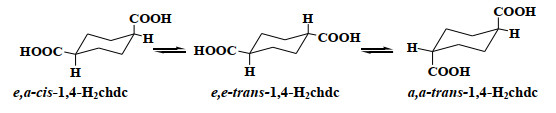
Scheme 1.

Two novel Cobalt(II) /Nickel(II) Metal-organic Coordination Polymers Based on Flexible Polycarboxylic Acids and Rigid Bis(imidazole) Mix Ligands
Ming-Xing YANG , Zhi-Wei YAN , Li-Juan CHEN , Xing-Ye LIN , Shen LIN


Metal-organic coordination polymers have attracted extensive attention owing to their potential applications in catalysis, gas adsorption, non-linear optics, sensor, luminescence, magnetism and other fields [1-9]. Many efforts have been devoted to the controlled synthesis and function development of open frameworks. Among the numerous strategies for constructing coordination polymers, the employment of the self-assembly of transition metal salts with carboxylic acids and a neutral N-donor ligands has become an effective approach. 1, 4-cyclohexanedicarboxylic acid (H2chdc) is a flexible ligand which possesses three possible configurations as regards to two carboxylate groups, namely, a, a-trans-H2chdc, e, e-trans-H2chdc and e, a-cis-H2chdc (Scheme 1)[10-15]. The rigid bis(imidazole) ligands, bis(1-imidazolyl)benzene and 4, 4'-bis(1-imidazolyl)biphenyl have two coordination fashions, cis-configuration and trans-configuration, while free rotation of the imidazolyl ring makes its style more diverse[13-19]. So they have been reported to be a good candidate for carboxylic acids and N-donor ligands, respectively, due to their superior bridging ability and flexible coordination fashion. Up to now, a few examples of Co, Zn-MOFs based on mixed cyclohexanedicarboxylic acid and rigid bis(imidazole) ligands have been synthesized by hydrothermal methods[13-15], but urothermal synthesis of this mixed-ligand system has not been explored to date. The solvents also can dramatically affect the self-assembly process of the metal organic frame-works. To further understand coordination chemistry of imidazole and polycarboxylate ligands in different solvents, we chose cyclohexanedicarboxylic acid (H2chdc) and the rigid bis(imidazole) ligands (bib, bibp) as organic linkers and synthesized under urothermal and hydrothermal condition. As expected, two novel compounds with extend structure, [Co2(OH)(chdc)1.5(bibp)]n (1) and [Ni(chdc)-(bib)]n·2H2O (2), were obtained. Their crystal structures, thermal and magnetic properties are reported herein.
All reagents were of analytical grade and used as obtained by commercial sources without further purification. The elemental analysis was carried out on an Elemental Vario EL III microanalyzer. Powder X-ray diffraction (PXRD) patterns were recorded on a Shimadzu XRD-7000 X-ray diffractometer with CuKa radiation (λ =1.5406 Å). The thermal behaviors (TGA) of 1 and 2 were measured by Metter Toledo Star under a flow of nitrogen (40 mL/min) from 30 to 800 ℃ at a heating rate of 10 ℃/min. IR spectra were recorded on a Nicolet Avatar360 spectrometer USA) as KBr pellets in the 4000~400 cm-1 region. The magnetic measurements were made using Quantum Design SQUID MPMS XL-7 instruments.
A mixture of Co(NO3)2·6H2O (0.015 mg, 0.05 mmol), bibp (0.014g, 0.05 mmol), H2chdc (0.009mg, 0.05 mmol) and 4 mL H2O-DMDP (v/v = 1 : 3) was stirred and sealed in a 18 mL Teflon-lined reactor and heated for 3 days at 433 K under autogenous pressure, followed by slow cooling (a descent rate of 5 K·h-1) to room temperature. Dark purple crystals of compound 1 were obtained in 20 % yield based on Co. Elemental analysis calcd for compound 1 (C30H30Co2N4O7) (%): C 53.27, H 4.47, N 8.28. Found: C 53.13, H. 4.55, N 8.21. Selected IR peaks (ν, cm-1): 3499 (s), 2934(m), 1616 (s), 1571 (m), 1518(s), 1449 (w), 1406 (s), 1345 (w), 1309(m), 1275 (w), 1052 (m), 963 (w), 880(w), 832(w), 746 (m), 656(m), 560(w).
A mixture of Ni(NO3)2·6H2O (0.029g, 0.1mmol), H2chdc (0.018mg, 0.1 mmol), bib (0.022g, 0.1 mmol), 2.5% NH3.H2O (0.2ml) and H2O (6ml) was stirred for 30 min, sealed in a 23 ml Teflon-lined autoclave and heated in an oven to 413 K for 3 days. After the sample had been cooled to room temperature at a descent rate of 5 K·h-1, green block crystals suitable for X-ray analysis were obtained, then washed with distilled water and dried in air (yield: 60% based on Ni). Selected IR bands (ν, cm-1): 3421 (s), 2930 (m), 1528 (s), 1406 (s), 1278 (w), 1242 (w), 1212 (w), 1228 (w), 1097 (w), 1067 (m), 962 (w), 937 (w), 838(m), 733(m), 656(m). Element analysis calcd for compound 2 (C20H24N4NiO6) (%): C 50.56, H 5.09, N 11.79; found (%): C 50.59, H 4.99, N 11.82.
Crystallographic data of compounds 1 and 2 were collected on a Bruker Apex Smart CCD diffractometer equipped with a graphite-monochromatized MoKα radiation (λ = 0.71073 Å). The structure analysis was performed with direct methods using SHELXS-97. A multi-scan absorption was applied to the intensity data. Structure refinement was done against F2 using SHELXL-97. All nonhydrogen atoms were refined with anisotropic displacement parameters. The C-H hydrogen atoms were positioned with idealized geometry and refined with isotropic displacement parameters using a riding model. The hydrogen atoms of water molecules and OH group were located from difference Fourier maps. A total of 12363 reflections of 1 were collected in the range of 2.49 < θ < 26.38 and 5792 were independent with Rint =0.0264, of which 4846 with I > 2σ(I) were observed. The final R = 0.0278, wR = 0.0732 (w = 1/[σ2(Fo2) +(0.0399P)2 + 0.00P], where P = (Fo2 + 2Fc2)/3), S = 1.003, (Δ/σ)max = 0.001, (Δ/σ)min = 0.000, (Δρ)max = 0.405 and (Δρ)min = –0.353 e/Å3. A total of 10530 reflections of 2 were collected in the range of 3.32 < θ < 26.30° and 4270 were independent with Rint = 0.0248, of which 3589 with I > 2σ(I) were observed. The final R = 0.0306, wR = 0.0804 (w = 1/[σ2(Fo2) + (0.0355P)2 + 0.62P], where P = (Fo2 + 2Fc2)/3), S = 1.027, (Δ/σ)max = 0.001, (Δ/σ)min = 0.000, (Δρ)max =0.245 and (Δρ)min = –0.336 e/Å3. Selected bond lengths and bond angles are listed in Tables 1 for compounds 1 and 2, respectively.
 DownLoad:
CSV
DownLoad:
CSV
| 1a | |||||||
| Bond | Dist. | Bond | Dist. | Bond | Dist. | ||
| Co(1)–O(6) | 2.065(1) | Co(1)–O(7) | 2.068(1) | Co(1)–O(2i) | 2.082(1) | ||
| Co(1)–O(7ii) | 2.143(1) | Co(1)–O(4ii) | 2.148(1) | Co(1)–N(4iii) | 2.156(1) | ||
| Co(2)–O(7) | 1.939(1) | Co(2)–O(3) | 1.971(1) | Co(2)–O(1iv) | 1.989(1) | ||
| Co(2)–N(1) | 2.022(2) | ||||||
| Angle | (°) | Angle | (°) | Angle | (°) | ||
| O(6)–Co(1)–O(7) | 92.86(5) | O(6)–Co(1)–O(2i) | 171.92(5) | O(7)–Co(1)–O(2i) | 87.90(6) | ||
| O(6)–Co(1)–O(7ii) | 96.00(5) | O(7)–Co(1)–O(7ii) | 81.72(5) | O(2i)–Co(1)–O(7ii) | 92.07(5) | ||
| O(6)–Co(1)–O(4ii) | 91.78(6) | O(7)–Co(1)–O(4ii) | 170.53(5) | O(2i)–Co(1)–O(4ii) | 88.66(6) | ||
| O(7ii)–Co(1)–O(4ii) | 89.59(5) | O(6)–Co(1)–N(4iii) | 88.83(5) | O(7)–Co(1)–N(4iii) | 99.56(5) | ||
| O(2i)–Co(1)–N(4iii) | 83.12(6) | O(7ii)–Co(1)–N(4iii) | 174.95(5) | O(4ii)–Co(1)–N(4iii) | 88.78(5) | ||
| O(7)–Co(2)–O(3) | 105.55(6) | O(7)–Co(2)–O(1iv) | 121.31(6) | O(3)–Co(2)–O(1iv) | 107.95(6) | ||
| O(7)–Co(2)–N(1) | 107.13(6) | O(3)–Co(2)–N(1) | 108.76(6) | O(1iv)–Co(2)–N(1) | 105.72(6) | ||
| 2b | |||||||
| Bond | Dist. | Bond | Dist. | Bond | Dist. | ||
| Ni(1)–N(1) | 2.0427(14) | Ni(1)–N(3) | 2.0435(14) | Ni(1)–O(1i) | 2.1163(12) | ||
| Ni(1)–O(4) | 2.1254(12) | Ni(1)–O(3) | 2.1293(13) | Ni(1)–O(2i) | 2.1441(13) | ||
| Angle | (°) | Angle | (°) | Angle | (°) | ||
| N(1)–Ni(1)–N(3) | 95.77(7) | N(1)–Ni(1)–O(1i) | 161.66(6) | N(3)–Ni(1)–O(1i) | 92.78(6) | ||
| N(1)–Ni(1)–O(4) | 90.30(6) | N(3)–Ni(1)–O(4) | 160.52(6) | O(1i)–Ni(1)–O(4) | 86.94(6) | ||
| N(1)–Ni(1)–O(3) | 101.16(6) | N(3)–Ni(1)–O(3) | 98.82(6) | O(1i)–Ni(1)–O(3) | 93.48(5) | ||
| O(4)–Ni(1)–O(3) | 61.78(5) | N(1)–Ni(1)–O(2i) | 100.26(6) | N(3)–Ni(1)–O(2i) | 107.98(6) | ||
| O(1i)–Ni(1)–O(2i) | 61.59(5) | O(4)–Ni(1)–O(2i) | 89.02(5) | O(3)–Ni(1)–O(2i) | 143.53(5) | ||
| Symmetry codes : a: (i) x, y+1, z (ii) –x+1, –y, –z+1 (iii) –x, –y+1, –z+2 (iv) –x+1, –y–1, –z+1. b: (i) #1 x–1, y, z | |||||||
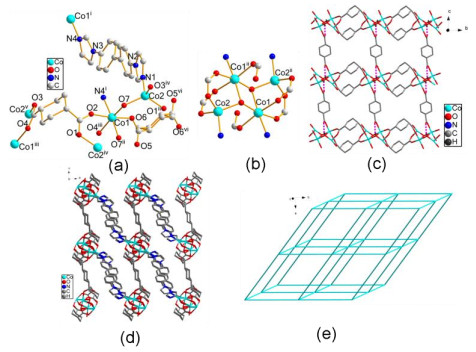
Single-crystal X-ray diffraction analysis reveals that compound [Co2(OH)(bibp)(chdc)1.5]n (1) crystallizes in the triclinic space group P
 DownLoad:
CSV
DownLoad:
CSV
| D–H…A | d(D–H) | d(H…A) | d(D…A) | < DHA |
| 1 | ||||
| O(7)–H(7)…O(5ii) | 0.76 | 2.10 | 2.787(4) | 151 |
| 2 | ||||
| O(6)–H(4)…O(4) | 0.85 | 2.22 | 3.0507(6) | 163 |
| O(5)–H(2)…O(1) | 0.85 | 1.96 | 2.7801(2) | 161 |
| O(6)–H(3)…O(3)v | 0.86 | 1.81 | 2.6222(4) | 157 |
| O(5)–H(1)…O(2)vi | 0.84 | 2.15 | 2.9679(4) | 164 |
| Symmetry codes: (ii) –x+1, –y, –z+1 (v) x, –y+3/2, z+1/2, (vi) x, –y+3/2, z–1/2 | ||||
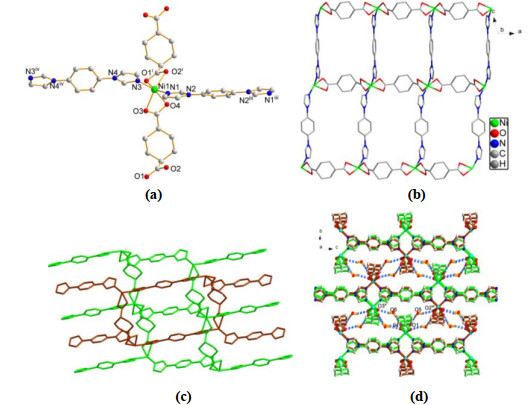
The compound [Ni(chdc)(bib)]n·2nH2O (2) is a 2D coordination polymer, which crystallizes in the monoclinic space group P2(1)/c. The asymmetric unit consists of one Ni(II) ion, two distinct half molecules of the bib ligand, one 1, 4-chdc ligand, as well as two lattice water molecules. As depicted in Fig. 2(a), the crystallographically independent Ni(II) center lies in a distorted octahedral coordination environment and is completed by two N-donors (N1 and N3) of two bib ligands and four O-donors (O3, O4, O1i and O2i) symmetry codes: i = x–1, y, z) from two carboxylate groups of two chdc2- ligands. The chdc2- ligand adopts an e, a-cis conformation with its two carboxylate groups in bidentate chelate mode. The bib ligands exhibit a bis-monodentate bridging mode, linking the adjacent Ni atoms together, and assemble into an infinite 1D [Ni(bib)]n chain. The 1D [Ni(bib)]n chains are further connected by the e, a-cis chdc2– ligands to form a corrugated (4, 4) lattice with the grid size of approximately 13.76×8.16 Å (Fig. 2(b)). However, the large window of one corrugated layer is pierced by a bib molecule of another symmetry-equivalent sheet. Two identical (4, 4) sheets are interlocked with each other to form a parallel interpenetration (Fig. 2(c)). Moreover, the free waters embed in the interlocking double-layers through hydrogen bond between the uncomplexed waters and the 1, 4-chdc2– ligand, O(6)–H(4)⋅⋅⋅O(4) (carboxylate) and O(6)–H(3)⋅⋅⋅O(3) ((carboxylate)), O(5)–H(2)⋅⋅⋅O(1) (carboxylate), O(5)–H(1)⋅⋅⋅O(2) (carboxylate) hydrogen bond (Table 2), forming a 3D supramolecular network (Fig. 2(d)).
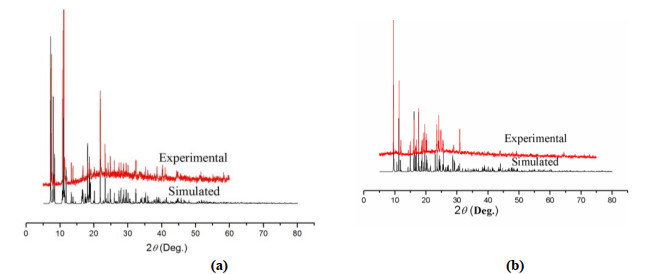
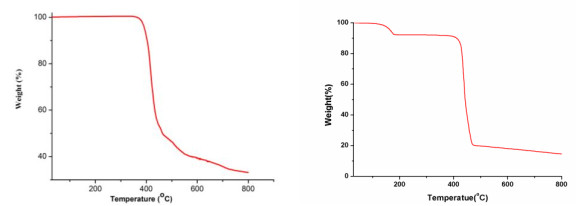
The XRD experimental and computer-simulated patterns of 1 and 2 are presented in Fig. 3, where the main diffraction peaks of the experimental and simulated patterns match well in the key positions, confirming the purity of 1 and 2. Thermal gravimetric (TG) analyses were carried out between 35 and 800 ℃ (Fig.4) to examine the thermal stability of 1 and 2. The samples were heated up under a flow of nitrogen (40 mL/min) at a heating rate of 10 ℃/min. The TG curves indicate that the frameworks of compounds 1 and 2 exhibit the good thermal stability. The frameworks of both compounds do not decompose till they are heated up to about 400 ℃. In 2, the weight loss of 7.75% (calc. 7.57%), in the temperature range of 90-180 ℃, is ascribed to release of lattice water molecules. While in two compounds the weight losses in the range of 400-800oC attribute to the partial decomposition of ligands.
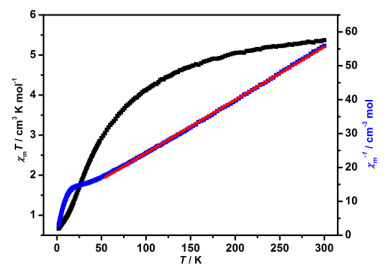
The variable-temperature magnetic susceptibility measurements of compounds 1 were performed in the temperature range of 2–300 K under a field of 1000 Oe. The temperature dependence of χMT and χM −1 are displayed in Fig. 5. The χMT value at room temperature is 5.34 cm3·K·mol−1 lower than the value for four isolated high spin Co(II) ions (7.48 cm3·K·mol−1) (S = 3/2) which can be attributed to the susceptible contribution from the orbital angular momentum at higher temperatures. With the temperature decreasing, the χMT value decreases evenly and descends rapidly at Tb = 100 K, reaching a minimum value of 0.67 cm3·K·mol−1 at 2 K for compound 1. Three magnetic susceptibility data between 300 and 50 K all obey the Curie-Weiss law, 1/χM = (T-θ)/C, giving the Curie constant C of 6.38 cm3·K·mol−1 and Weiss constant θ of -54.89 K. The Weiss constant θ value is more negative than that of the magnetic contribution of the single-ion Co(II) (–23 < θ < –20 K). The above features all indicate overall antiferromagnetic coupling between Co(II) centers[20].
Pan, M.; Liao, W. M.; Yin, S. Y.; Sun, S. S.; Su, C. Y. Single-phase white-light-emitting and photoluminescent color-tuning coordination assemblies. Chem. Rev. 2018, 118, 8889–8935. doi: 10.1021/acs.chemrev.8b00222
Wei, Y. H.; Dong, H. Y.; Wei, C.; Zhang, W. Y.; Yan, L.; Zhao, Y. S. Wavelength-tunable microlasers based on the encapsulation of organic dye in metal–organic frameworks. Adv. Mater. 2016, 28, 7424–7429. doi: 10.1002/adma.201601844
Chen, C.; Rao, H. Z.; Lin, S.; Zhang, J. A vapochromic strategy for ammonia sensing based on a bipyridinium constructed porous framework. DaltonTrans. 2018, 47, 8204–8208. doi: 10.1039/C8DT01728J
Getman, R. B.; Bae, Y. S.; Wilmer, C. E.; Snurr, R. Q. Review and analysis of molecular simulations of methane, hydrogen, and acetylene storage in metal–organic frameworks. Chem. Rev. 2012, 112, 703–723. doi: 10.1021/cr200217c
Alezi, D.; Peedikakkal, A. M. P.; Weseliński, Ł. J.; Guillerm, V.; Belmabkhout, Y.; Cairns, A. J.; Chen, Z. J.; Wojtas, Ł.; Eddaoudi, M. Quest for highly connected metal–organic framework platforms: rare-earth polynuclear clusters versatility meets net topology needs. J. Am. Chem. Soc. 2015, 137, 5421–5430. doi: 10.1021/jacs.5b00450
Bania, K. K.; Karunakar, G. V.; Goutham, K.; Deka, R. C. Enantioselective henry reaction catalyzed by "ship in a bottle" complexes. Inorg. Chem. 2013, 52, 8017–8029. doi: 10.1021/ic400599c
Wang, D. K.; Wang, M. T.; Li, Z. H. Fe-based metal–organic frameworks for highly selective photocatalytic benzene hydroxylation to phenol. ACS Catal. 2015, 5, 6852–6857. doi: 10.1021/acscatal.5b01949
Rajput, G.; Yadav, M. K.; Drew, M. G. B.; Singh, N. Impact of ligand framework on the crystal structures and luminescent properties of Cu(I) and Ag(I) clusters and a coordination polymer derived from thiolate/iodide/dppm ligands. Inorg. Chem. 2015, 54, 2572–2579. doi: 10.1021/ic502688h
Zhang, L.; Liu, L.; Huang, C.; Han, X.; Guo, L. A.; Xu, H.; Hou, H. W.; Fan, Y. T. Polynuclear Ni(II)/Co(II)/Mn(II) complexes based on terphenyl-tetracarboxylic acid ligand: crystal structures and research of magnetic properties. Cryst. Growth Des. 2015, 15, 3426–3434. doi: 10.1021/acs.cgd.5b00504
Wang, X. L.; Chen, N. L.; Liu, G. C.; Luan, J.; Qu, Y. Effect of dicarboxylates with different rigidity and length on crystal structures of cobalt(II) complexes derived from a semi-rigid tri-pyridyl-bis-amide ligand. Transition Met Chem. 2014, 39, 681–690. doi: 10.1007/s11243-014-9850-9
Su, Z.; Wang, Z. B.; Sun, W. Y. Counteranion-directed assembly of zinc(II) coordination polymers with 1, 3, 5-tris (1-imidazolyl)benzene. Inorg. Chem. Commun. 2010, 13, 1278–1280. doi: 10.1016/j.inoche.2010.07.015
Su, Z.; Fan, J.; Okamura, T.; Sun, W. Y.; Synthesis, crystal structure and photoluminescent property of metal-organic frameworks with mixed carboxylate and imidazole-containing ligands. Chin. J. Chem. 2012, 30, 2016–2022. doi: 10.1002/cjoc.201200715
Chen, S. S.; Zhao, Y.; Fan, J.; Okamura, T.; Bai, Z. S.; Chen Z. H.; Sun, W. Y. Construction of coordination frameworks based on 4-imidazolyl tecton 1, 4-di(1H-imidazol-4-yl)benzene and varied carboxylic acids. CrystEngComm. 2012, 14, 3564–3576. doi: 10.1039/c2ce06632g
Chen, Z. H.; Zhao, Y.; Wang, P.; Chen, S. S.; Sun, W. Y. Zinc(II) and cadmium(II) complexes with mixed 1, 3-di(1H-imidazol-4-yl)benzene and cyclohexanedicarboxylate ligands: Synthesis, structure and property. Polyhedron. 2013, 67, 253–263.
Hu, J. M.; Blatov, V. A.; Yu, B.; Heckec, K. V.; Cui, G. H. An unprecedented "strongly" self-catenated MOF containing inclined catenated honeycomb-like units. Dalton trans. 2016, 45, 2426–2429. doi: 10.1039/C5DT04679C

Figure 1 (a) View of the coordination environments of Co(II) centres and the coordination mode of the ligands. All hydrogen atoms are omitted for clarity. Symmetry codes: i: x, y+1, z; ii: –x+1, –y, –z+1; iii: x, –y+1, –z+2; iv: –x+1, –y–1, –z+1; v: x, y–1, z; vi: –x+1, –y, –z+2. (b) The tetranuclear cobalt(II) cluster. (c) The [Co2(μ3-OH)(chdc)3]n layer. (d) A perspective of 3D framework along the ac plane. (e) Topological representation of the 6-connected 3D net (the light blue nodes represent tetranuclear cobalt(II) subunits) in compound 1

Figure 2 (a) View of the coordination environments around of the Ni(II) atom of 2 showing the atom-labelling scheme. All hydrogen atoms are omitted for clarity. Symmetry codes: i: x–1, y, z; iii: –x, –y+1, –z–1. iv: –x, –y+1, –z–1. (b) A perspective view of the two-dimensional layer along the ac plane. (c) View of the interlocking double-layers (d) The three-dimensional supramolecular structure formed by hydrogen bond between the uncomplexed waters and the 1, 4-chdc2– ligands. Symmetry codes: v: x, –y+3/2, z+1/2; vi: x, –y+3/2, z–1/2.

Figure 5 The temperature dependence of magnetic susceptibilities of compound 1 under a static field of 1000 Oe
Table 1. Selected Bond Lengths (Å) and Bond Angles (º) of compounds 1 and 2
| 1a | |||||||
| Bond | Dist. | Bond | Dist. | Bond | Dist. | ||
| Co(1)–O(6) | 2.065(1) | Co(1)–O(7) | 2.068(1) | Co(1)–O(2i) | 2.082(1) | ||
| Co(1)–O(7ii) | 2.143(1) | Co(1)–O(4ii) | 2.148(1) | Co(1)–N(4iii) | 2.156(1) | ||
| Co(2)–O(7) | 1.939(1) | Co(2)–O(3) | 1.971(1) | Co(2)–O(1iv) | 1.989(1) | ||
| Co(2)–N(1) | 2.022(2) | ||||||
| Angle | (°) | Angle | (°) | Angle | (°) | ||
| O(6)–Co(1)–O(7) | 92.86(5) | O(6)–Co(1)–O(2i) | 171.92(5) | O(7)–Co(1)–O(2i) | 87.90(6) | ||
| O(6)–Co(1)–O(7ii) | 96.00(5) | O(7)–Co(1)–O(7ii) | 81.72(5) | O(2i)–Co(1)–O(7ii) | 92.07(5) | ||
| O(6)–Co(1)–O(4ii) | 91.78(6) | O(7)–Co(1)–O(4ii) | 170.53(5) | O(2i)–Co(1)–O(4ii) | 88.66(6) | ||
| O(7ii)–Co(1)–O(4ii) | 89.59(5) | O(6)–Co(1)–N(4iii) | 88.83(5) | O(7)–Co(1)–N(4iii) | 99.56(5) | ||
| O(2i)–Co(1)–N(4iii) | 83.12(6) | O(7ii)–Co(1)–N(4iii) | 174.95(5) | O(4ii)–Co(1)–N(4iii) | 88.78(5) | ||
| O(7)–Co(2)–O(3) | 105.55(6) | O(7)–Co(2)–O(1iv) | 121.31(6) | O(3)–Co(2)–O(1iv) | 107.95(6) | ||
| O(7)–Co(2)–N(1) | 107.13(6) | O(3)–Co(2)–N(1) | 108.76(6) | O(1iv)–Co(2)–N(1) | 105.72(6) | ||
| 2b | |||||||
| Bond | Dist. | Bond | Dist. | Bond | Dist. | ||
| Ni(1)–N(1) | 2.0427(14) | Ni(1)–N(3) | 2.0435(14) | Ni(1)–O(1i) | 2.1163(12) | ||
| Ni(1)–O(4) | 2.1254(12) | Ni(1)–O(3) | 2.1293(13) | Ni(1)–O(2i) | 2.1441(13) | ||
| Angle | (°) | Angle | (°) | Angle | (°) | ||
| N(1)–Ni(1)–N(3) | 95.77(7) | N(1)–Ni(1)–O(1i) | 161.66(6) | N(3)–Ni(1)–O(1i) | 92.78(6) | ||
| N(1)–Ni(1)–O(4) | 90.30(6) | N(3)–Ni(1)–O(4) | 160.52(6) | O(1i)–Ni(1)–O(4) | 86.94(6) | ||
| N(1)–Ni(1)–O(3) | 101.16(6) | N(3)–Ni(1)–O(3) | 98.82(6) | O(1i)–Ni(1)–O(3) | 93.48(5) | ||
| O(4)–Ni(1)–O(3) | 61.78(5) | N(1)–Ni(1)–O(2i) | 100.26(6) | N(3)–Ni(1)–O(2i) | 107.98(6) | ||
| O(1i)–Ni(1)–O(2i) | 61.59(5) | O(4)–Ni(1)–O(2i) | 89.02(5) | O(3)–Ni(1)–O(2i) | 143.53(5) | ||
| Symmetry codes : a: (i) x, y+1, z (ii) –x+1, –y, –z+1 (iii) –x, –y+1, –z+2 (iv) –x+1, –y–1, –z+1. b: (i) #1 x–1, y, z | |||||||
 下载: 导出CSV
Table 2. Hydrogen Bond geometry (Å, °) of Compounds 1 and 2
| D–H…A | d(D–H) | d(H…A) | d(D…A) | < DHA |
| 1 | ||||
| O(7)–H(7)…O(5ii) | 0.76 | 2.10 | 2.787(4) | 151 |
| 2 | ||||
| O(6)–H(4)…O(4) | 0.85 | 2.22 | 3.0507(6) | 163 |
| O(5)–H(2)…O(1) | 0.85 | 1.96 | 2.7801(2) | 161 |
| O(6)–H(3)…O(3)v | 0.86 | 1.81 | 2.6222(4) | 157 |
| O(5)–H(1)…O(2)vi | 0.84 | 2.15 | 2.9679(4) | 164 |
| Symmetry codes: (ii) –x+1, –y, –z+1 (v) x, –y+3/2, z+1/2, (vi) x, –y+3/2, z–1/2 | ||||
下载: 导出CSV

 扫一扫看文章


扫一扫关注我们


