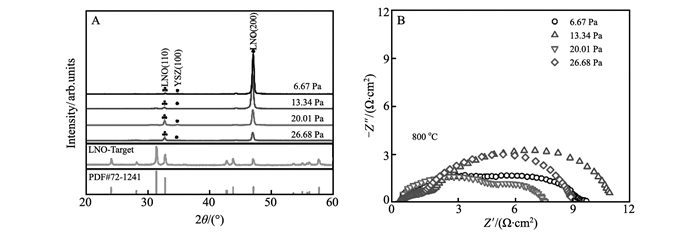
Figure 1.
(A) XRD patterns of the LNO target and HRXRD plots of LNO films with 2θ-ω scans under different oxygen pressures. (B)Nyquist plots of LNO films prepared under different oxygen pressures

Improving the Electrocatalytic Activity of La2NiO4+δ Cathode by Surface Modification with Conformal Heterojunction
Zhenye WEI , Junling MENG , Haocong WANG , Wenwen ZHANG , Xiaojuan LIU , Jian MENG


Solid oxide fuel cell (SOFC) is an electrochemical energy conversion device, which is composed of three main components, including the anode (which is for fuel oxidation), the cathode (which is for oxygen reduction), and the electrolyte (which is for oxygen-ion-conducting)[1-3]. During the development of commercial application of SOFC, the operation temperature should be further reduced. However, since the cathodic overvoltage for oxygen reduction was significantly larger than the other various internal cell resistances, increasing at lower operating temperatures, thus the electrochemical performance of SOFC was seriously restricted by polarization loss in the cathodic reaction with the decrease of working temperatures[4-6]. Therefore, reasonable design of cathode to explore a way to effectively improve its oxygen reduction reaction (ORR) activity is one of the key scientific issues to be solved urgently in SOFC field.
It is well known that oxygen surface exchange and oxygen ion diffusivity are the two limiting factors of ORR kinetics. Traditional methods for enhancing the ORR activity of cathode include regulating the crystal structure, chemical composition and morphology, which are not only time-consuming and costly, but also easy to trigger element segregation in long-term operation, forming second phase that was not favorable to transport ions and electrons[7-10]. In recent years, it has been found that the deposition of nanoscale heterogeneous film on the typical cathode surfaces, with surprising high oxygen surface exchange and oxygen diffuse properties, can greatly improve the ORR activity of cathode[11-16]. Sase et al[11, 17] applied paused laser deposition (PLD) technique to construct a La2-xSrxCoO4/La1-xSrxCoO3 (LSC214/LSC113) heterostructured cathode, and found that the oxygen surface exchange rate at the hetero-interface was enhance by about 103 times at 500 ℃ compared to that on the single-phase LSC113 surface. Subsequently, Bilge Yildiz and coworkers[15, 18-20] deeply studied the ORR mechanism of LSC214/LSC113 heterojunction cathode through the combination of experimental analysis and theoretical calculations. Most importantly, their findings showed that the LSC214 surface exposed to the ambient at the LSC113/LSC214 interface facilitated oxygen incorporation, resulting from the oxygen molecules were more favorable adsorb onto the heterostructured surface than that onto the LSC214 and LSC113 surfaces. Theoretically, it has revealed that the lattice strain field exhibit near the interfacial region of the hetero-structure is responsible for such impressively accelerated ORR kinetics. Therefore, to sum up, the construction of a cathode material with hetero-interface configuration, which can present electrochemical characteristics remarkably different from those of bulk oxides, is an interesting system to explore in search of highly active cathode for ORR.
So far, the most popular structure of heterojunction cathode is the nanocomposite heteroepitaxial oxide film with planar or vertically aligned interfaces between typical perovskite (P) cathode and Ruddlesden-Popper (RP) oxide in order to improve the electrochemical properties of bulk perovskite-type cathode. Especially, in RP/P hereto-structure system, RP oxide was mainly used for surface decoration because of its fast oxygen transport properties. It is noteworthy that the RP oxide is also a kind of promising mixed ionic electronic conducting (MIEC) cathode material, such as the typical La2NiO4+δ(LNO) cathode[21-24]. However, at intermediate temperatures (600~800 ℃), the ORR on LNO cathode was reported to be mainly limited by surface oxygen exchange[25]. Nevertheless, up to now, how to accelerate the surface ORR kinetics of LNO cathode has rarely been reported.
From the aforementioned, in the present work, in order to explore an effective way to further improve the electrocatalytic activity of the state-of-the-art LNO cathode, we modified the LNO cathode surface with Pr2NiO4+δ (PNO) thin film to form a heterostructure by using programmable logic device (PLD). The conformal heterojunction between LNO and PNO was first proposed in this work to explore the effect on the ORR activity. PNO was chosen as the decoration layer because of its highly active for ORR[26-28]. Meanwhile, the surface modification with conformal heterojunction under almost negligible lattice strain field would also enhance the compatibility with cathode. In addition, for the surface-turning LNO electrode, the porous LNO backbone provide a pathway to facilely transport both of oxygen ions and electrons, while the thin catalyst decorating offers enhanced ORR activity. Finally, through this work, we want to provide a new way to design of cathode materials for SOFC with high performance in the future.
X-ray diffraction (XRD, Bruker D8 Advance, Germany) was applied to confirm that all powders and targets are the pure phase. High resolution XRD (HRXRD, Rigaku Smart Lab, Japan) 2θ-ω scans were performed to determine the orientation and crystallinity of the thin films prepared by pulsed laser deposition (PLD, Neocera P180, USA). The deposition rate of the films was evaluated by a Profilers-system (Ambios XP-100, USA). S-4800 high resolution field emission scanning electron microscope(FE-SEM, Hitachi, Japan) was used to observe the morphology of the films. The RMS (root-mean-square) roughness was examined by atomic force microscopy (AFM, Bruker Dimension Icon, Germany). The oxidation state of the film was characterized by X-ray photoelectron spectroscopy (XPS), which was collected on a VG ESCALAB 250 Electron Spectrometer with a monochromatic AlKα(1486.6 eV) at 12 kV and 20 mA, and all binding energies were referred to the C1s peak (284.6 eV). The electrochemical performance test performed on model cells with the thin-film electrode as the working electrode, Ce0.9Gd0.1O2-δ (GDC) as the buffer layer, YSZ (Yttria-Stabilized Zirconia, purchased from Hefei Crystal Technical Material Co., Ltd) substrate as the electrolyte, and Ag as the counter electrode. Silver paste was painted on both sides as a current collector. Electrochemical impedance spectroscopy (EIS) was collected on an IVIUMSTAT equipment (Ivium, Netherlands) from 850 ℃ to 650 ℃ in steps of 50 ℃. The applied frequency range was from 1 MHz to 0.01 Hz with the amplitude signal 10 mV under open circuit voltage conditions. Pr6O11 (3N, Ourchem) and Ni(NO)2·6H2O (98%, Alfa Aesar) for synthesis PNO, La2O3(4N, SCR) and Ni(NO)2·6H2O (98%, Alfa Aesar) for synthesis LNO, Citric acid(AR, SCR) and polyethylene glycol(CP, XiLong Scientific) as additives. GDC powder (99.5%, SOFCMAN) for target preparation.
The target pellets of LNO and PNO (25.4 mm in diameter and 3 mm thick) were prepared by a modified Pechini method[29]. Firstly, rare-earth oxides (La2O3and Pr6O11) were pretreated at 1000 ℃ for 10 h to remove impurities, and then dissolved in nitric acid. Secondly, Ni(NO)2·6H2O powder was added to the above nitrate solution according to the stoichiometric ratio. Citric acid and polyethylene glycol, served as the chelating agents, were then added to the nitric acid mixture with constantly stirring for 30 minutes. Thirdly, transferred the mixed solution to a water bath and dried at 95 ℃ overnight until the solution became a gel state. Moreover, the obtained gel was dry-fired on a hot plate to obtain a precursor powder, and the residual organic matter was removed by sequentially sintering the mixture at 600 ℃ and 900 ℃ for 10 hours. In addition, the calcined powders were pelletized and annealed at 1300 ℃ for 10 h to get pure phase. Finally, the target pellets of LNO and PNO (25.4 mm in diameter) were fabricated by uniaxial pressing (36 MPa) followed by isostatic cool pressing under 270 MPa. The pellets were sintered at 1300 ℃ for 24 h with a heating rate of 1 ℃/min and a cooling rate of 1.5 ℃/min. The final products were characterized by XRD (Bruker D8), and were confirmed to be single phase materials.
The preparation of GDC target was similar to the above LNO, and the pellet was annealing at 1400 ℃ for 24 h with a heating rate of 1 ℃/min and a cooling rate of 1.5 ℃/min.
Single crystals of YSZ (100) with a size of 10 mm×10 mm×0.5 mm was used as a substrate. A KrF excimer laser with a wavelength of 248 nm, and a pulse frequency of 8 Hz was used for deposition. The target substrate distance was set to be 5 cm. The PLD growed LNO with ~450 mJ pulse energy under different oxygen pressures (6.67 Pa, 13.34 Pa, 20.01 Pa and 26.68 Pa) and thicknesses (10000 pulses, 30000 pulses and 50000 pulses) were prepared and discussed. 500 pulses of GDC (~5 nm) film, served as buffer layer between YSZ substrate and LNO film, deposited at a PLD condition of ~350 mJ pulse energy and 6.67 Pa oxygen pressure. Different thickness of surface coverage with PNO film was performed with 20 pulses (~0.1 nm), 40 pulses (~1 nm), 200 pulses (~5 nm), 290 pulses (~7 nm), and 410 pulses (~10 nm) under ~450 mJ and 1.33 Pa oxygen pressure. In addition, a reference sample with surface decoration of ~5 nm LNO was made for comparison. The substrate temperature was maintained at 720 ℃ for LNO (and PNO) and 520 ℃ for GDC during deposition. All of the films were cooled down to room temperature in 1.07 MPa oxygen pressure with a cooling rate of 5 ℃/min.
The XRD profile of LNO target is shown in Fig. 1A, in which the LNO exhibits a Ruddlesden Popper tetragonal structure with space group of I4/mmm(No.139) symmetry. The HRXRD curves of LNO films deposited on the single crystal YSZ (100) substrate under different oxygen pressures (6.67 Pa, 13.34 Pa, 20.01 Pa and 26.68 Pa) with the same number of deposition pulses (30000 pulses) are also presented in Fig. 1A. HRXRD results demonstrate that the LNO films were mainly textured in (100) orientation. Interestingly, as the oxygen pressure increases, (110) plane appears and the intensity reaches the strongest at 20.01 Pa. Fig. 1B displays the comparison of electrochemical properties of these LNO films, which are measured on the LNO//YSZ//Ag model cell at 800 ℃. Through combining Fig. 1B with Fig. 1A, it can be obviously find that the area specific resistance (ASR) is the smallest at 20.01 Pa oxygen pressure, which indicates that the (110) orientation is beneficial to the improvement of electrochemical performance. Notably, it has been reported that the (110) plane is an active surface for oxygen reduction related to the strong anisotropic oxide-ion/electron mixed conduction in Ruddlesden-Popper structure[30]. Therefore, the appearance of (110) plane is favorable to the enhancement of catalytic activity. In addition, this conclusion is consistent with the previous literature[31], which reported that the LNO110 has a higher ORR activity than that of LNO100. Therefore, 20.01 Pa was selected for LNO film deposition throughout the present work.
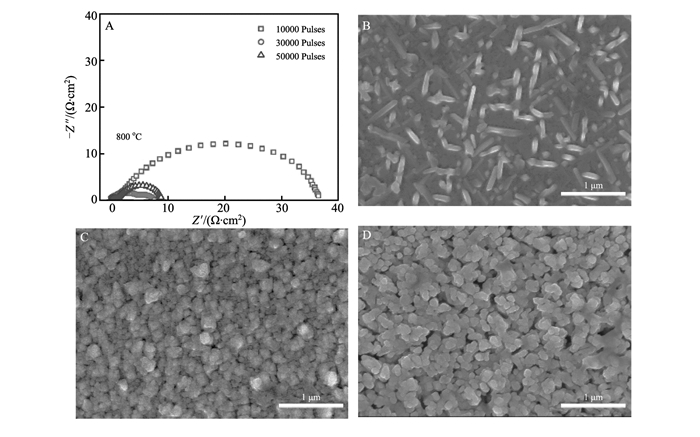
The effect of film thickness on electrochemical properties is also an important factor. As can be seen in Fig. 2A, LNO films with 30000 and 50000 deposition pulses exhibit much lower ASR than that with 10000 pulses. From the surface morphology of LNO with different thicknesses (Fig. 2B-2D) we can see that the LNO films with 30000 and 50000 prepared pulses display porous structure, while the film with 10000 pulses shows a relatively dense morphology. It was well known that the cathode of SOFC should be porously to adsorb oxygen, thus the LNO surface as-deposited with 30000 and 50000 pulses are beneficial for surface adsorption. In addition, because the ASR of LNO film deposited by 30000 pulses is a little smaller than that of 50000 pulses, the prepared condition of 30000 pulses (~830 nm) was chosen for LNO film in the following deposition.
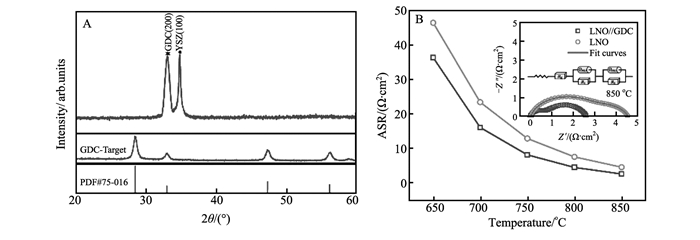
It has been reported that a GDC buffer layer can effectively avoid undesired reaction between cathode and YSZ substrate[32-33]. In order to investigate the influence of a buffer layer on LNO film cathode, a GDC (~5 nm) layer was deposited between the YSZ substrate and LNO film by using PLD. The HRXRD result (Fig. 3A) demonstrates that the GDC buffer layer is highly textured in the (100) orientation. From the comparison of EIS (Fig. 3B) between LNO//GDC//YSZ and LNO//YSZ model cells we can see that GDC layer is beneficial for reducing the ASR of cathode because of the GDC buffer layer not only increased the adhesion between electrolyte and cathode, but also would enlarge the effective area of three-phase boundaries (TPBs), leading to more easily incorporation of oxygen ions into the grain boundaries of GDC. Therefore, the GDC buffer layer is always grown between LNO film and YSZ substrate in the subsequent experiments.
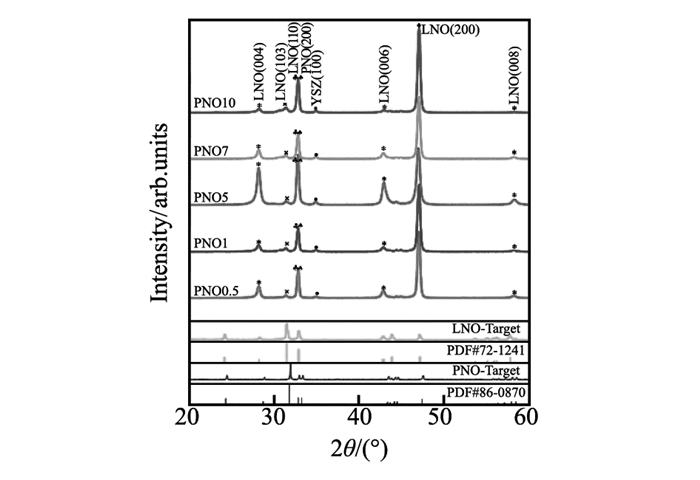
It has been reported that the conformal coating plays a vital role in facilitating rapid oxygen-ion transport into cathode[34-36]. In this work, the different thicknesses of conformal PNO thin film was deposited by PLD on the LNO//GDC//YSZ surface to explore the effect on ORR activity. From the XRD profile of PNO target (Fig. 4) we can see that the PNO exhibits a Ruddlesden Popper orthorhombic symmetry with Fmmm (No.69) space group. Fig. 4 also exhibits HRXRD results after surface decoration with PNO thin film. Interestingly, in addition to the (110) and (200) diffraction peaks of LNO, the external (004), (006), (008), and (103) diffraction peaks of LNO also appear after PNO coating. Therefore, the PNO modification triggers structural reorientation of LNO thin film, which tending to form polycrystalline film. In addition, the PNO thin film is grown with the a-axis perpendicular to the film surface. Therefore, the surface roughness will be different, as to be elaborated later.
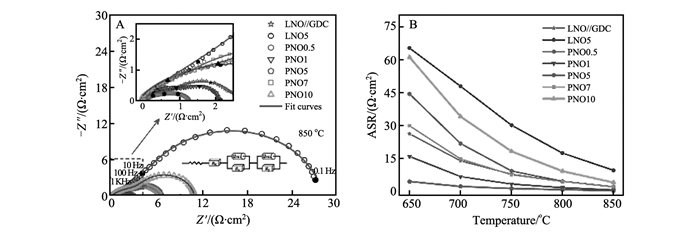
The Nyquist plots of PNO and LNO film directly deposited with 10000 pulses on YSZ substrate are shown as Fig.S1 in Supporting Information, in which the resistance of PNO is much smaller than that of LNO, providing the evidence that the PNO has better ORR activity. Therefore, PNO thin film was selected as the modified layer that deposited on the top layer of LNO in this work. Fig. 5 displays the EIS results of as-prepared conformal heterojunction films measured on the model cell (see in Fig. 7C). In order to clarify the effect of the thickness of the modified layer on the electrochemical resistance, the total ASR of different model cells obtained by fitting the equivalent electrical circuit (see the inset of Fig. 5A) based on Zview software. The ASR of bare LNO phases and the surface-modified LNO measured at 650~850 ℃ in air is presented in Fig. 5B. Firstly, for the comparison between bare LNO//GDC film and PNO decorated LNO film cathode, there is a optimum thickness (~5 nm) of PNO film for surface modification. When the modified layer is too thin (~0.5 nm and ~1 nm) or too thick (~7 nm and ~10 nm), the resistance increases. Meanwhile, both of the ~1 nm and ~5 nm thick surface coating can effectively decrease ASR when compared to the untreated LNO film. Secondly, for the comparison of PNO modified LNO films and ~5 nm LNO referenced on LNO surface, all of the conformal heterojunction of PNO films on LNO surface can effectively decrease the ARS, leading to improve the ORR activity. Meanwhile, it is noteworthy that the ASR of PNO (~5 nm) modified LNO cathode is 21 times lower than that of LNO (~5 nm) decorated LNO film at 850 ℃, which is also proved that PNO is highly active for ORR. Finally, from EIS analysis we can conclude that there is a thin electrochemical active region for LNO surface with conformal PNO modification (see Fig.S1 in Supporting Information).
From the above EIS tested, PNO modified layer with the thickness of ~5 nm on the LNO surface shows the most pronounced enhancement in ORR activity. In order to further reveal the ORR-kinetic process in the heterostructured cathode, the dependence of ASR on the oxygen partial pressure (PO2) of the PNO (~5 nm) modified LNO and corresponding bare surface phases (LNOand LNO//GDC) were investigated according to the following equation[37]:
|
$ {\rm{ASR}} = {\rm{AS}}{{\rm{R}}_0}{({p_{{o_2}}})^{ - n}} $ |
(1) |
where ASR0 is a constant, thus,
|
$ {\rm{ASR}} \propto {\left( {1/{p_{{o_2}}}} \right)^n} $ |
(2) |
Where the ASR is area specific resistance (Ω·cm2) and the pO2 is oxygen partial pressure (Pa). Thereinto, the exponent n is a parameter that is corresponding to the rate-limiting step (RLS) involved in ORR process. For a normal ORR, the relationship between the reaction steps and exponent n are as follows (in Krger-Vink notation)[38-41]:
|
$ {{\text{O}}_{\text{2}}}_{\text{, gas}}\rightleftharpoons {{\text{O}}_{\text{2}}}_{,\text{ads}};n=1 $ |
(3) |
|
$ {{\text{O}}_{\text{2}}}_{\text{, gas}}\rightleftharpoons {{\text{O}}_{\text{2}}}_{,\text{ads}};n=0.5 $ |
(4) |
|
$ {{\text{O}}_{\text{2}}}_{,\text{gas}}\text{+4e}\prime \text{+2V}_{\text{o}}^{\cdot \cdot }\rightleftharpoons 2O_{\text{o}}^{\text{x}};n=0.25 $ |
(5) |
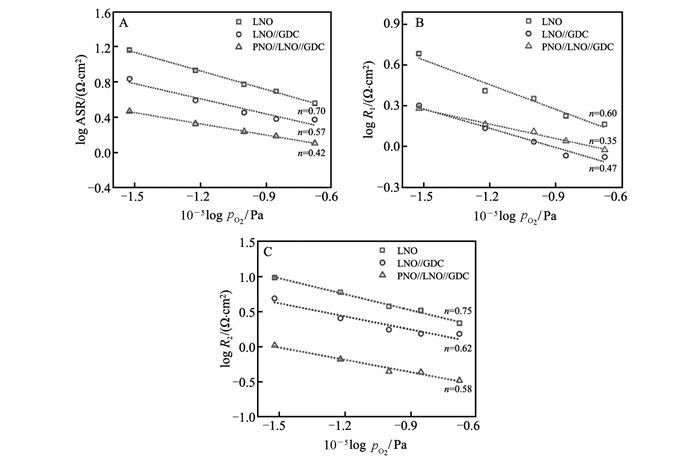
Fig. 6and Fig.S2 (in Supporting Information) show the dependence of polarization resistances on pO2 in the range of 3.03×10³~2.121×10⁴ Pa at 850 ℃. Obviously, after surface modification, the rely of ASR on oxygen pressure displayed noticeable changes. The ASR was seen to decrease with increasing pO2 with a power-law exponent n ranging between 0.42 and 0.70 (Fig. 6A). The n value for bare LNO without buffer layer is between 0.5 and 1, demonstrating that the rate of ORR would be limited by both of oxygen adsorption and dissociation. While for PNO modified surface and bare LNO with buffer layer inserted, n values are close to 0.5, implying that the dissociation of molecular oxygen to atomic oxygen is the RLS. In order to further distinguish the effect of surface modification and buffer layer on ORR, the fitting results of all kinds of the polarization resistances (RE, R1, and R2) emerged in the equivalent electrical circuit (see the inset of Fig.S2 in Supporting Information) are listed in Table S1. RE stands for ohmic resistance of electrolyte and circuits, which is subtracted to around zero in the impedance spectra for facilitating comparison (see in Fig.S2 in Supporting Information). R1 represents to the resistance of the high-frequency arcs, whereas R2 denote to the resistance of low-frequency arcs. The total ASR is equal to R1 plus R2. Hereinto, The log R1 and log R2 values obtained from the fitting of equivalent electrical circuit(see the inset of Fig.S2 in Supporting Information) as a function of pO2 were plotted in Fig. 6B and Fig. 6C. In general, it is believed that the larger one between R1 and R2 contributes more to total ASR. Therefore, the n value obtained by the larger resistance is considered to be the major RLS for ORR. Interestingly, for bare LNO with and without buffer layer inserted, the R1 is always smaller that R2, whereas for PNO (~5 nm) modified LNO cell, the R1 is much larger than R2 under different oxygen partial pressures. It can be inferred that surface modification can effectively reduce R2, which is corresponding to accelerate the adsorption and dissociation of oxygen on the surface, thus the PLS will change. The inference can be confirmed by the following discussions. Firstly, for bare surface phases (LNO and LNO//GDC), the polarization resistance is mainly derived from R2 (see Fig. 6C). Hereinto, the n value for LNO//GDC is 0.62, much closer to 0.5 than to 1, indicating that the RLS is dominated by the dissociation of molecular oxygen(
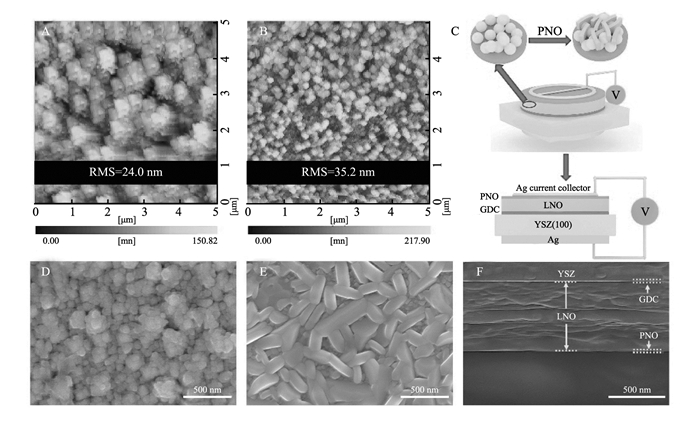
It has been reported that the surface roughness has a great influence on the electrocatalytic performance and a rough surface facilitate oxygen transport and diffusion[43]. Fig. 7A and Fig. 7B give the RMS surface roughness comparison before and after surface tuning measured by AFM. It is obviously that the RMS for the modified surface is much higher than that of bare LNO surface. Combining with the above XRD analysis, it is easy to find that the increased surface roughness originate from the surface modification of PNO film. Meanwhile, it therefore can be concluded that surface modification with conformal PNO (~5 nm) heterojunction can increase the oxygen transport because of much more active sites are exposed to facilitate the ORR kinetic. This conclusion is consistent with the above EIS results. Fig. 7D and Fig. 7E display the surface morphology of bare LNO film and PNO modified LNO film. By comparing the SEM images, the changes in morphology caused by surface modification can be clearly observed and the effect of surface morphology on ORR activity can be revealed. Intriguingly, the surface-modified cathode exhibits a nanopillar layer of PNO (~5 nm) attached to porous nanoparticle surface of LNO film. The porous LNO backbone provide a pathway to facilely transport both of oxygen ions and electrons, while the thin catalyst decorating offers enhanced surface active sites obtained from AFM analysis. Therefore, this conformal heterojunction can successfully increase the active region for ORR, and further improve the electrochemical properties. Fig. 7C and Fig. 7F present the schematics of model cell and the SEM image of cross-section of the model cell after EIS measurement, respectively. A sandwich structure can be seen in Fig. 7F, wherein the thicknesses of buffer layer (GDC), PNO modified layer, and LNO electrode are about 5 nm, 5 nm, and 830 nm, respectively. Meanwhile, the buffer layer is smoothly combined with the YSZ substrate and LNO cathode film, indicating that good compatibility among the YSZ substrate, GDC buffer layer, LNO cathode, and conformal PNO modified layer under the film growth and measurement conditions.
To further understand the influence of surface modification with conformal heterojunction on the chemical valance states and surface oxygen defects, we compared the chemical environment of O and Ni and Pr in the near surface for bare LNO, buffer layer inserted LNO, and modified LNO with PNO (~5 nm) film. XPS was applied to verify the chemical state of O, Ni, and Pr ions with the fitting software XPS PEAK 4.1. The core-level spectra and fitted curves of O1s, Ni3p, and Pr3d5/2 in their as-prepared state are shown in Fig. 8. Firstly, the O1s spectra can be resolved into three components, judging from three forms of bonding energy (BE) region (Fig. 8A and Table S2 in Supporting Information). The peak at the lowest BE is associated with lattice oxygen (Olattice), whereas the component at the highest BE is assigned to adsorbed molecular water (H2Oad) on the film surface. The ingredient at the intermediate BE is attributed to adsorbed oxygen (Oad) species including oxygen (O2), hydroxyl (OH-), and carbonate (CO32-), etc. The Oad would further incorporate with Olattice on the film surface, resulting in producing various kinds of charged oxygen species, such as O2-, O2-, and O-, which facilitate the transport of oxygen ions and electrons[44]. Therefore, the larger ratio of Oad/Olattice, the higher conductivity will be achieved. From Table S2 (in Supporting Information) we can see that the subsequence of Oad/Olattice ratio is in the order of LNO < LNO//GDC < PNO//LNO//GDC. Therefore, the surface tuning with PNO (~5 nm) is prefer to adsorb oxygen species to film surface, leading to improve the ORR activity, which is consistent with the above EIS analysis. Meanwhile, it also can be found that the GDC buffer layer introduced into the model cell is favorable to accelerate the surface oxygen exchange by adsorbing more oxygen species that that of bare LNO without buffer layer inserted. This discovery coincides with the above buffer layer analysis.
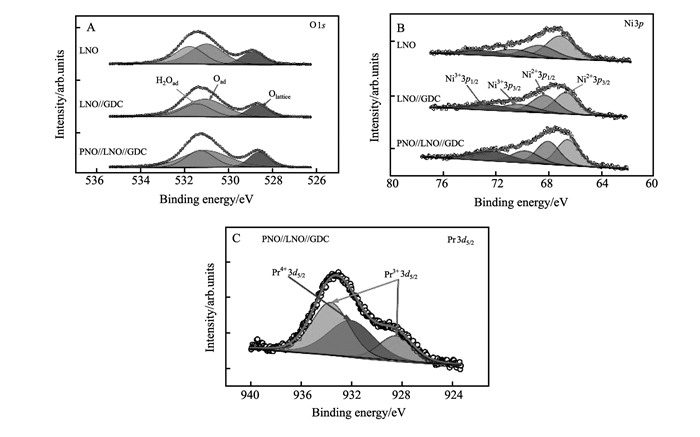
In La2NiO4+δ oxide with K2NiF4-type structure, Ni valence can be increased by excess oxygen (δ) in the form of oxide interstitials. Thus, the valence state of Ni ion is believed to play a decisive role in the catalytic activity. Fig. 8B displays the comparison of Ni3p spectra among bare LNO, buffer layer inserted LNO, and modified LNO with PNO (~5 nm) heterojunction. The Ni spectra can be fitted to two sets of split doublets, namely Ni3p1/2 and Ni3p3/2, respectively. The percentage contribution of the Ni2+ and Ni3+ and the average valence state of Niare given in Table S3 of Supporting Information. It is obviously that the valence state of Ni is gradually increased from Ni2+ to Ni3+ state in the sequence of LNO < LNO//GDC < PNO//LNO//GDC. Fig. 8C shows the excitation of Pr3d5/2 of the PNO (~5 nm) modified layer, in which the Pr3d5/2 was separated into three fitting peaks, which are located at 933.65 eV (Pr3+ 3d5/2), 932.04 eV (Pr4+ 3d5/2) and 928.45 eV (Pr3+ 3d5/2), respectively. This fitting result is agree with evidence from previous reports[45]. From the average valence state of Ni ions and Pr ions it can be inferred the value of excess oxygen (δ), which are listed in Table S3 of Supporting Information. Obviously, the surface decoration with PNO film has the highest δ, followed by GDC buffer layer inserted LNO, and the least is the bare LNO. Therefore, PNO modified layer is beneficial for enhancing the concentration of interstitial oxygen, corresponding to accelerate diffusion of oxygen ion, which is consistent with the above EIS and AFM results. Finally, to sum up, from the XPS analysis we can concluded that surface modification with PNO film provides rich surface oxygen defects, which can effectively accelerate both of the surface oxygen exchange and oxygen ion diffusivity, leading to further enhance the ORR activity.
In summary, we have explored the effect of surface modification of La2NiO4+δ (LNO) with conformal Pr2NiO4+δ (PNO)heterojunction on the electrochemical properties. Firstly, bare LNO film was successfully grown on single crystal YSZ substrate by using programmable logic device technique. The optimum oxygen pressure (20.01 Pa) and thickness (30000 pulses) for LNO deposition was confirmed. Secondly, the Ce0.9Gd0.1O2-δ (GDC) buffer layer deposited between LNO cathode and YSZ substrate was proved to be beneficial to increase the oxygen reduction reaction (ORR) activity. Thirdly, five different thicknesses of PNO modified layer were deposited on the LNO surface, and PNO with about 5 nm thick has the smallest ASR, resulting from the change of RLS for ORR from the adsorption and dissociation of oxygen steps to charge-transfer process. In addition, rougher surface after PNO decoration measured by AFM confirmed that PNO modified LNO has better catalytic activity than that of bare LNO film. Meanwhile, XPS analysis gave the evidence that the surface decoration of LNO with conformal PNO (~5 nm) layer was able to adsorb more oxygen species and accommodate higher excess oxygen (δ) than that of bare LNO phases. Finally, these results demonstrated the surface modification with conformal heterojunction would provide a potential direction for achieving high-performance cathode.
Steele B C H, Heinzel A. Materials for Fuel-Cell Technologies[J]. Nature, 2001, 414(6861): 345-352. doi: 10.1038/35104620
Ormerod R M. Solid Oxide Fuel Cells[J]. Chem Soc Rev, 2003, 32(1): 17-18. doi: 10.1039/b105764m
Shao Z P, Haile S M. A High-Performance Cathode for the Next Generation of Solid-Oxide Fuel Cells[J]. Mater Sustainable Energy, 2011, 431(9): 255-258. doi: 10.1038/nature02863
Duan C, Hook D, Chen Y. Zr and Y Co-doped Perovskite as a Stable, High Performance Cathode for Solid Oxide Fuel Cells Operating Below 500℃[J]. Environ Sci, 2017, 10(1): 176-182.
Lashtabeg A, Skinner S J. Solid Oxide Fuel Cells-A Challenge for Materials Chemists[J]. J Mater Chem, 2006, 16(31): 3161-3170. doi: 10.1039/B603620A
Liu Q, Dong X H, Xia G L. A Novel Electrode Material for Symmetrical SOFCs[J]. Adv Mater, 2010, 22(48): 5478-5482. doi: 10.1002/adma.201001044
Dulli H, Dowben P A, Liou S H. Surface Segregation and Restructuring of Colossal-Magnetoresistant Manganese Perovskites La0.65Sr0.35MnO3[J]. Phys Rev B, 2000, 62(22): R14629-R14632. doi: 10.1103/PhysRevB.62.R14629
Cai Z, Kubicek M, Fleig J. Chemical Heterogeneities on La0.6Sr0.4CoO3-delta Thin Films-correlations to Cathode Surface Activity and Stability[J]. Chem Mater, 2012, 24(6): 1116-1127. doi: 10.1021/cm203501u
Lee W, Han J W, Chen Y. Cation Size Mismatch and Charge Interactions Drive Dopant Segregation at the Surfaces of Manganite Perovskites[J]. J Am Chem Soc, 2013, 135(21): 7909-7925. doi: 10.1021/ja3125349
Tellez H, Druce J, Kilner J A. Relating Surface Chemistry and Oxygen Surface Exchange in LnBaCo2O5+δ Air Electrodes[J]. Chem Mater, 2015, 182: 145-157.
Sase M, Hermes F, Yashiro K. Enhancement of Oxygen Surface Exchange at the Hetero-interface of (La, Sr)CoO3/(La, Sr)2CoO4 with PLD-Layered Films[J]. J Electrochem Soc, 2008, 155(8): B793-B797. doi: 10.1149/1.2928612
Yoon J, Cho S, Kim J H. Vertically Aligned Nanocomposite Thin Films as a Cathode/Electrolyte Interface Layer for Thin-Film Solid-Oxide Fuel Cells[J]. Adv Funct Mater, 2009, 19(24): 3868-3873. doi: 10.1002/adfm.200901338
Crumlin E J, Mutoro E, Ahn S J. Oxygen Reduction Kinetics Enhancement on a Heterostructured Oxide Surface for Solid Oxide Fuel Cells[J]. J Phys Chem Lett, 2010, 1(21): 3149-3155. doi: 10.1021/jz101217d
Lynch M E, Yang L, Qin W. Enhancement of La0.6Sr0.4Co0.2Fe0.8O3-δ Durability and Surface Electrocatalytic Activity by La0.85Sr0.15MnO3±δ Investigated Using a New Test Electrode Platform[J]. Energy Environ Sci, 2011, 4(6): 2249-2258. doi: 10.1039/c1ee01188j
Ma W, Kim J J, Tsvetkov N. Vertically Aligned Nanocomposite La0.8Sr0.2CoO3/(La0.5Sr0.5)2CoO4 Cathodes-Electronic Structure, Surface Chemistry and Oxygen Reduction Kinetics[J]. J Mater Chem A, 2015, 3(1): 207-219.
Choi H J, Bae K, Grieshammer S. Surface Tuning of Solid Oxide Fuel Cell Cathode by Atomic Layer Deposition[J]. Adv Energy Mater, 2018, 8(33): 1802506-1802514. doi: 10.1002/aenm.201802506
Sase M, Yashiro K, Sato K. Enhancement of Oxygen Exchange at the Hetero Interface of (La, Sr)CoO3/(La, Sr)2CoO4 in Composite Ceramics[J]. Solid State Ionics, 2008, 178(35/36): 1843-1852.
Han J W, Yildiz B. Mechanism for Enhanced Oxygen Reduction Kinetics at the (La, Sr)CoO3-δ/(La, Sr)2CoO4+δ Hetero-Interface[J]. Energy Environ Sci, 2012, 5(9): 8598-8607. doi: 10.1039/c2ee03592h
Chen Y, Cai Z, Kuru Y. Electronic Activation of Cathode Superlattices at Elevated Temperatures-Source of Markedly Accelerated Oxygen Reduction Kinetics[J]. Adv Energy Mater, 2013, 3(9): 1221-1229. doi: 10.1002/aenm.201300025
Kushima A, Yildiz B. Oxygen Ion Diffusivity in Strained Yttria Stabilized Zirconia:Where is the Fastest Strain?[J]. J Mater Chem, 2010, 20(23): 4809-4819. doi: 10.1039/c000259c
Li X, Benedek N A. Enhancement of Ionic Transport in Complex Oxides Through Soft Lattice Modes and Epitaxial Strain[J]. Chem Mater, 2015, 27(7): 2647-2652. doi: 10.1021/acs.chemmater.5b00445
Halat D M, Dervişlu R, Kim G. Probing Oxide-Ion Mobility in the Mixed Ionic-Electronic Conductor La2NiO4+δ by Solid-State O-17 MAS NMR Spectroscopy[J]. J Am Chem Soc, 2016, 138(36): 11958-11969. doi: 10.1021/jacs.6b07348
Gu X K, Carneiro J S A, Samira S. Efficient Oxygen Electrocatalysis by Nanostructured Mixed-Metal Oxides[J]. J Am Chem Soc, 2018, 140(26): 8128-8137. doi: 10.1021/jacs.7b11138
Xu S, Jacobs R, Morgan D. Factors Controlling Oxygen Interstitial Diffusion in the Ruddlesden-Popper Oxide La2-xSrxNiO4+δ[J]. Chem Mater, 2018, 30(20): 7166-7177. doi: 10.1021/acs.chemmater.8b03146
Peng B, Chen G, Wang T. Hydride Reduced LaSrCoO4-δ as New Cathode Material for Ba(Zr0.1Ce0.7Y0.2)O3 Based Intermediate Temperature Solid Oxide Fuel Cells[J]. J Power Sources, 2012, 201: 174-178. doi: 10.1016/j.jpowsour.2011.10.121
Yashima M, Enoki M, Wakita T. Structural Disorder and Diffusional Pathway of Oxide Ions in a Doped Pr2NiO4-Based Mixed Conductor[J]. J Am Chem Soc, 2008, 130(9): 2762-2763. doi: 10.1021/ja711478h
Berger C, Egger A, Merkle R. Oxygen Surface Exchange Kinetics of Pr2(Ni, Co)O4+δ Thin-Film Model Electrodes[J]. J Electrochem Soc, 2019, 166(14): F1088-F1095. doi: 10.1149/2.0521914jes
Tropin E, Ananyev M, Porotnikova N. Oxygen Surface Exchange and Diffusion in Pr1.75Sr0.25Ni0.75Co0.25O4±δ[J]. Phys Chem Chem Phys, 2019, 31(9): 4779-4790. doi: 10.1039/C9CP00172G
Pérez-Flores J C, Pérez-Coll D, García-Martín S. A-and B-site Ordering in the A-Cation-Deficient Perovskite Series La2-xNiTiO6-δ (0 ≤ x < 0.20) and Evaluation as Potential Cathodes for Solid Oxide Fuel Cells[J]. Chem Mater, 2013, 25(12): 2484-2494. doi: 10.1021/cm4008014
Yamada A, Suzuki Y, Saka K. Ruddlesden-Popper-Type Epitaxial Film as Oxygen Electrode for Solid-Oxide Fuel Cells[J]. Adv Mater, 2008, 20(21): 4124-4138. doi: 10.1002/adma.200801199
Huan Y, Chen S, Zeng R. Intrinsic Effects of Ruddlesden-Popper-Based Bi Functional Catalysts for High-Temperature Oxygen Reduction and Evolution[J]. Adv Energy Mater, 2019, 9(29): 1901573-1901581. doi: 10.1002/aenm.201901573
Duan Z, Yang M, Yan A. Ba0.5Sr0.5Co0.8Fe0.2O3-δ as a Cathode for IT-SOFCs with a GDC Interlayer[J]. J Power Sources, 2006, 160(1): 57-64. doi: 10.1016/j.jpowsour.2006.01.092
Kim Y M, Kim-Lohsoontorn P, Bae J. Effect of Unsintered Gadolinium-Doped Ceria Buffer Layer on Performance of Metal-Supported Solid Oxide Fuel Cells Using Unsintered Barium Strontium Cobalt Ferrite Cathode[J]. J Power Sources, 2010, 195(19): 6420-6427. doi: 10.1016/j.jpowsour.2010.03.095
Ding D, Liu M, Liu Z. Efficient Electro-catalysts for Enhancing Surface Activity and Stability of SOFC Cathodes[J]. Adv Energy Mater, 2013, 3(9): 1149-1154. doi: 10.1002/aenm.201200984
Ding D, Li X, Lai S Y. Enhancing SOFC Cathode Performance by Surface Modification Through Infiltration[J]. Energy Environ Sci, 2014, 7(2): 552-575. doi: 10.1039/c3ee42926a
Chen Y, Chen Y, Ding D. A Robust and Active Hybrid Catalyst for Facile Oxygen Reduction in Solid Oxide Fuel Cells[J]. Energy Environ Sci, 2017, 10(4): 964-971. doi: 10.1039/C6EE03656B
Jacobson , A J. Materials for Solid Oxide Fuel Cells[J]. Chem Mater, 2010, 22(3): 660-674. doi: 10.1021/cm902640j
Takeda Y, Kanno R, Noda M. Cathodic Polarization Phenomena of Perovskite Oxide Electrodes with Stabilized Zirconia[J]. J Electrochem Soc, 1987, 134(11): 2656-2661. doi: 10.1149/1.2100267
Siebert E, Hammouche A, Kleitz M. Impedance Spectroscopy Analysis of La1-xSrxMnO3-Yttria-Stabilized Zirconia Electrode-Kinetics[J]. Electrochim Acta, 1995, 40(11): 1741-1753. doi: 10.1016/0013-4686(94)00361-4
Chen D, Ran R, Zhang K. Intermediate-Temperature Electrochemical Performance of a Polycrystalline PrBaCo2O5+δ Cathode on Samarium-Doped Ceria Electrolyte[J]. J Power Sources, 2009, 188(1): 96-105. doi: 10.1016/j.jpowsour.2008.11.045
Chen H, Guo Z, Zhang L A. Improving the Electrocatalytic Activity and Durability of the La0.6Sr0.4Co0.2Fe0.8O3-δ Cathode by Surface Modification[J]. ACS Appl Mater Interface, 2018, 10(46): 39785-39793. doi: 10.1021/acsami.8b14693
Mukherjee K, Hanyamizu Y, Kim C S. Praseodymium Cuprate Thin Film Cathodes for Intermediate Temperature Solid Oxide Fuel Cells:Roles of Doping, Orientation, and Crystal Structure[J]. ACS Appl Mater Interface, 2016, 8(50): 34295-34302. doi: 10.1021/acsami.6b08977
Sun S, Zhang H, Pan M. Dynamic Simulation of Oxygen Transport Rates in Highly Ordered Electrodes for Proton Exchange Membrane Fuel Cells[J]. Fuel Cells, 2015, 15(3): 456-462. doi: 10.1002/fuce.201400094
Meng J, Liu X, Yao C. Bi-Doped La2ZnMnO6-δ and Relevant Bi-Deficient Compound as Potential Cathodes for Intermediate Temperature Solid Oxide Fuel Cells[J]. Solid State Ionics, 2015, 279: 32-38. doi: 10.1016/j.ssi.2015.07.016
Zhang L, Yao G, Song Z. Effects of Pr-Deficiency on Thermal Expansion and Electrochemical Properties in Pr1-xBaCo2O5+δ Cathodes for IT-SOFCs[J]. Electrochim Acta, 2016, 212: 522-534. doi: 10.1016/j.electacta.2016.07.014

Figure 1 (A) XRD patterns of the LNO target and HRXRD plots of LNO films with 2θ-ω scans under different oxygen pressures. (B)Nyquist plots of LNO films prepared under different oxygen pressures

Figure 2 (A) EIS of LNO films with different thicknesses measured at 800 ℃ in air. (B)SEM images of LNO film deposited by 10000 pulses. (C)SEM images of LNO film deposited by 30000 pulses. (D)SEM images of LNO film deposited by 50000 pulses

Figure 3 (A) XRD patterns of GDC target and HRXRD pattern GDC film on YSZ single substrates. (B)The comparison of polarization resistance for bare LNO with and without GDC buffer layer inserted. The corresponding Nyquist plots was given in the inset

Figure 4 XRD patterns of LNO and PNO targets, and symmetric 2θ-ω HRXRD scans of the surface modification films as a function of thickness

Figure 5 (A) The EIS curves measured on bare LNO phases and PNO decorated LNO film cells. The LNO (~5 nm) modified LNO film was displayed as a reference. (B)The ASR of the model cells

Figure 7 AFM images of as-grown (A)LNO//GDC and (B)PNO(~5 nm) modified LNO//GDC films deposited on YSZ, respectively; (C)Schematics of the EIS measurement setup(model cell); SEM images of (D)bare LNO surface and (E)PNO (~5 nm) modified LNO films; (F)Cross section of PNO//LNO//GDC//YSZ model cell

Figure 6 The oxygen partial pressure dependence of polarization resistance for (A) total ASR, (B) R1, and (C) R2 measured on three types of model cells at 850 ℃

 扫一扫看文章


扫一扫关注我们
 下载:
下载:
 下载:
下载:
