Login In
A Coumarin-Based Fluorescent Probe for Rapid Detection of Endogenous Formaldehyde
- Corresponding author: CUI Jingnan, jncui@dlut.edu.cn
Figures(9)
Citation:
GAO Man, HE Xin, CUI Jingnan, LIU Tao, TIAN Zhenhao, HE Shengui. A Coumarin-Based Fluorescent Probe for Rapid Detection of Endogenous Formaldehyde[J]. Chinese Journal of Applied Chemistry,
;2019, 36(9): 1053-1060.
doi:
10.11944/j.issn.1000-0518.2019.09.190023

Figures(9)


HONG Jiamin. Summary of Research Progress on Hazards and Detection Methods of Formaldehyde Pollution[J]. Anhui J Prev Med, 2007,13(1):44-47.
HUANG Zhongqian, LI Yanan, GAO Lixia. Research Progress on Formaldehyde Analysis Methods in Food[J]. J Food Saf Qual, 2015,6(12):4712-4718.
LI Xinru. Talking about the Harm and Prevention of Indoor Formaldehyde Pollution[J]. J Jiaozuo Univ, 2017,31(4):83-84.
SUN Zhaodong. Brief Introduction of the Harm of Formaldehyde and Its Prevention and Treatment Methods[J]. Technol Wind, 2014,14(161):194-200.
TONG Zhiqian, WAN You, LUO Wenhong. Endogenous Formaldehyde and Its Related Major Human Diseases[J]. Prog Nat Sci, 2008,18(11):1201-1210. doi: 10.3321/j.issn:1002-008X.2008.11.001
LONG Yunfei, ZHOU Liping, HAN Ming. Determination of Trace Formaldehyde Based on the Formation of Silver Nanoparticles[J]. Chinese J Appl Chem, 2009,26(11):1349-1352. doi: 10.3969/j.issn.1000-0518.2009.11.022
YANG Lei, LIU Wenjie. Research and Development of Formaldehyde Detection Fluorescent Probe[J]. China Fiber Ins, 2018,20:77-79.
Tang Y, Kong X, Xu A. Development of a Two-Photon Fluorescent Probe for Imaging of Endogenous Formaldehyde in Living Tissues[J]. Angew Chem, 2016,128:3417-3420. doi: 10.1002/ange.201510373
Song H, Rajendiran S, Kim N. A Tailor Designed Fluorescent 'Turn-On' Sensor of Formaldehyde Based on the BODIPY Motif[J]. Tetrahedron Lett, 2012,53:4913-4916. doi: 10.1016/j.tetlet.2012.06.117
Roth A, Li H, Anorma C. A Reaction-Based Fluorescent Probe for Imaging of Formaldehyde in Living Cells[J]. J Am Chem Soc, 2015,137(34):10890-10893. doi: 10.1021/jacs.5b05339
Brewer T F, Chang C J. An Aza-Cope Reactivity-Based Fluorescent Probe for Imaging Formaldehyde in Living Cells[J]. J Am Chem Soc, 2015,137(34):10886-10889. doi: 10.1021/jacs.5b05340
Xie Z, Ge J, Zhang H. A Highly Selective Two-Photon Fluorescence Probe for Formaldehyde and Its Bioimaging Application in Cells and Zebrafish[J]. Sens Actuators B:Chem, 2016,241:1050-1056.
Chen L, Fu Y, Fang W. Screening of a Highly Effective Fluorescent Derivatization Reagent for Carbonyl Compounds and Its Application in HPLC with Fluorescence Detection[J]. Talanta, 2018,186:221-228. doi: 10.1016/j.talanta.2018.04.017
Macmillan K S, Nguyen T, Hwang I. Total Synthesis and Evaluation of Iso-Duocarmycin SA and Iso-Yatakemycin[J]. J Am Chem Soc, 2009,131(3):1187-1194. doi: 10.1021/ja808108q
YANG Chunhao, SHAO Jimin, ZHU Weiliang, et al. Substituted Amide Phenols and Their Preparation Methods, Pharmaceutical Compositions and Applications: CN, 105085433.A[P]. 2015-11-25(in Chinese).
Wang P, Xia Y, Zou L. An Optimized Two-Photon Fluorescent Probe for Biological Sensing and Imaging of Catechol-O-Methyltransferase[J]. Chem Eur J, 2017,23(45):10800-10807. doi: 10.1002/chem.201701384
Banerjee A, Panosian T D, Mukherjee K. Site-Specific Orthogonal Labeling of the Carboxy Terminus of α-Tubulin[J]. ACS Chem Biol, 2010,5(8):777-785. doi: 10.1021/cb100060v
Okata H, Hatta W, Iijima K. Detection of Acetaldehyde in the Esophageal Tissue among Healthy Male Subjects after Ethanol Drinking and Subsequent L-Cysteine Intake[J]. Tohoku J Exp Med, 2018,244(4):317-325. doi: 10.1620/tjem.244.317
Daniele D R, Amanda J S, Nicoletta P. A Review of Recent Studies on Malondialdehyde as Toxic Molecule and Biological Marker of Oxidative Stress[J]. Nutr Metab Cardiovasc Dis, 2005,15(4):316-328. doi: 10.1016/j.numecd.2005.05.003
Pengli GUAN , Renhu BAI , Xiuling SUN , Bin LIU . Trianiline-derived aggregation-induced emission luminogen probe for lipase detection and cell imaging. Chinese Journal of Inorganic Chemistry, 2025, 41(9): 1817-1826. doi: 10.11862/CJIC.20250058
Yanxi LIU , Mengjia XU , Haonan CHEN , Quan LIU , Yuming ZHANG . A fluorescent-colorimetric probe for peroxynitrite-anion-imaging in living cells. Chinese Journal of Inorganic Chemistry, 2025, 41(6): 1112-1122. doi: 10.11862/CJIC.20240423
Yuting DU , Jing YUAN , Peiyao DENG . Synthesis and application of a fluorescent probe for the detection of reduced glutathione. Chinese Journal of Inorganic Chemistry, 2025, 41(7): 1331-1337. doi: 10.11862/CJIC.20240461
Qiang HU , Zhiqi CHEN , Zhong CHEN , Xu WANG , Weina WU . Pyridinium-chalcone-based ClO- fluorescent probe: Preparation and biological imaging applications. Chinese Journal of Inorganic Chemistry, 2025, 41(9): 1789-1795. doi: 10.11862/CJIC.20250086
Jinlong YAN , Weina WU , Yuan WANG . A simple Schiff base probe for the fluorescent turn-on detection of hypochlorite and its biological imaging application. Chinese Journal of Inorganic Chemistry, 2024, 40(9): 1653-1660. doi: 10.11862/CJIC.20240154
Jiakun BAI , Ting XU , Lu ZHANG , Jiang PENG , Yuqiang LI , Junhui JIA . A red-emitting fluorescent probe with a large Stokes shift for selective detection of hypochlorous acid. Chinese Journal of Inorganic Chemistry, 2024, 40(6): 1095-1104. doi: 10.11862/CJIC.20240002
Yingpeng ZHANG , Xingxing LI , Yunshang YANG , Zhidong TENG . A pyrazole-based turn-off fluorescent probe for visual detection of hydrazine. Chinese Journal of Inorganic Chemistry, 2025, 41(7): 1301-1308. doi: 10.11862/CJIC.20250064
Jun LUO , Baoshu LIU , Yunchang ZHANG , Bingkai WANG , Beibei GUO , Lan SHE , Tianheng CHEN . Europium(Ⅲ) metal-organic framework as a fluorescent probe for selectively and sensitively sensing Pb2+ in aqueous solution. Chinese Journal of Inorganic Chemistry, 2024, 40(12): 2438-2444. doi: 10.11862/CJIC.20240240
Lei ZHANG , Cheng HE , Yang JIAO . An azo-based fluorescent probe for the detection of hypoxic tumor cells. Chinese Journal of Inorganic Chemistry, 2025, 41(6): 1162-1172. doi: 10.11862/CJIC.20250081
Yu SU , Xinlian FAN , Yao YIN , Lin WANG . From synthesis to application: Development and prospects of InP quantum dots. Chinese Journal of Inorganic Chemistry, 2024, 40(11): 2105-2123. doi: 10.11862/CJIC.20240126
Siyi ZHONG , Xiaowen LIN , Jiaxin LIU , Ruyi WANG , Tao LIANG , Zhengfeng DENG , Ao ZHONG , Cuiping HAN . Targeting imaging and detection of ovarian cancer cells based on fluorescent magnetic carbon dots. Chinese Journal of Inorganic Chemistry, 2024, 40(8): 1483-1490. doi: 10.11862/CJIC.20240093
Linfang ZHANG , Wenzhu YIN , Gui YIN . A 2-dicyanomethylene-3-cyano-4,5,5-trimethyl-2,5-dihydrofuran-based near-infrared fluorescence probe for the detection of hydrogen sulfide and imaging of living cells. Chinese Journal of Inorganic Chemistry, 2025, 41(3): 540-548. doi: 10.11862/CJIC.20240405
Meirong HAN , Xiaoyang WEI , Sisi FENG , Yuting BAI . A zinc-based metal-organic framework for fluorescence detection of trace Cu2+. Chinese Journal of Inorganic Chemistry, 2024, 40(8): 1603-1614. doi: 10.11862/CJIC.20240150
Yuan ZHU , Xiaoda ZHANG , Shasha WANG , Peng WEI , Tao YI . Conditionally restricted fluorescent probe for Fe3+ and Cu2+ based on the naphthalimide structure. Chinese Journal of Inorganic Chemistry, 2025, 41(1): 183-192. doi: 10.11862/CJIC.20240232
Shuwen SUN , Gaofeng WANG . Design and synthesis of a Zn(Ⅱ)-based coordination polymer as a fluorescent probe for trace monitoring 2, 4, 6-trinitrophenol. Chinese Journal of Inorganic Chemistry, 2025, 41(4): 753-760. doi: 10.11862/CJIC.20240399
Zhifeng CAI , Ying WU , Yanan LI , Guiyu MENG , Tianyu MIAO , Yihao ZHANG . Effective detection of malachite green by folic acid stabilized silver nanoclusters. Chinese Journal of Inorganic Chemistry, 2025, 41(5): 983-993. doi: 10.11862/CJIC.20240394
Wei GAO , Meiqi SONG , Xuan REN , Jianliang BAI , Jing SU , Jianlong MA , Zhijun WANG . A self-calibrating fluorescent probe for the selective detection and bioimaging of HClO. Chinese Journal of Inorganic Chemistry, 2025, 41(6): 1173-1182. doi: 10.11862/CJIC.20250112
Di WU , Ruimeng SHI , Zhaoyang WANG , Yuehua SHI , Fan YANG , Leyong ZENG . Construction of pH/photothermal dual-responsive delivery nanosystem for combination therapy of drug-resistant bladder cancer cell. Chinese Journal of Inorganic Chemistry, 2024, 40(9): 1679-1688. doi: 10.11862/CJIC.20240135
Yongmei Liu , Lisen Sun , Zhen Huang , Tao Tu . Curriculum-Based Ideological and Political Design for the Experiment of Methanol Oxidation to Formaldehyde Catalyzed by Electrolytic Silver. University Chemistry, 2024, 39(2): 67-71. doi: 10.3866/PKU.DXHX202308020
Benhua Wang , Chaoyi Yao , Yiming Li , Qing Liu , Minhuan Lan , Guipeng Yu , Yiming Luo , Xiangzhi Song . 一种基于香豆素氟离子荧光探针的合成、表征及性能测试——“科研反哺教学”在有机化学综合实验教学中的探索与实践. University Chemistry, 2025, 40(6): 201-209. doi: 10.12461/PKU.DXHX202408070
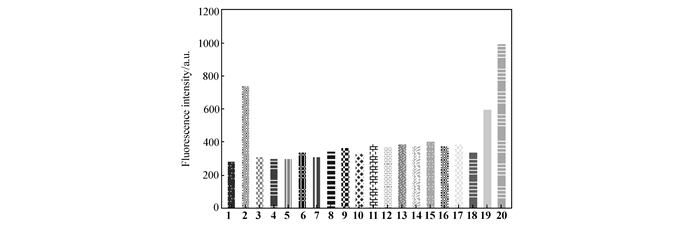
1.PBS; 2.Formaldehyde; 3.Aspartic acid; 4.Alanine; 5.Methionine; 6.Phenylalanine; 7.L-glutamic acid; 8.Homocysteine; 9.Glycine; 10.Glutathione; 11.L-arginine; 12.Sodium ascorbate; 13.Sodium citrate; 14.Mg2+; 15.Na+; 16.K+; 17.Ca2+; 18.H2O2; 19.Acetaldehyde; 20.Malondialdehyde
 DownLoad: