
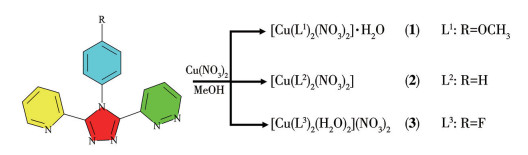
Scheme 1.
Synthetic routes of complexes 1-3


During the last thirty years, 3,4,5-trisubstituted 1,2,4-triazole compounds have been widely adopted as important bridging ligands in coordination chemistry owing to their variable coordinating modes and interesting topological structures[1]. In particular, some iron(Ⅱ) complexes based on 3,4,5-trisubstituted 1,2,4-triazoles can display intriguing spin-crossover properties[2], which enable their application across fields ranging from molecular switches and display devices to optical sensors and information storage materials[3-7].
Our research group has been devoted to the design and synthesis of various 3,4,5-triaryl-substituted 1,2,4-triazole derivatives for two decades. Up to now, a series of asymmetrically 3,4,5-triaryl-substituted 1,2,4-triazoles containing five-membered aromatic heterocycles such as pyrrole, furan, thiophene, and imidazole; six-membered aromatic rings such as benzene, pyridine, and pyrimidine; and aromatic polycycles such as naphthalene and quinoline have been reported[8-26]. However, 3-pyridazinyl (Pyd)-substituted 1,2,4-triazole compounds remain exceptionally scarce. To date, there has been only one known example. In 2016, Prof. Brooker reported 4-(4-methylphenyl)-3-(2-pyridyl)-5-(3-pyridazinyl)-1,2,4-triazole (L) and its spin-crossover binuclear iron(Ⅱ) complex, [Fe2(L)2(CH3CN)4](BF4)4·2CH3CN[27-28]. As a continuation of our research on asymmetrically substituted triaryltriazoles, we report herein the first syntheses of three novel 3-Pyd substituted triaryltriazoles: 4-(4-R-phenyl)-3-(2-pyridyl)-5-(3-pyridazinyl)-1,2,4-triazole (L1: R=OCH3; L2: R=H; L3: R=F) (Scheme S1, Supporting information) and their Cu(Ⅱ) complexes, [Cu(L1)2(NO3)2]·H2O (1), [Cu(L2)2 (NO3)2] (2) and [Cu(L3)2(H2O)2](NO3)2 (3) (Scheme 1). The crystal structures of ligands (L1)3, L2, L3 and three Cu(Ⅱ) complexes 1-3 have been determined by single-crystal X-ray crystallography, and their intermolecular interactions have been investigated in detail by Hirshfeld surface analysis.
Unless otherwise stated, all reagents and solvents were purchased from commercial sources and used without further purification. Melting points were determined with an X-4 digital microscope melting-point apparatus (Beijing) and are uncorrected. Elemental analyses (C, H, N) were performed on a Thermo Finnigan Flash 1112A elemental analyzer. Infrared (IR) spectra were recorded in a range of 4 000-400 cm-1 on a Nicolet Avatar 380 FTIR spectrophotometer using KBr pellets. Thermogravimetric analysis (TGA) was performed with a simultaneous NETZSCH STA 449C thermal analyzer under flowing nitrogen from 25 to 600 ℃ at a heating rate of 5 ℃·min-1. 1H NMR spectra were measured on a Bruker AM 400 MHz spectrometer in DMSO-d6 solution. Powder X-ray diffraction (PXRD) data were collected on a Bruker D8 Advance diffractometer equipped with Cu Kα radiation (λ=0.154 06 nm) at 40 kV and 40 mA in a range of 5°-50°.
Ligands L1-L3 were synthesized according to our reported procedure[25], and their synthetic route is shown in Scheme S1.
4-(4-methoxyphenyl)-3-(2-pyridyl)-5-(3-pyridazinyl)-1,2,4-triazole (L1): white powder (Yield: 70.5%, m.p. 202.3-203.5 ℃). Anal. Calcd. for C18H14N6O(%): C, 65.45; H, 4.27; N, 25.44. Found(%): C, 65.64; H, 4.46; N, 25.32. IR (KBr, cm-1): 3 077(w), 2 957(w), 1 576(s), 1 570(s), 1 241(m), 823(m). 1H NMR (400 MHz): δ 9.22-9.23(d, 1H, JH,H=4.0 Hz, Pyd-H), 8.42-8.43(d, 1H, JH,H=4.0 Hz, Py-H), 8.20-8.22(d, 1H, JH,H=8.0 Hz, Py-H), 7.92-7.99(m, 2H, Py-H and Pyd-H), 7.83-7.87(m, 1H, Pyd-H), 7.41-7.48(m, 1H, Py-H), 7.21-7.23(d, 2H, JH,H=8.0 Hz, Ph-H), 7.13-7.15(d, 2H, JH,H=8.0 Hz, Ph-H), 2.30(s, 3H, OCH3).
4-phenyl-3-(2-pyridyl)-5-(3-pyridazinyl)-1,2,4-triazole (L2): colorless block-shaped crystal (Yield: 73.8%, m.p. 192.5-193.7 ℃). Anal. Calcd. for C17H12N6(%): C, 67.99; H, 4.03; N, 27.98. Found(%): C, 67.84; H, 4.16; N, 27.76. IR (KBr, cm-1): 3 060(m), 1 580(m), 1 500(s), 833(m), 775(m). 1H NMR (400 MHz): δ 9.22-9.23(d, 1H, JH,H=4.0 Hz, Pyd-H), 8.38-8.39(d, 1H, JH,H=4.0 Hz, Py-H), 8.23-8.25(d, 1H, JH,H=8.0 Hz, Py-H), 8.00-8.02(d, 1H, JH,H=8.0 Hz, Py-H), 7.93-7.97(t, 1H, Pyd-H), 7.41-7.44(m, 1H, Pyd-H), 7.34-7.38(m, 6H, Py-H and Ph-H).
4-(4-fluorophenyl)-3-(2-pyridyl)-5-(3-pyridazinyl)-1,2,4-triazole (L3): white powder (yield: 71.8%; m.p. 189.5-190.6 ℃). Anal. Calcd. for C17H11N6F(%): C, 64.15; H, 3.48; N, 26.40. Found(%): C, 64.31; H, 3.36; N, 26.56. IR (KBr, cm-1): 3 060(w), 1 590(s), 1 510(s), 1 090(w), 849(m). 1H NMR (400 MHz): δ 9.22-9.23(d, 1H, JH,H=4.0 Hz, Pyd-H), 8.40-8.41(d, 1H, JH,H=4.0 Hz, Py-H), 8.27-8.29(d, 1H, JH,H=8.0 Hz, Py-H), 8.05-8.07(d, 1H, Py-H), 7.94-7.98(t, 1H, JH,H=8.0 Hz, Pyd-H), 7.84-7.88(m, 1H, Pyd-H), 7.41-7.48(m, 3H, JH,H=8.0 Hz, Py-H and Ph-H), 7.19-7.23(t, 2H, JH,H=8.0 Hz, Ph-H).
A solution of Cu(NO3)2·3H2O (24.2 mg, 0.1 mmol) in anhydrous MeOH (3 mL) was added to a solution of L1 (66.1 mg, 0.2 mmol) in MeOH (4 mL). The mixture was stirred for 6 h at room temperature. Then the green precipitate was separated by filtration, washed with water, and dried under vacuum to obtain complex 1 in a yield of 80.4%. The green block-shaped single crystals suitable for X-ray diffraction were obtained by slow evaporation from a methanol solution of 1. Anal. Calcd. for C36H30CuN14O9(%): C, 49.91; H, 3.49; N, 22.64. Found(%): C, 49.78; H, 3.32; N, 22.52. FTIR (KBr, cm-1): 3 420(m, br), 3 060(w), 2 940(w), 1 510(s), 1 450(m), 1 380(vs), 1 260(s), 1 020(m), 837(m).
The preparation procedure for 2 was the same as that for 1 except that L2 (60.1 mg, 0.2 mmol) was used instead of the L1 ligand. The yield of 2 was 71.6%. A green block-shaped single crystal suitable for X-ray diffraction was obtained by slow evaporation from a methanol solution of 2. Anal. Calcd. for C34H24CuN14O6(%): C, 51.81; H, 3.07; N, 24.88. Found(%): C, 51.59; H, 3.25; N, 24.76. FTIR (KBr, cm-1): 3 060(w), 1 500(m), 1 460(m), 1 380(vs), 698(w).
The synthesis procedure for 3 was the same as that for 1 except using L3 (63.7 mg, 0.2 mmol) to replace the L1 ligand. The yield of 3 was 82.6%. A green block-shaped single crystal suitable for X-ray diffraction was obtained by slow evaporation from a methanol solution of 3. Anal. Calcd. for C34H26CuF2N14O8(%): C, 47.47; H, 3.05; N, 22.80. Found(%): C, 47.34; H, 3.17; N, 22.62. FTIR (KBr, cm-1): 3 411(m, br), 3 081(w), 1 580(m), 1 493(s), 1 380(vs), 1 320(m), 1 089(w), 841(m).
Single crystals of (L1)3, L2, L3 and 1-3 suitable for X-ray diffraction were obtained by slow evaporation of the corresponding solutions in methanol. The single-crystal X-ray diffraction data were collected on a Rigaku XtaLAB Synergy-R DW diffractometer using graphite-monochromated Mo Kα radiation (λ=0.071 073 nm) for L2, L3, 1 and 2, but Cu Kα radiation (λ=0.154 184 nm) for (L1)3 and 3. The unit cell parameters were determined by the multi-scan program using the ω-2θ method and subjected to empirical absorption correction using the CrysAlisPro program. The structures were solved by direct methods and refined on F2 by full-matrix least squares procedures using SHELXTL software[29]. All non-hydrogen atoms were refined with anisotropic displacement parameters, and all hydrogen atoms were calculated and refined as riding modes except water molecules. The F atom in L3 was disordered over two positions with an occupancy of 0.923(9) for F1 and 0.077(9) for F1A. The 4-methoxyphenyl group and the O2 atom of the NO3- ion in 1 were also disordered over two sites with an occupancy of 0.618(5) for O1, C12-C18, and 0.382(5) for O1A, C12A-C18A, and 0.65(3) for O2 and 0.35(3) for O2A. The O2 atom of the NO3- ion in 2 was disordered over two positions with an occupancy of 0.893(17) for O2 and 0.107(17) for O2A. The 4-fluorophenyl group and three O atoms of the NO3- ion in 3 were also disordered over two sites with an occupancy of 0.506(17) for F1, C12-C17 and O1-O3 and 0.494(17) for F1A, C12A-C17A and O1A-O3A. Crystallographic data of (L1)3, L2, L3 and 1-3 are summarized in Table S1, and selected bond lengths and angles are listed in Table S2 and S3.
The 3D Hirshfeld surface constructed from the electron distribution calculated by summing spherical atom electron densities can visualize the shape profile of a molecule within a crystal structure. For a given crystal structure with a set of spherical atom electron densities, the 3D Hirshfeld surface is unique. The normalized contact distance (dnorm) derived from the external distance (de) and internal distance (di) can be used to identify regions of particular importance for intermolecular interactions—where de is defined as the distance from a point on the surface to the nearest nucleus outside the surface, and di is the distance to the nearest nucleus inside the surface. The 2D fingerprint plot, which combines de and di, provides a comprehensive overview of the nature and types of all intermolecular contacts in the crystal. In this work, the 3D Hirshfeld surfaces mapped with dnorm and the corresponding 2D fingerprint plots were generated using the Crystal Explorer 3.1 program[30].
Three new 3-Pyd-substituted triaryltriazoles, L1-L3, have been successfully synthesized by a multi-step organic synthesis (Scheme S1) with yields of 70.5%, 73.8% and 71.8%, respectively. The ligands were soluble in MeOH, MeCN and DMF but slightly soluble in acetone and ethanol. The structures of L1-L3 have been characterized by FTIR, 1H NMR, elemental analysis and single-crystal X-ray diffraction.
As shown in Scheme 1, the ligands L1-L3 react with Cu(NO3)2·3H2O in a 2∶1 molar ratio in methanol, affording three mononuclear Cu(Ⅱ) complexes: trans-[Cu(L1)2(NO3)2]·H2O (1), trans-[Cu(L2)2(NO3)2] (2) and trans-[Cu(L3)2(H2O)2](NO3)2 (3) with a yield of 80.4%, 71.6% and 82.6%, respectively. Three complexes are air-stable, and their compositions have been confirmed by elemental analyses. 1 contains one Cu(Ⅱ) cation, two L1 ligands, two NO3- ions and one water molecule, 2 comprises one Cu(Ⅱ) ion, two L2 ligands and two NO3- ions, while 3 consists of one Cu(Ⅱ) ion, two L3 ligands, two coordinated water molecules and two NO3- counterions. The complexes were slightly soluble in MeOH, EtOH and DMF but poorly soluble in H2O, Me2CO, MeCN, THF and CH2Cl2.
The X-ray structure analyses indicate that the supramolecular trimer (L1)3 crystallizes in the triclinic P1 space group, while L2 and L3 crystallize in the monoclinic space group P21/c and P21/n, respectively (Table S1). These ligands all consist of three aromatic rings and one central 1,2,4-triazole ring (Fig.1). Furthermore, the substituted phenyl (Ph), pyridyl (Py), and Pyd rings are located in a propeller arrangement around the central 1,2,4-triazole ring (Trz). The relevant dihedral angles are listed in Table 1. Their bond lengths and angles are within the normal ranges observed for the related triaryltriazoles (Table S2)[15, 25].
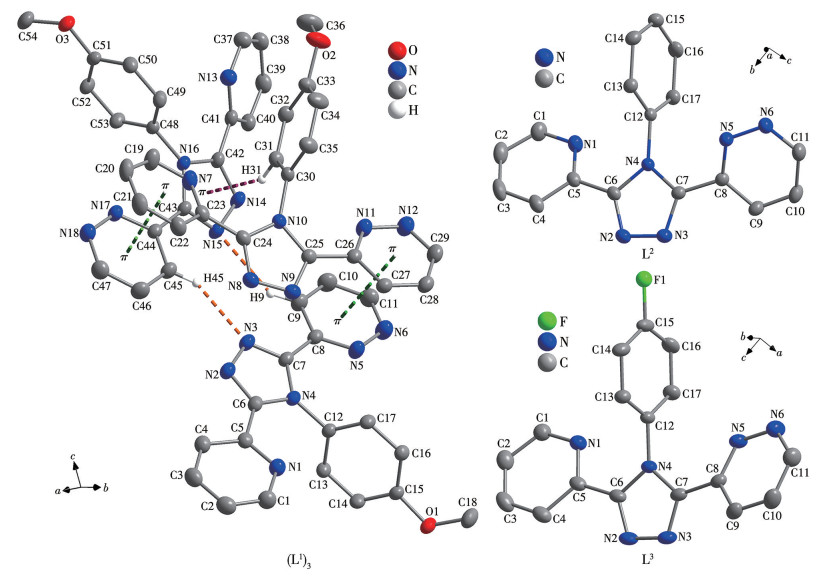
The disordered atoms are omitted for clarity.

 下载:
导出CSV
下载:
导出CSV
| Compounds | Py/Trz | Ph/Trz | Pyd/Trz |
| (L1)3 (O1) | 11.2(2) | 78.5(4) | 11.7(1) |
| (L1)3 (O2) | 26.0(2) | 83.2(4) | 23.1(3) |
| (L1)3 (O3) | 35.7(1) | 87.1(2) | 24.2(4) |
| L2 | 29.1(3) | 77.2(1) | 41.4(4) |
| L3 | 21.7(3) | 87.7(2) | 23.6(1) |
| 1 | 5.5(2) | 79.9(3) | 3.6(2) |
| 2 | 6.6(1) | 83.0(2) | 2.9(2) |
| 3 | 5.8(3) | 69.9(1) | 29.4(2) |
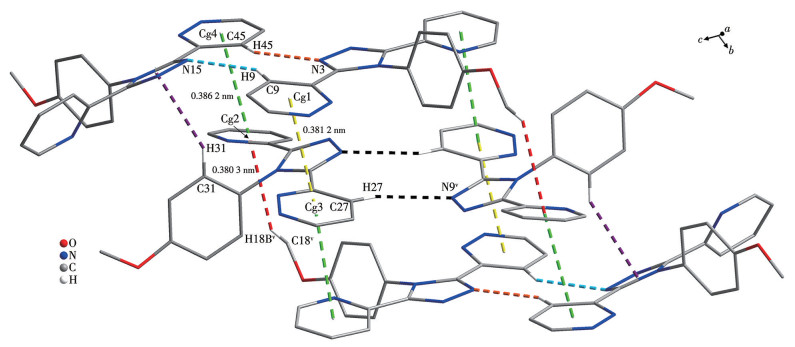
Notably, in the asymmetric unit of L1, there is a hydrogen-bonded trimer (L1)3 (Fig.1), which has not been observed in any of the known triaryltriazoles until now[1, 5, 10, 12, 14-15, 20-25]. These interactions include six kinds of C—H…N hydrogen bonds, one type of C—H…O hydrogen bond, four kinds of edge-to-face C—H…π interactions and two types of π…π stacking interactions [π(N5-pyd)…π(N11-pyd), Cg1…Cg3 0.381 2(3) nm/1.43°; π(N7-py)…π(N17-pyd), Cg2…Cg4 0.386 2(2) nm/14.24°] (Table S4). Among them, the L1 with O1 and the L1 with O3 are first linked by C9—H9…N15 and C45—H45…N3 hydrogen bonds to form a dimer, and then this dimer further connects the L1 containing O2 through C31—H31…π(Trz) interaction and π(Pyd)…π(Pyd) and π(Py)…π(Pyd) stacking interactions to form a trimer (Fig.S1). Ultimately, two trimers interconnect with each other by other hydrogen bonds to produce a 3D supramolecular network (Fig.2). Additionally, the hydrogen-bond interactions link the molecules of L2 into a 1D chain, while a 2D layered structure is observed in L3 (Fig.S2). Obviously, the different substituted groups on the 4-R-phenyl ring (R=OCH3, H, F) can influence the crystal packing of the corresponding ligands L1-L3.
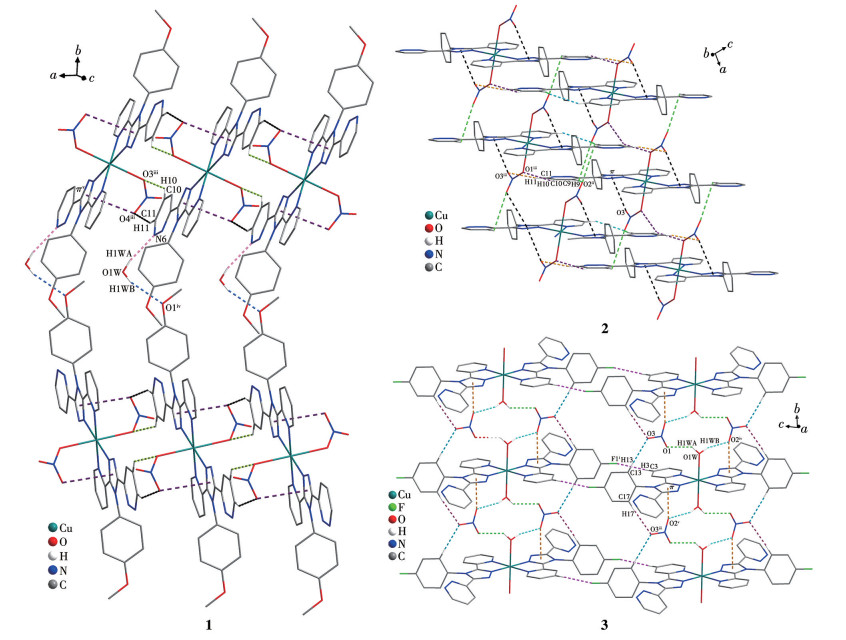
The ORTEP views of 1-3 are shown in Fig.3 together with the atomic labeling system. Because 1 and 2 crystallize in the same monoclinic P21/c space group (Table S1) and have an almost similar structure except for the lattice water, herein, only the structure of 1 is discussed in detail. The asymmetric unit of 1 includes one Cu(Ⅱ) ion (the occupancy factor is 0.5), one L1 ligand, one coordinated NO3- ion, and a half H2O molecule. The Cu(Ⅱ) ion in 1 displays a distorted trans-[CuN4O2] octahedron with four N atoms from two L1 ligands in the equatorial plane and two NO3- ions in the axial positions, as confirmed by the SHAPE software with the continuous symmetry measures (CSM) of 1.22[31]. Each L1 ligand coordinates to the Cu(Ⅱ) ion via the N1 atom of the pyridyl and N2 atom of the triazole, very similar to the coordinated modes of the triaryltriazoles in the reported mononuclear Cu(Ⅱ) complexes[11, 13, 22-24, 26]. The 3-pyridazinyl group of the L1 ligand is uncoordinated. The Cu—N bond lengths are within the normal ranges observed for the triaryltriazole-based Cu(Ⅱ) complexes (Table S3)[22-24]. The triazole forms dihedral angles of 5.5(2)°, 79.9(3)° and 3.6(2)° with the Py, Ph and Pyd rings, respectively (Table 1), revealing that the pyridyl, triazole and 3-pyridazinyl rings of the L1 ligand in 1 are almost coplanar. Moreover, the dihedral angle between the coordinated pyridyl and the triazole ring in 1 becomes quite smaller than that in the free L1 ligand (Table 1), unveiling that the L1 ligand in 1 adopts an optimal conformation in favor of coordination[10]. In 1, there are two kinds of strong hydrogen bond interactions involving lattice H2O [O1W— H1WA…N6: 0.292 5(4) nm/179° and O1W—H1WB…O1iv: 0.312 7(3) nm/155°] and four kinds of weak C— H…O hydrogen bond interactions involving the NO3- ions [C2—H2…O2ⅰ=0.328 9(6) nm/132°, C9—H9…O2ⅱ=0.327 1(1) nm/153°, C10—H10…O3ⅲ: 0.333 3(4) nm/136° and C11—H11…O4ⅲ: 0.314 6(3) nm/155°] (Table S4, Fig.S6). Additionally, there are a kind of C—H…π interaction [C4—H4…π(Ph): 0.368 9(4) nm/150°] and a kind of lone-pair p-electron…π interaction [O4ⅴ…π(Trz): 0.318 8(3) nm] (Table S5). These interactions further link the mononuclear unit and lattice water to create a 3D supramolecular framework (Fig.4).
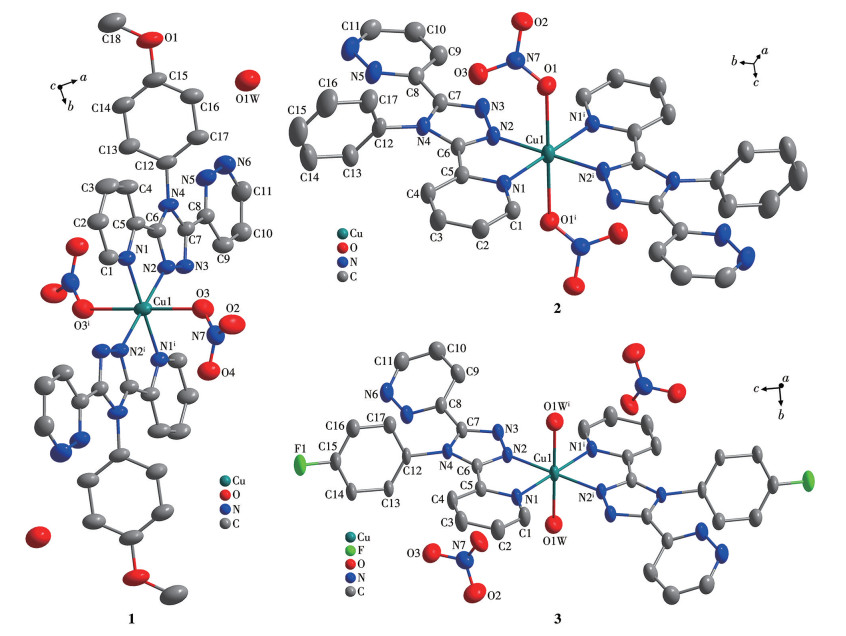
All H and disordered atoms are omitted for clarity; Symmetry codes: ⅰ 1-x, 1-y, 1-z for 1 and 2; ⅰ 1-x, 1-y, -z for 3.
Different from 1 and 2, complex 3 crystallizes in the triclinic P1 space group (Table S1) and its asymmetric unit consists of a Cu(Ⅱ) cation (the occupancy factor is 0.5), one L3 ligand, one coordinated H2O molecule, and one NO3- ion. The Cu(Ⅱ) ion also exhibits a distorted trans-[CuN4O2] octahedron (CSM=1.18) but contains four N atoms from two L3 ligands in the equatorial plane and two H2O molecules in the axial positions. Each L3 ligand coordinates to the Cu(Ⅱ) ion via the N1 atom of the pyridyl and N2 atom of the triazole, while the 3-pyridazinyl group is also uncoordinated, which is very similar to the coordinated modes of L1 in 1. The NO3- ion only acts as the counterion and does not involve coordination. The Cu—N and Cu—O bond distances are all within the normal ranges found for the related Cu(Ⅱ) complexes with the triaryltriazoles (Table S3)[22, 24, 26]. The triazole ring makes dihedral angles of 5.8(3)°, 69.9(1)° and 29.4(2)° with the Py, Ph and Pyd rings, respectively (Table 1), disclosing that the pyridyl and triazole rings of the L3 ligand in 3 are almost coplanar to make a better coordination[10]. In 3, there are two kinds of strong hydrogen bond interactions involving the coordinated H2O [O1W—H1WA…O1: 0.275 3(5) nm/132°; O1W—H1WB…O2ⅳ: 0.287 3(2) nm/158°] and three kinds of weak C—H…O hydrogen bond interactions involving the NO3- ions [C10—H10…O1ⅱ: 0.336 4(2) nm/144°; C13—H13…O3: 0.339 9(3) nm/164°; C17—H17…O3ⅲ: 0.330 6(1) nm/173°] (Table S4, Fig.S8). In addition, there are a kind of C—H…π interaction [C4—H4…π(Ph): 0.386 7(3) nm/149°] and a kind of lone-pair p-electron…π interaction [O2ⅴ…π(Trz): 0.293 3(2) nm] (Table S5). These interactions further connect the mononuclear units and NO3- ions to generate a 3D framework (Fig.4).
As shown in Fig.S9-S11, the PXRD patterns of as-synthesized samples of 1-3 are in good agreement with the simulated ones from the single crystal data, displaying the high phase purity of the bulk samples.
In the IR spectra of 1-3 (Fig.S12-S14), a medium-broad peak at 3 420 cm-1 (1) and 3 411 cm-1 (3) can be attributed to the O—H stretching vibrations of water molecules[26]. A strong band at 1 510 cm-1 (1), 1 500 cm-1 (2) and 1 580 cm-1 (3) can be assigned to the coordinated pyridyl ring vibration[10, 24]. A very strong band at 1 380 cm-1 is assigned to characteristic N=O stretching vibrations of the NO3- ion in 1-3[22, 24, 26]. Two bands at 1 260 and 1 020 cm-1, respectively, are due to asymmetric and symmetric stretching vibrations of the O—CH3 group in 1[8]. In addition, the stretching vibration of C—F at 1 089 cm-1 can be found in 3[24]. These features are in agreement with the X-ray analysis results.
As shown in Fig.S15, the first weight loss of 2.2% between 25 and 135 ℃ for 1 was observed due to the loss of one lattice water molecule (Calcd. 2.1%). Then 1 started to decompose, and the remaining weight of 9.5% after heating to 485 ℃ is owing to the final residue of CuO (Calcd. 9.2%). Due to the lack of any guest molecule, 2 showed high thermal stability. Practically no weight loss was observed up to 290 ℃ (Fig.S16). Then an abrupt decomposition was observed. The remaining weight of 10.5% after heating to 490 ℃ is owing to the final residue of CuO (Calcd. 10.1%). In 3, the first weight loss of 4.4% between 25 and 175 ℃ was found because of the loss of two coordinated water molecules (Calcd. 4.2%). Then 3 began to collapse, and the remaining weight of 9.3% after heating to 500 ℃ is due to the final residue of CuO, in agreement with the calculated value of 9.2% (Fig.S17). Notably, the differences in substituted groups on the 4-R-phenyl ring (R=OCH3, H, F) of ligands L1-L3 can also influence the thermal stabilities of the corresponding complexes, with decomposition temperatures of 235, 290 and 258 ℃ for 1-3, respectively.
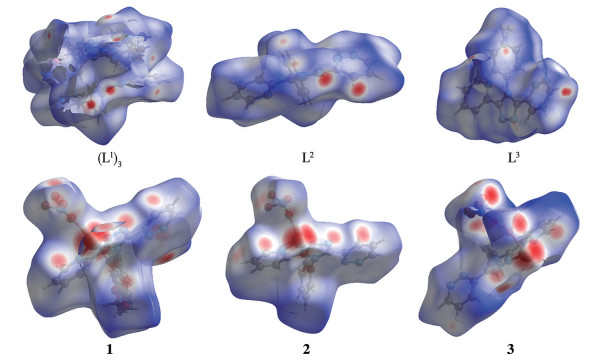
Hirshfeld surface analysis serves as a powerful visualization tool for probing weak intermolecular interactions, such as hydrogen bonds, C—H…π contacts and π…π stacking interactions[25-26]. To elucidate the intermolecular interactions in the three ligands (L1)3, L2, L3 and their complexes 1-3, 3D Hirshfeld surface analyses were performed. The corresponding 2D fingerprint plots provide a clear quantitative analysis of each type of interaction present in the six compounds[31]. Fig.5 shows the 3D Hirshfeld surfaces of (L1)3, L2, L3 and 1-3 mapped with dnorm, respectively. The surface is shown with a red-white-blue color: the red spots represent close contacts such as O—H…O, O—H…N and C—H…N interactions, while the white and blue regions stand for weak contacts, like C—H…π and p…π interactions. For (L1)3, there are six strong red dots close to the 4-methoxyphenyl group and pyridyl ring. For L2, there are two strong red dots close to the pyridazinyl group and triazole ring. For L3, five strong red dots are found near the pyridazinyl group and pyridyl ring. For 1, there are five strong red dots close to the water molecule, one methoxyphenyl group, and one NO3- ion. For 2, there are four strong red dots close to the phenyl group and the NO3- ion. For 3, seven strong red dots are found near the water molecule, the 4-fluorophenyl group, and the NO3- ion.
The 2D fingerprint plots of (L1)3, L2, L3 and 1-3 are shown in Fig.S18-S23, respectively. As summarized in Table S6, the maximum contribution is from H…H contacts for all the compounds: 45.8% in (L1)3 and 35.9% in 1, 39.7% in L2 and 31.7% in 2, 27.3% in L3 and 27.0% in 3. The next contribution is from C…H/H…C contacts (23.5%) for (L1)3 but O…H/H…O contacts (24.8%) for 1; N…H/H…N contacts (29.0%) for L2 but O…H/H…O contacts (22.6%) for 2; C…H/H…C contacts (24.8%) and N…H/H…N contacts (24.7%) for L3 but N…H/H…N contacts (17.5%) and O…H/H…O contacts (16.7%) for 3. These results reveal that there are some important changes in the types of weak intermolecular interactions between the free ligands (L1)3, L2, L3 and their corresponding Cu(Ⅱ) complexes 1-3.
Three novel 3-pyridazinyl-substituted triaryltriazoles, 4-(4-R-phenyl)-3-(2-pyridyl)-5-(3-pyridazinyl)-1,2,4-triazole (L1: R=OCH3; L2: R=H; L3: R=F), and their Cu(Ⅱ) complexes, trans-[Cu(L1)2(NO3)2]·H2O (1), trans-[Cu(L2)2(NO3)2] (2) and trans-[Cu(L3)2(H2O)2](NO3)2 (3), have been synthesized and characterized by single crystal X-ray crystallography. It is first observed that L1 shows a hydrogen-bonded trimer (L1)3 in all known triaryltriazoles. Three complexes have a similar [CuN4O2] octahedron with two NO3- ions in the trans-positions in both 1 and 2, but two H2O molecules in the trans-positions in 3.
KITCHEN J A, BROOKER S. Spin crossover in iron(Ⅱ) complexes of 3, 5-di(2-pyridyl)-1,2,4-triazoles and 3, 5-di(2-pyridyl)-1,2,4-triazolates[J]. Coord. Chem. Rev., 2008, 252(18/19/20): 2072-2092
QI L, CHENG H M, SHEN X, LU W, ZHU D R. Fe(Ⅱ) spin crossover molecule-based materials[J]. Prog. Chem., 2009, 21(6): 1187-1198
ZHU D R, XU Y, YU Z, GUO Z J, SANG H, LIU T, YOU X Z. A novel bis(trans-thiocyanate)iron(Ⅱ) spin-transition molecular material with bidentate triaryltriazole ligands and its bis(cis-thiocyanate)iron(Ⅱ) high-spin isomer[J]. Chem. Mater., 2002, 14(2): 838-843 doi: 10.1021/cm010688u
SHEU C F, SHIH C H, SUGIMOTO K, CHENG B M, TAKATA M, WANG Y. A long-lived photo-induced metastable state of linkage isomerization accompanied with a spin transition[J]. Chem. Commun., 2012, 48(46): 5715-5717 doi: 10.1039/c2cc31326j
SHEN G P, QI L, WANG L, XU Y, JIANG J J, ZHU D R, LIU X Q, YOU X Z. Spin-crossover in a trans-[FeL2(NCS)2] family (L=triaryltriazole): Remote substituent effects on spin transition modes and temperature[J]. Dalton Trans., 2013, 42(48): 10144-10152
PALIWODA D, VENDIER L, GETZNER L, ALABARSE F, COMBONI D, MARTIN B, ALAVI S E, BELLO M P, SALMON L, NICOLAZZI W, MOLNÁR G, BOUSSEKSOU A. Elastic properties of the iron(Ⅱ)-triazole spin crossover complexes [Fe(Htrz)2trz]BF4 and [Fe(NH2trz)3]SO4[J]. Cryst. Growth Des., 2023, 23(3): 1903-1914 doi: 10.1021/acs.cgd.2c01396
FENG Z, LING J J, SONG H J, ZHU D R. A water-tuned reversible spin transition with the largest hysteresis loop in 3D Hofmann frameworks pillared by flexible ligands[J]. Inorg. Chem. Front., 2023, 10(1): 305-315 doi: 10.1039/D2QI01873J
ZHOU J, YANG J, QI L, SHEN X, ZHU D R. Synthesis, crystal structure and magnetic property of the novel dinuclear nickel(Ⅱ) complex with 4-(p-methoxyphenyl)-3, 5-bis(pyridine-2-yl)-1,2,4-triazole[J]. Transit. Metal Chem., 2007, 32(6): 711-715 doi: 10.1007/s11243-007-0234-2
CHENG H M, ZHU D R, LU W, XU R H, SHEN X. Synthesis and crystal structure characterization of 3, 5-bis(2-quinolyl)-1,2,4-triazole[J]. J. Heterocycl. Chem., 2010, 47(1): 210-213 doi: 10.1002/jhet.262
SHEN G P, ZHAO J, JIANG J J, LIU Q, SHEN X, XU Y, ZHU D R, LIU X Q. Abnormal conformation change of an asymmetrical triaryltriazole before and after its coordination[J]. J. Mol. Struct., 2011, 1002(1/2/3): 159-166
CHEN L, ZHAO J, SHEN G P, SHEN X, XU Y, ZHU D R, WANG J. Syntheses, crystal structures, and spectral characterization of two new Cu(Ⅱ) and Co(Ⅱ) complexes with an asymmetrical substituted triaryltriazole[J]. J. Coord. Chem., 2011, 64(22): 3980-3991 doi: 10.1080/00958972.2011.634909
ZHAO J, SHEN G P, ZHANG Y, SHEN X, ZHU D R. Syntheses, crystal structures, and spectral characterization of three new asymmetrical substituted triaryltriazoles[J]. J. Heterocycl. Chem., 2012, 49(5): 1114-1119 doi: 10.1002/jhet.949
陈浪, 程慧敏, 江静静, 沈旋, 朱敦如. 铜配合物[CuL2(ClO4)2]的合成、晶体结构及热稳定性(L=3-对溴苯基-4-对甲苯基-5-(2-吡啶基)-1,2,4-三氮唑)[J]. 无机化学学报, 2012, 28(2): 381-385CHEN L, CHENG H M, JIANG J J, SHEN X, ZHU D R. Synthesis, crystal structure and thermal stability of [CuL2(ClO4)2] (L=3-(p-bromophenyl)-4-(p-methylphenyl)-5-(2-pyridyl)-1,2,4-triazole)[J]. Chinese J. Inorg. Chem., 2012, 28(2): 381-385
江静静, 陈浪, 赵建, 沈旋, 许岩, 朱敦如. 不对称三芳基三氮唑的钴配合物中三氮唑-吡啶间二面角的反常变化[J]. 无机化学学报, 2012, 28(9): 1940-1944JIANG J J, CHEN L, ZHAO J, SHEN X, XU Y, ZHU D R. Abnormal change of triazole-pyridyl dihedral angle in a Co(Ⅱ) complex with asymmetrical substituted triaryltriazoles[J]. Chinese J. Inorg. Chem., 2012, 28(9): 1940-1944
SHEN G P, JIANG J J, SUN F, SHEN X, ZHU D R, LIU X Q. Syntheses, crystal structures, and spectral characterization of two novel quinolyl substituted triazoles [J]. J. Heterocycl. Chem., 2013, 50(5): 1152-1156 doi: 10.1002/jhet.1611
GONG J, HE X, CHEN L, SHEN X, ZHU D R. Syntheses, crystal structures, and spectral characterization of an asymmetrically substituted 1,2,4-triazole and its iron(Ⅱ) complex[J]. J. Coord. Chem., 2013, 66(16): 2875-2884 doi: 10.1080/00958972.2013.818139
WANG L, JIANG J J, CHEN L, SHEN X, ZHU D R. Coexistence of two distinct axial ligands and their thermo-induced substitution in trans-[FeL2(NCS)2][FeL2(CH3OH)2](NCS)2 (L=4-amino-3-(p-chlorophenyl)-5-(2-pyridyl)-1,2,4-triazole)[J]. Inorg. Chem. Commun., 2013, 28: 104-108 doi: 10.1016/j.inoche.2012.11.022
HE X, CAO D Y, JIANG J J, SHEN X, ZHU D R. Synthesis, crystal structures, and magnetic properties of three iron(Ⅱ) complexes with 3-(p-bromophenyl)-4-phenyl-5-(2-pyridyl)-1,2,4-triazole[J]. J. Coord. Chem., 2014, 67(2): 227-235 doi: 10.1080/00958972.2013.877585
LI B, ZHOU Y F, ZHANG S P, QIN T, SHEN X, XU Y, ZHU D R. Synthesis, crystal structures, and magnetic properties of three new iron(Ⅱ) complexes with pyrrolyl-substituted triaryltriazoles[J]. J. Coord. Chem., 2016, 69(18): 2647-2655 doi: 10.1080/00958972.2016.1214724
ZHOU Y F, ZHANG S P, FENG Z, SHEN X, ZHU D R. Syntheses, crystal structures, and spectral characterization of six novel benzimidazolyl substituted triaryltriazoles[J]. J. Heterocycl. Chem., 2017, 54(5): 2773-2780 doi: 10.1002/jhet.2880
ZHANG S P, FENG Z, WU B, JIANG J J, ZHU D R, HE B F. Syntheses, crystal structures and antibacterial activities of two new Mn(Ⅱ) complexes based on triaryltriazoles[J]. J. Coord. Chem., 2018, 71(1): 46-56 doi: 10.1080/00958972.2018.1425838
冯哲, 高健飞, 李刚, 朱敦如. 喹啉和吡啶取代三芳基三唑的两个铜配合物的合成与晶体结构[J]. 无机化学学报, 2020, 36(6): 1169-1175FENG Z, GAO J F, LI G, ZHU D R. Syntheses and crystal structures of two copper complexes based on quinolyl and pyridyl substituted triaryltriazoles[J]. Chinese J. Inorg. Chem., 2020, 36(6): 1169-1175
李刚, 冯哲, 聂荣荣, 朱敦如. 噻吩和吡啶取代三芳基三唑的两个铜配合物的合成与晶体结构[J]. 无机化学学报, 2021, 37(3): 561-568LI G, FENG Z, NIE R R, ZHU D R. Syntheses and crystal structures of two copper complexes based on thienyl and pyridyl substituted triaryltriazoles[J]. Chinese J. Inorg. Chem., 2021, 37(3): 561-568
高健飞, 聂荣荣, 冯哲, 朱敦如. 呋喃取代三芳基三唑的单核铜配合物中共存两个不同的铜离子[J]. 无机化学学报, 2021, 37(9): 1707-1712GAO J F, NIE R R, FENG Z, ZHU D R. Coexistence of two unique Cu(Ⅱ) ions in mononuclear Cu(Ⅱ) complexes with furanyl substituted triaryltriazoles[J]. Chinese J. Inorg. Chem., 2021, 37(9): 1707-1712
SONG H J, PENG R, ZUO Y, WANG T, ZHU D R. Syntheses, crystal structures and intermolecular interactions of six novel pyrimidin-2-yl-substituted triaryltriazoles[J]. Acta Crystallogr. Sect. C, 2024, C80(2): 104-114
WANG T, SONG H J, ZHUANG R, ZHU D R. Syntheses, crystal structures, Hirshfeld surface analyses and magnetic property of a new dinuclear nickel(Ⅱ) and two mononuclear copper(Ⅱ) complexes with triaryltriazoles[J]. J. Coord. Chem., 2024, 77(22/23/24): 2844-2855
JIMÉNEZ S R, FELTHAM H L C, BROOKER S. Non-porous iron(Ⅱ)-based sensor: Crystallographic insights into a cycle of colorful guest-induced topotactic transformations[J]. Angew. Chem. ‒ Int. Edit., 2016, 55(48): 15067-15071 doi: 10.1002/anie.201608813
JIMÉNEZ S R, YANG M R, STEWARY I, GARDEN A L, BROOKER S. A simple method of predicting spin state in solution[J]. J. Am. Chem. Soc., 2017, 139(50): 18392-18396 doi: 10.1021/jacs.7b11069
DOLOMANOV O V, BOURHIS L J, GILDEA R J, HOWARD J A K, PUSCHMANN H. OLEX2: A complete structure solution, refinement and analysis program[J]. J. Appl. Cryst., 2009, 42(2): 339-341 doi: 10.1107/S0021889808042726
SPACKMAN P R, TUINER M J, MCKINNON J J, WOLFF S K, GRIMWOOD D J, JAYATILAKA D, SPACKMAN M A. CrystalExplorer: A program for Hirshfeld surface analysis, visualization and quantitative analysis of molecular crystals[J]. J. Appl. Cryst., 2021, 54(3): 1006-1011 doi: 10.1107/S1600576721002910
SUN E X, FANG H Y, JIANG J J, ZHU D R. Syntheses, crystal structures, Hirshfeld surface analyses and fluorescence of binuclear complexes with unsymmetrical phenol-based compartmental ligands[J]. J. Coord. Chem., 2023, 76(7/8): 946-959

Figure 1 ORTEP views of (L1)3, L2, L3 with 20% thermal ellipsoids probability
The disordered atoms are omitted for clarity.

Figure 3 ORTEP views of 1-3 with 30% thermal ellipsoids probability
All H and disordered atoms are omitted for clarity; Symmetry codes: ⅰ 1-x, 1-y, 1-z for 1 and 2; ⅰ 1-x, 1-y, -z for 3.

Figure 5 Three-dimensional Hirshfeld surfaces of (L1)3, L2, L3 and 1-3 mapped with dnorm
Table 1. Dihedral angles (°) for (L1)3, L2, L3 and 1-3
| Compounds | Py/Trz | Ph/Trz | Pyd/Trz |
| (L1)3 (O1) | 11.2(2) | 78.5(4) | 11.7(1) |
| (L1)3 (O2) | 26.0(2) | 83.2(4) | 23.1(3) |
| (L1)3 (O3) | 35.7(1) | 87.1(2) | 24.2(4) |
| L2 | 29.1(3) | 77.2(1) | 41.4(4) |
| L3 | 21.7(3) | 87.7(2) | 23.6(1) |
| 1 | 5.5(2) | 79.9(3) | 3.6(2) |
| 2 | 6.6(1) | 83.0(2) | 2.9(2) |
| 3 | 5.8(3) | 69.9(1) | 29.4(2) |
 下载: 导出CSV

 扫一扫看文章


扫一扫关注我们


 下载:
下载: