A (3,6)-c [Fe3(μ3-O)(acetate)2(carboxyl)4(pyridyl)2] cluster-based metal-organic framework with methyl-impendent gourd-shaped pores for natural gas purification
A (3,6)-c [Fe3(μ3-O)(acetate)2(carboxyl)4(pyridyl)2] cluster-based metal-organic framework with methyl-impendent gourd-shaped pores for natural gas purification
Received Date:
15 April 2026 Revised Date:
31 May 2026 Available Online:
10 July 2026
Abstract:
Novel adsorbents for efficient natural gas purification should strike a balance between high selective adsorption performance and moderate adsorption enthalpy. To develop such materials, herein, a novel (3,6)-c topological metal-organic framework (MOF) featuring terminal coordinated acetate was constructed from [Fe3(μ3-O)(acetate)2(carboxyl)4(pyridyl)2] cluster and 5-(pyridin-4-yl)isophthalic acid, yielding [Fe2ⅢFeⅡ(μ3-O)(acetate)2(L)2(H2O)]·xGuest (designated as NJTU-Bai89; NJTU-Bai stands for Nanjing Tech University Bai′s group). The methyl group of acetate is impendent in the 1D pore channel, dividing it into the gourd-shaped one. Interestingly, NJTU-Bai89 exhibited high low-pressure C3H8 uptake and moderate adsorption enthalpy, owing to effective synergy between a suitable pore size and accessible nonpolar pore surfaces.
Natural gas (75%-90%, CH4; 0-20%, C2H6; 0-5%, C3H8, etc.) plays an increasingly indispensable role in the energy production[1-4]. Methane (CH4), due to its abundant reserves, high calorific value, and environmentally friendly combustion products, is widely regarded as a promising alternative energy source (for example, as a fuel and a chemical feedstock)[3, 5-6]. However, the small amounts of propane (C3H8) and ethane (C2H6) in natural gas will directly reduce the conversion efficiency and commercial value of CH4, and also significantly influence its circulation steady-state in storage tanks and safe transportation in pipelines[4, 7-8]. Moreover, the recovered C3H8 and C2H6 may be converted into propylene and ethylene, respectively, which serve as industrial feedstocks for the synthesis of various polymer materials[9-13]. Thus, efficient C3H8/CH4 and C2H6/CH4 separations are crucial for upgrading the natural gas to pipeline-quality standards, optimizing the downstream processing and utilization, and recovering valuable C3H8 and C2H6 as feedstocks for petrochemical processes[3, 14-21]. At present, the primary technology for industrial purification of natural gas is traditional cryogenic distillation methods under high pressure and low temperature, which consumes substantial energy[3-4, 7-8, 12-14, 17]. Due to the high separation efficiency and low energy consumption, adsorbent-based separation technology has been considered a promising alternative[3-4, 7-8, 12-14, 17].
Metal-organic frameworks (MOFs) possess tunable structures and properties, which have attracted great attention in natural gas purification[3, 7-8, 12-14, 17, 19, 22-23]. Up to now, a lot of MOFs, such as SNNU-186[19], ZUL-C2[23], and MIL-142A[22], have been reported to exhibit high C3H8 and C2H6 adsorption uptakes at 100 kPa. Due to low contents of C3H8 and C2H6 in natural gas, developing MOFs with high adsorption uptakes at low pressures will be very crucial[3, 8, 12-13]. For thermodynamic equilibrium separations, enhancing the affinity between the framework and guest molecule, such as strategically introducing open metal sites (OMSs) or electrostatic adsorption sites, can effectively increase the adsorption uptakes of C3H8 and C2H6 under low pressures[24-25]. However, the introduction of strong adsorption sites into the framework usually leads to MOFs exhibiting very high adsorption enthalpies for the gas molecules[24-25]. Many reported high-performance MOFs for the natural gas purification exhibit largely high C3H8 adsorption enthalpies, which approach or even belong to the chemical adsorption range, such as ZUL-C1/ZUL-C2 (-54.0 and 71.0 kJ·mol-1)[23] and Co- 3-AIN (-69.0 kJ·mol-1)[3]. As we all know, an ideal adsorbent should show a good balance of high selective adsorption performances with moderate adsorption enthalpy; however, achieving this kind of MOF is a great challenge. Very importantly, designing and synthesizing MOFs with pore sizes slightly larger than the kinetic diameter of C3H8, through the formation of multiple C—H…π interactions between aromatic ligands and saturated alkanes, can also be beneficial to obtain MOFs with high low-pressure adsorption uptakes (such as SNNU-Bai68[26] and Co-MOF[12]). Moreover, due to the lack of excessively strong adsorption sites on the pore surface, these MOFs may show a moderate C3H8 adsorption enthalpy. Until now, MOFs with both high low-pressure adsorption C3H8 uptakes and moderate C3H8 adsorption enthalpy are still rare in the application of natural gas purification (Table S1, Supporting information).
The trinuclear [M3(μ3-O)(carboxyl)6] (M=Fe, In, Co, etc.) cluster, due to its variable connectivity (6-c to 9-c) and predictable spatial configuration, is usually selected as a building block to construct MOFs[27-31]. During its assembly with N-heterocyclic carboxylic acid ligands for the construction of MOFs, metal ions may also be coordinated by N atoms, leading to the occupation of potential open metal sites (OMSs). Furthermore, introducing terminal coordinating ligands (for example, CH3COO-) into the trinuclear [M3(μ3-O)(carboxyl)6] cluster may result in the tuning of its connectivity and spatial configuration, as well as the pore size and pore surface polarity of the obtained MOFs, for example, the high-performance CO2 capture MOFs (SNNU-Bai80-82) previously reported by our group[30].
Herein, by the assembly of [Fe3(μ3-O)(acetate)2(carboxyl)4(pyridyl)2] clusters with 5-(pyridin-4-yl)isophthalic acid (H2L), a terminal CH3COO- coordinating MOF, [Fe2ⅢFeⅡ(μ3-O)(acetate)2(L)2(H2O)]·xGuest, with a (3,6)-c new topology was successfully built as NJTU-Bai89, in which the methyl group of acetic acid is suspended in the 1D pore channel, dividing it into the gourd-shaped one. NJTU-Bai89 exhibited high adsorption capacities for C3H8 and C2H6 at 298K, particularly for C3H8 (39.6 cm3·g-1, 5 kPa), and low zero-loading isosteric heat of adsorption (Qst) of only -30.2 and -22.6 kJ·mol-1 for C3H8 and C2H6, respectively. This may be attributed to the effective synergistic effect of suitable pore size and accessible non-polar pore surface in the material.
1.
Experimental
The details of reagents and instruments, X-ray crystallography, and gas sorption measurements can be found in the Supporting information.
1.1
Synthesis of NJTU-Bai89
The [Fe2ⅢFeⅡ(μ3-O)(acetate)6] compound was synthesized according to the procedure reported in the literature[30]. A solution of [Fe2ⅢFeⅡ(μ3-O)(acetate)6] (8.0 mg, 0.018 mmol) in 0.5 mL of N,N-dimethylformamide was mixed with H2L (8.0 mg, 0.033 mmol) in 1.5 mL of N,N-dimethylformamide. To this was added 0.5 mL of acetic acid and 0.25 mL of trifluoroacetic acid with stirring. The mixture was sealed in a Pyrex tube and heated to 150 ℃ for 24h. The orange needle-shaped crystals obtained were filtered and washed with DMF. Yield: 40%. IR (KBr, cm-1): 1 659(s), 1 617(s), 1 576(s), 1 505(w), 1 439(s), 1 370(s), 1 299(w), 1 192(m), 1 097(m), 1 011(w).
1.2
Activation of NJTU-Bai89
The as-synthesized sample of NJTU-Bai89 was soaked in ultra-dry acetonitrile for 3 d with ultra-dry acetonitrile refreshed every 8 h. The ultra-dry acetonitrile exchanged sample was activated at 30 ℃ under vacuum for 2 h, and then at 100 ℃ under vacuum for 10 h to give the activated NJTU-Bai89, [Fe2ⅢFeⅡ(μ3-O)(acetate)2(L)2]·22H2O. Elemental analysis Calcd. for C30H66Fe3N2O36(%): C 30.07, H 2.55, N 2.34; Found(%): C 30.09, H 2.58, N 2.41. The water molecules in the analytical data were present because water was re-adsorbed from the air during measurement preparations. IR (KBr, cm-1): 1 720(w), 1 625(s), 1 568(s), 1 444(m), 1 370(s), 1 296(w), 1 217(w), 1 072(w), 1 014(m).
2.
Results and discussion
2.1
Crystal structure of NJTU-Bai89
Solvothermal reaction of [Fe2ⅢFeⅡ(μ3-O)(acetate)6] compound with H2L in N,N-dimethylformamide containing acetic acid and trifluoroacetic acid afforded a high yield of orange needle-shaped crystals of NJTU-Bai89. Single crystal X-ray diffraction reveals NJTU-Bai89 crystalizes in the trigonal space group R3c.
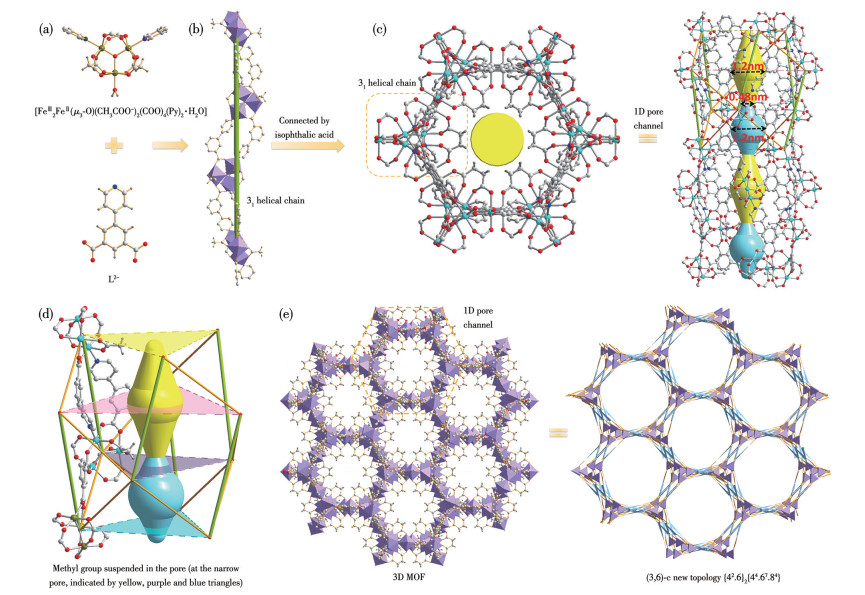
In the asymmetric unit of NJTU-Bai89, there is half a crystallographically independent Fe2+ ion, one Fe3+ ions, half a μ3-O2- ion, one L2- ions, one acetate ions and half a coordinated H2O molecules, respectively (Fig.1a). Three Fe2+/Fe3+ ions are bridged by a μ3-O2- and six carboxyl groups from four ligands and two acetic acids and coordinated by two pyridyl groups, forming a triangular prismatic trinuclear [Fe3(μ3-O)(acetate)2(carboxyl)4(pyridyl)2(H2O)] cluster (Fig.1a).
Figure 1
Figure 1.
(a) [Fe3(μ3-O)(acetate)2(carboxyl)4(pyridyl)2·H2O] cluster and ligand; (b) 31 helical chain; (c) 1D pore channel surrounded by six 31 helical chains; (d) Methyl group suspended in the pore (at the narrow pore, indicated by yellow, purple and blue triangles) dividing the 1D pore channel into a gourd-shaped pore; (e) 3D framework and topology of NJTU-Bai89
The trinuclear [Fe3(μ3-O)(acetate)2(carboxyl)4(pyridyl)2] cluster, with one potential OMS, is connected with L2-, leading to the formation of a 1D 31 helical chain (Fig.1b). Six 31 helix chains, which locate at the vertices of hexagon in the cross-sectional direction, are further connected by isophthalic acid, resulting in the generation of 1D channels (Fig.1c). Due to the special orientation of OMSs in the cluster, it is precisely embedded within the pore walls, making it less likely to be accessible to guest molecules. In contrast, methyl groups of acetic acid in three adjacent trinuclear [Fe3(μ3-O)(acetate)2(carboxyl)4(pyridyl)2] clusters are suspended in the pore and oriented towards its center, thus dividing them into the gourd-shaped pore channels consisting of the wide pores (1.2 nm) and the narrow pores (0.48 nm) (Fig.1c and 1d). Then, through the connection of L2-, different 1D pore channels are stacked in a hexagonal array in the cross-sectional direction, forming the 3D framework of NJTU-Bai89 (Fig.1e).
To better understand the structure, the trinuclear [Fe3(μ3-O)(acetate)2(carboxyl)4(pyridyl)2] cluster is simipilified as a 6-connected node, and the L2- is viewed as a 3-connected linker, the framework of NJTU-Bai89 is simplified to a (3, 6)-connected topology with the Schläfli symbol of (42·6)2(44·67·84) (Fig.1f). The total potential solvent accessible volume in desolvated NJTU-Bai89 is about 59.1% as determined by the PLATON/SOLV program[32], giving a calculated density of 0.872 g·cm-3 for the desolvated framework.
2.2
Permanent porosity and selective adsorption
The purity of the bulk sample of NJTU-Bai89 and the integrity of the framework of the MeCN-exchanged and activated samples were confirmed by powder X-ray diffraction (PXRD) (Fig.S1). The peaks of PXRD patterns of the as-synthesized, MeCN-exchanged, and activated samples were well consistent with those of the simulated PXRD pattern. In addition, the thermal stability and activation of the NJTU-Bai89 sample were investigated through thermogravimetric analysis. No significant weight loss was observed below 300 ℃, indicating the complete activation of the NJTU-Bai89 sample. Subsequently, the framework began to collapse (Fig.S2).
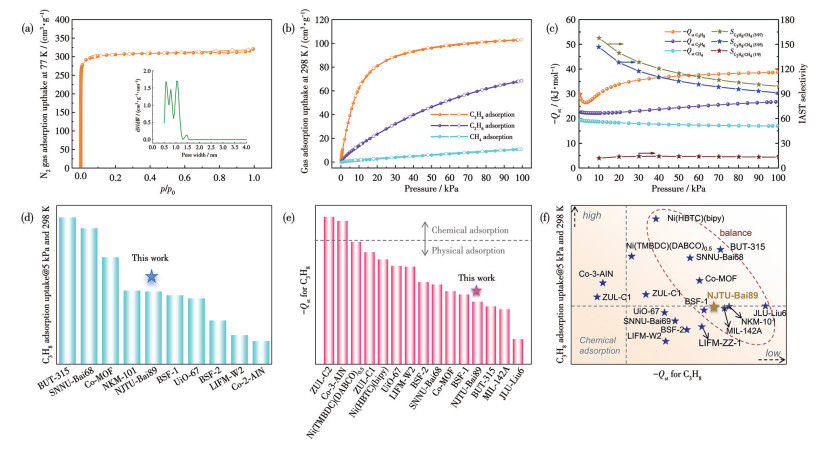
To investigate the permanent porosity of NJTU-Bai89, the N2 adsorption-desorption isotherm at 77 K of NJTU-Bai89 was measured. The N2 adsorption-desorption isotherm exhibited a Ⅰ-type adsorption isotherm without hysteresis on the desorption isotherm (Fig.2a), indicating NJTU-Bai89 is a microporous material. The Langmuir and Brunauer-Emmett-Teller (BET) surface areas were 1 362 and 1 231 m2·g-1, respectively. Moreover, the pore size determined by density functional theory (DFT) was estimated to be 0.5-0.8 nm and 0.9-1.2 nm based upon the N2 adsorption-desorption isotherm at 77 K, which were very close to the pore size determined from its crystal structure. The total pore volume of NJTU-Bai89 was calculated to be about 0.49 cm3·g-1 from the N2 adsorbed amount at 77 K (p/p0=0.974). It was lower than the theoretical value of 0.68 cm3·g-1 determined from its crystal structure using PLATON[29-30], which may be due to the slight shrinkage of the framework of NJTU-Bai89 after the activation, evidenced by the shifting of the first peak towards a higher angle in PXRD patterns of activated NJTU-Bai89 (Fig.S1).
Figure 2
Figure 2.
(a) N2 adsorption-desorption isotherm of NJTU-Bai89 at 77 K; (b) C3H8, C2H6, and CH4 adsorption isotherms of NJTU-Bai89 at 298 K; (c) C3H8 and C2H6 adsorption enthalpies and IAST (ideal adsorbed solution theory) predicted selectivities for C3H8/CH4 (3/97, 5/95), and C2H6/CH4 (1/9) mixtures at 298 K; Comparison of (d) C3H8 adsorption uptakes at 5 kPa and 298 K, (e) C3H8 adsorption enthalpies, and (f) both C3H8 adsorption uptakes and enthalpies of NJTU-Bai89 with representative MOFs (panels d-f were drawn according to data in Table S3)
The permanent porosity of NJTU-Bai89 prompted us to investigate its selective C3H8/CH4 and C2H6/CH4 adsorption performances. At 298 K and 0-100 kPa, the gas adsorption isotherms of C3H8, C2H6, and CH4 on NJTU-Bai89 were measured (Fig.2b). In the low-pressure range, the adsorption of C3H8 on NJTU-Bai89 increased rapidly, and the adsorption uptakes for C3H8 at 3 and 5 kPa were as high as 26.8 and 39.6 cm3·g-1, respectively. As shown in Fig.2d and Table S3, although these values were lower than those of the well-known BUT-315 (79.5 cm3·g-1, 5 kPa)[8], SNNU-Bai68 (73.7 cm3·g-1, 5 kPa)[26], and Co-MOF (58.0 cm3·g-1, 5 kPa)[12], they were close to the data of representative NKM-101 (40.0 cm3·g-1, 5 kPa)[33] and even slightly higher than those of the well-known BSF-1 (37.5 cm3·g-1, 5 kPa)[34] and UiO-67 (35.8 cm3·g-1, 5 kPa)[35]. This indicates that the framework of NJTU-Bai89 exhibits a strong affinity for C3H8 gas molecules. Differently, the adsorption of C2H6 increased slowly, and the adsorption uptake for C2H6 at 10 kPa was 13.8 cm3·g-1, which suggests that the framework shows a relatively weak affinity for C2H6 gas molecules. However, at 298 K and 100 kPa, NJTU-Bai89 could only adsorb 10.9 cm3·g-1 of CH4 gas, implying the framework has only a very weak affinity for CH4 gas molecules. To further understand the different affinities of NJTU-Bai89 for C3H8, C2H6, and CH4, the zero-load adsorption enthalpies of NJTU-Bai89 for C3H8, C2H6, and CH4 were calculated using the virial equation based on its adsorption isotherms at 273 and 298 K, which were -30.2, -22.6, and -19.3 kJ·mol-1, respectively (Fig.2c). This further confirms that among the three kinds of gases (C3H8, C2H6, and CH4), the framework of NJTU-Bai89 has the strongest affinity for C3H8 and the weakest affinity for CH4. In addition, it is worth mentioning that, very different from many high-performance MOFs for natural gas purification, which exhibit high adsorption enthalpies for C3H8 approaching or even belonging to the chemical adsorption range (as shown in Fig.2e), the adsorption enthalpy of NJTU-Bai89 for C3H8 was much lower than that within the chemical adsorption range, especially lower than those of some MOFs with comparable adsorption uptakes, such as BSF-1/BSF-2 (-33.7/-39.7 kJ·mol-1)[34] and UiO-67 (-47.5 kJ·mol-1)[35]. Thus, NJTU-Bai89 displays a certain balance between the high C3H8 adsorption uptake and the moderate C3H8 adsorption enthalpy, which is rare in the application of natural gas purification (Fig.2f and Table S3). All of these results suggest that NJTU-Bai89 is possible to exhibit the good selective adsorption behavior for C3H8/CH4 and C2H6/CH4.
To evaluate the selective adsorption performance of NJTU-Bai89 for C3H8/CH4 and C2H6/CH4, based on the single-component gas adsorption isotherms of C3H8, C2H6, and CH4 at 298 K (Fig.2c), the selectivity of NJTU-Bai89 for C3H8/CH4 (volume ratio: 3/97 and 5/95) and C2H6/CH4 (volume ratio: 1/9) gas mixtures was calculated using IAST (ideal adsorbed solution theory). At the pressure of 100 kPa, the IAST selectivities for C3H8/CH4 (3/97 and 5/95) and C2H6/CH4 (1/9) were 99.0, 90.9, and 13.2, respectively. Although these values were lower than those reported for many high-performance MOFs for natural gas purification, they were still higher than the IAST selectivities of some well-known MOFs for C3H8/CH4 (5/95) and C2H6/CH4 (1/9), such as MIL-142A (85.5 and 8.6)[22] and UiO-67 (73.7 and 8.1)[35] (Table S3). Interestingly, NJTU-Bai89 exhibited high gas adsorption capacity, selectivity, and moderate adsorption enthalpy, indicating its promising application in natural gas purification. This may be attributed to the narrow pore size (0.48 nm) in the 1D channels, which is close to the kinetic diameters of C3H8 (0.43-0.51 nm) and C2H6 (0.4-0.47 nm) gas molecules, and the aromatic ligands in the framework, which can generate more intermolecular interactions with C3H8 and C2H6 gas molecules containing more C—H bonds[5].
To further confirm the separation of C3H8/CH4 and C2H6/CH4 in NJTU-Bai89, dynamic breakthrough experiments for C3H8/CH4 (volume ratio: 0.5/8.5) and C2H6/CH4 (volume ratio: 1.0/8.5) gas mixtures were measured at 298 K and 100 kPa, respectively (Fig.S8). When the mixed gas with a flow rate of about 9 mL·min-1 passed through the adsorption column packed with 1.0 g of activated NJTU-Bai89, C3H8 and C2H6 would be adsorbed in the column; however, CH4 could flow out smoothly. Very interestingly, the CH4 gas with high purity (> 99.99%) can be collected at the end of the adsorption column. Moreover, the breakthrough time of NJTU-Bai89 for C3H8/CH4 (0.5/8.5) and C2H6/CH4 (1.0/8.5) was about 50 and 25 min, respectively. These all indicate that NJTU-Bai89 exhibits the promisingly potential application in natural gas purification to produce high-purity methane.
3.
Conclusions
In summary, a terminal CH3COO- coordinating (3,6)-c [Fe3(μ3-O)(acetate)2(carboxyl)4(pyridyl)2] cluster-based MOF with a new topology was successfully built (NJTU-Bai89), exhibiting the 1D gourd-shaped pore channel. The methyl group of CH3COO- impendent in the 1D pore channel not only reduces the narrow pore size to be close to the kinetic diameter of C3H8 molecules, but also decreases the polarity of the accessible pore surface. By their effective synergistic effect, NJTU-Bai89 has a certain balance between the high low- pressure C3H8 adsorption uptake and the moderate C3H8 adsorption enthalpy. Moreover, this MOF displays the high IAST selectivities for C3H8/CH4 and C2H6/CH4, respectively, which implies its potential prospect in natural gas purification. This work not only provides a potential new adsorbent but also offers important insights into the design and synthesis of high-performance MOFs for natural gas purification.
Supporting information is available at http://www.wjhxxb.cn
[1]
GUO P T, CHANG M, YAN T G, LI Y X, LIU D H. A pillared-layer metal-organic framework for efficient separation of C3H8/C2H6/CH4 in natural gas[J]. Chin. J. Chem. Eng., 2022, 42: 10-16 doi: 10.1016/j.cjche.2021.08.011
[2]
LI Z F, ZHANG Q, WANG L L, LI Y L, YANG S Q, HU T L. Aromatic pore engineering in microporous metal-organic frameworks for high-production one-step methane purification from ternary alkanes mixtures[J]. Sep. Purif. Technol., 2025, 355: 129685 doi: 10.1016/j.seppur.2024.129685
[3]
LIU P X, CAO J W, LI J H, LI H B, WANG J B, CAI J, LI L B, CHEN K J. Electrostatic potential optimization by precise tailoring of amino site arrays in isostructural metal-organic frameworks for high-efficiency CH4 purification[J]. Adv. Funct. Mater., 2025: e18494
[4]
XIAN S K, PENG J J, PANDEY H, THONHAUSER T, WANG H, LI J. Robust metal-organic frameworks with high industrial applicability in efficient recovery of C3H8 and C2H6 from natural gas upgrading[J]. Engineering, 2023, 23: 56-63 doi: 10.1016/j.eng.2022.07.017
[5]
ZHANG B, SHI Z H, YU X Y, LIU X, LIU Y L. Two stable metal- organic frameworks with new topology constructed from formic acid-coordinated trinuclear clusters for natural gas purification[J]. Sep. Purif. Technol., 2025, 363: 132308 doi: 10.1016/j.seppur.2025.132308
[6]
ZHANG X X, GUO X Z, CHEN S S, KANG H W, ZHAO Y, GAO J X, XIONG G Z, HOU L. A stable microporous framework with multiple accessible adsorption sites for high capacity adsorption and efficient separation of light hydrocarbons[J]. Chem. Eng. J., 2023, 466: 143170 doi: 10.1016/j.cej.2023.143170
[7]
LIU Y Y, WANG J W, FAN S C, XING C C, ZHONG Z L, YUAN F, YUAN W Y, WANG Y, ZHAI Q G. Maximizing the density of π- electron in metal-organic frameworks for benchmark paraffin separation[J]. Adv. Funct. Mater., 2025, 35(35): 2504614 doi: 10.1002/adfm.202504614
[8]
ZHAO Y L, LI X Y, YU J M, LIU T H, RUAN H Y, ZHANG X, LI J R. Highly efficient C3H8/C2H6/CH4 separation under humidity condition by a metal-organic framework[J]. Adv. Funct. Mater., 2025, 35(49): 09805 doi: 10.1002/adfm.202509805
[9]
CHENG H T, WANG Q, BAI J F. Ligand-functional groups induced tuning MOFs′ 2D into 1D pore channels for pipeline natural gas purification[J]. Chem. ‒Eur. J., 2022, 29(4): e202202047
[10]
DENG C H, ZHAO L, GAO M Y, DARWISH S, SONG B Q, SENSHARMA D, LUSI M, PENG Y L, MUKHERJEE S, ZAWOROTKO J M. Ultramicroporous lonsdaleite topology MOF with high propane uptake and propane/methane selectivity for propane capture from simulated natural gas[J]. ACS Mater. Lett., 2023, 6(1): 56-65
[11]
WANG K, JIANG Y, XU M M, ZHENG D D, JIA S J, CUI P. Tailoring a MOF-based adsorbent with partitioned aliphatic pore spaces for efficient CH4 purification from natural gas[J]. AIChE J., 2024, 70(7): e18443 doi: 10.1002/aic.18443
[12]
WANG S M, XU L, ZHANG L P, LI Y T, WANG T, YANG Q Y. Rational design of a π-electron rich Co-MOF enabling benchmark C2H6/CH4 selectivity in natural gas purification[J]. Adv. Funct. Mater., 2025, 35(37): 2504251 doi: 10.1002/adfm.202504251
[13]
ZOU S X, YE J X, CHEN C, SONG D H, YANG J H, WU M Y. Shape-matched nonpolar pore surfaces enhance alkane recognition toward natural gas upgrading[J]. Angew. Chem. ‒Int. Edit., 2025, 64(52): e202517133 doi: 10.1002/anie.202517133
[14]
CHEN C, LI M, ZOU S X, WEI W, HONG M C, WU M Y. Reversible trace-water-buffering frameworks for efficient humid methane purification[J]. Angew. Chem. ‒Int. Edit., 2025, 64(31): e202510669 doi: 10.1002/anie.202510669
[15]
CHEN F, GUO K Q, HUANG X L, ZHANG Z G, YANG Q W, YANG Y W, REN Q L, BAO Z B. Extraction of propane and ethane from natural gas on ultramicroporous carbon adsorbent with record selectivity[J]. Sci. China Mater., 2022, 66(1): 319-326
[16]
HE R R, WANG W, LIU X Y, WANG S, ZHANG M X. Molecular clamp-engineered pillar-layered MOF for purification of methane[J]. Inorg. Chem., 2025, 64(27): 13582-13586 doi: 10.1021/acs.inorgchem.5c01903
[17]
JIANG C H, WANG J X, LIU D, WU E Y, GU X W, ZHANG X, LI B, CHEN B L, QIAN G D. Supramolecular entanglement in a hydrogen-bonded organic framework enables flexible-robust porosity for highly efficient purification of natural gas[J]. Angew. Chem. ‒Int. Edit., 2024, 63(26): e202404734 doi: 10.1002/anie.202404734
[18]
LAN L, LU N, YIN J C, GAO Q, LANG F F, ZHANG Y H, NIE H X, LI N, BU X H. Simultaneous extraction of C3H8 and C2H6 from ternary C3H8/C2H6/CH4 mixtures in an ultra-microporous metal-organic framework[J]. Chem. Eng. J., 2023, 476: 146750 doi: 10.1016/j.cej.2023.146750
[19]
LI S Y, XUE Y Y, WANG J W, LI H P, LEI J, LV H J, BU X H, ZHANG P, WANG Y, YUAN W Y, ZHAI Q G. Metal-organic frameworks with two different-sized aromatic ring-confined nanotraps for benchmark natural gas upgrade[J]. Chem. Sci., 2024, 15(42): 17547-17555 doi: 10.1039/D4SC04387A
[20]
REN Q, FANG Y J, ZHANG Y K, DI Z P, DONG L Z, YAN Y. Modulating the host-guest interactions in a microporous methyl- functionalized pillar-layered framework for natural gas valorization[J]. Chem. Res. Chin. Univ., 2025, 41(4): 831-838 doi: 10.1007/s40242-025-5093-x
[21]
WANG T, ZHANG Y, ZHENG W Q, LIN E, DENG C H, GENG S B, CHEN Y, CHENG P, ZHANG Z J. Fabricating a robust ultramicroporous metal-organic framework for purifying natural gas and coal mine methane[J]. Small, 2024, 20(52): e2407701 doi: 10.1002/smll.202407701
[22]
YUAN Y, WU H X, XU Y Z, LV D F, TU S, WU Y, LI Z, XIA Q B. Selective extraction of methane from C1/C2/C3 on moisture-resistant MIL-142A with interpenetrated networks[J]. Chem. Eng. J., 2020, 395: 125057 doi: 10.1016/j.cej.2020.125057
[23]
ZHOU J Y, KE T, STEINKE F, STOCK N, ZHANG Z G, BAO Z B, HE X, REN Q L, YANG Q W. Tunable confined aliphatic pore environment in robust metal-organic frameworks for efficient separation of gases with a similar structure[J]. J. Am. Chem. Soc., 2022, 144(31): 14322-14329 doi: 10.1021/jacs.2c05448
[24]
HUANG W Q, ZHOU Y K, LI X F, WANG X Y, LI Y N, FENG F R, CHAI X H, ZHONG J. Anion pillar inserted MOF-74-Cu with customized pore environment for efficient purification of natural gas[J]. Fuel, 2025, 382: 133678 doi: 10.1016/j.fuel.2024.133678
[25]
WU X F, BAO Z B, YUAN B, WANG J, SUN Y Q, LUO H M, DENG S G. Microwave synthesis and characterization of MOF-74 (M=Ni, Mg) for gas separation[J]. Microporous Mesoporous Mat., 2013, 180: 114-122 doi: 10.1016/j.micromeso.2013.06.023
[26]
CHENG H T, WANG Q, MENG L L, SHENG P, ZHANG Z H, DING M, GAO Y J, BAI J F. Formation of a N/O/F-rich and rooflike cluster-based highly stable Cu(Ⅰ/Ⅱ)-MOF for promising pipeline natural gas upgrading by the recovery of individual C3H8 and C2H6 gases[J]. ACS Appl. Mater. Interfaces, 2021, 13(34): 40713-40723 doi: 10.1021/acsami.1c11971
[27]
CHEN C, ZHANG W W, ZHANG M X, BAI J F. Solvents-dependent formation of three MOFs from the Fe3O cluster and 3, 3′, 5, 5′-diphenyltetracarboxylic acid and their selective CO2 adsorption[J]. Inorg. Chem., 2019, 58(20): 13836-13842 doi: 10.1021/acs.inorgchem.9b01697
[28]
LIU Q, CONG H T, DENG H X. Deciphering the spatial arrangement of metals and correlation to reactivity in multivariate metal- organic frameworks[J]. J. Am. Chem. Soc., 2016, 138(42): 13822-13825 doi: 10.1021/jacs.6b08724
[29]
SONG X H, ZHANG M X, CHEN C, DUAN J G, ZHANG W W, PAN Y, BAI J F. Pure-supramolecular-linker approach to highly connected metal-organic frameworks for CO2 capture[J]. J. Am. Chem. Soc., 2019, 141(37): 14539-14543 doi: 10.1021/jacs.9b07422
[30]
WANG Q, CHENG H T, BAI J F. Finely tuning metal ion valences of [Fe3-xMx(μ3-OH)(Carboxyl)6(pyridyl)2] cluster-based ant-MOFs for highly improved CO2 capture performances[J]. ACS Appl. Mater. Interfaces, 2024, 16(6): 8077-8085 doi: 10.1021/acsami.3c16867
[31]
ZHANG Z H, WANG Q, XUE D X, BAI J F. Syntheses, structures and sorption properties of three isoreticular trinuclear indium-based amide-functionalized metal-organic frameworks[J]. Chem. ‒Asian J., 2019, 14(20): 3603-3610 doi: 10.1002/asia.201900536
[32]
SPEK A L. Single-crystal structure validation with the program PLATON[J]. J. Appl. Crystallogr., 2003, 36(1): 7-13 doi: 10.1107/S0021889802022112
[33]
QIAO Y, CHANG X, ZHENG J Y, YI M, CHANG Z, YU M H, BU X H. Self-interpenetrated water-stable microporous metal-organic framework toward storage and purification of light hydrocarbons[J]. Inorg. Chem., 2021, 60(4): 2749-2755 doi: 10.1021/acs.inorgchem.0c03618
[34]
ZHANG Y B, YANG L F, WANG L Y, CUI X L, XING H B. Pillar iodination in functional boron cage hybrid supramolecular frameworks for high performance separation of light hydrocarbons[J]. J. Mater. Chem. A, 2019, 7(48): 27560-27566 doi: 10.1039/C9TA09928J
[35]
ZHANG Y F, XIAO H Y, ZHOU X, WANG X, LI Z. Selective adsorption performances of UiO-67 for separation of light hydrocarbons C1, C2, and C3[J]. Ind. Eng. Chem. Res., 2017, 56(30): 8689-8696 doi: 10.1021/acs.iecr.7b01420
Figure 1
(a) [Fe3(μ3-O)(acetate)2(carboxyl)4(pyridyl)2·H2O] cluster and ligand; (b) 31 helical chain; (c) 1D pore channel surrounded by six 31 helical chains; (d) Methyl group suspended in the pore (at the narrow pore, indicated by yellow, purple and blue triangles) dividing the 1D pore channel into a gourd-shaped pore; (e) 3D framework and topology of NJTU-Bai89
Figure 2
(a) N2 adsorption-desorption isotherm of NJTU-Bai89 at 77 K; (b) C3H8, C2H6, and CH4 adsorption isotherms of NJTU-Bai89 at 298 K; (c) C3H8 and C2H6 adsorption enthalpies and IAST (ideal adsorbed solution theory) predicted selectivities for C3H8/CH4 (3/97, 5/95), and C2H6/CH4 (1/9) mixtures at 298 K; Comparison of (d) C3H8 adsorption uptakes at 5 kPa and 298 K, (e) C3H8 adsorption enthalpies, and (f) both C3H8 adsorption uptakes and enthalpies of NJTU-Bai89 with representative MOFs (panels d-f were drawn according to data in Table S3)



 下载:
下载:

 下载:
下载:


 下载:
下载:

