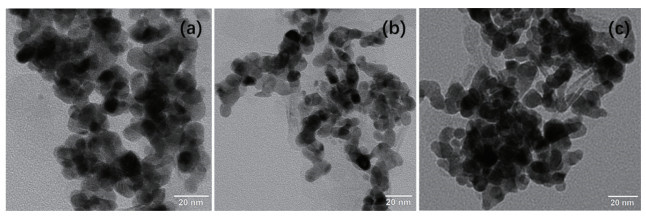
Figure 1.
TEM images of Pt3Cu1-y: (a) y=5, (b) y=3, (c) y=1

Oxygen reduction reaction performance and formation process mechanism on PtxCu1 3D nanoporous conductive networks via tuned inorganic salt self-assembly
Yuexia LI , Guodi CHEN , Jiani HE , Caiting JI , Yan SUN , Zhiyi ZHANG , Jianhuang ZENG


With the rapid development of hydrogen energy technologies, proton exchange membrane fuel cells (PEMFCs) have emerged as promising energy conversion devices for transportation and stationary power applications owing to their high energy-conversion efficiency, low operating temperature, and near-zero pollutant emissions[1-4]. However, their large-scale commercialization remains hindered by the sluggish oxygen reduction reaction (ORR) kinetics at the cathode[2-4] and the substantial reliance on platinum (Pt)-based catalysts[1, 5-6]. Although various low-cost alternatives, including carbon-based catalysts and transition-metal compounds, have been explored, their catalytic activity and long-term stability remain insufficient for practical PEMFC applications.
Alloying Pt with 3d transition metals (e.g., Fe, Co, Ni, and Cu) has been widely recognized as an effective strategy to enhance Pt utilization efficiency and regulate its electronic structure[7]. Pt-based alloys can optimize the adsorption energies of oxygen-containing intermediates (e.g., OH*) through ligand and strain effects, thereby facilitating the oxidative removal of poisoning species (e.g., CO*) and improving ORR activity and durability[8-13]. Among these alloying elements, Cu has attracted particular interest owing to its abundance, low cost, and tunable electronic properties. The incorporation of Cu into Pt induces favorable electronic and geometric effects, while the similar atomic radii of Cu and Pt (127.8 and 138.7 pm, respectively) generate moderate lattice strain and optimize the d-band electronic structure of Pt. Furthermore, Cu can be selectively removed under acidic conditions, to form a Pt-enriched surface, improving structural stability and CO* tolerance while creating abundant surface vacancies that facilitate ORR kinetics[9-11, 14].
Various PtCu nanostructures, including nanoparticles[2, 15], nanosheets[16], nanowires[17], nanoframes[5, 18], and atomically dispersed structures[12, 19], have been developed to maximize active-site exposure and enhance catalytic performance[18, 20-21]. However, structural degradation caused by dissolution, aggregation, and collapse during long-term operation remains a major challenge. Porous architectures constructed through dealloying can provide high surface areas, interconnected frameworks, and abundant accessible active sites, providing an effective strategy to simultaneously improve both catalytic activity and stability[3, 9].
Recently, 3D nanoporous conductive networks (3D NCNs) have attracted considerable attention as advanced Pt-based ORR catalysts due to their large surface area, continuous electron-transport pathways, abundant interfacial active sites, and robust structural integrity[22-24]. However, current fabrication methods, including template-assisted synthesis and galvanic replacement reactions, often involve complicated procedures, surfactants, or organic solvents, which increase costs and hinder large-scale production[6, 10, 13, 18, 25-30].
Therefore, developing a simple, environmentally friendly, and industrially scalable strategy for constructing Pt-based 3D NCN catalysts remains highly desirable. In this work, we report a one-pot, surfactant-free, inorganic-salt-mediated self-assembly approach for the rapid synthesis of PtCu 3D NCNs. The structural and compositional characteristics of the resulting materials were systematically investigated using X-ray diffraction (XRD), transmission electron microscopy (TEM), high-angle annular dark-field scanning transmission electron microscopy (HAADF-STEM), energy-dispersive X-ray spectroscopy (EDS), X-ray photoelectron spectroscopy (XPS), and inductively coupled plasma atomic emission spectroscopy (ICP-AES). Their electrocatalytic activity and durability toward the ORR were evaluated in 0.1 mol·L-1 HClO4 electrolyte. This work provides a facile and scalable route for the fabrication of high-performance Pt-based ORR catalysts and offers insights into the rational design of cost-effective electrocatalysts for advanced PEMFC applications.
Potassium chloride (KCl), aluminum chloride hexahydrate (AlCl3·6H2O), chloroplatinic acid hexahydrate (H2PtCl6·6H2O), copper chloride dihydrate (CuCl2·2H2O), urea, sodium hydroxide (NaOH), acetic acid (C2H4O2, 60%), absolute ethanol, and isopropanol (99%) were purchased from Macklin Chemical Reagent Co., Ltd. A 5% Nafion solution was obtained from DuPont. All reagents were of analytical grade and used as received without further purification. Deionized (DI) water with a resistivity higher than 18.0 MΩ·cm was produced using an ultrapure water purification system and used throughout all experiments.
As a representative example, Pt3Cu1 3D NCNs (denoted as Pt3Cu1, where the precursor molar ratio of Pt to Cu was 3) were synthesized via a one-pot solvothermal self-assembly strategy. In a typical synthesis, 385 μL of KCl solution (0.02 mol·L-1) and 1.53 mL of AlCl3 solution (0.02 mol·L-1) were sequentially added to 14 mL of isopropanol under stirring. The resulting mixture was ultrasonicated to ensure homogeneous dispersion. Subsequently, 3.0 mL of H2PtCl6 solution (0.038 6 mol·L-1) and 185 μL of CuCl2 solution (0.20 mol·L-1) were added successively, followed by stirring and ultrasonication for 30 min. Next, 4.0 mL of urea solution (0.05 mol·L-1) was introduced dropwise under continuous magnetic stirring. After an additional 30 min of ultrasonication, the pH of the suspension was adjusted to 12 using 0.5 mol·L-1 NaOH solution. The resulting mixture was transferred into a 50 mL Teflon-lined stainless-steel autoclave and maintained at 220 ℃ for 4 h. After naturally cooling to room temperature, XC-72 carbon black was added to the obtained product, and the suspension was stirred for 2 h to facilitate catalyst loading. The metal loading (mass fraction) of all catalysts was fixed at 20%. The solid product was then collected by centrifugation, thoroughly washed, and dried for subsequent treatment and the Pt3Cu1/C catalyst was obtained. To investigate the effect of alloy composition on catalytic performance, a series of PtxCu1/C catalysts (x=1, 2, 4, 5; x is the precursor molar ratio of Pt to Cu) were prepared using the same procedure. If carbon loading was not carried out, the product (PtxCu1) was obtained after filtration, washing, and drying the above suspension. The as-prepared PtxCu1/C catalysts were further subjected to a chemical dealloying treatment. Specifically, the samples were refluxed in a 60% acetic acid solution at 60 ℃ for 6 h under a nitrogen atmosphere. After dealloying, the catalysts were washed repeatedly with ethanol, collected by centrifugation, and dried overnight at 50 ℃. Unless otherwise treated, all final catalysts mentioned in the following text underwent dealloying treatment.
For comparison, monometallic Pt 3D NCNs (denoted as Pt) and Pt/C 3D NCNs (denoted as Pt/C) were synthesized following the same procedure in the absence of the Cu precursor. A commercial Pt/C catalyst (TKK, denoted as com-Pt/C) was also employed as a benchmark catalyst.
The crystal structure, morphology, elemental distribution, surface composition, and metal contents of the catalysts were characterized using various physicochemical techniques. Electrochemical measurements were performed to evaluate the ORR activity and durability of the catalysts. Detailed descriptions of the characterization methods and electrochemical testing procedures were provided in the Supporting information.
The role of Al3+ in mediating the formation of Pt3Cu1 was systematically investigated by varying the amount of AlCl3 while keeping the KCl dosage constant. Previous studies have demonstrated that high-valent cations, such as Fe3+ and Al3+, can facilitate the face-to-face self-assembly of two-dimensional nanostructures, ultimately leading to the formation of one-dimensional superlattice nanowires[31-32]. These cations exhibit a strong affinity for metal ions, forming stable complexes that promote the desired assembly behavior[33]. Additionally, anions such as Cl- can selectively adsorb onto the (100) crystal plane of the face-centered cubic (fcc) lattice, inhibiting growth along this direction and promoting anisotropic evolution of the nanostructures[2, 34].
In our experiments, the molar ratio (y) of metal ions (Mn+, defined as the total of Pt2+ and Cu2+ ions) to Al3+ was used as a controlling parameter. The resulting samples are denoted as Pt3Cu1-y (y=1, 3, 5). At a high ratio (y=5), nanoparticles formed via isopropanol reduction were well dispersed, with only a few short chains connecting the particles (Fig. 1a). Increasing the Al3+ content induced the formation of a 3D nanowire network, which became more defined as the ratio approached 3 (Fig. 1b). At a higher Al3+ concentration (y=1), significant nanoparticle aggregation occurred, which could not be effectively dispersed by ultrasonication (Fig. 1c). Therefore, the sample prepared with a metal ion to Al3+ ratio of 3 was selected as the optimized catalyst for further investigation in this work (Unless otherwise specified in the following text, Pt3Cu1 refers to this sample).
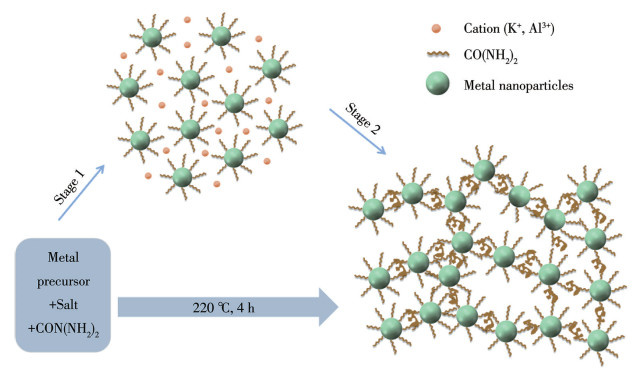
Based on these experimental results and previously reported literature, we propose the following formation mechanism of Pt3Cu1, as illustrated in Fig. 2:
(1) Nucleation: Al3+, as a trivalent cation with high charge density, forms stable ion pairs with negatively charged [PtCl6]2- (the Pt species in the reaction system exists as the anionic complex [PtCl6]2-) and [CuCl4]2- (the Cu2+ also mainly exists as [CuCl4]2- under high Cl- concentration conditions) complexes via electrostatic interaction. This association reduces electrostatic repulsion between the metal complex anions, facilitating aggregation. Subsequent reduction by isopropanol produces nanocrystalline nuclei, which are further capped by amide groups generated from urea decomposition.
(2) Directed assembly and growth: Al3+ mediates the ordered assembly of nanoparticles through electrostatic adsorption, promoting the formation of a continuous network structure[33]. Simultaneously, Cl- selectively adsorbs on the (100) plane of the fcc PtCu alloy, suppressing crystal growth along this direction and driving anisotropic growth toward the (111) orientation[34]. High-resolution TEM (HRTEM) analysis confirmed that the (111) and (220) planes of PtCu alloy, with interplanar spacings of 0.219 and 0.139 nm, respectively, dominate the exposed surfaces, whereas the (200) plane (0.191 nm) was rarely observed, consistent with the selective adsorption of Cl- on the (100) plane of the PtCu alloy. The moderate aspect ratio of the final products arises from the concurrent progress of crystal growth and Al3+-induced interparticle assembly. As nanoparticles evolve into short nanowires, Al3+ acts as a linker, cross-linking these units into a 3D network while preventing excessive elongation of individual nanowires. This synergistic effect results in an interconnected zigzag nanoporous network rather than discrete nanowires with high aspect ratios.
The morphology and microstructure of the assynthesized Pt3Cu1 were first investigated by TEM. As shown in Fig. 3a, the catalyst exhibited a typical 3D NCN composed of interconnected open channels and ultrathin nanowires. Higher-magnification TEM images (Fig. 3b and 3c) reveal a distinctive zigzag nanowire morphology, with an average diameter of approximately 9.6 nm.
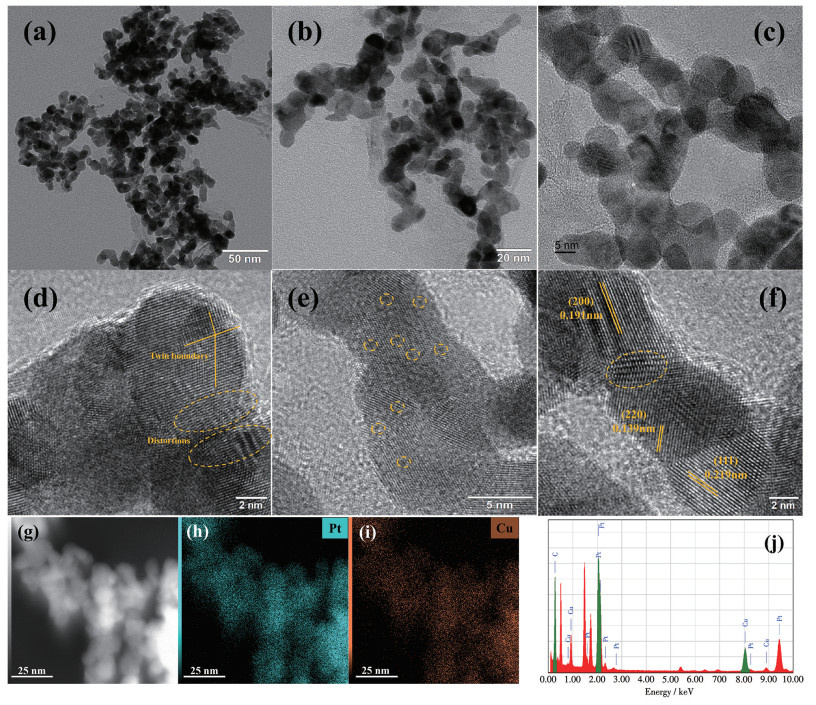
To further elucidate the crystalline structure, HRTEM analyses were performed at representative branch tips and network junctions (Fig. 3d-3f). Well-defined lattice fringes were clearly observed throughout the nanowire framework. In addition, numerous grain boundaries, twin boundaries, and vacancy-related defects could be identified. These structural defects are expected to generate local lattice distortions and modify the electronic environment of surface atoms, which may provide additional catalytically active sites. The zigzag configuration of the nanowire further introduces abundant step and corner sites while preserving the structural continuity of the conductive network. The measured lattice spacings of 0.219, 0.191, and 0.139 nm correspond to the (111), (200), and (220) planes of an fcc PtCu alloy phase, respectively, confirming successful alloy formation[13, 27]. Such an interconnected porous architecture is beneficial for efficient electron transport, rapid mass diffusion, and enhanced structural robustness, which are advantageous for electrocatalytic applications[5, 31].
Elemental distributions were further examined using HAADF-STEM coupled with EDS. As shown in Fig. 3g-3i, Pt and Cu were homogeneously distributed throughout the entire network without detectable elemental segregation, indicating the formation of a uniform alloy structure. Quantitative analysis from the EDS spectrum (Fig. 3j) gave an atomic ratio of Pt to Cu of 3.18, which was slightly higher than the nominal precursor ratio (3) and agreed well with the ICP-AES result (3.26). This slight increase in Pt content is attributed to the partial dissolution of Cu during the subsequent dealloying process.
The crystal structure of the PtxCu1/C was further investigated by XRD. As shown in Fig. 4a, Pt exhibited characteristic diffraction peaks at 39.76°, 46.24°, 67.45°, and 81.28°, corresponding to the (111), (200), (220), and (311) planes of the fcc Pt (PDF No.04-0802), respectively[20, 22]. After alloying with Cu, all PtxCu1 retained the fcc structure, while their diffraction peaks gradually shifted toward higher 2θ values with increasing Cu content. This shift reflects lattice contraction arising from the incorporation of smaller Cu atoms into the Pt lattice.
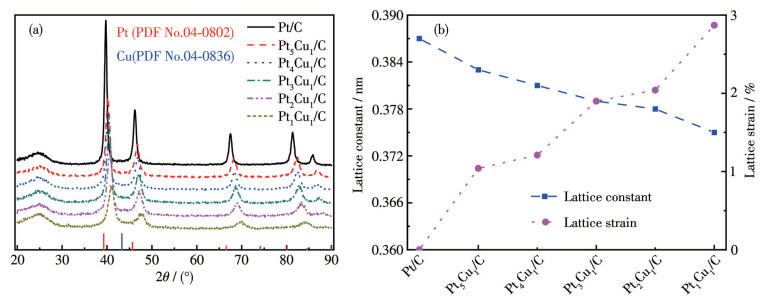
Notably, all diffraction peaks of PtxCu1/C were located between those of pure Pt (PDF No.04-0802) and pure Cu (PDF No.04-0836), and no diffraction peaks associated with separate Pt or Cu phases were detected, further confirming the formation of a single-phase PtCu alloy[13, 27]. Meanwhile, the progressive broadening of diffraction peaks with increasing Cu content indicates a reduction in crystallite size and/or an increase in lattice distortion.
To quantitatively evaluate the alloy-induced structural changes, the lattice constants (α) were calculated from the (111) diffraction peak using Bragg′s law[35]:
|
|
(1) |
where λ is the wavelength of Cu Kα radiation (0.154 059 nm), and θ is the diffraction angle of the (111) plane. The lattice strain (Sl) was estimated according to:
|
|
(2) |
where dalloy and dPt represent the nearest-neighbor bond lengths in the alloy and pure Pt structures, respectively. A negative Sl value indicates that the alloy bond length is reduced relative to pure Pt, resulting in compressive strain within the Pt lattice.
As summarized in Fig. 4b, the lattice constant and the lattice strain values of all PtxCu1/C were between those of pure Pt (0.392 31 nm) and pure Cu (0.361 49 nm), and increased approximately linearly with increasing Pt content, consistent with Vegard′s law[8]. Correspondingly, the compressive strain became progressively stronger as the Cu concentration increased. The calculated lattice contraction values for Pt5Cu1/C, Pt4Cu1/C, Pt3Cu1/C, Pt2Cu1/C, and Pt1Cu1/C were 1.04%, 1.21%, 1.90%, 2.04%, and 2.87%, respectively. Such compressive strain can regulate the Pt d-band center and optimize the adsorption behavior of oxygen-containing intermediates, thereby promoting ORR activity.
XPS was employed to investigate the surface composition and chemical states of Pt3Cu1/C. The survey spectrum reveals a surface atomic ratio of Pt to Cu of 3.35, which was higher than both the nominal precursor ratio (3) and the bulk composition determined by ICP-AES (3.26). Considering the surface-sensitive nature of XPS (probing depth of 2-5 nm), this result provides direct evidence for the preferential dissolution of Cu during dealloying and the formation of a Ptenriched surface layer[13, 22, 27]. Consistently, HRTEM images (Fig. 3e) showed discernible lattice distortions near the surface region, which can be attributed to the lattice mismatch between the Pt-rich shell and the PtCu alloy core.
Fig. 5 compares the XPS spectra of Pt3Cu1/C and Pt/C. In the Pt4f region (Fig. 5a), the Pt4f7/2 and Pt4f5/2 peaks of Pt3Cu1/C were located at 70.9 and 74.3 eV, respectively, exhibiting a negative shift of approximately 0.65 eV relative to those of Pt/C (71.5/75.0 eV). High-resolution Pt4f spectra fitting (Fig. 5b and 5c) indicates that Pt/C exists predominantly in the metallic state (Pt0), accompanied by a small amount of oxidized Pt2+ species. For Pt3Cu1/C, the major peaks at 71.0 and 74.2 eV correspond to Pt0, while the weaker components at 71.8 and 75.9 eV are assigned to Pt2+. Similar species are observed for Pt/C, which display Pt0 peaks at 71.6 and 74.9 eV and Pt2+ peaks at 72.5 and 76.3 eV[36].
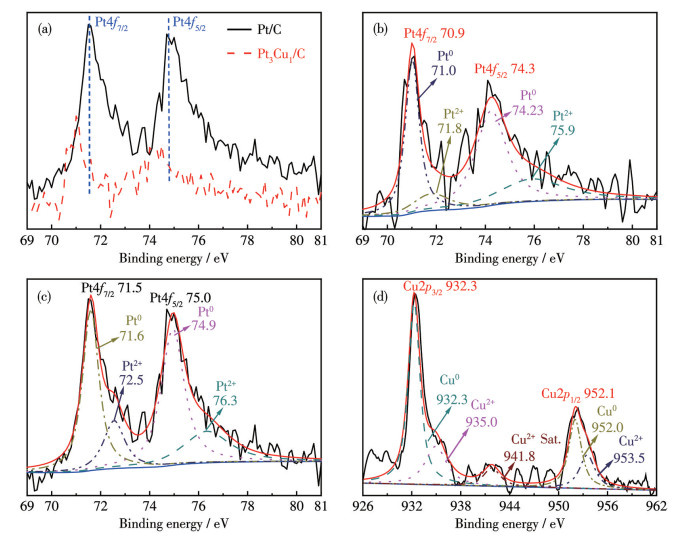
The Cu2p spectrum of Pt3Cu1/C (Fig. 5d) can be deconvoluted into Cu0 and Cu2+ components. Peaks at 932.3 and 952.0 eV are attributed to metallic Cu0 (Cu2p3/2 and Cu2p1/2), whereas those at 935.0 and 953.5 eV correspond to Cu2+ (Cu2p3/2 and Cu2p1/2) species. In addition, a characteristic shake-up satellite peak appeared at approximately 941.8 eV, confirming the presence of surface Cu2+ generated by air oxidation.
Importantly, the negative shift of the Pt4f peaks together with the slight positive shift of the Cu2p peaks suggests electron transfer from Cu to Pt within the alloy framework. Such electronic interaction modifies the electronic structure of Pt and is expected to downshift the Pt d-band center, thereby optimizing the adsorption strength of ORR intermediates and enhancing catalytic activity[13, 18, 22].
To evaluate the role of Cu incorporation in catalyst formation and electrocatalytic performance, monometallic Pt 3D NCNs were synthesized under identical conditions without the addition of Cu precursors. A com-Pt/C catalyst was also employed as a benchmark.
Fig. 6a presents the cyclic voltammetry (CV) curves of the catalysts recorded in an N2-saturated 0.5 mol·L-1 H2SO4 solution. The ECSA was determined from the hydrogen underpotential deposition (Hupd) region. As summarized in Fig. 6b and Table S1, the ECSA values of Pt1Cu1/C, Pt3Cu1/C, Pt5Cu1/C, Pt/C, and com-Pt/C were calculated to be 39.3, 47.4, 41.3, 34.4, and 60.4 m2·gPt-1, respectively. Among the synthesized catalysts, Pt3Cu1/C exhibited the largest ECSA, which can be attributed to the interconnected nanoporous framework and defect-rich zigzag nanowires that provide abundant accessible active sites.
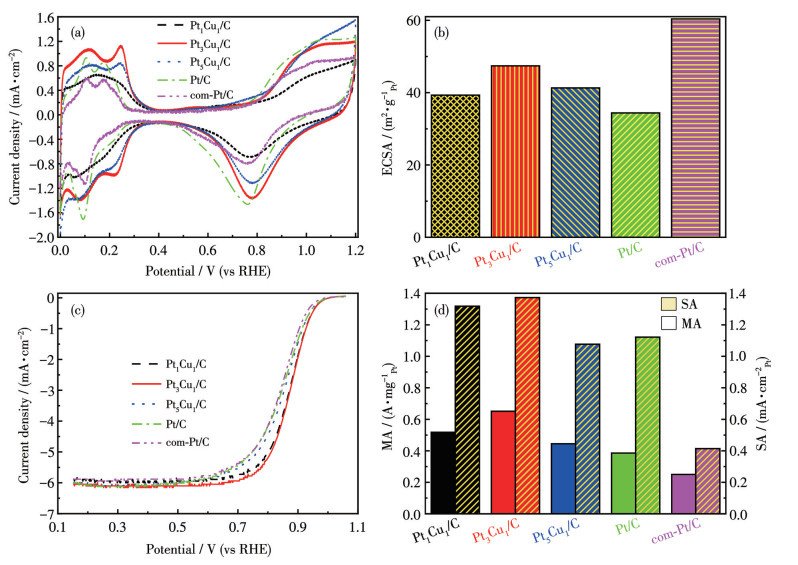
Notably, all PtxCu1/C displayed a pronounced positive shift of the oxide reduction peak compared with Pt/C and com-Pt/C. Since the oxide reduction potential is closely related to the adsorption strength of oxygen-containing intermediates on Pt surfaces, a more positive reduction peak generally indicates weaker oxygen binding and more favorable ORR kinetics[5]. This observation suggests that alloying Pt with Cu effectively modifies the surface electronic structure and optimizes the adsorption behavior of reaction intermediates.
The ORR activities of the catalysts were further evaluated in O2-saturated 0.1 mol·L-1 HClO4 electrolyte using a rotating disk electrode (RDE). As shown in Fig. 6c, the half-wave potentials (E1/2) of Pt1Cu1/C, Pt3Cu1/C, Pt5Cu1/C, Pt/C, and com-Pt/C were 0.872, 0.875, 0.852, 0.844, and 0.839 V, respectively (Table S1). All PtxCu1/C catalysts exhibited higher ORR activity than both Pt/C and com-Pt/C, with Pt3Cu1/C delivering the most positive half-wave potential.
The kinetic current densities were further extracted using the Koutecký-Levich (K-L) equation, and the corresponding mass activity (MA) and specific activity (SA) at 0.90 V (vs RHE) are summarized in Fig. 6d and Table S1[13, 23, 37]. Pt3Cu1/C achieved an MA of 0.651 A·mgPt-1, which was 1.26, 1.46, 1.69, and 2.60 times higher than those of Pt1Cu1/C, Pt5Cu1/C, Pt/C, and com-Pt/C, respectively. The corresponding SA of Pt3Cu1/C reached 1.373 mA·cm-2, which was also the highest among all catalysts investigated.
It is noteworthy that although com-Pt/C possessed the largest ECSA, its ORR activity remained significantly lower than that of Pt3Cu1/C. This result indicates that the enhanced catalytic performance cannot be solely attributed to an increase in surface area. Instead, the superior activity of Pt3Cu1/C primarily originates from the synergistic effects of PtCu alloying, including compressive strain, electronic structure modulation, and the formation of a Pt-enriched surface layer, all of which optimize the adsorption energetics of ORR intermediates.
To further elucidate the ORR pathway, rotating ring-disk electrode (RRDE) measurements were conducted. Based on the disk and ring currents (Fig.S2a), the electron transfer number (n) and H2O2 yield (Y) were calculated according to Eq.3 and 4, where ID is the disk current corresponding to the overall ORR process, IR is the ring current derived from the oxidation of H2O2 species collected at the ring electrode, and N is the collection efficiency of the RRDE electrode. The results are shown in Fig.S2b. Throughout the investigated potential range, Pt3Cu1/C exhibited an average electron transfer number of approximately 3.99 and an H2O2 yield below 5%, indicating that oxygen reduction proceeds predominantly through a highly efficient four-electron pathway with negligible peroxide formation. These results are consistent with those reported for state-of-the-art Pt-based ORR catalysts[13, 23].
|
|
(3) |
|
|
(4) |
The overall electrochemical performance of all catalysts is summarized in Table S1. Among the investigated samples, Pt3Cu1/C exhibited the most balanced combination of ECSA, half-wave potential, MA, and SA, demonstrating its superior intrinsic ORR activity. In addition, the methanol oxidation reaction (MOR) performance of Pt3Cu1/C was evaluated to explore its potential applicability beyond ORR, and the corresponding results are presented in Fig.S3.
To investigate the influence of inorganic salt composition on catalyst formation and electrocatalytic behavior, catalysts prepared with different molar ratios of Mn+ to Al3+ were also examined. Detailed structural and electrochemical characterization results are provided in Fig.S1. As shown in Fig.S1, the ECSA of the catalysts increased from 96.4 to 118.5 m2·gPt-1 as the y value decreased from 5 to 3, while further decreasing y to 1 resulted in a reduced ECSA of 80.3 m2·gPt-1, indicating that the Mn+/Al3+ ratio plays a critical role in regulating the formation of surface-active sites. The ORR measurements further confirmed this trend, with Pt3Cu1/C when y=3 exhibiting the highest half-wave potential (0.873 V) and MA (0.651 A·mgPt-1), significantly outperforming other catalysts with different Mn+/Al3+ ratios and com-Pt/C. The superior ORR performance of Pt3Cu1/C when y=3 can be attributed to the defect-rich 3D porous architecture induced by an appropriate Al3+ content, which not only enhances the exposure of Pt active sites but also optimizes oxygen intermediate adsorption through electronic modulation of the PtCu alloy, thereby accelerating the ORR kinetic process.
The long-term durability of electrocatalysts is a critical prerequisite for their practical application in PEMFCs. To evaluate catalyst stability under harsh operating conditions, accelerated durability tests (ADT) were performed for Pt3Cu1/C and com-Pt/C in an O2-saturated 0.1 mol·L-1 HClO4 electrolyte[38]. The potential was cycled between 0.60 and 1.00 V (vs RHE) at a scan rate of 100 mV·s-1 for up to 30 000 cycles. The electrochemical properties before and after ADT were compared to assess the structural and catalytic stability of the catalysts (Fig. 7).
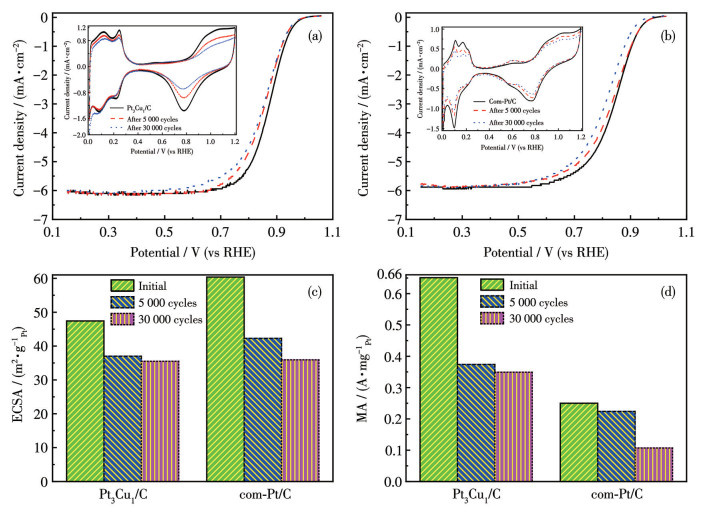
Fig. 7a and 7b present the ORR polarization curves of Pt3Cu1/C and com-Pt/C before and after ADT. The corresponding CV curves recorded in an N2-saturated 0.5 mol·L-1 H2SO4 are shown in the insets. The evolution of ECSA and MA during the durability test is summarized in Fig. 7c and 7d, respectively. After 30 000 cycles, the ECSA of com-Pt/C decreased from 60.4 to 35.9 m2·gPt-1, corresponding to only 59% retention of its initial value. This substantial loss is primarily attributed to Ostwald ripening, nanoparticle migration, and particle aggregation during prolonged electrochemical cycling. In contrast, Pt3Cu1/C retained an ECSA of 35.5 m2·gPt-1 after 30 000 cycles, corresponding to 75% retention of the initial value. The significantly improved ECSA retention demonstrates the superior structural robustness of the 3D nanoporous network.
A similar trend was observed for catalytic activity. As shown in Fig. 7d and Table S2, the MA of com-Pt/C at 0.90 V (vs RHE) decreased to 0.107 A·mgPt-1 after 30 000 cycles, retaining only 43% of its initial activity. By comparison, Pt3Cu1/C maintained a MA of 0.374 A·mgPt-1, corresponding to an activity retention of 57%. Even after extensive durability testing, the MA of Pt3Cu1/C remained substantially higher than that of com-Pt/C. A comparison with recently reported Pt-based ORR catalysts is provided in Table S3.
To elucidate the origin of the enhanced durability, post-ADT structural characterization was performed (Fig.S5). Although the Pt-enriched surface generated by chemical dealloying cannot completely suppress Cu dissolution under prolonged cycling conditions, it effectively slows Cu leaching and mitigates catastrophic structural degradation. TEM images collected after ADT reveal partial nanowire coarsening and localized aggregation; however, the overall 3D interconnected framework remained largely intact. Such structural preservation contributes significantly to the superior ECSA retention observed for Pt3Cu1/C. Further evidence is provided by the post-ADT XPS spectra, where the Cu2p signal intensity decreased markedly, indicating substantial dissolution of surface Cu species during long-term electrochemical operation. Nevertheless, the remaining Pt-rich shell effectively stabilizes the alloy framework and prevents rapid collapse of the porous architecture. Consequently, Pt3Cu1/C exhibited considerably higher ECSA retention (75%) than its monometallic Pt counterparts (52%).
The beneficial role of dealloying is further associated with the generation of Cu vacancies. Numerous studies have shown that vacancy sites formed after selective Cu removal can regulate the adsorption energies of oxygen-containing intermediates (HO* and O*), thereby facilitating ORR kinetics and enhancing catalytic activity[2-3, 5, 15, 22]. The existence of such vacancy-rich structures is supported by several experimental observations. First, XPS analysis revealed a higher surface atomic ratio (3.35) of Pt to Cu than the bulk composition determined by ICP-AES (3.26), indicating preferential surface Cu dissolution. Second, ICP-AES measurements showed a measurable decrease in Cu content after dealloying. Third, HRTEM images (Fig. 3e) reveal lattice distortions and vacancy-type defects within the subsurface region. These observations collectively support the formation of a Ptenriched and vacancy-rich surface structure.
Based on the experimental results and discussions above, we conclude that PtCu exhibits excellent ORR activities and stabilities in acidic media, primarily due to the following four key factors: (1) optimal Pt/Cu composition and electronic regulation. The introduction of Cu atoms effectively promotes the removal of toxic intermediates (e.g., CO*) adsorbed on adjacent Pt active sites, thereby freeing up Pt active sites[18, 20, 38-39]. An appropriate Cu content optimizes the binding strength between Pt and reaction intermediates, accelerating the oxidation kinetics of these intermediates[40]. However, excessive Cu content may inhibit overall activity due to its own low-potential oxidation inertness to alcohols[41]. Therefore, an optimal ratio of Pt to Cu significantly enhances electrocatalytic performance by balancing the surface Pt and Cu sites. (2) Abundant defects and 3D porous structure. The presence of grain boundaries (line defects) and vacancies (point defects) in the catalyst provides abundant active catalytic sites[3, 7, 22, 42]. Additionally, the 3D interconnected porous network structure not only enhances the accessibility of active sites but also facilitates the mass transfer of reactants and products, further improving catalytic efficiency. (3) Synergistic catalytic effect of Pt and Cu. The electronic and geometric strain effects induced by alloying create a significant synergistic interaction between Pt and Cu. This interaction optimizes the reaction pathways and energy barriers on the catalytic surface, thereby enhancing the intrinsic activity for both MOR[43] (Fig.S3) and ORR[3, 17, 18, 22]. (4) Pt-enriched surface layer. The formation of a Pt-enriched surface layer during the chemical dealloying process effectively prevents further Cu leaching and stabilizes the crystal structure. Combined with the Cu vacancies generated after dealloying, which have been shown to enhance the adsorption energy of HO* and O* intermediates[2, 5, 22], the catalyst exhibits high activity, stability, and anti-poisoning ability. This proves that interfacial engineering is an effective strategy for the rational design of PEMFC catalysts.
These combined features make Pt3Cu1/C a highly effective and stable catalyst for electrocatalytic applications in PEMFCs.
A facile, surfactant-free, and scalable strategy was developed for the synthesis of PtCu 3D NCNs with abundant surface defects and tunable compositions. This proposed method does not require surfactants, hard templates, or long reaction times, making it highly suitable for large-scale commercial applications. Structural characterization revealed that the synthesized PtCu NCNs possess a highly interconnected 3D porous architecture composed of defect-rich zigzag nanowires.
The cooperative effects of Al3+ and Cl- ions play a crucial role in directing the formation of the network structure, where Al3+ promotes nanoparticle assembly and framework formation, while Cl- facilitates anisotropic growth. Furthermore, the dealloying process generates a Pt-enriched surface layer and abundant Cuvacancy defects, leading to optimized electronic structures and enhanced accessibility of catalytic active sites. By tuning the Pt/Cu precursor ratio, the catalytic performance of the PtCu NCNs could be effectively regulated. Among the investigated catalysts, Pt3Cu1/C 3D NCNs exhibited the best electrocatalytic performance, delivering an MA that was 2.60 times higher for ORR than that of the com-Pt/C catalyst. In addition, Pt3Cu1/C 3D NCNs demonstrated excellent durability, retaining 75% of their initial ECSA and 57% of their initial MA after 30 000 ADT cycles.
The outstanding electrocatalytic performance of PtCu 3D NCNs is primarily attributed to their unique, highly interconnected, and intertwined 3D network structure, high specific surface area, high porosity, and abundant edge/corner atoms, which act as active sites. The synergistic effect of the PtCu alloy significantly enhances the catalyst′s performance, with Cu playing a key role in improving the catalyst′s resistance to poisoning, inducing lattice strain, and tuning the electronic structure. Therefore, Pt3Cu1/C 3D NCNs, with their simple and effective synthesis process and high catalytic activity, are promising candidates to replace com-Pt/C catalysts and offer attractive electrocatalytic materials for various energy-related applications.
ZHANG S H, LIU S Y, HUANG J W, ZHOU H K, LIU X Z, TAN P F, CHEN H Y, LIANG Y L, PAN J. Microbial synthesis of N, P co-doped carbon supported PtCu catalysts for oxygen reduction reaction[J]. J. Energy Chem., 2023, 84(1): 486-495
LU X W, ZHANG X L, CHEN R X, WANG S W, WANG Z L, TIAN H J, JIAO L Y. Synthesis of uniform two-dimensional nitrogen-doped graphene films via thermal evaporation as efficient oxygen reduction catalysts[J]. Energy Mater. Devices, 2024, 2(4): 9370052 doi: 10.26599/EMD.2024.9370052
CHEN Y Q, CEN Z H, HUANG J L, YI T, LIANG M, JI Y W, LIU M, LIU S H. Thermal activation of graphitic carbon nanosheets for high-performance oxygen electrocatalysis[J]. Energy Mater. Devices, 2026, 4(1): 9370084 doi: 10.26599/EMD.2026.9370084
REN Y Y, LI B B, ZHANG G C, LU Z M, LI L L, YANG X J, ZHANG X H, YU X F. Lewis acid sites assisted PtCu/CeO2-C enabling high-performance for oxygen reduction[J]. Small, 2025, 21(5): 2408391 doi: 10.1002/smll.202408391
GONG M X, XIAO D D, DENG Z P, ZHANG R, XIA W W, ZHAO T H, LIU X P, SHEN T, HU Y Z, LU Y, ZHAO X, XIN H L, WANG D L. Structure evolution of PtCu nanoframes from disordered to ordered for the oxygen reduction reaction[J]. Appl. Catal. B-Environ., 2021, 282: 119617 doi: 10.1016/j.apcatb.2020.119617
ZHAO J Y, DUAN Y R, LIAN J, ZHAO Z X, DOU H L, GAO Y, WANG X M. Insights into the trigger effect of Pt—N bond on lattice distortions of novel PtCu alloys enabling an unusual pathway in oxygen reduction[J]. Sep. Purif. Technol., 2023, 320: 124092 doi: 10.1016/j.seppur.2023.124092
SHAO R Y, NIU X F, XU X C, ZHOU Z H, CHU S Q, TONG L, ZHANG L, LIANG H W. Enhancing surface strain of intermetallic fuel cell catalysts by composition-induced phase transition[J]. Nano Lett., 2024, 24(18): 5578-5584 doi: 10.1021/acs.nanolett.4c00898
SUN S B, MA D D, MA J F, LEI L, WANG D G, ZHAN J, SUN Y, WANG L, LI G H, YAN J H, FELSER C, LI G W, LI W. Promoting four-electron oxygen reduction reaction with chiral semimetals PtGa[J]. Rare Met., 2025, 44(8): 5633-5642 doi: 10.1007/s12598-025-03336-5
ZHANG Z Y, LIU J, LIU F, RUZIMURADOV O, YANG H, FANG D. Pre-lithiation depositing PtCu nanoparticles onto N-doped carbon as an efficient catalyst for oxygen reduction reaction[J]. J. Alloy. Compd., 2025, 1036: 182057 doi: 10.1016/j.jallcom.2025.182057
ZHANG X, LIU X K, WU D, HU L F, ZHANG H J, SUN Z G, QIAN S T, XIA Z Y, LUO Q Q, CAO L L, YANG J L, YAO T. Self-assembly intermetallic PtCu3 core with high-index faceted Pt shell for high-efficiency oxygen reduction[J]. Nano Lett., 2024, 24(10): 3213-3220 doi: 10.1021/acs.nanolett.4c00111
LI X, ZHANG J J, LI Q H, YANG S M, WEI C Z, ZHANG F, WANG Z B. ZIF-derived PtCu/N-DC dodecahedrons: Synergistic enhancement mechanism of methanol oxidation activity and poisoning resistance under low platinum loading[J]. Appl. Surf. Sci., 2025, 703: 163388 doi: 10.1016/j.apsusc.2025.163388
ZHAO F L, ZHENG L, YUAN Q, ZHANG Q H, SHENG T, YANG X T, GU L, WANG X. PtCu subnanoclusters epitaxial on octahedral PtCu/Pt skin matrix as ultrahigh stable cathode electrocatalysts for room temperature hydrogen fuel cells[J]. Nano Res., 2022, 16(2): 2252-2258
LI X M, FU L F, CAO L, LEI L H, ZHAN X X, HU C G, TONG X, TIAN J. High electrocatalytic activity of crystallization-modulated ordered PtCu3/C nanoalloy catalysts for oxygen reduction reaction[J]. Chem. Eng. J., 2025, 507: 160445 doi: 10.1016/j.cej.2025.160445
CASTILLO R, DOMINGUEZ G, GARCIA E, SANTOS J L, CENTENO M Á, ROMERO SARRIA F, DATURI M, ODRIOZOLA J A. Upgrading the PtCu intermetallic compounds: The role of Pt and Cu in the alloy[J]. Catal. Today, 2020, 356: 390-398 doi: 10.1016/j.cattod.2019.11.026
LI W Q, HU Z Y, ZHANG Z W, WEI P, ZHANG J A, PU Z H, ZHU J W, HE D P, MU S C, TENDELOO G. Nano-single crystal coalesced PtCu nanospheres as robust bifunctional catalyst for hydrogen evolution and oxygen reduction reactions[J]. J. Catal., 2019, 375: 164-170 doi: 10.1016/j.jcat.2019.05.031
FUNATSU A, TATEISHI H, HATAKEYAMA K, FUKUNAGA Y, TANIGUCHI T, KOINUMA M, MATSUURA H, MATSUMOTO Y. Synthesis of monolayer platinum nanosheets[J]. Chem. Commun., 2014, 50(62): 8503-8506 doi: 10.1039/C4CC02527J
WANG K, SRIPHATHOORAT R, LUO S P, TANG M, DU H Y, SHEN P K. Ultrathin PtCu hexapod nanocrystals with enhanced catalytic performance for electro-oxidation reactions[J]. J. Mater. Chem. A, 2016, 4(35): 13425-13430 doi: 10.1039/C6TA05230D
MA G, ZHAO X N, WANG J X, QIN G Q, LU Z M, YU X F, LI L L, ZHANG X H, YANG X J. Structural evolution of PtCu nanoframe for efficient oxygen reduction reactions[J]. J. Electroanal. Chem., 2022, 922: 116756 doi: 10.1016/j.jelechem.2022.116756
GAO R J, WANG J, HUANG Z F, ZHANG R R, WANG W, PAN L, ZHANG J F, ZHU W K, ZHANG X W, SHI C X, LIM J W, ZOU J J. Pt/Fe2O3 with Pt-Fe pair sites as a catalyst for oxygen reduction with ultra low Pt loading[J]. Nat. Energy, 2021, 6(6): 614-623 doi: 10.1038/s41560-021-00826-5
NAIR A S, JAFRI R I. A facile one-step microwave synthesis of Pt deposited on N & P co-doped graphene intercalated carbon black-An efficient cathode electrocatalyst for PEM fuel cell[J]. Int. J. Hydrog. Energy, 2023, 48(9): 3653-3664 doi: 10.1016/j.ijhydene.2022.10.210
LUO X S, FU C H, SHEN S Y, LUO L X, ZHANG J L. Free templated synthesis of N-doped PtCu porous hollow nanospheres for efficient ethanol oxidation and oxygen reduction reactions[J]. Appl. Catal. B-Environ., 2023, 330: 122602 doi: 10.1016/j.apcatb.2023.122602
WANG K L, WANG M Z, LEI Q Z, ZHOU T T, LIU X J, CAO Z, JIANG Z Y, HE J. Strain effect of PtCu alloy aerogel nanocatalysts on the oxygen reduction reaction enhancement[J]. Mol. Catal., 2025, 580: 115121
ZHANG S H, ZHOU H K, LIU X Z, TAN P F, LIU H W, PAN J. Highly stable PtCu3Auy nanowires-nanoparticles composite as efficient electrocatalysts towards oxygen reduction reaction[J]. J. Power Sources, 2023, 567: 232924 doi: 10.1016/j.jpowsour.2023.232924
SHAO Q, LU K Y, HUANG X Q. Platinum group nanowires for efficient electrocatalysis[J]. Small Methods, 2019, 3(5): 1800545 doi: 10.1002/smtd.201800545
HONG W, WANG J, WANG E. Facile synthesis of PtCu nanowires with enhanced electrocatalytic activity[J]. Nano Res., 2015, 8(7): 2308-2316 doi: 10.1007/s12274-015-0741-y
CAO H H, CAO J D, WANG F H, DI S X, ZHU H, PU M, BULANOVA A. Composition-tunable PtCu porous nanowires as highly active and durable catalyst for oxygen reduction reaction[J]. Int. J. Hydrog. Energy, 2021, 46(35): 18284-18293 doi: 10.1016/j.ijhydene.2021.02.208
YU L, LI B S, WANG Q S, CHAI Z Q, LIU L L, MA P J, TAI X S, LV Y P, ZHANG P F, GAO D W. Synthesis of PtCuFe alloy nanoframes with high-index facets for efficient electro-oxidation of liquid fuels[J]. Fuel, 2022, 315: 123280 doi: 10.1016/j.fuel.2022.123280
WU H, ZHONG H C, PAN Y Z, LI H B, PENG Y, YANG L J, LUO S S, BANHAM D, ZENG J H. Highly stable and active Pt-skinned octahedral PtCu/C for oxygen reduction reaction[J]. Colloids Surf. A-Physicochem. Eng. Asp., 2023, 656: 130340 doi: 10.1016/j.colsurfa.2022.130340
LI Y X, ZHANG Z Y, XIAO Z J, ZHAO G Z, SONG H Y, LIU Y Q, ZENG J H. Stable and active Pt colloid preparation by modified citrate reduction and a mechanism analysis of inorganic additives[J]. J. Colloid Interf. Sci., 2020, 572: 74-82 doi: 10.1016/j.jcis.2020.03.070
PAPERZH K, ALEKSEENKO A, SAFRONENKO O, NIKULIN A, PANKOV I, GUTERMAN V. UV radiation effect on the microstructure and performance of electrocatalysts based on small Pt nanoparticles synthesized in the liquid phase[J]. Colloid Interface Sci., 2021, 45: 100517 doi: 10.1016/j.colcom.2021.100517
ZHANG J M, CHEN Y, ZHANG X J, FANG Y J, GAO Y, ZHAO J, XU X C, XIAO H, ZHAO M, HU T J, PEI L J, LUO E, LV B L, JIA J F. Au-doped PtCu2 nanonetworks with interface-rich for enhancing methanol electro-oxidation performance[J]. Int. J. Hydrog. Energy, 2024, 71: 14-22 doi: 10.1016/j.ijhydene.2024.05.220
HU C Y, LIN K Q, WANG X L, LIU S J, YI J, TIAN Y, WU B H, CHEN G X, YANG H Y, DAI Y. Electrostatic self-assembling formation of Pd superlattice nanowires from surfactant-free ultrathin Pd nanosheets[J]. J. Am. Chem. Soc., 2014, 136(37): 12856-12859 doi: 10.1021/ja507409p
LIU J W, HUANG Z, CAI K, ZHANG H, LU Z C, LI T T, ZUO Y P, HAN H Y. Clean synthesis of an economical 3D nanochain network of PdCu alloy with enhanced electrocatalytic performance towards ethanol oxidation[J]. Chem. Eur. J., 2015, 21(49): 17779-17785 doi: 10.1002/chem.201503432
WU T, ZHOU H M, XIA B Y, XIAO P, YAN Y, XIE M S, WANG X. Facile synthesis of 3D platinum dendrites with a clean surface as highly stable electrocatalysts[J]. ChemCatChem, 2014, 6(6): 1538-1542 doi: 10.1002/cctc.201400058
JIANG M H, MA L, GAN M Y, HU L Q, HE H M, XIE F, ZHANG H H. Worm-like PtP nanocrystals supported on NiCo2Px/C composites for enhanced methanol electrooxidation performance[J]. Electrochim. Acta, 2019, 293: 30-39 doi: 10.1016/j.electacta.2018.10.022
WANG H Y, ZHANG K, WU L L, WANG Y J, DU X H, LI J D. Charge transfer and spillover effect enabled high-performance titanium dioxide supported PtCu catalyst towards acidic oxygen reduction[J]. Chem. Eng. J., 2024, 481: 148097 doi: 10.1016/j.cej.2023.148097
MURTZ S D, MUSIALEK F, PFANDER N, PALKOVITS R. Bimetallic PtCu/C catalysts for glycerol assisted hydrogen evolution in acidic media[J]. ChemElectroChem, 2023, 10(11): e202201114
DI S X, LIU W J, GUO C, WANG F H, BULANOVA A, MEBEL A, ZHU H. Hierarchical porous N-doped carbon-supported PtCu nanoparticles as an efficient catalyst for oxygen reduction reaction[J]. J. Power Sources, 2022, 533: 231270 doi: 10.1016/j.jpowsour.2022.231270
LONG Q R, SHI C Y, ZHANG D W, WEI D Y, LI H Q, ZHOU L X, TAN H Y, YU J, XU M L. The synthesis of PtCu/C catalyst with a hollow sphere structure by chlorine-free platinum precursor for the oxygen reduction reaction[J]. Int. J. Hydrog. Energy, 2025, 133: 214-224 doi: 10.1016/j.ijhydene.2025.04.487
XIANG H Y, ZHENG Y S, SUN Y. Bimetallic and postsynthetically alloyed PtCu nanostructures with tunable reactivity for the methanol oxidation reaction[J]. Nanoscale Adv., 2020, 2(4): 1603-1612 doi: 10.1039/D0NA00076K
YANG L M, YAN D F, LIU C B, SONG H J, TANG Y H, LUO S L, LIU M J. Vertically oriented reduced graphene oxide supported dealloyed palladium-copper nanoparticles for methanol electrooxidation[J]. J. Power Sources, 2015, 278: 725-732 doi: 10.1016/j.jpowsour.2014.12.141
SUN Y D, ZHANG S K, SUN S Q, WU L, TIAN J, WU Y P, CHEN Y H, LIU X J. Cu tailoring Pt enables branched-structured electrocatalysts with high concave surface curvature toward efficient methanol oxidation[J]. Small, 2024, 20(18): e2307970 doi: 10.1002/smll.202307970
LIANG X Y, HUANG M Z, HUANG F Y, PENG X L, RANI K K, WANG L M, YANG Z Y, FAN Y J, CHEN D H. Composition-adjustable PtCoCu alloy nanoparticles for promoting methanol oxidation reaction[J]. Mol. Catal., 2023, 545: 113225

Figure 3 (a-c) TEM images, (d-f) HRTEM images, (g-i) elemental mappings, and (j) EDS spectrum of as-synthesized Pt3Cu1 catalyst

Figure 4 (a) XRD patterns and (b) lattice constants and lattice strains of PtxCu1/C and Pt/C

Figure 5 (a) Pt4f XPS spectra for Pt3Cu1/C and Pt/C; Pt4f XPS spectra for (b) Pt3Cu1/C and (c) Pt/C; (d) Cu2p XPS spectra for Pt3Cu1/C

Figure 6 (a) CV curves of catalysts in a 0.5 mol·L-1 H2SO4 solution at room temperature at a scanning rate of 50 mV·s-1 and (b) the corresponding ECSA; (c) ORR polarization curves in O2-satured 0.1 mol·L-1 HClO4 electrolyte under room temperature at a scan rate of 10 mV·s-1 and a rotation rate of 1 600 r·min-1 and (d) the corresponding MA and SA at 0.9 V (vs RHE)

Figure 7 ORR polarization curves of (a) Pt3Cu1/C and (b) com-Pt/C catalysts before and after ADT in O2-saturated 0.1 mol·L-1 HClO4 electrolyte under room temperature at a rotation speed of 1 600 r·min-1 and a scanning rate of 10 mV·s-1 and the corresponding CV curves in a 0.5 mol·L-1 H2SO4 solution at a scan rate of 50 mV·s-1 under room temperature (inset); (c) ECSA and (d) MA at 0.9 V (vs RHE) of the catalysts before and after ADT

 扫一扫看文章


扫一扫关注我们
 下载:

 下载:

 下载: