Citation: Kun HUANG, Chengyu SUN, Dongqi WANG, Yuxin CHEN, Shuxia LIU. A stable and easily synthesized polyoxometalate-based Cu-MOF for trace detection of pollutants in water[J]. Chinese Journal of Inorganic Chemistry, 2026, 42(8): 1593-1602. doi: 10.11862/CJIC.20260107
稳定、易合成的多酸基Cu-MOF用于水中污染离子的痕量检测
English
A stable and easily synthesized polyoxometalate-based Cu-MOF for trace detection of pollutants in water
-
Key words:
- electrocatalysis
- / polyoxometalate-based MOFs
- / trace detection
-
环境安全是生态环境保护与公共卫生保障的核心议题,水中痕量无机离子的精准检测,是水质风险评价、污染控制及水处理工艺优化的关键[1-3]。IO3-是饮用水臭氧消毒、氯化消毒过程中生成的典型消毒副产物[4],具有潜在毒性与致癌性,其在水体中的累积已成为饮用水安全的重要隐患。Cr2O72-具有强氧化性与生物累积性,是水环境中优先控制的重金属污染物,其过量存在会对人体肝脏及肾脏造成不可逆损伤[5-6];NO2-是水体富营养化与氮循环过程的重要指标,会导致人体高铁血红蛋白血症[5]。上述3类物质在天然水体与饮用水中通常以痕量浓度水平存在,且易受到环境中其他离子的干扰。因此,选择高灵敏、高选择性、快速便捷、绿色环保的检测方法对其进行检测,对实现水环境质量的精准监测与污染风险的有效管控具有重要现实意义。
目前,尽管离子色谱[7-9]、高效液相色谱、电感耦合等离子体-质谱、纳米传感[10]等传统方法可实现对目标物的精准定量检测,但这些方法仍存在一定的局限性,比如大型仪器设备昂贵、前处理繁琐、检测耗时,难以实现原位实时监测;部分纳米传感体系制备复杂、成本较高,且在复杂水环境中易受蛋白质、金属离子等干扰。相比之下,电化学传感器[11-13]凭借响应快速、灵敏度高、体积小巧、成本低廉等优势,成为痕量污染物现场快速检测的理想选择。通过修饰材料设计可实现对IO3-、Cr2O72-、NO2-的高灵敏检测,能够有效弥补现有技术在现场化、实时化、多目标监测方面的不足,为水环境复杂体系的高效监测提供新路径。
多金属氧酸盐[14-18](简称多酸,POM)具有结构可调、氧化还原活性位点丰富[19-21]、质子传导性能优良[22-23]、酸性条件下稳定等优点,是构建高性能电化学传感器的理想修饰材料[24]。Han等设计了2种基于磷钼酸盐的电化学传感器[25],用于检测重金属离子Cr(Ⅵ)。You等[26]使用模块化的Keggin簇作为构建单元和银离子作为桥接单元合成了2种聚合物,由其制备的2种碳糊电极对亚硝酸根的电催化还原反应表现出优异的电催化活性。基于此,按照文献[27]的方法成功合成了一例POM基Cu-MOF杂化物(POM-Cu-MOF),该杂化物兼具POM的优异电催化性能与金属有机骨架(MOF)的三维结构优势,显著提升了电催化效率与电化学响应性能。接着将此杂化物构建成可更新式的碳糊电化学传感器(POM-Cu-MOF-CPE,CPE代表碳糊电极),并应用于水溶液中多种典型污染离子的电化学传感检测。该传感器充分结合了POM基MOFs杂化物的电子传递速率快、电催化活性突出、酸性条件下稳定性强的特性,以及碳糊电极制备简便[28]、表面可更新、成本低廉的优势,展现出响应快速、灵敏度优异、线性检测范围宽广等良好性能,同时具备较强的抗干扰能力,在复杂水体中仍可保持稳定的电流响应,适用于实际水环境中痕量污染物的快速监测,为水环境中多种无机污染物的高效电化学传感研究提供了可行思路。
1. 实验部分
1.1 仪器与试剂
硫脲、醋酸铜、盐酸、硫酸(98%)、吡嗪(Pz)、Na2SO4、MgSO4、氯化钙、氯化钾、抗坏血酸(AA)、多巴胺(DA)等试剂均购买于阿拉丁,均为分析纯。所有材料均未经处理,直接使用。电解液为0.1 mol·L-1 H2SO4+0.5 mol·L-1 Na2SO4溶液,使用去离子水配制。
实验仪器主要包括傅里叶变换红外光谱仪(FTIR,扫描范围为4 000~400 cm-1)、粉末X射线衍射仪(Smartlab仪器,Cu Kα辐射,λ=0.154 06 nm,40 kV,30 mA,5°~50°)和上海华辰CHI760电化学工作站。
1.2 POM-Cu-MOF的合成
POM-Cu-MOF按照文献方法合成[27]。将H3PMo12O40(0.31 g,0.16 mmol)、硫脲(0.032 g,0.4 mmol)、Cu(OAc)2·H2O(0.084 g,0.4 mmol)以及Pz(0.016 1 g,0.2 mmol)在室温下溶解于10 mL蒸馏水中。搅拌1 h后,用1 mol·L-1的盐酸调节溶液pH值至2.1。随后,将所得混合物放置于带有25 mL聚四氟乙烯内衬的反应釜中,并在120 ℃下加热72 h。待反应釜自然冷却至室温后,得到深绿色块状晶体(产率:50.3%)。
1.3 工作电极的制备
POM-Cu-MOF-CPE的制备过程如下:将0.08 g的石墨粉和0.01 g POM-Cu-MOF混合,在玛瑙研钵中研磨20 min至混合均匀。混合均匀后,向混合物中滴入0.2 mL石蜡油,不间断研磨60 min,得到均匀混合的糊状物。将糊状物装至外径为5 mm、内径为3 mm的玻璃管中,用直径约为3 mm的铜丝压实底部,排除玻璃管内的空气,在滤纸上磨平顶部,制备得到POM-Cu-MOF-CPE,用于后续测试。
1.4 电化学测试
所有电化学测试均在上海华辰CHI760电化学工作站上使用标准三电极体系进行,其中,铂片为对电极,Ag/AgCl电极(饱和KCl)为参比电极,POM-Cu-MOF-CPE为工作电极。所有电化学测试前均使用高纯氮气对电解液鼓泡除氧15 min。循环伏安法(CV)测试的范围为-0.25~0.60 V(vs Ag/AgCl)。后文如无特别指出,电位均指相对Ag/AgCl电极电位。电化学阻抗谱(EIS)在开路电位(OCP)下测试,频率范围为10 kHz~1 Hz。
1.5 抗干扰测试
采用安培电流-时间法考察POM-Cu-MOF-CPE对目标污染离子检测的抗干扰性能,测试采用与1.4节一致的三电极体系及0.1 mol·L-1 H2SO4+0.5 mol·L-1 Na2SO4电解液,施加恒定工作电位为-0.16 V;测试前电解液经高纯氮气鼓泡除氧15 min,测试全程维持恒定速率磁力搅拌以保证传质均匀,待基线电流平稳后,依次向电解液中加入水环境中常见的共存无机离子K+、Na+、Cl-、Mg2+、Ca2+、SO42-以及典型有机干扰物AA、DA,每种干扰物的终浓度均为1 mmol·L-1,每次加样后待电流达到稳态并保持150 s,再加入下一种干扰物;待全部干扰物添加完成且电流稳定后,分别加入终浓度为30 μmol·L-1的IO3-、0.1 mmol·L-1的NO2-与30 μmol·L-1的Cr2O72-并记录电流响应。
2. 结果与讨论
2.1 POM-Cu-MOF的组成与结构
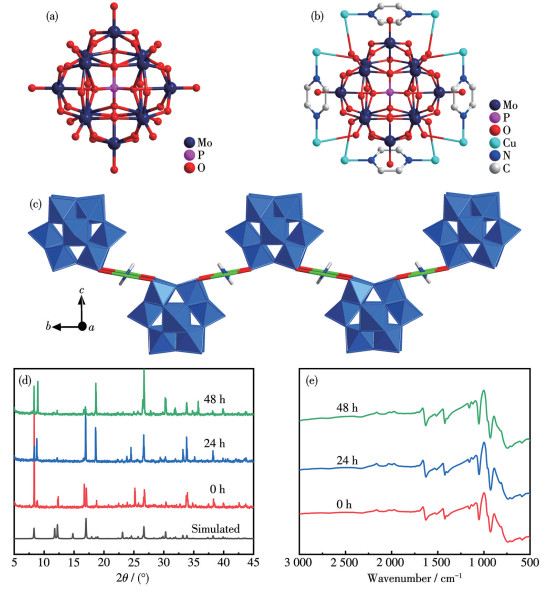
[Cu4Ⅰ(Pz)2(H2O)8(PMo11ⅥMoⅤO40)]·3.5H2O(POM-Cu-MOF)按照文献[27]方法合成。POM-Cu-MOF结构单元中包含1个POM阴离子([PMo11ⅥMoⅤO40]4-,图 1a),其周围对称地配位有8个Cu+离子。POM阴离子由4个{Mo3O13}三金属氧簇构成,每个簇中的3个端氧原子中有2个与Cu+发生配位,另一个端氧(记为O6′)则位于相邻Cu+离子之间。这些{Mo3O13}簇及与之键合的Cu+通过[PO4]四面体以共角氧的方式连接,共同形成{PMo12O40Cu8}结构片段(图 1b)。沿b轴方向,2个平行的Cu+通过Cu—O6键的连接将POM限定在由铜组成的平面两侧,Pz则穿插在铜与铜之间,以类似桥梁的作用使这2个Cu+两两连接,形成梯状结构;该梯状结构分别与POM单元交替连接构成一维链状结构(图 1c)。这一独特的结构特征使其在电化学测试中展现出显著优势:首先,POM中Mo/Mo(Ⅵ)的混合价态构成了丰富的电子储存与转移位点,为电催化过程提供了高效的多电子传输通道,确保了优异的电子传导能力;其次,POM-Cu-MOF的三维框架结构为电子的迁移提供了连续路径,增强了材料的导电性。
图 1
图 1. (a) Keggin型POM阴离子的结构示意图; (b) POM-Cu-MOF中POM阴离子与Cu+、Pz的配位结构图; (c) POM-Cu-MOF的1D链状结构; POM-Cu-MOF在1 mol·L-1 H2SO4中浸泡0、24、48 h后的(d) PXRD图和(e) FTIR谱图Figure 1. (a) Structural diagram of Keggin-type POM anions; (b) Coordination structural diagram of POM anions with Cu+ and Pz in POM-Cu-MOF; (c) 1D chain structure of POM-Cu-MOF; (d) PXRD patterns and (e) FTIR spectra of POM-Cu-MOF after soaking in 1 mol·L-1 H2SO4 for 0, 24, and 48 h进行电化学测试的电解液pH为1.68,为了证明POM-Cu-MOF在强酸性条件下能够稳定存在,在pH=0的条件下,将该POM-Cu-MOF分别浸泡0、24、48 h之后进行粉末X射线衍射(PXRD)、FTIR测试,如图 1d和1e所示。浸泡后POM-Cu-MOF的PXRD图与模拟PXRD图相比基本吻合,而且与新合成的POM-Cu-MOF的FTIR谱图对比没有明显变化,证明POM-Cu-MOF在强酸性条件下具有优异的稳定性。
2.2 POM-Cu-MOF的电化学行为
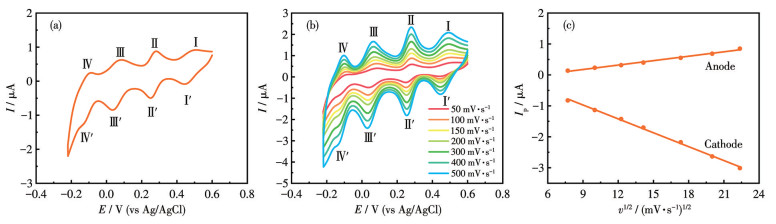
电化学测试是在0.5 mol·L-1 Na2SO4+0.1 mol·L-1 H2SO4电解液中进行的。POM-Cu-MOF-CPE显示出4个对称性良好的氧化还原对(图 2a,100 mV·s-1),4对峰的半波电位(E1/2)分别为0.471、0.269、0.056和-0.109 V。阴极峰和阳极峰电位差(ΔE)分别为60、33、42和35 mV。通过能斯特方程计算电子转移数可知,氧化还原对Ⅰ/Ⅰ′对应Cu2+/Cu+一步单电子氧化还原过程,氧化还原对Ⅱ/Ⅱ′、Ⅲ/Ⅲ′、Ⅳ/Ⅳ′对应Mo6+的三步双电子氧化还原过程。不同扫描速率下POM-Cu-MOF-CPE的CV曲线如图 2b所示。通过CV曲线可以发现,随着扫描速率的增加,Ⅳ/Ⅳ′氧化还原对的峰电流随扫描速率的增加而增加,并且峰电位不随扫描速率的增加而增加。通过统计阴极峰和阳极峰的峰电流(Ip)与扫描速率(v1/2)的关系(图 2c)可知,在500 mV·s-1以下Ip与v1/2呈线性关系,展示出典型的由扩散控制的电化学行为。
图 2
2.3 POM-Cu-MOF电化学行为的pH依赖性
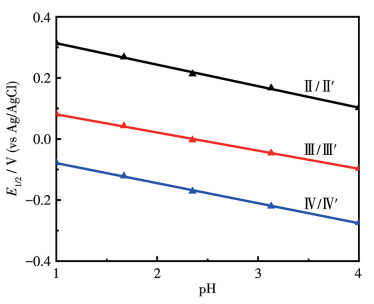
POM的氧化还原过程常伴随质子化,故其氧化还原行为具有pH依赖性。在H2SO4/Na2SO4缓冲体系(pH=1.0~4.0)中进行POM-Cu-MOF电化学行为的pH依赖性测试,结果显示,Ⅱ/Ⅱ′、Ⅲ/Ⅲ′、Ⅳ/Ⅳ′氧化还原对的电位随pH增加而负移,如图 3所示,峰电流逐渐减小。在pH为1.0~4.0的范围内,E1/2与pH呈良好线性关系,线性斜率分别为-59、-59和-55 mV,接近2e-/2H+理论值(-60 mV),证实Mo6+的3对氧化还原峰涉及双电子、双质子转移过程,说明该POM-Cu-MOF-CPE可用作pH电位传感器。在酸性条件(pH≤4.0)下Mo6+的3步氧化还原过程可表述如下:
$ \begin{aligned} \left[\mathrm{PMo}^{\mathrm{VI}}{ }_{11} \mathrm{Mo}^{\mathrm{V}} \mathrm{O}_{40}\right]^{4-}+2 \mathrm{e}^{-}+ & 2 \mathrm{H}^{+} \rightleftharpoons \\ &{\left[\mathrm{H}_2 \mathrm{PMo}^{\mathrm{VI}}{}_9 \mathrm{Mo}^{\mathrm{V}}{ }_3 \mathrm{O}_{40}\right]^{4-}} \end{aligned} $ (1) $ \begin{aligned} \left[\mathrm{H}_2 \mathrm{PMo}^{\mathrm{VI}}{ }_9 \mathrm{Mo}^{\mathrm{V}}{ }_3 \mathrm{O}_{40}\right]^{4-}+2 &\mathrm{e}^{-}+2 \mathrm{H}^{+} \rightleftharpoons \\ &{\left[\mathrm{H}_4 \mathrm{PMo}^{\mathrm{VI}}{ }_7 \mathrm{Mo}^{\mathrm{V}}{ }_5 \mathrm{O}_{40}\right]^{4-}} \end{aligned} $ (2) $ \begin{aligned} \left[\mathrm{H}_4 \mathrm{PMo}^{\mathrm{VI}}{ }_7 \mathrm{Mo}^{\mathrm{V}}{ }_5 \mathrm{O}_{40}\right]^{4-}+2 &\mathrm{e}^{-}+2 \mathrm{H}^{+} \rightleftharpoons \\ &{\left[\mathrm{H}_6 \mathrm{PMo}^{\mathrm{VI}}{ }_5 \mathrm{Mo}^{\mathrm{V}}{ }_7 \mathrm{O}_{40}\right]^{4-}} \end{aligned} $ (3) 图 3
2.4 POM-Cu-MOF的电催化行为
2.4.1 对水溶液中IO3-的电化学检测
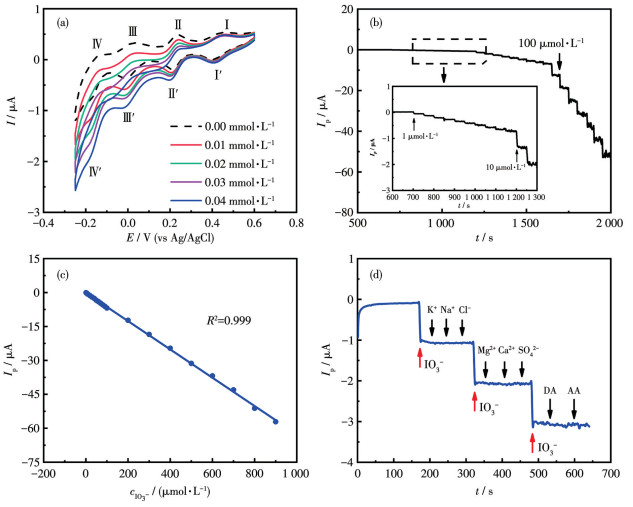
在0.5 mol·L-1 Na2SO4+0.1 mol·L-1 H2SO4的电解液中使用POM-Cu-MOF-CPE检测水溶液中的IO3-,测试范围为-0.25~0.60 V,扫描速率为60 mV·s-1。如图 4a所示,随着IO3-浓度的增加,Ⅳ/Ⅳ′氧化还原对的峰值电流增大,表明POM-Cu-MOF-CPE对IO3-具有稳定有效的催化还原活性。通过CV曲线确定了POM-Cu-MOF-CPE的电催化还原电位(-0.16 V),并将其作为安培检测IO3-的最佳电位。图 4b展示了POM-Cu-MOF-CPE对不同浓度IO3-的安培响应结果。当向搅拌中的Na2SO4/H2SO4缓冲液中加入IO3-时,在最佳电位-0.16 V(Ⅳ峰)下可观察到电流呈现动态阶梯状响应并快速达到稳态,且电流值(绝对值)随IO3-的持续加入而增大。这可能归因于IO3-从溶液到POM-Cu-MOF-CPE表面的快速扩散,以及POM-Cu-MOF-CPE中电子转移速率的提升。图 4c展示了IO3-浓度(
,1 μmol·L-1~0.9 mmol·L-1)与峰电流(Ip)的关系。如图所示,POM-Cu-MOF-CPE用于IO3-检测的浓度线性范围为1 μmol·L-1~0.9 mmol·L-1,加入的IO3-浓度与响应电流的拟合曲线符合方程:$ {c}_{\text{IO}_{3}^{-}} $ =-0.062 6Ip-0.092 6(R2=0.999)。按照公式2~4计算得到检出限(LOD)为0.102 2 μmol·L-1:$ {c}_{\text{IO}_{3}^{-}} $ $ \text { LOD }=3 \sigma / k $ (4) 其中,σ表示空白样品平行测定的标准偏差,k表示校准曲线的斜率。
图 4
图 4. (a) POM-Cu-MOF-CPE电催化还原不同浓度IO3-的CV曲线; (b) 在电解液中连续加入IO3-的过程中POM-Cu-MOF-CPE的安培响应曲线(插图: 相应的放大曲线)及(c) 相应的Ip-曲线; (d) POM-Cu-MOF-CPE加入各种干扰物及IO3-时的Ip-t曲线Figure 4. (a) CV curves of POM-Cu-MOF-CPE for electrocatalytic reduction of IO3- at different concentrations; (b) Amperometric response curves of POM-Cu-MOF-CPE during successive additions of IO3- into the electrolyte (inset: the corresponding magnified curve) and (c) the corresponding Ip-plot; (d) Ip-t curves of POM-Cu-MOF-CPE upon addition of various interfering substances and IO3-在常见干扰物(如K+、Na+、Cl-、Mg2+、Ca2+、SO42-、AA、DA)存在下,监测了POM-Cu-MOF-CPE对IO3-的电流响应,如图 4d所示。电流-时间响应是在连续添加干扰物(1 mmol·L-1)后实现的,当加入干扰物时,电流无变化,而一段时间后加入IO3-(30 μmol·L-1),电流立刻出现明显变化。结果显示干扰物对POM-Cu-MOF-CPE检测IO3-无干扰现象,该电极对IO3-检测具有高选择性。由此可知POM-Cu-MOF-CPE电催化还原IO3-的化学反应如下:
$ \begin{aligned} & 3\left[\mathrm{H}_6 \mathrm{PMo}^{\mathrm{VI}}{ }_5 \mathrm{Mo}^{\mathrm{V}}{ }_7 \mathrm{O}_{40}\right]^{4-}+\mathrm{IO}_3{ }^{-}= \\ & \qquad\qquad\qquad 3\left[\mathrm{H}_4 \mathrm{PMo}^{\mathrm{VI}}{ }_7 \mathrm{Mo}^{\mathrm{V}}{ }_5 \mathrm{O}_{40}\right]^{4-}+\mathrm{I}^{-}+3 \mathrm{H}_2 \mathrm{O} \end{aligned} $ (5) 2.4.2 对水溶液中NO2-的电化学检测
在0.1 mol·L-1 H2SO4+0.5 mol·L-1 Na2SO4的电解液中使用POM-Cu-MOF-CPE检测水溶液中的NO2-。由于该酸性条件下大部分NO2-会被质子化,而亚硝酸(HNO2)的酸解离常数为5.0×10⁻⁴,因此实际反应活性物种可能为HNO2或NO。尽管已知HNO2在酸性溶液中会发生歧化反应(式6),但反应速率较低。
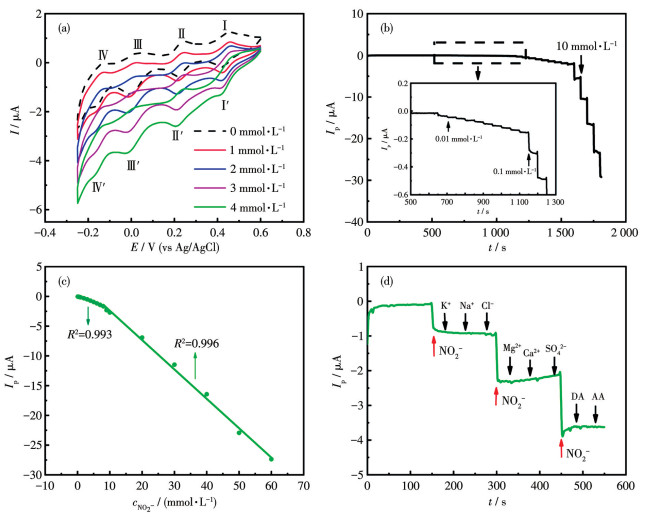
$ 3 \mathrm{H}^{+}+3 \mathrm{NO}_2{}^{-} \rightarrow \mathrm{HNO}_3+2 \mathrm{NO}+\mathrm{H}_2 \mathrm{O} $ (6) 如图 5a所示,随着NO2-的加入,4对氧化还原峰的峰电流显著增加,而峰电位保持不变,Ⅳ/Ⅳ′氧化还原对的峰值电流变化最大,这表明[H6PMo5ⅥMo7ⅤO40]4-对NO2-具有电催化还原活性。
图 5
图 5. (a) POM-Cu-MOF-CPE电催化还原不同浓度NO2-的CV曲线(扫描速率: 60 mV·s-1); (b)在电解液中连续加入NO2-过程中POM-Cu-MOF-CPE的安培响应曲线(插图: 相应的放大曲线)及(c) 相应的Ip-曲线; (d) POM-Cu-MOF-CPE加入各种干扰物及NO2-时的Ip-t曲线Figure 5. (a) CV curves of POM-Cu-MOF-CPE for electrocatalytic reduction of IO3- at different concentrations; (b) Amperometric response curves of POM-Cu-MOF-CPE during successive additions of NO2- into the electrolyte (inset: the corresponding magnified curve) and (c) the corresponding Ip-plot; (d) Ip-t curves of POM-Cu-MOF-CPE upon addition of various interfering substances and NO2-当向搅拌的Na2SO4/H2SO4缓冲溶液中加入NO2-时,POM-Cu-MOF-CPE在最佳电位-0.16 V(Ⅳ峰)下电流呈现动态阶梯状响应并快速达到稳态,且电流随NO2-的持续加入而增大,如图 5b所示。图 5c展示了NO2-浓度(
,0.1~60 mmol·L-1)与对应Ip的关系。如图所示,POM-Cu-MOF-CPE用于NO2-检测的线性范围为0.1~8 mmol·L-1,加入的NO2-浓度与响应电流的拟合曲线符合方程:$ {c}_{\text{NO}_{2}^{-}} $ =-0.202Ip+0.037(R2=0.993),根据式4计算得到LOD为2.74 μmol·L-1。NO2-检测的线性范围为8~60 mmol·L-1,加入的NO2-浓度与响应电流的拟合曲线符合方程:$ {c}_{\text{NO}_{2}^{-}} $ = -0.494Ip+2.548(R2=0.996)。在常见干扰物(如K+、Na+、Cl-、Mg2+、Ca2+、SO42-、AA、DA)存在下,监测了POM-Cu-MOF-CPE对NO2-的电流响应,如图 5d所示。电流-时间响应是在连续添加干扰物(1 mmol·L-1)后实现的,加入NO2-的时间间隔为150 s。结果显示,干扰物对POM-Cu-MOF-CPE检测NO2-的无干扰现象,表明在干扰分析物存在的情况下,POM-Cu-MOF-CPE对NO2-具有高的灵敏度和选择性。NO2-可能通过与POM阴离子反应被瞬间还原为NO,当HNO2接触到POM-Cu-MOF-CPE表面时,生成的[H6PMo5ⅥMo7ⅤO40]4-进一步被氧化,从而促进了对NO2-还原的催化作用:$ {c}_{\text{NO}_{2}^{-}} $ $ \mathrm{HNO}_2+\mathrm{H}^{+} \rightarrow \mathrm{NO}^{+}+\mathrm{H}_2 \mathrm{O} $ (7) $ \mathrm{NO}^{+}+\mathrm{e}^{-} \rightarrow \mathrm{NO} $ (8) $ \begin{aligned} & {\left[\mathrm{H}_6 \mathrm{PMo}^{\mathrm{VI}}{ }_5 \mathrm{Mo}^{\mathrm{V}}{ }_7 \mathrm{O}_{40}\right]^{4-}+2 \mathrm{HNO}_2=} \\ & \qquad\qquad 2 \mathrm{NO} \uparrow+2 \mathrm{H}_2 \mathrm{O}+\left[\mathrm{H}_4 \mathrm{PMo}^{\mathrm{VI}}{ }_7 \mathrm{Mo}^{\mathrm{V}}{ }_5 \mathrm{O}_{40}\right]^{4-} \end{aligned} $ (9) 2.4.3 对水溶液中Cr2O72-的电化学检测
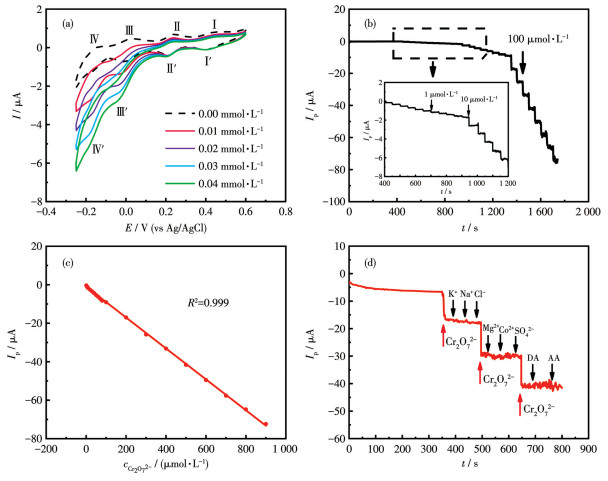
在含有0.5 mol·L-1 Na2SO4+0.1 mol·L-1 H2SO4的溶液中,通过加入不同浓度的Cr2O72-对POM-Cu-MOF-CPE进行CV测试。图 6a展示了POM-Cu-MOF-CPE对Cr2O72-的电催化还原作用。随着Cr2O72-浓度的增加,Ⅳ/Ⅳ′氧化还原对的阴极峰值电流增大,表明POM-Cu-MOF-CPE对Cr2O72-具有稳定有效的电催化还原活性。通过CV曲线确定了电催化还原电位(-0.16 V),并将其作为安培检测Cr2O72-的最佳电位。图 6b展示了POM-Cu-MOF-CPE对不同浓度Cr2O72-的安培响应结果。当向搅拌的Na2SO4/H2SO4缓冲溶液中加入Cr2O72-时,在最佳电位-0.16 V下可观察到电流呈现动态阶梯状响应并快速达到稳态,且电流随Cr2O72-的持续加入而增大。图 6c展示了Cr2O72-的浓度(
,1 μmol·L-1~0.9 mmol·L-1)与对应Ip的关系。如图所示,POM-Cu-MOF-CPE检测Cr2O72-的浓度线性范围为1 μmol·L-1~0.9 mmol·L-1,拟合曲线符合方程:$ {c}_{\text{Cr}_{2}\text{O}_{7}^{2-}} $ =-0.080 3Ip-0.956(R2=0.999)。根据式4计算得到LOD为0.021 6 μmol·L-1。在常见干扰物(如K+、Na+、Cl-、Mg2+、Ca2+、SO42-、AA、DA)存在下,监测了POM-Cu-MOF-CPE对Cr2O72-的电流响应,如图 6d所示。电流-时间响应是在连续添加干扰物(1 mmol·L-1)后实现的,结果显示无干扰现象,表明在干扰分析物存在的情况下,POM-Cu-MOF-CPE对Cr2O72-具有高选择性。由此可知电催化还原Cr2O72-的化学反应如下:$ {c}_{\text{Cr}_{2}\text{O}_{7}^{2-}} $ $ \begin{aligned} & 3\left[\mathrm{H}_6 \mathrm{PMo}^{\mathrm{VI}}{ }_5 \mathrm{Mo}^{\mathrm{V}}{ }_7 \mathrm{O}_{40}\right]^{4-}+\mathrm{Cr}_2 \mathrm{O}_7{ }^{2-}+8 \mathrm{H}^{+}= \\ & \qquad\quad 3\left[\mathrm{H}_4 \mathrm{PMo}^{\mathrm{VI}}{ }_7 \mathrm{Mo}^{\mathrm{V}}{ }_5 \mathrm{O}_{40}\right]^{4-}+2 \mathrm{Cr}^{3+}+7 \mathrm{H}_2 \mathrm{O} \end{aligned} $ (10) 图 6
图 6. (a) POM-Cu-MOF-CPE电催化还原不同浓度Cr2O72-的CV曲线(扫描速率: 60 mV·s-1); (b) 在电解液中连续加入Cr2O72-过程中POM-Cu-MOF-CPE的安培响应曲线(插图: 相应的放大曲线)及(c) 相应的Ip-曲线; (d) POM-Cu-MOF-CPE加入各种干扰物及Cr2O72-时的Ip-t曲线Figure 6. (a) CV curves of POM-Cu-MOF-CPE for electrocatalytic reduction of Cr2O72- at different concentrations; (b) Amperometric response curves of POM-Cu-MOF-CPE during successive additions of NO2- into the electrolyte (inset: the corresponding magnified curve) and (c) the corresponding Ip-plot; (d) Ip-t curves of POM-Cu-MOF-CPE upon addition of various interfering substances and Cr2O72-将POM-Cu-MOF-CPE检测IO3-、NO2-、Cr2O72-的线性范围及LOD与其他文献报道进行对比,相关数据汇总于表 1[29-37]。
表 1
表 1 不同材料修饰电极检测IO3-、NO2-、Cr2O72-的性能对比Table 1. Comparison of electrochemical properties of different material-modified electrodes toward IO3-, NO2-, and Cr2O72- detectionElectrode Analyte Linear range LOD Ref. Ag/PMo12/PBz-modified electrode IO3- 0-12 mmol·L-1 1.45 μmol·L-1 [29] RuON-GCE 1.5-518.3 μmol·L-1 0.9 μmol·L-1 [30] RuOHCF/GC 5-3 200 μmol·L-1 1 μmol·L-1 [31] This work 1-900 μmol·L-1 0.102 2 μmol·L-1 Au-NPs electrode NO2- 0.37-10 mmol·L-1 0.11 mmol·L-1 [32] Graphene and multiwall carbon nanotubes hybrid materials electrode 0.75-6.06 mmol·L-1 25 μmol·L-1 [33] Polyaniline grafted nanodiamond 0.005-3 mmol·L-1 16 μmol·L-1 [34] This work 0.1-60 mmol·L-1 2.74 μmol·L-1 Poly-Fe modified GCE Cr2O72- 1 μmol·L-1-2 mmol·L-1 0.138 μmol·L-1 [35] E-ION sensor 0.5-10 μmol·L-1 0.5 μmol·L-1 [36] Graphite-epoxy sensor 1-1 000 μmol·L-1 0.63 μmol·L-1 [37] This work 1-900 μmol·L-1 0.021 6 μmol·L-1 2.5 导电性能
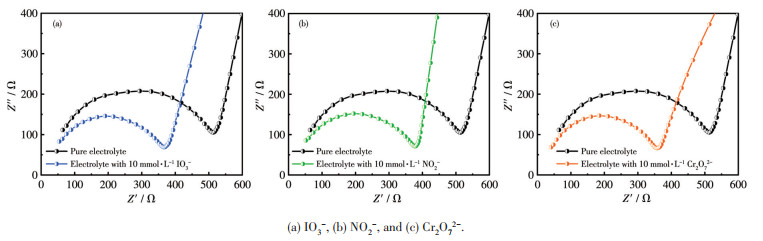
为了进一步探究POM-Cu-MOF-CPE对IO3-、NO2-、Cr2O72-三种离子电催化还原的机理,分别在加入待测离子前后进行交流阻抗测试。如图 7所示,在电解液中加入待检测物质(IO3-、NO2-、Cr2O72-)之后,电阻降低,说明POM-Cu-MOF-CPE电极界面电子转移速率加快,电催化效果更显著。
图 7
3. 结论
POM-Cu-MOF-CPE实现了对水溶液中IO3-、Cr2O72-、NO2-三种典型污染离子的高灵敏、高稳定痕量检测,充分发挥了该Keggin型POM-Cu-MOF的电子传递快、电催化活性强、酸性稳定性高的优势。电化学阻抗分析进一步表明,此电极界面电子转移速率快,导电性能优异,且在常见干扰物存在下仍保持稳定电流响应,适用于地表水、饮用水等复杂水体中多种污染物的快速检测。
-
-
[1]
SHABRINA A N, NURSA'ADAH E, FIRDAUS M L. Quantitative detection of hexavalent chromium in aquatic environments using digital image colorimetry and the green chemistry approach[J]. ACS Sustain. Chem. Eng., 2025, 13: 9177-9185 doi: 10.1021/acssuschemeng.5c02305
-
[2]
LEW T T S, KOMAN V B, SILMORE K S, SEO J S, GORDIICHUK P, KWAK S Y, PARK M, ANG M C Y, KHONG D T, LEE M A, CHAN-PARK M B, CHUA N H, STRANO M S. Real-time detection of wound-induced H2O2 signalling waves in plants with optical nanosensors[J]. Nat. Plants., 2020, 6(4): 404-415 doi: 10.1038/s41477-020-0632-4
-
[3]
KWEDI-NSAH L M, KOBAYASHI T. Sonochemical nitrogen fixation for the generation of NO2- and NO3- ions under high-powered ultrasound in aqueous medium[J]. Ultrason. Sonochem., 2020, 66: 105051 doi: 10.1016/j.ultsonch.2020.105051
-
[4]
SNYDER S A, VANDERFORD B J, REXING D J. Trace analysis of bromate, chlorate, iodate, and perchlorate in natural and bottled waters[J]. Environ. Sci. Technol., 2005, 39(12): 4586-4593 doi: 10.1021/es047935q
-
[5]
BAGHERI H, HAJIAN A, REZAEI M, SHIRZADMEHR A. Composite of Cu metal nanoparticles-multiwall carbon nanotubes-reduced graphene oxide as a novel and high performance platform of the electrochemical sensor for simultaneous determination of nitrite and nitrate[J]. J. Hazard. Mater., 2017, 324: 762-772 doi: 10.1016/j.jhazmat.2016.11.055
-
[6]
LIAO J, WU Y, CHEN X, YU H, LIN Y, HUANG K, ZHANG J, ZHENG C. Light-triggered oxidative activity of chromate at neutral pH: A colorimetric system for accurate and on-site detection of Cr(Ⅵ) in natural water[J]. J. Hazard. Mater., 2022, 440: 129812 doi: 10.1016/j.jhazmat.2022.129812
-
[7]
WANG N, WANG R Q, ZHU Y. A novel ion chromatography cycling-column-switching system for the determination of low-level chlorate and nitrite in high salt matrices[J]. J. Hazard. Mater., 2012, 235-236: 123-127
-
[8]
HAMILTON E M, YOUNG S D, BAILEY E H, HUMPHREY O S, WATTS M J. Online microdialysis-high-performance liquid chromatography-inductively coupled plasma mass spectrometry (MD-HPLC-ICP-MS) as a novel tool for sampling hexavalent chromium in soil solution[J]. Environ. Sci. Technol., 2021, 55: 2422-2429 doi: 10.1021/acs.est.0c08140
-
[9]
KODAMATANI H, KUBO S, TAKEUCHI A, KANZAKI R, TOMIYASU T. Sensitive detection of nitrite and nitrate in seawater by 222 nm UV-irradiated photochemical conversion to peroxynitrite and ion chromatography-luminol chemiluminescence system[J]. Environ. Sci. Technol., 2023, 57: 5924-5933 doi: 10.1021/acs.est.3c00273
-
[10]
HE H, SUN D W, WU Z, PU H, WEI Q. On-off-on fluorescent nanosensing: Materials, detection strategies and recent food applications[J]. Trends Food Sci. Technol., 2022, 119: 243-256 doi: 10.1016/j.tifs.2021.11.029
-
[11]
SUN Y, XU H W, ZHOU D Q, XIA C Y, LIU W Q, CUI A, WANG Z Y, ZHENG W, SHAN G Y, HUANG J P, WANG X. A portable integrated electrochemical sensing system for on-site nitrite detection in food[J]. Small, 2024, 20: 2309357 doi: 10.1002/smll.202309357
-
[12]
MAHAPATRA S, KUMARI R, CHANDRA P. Fabrication of a laser-directed electrochemical paper analytical device and its deployment for multi-functional electrochemical sensing[J]. Chem. Eng. J., 2024, 486: 150232 doi: 10.1016/j.cej.2024.150232
-
[13]
YANG Q Y, WAN C Q, WANG Y X, SHEN X F, PANG Y H. Bismuth-based metal-organic framework peroxidase-mimic nanozyme: Preparation and mechanism for colorimetric-converted ultra-trace electrochemical sensing of chromium ion[J]. J. Hazard. Mater., 2023, 451: 131148 doi: 10.1016/j.jhazmat.2023.131148
-
[14]
SUN C Y, ZHU M C, ZHANG A G, WANG S Y, LU Y, LIU S X. Highly stable catalysts with adamantane topology based on a mixed-valence V16 cluster for the aerobic epoxidation of olefins[J]. Inorg. Chem., 2026, 65(16): 8871-8879 doi: 10.1021/acs.inorgchem.5c05986
-
[15]
BAI X, HAN X, WANG Y X, ZHANG A G, YANG Y L, LU Y, LIU S X. Two 3D two-fold interpenetrated dia-like polyoxometalate-based metal-organic frameworks: Synthesis and sulfide selective oxidation activity[J]. Inorg. Chem., 2023, 62(33): 13221-13229 doi: 10.1021/acs.inorgchem.3c01393
-
[16]
ZHU M C, BAI X, YANG Y L, ZHANG A G, WANG S Y, SUN C Y, LU Y, LI B, LIU S X. The stepwise construction of polyoxovanadate-based Zn-MOF nanoparticles with Lewis acid sites for the one-pot synthesis of N-heterocycles in air[J]. Green Chem., 2025, 27(48): 15753-15765 doi: 10.1039/D5GC04571A
-
[17]
LI L, YU Y T, ZHANG N N, LI S H, ZENG J G, HUA Y, ZHANG H. Polyoxometalate (POM)-based crystalline hybrid photochromic materials[J]. Coord. Chem. Rev., 2024, 500: 215526 doi: 10.1016/j.ccr.2023.215526
-
[18]
YANG Y L, GUO K K, BAI X, ZHU M C, WANG S Y, LIU S X. Water-stable perovskite nanotube array with enhanced transport of charge carriers induced by functionalized polyoxometalate for the highly efficient photoreduction of uranium(Ⅵ)[J]. Inorg. Chem. Front., 2025, 12(1): 261-272 doi: 10.1039/D4QI02393E
-
[19]
TANG W S, ZhANG L N, QIU T Y, TAN H Q, WANG Y H, LIU W, LI Y G. Efficient conversion of biomass to formic acid coupled with low energy consumption hydrogen production from water electrolysis[J]. Angew. Chem.‒Int. Edit., 2023, 62(30): e202305843
-
[20]
LV J Q, LI B, LIU Q Q, GAO Z X, LANG Z L, LIANG S, LI Y Q, ZANG H Y. Designed tetranuclear iron-oxo clusters with redox activity for high-performance lithium storage[J]. Angew. Chem.‒Int. Edit., 2023, 62(30): e202306193
-
[21]
QI Y, ChEN Y N, WANG J, WANG Q W, WANG X H. Hydrolysis of cellulose by polyoxometalate pickering interfacial catalysts bearing a flexible surface and hard core[J]. ACS Sustain. Chem. Eng., 2025, 13(2): 1031-1041 doi: 10.1021/acssuschemeng.4c08961
-
[22]
REN W B, SUN S, GAO Z X, LI B, CHEN X Y, LIU Q Q, ZANG H Y. Synthesis of phosphovanadate-based porous inorganic frameworks with high proton conductivity[J]. Inorg. Chem., 2023, 62(49): 20506-20512 doi: 10.1021/acs.inorgchem.3c03703
-
[23]
CHU J, LIU Z L, YU J, CHENG L Q, WANG H G, CUI F Z, ZHU G S. Boosting H+ storage in aqueous zinc ion batteries via integrating redox-active sites into hydrogen-bonded organic frameworks with strong π-π stacking[J]. Angew. Chem.‒Int. Edit., 2024, 136(3): e202314411
-
[24]
ZHU H T, MA Y Y, DU J, TAN H Q, WANG Y H, LI Y G. Efficient electrochemical detection of hydrogen peroxide based on silver-centered Pressler-type polyoxometalate hybrids[J]. Inorg. Chem., 2022, 61(18): 6910-6918 doi: 10.1021/acs.inorgchem.2c00244
-
[25]
YIN X Y, ZHANG Y Q, MA Y Y, HE J Y, SONG H, HAN Z G. Bifunctional sensors based on phosphomolybdates for detection of inorganic hexavalent chromium and organic tetracycline[J]. Inorg. Chem., 2022, 61(33): 13174-13183 doi: 10.1021/acs.inorgchem.2c02016
-
[26]
DAI L M, YOU W S, WANG E B, WU S X, SU Z M, DU Q H, ZHAO Y, FANG Y. Two novel one-dimensional α-Keggin-based coordination polymers with argentophilic {Ag3}3+/{Ag4}4+ clusters[J]. Cryst. Growth Des., 2009, 9(5): 2110-2116 doi: 10.1021/cg8006734
-
[27]
JI X Y, XING M, ZHU M C, BAI X, YANG Y L, ZHANG A G, LU Y, LIU S X. Rapid oxidative detoxification of mustard simulant by the multisite synergistic catalytic action of {PMo11ⅥMoⅤO40Cu8Ⅰ} units[J]. Inorg. Chem., 2024, 63: 346-352 doi: 10.1021/acs.inorgchem.3c03220
-
[28]
MOSTAFIZ B, BIGDELI S A, BANAN K, AFSHARARA H, HATAMABADI D, MOUSAVI P, HUSSAIN C M, KEÇILI R, GHORBANI-BIDKORBEH F. Molecularly imprinted polymer-carbon paste electrode (MIP-CPE)-based sensors for the sensitive detection of organic and inorganic environmental pollutants: A review[J]. Trends Environ. Anal. Chem., 2021, 32: e00144 doi: 10.1016/j.teac.2021.e00144
-
[29]
MANIVEL A, SIVAKUMAR R, ANANDAN S, ASHOKKUMAR M. Ultrasound-assisted synthesis of hybrid phosphomolybdate-polybenzidine containing silver nanoparticles for electrocatalytic detection of chlorate, bromate and iodate ions in aqueous solutions[J]. Electrocatalysis, 2012, 3: 22-29 doi: 10.1007/s12678-011-0072-z
-
[30]
CHATRAEI F, ZARE H R. Nano-scale islands of ruthenium oxide as an electrochemical sensor for iodate and periodate determination[J]. Mater. Sci. Eng. C‒Mater. Biol. Appl., 2013, 33: 721-726
-
[31]
DODEVSKA T, SHTEREV I, LAZAROVA Y, HADZHIEV D. Ruthenium oxide hexacyanoferrate as an effective electrode modifier for amperometric detection of iodate and hydrogen peroxide[J]. Acta Chim. Slov., 2020, 67: 1216-1226 doi: 10.17344/acsi.2020.6111
-
[32]
TAIB S H M, SHAMELI K, NIA P M, ETESAMI M, MIYAKE M, ALI R R, ABOUZARI-LOTF E, IZADIYAN Z. Electrooxidation of nitrite based on green synthesis of gold nanoparticles using Hibiscus sabdariffa leaves[J]. J. Taiwan Inst. Chem. Eng., 2019, 95: 616-626 doi: 10.1016/j.jtice.2018.09.021
-
[33]
HU F X, CHEN S H, WANG C Y, YUAN R, YUAN D H, WANG C. Study on the application of reduced graphene oxide and multiwall carbon nanotubes hybrid materials for simultaneous determination of catechol, hydroquinone, p-cresol and nitrite[J]. Anal. Chim. Acta, 2012, 724: 40-46 doi: 10.1016/j.aca.2012.02.037
-
[34]
RAMDANE-TERBOUCHE C A, TERBOUCHE A, DJEBBAR S, HAUCHARD D. Electrochemical sensors using modified electrodes based on copper complexes formed with Algerian humic acid modified with ethylenediamine or triethylenetetramine for determination of nitrite in water[J]. Talanta, 2014, 119: 214-225 doi: 10.1016/j.talanta.2013.10.049
-
[35]
HALDER S, CHAKRABORTY C. Fe(Ⅱ)-based metallo-supramolecular polymer nanostructures: An efficient electrode material for highly sensitive electrochemical detection and abatement of hexavalent chromium[J]. J. Environ. Chem. Eng., 2023, 11: 110183 doi: 10.1016/j.jece.2023.110183
-
[36]
KORSHOJ L E, ZAITOUNA A J, LAI R Y. Methylene blue-mediated electrocatalytic detection of hexavalent chromium[J]. Anal. Chem., 2015, 87: 2560-2564 doi: 10.1021/acs.analchem.5b00197
-
[37]
SÁNCHEZ-MORENO R A, GISMERA M J, SEVILLA M T, PROCOPIO J R. Evaluation of solid-state platforms for chromium(Ⅵ) potentiometric sensor development[J]. Sens. Actuator B‒Chem., 2010, 143: 716-723 doi: 10.1016/j.snb.2009.10.022

-
[1]
-
图 1 (a) Keggin型POM阴离子的结构示意图; (b) POM-Cu-MOF中POM阴离子与Cu+、Pz的配位结构图; (c) POM-Cu-MOF的1D链状结构; POM-Cu-MOF在1 mol·L-1 H2SO4中浸泡0、24、48 h后的(d) PXRD图和(e) FTIR谱图
Figure 1 (a) Structural diagram of Keggin-type POM anions; (b) Coordination structural diagram of POM anions with Cu+ and Pz in POM-Cu-MOF; (c) 1D chain structure of POM-Cu-MOF; (d) PXRD patterns and (e) FTIR spectra of POM-Cu-MOF after soaking in 1 mol·L-1 H2SO4 for 0, 24, and 48 h
图 4 (a) POM-Cu-MOF-CPE电催化还原不同浓度IO3-的CV曲线; (b) 在电解液中连续加入IO3-的过程中POM-Cu-MOF-CPE的安培响应曲线(插图: 相应的放大曲线)及(c) 相应的Ip-曲线; (d) POM-Cu-MOF-CPE加入各种干扰物及IO3-时的Ip-t曲线
Figure 4 (a) CV curves of POM-Cu-MOF-CPE for electrocatalytic reduction of IO3- at different concentrations; (b) Amperometric response curves of POM-Cu-MOF-CPE during successive additions of IO3- into the electrolyte (inset: the corresponding magnified curve) and (c) the corresponding Ip-plot; (d) Ip-t curves of POM-Cu-MOF-CPE upon addition of various interfering substances and IO3-
图 5 (a) POM-Cu-MOF-CPE电催化还原不同浓度NO2-的CV曲线(扫描速率: 60 mV·s-1); (b)在电解液中连续加入NO2-过程中POM-Cu-MOF-CPE的安培响应曲线(插图: 相应的放大曲线)及(c) 相应的Ip-曲线; (d) POM-Cu-MOF-CPE加入各种干扰物及NO2-时的Ip-t曲线
Figure 5 (a) CV curves of POM-Cu-MOF-CPE for electrocatalytic reduction of IO3- at different concentrations; (b) Amperometric response curves of POM-Cu-MOF-CPE during successive additions of NO2- into the electrolyte (inset: the corresponding magnified curve) and (c) the corresponding Ip-plot; (d) Ip-t curves of POM-Cu-MOF-CPE upon addition of various interfering substances and NO2-
图 6 (a) POM-Cu-MOF-CPE电催化还原不同浓度Cr2O72-的CV曲线(扫描速率: 60 mV·s-1); (b) 在电解液中连续加入Cr2O72-过程中POM-Cu-MOF-CPE的安培响应曲线(插图: 相应的放大曲线)及(c) 相应的Ip-曲线; (d) POM-Cu-MOF-CPE加入各种干扰物及Cr2O72-时的Ip-t曲线
Figure 6 (a) CV curves of POM-Cu-MOF-CPE for electrocatalytic reduction of Cr2O72- at different concentrations; (b) Amperometric response curves of POM-Cu-MOF-CPE during successive additions of NO2- into the electrolyte (inset: the corresponding magnified curve) and (c) the corresponding Ip-plot; (d) Ip-t curves of POM-Cu-MOF-CPE upon addition of various interfering substances and Cr2O72-
表 1 不同材料修饰电极检测IO3-、NO2-、Cr2O72-的性能对比
Table 1. Comparison of electrochemical properties of different material-modified electrodes toward IO3-, NO2-, and Cr2O72- detection
Electrode Analyte Linear range LOD Ref. Ag/PMo12/PBz-modified electrode IO3- 0-12 mmol·L-1 1.45 μmol·L-1 [29] RuON-GCE 1.5-518.3 μmol·L-1 0.9 μmol·L-1 [30] RuOHCF/GC 5-3 200 μmol·L-1 1 μmol·L-1 [31] This work 1-900 μmol·L-1 0.102 2 μmol·L-1 Au-NPs electrode NO2- 0.37-10 mmol·L-1 0.11 mmol·L-1 [32] Graphene and multiwall carbon nanotubes hybrid materials electrode 0.75-6.06 mmol·L-1 25 μmol·L-1 [33] Polyaniline grafted nanodiamond 0.005-3 mmol·L-1 16 μmol·L-1 [34] This work 0.1-60 mmol·L-1 2.74 μmol·L-1 Poly-Fe modified GCE Cr2O72- 1 μmol·L-1-2 mmol·L-1 0.138 μmol·L-1 [35] E-ION sensor 0.5-10 μmol·L-1 0.5 μmol·L-1 [36] Graphite-epoxy sensor 1-1 000 μmol·L-1 0.63 μmol·L-1 [37] This work 1-900 μmol·L-1 0.021 6 μmol·L-1 -
扫一扫看文章
计量
- PDF下载量: 0
- 文章访问数: 5
- HTML全文浏览量: 0

下载:
下载:
下载: