Received Date:
20 February 2026 Revised Date:
02 June 2026 Available Online:
10 October 2026
Abstract:
A microporous acs-metal-organic framework (MOF) is reported as [Fe2.9Mn0.1(μ3-OH)(L)3·xGuest] (NJTU-Bai88, NJTU-Bai=Nanjing Tech University Bai′s group; H2L=bicyclo[2.2.2]octane-1, 4-dicarboxylic acid), in which potential open metal sites (OMSs) are occupied by solvent molecules with the pore size adjusted (approximately 0.47 nm by Horváth-Kawazoe model) to be close to the kinetic diameter of C3H4 (0.476 nm) and the strong adsorption sites reduced. Interestingly, NJTU-Bai88 showed a high C3H4 adsorption uptake (27.5 cm3·g-1 at 298 K and 1 kPa) and moderate adsorption enthalpy (-58.8 kJ·mol-1).
Propylene (C3H6), another important olefin feedstock in the petrochemical industry besides ethylene, is widely used to produce polypropylene, propylene oxide, acrylonitrile, etc[1-5]. It is mainly produced through naphtha cracking or hydrocarbon fractionation, as well as propane steam cracking[4, 6-9]. However, C3H6 obtained in these processes often contains some impurities such as propyne (C3H4) or propane[10-17]. Polymer-grade purity (> 99.5%) propylene requires an impurity content (C3H4, etc.) of less than 1 μL·L-1[5, 10, 12, 16, 18-21]. At present, the main technology to remove trace amounts of C3H4 is selective hydrogenation by noble metal catalysts, which has the disadvantages of high catalyst cost, short lifespan, low efficiency, and potential secondary pollution[4, 6, 14, 22-23]. Recently, physical adsorption-based separation technology, due to its environmental friendliness and energy efficiency, has received widespread attention[4, 7, 9-12, 14, 16, 19-20, 23].
Metal-organic frameworks (MOFs), which possess tunable structures and properties, have been investigated for the trace C3H4 capture[1, 4-9, 11, 14, 18-19, 21-23]. By introducing strong adsorption sites, such as open metal sites (OMSs) (MOF-74[1], etc.) or anion pillars (SIFSIX-2-Cu-i, etc.)[5, 24], MOFs can exhibit high adsorption uptake for C3H4; however, these MOFs also usually show high adsorption enthalpies. Until now, MOFs reported for C3H4/C3H6 separation (SIFSIX-2-Cu-i[24], ZU-62[5, 7], NKMOF-1-Cu/Ni[4], Co-gallate[25], etc.) display the chemical adsorption of C3H4. Low adsorption enthalpy is preferred for the easy regeneration of MOFs, but it usually results in low adsorption uptakes for C3H4 at ultra-low pressures. It is rather difficult to achieve MOFs with both high C3H4 adsorption uptake and moderate adsorption enthalpy. Notably, designing MOFs with the pore size approaching the kinetic diameter of C3H4, an alternative way to increase the affinity of the framework toward guest molecules[26], may be beneficial to balance these two parameters. In this work, it is speculated that if OMSs are occupied by solvent molecules, strong adsorption sites in MOFs will be eliminated and pore sizes will consequently be decreased, which may be favorable to achieve the target MOFs. The acs topological MOFs based upon trinuclear [M3(μ3-OH)(COO)6] (M=Fe, Co, Mn, etc.) clusters and linear dicarboxylic acids are usually decorated by OMSs[27]. Thus, herein, based upon the trinuclear [Fe2.9Mn0.1(μ3-OH)(COO)6] cluster and bicyclo[2.2.2] octane‑1, 4-dicarboxylic acid (H2L), a new acs‑MOF, [FeⅢFe1.9Ⅱ Mn0.1Ⅱ(μ3-OH)(C10O4H12)3·xGuest] (NJTU-Bai88, NJTU-Bai=Nanjing Tech University Bai′s group), has been successfully synthesized under solvothermal conditions. Confirmed by thermogravimetric (TG) curves and elemental analysis, the coordinated N, N-dimethylformamide (DMF) molecules were still retained in activated NJTU‑Bai88, occupying the potential OMSs. Very interestingly, its HK pore size was 0.47 nm, which is very close to the kinetic diameter of the C3H4 molecule. NJTU‑Bai88 exhibited high C3H4 adsorption uptake at 1 kPa, large C3H4/C3H6 and C3H4/C3H8 selectivities, and a moderate C3H4 adsorption enthalpy. This may be attributed to the effective synergy of suitable pore size and nonpolar pore surfaces.
1.
Experimental
1.1
Synthesis of [FeⅢFeⅡMnⅡ(μ3‑OH)(COO)6] cluster
A solution of sodium acetate (25.4 g, 0.31 mol) in 40 mL of H2O was mixed with iron(Ⅲ) nitrate nonahydrate (8.0 g, 0.02 mol) and manganese nitrate tetrahydrate (25.1 g, 0.10 mol) in 30 mL of H2O. The mixture was stirred at room temperature overnight. The black-brown precipitate obtained was filtered and washed alternately with water and ethanol. Yield: 70 %. The results of ICP showed that the molar ratio of Fe to Mn was 2∶1.
1.2
Synthesis of NJTU-Bai88
A solution of [Fe2Mn(μ3‑OH)(COO)6] (8.0 mg, 0.018 mmol) in 0.5 mL of DMF was mixed with H2L (8.0 mg, 0.04 mmol) in 1.5 mL of DMF. To this was added 0.1 mL of acetic acid and 0.08 mL of trifluoroacetic acid with stirring. The mixture was sealed in a Pyrex tube and heated to 140 ℃ for 48 h. The reddish-brown block crystals obtained were filtered and washed with DMF. Yield: 40 %. ICP analysis of the crystal resulted in a molar ratio of Fe to Mn of 27∶1. According to this molar ratio and the total number of metal ions in the trinuclear [Fe27xMnx(μ3-OH)(COO)6] cluster as 3, it can be calculated that x=0.107 and 27x=2.89, which gave the estimated molecular formula of the trinuclear cluster as [Fe2.9Mn0.1(μ3-OH)(COO)6]. Combined with the single-crystal X-ray diffraction data, TG, and charge balancing, the molecular formula of NJTU-Bai88 was determined to be [FeⅢFe1.9ⅡMn0.1Ⅱ(μ3-OH)(C10H12O4)3·xGuest].
1.3
Activation of NJTU-Bai88
The as-synthesized sample of NJTU-Bai88 was activated by heating under vacuum conditions, with gradient heating at 80, 100, 120, and 140 ℃ for 3 h at each temperature to give the activated NJTU‑Bai88, [Fe2.9Mn0.1(μ3‑OH)(C10O4H12)3]. Elemental analysis Calcd. for C39H68N3Fe2.9Mn0.1O21 [Fe2.9Mn0.1(μ3‑OH)(C10O4H12)3(DMF)3·5H2O](%): C 43.28, H 6.33, N 3.88; Found(%): C 43.12, H 5.92, N 3.48. The water in the pores was due to moisture absorbed from the air during experimental operations. After thoroughly removing the coordinated DMF molecules under high temperature and vacuum, powder X‑ray diffraction (PXRD) patterns indicated that the framework had severely collapsed and was almost amorphous. In addition, the CO2 adsorption capacity at 195 K was very low, indicating that the sample does not have permanent porosity after complete activation.
1.4
Single-crystal X-ray diffraction analysis
A single crystal of NJTU-Bai88 with the size of 0.080 mm×0.040 mm×0.030 mm was selected and mounted on a CrysAlisPro 1.171.42.95a (Rigaku OD, 2023). Single-crystal X-ray diffraction data were measured at about 300 K using graphite-monochromated Mo Kα radiation (λ=0.071 073 nm) with the absorption correction type of multi-scan. Data reduction was performed with the CrysAlisPro 1.171.42.95a (Rigaku OD, 2023). The structures were solved by direct methods and refined with the full-matrix least-squares technique using the Olex package. Due to the very low content of Mn, inducing its ADP to be N.P.D., the occupancy rate of the metal atom in the structure was refined according to the fact that the sites of the metal atom were all occupied by the Fe atom. Non-hydrogen atoms were refined with anisotropic displacement parameters during the final cycles. Organic hydrogen atoms were placed in calculated positions with isotropic displacement parameters set to 1.2Ueq of the attached atom. The unit cell includes a large region of disordered solvent molecules, which could not be modelled as discrete atomic sites. We employed PLATON/SQUEEZE to calculate the diffraction contribution of the solvent molecules and, thereby, to produce a set of solvent-free diffraction intensities; structures were then refined again using the data generated by the SHELXTL package. The crystallographic data and structure refinement parameters are listed in Table S1 (Supporting information).
2.
Results and discussion
2.1
Crystal structure
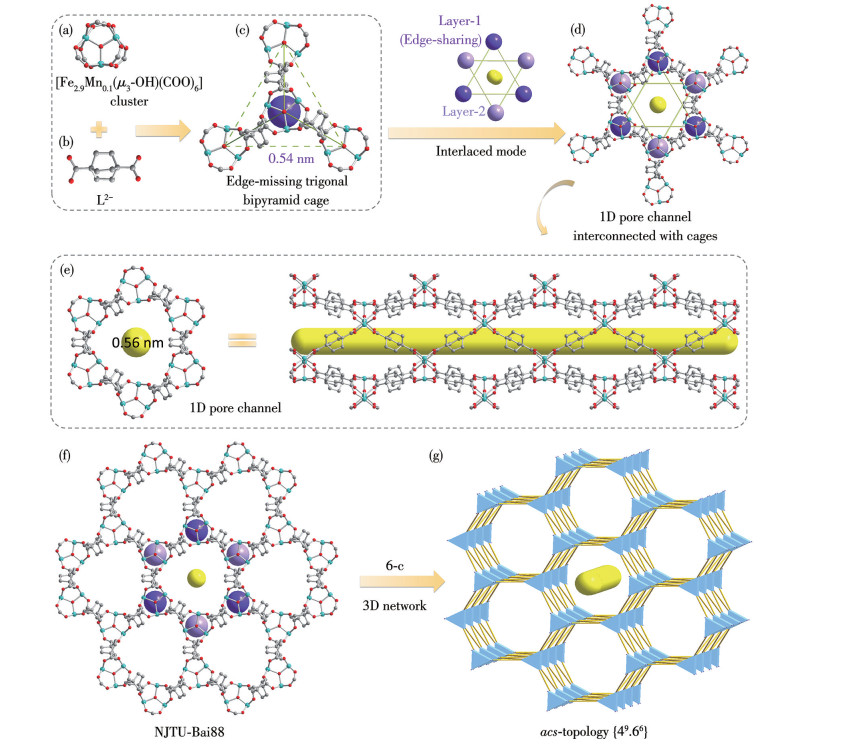
Solvothermal reaction of [Fe2Mn(μ3‑OH)(COO)6] cluster with bicyclo[2.2.2]octane-1, 4-dicarboxylic acid (H2L) in DMF containing acetic acid and trifluoroacetic acid afforded a high yield of reddish-brown block crystals of NJTU-Bai88. Single-crystal X-ray diffraction reveals that NJTU‑Bai88 crystallizes in hexagonal space group P62c. In the structure of NJTU‑Bai88, each metal ion is coordinated by four O atoms from four L2- ions, one O atom from μ3-OH-, and one O atom from a DMF molecule, respectively (Fig.1a). Three metal ions are bridged by a μ3‑OH- and six carboxyl groups from six ligands, forming a triangular-prismatic trinuclear [Fe2.9Mn0.1(μ3-OH)(COO)6] cluster (Fig.1a).
Figure 1
Figure 1.
(a) [Fe2.9Mn0.1(μ3-OH)(COO)6] cluster; (b) Ligand L2-; (c) Edge-missing trigonal bipyramid cage with the pore size of 0.54 nm; (d) Six edge-missing trigonal bipyramidal cages at the vertices of two interlaced triangles in different layers, respectively, surrounding a 1D pore channel; (e) 1D pore channel with a pore size of approximately 0.56 nm; (f) Framework and (g) topology of NJTU-Bai88
The gray, red, aqua, and blue spheres represent C, O, Fe/Mn, and N atoms, respectively.
Five trinuclear [Fe2.9Mn0.1(μ3-OH)(COO)6] clusters are connected by six L2- ions, leading to the formation of an edge-missing triangular bipyramidal cage with a pore size of approximately 0.54 nm (Fig.1a‑1c). Six edge-missing triangular bipyramidal cages, located at the vertices of two interlaced triangles in different layers, respectively, are connected with each other by sharing the edges, forming the 1D pore channel with a pore size of approximately 0.56 nm (Fig.1d, 1e, and S2). Moreover, the edge-missing triangular bipyramidal cages are interconnected with the 1D pore channel (Fig.S2). Then, through the connection of L2-, different 1D pore channels are stacked with each other in a hexagonal mode in the cross-sectional direction, which results in the generation of the 3D framework of NJTU-Bai88 (Fig.1f).
To better understand the structure, the trinuclear [Fe2.9Mn0.1(μ3-OH)(COO)6] cluster is simplified as a 6-connected node, and the L2- is viewed as a 2-connected linker; the framework of NJTU-Bai88 can be simplified to a 6-connected acs topology with the Schläfli symbol of (49·66 (Fig.1g)). The total potential solvent accessible volume in desolvated NJTU-Bai88 is about 49.0% as determined by the PLATON/SOLV program, giving a calculated density of 0.983 g·cm-3 for the desolvated framework.
2.2
Permanent porosity and selective adsorption
The purity of the bulk sample of NJTU-Bai88 and the integrity of the framework of the activated sample were confirmed by PXRD (Fig.S4). The peaks of PXRD patterns of the as-synthesized and activated samples are consistent with those of the simulated PXRD pattern. In addition, the thermal stability and activation of the NJTU-Bai88 sample were investigated through thermogravimetric analysis. No significant weight loss was observed in the range of 110-220 ℃, which indicates the complete removal of solvent molecules packed in the pores of the NJTU-Bai88 sample, with the coordinating DMF molecules remaining (Fig.S5).
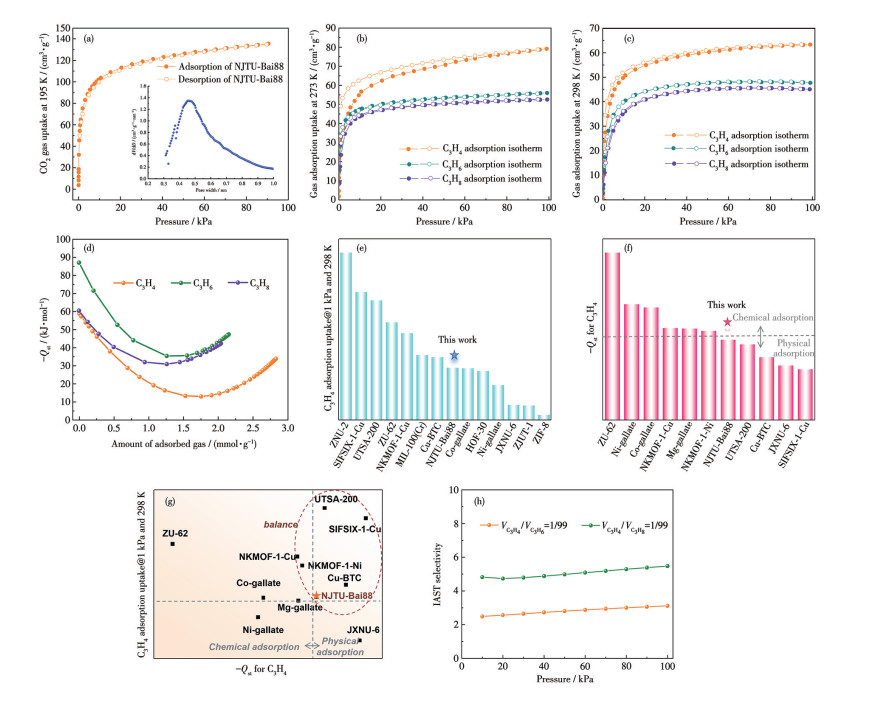
To investigate the permanent porosity of NJTU-Bai88, its CO2 adsorption isotherm was measured at 195 K and 0-100 kPa. The CO2 adsorption isotherm exhibited the Ⅰ-type adsorption isotherm without hysteresis on the desorption isotherm (Fig.2), indicating that NJTU-Bai88 is a microporous material. The Langmuir and Brunauer-Emmett-Teller (BET) surface areas were 758.5 and 554 m2·g-1, respectively. The HK pore size estimated from the CO2 adsorption isotherm at 195 K was about 0.47 nm, which was close to the pore size determined from the crystal structure (Fig.S1b and 3b).
Figure 2
Figure 2.
(a) CO2 adsorption isotherms of NJTU-Bai88 at 195 K; C3H4, C3H6 and C3H8 adsorption isotherms for NJTU-Bai88 at (b) 273 K and (c) 298 K; (d) C3H4, C3H6 and C3H8 adsorption enthalpies; Comparison of (e) C3H4 adsorption uptakes at 1 kPa and 298 K, (f) C3H4 adsorption enthalpies, and (g) both C3H4 adsorption capacities and enthalpies of NJTU-Bai88 with reported representative MOFs; (h) IAST (ideal adsorbed solution theory) predicted selectivities of NJTU-Bai88 for C3H4/C3H6 (volume ratio of 1/99) and C3H4/C3H8 (1/99) mixtures at 298 K
Panels e-g are drawn according to the data in Table S3.
The permanent porosity of NJTU-Bai88 prompted us to investigate its selective C3H4/C3H6 and C3H4/C3H8 adsorption performances. Gas adsorption isotherms of C3H4, C3H6, and C3H8 were measured under 0-100 kPa at 273 and 298 K (Fig.2b and 2c). In the low-pressure range, especially at 298 K, the C3H4 adsorption of NJTU-Bai88 increased rapidly, and the adsorption uptake reached 27.5 cm3·g-1 at 1 kPa. As shown in Fig.2e and Table S3, although this was lower than the values of benchmark MOFs, ZNU-2 (87.4 cm3·g-1)[7] and UTSA-200 (67.0 cm3·g-1)[1], it was close to those of representative MIL-100(Cr) (34.0 cm3·g-1)[1] and Cu-BTC (32.9 cm3·g-1)[1], and even much higher than the data of well-known ZIF-8 (2.9 cm3·g-1)[1]. This indicates that the framework of NJTU-Bai88 exhibits a strong affinity for C3H4 gas molecules. Differently, the adsorption of C3H6 and C3H8 increased slightly more slowly, and the adsorption uptakes for C3H6 and C3H8 at 100 kPa were 47.9 and 45.3 cm3·g-1, respectively, significantly lower than that of C3H4 (63.4 cm3·g-1). Thus, NJTU‑Bai88 exhibited highly selective C3H4/C3H6 and C3H4/C3H8 adsorptions. Based upon adsorption isotherms at 273 and 298 K, the zero-loading adsorption enthalpies for C3H4, C3H6, and C3H8 of NJTU-Bai88 were calculated, using the virial equation, to be -58.8, -87.0, and -60.5 kJ·mol-1, respectively (Fig.2d). This demonstrates that the affinity of the framework of NJTU-Bai88 for the C3H6 or C3H8 molecule is slightly higher than that for the C3H4 molecule. Consequently, the selective C3H4/C3H6 and C3H4/C3H8 adsorptions of NJTU-Bai88 are primarily attributed to the effective synergy of suitable pore size and nonpolar pore surface. Very interestingly, the C3H4 adsorption enthalpy of NJTU‑Bai88 belongs to the physical adsorption range and is even lower than those of MOFs with comparable adsorption uptakes, such as Co-gallate (-82.1 kJ·mol-1)[25] and Mg‑gallate (-66.8 kJ·mol-1)[25]. NJTU‑Bai88 can achieve a certain balance between high low‑pressure C3H4 adsorption uptake and moderate adsorption enthalpy, which is rare in MOFs for trace C3H4 capture (Fig.2g and Table S3).
To evaluate the selective C3H4/C3H6 and C3H4/C3H8 adsorptions of NJTU-Bai88, the selectivities for C3H4/C3H6 (molar ratio of 1/99) and C3H4/C3H8 (1/99) gas mixtures were calculated using IAST (ideal adsorbed solution theory), based upon the single-component gas adsorption isotherms of C3H4, C3H6, and C3H8 at 298 K (Fig.2h). At 100 kPa, the IAST selectivities of C3H4/C3H6 (1/99) and C3H4/C3H8 (1/99) reached 3.1 and 5.5, respectively. Although the selectivity for C3H4/C3H6 was lower than the values of many high-performance MOFs, it is close to those of some representative MOFs, such as MIL-100(Cr) (4.5)[1] and Cu-BTC (3.2)[1], and even higher than the data for the well-known ZIF-8 (1.9)[1] (Table S3). Very interestingly, NJTU‑Bai88 exhibits high C3H4 adsorption uptake, selectivity, and moderate adsorption enthalpy, which implies its potential prospect for the trace C3H4 capture.
3.
Conclusions
In summary, occupying OMSs with solvent molecules in MOFs was proposed to appropriately decrease pore sizes and eliminate strong adsorption sites. A new acs-MOF based upon [Fe2.9Mn0.1(μ3-OH)(COO)6] clusters and bicyclo[2.2.2]octane-1, 4-dicarboxylic acid was successfully synthesized as NJTU-Bai88, in which the potential OMSs are occupied by coordinated DMF molecules after activation. Very interestingly, the HK pore size was 0.47 nm, being close to the kinetic diameter of the C3H4 molecule. NJTU-Bai88 exhibited a high C3H4 adsorption uptake of 27.5 cm3·g-1 at 298 K and 1 kPa and a moderate zero‑loading adsorption enthalpy of -58.8 kJ·mol-1. Moreover, its IAST selectivities for C3H4/C3H6 (1/99) and C3H4/C3H8 (1/99) reached 3.1 and 5.5, respectively. This work not only provides a potential new material for the removal of C3H4 from C3H6, but also offers important insights into the design and synthesis of high-performance MOFs for the trace C3H4 capture.
Supporting information is available at http://www.wjhxxb.cn
[1]
LI L B, WEN H M, HE C H, LIN R B, KRISHNA R, WU H, ZHOU W, LI J P, LI B, CHEN B L. A metal-organic framework with suitable pore size and specific functional sites for the removal of trace propyne from propylene[J]. Angew. Chem., 2018, 130(46): 15403-15408 doi: 10.1002/ange.201809869
[2]
LI T, ZHANG L, WANG Y, JIA X X, CHEN H, LI Y J, SHI Q, SUN L B, LI J P, CHEN B L, LI L B. Optimizing supramolecular interactions within metal-organic frameworks for ultra-high purity propylene purification[J]. AIChE J., 2025, 71(2): e18646 doi: 10.1002/aic.18646
[3]
LIAN X, LIU P X, YUAN Y C, PANG J J, LI L, LIU S S, YUE B, ZHANG Y H, LI L B, XU J, BU X H. Leveraging surface chemistry and pore shape engineering in a metal-organic framework for one-step olefin purification[J]. Adv. Funct. Mater., 2024, 34(11): 2312150 doi: 10.1002/adfm.202312150
[4]
PENG Y L, HE C H, PHAM T, WANG T, LI P F, KRISHNA R, FORREST K A, HOGAN A, SUEPAUL S, SPACE B, FANG M, CHEN Y, ZAWOROTKO M J, LI J P, LI L B, ZHANG Z J, CHENG P, CHEN B L. Robust microporous metal-organic frameworks for highly efficient and simultaneous removal of propyne and propadiene from propylene[J]. Angew. Chem., 2019, 131(30): 10315-10320 doi: 10.1002/ange.201904312
[5]
YANG L F, CUI X L, ZHANG Z Q, YANG Q W, BAO Z B, REN Q L, XING H B. An asymmetric anion-pillared metal-organic framework as a multisite adsorbent enables simultaneous removal of propyne and propadiene from propylene[J]. Angew. Chem., 2018, 130(40): 13329-13333 doi: 10.1002/ange.201807652
[6]
HUANG Y H, FENG Y F, LI Y, TAN K, TANG J, BAI J F, DUAN J G. Immobilization of amino-site into a pore-partitioned metal-organic framework for highly efficient separation of propyne/propylene[J]. Angew. Chem. ‒Int. Edit., 2024, 63(22): e202403421 doi: 10.1002/anie.202403421
[7]
JIANG Y J, HU J B, WANG L Y, SUN W Q, XU N, KRISHNA R, DUTTWYLER S, CUI X L, XING H B, ZHANG Y B. Comprehensive pore tuning in an ultrastable fluorinated anion cross-linked cage-like MOF for simultaneous benchmark propyne recovery and propylene purification[J]. Angew. Chem. ‒Int. Edit., 2022, 61(18): e202200947 doi: 10.1002/anie.202200947
[8]
KE T, WANG Q J, SHEN J, ZHOU J Y, BAO Z B, YANG Q W, REN Q L. Molecular sieving of C2-C3 alkene from alkyne with tuned threshold pressure in robust layered metal-organic frameworks[J]. Angew. Chem. ‒Int. Edit., 2020, 59(31): 12725-12730 doi: 10.1002/anie.202003421
[9]
WAN J M, ZHOU H L, HYEON-DEUK K, CHANG I Y, HUANG Y H, KRISHNA R, DUAN J G. Molecular sieving of propyne/propylene by a scalable nanoporous crystal with confined rotational shutters[J]. Angew. Chem., 2023, 135(52): e202316792 doi: 10.1002/ange.202316792
[10]
JIANG Y J, WANG L Y, YAN T A, HU J B, SUN W Q, KRISHNA R, WANG D M, GU Z L, LIU D H, CUI X L, XING H B, ZHANG Y B. Insights into the thermodynamic-kinetic synergistic separation of propyne/propylene in anion pillared cage MOFs with entropy-enthalpy balanced adsorption sites[J]. Chem. Sci., 2023, 14(2): 298-309 doi: 10.1039/D2SC05742E
[11]
LI L Y, GUO L D, ZHENG F, ZHANG Z G, YANG Q W, YANG Y W, REN Q L, BAO Z B. Calcium-based metal-organic framework for simultaneous capture of trace propyne and propadiene from propylene[J]. ACS Appl. Mater. Interfaces., 2020, 12(14): 17147-17154 doi: 10.1021/acsami.0c03139
[12]
PENG Y L, WANG T, JIN C N, LI P F, SUEPAUL S, BEEMER G, CHEN Y, KRISHNA R, CHENG P, PHAM T, SPACE B, ZAWOROTKO M J, ZHANG Z J. A robust heterometallic ultramicroporous MOF with ultrahigh selectivity for propyne/propylene separation[J]. J. Mater. Chem. A, 2021, 9(5): 2850-2856 doi: 10.1039/D0TA08498K
[13]
WEN H M, LI L B, LIN R B, LI B, HU B, ZHOU W, HU J, CHEN B L. Fine-tuning of nano-traps in a stable metal-organic framework for highly efficient removal of propyne from propylene[J]. J. Mater. Chem. A, 2018, 6(16): 6931-6937 doi: 10.1039/C8TA00598B
[14]
XIE X J, ZHANG Z H, CAO Q Y, HUANG Y L, LUO D, ZENG H, LU W G, LI D. Surface chemistry regulation in Cu4I4-triazolate metal-organic frameworks for one-step C3H6 purification from quaternary C3 mixtures[J]. J. Am. Chem. Soc., 2024, 146(44): 30155-30163 doi: 10.1021/jacs.4c08530
[15]
XU M M, KONG X J, HE T, WU X Q, XIE L H, LI J R. Reaction duration-dependent formation of two Cu(Ⅱ)-MOFs with selective adsorption properties of C3H4 over C3H6[J]. Dalton Trans., 2019, 48(25): 9225-9233 doi: 10.1039/C9DT01677E
[16]
XU M M, LIU Y H, ZHANG X, WANG H T, XIE L H, LI J R. Size exclusion propyne/propylene separation in an ultramicroporous yet hydrophobic metal-organic framework[J]. Inorg. Chem. Front., 2022, 9(19): 4952-4961 doi: 10.1039/D2QI01152B
[17]
YANG L F, CUI X L, ZHANG Y B, YANG Q W, XING H B. A highly sensitive flexible metal-organic framework sets a new benchmark for separating propyne from propylene[J]. J. Mater. Chem. A, 2018, 6(47): 24452-24458 doi: 10.1039/C8TA08198K
[18]
LI L B, LIN R B, KRISHNA R, WANG X, LI B, WU H, LI J P, ZHOU W, CHEN B L. Flexible-robust metal-organic framework for efficient removal of propyne from propylene[J]. J. Am. Chem. Soc., 2017, 139(23): 7733-7736 doi: 10.1021/jacs.7b04268
[19]
SHEN J W, ZHANG L J, HUANG Y, CHEN L, LIU Q Y, WANG Y L. Enhancement of propadiene/propylene separation performance of metal-organic frameworks by an amine-functionalized strategy[J]. Inorg. Chem., 2022, 61(46): 18752-18758 doi: 10.1021/acs.inorgchem.2c03276
[20]
XING W H, KANG K J, TANG J, TANG C L, YIN W L, KANG B, DENG J G. Ultrastable 3D cage-like metal-organic frameworks constructed using polydentate cyanurate ligands and their gas adsorption properties[J]. Dalton Trans., 2023, 52(29): 10183-10189 doi: 10.1039/D3DT01317K
[21]
ZHANG P D, LIU J H, WU X Q, XIE Y, YU J, LI J R. Flexible-robust interlayer space in a 2D metal-organic framework for light hydrocarbons separation[J]. Sep. Purif. Technol., 2024, 333: 125791 doi: 10.1016/j.seppur.2023.125791
[22]
WU X Q, LIU J H, HE T, ZHANG P D, YU J, LI J R. Understanding how pore surface fluorination influences light hydrocarbon separation in metal-organic frameworks[J]. Chem. Eng. J., 2021, 407: 127183 doi: 10.1016/j.cej.2020.127183
[23]
XU M M, LIU Y H, ZHANG X, LV J A, ZHAO R C, XIE L H, LI J R. Highly efficient propyne/propylene separation in a "flexible‑robust" and hydrolytically stable Cu(Ⅱ)-MOF[J]. Inorg. Chem., 2023, 62(31): 12329-12336 doi: 10.1021/acs.inorgchem.3c01285
[24]
QIAN S H, HU J, WANG X B, YANG L F, SUO X, WANG Z B, CUI X L, XING H B. Anion-pillared microporous material incorporated mixed-matrix fiber adsorbents for removal of trace propyne from propylene[J]. AIChE J., 2023, 69(7): e18091 doi: 10.1002/aic.18091
[25]
LI Z, LI L Y, GUO L D, WANG J W, YANG Q W, ZHANG Z G, YANG Y W, BAO Z B, REN Q L. Gallate-based metal-organic frameworks for highly efficient removal of trace propyne from propylene[J]. Ind. Eng. Chem. Res., 2020, 59(30): 13716-13723 doi: 10.1021/acs.iecr.0c01726
[26]
DU L T, LU Z Y, ZHENG K Y, WANG J Y, ZHENG X, PAN Y, YOU X Z, BAI J F. Fine-tuning pore size by shifting coordination sites of ligands and surface polarization of metal-organic frameworks to sharply enhance the selectivity for CO2[J]. J. Am. Chem. Soc., 2013, 135(2): 562-565 doi: 10.1021/ja309992a
[27]
FENG D W, WANG K C, WEI Z W, CHEN Y P, SIMON C M, ARVAPALLY R K, MARTIN R L, BOSCH M, LIU T F, FORDHAM S, YUAN D Q, OMARY M A, HARANCZYK M, SMIT B, ZHOU H C. Kinetically tuned dimensional augmentation as a versatile synthetic route towards robust metal-organic frameworks[J]. Nat. Commun., 2014, 5(1): 5723 doi: 10.1038/ncomms6723
Figure 1
(a) [Fe2.9Mn0.1(μ3-OH)(COO)6] cluster; (b) Ligand L2-; (c) Edge-missing trigonal bipyramid cage with the pore size of 0.54 nm; (d) Six edge-missing trigonal bipyramidal cages at the vertices of two interlaced triangles in different layers, respectively, surrounding a 1D pore channel; (e) 1D pore channel with a pore size of approximately 0.56 nm; (f) Framework and (g) topology of NJTU-Bai88
The gray, red, aqua, and blue spheres represent C, O, Fe/Mn, and N atoms, respectively.
Figure 2
(a) CO2 adsorption isotherms of NJTU-Bai88 at 195 K; C3H4, C3H6 and C3H8 adsorption isotherms for NJTU-Bai88 at (b) 273 K and (c) 298 K; (d) C3H4, C3H6 and C3H8 adsorption enthalpies; Comparison of (e) C3H4 adsorption uptakes at 1 kPa and 298 K, (f) C3H4 adsorption enthalpies, and (g) both C3H4 adsorption capacities and enthalpies of NJTU-Bai88 with reported representative MOFs; (h) IAST (ideal adsorbed solution theory) predicted selectivities of NJTU-Bai88 for C3H4/C3H6 (volume ratio of 1/99) and C3H4/C3H8 (1/99) mixtures at 298 K
Panels e-g are drawn according to the data in Table S3.



 下载:

 下载:


 下载: